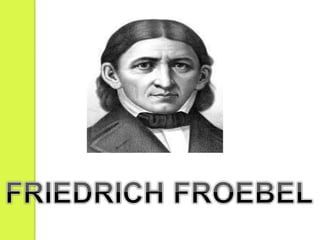
• Friedrich Froebel was born on April 21, 1782, in 
Oberweissbach, a small village in Thuringia, Germany. 
• Froebel's mother died when he was nine months old. 
When Friedrich was four years old, his father remarried. 
Feeling neglected by his stepmother and father, Froebel 
experienced a profoundly unhappy childhood. 
• The year 1805 marked a turning point in Froebel's life. He 
went to Frankfurt intending to become an architect but 
instead ended up teaching in a preparatory school. The 
effect of this teaching experience on Froebel was such 
that he decided to make education his life's work.
• In 1808 he went to Yverdon, Switzerland, where he tutored 
boys attending Johann Pestalozzi's institute. Feeling 
somewhat lacking in his own educational background, he 
left Yverdon in 1811 and studied at the universities of 
Gttingen and Berlin until 1816. 
• In 1816 Froebel opened the Universal German Educational 
Institute at Keilham, a school based on his own educational 
theories. 
• Its curriculum was comprehensive in nature, covering all 
aspects of the student's growth and development—both 
physical and mental.
FROEBEL'S KINDERGARTEN 
PHILOSOPHY. 
In the Education of Man (1826), Froebel articulated the 
following idealist themes: 
1. All existence originates in and with God. 
2. Humans possess an inherent spiritual essence that is the 
vitalizing life force that causes development. 
3. All beings and ideas are interconnected parts of a grand, 
ordered, and systematic universe.
• The kindergarten is a special educational environment in which this 
self-active development occurs. 
• The kindergarten's gifts, occupations, and social and cultural 
activities, especially play, promote this self-actualization. 
• Froebel was convinced that the kindergarten's primary focus should 
be on play–the process by which he believed children expressed 
their innermost thoughts, needs, and desires. 
• For Froebel, play facilitated children's process of cultural 
recapitulation, imitation of adult vocational activities, and 
socialization. 
• According to Froebel's theory of cultural recapitulation, each 
individual human being repeated the general cultural epoch in his or 
her own development.
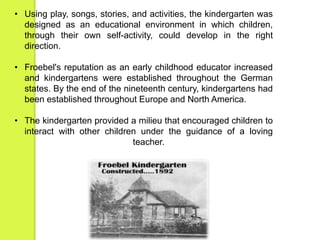
• Using play, songs, stories, and activities, the kindergarten was 
designed as an educational environment in which children, 
through their own self-activity, could develop in the right 
direction. 
• Froebel's reputation as an early childhood educator increased 
and kindergartens were established throughout the German 
states. By the end of the nineteenth century, kindergartens had 
been established throughout Europe and North America. 
• The kindergarten provided a milieu that encouraged children to 
interact with other children under the guidance of a loving 
teacher.
THE KINDERGARTEN CURRICULUM 
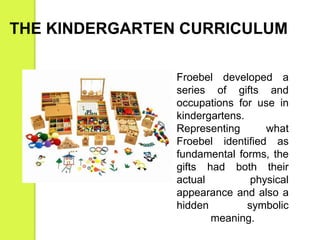
Froebel developed a 
series of gifts and 
occupations for use in 
kindergartens. 
Representing what 
Froebel identified as 
fundamental forms, the 
gifts had both their 
actual physical 
appearance and also a 
hidden symbolic 
meaning.
FROEBEL'S GIFTS WERE THE FOLLOWING ITEMS: 
• Six soft, colored balls. 
• A wooden sphere, cube, and cylinder. 
• A large cube divided into eight smaller cubes. 
• A large cube divided into eight oblong blocks. 
• A large cube divided into twenty-one whole, six half, and twelve 
quarter cubes. 
• A large cube divided into eighteen whole oblongs: three divided 
lengthwise; three divided breadthwise. 
• Quadrangular and triangular tablets used for arranging figures. 
• Sticks for outlining figures· Whole and half wire rings for 
outlining figures. 
• Various materials for drawing, perforating, embroidering, paper 
cutting, weaving or braiding, paper folding, modeling, and 
interlacing.
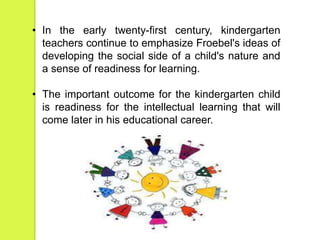
• In the early twenty-first century, kindergarten 
teachers continue to emphasize Froebel's ideas of 
developing the social side of a child's nature and 
a sense of readiness for learning. 
• The important outcome for the kindergarten child 
is readiness for the intellectual learning that will 
come later in his educational career.
Today’s application 
Before Froebel, Kindergarten didn't exist, now 
it's a obligation due to its importance in the 
children's educational process. 
Nowadays many institutions are working with 
the progressive ideas developed by Froebel, 
because they appreciate children as free, 
active, feeling and thinking human beings. 
Thanks to Froebel´s ideas, now the teachers 
are aware about the importance of game in the 
children's learning process.
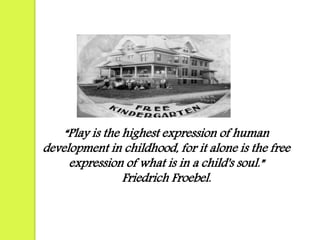
“Play is the highest expression of human 
development in childhood, for it alone is the free 
expression of what is in a child's soul.” 
Friedrich Froebel.
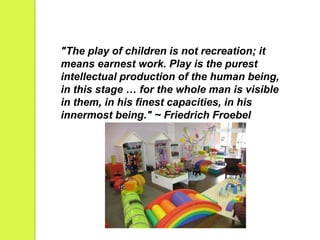
"The play of children is not recreation; it 
means earnest work. Play is the purest 
intellectual production of the human being, 
in this stage … for the whole man is visible 
in them, in his finest capacities, in his 
innermost being." ~ Friedrich Froebel
READ MORE: 
• http://biography.yourdictionary.com/friedrich-wilhelm- 
august-froebel 
• http://www.communityplaythings.co.uk/learning-library/ 
articles/friedrich-froebel 
• http://education.stateuniversity.com/pages/1999/Fr 
oebel-Friedrich-1782-1852.html

Fredrich froebel.

  • 2.
    • Friedrich Froebelwas born on April 21, 1782, in Oberweissbach, a small village in Thuringia, Germany. • Froebel's mother died when he was nine months old. When Friedrich was four years old, his father remarried. Feeling neglected by his stepmother and father, Froebel experienced a profoundly unhappy childhood. • The year 1805 marked a turning point in Froebel's life. He went to Frankfurt intending to become an architect but instead ended up teaching in a preparatory school. The effect of this teaching experience on Froebel was such that he decided to make education his life's work.
  • 3.
    • In 1808he went to Yverdon, Switzerland, where he tutored boys attending Johann Pestalozzi's institute. Feeling somewhat lacking in his own educational background, he left Yverdon in 1811 and studied at the universities of Gttingen and Berlin until 1816. • In 1816 Froebel opened the Universal German Educational Institute at Keilham, a school based on his own educational theories. • Its curriculum was comprehensive in nature, covering all aspects of the student's growth and development—both physical and mental.
  • 4.
    FROEBEL'S KINDERGARTEN PHILOSOPHY. In the Education of Man (1826), Froebel articulated the following idealist themes: 1. All existence originates in and with God. 2. Humans possess an inherent spiritual essence that is the vitalizing life force that causes development. 3. All beings and ideas are interconnected parts of a grand, ordered, and systematic universe.
  • 5.
    • The kindergartenis a special educational environment in which this self-active development occurs. • The kindergarten's gifts, occupations, and social and cultural activities, especially play, promote this self-actualization. • Froebel was convinced that the kindergarten's primary focus should be on play–the process by which he believed children expressed their innermost thoughts, needs, and desires. • For Froebel, play facilitated children's process of cultural recapitulation, imitation of adult vocational activities, and socialization. • According to Froebel's theory of cultural recapitulation, each individual human being repeated the general cultural epoch in his or her own development.
  • 6.
    • Using play,songs, stories, and activities, the kindergarten was designed as an educational environment in which children, through their own self-activity, could develop in the right direction. • Froebel's reputation as an early childhood educator increased and kindergartens were established throughout the German states. By the end of the nineteenth century, kindergartens had been established throughout Europe and North America. • The kindergarten provided a milieu that encouraged children to interact with other children under the guidance of a loving teacher.
  • 7.
    THE KINDERGARTEN CURRICULUM Froebel developed a series of gifts and occupations for use in kindergartens. Representing what Froebel identified as fundamental forms, the gifts had both their actual physical appearance and also a hidden symbolic meaning.
  • 8.
    FROEBEL'S GIFTS WERETHE FOLLOWING ITEMS: • Six soft, colored balls. • A wooden sphere, cube, and cylinder. • A large cube divided into eight smaller cubes. • A large cube divided into eight oblong blocks. • A large cube divided into twenty-one whole, six half, and twelve quarter cubes. • A large cube divided into eighteen whole oblongs: three divided lengthwise; three divided breadthwise. • Quadrangular and triangular tablets used for arranging figures. • Sticks for outlining figures· Whole and half wire rings for outlining figures. • Various materials for drawing, perforating, embroidering, paper cutting, weaving or braiding, paper folding, modeling, and interlacing.
  • 9.
    • In theearly twenty-first century, kindergarten teachers continue to emphasize Froebel's ideas of developing the social side of a child's nature and a sense of readiness for learning. • The important outcome for the kindergarten child is readiness for the intellectual learning that will come later in his educational career.
  • 10.
    Today’s application BeforeFroebel, Kindergarten didn't exist, now it's a obligation due to its importance in the children's educational process. Nowadays many institutions are working with the progressive ideas developed by Froebel, because they appreciate children as free, active, feeling and thinking human beings. Thanks to Froebel´s ideas, now the teachers are aware about the importance of game in the children's learning process.
  • 11.
    “Play is thehighest expression of human development in childhood, for it alone is the free expression of what is in a child's soul.” Friedrich Froebel.
  • 12.
    "The play ofchildren is not recreation; it means earnest work. Play is the purest intellectual production of the human being, in this stage … for the whole man is visible in them, in his finest capacities, in his innermost being." ~ Friedrich Froebel
  • 13.
    READ MORE: •http://biography.yourdictionary.com/friedrich-wilhelm- august-froebel • http://www.communityplaythings.co.uk/learning-library/ articles/friedrich-froebel • http://education.stateuniversity.com/pages/1999/Fr oebel-Friedrich-1782-1852.html