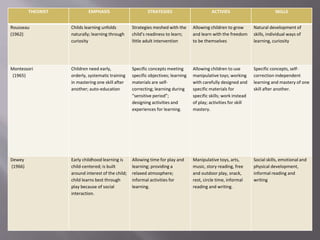
THEORIST EMPHASIS STRATEGIES ACTIVIES SKILLS
Rousseau
(1962)
Childs learning unfolds
naturally; learning through
curiosity
Strategies meshed with the
child’s readiness to learn;
little adult intervention
Allowing children to grow
and learn with the freedom
to be themselves
Natural development of
skills, individual ways of
learning, curiosity
Montessori
(1965)
Children need early,
orderly, systematic training
in mastering one skill after
another; auto-education
Specific concepts meeting
specific objectives; learning
materials are self-
correcting; learning during
“sensitive period”;
designing activities and
experiences for learning.
Allowing children to use
manipulative toys; working
with carefully designed and
specific materials for
specific skills; work instead
of play; activities for skill
mastery.
Specific concepts, self-
correction independent
learning and mastery of one
skill after another.
Dewey
(1966)
Early childhood learning is
child-centered; is built
around interest of the child;
child learns best through
play because of social
interaction.
Allowing time for play and
learning; providing a
relaxed atmosphere;
informal activities for
learning.
Manipulative toys, arts,
music, story reading, free
and outdoor play, snack,
rest, circle time, informal
reading and writing.
Social skills, emotional and
physical development,
informal reading and
writing
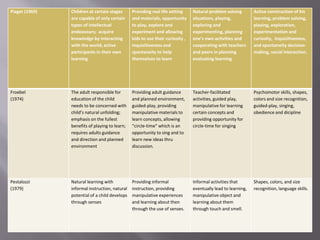
Piaget (1969) Children at certain stages
are capable of only certain
types of intellectual
endeavours; acquire
knowledge by interacting
with the world; active
participants in their own
learning
Providing real life setting
and materials, opportunity
to play, explore and
experiment and allowing
kids to use their curiosity ,
inquisitiveness and
spontaneity to help
themselves to learn
Natural problem solving
situations, playing,
exploring and
experimenting, planning
one’s own activities and
cooperating with teachers
and peers in planning
evaluating learning
Active construction of his
learning, problem solving,
playing, exploration,
experimentation and
curiosity, inquisitiveness,
and spontaneity decision-
making, social interaction.
Froebel
(1974)
The adult responsible for
education of the child
needs to be concerned with
child’s natural unfolding;
emphasis on the fullest
benefits of playing to learn;
requires adults guidance
and direction and planned
environment
Providing adult guidance
and planned environment,
guided-play, providing
manipulative materials to
learn concepts, allowing
“circle-time” which is an
opportunity to sing and to
learn new ideas thru
discussion.
Teacher-facilitated
activities, guided play,
manipulative for learning
certain concepts and
providing opportunity for
circle-time for singing
Psychomotor skills, shapes,
colors and size recognition,
guided-play, singing,
obedience and dicipline
Pestalozzi
(1979)
Natural learning with
informal instruction, natural
potential of a child develops
through senses
Providing informal
instruction, providing
manipulative experiences
and learning about then
through the use of senses.
Informal activities that
eventually lead to learning,
manipulative object and
learning about them
through touch and smell.
Shapes, colors, and size
recognition, language skills.

Concept on emergent literacy

  • 5.
    THEORIST EMPHASIS STRATEGIESACTIVIES SKILLS Rousseau (1962) Childs learning unfolds naturally; learning through curiosity Strategies meshed with the child’s readiness to learn; little adult intervention Allowing children to grow and learn with the freedom to be themselves Natural development of skills, individual ways of learning, curiosity Montessori (1965) Children need early, orderly, systematic training in mastering one skill after another; auto-education Specific concepts meeting specific objectives; learning materials are self- correcting; learning during “sensitive period”; designing activities and experiences for learning. Allowing children to use manipulative toys; working with carefully designed and specific materials for specific skills; work instead of play; activities for skill mastery. Specific concepts, self- correction independent learning and mastery of one skill after another. Dewey (1966) Early childhood learning is child-centered; is built around interest of the child; child learns best through play because of social interaction. Allowing time for play and learning; providing a relaxed atmosphere; informal activities for learning. Manipulative toys, arts, music, story reading, free and outdoor play, snack, rest, circle time, informal reading and writing. Social skills, emotional and physical development, informal reading and writing
  • 6.
    Piaget (1969) Childrenat certain stages are capable of only certain types of intellectual endeavours; acquire knowledge by interacting with the world; active participants in their own learning Providing real life setting and materials, opportunity to play, explore and experiment and allowing kids to use their curiosity , inquisitiveness and spontaneity to help themselves to learn Natural problem solving situations, playing, exploring and experimenting, planning one’s own activities and cooperating with teachers and peers in planning evaluating learning Active construction of his learning, problem solving, playing, exploration, experimentation and curiosity, inquisitiveness, and spontaneity decision- making, social interaction. Froebel (1974) The adult responsible for education of the child needs to be concerned with child’s natural unfolding; emphasis on the fullest benefits of playing to learn; requires adults guidance and direction and planned environment Providing adult guidance and planned environment, guided-play, providing manipulative materials to learn concepts, allowing “circle-time” which is an opportunity to sing and to learn new ideas thru discussion. Teacher-facilitated activities, guided play, manipulative for learning certain concepts and providing opportunity for circle-time for singing Psychomotor skills, shapes, colors and size recognition, guided-play, singing, obedience and dicipline Pestalozzi (1979) Natural learning with informal instruction, natural potential of a child develops through senses Providing informal instruction, providing manipulative experiences and learning about then through the use of senses. Informal activities that eventually lead to learning, manipulative object and learning about them through touch and smell. Shapes, colors, and size recognition, language skills.