Cognition, Learning &
Literacy Development
Aini Syahira Bt Jamaluddin
Nur Najuha Bt Mohammad Hayat
WHAT IS LITERACY?
● Literacy is the ability to understand and evaluate meaning through reading
and writing, listening and speaking, viewing and representing.
● Literacy skills need to continually expand and diversify because our rapidly
changing social and economic environment requires competence in a range
of new communication forms and media.
● Literacy competence is central to achievement in all areas of learning as
students progress through the early, middle and later years of schooling and
into the workforce and personal life.
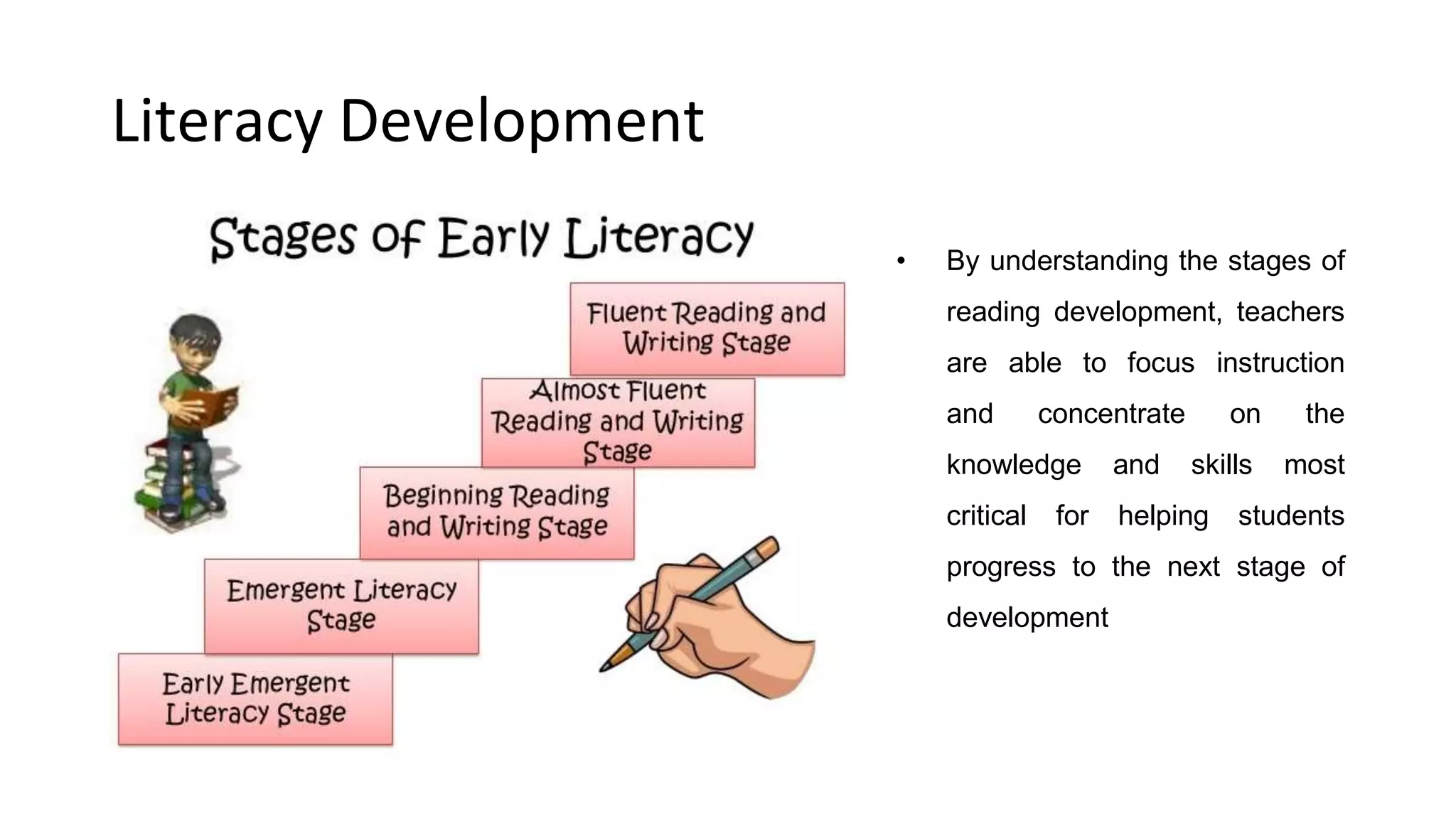
Literacy Development
• By understanding the stages of
reading development, teachers
are able to focus instruction
and concentrate on the
knowledge and skills most
critical for helping students
progress to the next stage of
development
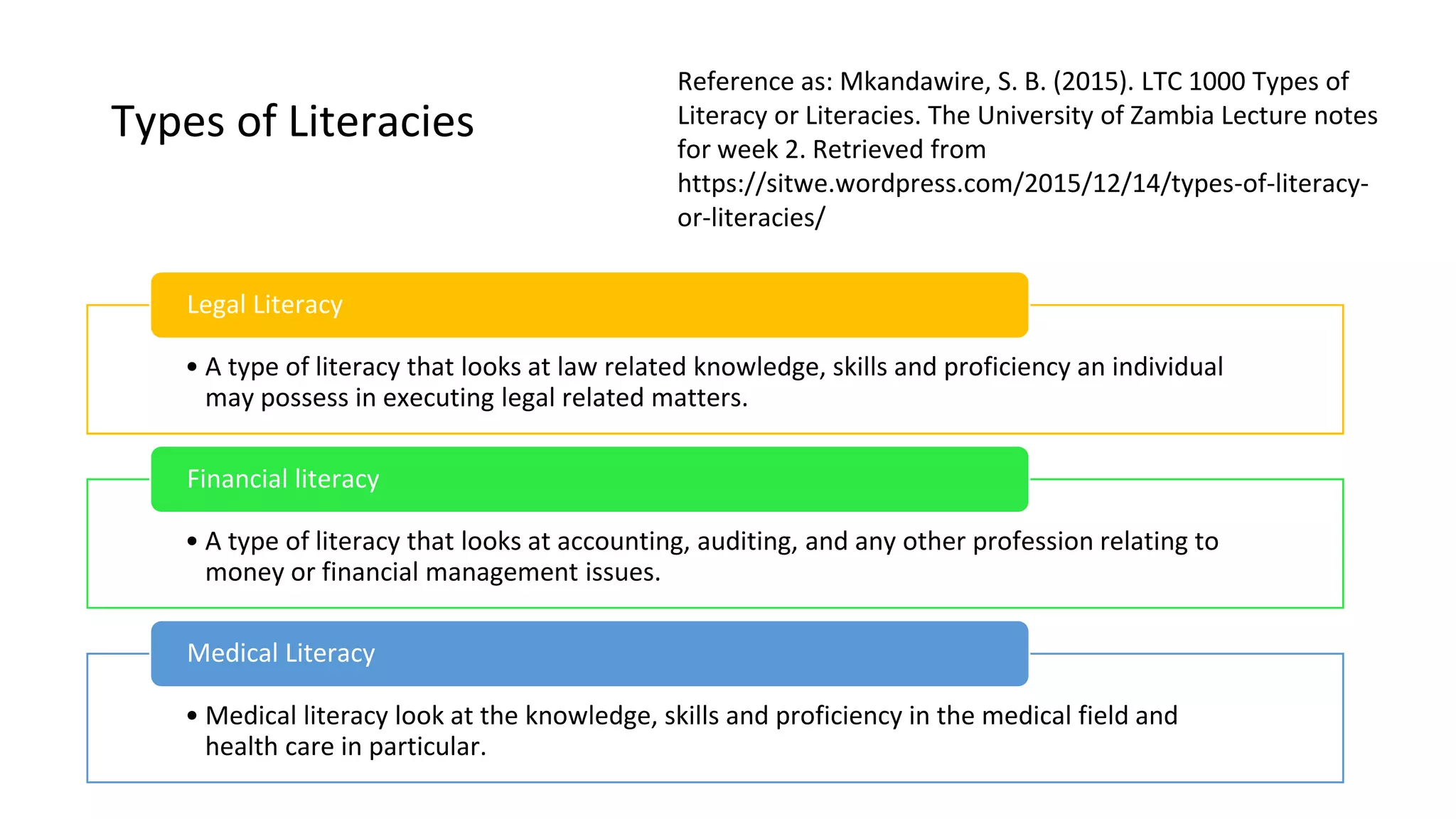
Types of Literacies
• A type of literacy that looks at law related knowledge, skills and proficiency an individual
may possess in executing legal related matters.
Legal Literacy
• A type of literacy that looks at accounting, auditing, and any other profession relating to
money or financial management issues.
Financial literacy
• Medical literacy look at the knowledge, skills and proficiency in the medical field and
health care in particular.
Medical Literacy
Reference as: Mkandawire, S. B. (2015). LTC 1000 Types of
Literacy or Literacies. The University of Zambia Lecture notes
for week 2. Retrieved from
https://sitwe.wordpress.com/2015/12/14/types-of-literacy-
or-literacies/
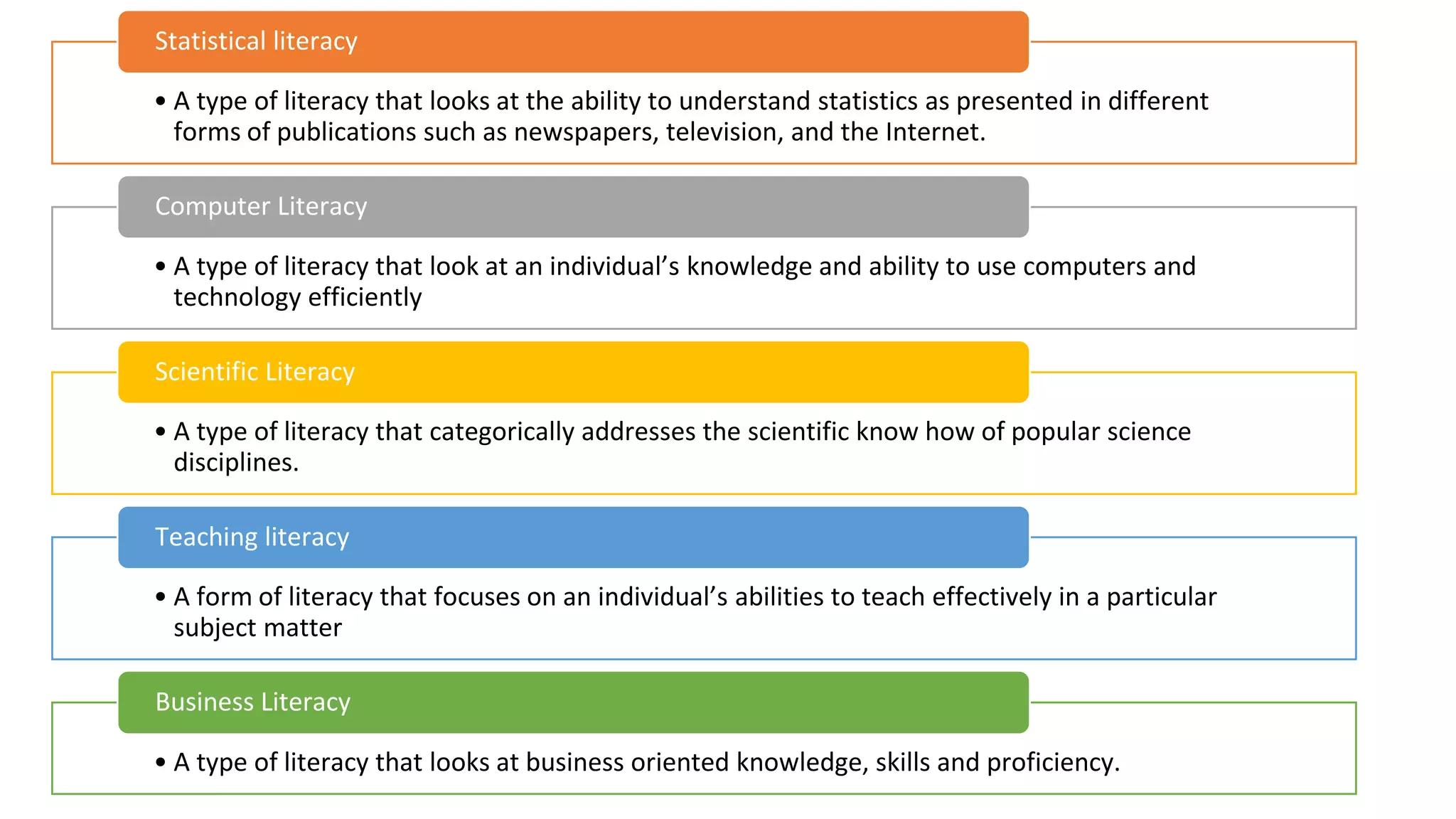
• A type of literacy that looks at the ability to understand statistics as presented in different
forms of publications such as newspapers, television, and the Internet.
Statistical literacy
• A type of literacy that look at an individual’s knowledge and ability to use computers and
technology efficiently
Computer Literacy
• A type of literacy that categorically addresses the scientific know how of popular science
disciplines.
Scientific Literacy
• A form of literacy that focuses on an individual’s abilities to teach effectively in a particular
subject matter
Teaching literacy
• A type of literacy that looks at business oriented knowledge, skills and proficiency.
Business Literacy
THEME AND ISSUES
● As young children are forming their own grasp on language,
there are several factors that might influence development.
Children between the ages of two and five are especially
vulnerable to these influences, so it's important for parents and
caregivers to be aware of them.
What is illiteracy?
Illiteracy can refer not only to the inability to read, but also to a lack of
knowledge in other subject areas.
E.g.: Shakespeare
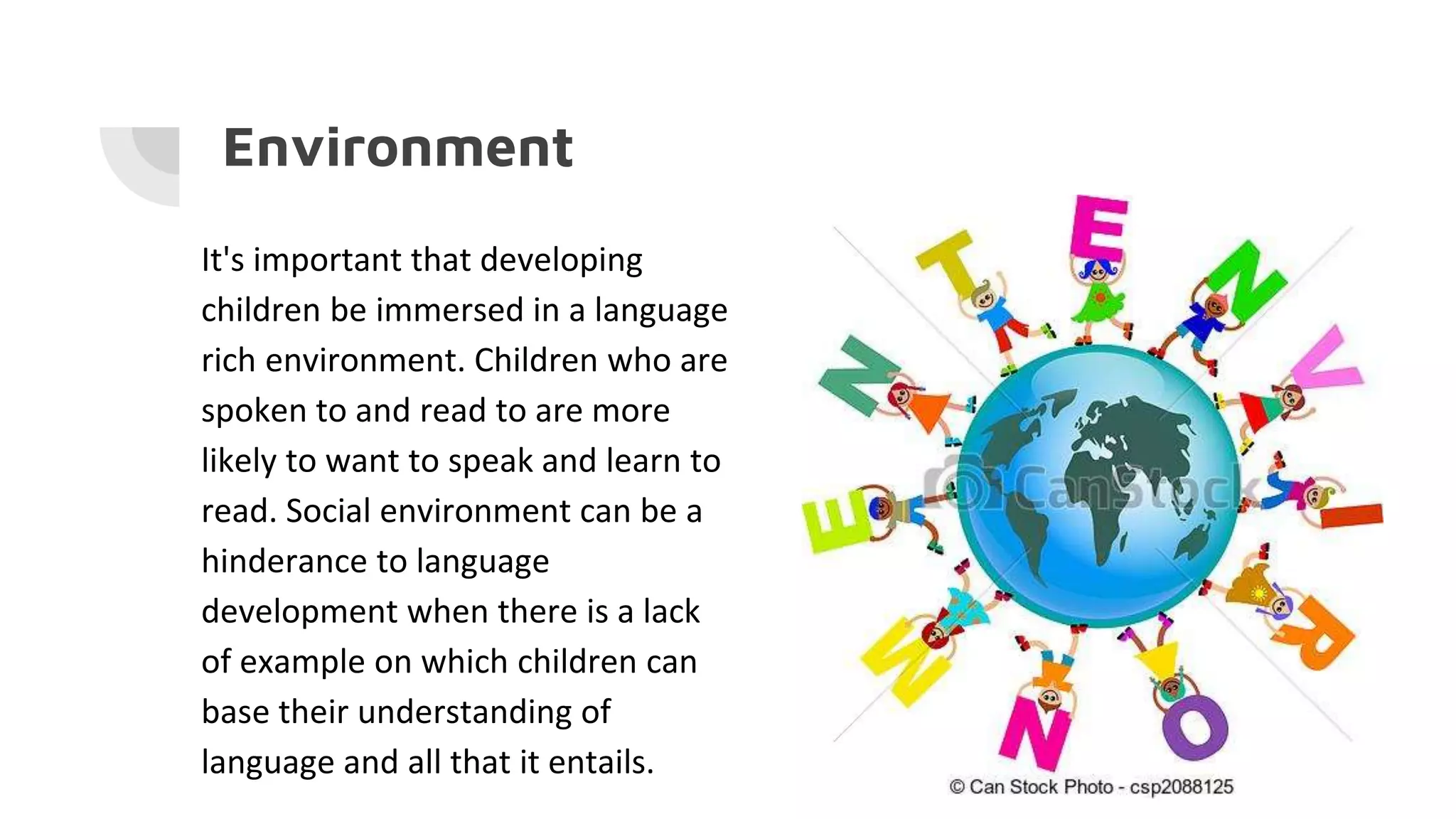
Environment
It's important that developing
children be immersed in a language
rich environment. Children who are
spoken to and read to are more
likely to want to speak and learn to
read. Social environment can be a
hinderance to language
development when there is a lack
of example on which children can
base their understanding of
language and all that it entails.
Health and Physical Development
● Illness can affect hearing which, in turn, will cause problems with understanding spoken language
or other auditory cues. Hearing problems can, in turn, effect speech development. Children who
are ill also lack enthusiasm to speak and communicate non-verbally. This can hinder development
of language and communication. In addition to illness, physical development can influence
language. Vocal cords and speech related facial muscles must be developed in order for a child to
orally communicate effectively. Fine motor skills are also necessary to write or draw letters and
symbols.
Motivation
If a child has no desire to
communicate or understand the
world around her or him, there will
be a lack of language
development. Until he sees the
value and need for use of the
language, development may be
slow.
Cognition, Learning & Developing
Literacy Theories
Jean Piaget’s theory of Cognitive Development (1969)
Theory of Literacy Development, Holdaway (1979)
Maturation Theory, Aldridge & Goldman (2007)
Stages Model of Reading Frith (1985), Ehri (1991), and Gough, Joel & Griffith (1992)
Family Literacy Theory Godwin etal, (2013)
Behaviorism, B. F. Skinner (1954)
Progressive Education, John Dewey (1966)
1) Jean Piaget’s theory of
Cognitive Development
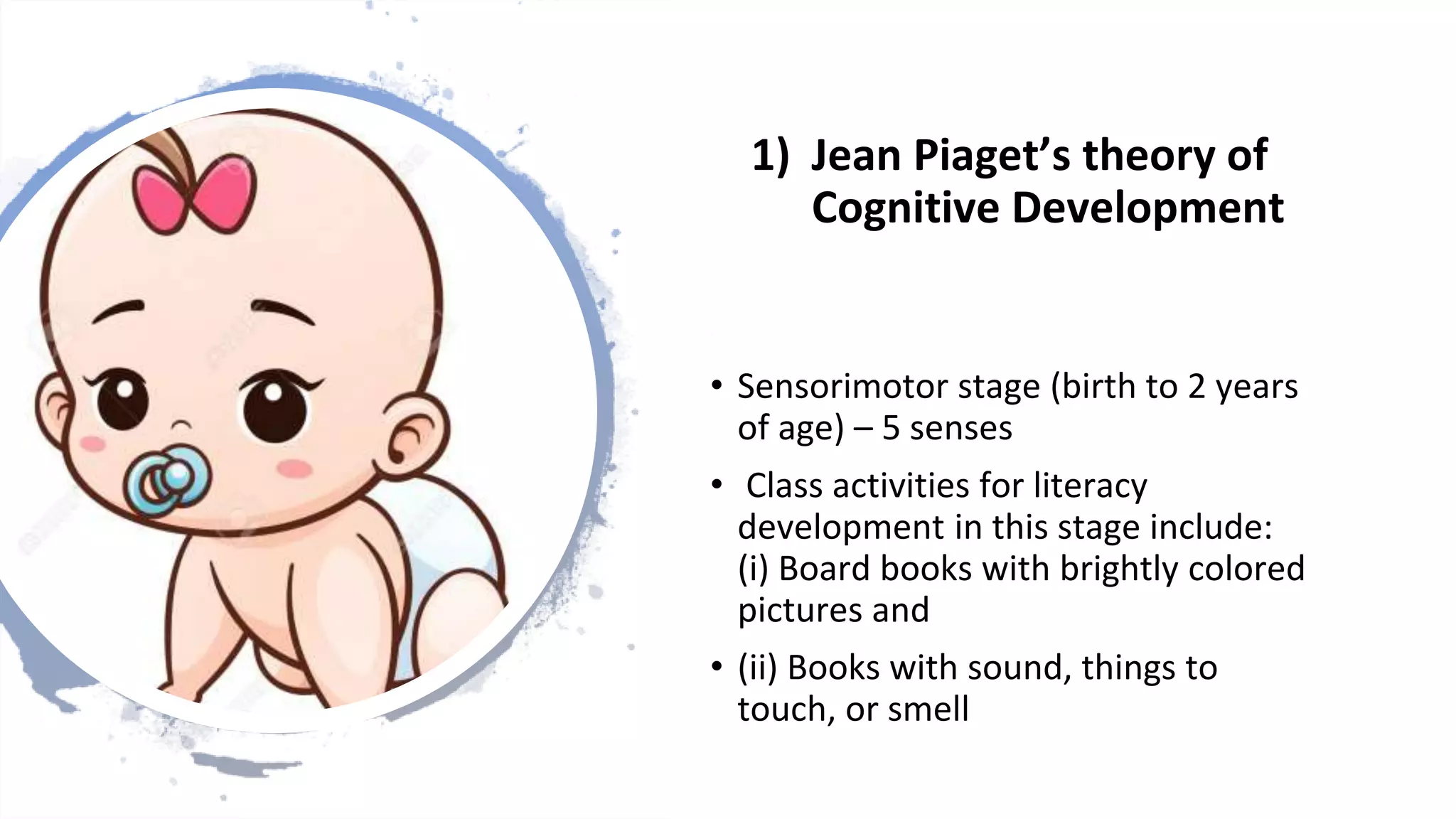
• Sensorimotor stage (birth to 2 years
of age) – 5 senses
• Class activities for literacy
development in this stage include:
(i) Board books with brightly colored
pictures and
• (ii) Books with sound, things to
touch, or smell
• Preoperational stage (2 to 7 years of age)
There is rapid language development skills in
this stage as children begin to categorize things
with words. Literacy activities include story
book reading and discussing the story
• Concrete Operational (7 to 11 years of age)
In this stage of development, children use
concrete objects to begin to think about
abstract concepts. Activities for Literacy
development include Graphic Organizers {Venn
Diagrams, Flow Maps} and others.
• Formal Operational (11 years of age
to adult)
In this stage, children use language in
an abstract way. Activities for Literacy
include the use of metacognitive
reading strategies helps students to
“think about their thinking” before and
after they read. Examples: Making
Inferences and Summarizing
information.
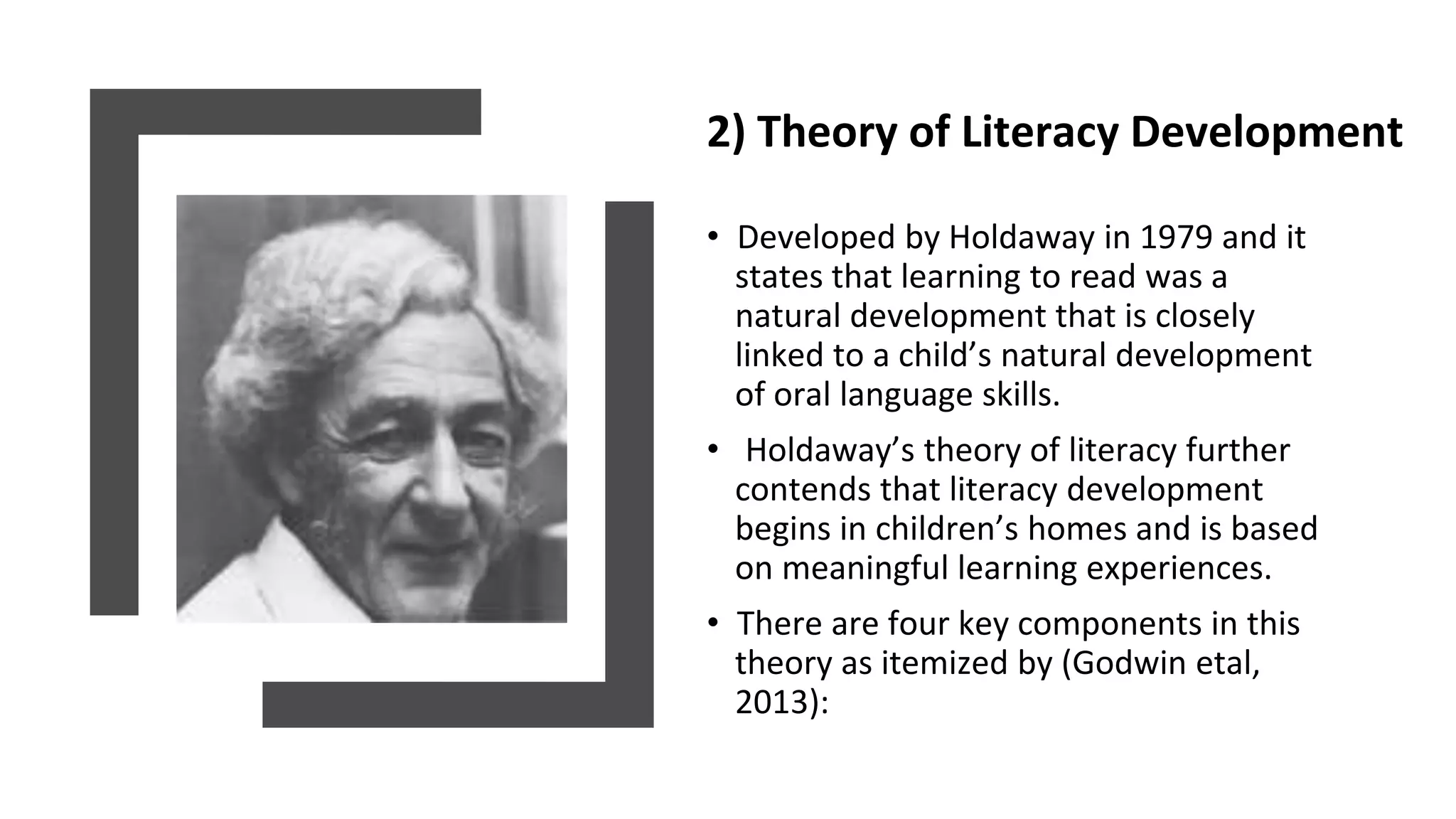
2) Theory of Literacy Development
• Developed by Holdaway in 1979 and it
states that learning to read was a
natural development that is closely
linked to a child’s natural development
of oral language skills.
• Holdaway’s theory of literacy further
contends that literacy development
begins in children’s homes and is based
on meaningful learning experiences.
• There are four key components in this
theory as itemized by (Godwin etal,
2013):
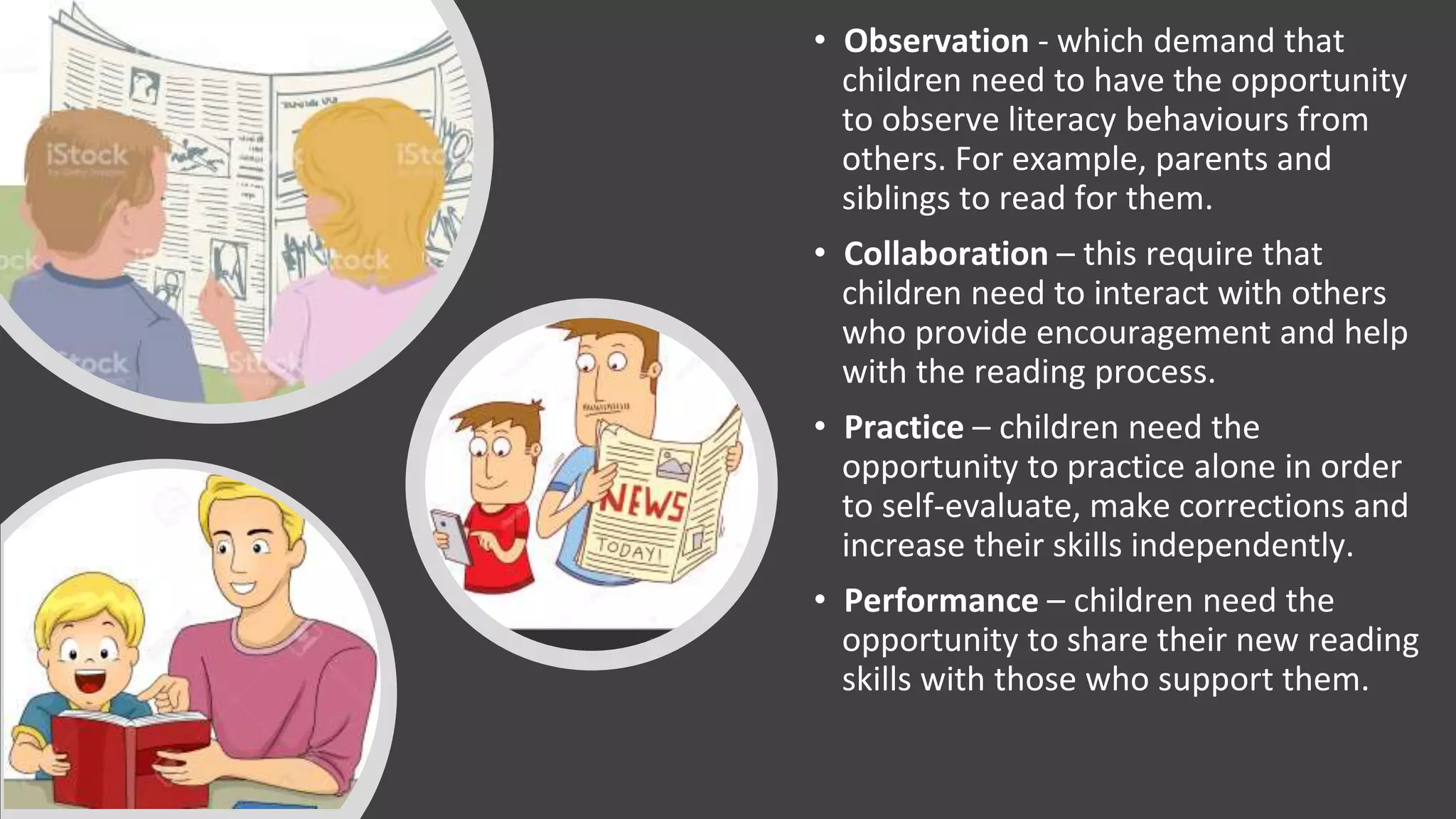
• Observation - which demand that
children need to have the opportunity
to observe literacy behaviours from
others. For example, parents and
siblings to read for them.
• Collaboration – this require that
children need to interact with others
who provide encouragement and help
with the reading process.
• Practice – children need the
opportunity to practice alone in order
to self-evaluate, make corrections and
increase their skills independently.
• Performance – children need the
opportunity to share their new reading
skills with those who support them.

Cognition, Learning and Literacy Development

  • 1.
    Cognition, Learning & LiteracyDevelopment Aini Syahira Bt Jamaluddin Nur Najuha Bt Mohammad Hayat
  • 2.
    WHAT IS LITERACY? ●Literacy is the ability to understand and evaluate meaning through reading and writing, listening and speaking, viewing and representing. ● Literacy skills need to continually expand and diversify because our rapidly changing social and economic environment requires competence in a range of new communication forms and media. ● Literacy competence is central to achievement in all areas of learning as students progress through the early, middle and later years of schooling and into the workforce and personal life.
  • 3.
    Literacy Development • Byunderstanding the stages of reading development, teachers are able to focus instruction and concentrate on the knowledge and skills most critical for helping students progress to the next stage of development
  • 4.
    Types of Literacies •A type of literacy that looks at law related knowledge, skills and proficiency an individual may possess in executing legal related matters. Legal Literacy • A type of literacy that looks at accounting, auditing, and any other profession relating to money or financial management issues. Financial literacy • Medical literacy look at the knowledge, skills and proficiency in the medical field and health care in particular. Medical Literacy Reference as: Mkandawire, S. B. (2015). LTC 1000 Types of Literacy or Literacies. The University of Zambia Lecture notes for week 2. Retrieved from https://sitwe.wordpress.com/2015/12/14/types-of-literacy- or-literacies/
  • 5.
    • A typeof literacy that looks at the ability to understand statistics as presented in different forms of publications such as newspapers, television, and the Internet. Statistical literacy • A type of literacy that look at an individual’s knowledge and ability to use computers and technology efficiently Computer Literacy • A type of literacy that categorically addresses the scientific know how of popular science disciplines. Scientific Literacy • A form of literacy that focuses on an individual’s abilities to teach effectively in a particular subject matter Teaching literacy • A type of literacy that looks at business oriented knowledge, skills and proficiency. Business Literacy
  • 6.
    THEME AND ISSUES ●As young children are forming their own grasp on language, there are several factors that might influence development. Children between the ages of two and five are especially vulnerable to these influences, so it's important for parents and caregivers to be aware of them.
  • 7.
    What is illiteracy? Illiteracycan refer not only to the inability to read, but also to a lack of knowledge in other subject areas. E.g.: Shakespeare
  • 8.
    Environment It's important thatdeveloping children be immersed in a language rich environment. Children who are spoken to and read to are more likely to want to speak and learn to read. Social environment can be a hinderance to language development when there is a lack of example on which children can base their understanding of language and all that it entails.
  • 9.
    Health and PhysicalDevelopment ● Illness can affect hearing which, in turn, will cause problems with understanding spoken language or other auditory cues. Hearing problems can, in turn, effect speech development. Children who are ill also lack enthusiasm to speak and communicate non-verbally. This can hinder development of language and communication. In addition to illness, physical development can influence language. Vocal cords and speech related facial muscles must be developed in order for a child to orally communicate effectively. Fine motor skills are also necessary to write or draw letters and symbols.
  • 10.
    Motivation If a childhas no desire to communicate or understand the world around her or him, there will be a lack of language development. Until he sees the value and need for use of the language, development may be slow.
  • 11.
    Cognition, Learning &Developing Literacy Theories Jean Piaget’s theory of Cognitive Development (1969) Theory of Literacy Development, Holdaway (1979) Maturation Theory, Aldridge & Goldman (2007) Stages Model of Reading Frith (1985), Ehri (1991), and Gough, Joel & Griffith (1992) Family Literacy Theory Godwin etal, (2013) Behaviorism, B. F. Skinner (1954) Progressive Education, John Dewey (1966)
  • 12.
    1) Jean Piaget’stheory of Cognitive Development • Sensorimotor stage (birth to 2 years of age) – 5 senses • Class activities for literacy development in this stage include: (i) Board books with brightly colored pictures and • (ii) Books with sound, things to touch, or smell
  • 13.
    • Preoperational stage(2 to 7 years of age) There is rapid language development skills in this stage as children begin to categorize things with words. Literacy activities include story book reading and discussing the story • Concrete Operational (7 to 11 years of age) In this stage of development, children use concrete objects to begin to think about abstract concepts. Activities for Literacy development include Graphic Organizers {Venn Diagrams, Flow Maps} and others.
  • 14.
    • Formal Operational(11 years of age to adult) In this stage, children use language in an abstract way. Activities for Literacy include the use of metacognitive reading strategies helps students to “think about their thinking” before and after they read. Examples: Making Inferences and Summarizing information.
  • 15.
    2) Theory ofLiteracy Development • Developed by Holdaway in 1979 and it states that learning to read was a natural development that is closely linked to a child’s natural development of oral language skills. • Holdaway’s theory of literacy further contends that literacy development begins in children’s homes and is based on meaningful learning experiences. • There are four key components in this theory as itemized by (Godwin etal, 2013):
  • 16.
    • Observation -which demand that children need to have the opportunity to observe literacy behaviours from others. For example, parents and siblings to read for them. • Collaboration – this require that children need to interact with others who provide encouragement and help with the reading process. • Practice – children need the opportunity to practice alone in order to self-evaluate, make corrections and increase their skills independently. • Performance – children need the opportunity to share their new reading skills with those who support them.