The Constructivist Model
Views on Reading
 From these learning
theories, concrete
teaching models have
evolved and have been
continuously modified to
meet the needs of
emergent learners and
to develop their literacy
skills.
Literacy of 20th Century
Has paved the way
new literacy studies
which would
gradually lead to
redefining literacy.
From the historical
perspective of Christie
 The greater level of sophistication in literacy
such as new kinds of writing, new genres
which are necessary for new knowledge and
new ways of thinking .
 The kind of literacy provided in the home will
be brought by the young learner in the school
and therefore the school has to take such
considerations in designing early literacy
instruction.
Constructivist Model
 The Constructivist model asserts that emergent
learners need to interact which would positively
make them interested and be involved in
meaningful activities.
 In Dewey constructivist education, a view on
teaching and learning as a conscious process
of reconstruction of experience.
 An educative
experience must be
continuous, provoke
change, and
emphasized the
importance of the
participation of the
learner in the
formation of
purposes purposes.
 Skills are taught at
the point when they
are likely to be e
usefuk to kifs, as
part of an
authentic literary
task.
Distinct advantaged of the
Constructivist Model
 Literacy instruction
embedded in meaningful
social context,
 Students exploration of
the functions if literacy,
 Students-centered, and
 Recognize different life
experiences and cultural
schemata in the
meaning making
process.
Views on Reading
Silbestein (1987)-
accounted for the
developments in
reading
instruction.
Reading was viewed
simply as speech
written down.
Psycholinguistic
theory was
elaborated in a
contemporary
interactive
approach which
emphasized the
role of cognition in
an interaction of
reader and text .
+
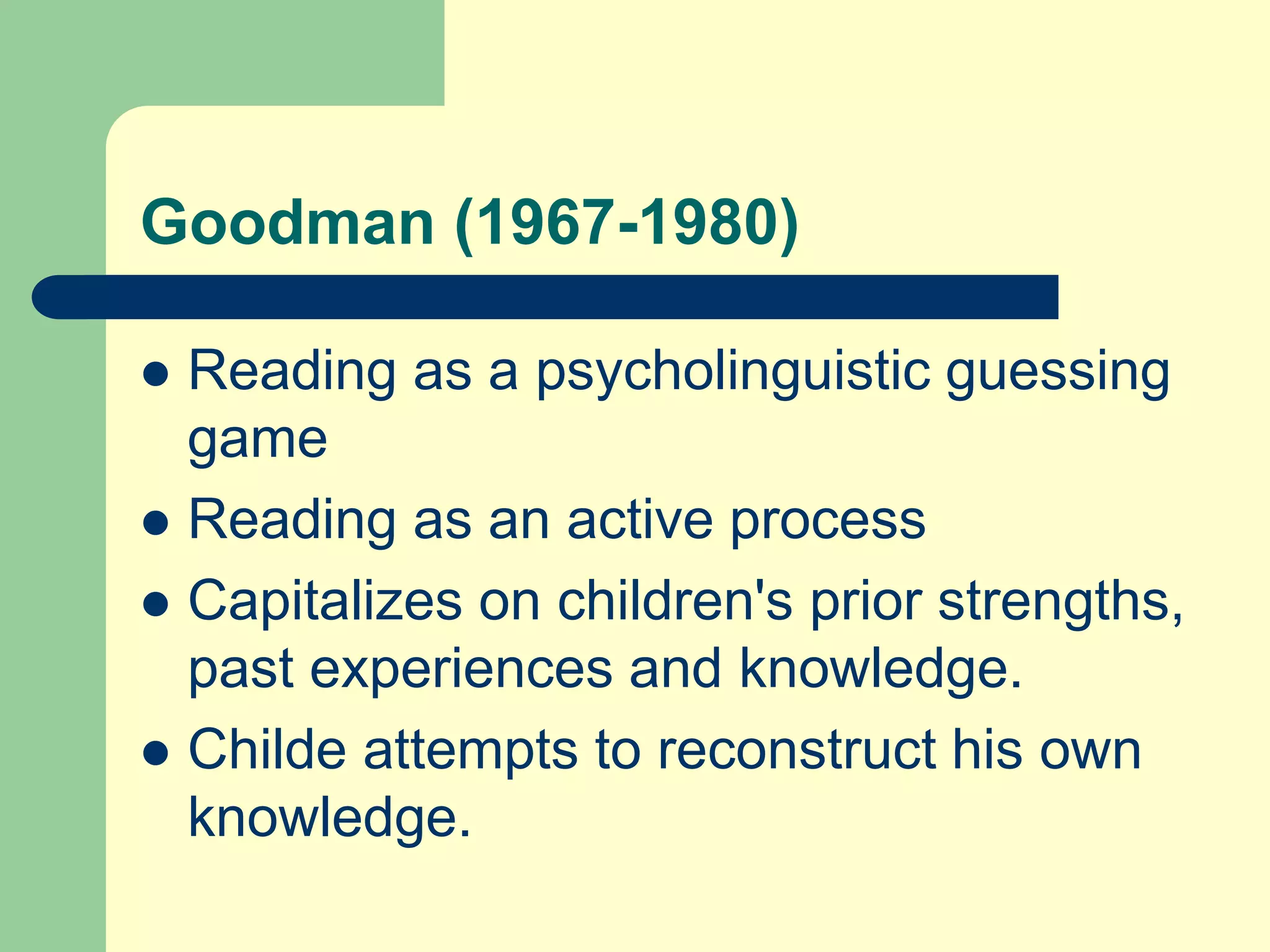
Goodman (1967-1980)
 Reading as a psycholinguistic guessing
game
 Reading as an active process
 Capitalizes on children's prior strengths,
past experiences and knowledge.
 Childe attempts to reconstruct his own
knowledge.
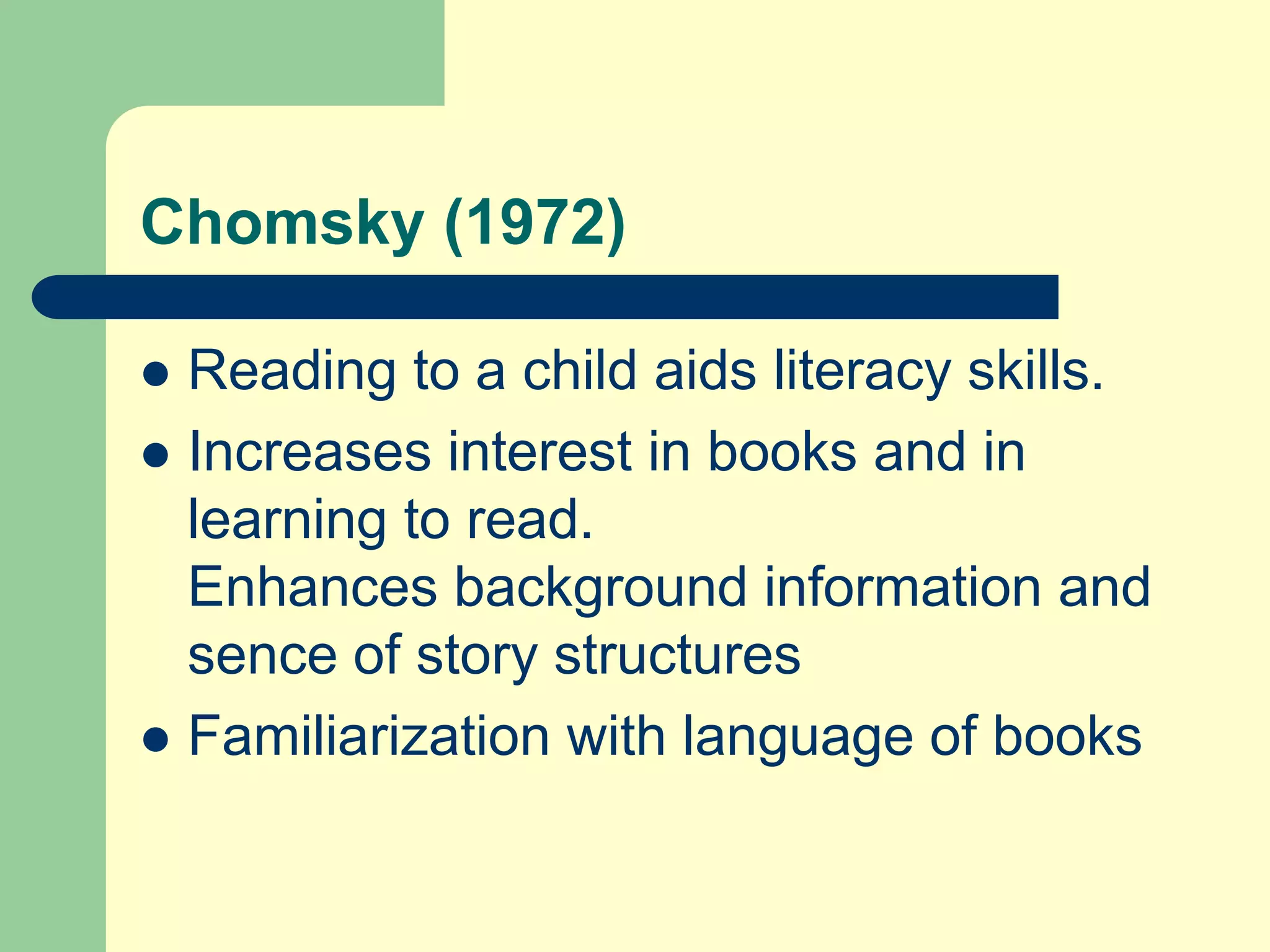
Chomsky (1972)
 Reading to a child aids literacy skills.
 Increases interest in books and in
learning to read.
Enhances background information and
sence of story structures
 Familiarization with language of books
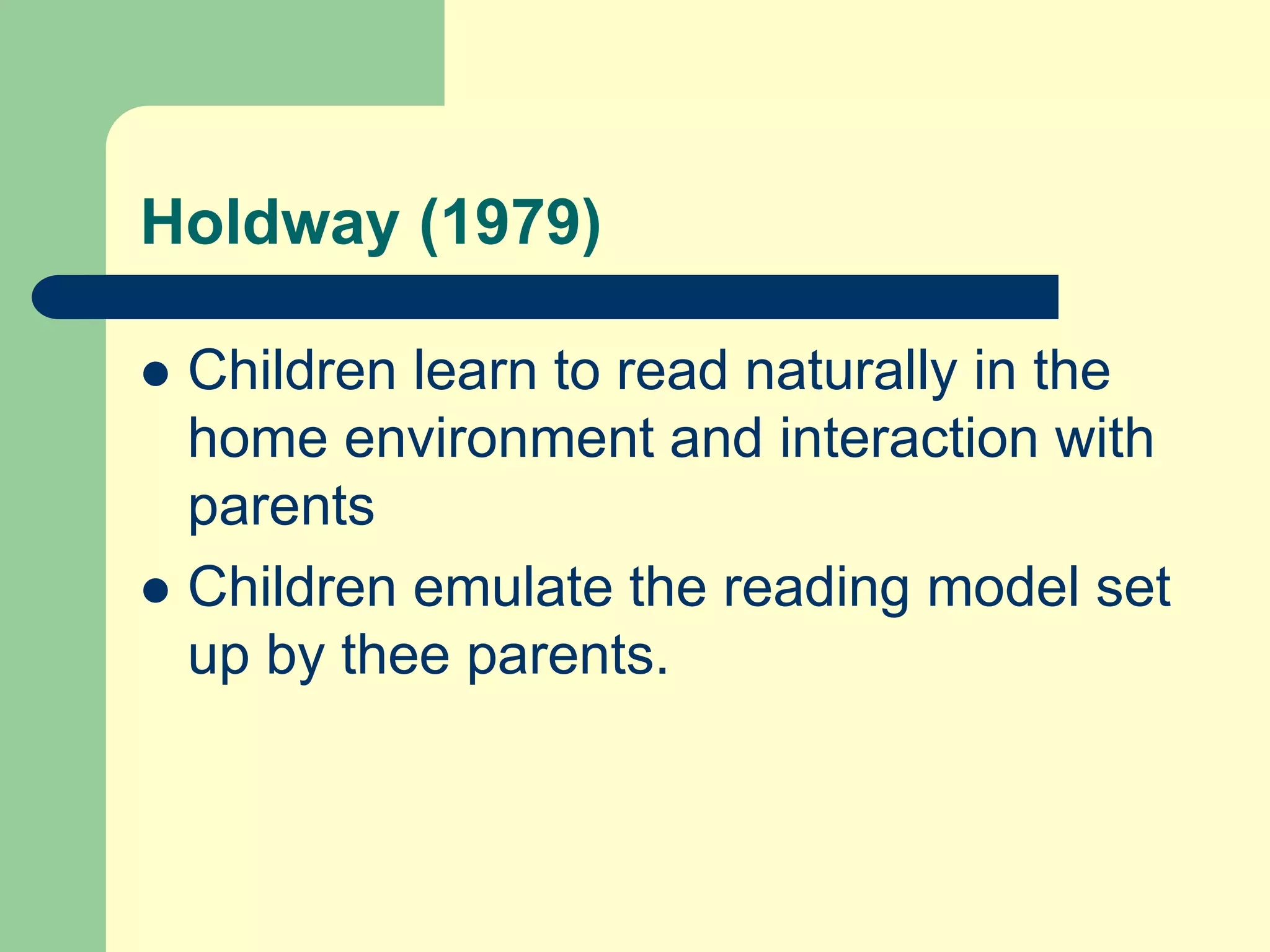
Holdway (1979)
 Children learn to read naturally in the
home environment and interaction with
parents
 Children emulate the reading model set
up by thee parents.
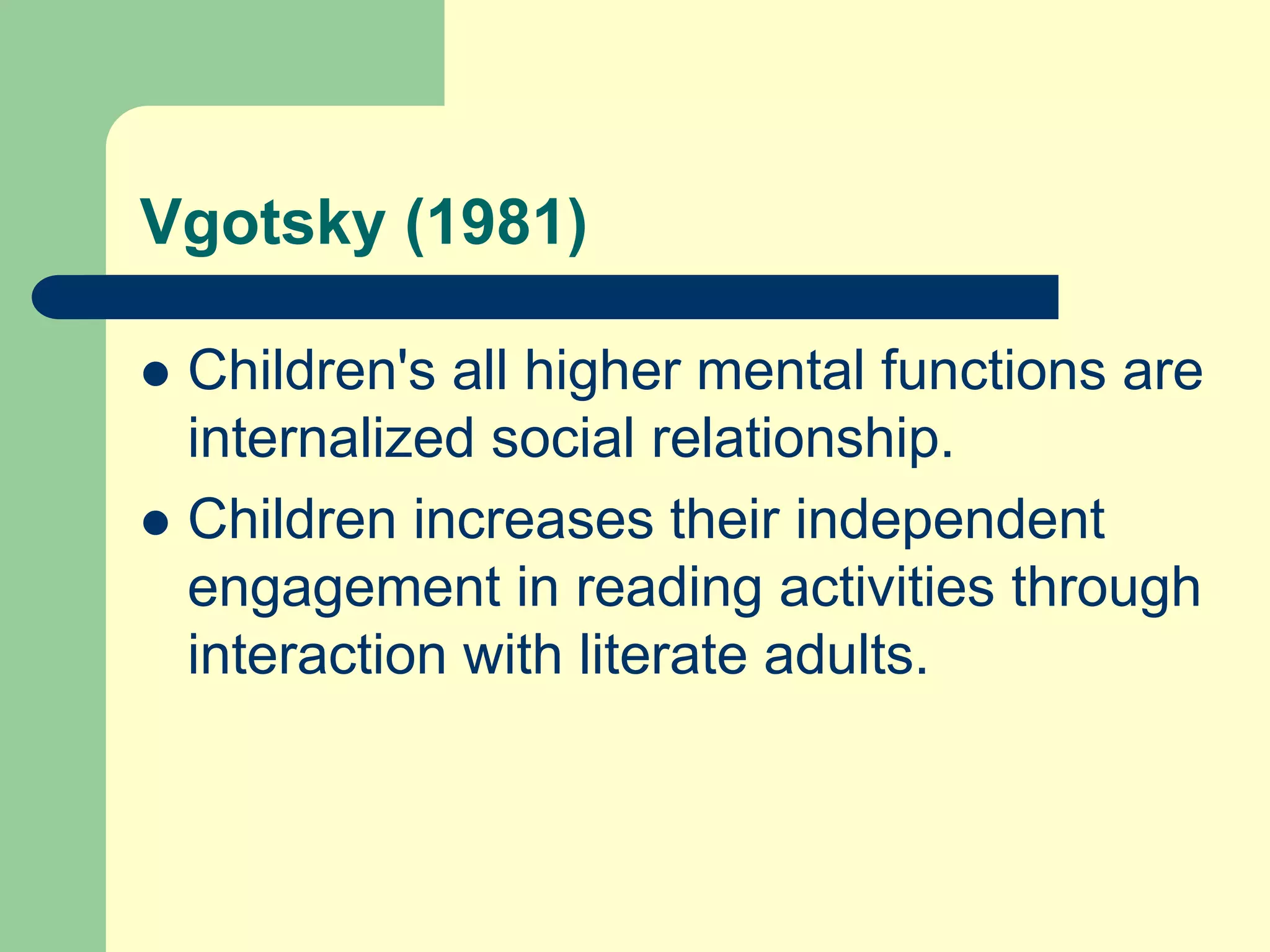
Vgotsky (1981)
 Children's all higher mental functions are
internalized social relationship.
 Children increases their independent
engagement in reading activities through
interaction with literate adults.
Teale (1982)
 Reading is acquired through socially
interactive and emulative behavior
 Social function and conventions of
reading are acquired through interactive
literacy events.
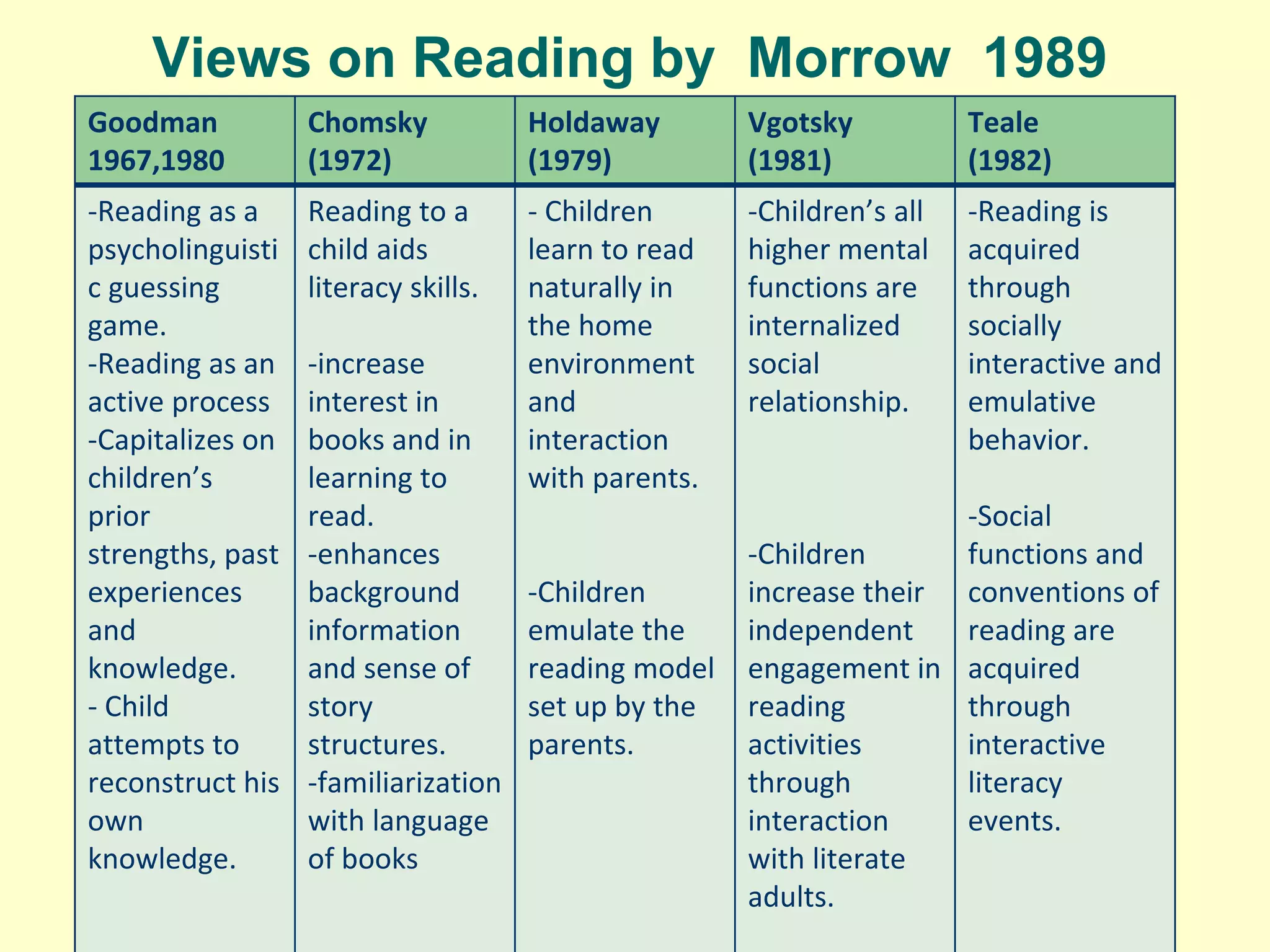
Views on Reading by Morrow 1989
Goodman
1967,1980
Chomsky
(1972)
Holdaway
(1979)
Vgotsky
(1981)
Teale
(1982)
-Reading as a
psycholinguisti
c guessing
game.
-Reading as an
active process
-Capitalizes on
children’s
prior
strengths, past
experiences
and
knowledge.
- Child
attempts to
reconstruct his
own
knowledge.
Reading to a
child aids
literacy skills.
-increase
interest in
books and in
learning to
read.
-enhances
background
information
and sense of
story
structures.
-familiarization
with language
of books
- Children
learn to read
naturally in
the home
environment
and
interaction
with parents.
-Children
emulate the
reading model
set up by the
parents.
-Children’s all
higher mental
functions are
internalized
social
relationship.
-Children
increase their
independent
engagement in
reading
activities
through
interaction
with literate
adults.
-Reading is
acquired
through
socially
interactive and
emulative
behavior.
-Social
functions and
conventions of
reading are
acquired
through
interactive
literacy
events.
Presentation created by:
Jecelyn C. Anain
Beed 3d
Submitted to
Mam Janette Fronda
Professor

Constructivist model and views on reading

  • 1.
  • 2.
     From theselearning theories, concrete teaching models have evolved and have been continuously modified to meet the needs of emergent learners and to develop their literacy skills.
  • 3.
    Literacy of 20thCentury Has paved the way new literacy studies which would gradually lead to redefining literacy.
  • 4.
    From the historical perspectiveof Christie  The greater level of sophistication in literacy such as new kinds of writing, new genres which are necessary for new knowledge and new ways of thinking .  The kind of literacy provided in the home will be brought by the young learner in the school and therefore the school has to take such considerations in designing early literacy instruction.
  • 5.
    Constructivist Model  TheConstructivist model asserts that emergent learners need to interact which would positively make them interested and be involved in meaningful activities.  In Dewey constructivist education, a view on teaching and learning as a conscious process of reconstruction of experience.
  • 6.
     An educative experiencemust be continuous, provoke change, and emphasized the importance of the participation of the learner in the formation of purposes purposes.  Skills are taught at the point when they are likely to be e usefuk to kifs, as part of an authentic literary task.
  • 7.
    Distinct advantaged ofthe Constructivist Model  Literacy instruction embedded in meaningful social context,  Students exploration of the functions if literacy,  Students-centered, and  Recognize different life experiences and cultural schemata in the meaning making process.
  • 8.
    Views on Reading Silbestein(1987)- accounted for the developments in reading instruction. Reading was viewed simply as speech written down. Psycholinguistic theory was elaborated in a contemporary interactive approach which emphasized the role of cognition in an interaction of reader and text . +
  • 9.
    Goodman (1967-1980)  Readingas a psycholinguistic guessing game  Reading as an active process  Capitalizes on children's prior strengths, past experiences and knowledge.  Childe attempts to reconstruct his own knowledge.
  • 10.
    Chomsky (1972)  Readingto a child aids literacy skills.  Increases interest in books and in learning to read. Enhances background information and sence of story structures  Familiarization with language of books
  • 11.
    Holdway (1979)  Childrenlearn to read naturally in the home environment and interaction with parents  Children emulate the reading model set up by thee parents.
  • 12.
    Vgotsky (1981)  Children'sall higher mental functions are internalized social relationship.  Children increases their independent engagement in reading activities through interaction with literate adults.
  • 13.
    Teale (1982)  Readingis acquired through socially interactive and emulative behavior  Social function and conventions of reading are acquired through interactive literacy events.
  • 14.
    Views on Readingby Morrow 1989 Goodman 1967,1980 Chomsky (1972) Holdaway (1979) Vgotsky (1981) Teale (1982) -Reading as a psycholinguisti c guessing game. -Reading as an active process -Capitalizes on children’s prior strengths, past experiences and knowledge. - Child attempts to reconstruct his own knowledge. Reading to a child aids literacy skills. -increase interest in books and in learning to read. -enhances background information and sense of story structures. -familiarization with language of books - Children learn to read naturally in the home environment and interaction with parents. -Children emulate the reading model set up by the parents. -Children’s all higher mental functions are internalized social relationship. -Children increase their independent engagement in reading activities through interaction with literate adults. -Reading is acquired through socially interactive and emulative behavior. -Social functions and conventions of reading are acquired through interactive literacy events.
  • 15.
    Presentation created by: JecelynC. Anain Beed 3d Submitted to Mam Janette Fronda Professor