LANGUAGE & LITERACY
DEVELOPMENT
Angela Williams
SOE 115 Psychology of
Teaching and Learning
THE IMPORTANCE OF
LANGUAGE FOR LITERACY
DEVELOPMENT
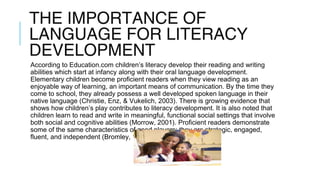
According to Education.com children’s literacy develop their reading and writing
abilities which start at infancy along with their oral language development.
Elementary children become proficient readers when they view reading as an
enjoyable way of learning, an important means of communication. By the time they
come to school, they already possess a well developed spoken language in their
native language (Christie, Enz, & Vukelich, 2003). There is growing evidence that
shows how children’s play contributes to literacy development. It is also noted that
children learn to read and write in meaningful, functional social settings that involve
both social and cognitive abilities (Morrow, 2001). Proficient readers demonstrate
some of the same characteristics of good players; they are strategic, engaged,
fluent, and independent (Bromley, 1998).
OBSERVATION OF LANGUAGE
& LITERACY IN MY FAMILY
CHILDCARE SETTING
I observed two children in my FCC setting. The children observed are ages 1 and 4
months. I had set time with each child. During this time I engaged with them
individually and optimized those spontaneous moments of engagement, i.e.;
laughing when they laugh, smiling back, talking to them using adult language during
diaper changes. In addition, I always greet each child when they’re dropped off in
the morning the same way I greet my older children. Although, at times it can be
hard sticking to a particular routine when you are dealing with very young children.
Routines are great for intentional interactions like, singing the alphabet song,
counting and commenting on their emotional state. Lastly, I always open and close
each routine with set time together.
LANGUAGE & LITERACY
SOURCE 1
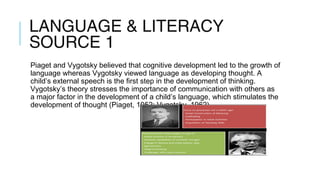
Piaget and Vygotsky believed that cognitive development led to the growth of
language whereas Vygotsky viewed language as developing thought. A
child’s external speech is the first step in the development of thinking.
Vygotsky’s theory stresses the importance of communication with others as
a major factor in the development of a child’s language, which stimulates the
development of thought (Piaget, 1952; Vygotsky, 1962).
SOURCE 2
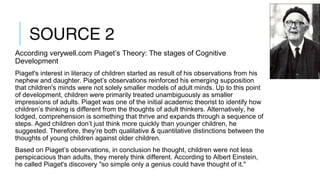
According verywell.com Piaget’s Theory: The stages of Cognitive
Development
Piaget's interest in literacy of children started as result of his observations from his
nephew and daughter. Piaget’s observations reinforced his emerging supposition
that children's minds were not solely smaller models of adult minds. Up to this point
of development, children were primarily treated unambiguously as smaller
impressions of adults. Piaget was one of the initial academic theorist to identify how
children’s thinking is different from the thoughts of adult thinkers. Alternatively, he
lodged, comprehension is something that thrive and expands through a sequence of
steps. Aged children don’t just think more quickly than younger children, he
suggested. Therefore, they’re both qualitative & quantitative distinctions between the
thoughts of young children against older children.
Based on Piaget’s observations, in conclusion he thought, children were not less
perspicacious than adults, they merely think different. According to Albert Einstein,
he called Piaget's discovery "so simple only a genius could have thought of it."
SOURCE 3
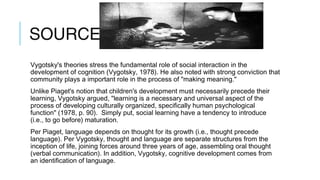
Vygotsky's theories stress the fundamental role of social interaction in the
development of cognition (Vygotsky, 1978). He also noted with strong conviction that
community plays a important role in the process of "making meaning."
Unlike Piaget's notion that children's development must necessarily precede their
learning, Vygotsky argued, "learning is a necessary and universal aspect of the
process of developing culturally organized, specifically human psychological
function" (1978, p. 90). Simply put, social learning have a tendency to introduce
(i.e., to go before) maturation.
Per Piaget, language depends on thought for its growth (i.e., thought precede
language). Per Vygotsky, thought and language are separate structures from the
inception of life, joining forces around three years of age, assembling oral thought
(verbal communication). In addition, Vygotsky, cognitive development comes from
an identification of language.
CONNECTIONS
According to research, I made the connection that literacy and language at
it’s core is about communicating with children. Communicating with babies
begins while the baby is in the mother’s womb. Babies inherently need to
learn how to communicate, and engage with their parents and care-givers.
They engage with their providers via various ways. Through their cries, finger
playing, kicking, and facial movements. The overall growth of infants and
toddlers is not always supported by set routines. However, their growth and
development is defined through observation, and the daily activities in the
environment for which they interact with their parents and care-givers.
A child will achieve competency and school readiness skills—such as
language and early literacy—when he or she is exposed to and understand
the domains of development. Language and literacy development include,
speaking, listening, fluency, comprehension and phonemic awareness.
SUMMARY
In summary a young child’s ability to use language, as well as adapt to and
comprehend the explanation of spoken and written words, is affiliated with
later accomplishment in reading, writing, and spelling. In addition, research
show that children who come from low-income households. Their parents
typically speak and read to them less often than children who come from
middle-class households. This practice hinders the ability of children in low-
income families to develop literacy and language skills. Therefore, the
achievement gap is widen. The data regarding these gaps manifest early
and begins to widen before the children start school.
ANALYSIS
Language and literacy can be analyzed in many different ways. My
interpretation is, young learners early educational years must be experiences
filled with quality. Although, I understand the importance of a unified
curriculum to meet the needs of young children. Some routines can be
altered. As long as the common academic goal is met, variations should be
accepted. Even-though, I pride myself on having personal and social
connections with the children in my care. After being in a Family Childcare
Cohort for nine months. I realized that some of my practices needed to fined
tuned i.e.; when I changing diapers I didn’t communicate with my children.
When changing diapers, I communicate with them. I noticed that they
anticipate the dialogue. The children also watch my lips and respond to my
verbal cues.
CONCLUSION
In conclusion, language is a critical component of literacy. As a Family
Childcare Provider, I’m committed to providing a high quality holistic
approach to language and literacy development. In addition, I will continue to
engage with families to ensure that positive early literacy is practiced at
home. During my interview with Ms. Boyd, I noticed that many of the
kindergarten children in her class had language difficulties. Research has
suggested that children who come from low-income households are read to
and spoken to much less than children who come from middleclass homes.
At least 90% of Ms. Boyd’s class live in a low-income home. I noticed that
she was pressed trying to ensure that every child understood material she
presented. She used a lot of visual and auditory aids as well. During this
interview, I realized how important language and communication contributes
to the key areas of learning and understanding.
REFERENCES
Close, N. (2010, July 20). Language Development. Retrieved February 14,
2018, from https://www.education.com/reference/article/language-
development-2/.
Kendra Cherry | Reviewed by Steven Gans, MD. (n.d.). What Are Some
Theories of Child Development? Retrieved February 14, 2018, from
https://www.verywell.com/child-development-theories-2795068
Lemetyinen, H. (1970, January 01). Language Acquisition. Retrieved
February 14, 2018, from https://simplypsychology.org/language.html
(n.d.). Retrieved February 14, 2018, from https://images.google.com/

Language presentation 16

  • 1.
    LANGUAGE & LITERACY DEVELOPMENT AngelaWilliams SOE 115 Psychology of Teaching and Learning
  • 2.
    THE IMPORTANCE OF LANGUAGEFOR LITERACY DEVELOPMENT According to Education.com children’s literacy develop their reading and writing abilities which start at infancy along with their oral language development. Elementary children become proficient readers when they view reading as an enjoyable way of learning, an important means of communication. By the time they come to school, they already possess a well developed spoken language in their native language (Christie, Enz, & Vukelich, 2003). There is growing evidence that shows how children’s play contributes to literacy development. It is also noted that children learn to read and write in meaningful, functional social settings that involve both social and cognitive abilities (Morrow, 2001). Proficient readers demonstrate some of the same characteristics of good players; they are strategic, engaged, fluent, and independent (Bromley, 1998).
  • 3.
    OBSERVATION OF LANGUAGE &LITERACY IN MY FAMILY CHILDCARE SETTING I observed two children in my FCC setting. The children observed are ages 1 and 4 months. I had set time with each child. During this time I engaged with them individually and optimized those spontaneous moments of engagement, i.e.; laughing when they laugh, smiling back, talking to them using adult language during diaper changes. In addition, I always greet each child when they’re dropped off in the morning the same way I greet my older children. Although, at times it can be hard sticking to a particular routine when you are dealing with very young children. Routines are great for intentional interactions like, singing the alphabet song, counting and commenting on their emotional state. Lastly, I always open and close each routine with set time together.
  • 4.
    LANGUAGE & LITERACY SOURCE1 Piaget and Vygotsky believed that cognitive development led to the growth of language whereas Vygotsky viewed language as developing thought. A child’s external speech is the first step in the development of thinking. Vygotsky’s theory stresses the importance of communication with others as a major factor in the development of a child’s language, which stimulates the development of thought (Piaget, 1952; Vygotsky, 1962).
  • 5.
    SOURCE 2 According verywell.comPiaget’s Theory: The stages of Cognitive Development Piaget's interest in literacy of children started as result of his observations from his nephew and daughter. Piaget’s observations reinforced his emerging supposition that children's minds were not solely smaller models of adult minds. Up to this point of development, children were primarily treated unambiguously as smaller impressions of adults. Piaget was one of the initial academic theorist to identify how children’s thinking is different from the thoughts of adult thinkers. Alternatively, he lodged, comprehension is something that thrive and expands through a sequence of steps. Aged children don’t just think more quickly than younger children, he suggested. Therefore, they’re both qualitative & quantitative distinctions between the thoughts of young children against older children. Based on Piaget’s observations, in conclusion he thought, children were not less perspicacious than adults, they merely think different. According to Albert Einstein, he called Piaget's discovery "so simple only a genius could have thought of it."
  • 6.
    SOURCE 3 Vygotsky's theoriesstress the fundamental role of social interaction in the development of cognition (Vygotsky, 1978). He also noted with strong conviction that community plays a important role in the process of "making meaning." Unlike Piaget's notion that children's development must necessarily precede their learning, Vygotsky argued, "learning is a necessary and universal aspect of the process of developing culturally organized, specifically human psychological function" (1978, p. 90). Simply put, social learning have a tendency to introduce (i.e., to go before) maturation. Per Piaget, language depends on thought for its growth (i.e., thought precede language). Per Vygotsky, thought and language are separate structures from the inception of life, joining forces around three years of age, assembling oral thought (verbal communication). In addition, Vygotsky, cognitive development comes from an identification of language.
  • 7.
    CONNECTIONS According to research,I made the connection that literacy and language at it’s core is about communicating with children. Communicating with babies begins while the baby is in the mother’s womb. Babies inherently need to learn how to communicate, and engage with their parents and care-givers. They engage with their providers via various ways. Through their cries, finger playing, kicking, and facial movements. The overall growth of infants and toddlers is not always supported by set routines. However, their growth and development is defined through observation, and the daily activities in the environment for which they interact with their parents and care-givers. A child will achieve competency and school readiness skills—such as language and early literacy—when he or she is exposed to and understand the domains of development. Language and literacy development include, speaking, listening, fluency, comprehension and phonemic awareness.
  • 8.
    SUMMARY In summary ayoung child’s ability to use language, as well as adapt to and comprehend the explanation of spoken and written words, is affiliated with later accomplishment in reading, writing, and spelling. In addition, research show that children who come from low-income households. Their parents typically speak and read to them less often than children who come from middle-class households. This practice hinders the ability of children in low- income families to develop literacy and language skills. Therefore, the achievement gap is widen. The data regarding these gaps manifest early and begins to widen before the children start school.
  • 9.
    ANALYSIS Language and literacycan be analyzed in many different ways. My interpretation is, young learners early educational years must be experiences filled with quality. Although, I understand the importance of a unified curriculum to meet the needs of young children. Some routines can be altered. As long as the common academic goal is met, variations should be accepted. Even-though, I pride myself on having personal and social connections with the children in my care. After being in a Family Childcare Cohort for nine months. I realized that some of my practices needed to fined tuned i.e.; when I changing diapers I didn’t communicate with my children. When changing diapers, I communicate with them. I noticed that they anticipate the dialogue. The children also watch my lips and respond to my verbal cues.
  • 10.
    CONCLUSION In conclusion, languageis a critical component of literacy. As a Family Childcare Provider, I’m committed to providing a high quality holistic approach to language and literacy development. In addition, I will continue to engage with families to ensure that positive early literacy is practiced at home. During my interview with Ms. Boyd, I noticed that many of the kindergarten children in her class had language difficulties. Research has suggested that children who come from low-income households are read to and spoken to much less than children who come from middleclass homes. At least 90% of Ms. Boyd’s class live in a low-income home. I noticed that she was pressed trying to ensure that every child understood material she presented. She used a lot of visual and auditory aids as well. During this interview, I realized how important language and communication contributes to the key areas of learning and understanding.
  • 11.
    REFERENCES Close, N. (2010,July 20). Language Development. Retrieved February 14, 2018, from https://www.education.com/reference/article/language- development-2/. Kendra Cherry | Reviewed by Steven Gans, MD. (n.d.). What Are Some Theories of Child Development? Retrieved February 14, 2018, from https://www.verywell.com/child-development-theories-2795068 Lemetyinen, H. (1970, January 01). Language Acquisition. Retrieved February 14, 2018, from https://simplypsychology.org/language.html (n.d.). Retrieved February 14, 2018, from https://images.google.com/