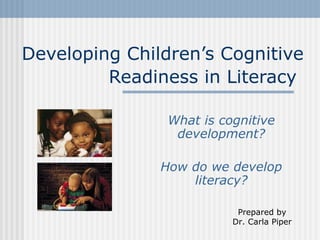
Developing Children’s Cognitive Readiness in Literacy   What is cognitive development? How do we develop literacy? Prepared by Dr. Carla Piper
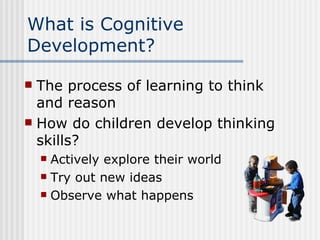
What is Cognitive Development? The process of learning to think and reason How do children develop thinking skills? Actively explore their world Try out new ideas Observe what happens
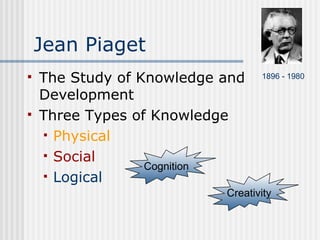
Jean Piaget The Study of Knowledge and Development Three Types of Knowledge  Physical   Social   Logical 1896 - 1980  Cognition Creativity
Piaget Quotes Equilibrium  - balance between the structure of the mind and the environment "The  principle goal of education  is to create men  [women]  who are capable of doing new things, not simply of repeating what other generations have done – men  [women]  who are  creative, inventive and discoverers.“ 
Developmental Concept Learning Assimilation  – what makes sense in child’s environment  Accommodation  – new in context with known Adaptation  – adjusts to the environment and learns the consequences of specific actions Organization  – integrates schemata and develop more complex logic
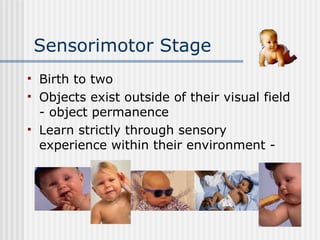
Sensorimotor Stage Birth to two Objects exist outside of their visual field - object permanence Learn strictly through sensory experience within their environment -
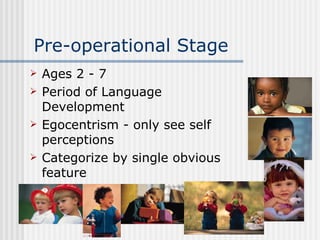
Pre-operational Stage  Ages 2 - 7 Period of Language Development Egocentrism - only see self perceptions Categorize by single obvious feature
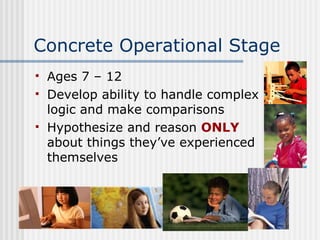
Concrete Operational Stage  Ages 7 – 12 Develop ability to handle complex logic and make comparisons Hypothesize and reason  ONLY  about things they’ve experienced themselves
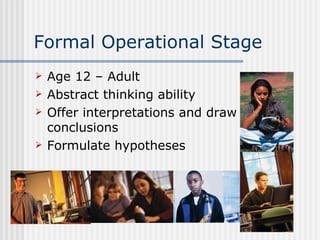
Formal Operational Stage  Age 12 – Adult Abstract thinking ability Offer interpretations and draw conclusions Formulate hypotheses
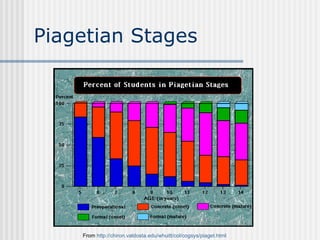
Piagetian Stages From  http://chiron.valdosta.edu/whuitt/col/cogsys/piaget.html
Lev Vygotsky  Advocate of preschool programs that meet the needs of the whole child Children need to acquire a set of fundamental competencies that shape their minds for further learning: Cognitive Linguistic Social-emotional Lifelong process of development dependent on social interaction with adults and peers 1896-1934
Explicit Instruction Skills for preschoolers need explicit instruction: Oral language Deliberate memory Focused attention Self regulation Preschool thinking is reactive – immediate response to what children see and feel Preschoolers ability to learn depends on: repetition or  an experience that is personally meaningful Bodrova and Leong, 2005 Vygotsky
Goals of Preschool Education Children move from reactive thinking to the ability to  think before they act . Children are able to reflect and draw on past experience to engage in thoughtful behaviors. Bodrova and Leong, 2005 Vygotsky “ Children who do not develop the ability to regulate their attention and their behavior before they enter kindergarten face a higher risk of falling behind academically.”
Changes in cognitive skills are related to intellectual growth and age Child’s behavior not just result of external stimuli – but also internal stimuli Social learning actually leads to cognitive development  Individual differences in children should be recognized and addressed Cognitive Development
Lev Vygotsky’s Theories Children learn best through social interactions with children and adults Adults provide mental scaffolding  Give children a framework for understanding Gives children support so they can use their own cognitive skills  Adults are guides or facilitators who help children understand their world
Fostering Cognitive Growth What do children need? Self-confidence and skills to explore their world To try out new ideas To make mistakes To solve problems on their own Take on new challenges What can the teacher do? Build on child’s natural curiosity Create an environment for exploration Ask questions and talk with children Give children a chance to construct their own knowledge
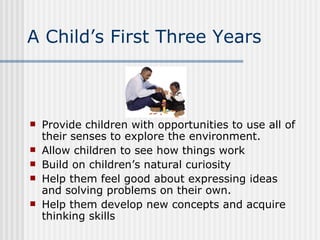
A Child’s First Three Years Provide children with opportunities to use all of their senses to explore the environment. Allow children to see how things work Build on children’s natural curiosity Help them feel good about expressing ideas and solving problems on their own. Help them develop new concepts and acquire thinking skills
Learn through everyday experiences Think through daily routines Explore through mouthing, dropping, banging, squeezing, etc. Learn “object permanence” – Object exists even when it’s out of sight Begin to understand cause and effect Learn how to use one object to get another Infants
Toddlers Learning all the time! As they develop, the same experiences take on new meanings Just beginning to understand how things and events relate to each other – in, out, under Think concretely and understand words very literally Can anticipate what will happen next and learn order in daily routines and schedules Beginning to understand cause and effect.
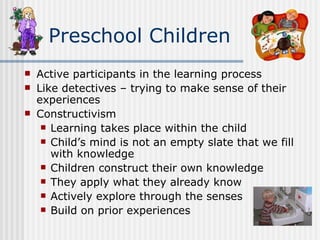
Active participants in the learning process Like detectives – trying to make sense of their experiences Constructivism Learning takes place within the child Child’s mind is not an empty slate that we fill with knowledge Children construct their own knowledge They apply what they already know  Actively explore through the senses Build on prior experiences Preschool Children
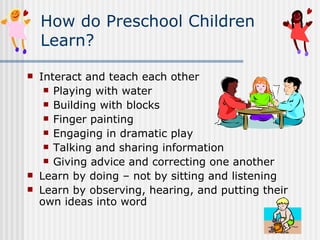
How do Preschool Children Learn? Interact and teach each other Playing with water Building with blocks Finger painting Engaging in dramatic play Talking and sharing information Giving advice and correcting one another Learn by doing – not by sitting and listening Learn by observing, hearing, and putting their own ideas into word
Learning through play! Functional play Examine physical properties of materials and objects Handling, experimenting, observing, etc. Constructive play Use materials to create a representation of something Build a farm with blocks, paint a picture, make something Socio-dramatic play Make believe and pretend Re-enact experiences, use props, role play Games with rules Board games or active games Learn to understand rules and control their behavior
Constantly Asking Questions Why?  Want to know the purpose of things. “ Why does a car need gas?” What? Want to learn the name of things. “ What is that and what do you do with it?” How? Want to understand processes and relationships. “ How does that work?”
Learning Language Need to be able to communicate To understand the world  To function in the world Language unites people Talking and Listening Literacy – reading and writing Literature – the art form that uses language
Learning Language Significant accomplishment of early childhood All children learn language in all cultures at about the same time “Caught, not taught!” Language is tool: Communication Self Expression Learning
Goal of Communication Curriculum Help children become enthusiastic and competent users of spoken and written language Foster children’s natural desire, ability, and pleasure in communication
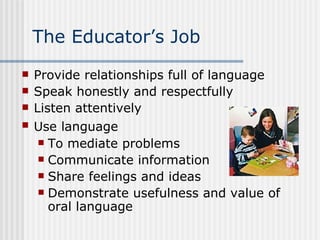
The Educator’s Job Provide relationships full of language Speak honestly and respectfully Listen attentively Use language   To mediate problems Communicate information Share feelings and ideas Demonstrate usefulness and value of oral language
Value of Written Language Demonstrate to children the value Write a note Prepare a grocery list Read a recipe Read a story, poem, book Demonstrate value of good literature Read well-written books Help children appreciate all kinds of literature
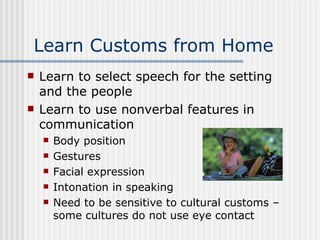
Learn Customs from Home Learn to select speech for the setting and the people Learn to use nonverbal features in communication Body position Gestures Facial expression Intonation in speaking Need to be sensitive to cultural customs – some cultures do not use eye contact
Developmental Stages Children learn complex structure, rules, and meanings of language Normal development - develop ability to create speech Taught through “language-rich” relationships Learn through conversations Learn through play Learn through planned activities Games, stories, songs, rhymes Taught through structured group activities
Conversations How to talk to children: Allow children to express ideas, tell about things they know Help children make sense of their experiences Allow children to take the lead Follow their topics and show interest Encourage them to continue the conversation Allow time for them to speak and respond Limit questioning (may seem like a test) Be patient
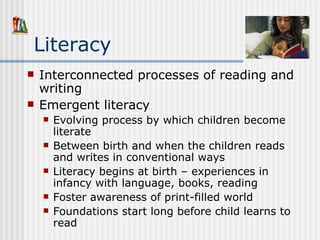
Literacy Interconnected processes of reading and writing Emergent literacy  Evolving process by which children become literate Between birth and when the children reads and writes in conventional ways Literacy begins at birth – experiences in infancy with language, books, reading Foster awareness of print-filled world Foundations start long before child learns to read
Children’s Defense Fund Report The State of America’s Yearbook - 1999 40% of nation’s fourth graders could not read at a basic level A child who can’t read well by 3 rd  grade is seriously disadvantaged Early childhood experiences are critical
Curriculum for Literacy Must be individualized Include experience with books Each child needs to be read to Even the youngest children must have books and words throughout their environment Stimulate interest in children Point to print Retell story Discuss meanings of signs and labels Write child’s name
Concepts About Print Comment on print by pointing out words, punctuation, parts of a book Do silly things – turn it upside down and discuss why it can’t be read Label shelves, containers, puzzles, games, charts, posters Have permanent and temporary classroom signs
More Concepts About Print Encourage children to write or dictate stories that they can illustrate and bind Provide time and accept “free” writing, including scribble-writing or pretend writing Keep favorite books in classroom Reread favorite stories Read so child can see the print Read individually as well as for the group Allow child to turn the pages
Literature Children experience both language and art Children learn about the world and relationships Provides information  Motivates exploration, creativity, and a concern for others Stimulates a love of reading
Classroom Books Need a variety of different kinds of books Create a sense of adventure with new books All books must respect childhood and children’s lives Fiction  Should create memorable, believable characters Give an illusion of reality in time and place Plot encourages children to understand reasons behind events
Fiction Fantasy – Rules remain true for the story Folklore Themes and questions have universal appeal Universal similarity – magic, good and evil, joy and sorrow, origins of the world, people and animals Realistic fiction Affectionate, unsentimental voice Make all children feel included Support appreciation of common humanity Provide range of diverse characters
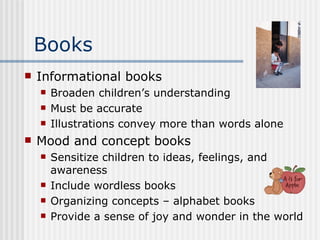
Books Informational books Broaden children’s understanding Must be accurate Illustrations convey more than words alone Mood and concept books Sensitize children to ideas, feelings, and awareness Include wordless books Organizing concepts – alphabet books Provide a sense of joy and wonder in the world
Poetry Natural response to rhythm and rhyme Nursery rhymes Present mood and melody in language Help children develop sensitivity to language Collections of rhymes and poems belong in every program
Literature-Rich Environment Extensive collection of high quality books Books presented in ways that connect – “friendship” Time and space provided for children to interact with books Daily story reading important part of schedule Learn to read to children with skill and responsiveness
Criteria for Good Literature Shows respect for the reader  Not condescending or stereotyped Has integrity – honesty and truthfulness within the story Uses aesthetic language Helps the reader understand and feel more deeply Teaches by example (not preach) Has illustrations  Enhance and enlarge the text Show craftsmanship
Suggestions for Reading to a Group of Young Children Practice in front of a mirror Sit on low stool so children can see Make sure children are settled before you begin Focus children’s attention through fingerplays, looking at the cover of the book, reading title and author Read in natural tone of voice Match your tempo, volume, pauses, and facial expressions to the content of the story
More Suggestions Try adding different voices for different characters Regularly look at the children and read their body language to see if they are interested Don’t interrupt the story by asking lots of questions Quit while you’re ahead (only read one or two stories at a time) If children aren’t paying attention, try making a comment or asking a question to focus interest
Resources Who am I in the Lives of Children? Feeny, Christensen, Moravcik Pages 310-314 Teaching Strategies  Caring for Infants and Toddlers Caring for Preschool Children -  from CDA Module Five  (1999 & 2000) Developmental Websites NNCC Child Development Charts Developmental Sequence Educational Leadership   Bodrova and Leong, 2005 September 2005 : The Whole Child

Developing language

  • 1.
    Developing Children’s CognitiveReadiness in Literacy What is cognitive development? How do we develop literacy? Prepared by Dr. Carla Piper
  • 2.
    What is CognitiveDevelopment? The process of learning to think and reason How do children develop thinking skills? Actively explore their world Try out new ideas Observe what happens
  • 3.
    Jean Piaget TheStudy of Knowledge and Development Three Types of Knowledge Physical Social Logical 1896 - 1980 Cognition Creativity
  • 4.
    Piaget Quotes Equilibrium - balance between the structure of the mind and the environment "The principle goal of education is to create men [women] who are capable of doing new things, not simply of repeating what other generations have done – men [women] who are creative, inventive and discoverers.“ 
  • 5.
    Developmental Concept LearningAssimilation – what makes sense in child’s environment Accommodation – new in context with known Adaptation – adjusts to the environment and learns the consequences of specific actions Organization – integrates schemata and develop more complex logic
  • 6.
    Sensorimotor Stage Birthto two Objects exist outside of their visual field - object permanence Learn strictly through sensory experience within their environment -
  • 7.
    Pre-operational Stage Ages 2 - 7 Period of Language Development Egocentrism - only see self perceptions Categorize by single obvious feature
  • 8.
    Concrete Operational Stage Ages 7 – 12 Develop ability to handle complex logic and make comparisons Hypothesize and reason ONLY about things they’ve experienced themselves
  • 9.
    Formal Operational Stage Age 12 – Adult Abstract thinking ability Offer interpretations and draw conclusions Formulate hypotheses
  • 10.
    Piagetian Stages From http://chiron.valdosta.edu/whuitt/col/cogsys/piaget.html
  • 11.
    Lev Vygotsky Advocate of preschool programs that meet the needs of the whole child Children need to acquire a set of fundamental competencies that shape their minds for further learning: Cognitive Linguistic Social-emotional Lifelong process of development dependent on social interaction with adults and peers 1896-1934
  • 12.
    Explicit Instruction Skillsfor preschoolers need explicit instruction: Oral language Deliberate memory Focused attention Self regulation Preschool thinking is reactive – immediate response to what children see and feel Preschoolers ability to learn depends on: repetition or an experience that is personally meaningful Bodrova and Leong, 2005 Vygotsky
  • 13.
    Goals of PreschoolEducation Children move from reactive thinking to the ability to think before they act . Children are able to reflect and draw on past experience to engage in thoughtful behaviors. Bodrova and Leong, 2005 Vygotsky “ Children who do not develop the ability to regulate their attention and their behavior before they enter kindergarten face a higher risk of falling behind academically.”
  • 14.
    Changes in cognitiveskills are related to intellectual growth and age Child’s behavior not just result of external stimuli – but also internal stimuli Social learning actually leads to cognitive development Individual differences in children should be recognized and addressed Cognitive Development
  • 15.
    Lev Vygotsky’s TheoriesChildren learn best through social interactions with children and adults Adults provide mental scaffolding Give children a framework for understanding Gives children support so they can use their own cognitive skills Adults are guides or facilitators who help children understand their world
  • 16.
    Fostering Cognitive GrowthWhat do children need? Self-confidence and skills to explore their world To try out new ideas To make mistakes To solve problems on their own Take on new challenges What can the teacher do? Build on child’s natural curiosity Create an environment for exploration Ask questions and talk with children Give children a chance to construct their own knowledge
  • 17.
    A Child’s FirstThree Years Provide children with opportunities to use all of their senses to explore the environment. Allow children to see how things work Build on children’s natural curiosity Help them feel good about expressing ideas and solving problems on their own. Help them develop new concepts and acquire thinking skills
  • 18.
    Learn through everydayexperiences Think through daily routines Explore through mouthing, dropping, banging, squeezing, etc. Learn “object permanence” – Object exists even when it’s out of sight Begin to understand cause and effect Learn how to use one object to get another Infants
  • 19.
    Toddlers Learning allthe time! As they develop, the same experiences take on new meanings Just beginning to understand how things and events relate to each other – in, out, under Think concretely and understand words very literally Can anticipate what will happen next and learn order in daily routines and schedules Beginning to understand cause and effect.
  • 20.
    Active participants inthe learning process Like detectives – trying to make sense of their experiences Constructivism Learning takes place within the child Child’s mind is not an empty slate that we fill with knowledge Children construct their own knowledge They apply what they already know Actively explore through the senses Build on prior experiences Preschool Children
  • 21.
    How do PreschoolChildren Learn? Interact and teach each other Playing with water Building with blocks Finger painting Engaging in dramatic play Talking and sharing information Giving advice and correcting one another Learn by doing – not by sitting and listening Learn by observing, hearing, and putting their own ideas into word
  • 22.
    Learning through play!Functional play Examine physical properties of materials and objects Handling, experimenting, observing, etc. Constructive play Use materials to create a representation of something Build a farm with blocks, paint a picture, make something Socio-dramatic play Make believe and pretend Re-enact experiences, use props, role play Games with rules Board games or active games Learn to understand rules and control their behavior
  • 23.
    Constantly Asking QuestionsWhy? Want to know the purpose of things. “ Why does a car need gas?” What? Want to learn the name of things. “ What is that and what do you do with it?” How? Want to understand processes and relationships. “ How does that work?”
  • 24.
    Learning Language Needto be able to communicate To understand the world To function in the world Language unites people Talking and Listening Literacy – reading and writing Literature – the art form that uses language
  • 25.
    Learning Language Significantaccomplishment of early childhood All children learn language in all cultures at about the same time “Caught, not taught!” Language is tool: Communication Self Expression Learning
  • 26.
    Goal of CommunicationCurriculum Help children become enthusiastic and competent users of spoken and written language Foster children’s natural desire, ability, and pleasure in communication
  • 27.
    The Educator’s JobProvide relationships full of language Speak honestly and respectfully Listen attentively Use language To mediate problems Communicate information Share feelings and ideas Demonstrate usefulness and value of oral language
  • 28.
    Value of WrittenLanguage Demonstrate to children the value Write a note Prepare a grocery list Read a recipe Read a story, poem, book Demonstrate value of good literature Read well-written books Help children appreciate all kinds of literature
  • 29.
    Learn Customs fromHome Learn to select speech for the setting and the people Learn to use nonverbal features in communication Body position Gestures Facial expression Intonation in speaking Need to be sensitive to cultural customs – some cultures do not use eye contact
  • 30.
    Developmental Stages Childrenlearn complex structure, rules, and meanings of language Normal development - develop ability to create speech Taught through “language-rich” relationships Learn through conversations Learn through play Learn through planned activities Games, stories, songs, rhymes Taught through structured group activities
  • 31.
    Conversations How totalk to children: Allow children to express ideas, tell about things they know Help children make sense of their experiences Allow children to take the lead Follow their topics and show interest Encourage them to continue the conversation Allow time for them to speak and respond Limit questioning (may seem like a test) Be patient
  • 32.
    Literacy Interconnected processesof reading and writing Emergent literacy Evolving process by which children become literate Between birth and when the children reads and writes in conventional ways Literacy begins at birth – experiences in infancy with language, books, reading Foster awareness of print-filled world Foundations start long before child learns to read
  • 33.
    Children’s Defense FundReport The State of America’s Yearbook - 1999 40% of nation’s fourth graders could not read at a basic level A child who can’t read well by 3 rd grade is seriously disadvantaged Early childhood experiences are critical
  • 34.
    Curriculum for LiteracyMust be individualized Include experience with books Each child needs to be read to Even the youngest children must have books and words throughout their environment Stimulate interest in children Point to print Retell story Discuss meanings of signs and labels Write child’s name
  • 35.
    Concepts About PrintComment on print by pointing out words, punctuation, parts of a book Do silly things – turn it upside down and discuss why it can’t be read Label shelves, containers, puzzles, games, charts, posters Have permanent and temporary classroom signs
  • 36.
    More Concepts AboutPrint Encourage children to write or dictate stories that they can illustrate and bind Provide time and accept “free” writing, including scribble-writing or pretend writing Keep favorite books in classroom Reread favorite stories Read so child can see the print Read individually as well as for the group Allow child to turn the pages
  • 37.
    Literature Children experienceboth language and art Children learn about the world and relationships Provides information Motivates exploration, creativity, and a concern for others Stimulates a love of reading
  • 38.
    Classroom Books Needa variety of different kinds of books Create a sense of adventure with new books All books must respect childhood and children’s lives Fiction Should create memorable, believable characters Give an illusion of reality in time and place Plot encourages children to understand reasons behind events
  • 39.
    Fiction Fantasy –Rules remain true for the story Folklore Themes and questions have universal appeal Universal similarity – magic, good and evil, joy and sorrow, origins of the world, people and animals Realistic fiction Affectionate, unsentimental voice Make all children feel included Support appreciation of common humanity Provide range of diverse characters
  • 40.
    Books Informational booksBroaden children’s understanding Must be accurate Illustrations convey more than words alone Mood and concept books Sensitize children to ideas, feelings, and awareness Include wordless books Organizing concepts – alphabet books Provide a sense of joy and wonder in the world
  • 41.
    Poetry Natural responseto rhythm and rhyme Nursery rhymes Present mood and melody in language Help children develop sensitivity to language Collections of rhymes and poems belong in every program
  • 42.
    Literature-Rich Environment Extensivecollection of high quality books Books presented in ways that connect – “friendship” Time and space provided for children to interact with books Daily story reading important part of schedule Learn to read to children with skill and responsiveness
  • 43.
    Criteria for GoodLiterature Shows respect for the reader Not condescending or stereotyped Has integrity – honesty and truthfulness within the story Uses aesthetic language Helps the reader understand and feel more deeply Teaches by example (not preach) Has illustrations Enhance and enlarge the text Show craftsmanship
  • 44.
    Suggestions for Readingto a Group of Young Children Practice in front of a mirror Sit on low stool so children can see Make sure children are settled before you begin Focus children’s attention through fingerplays, looking at the cover of the book, reading title and author Read in natural tone of voice Match your tempo, volume, pauses, and facial expressions to the content of the story
  • 45.
    More Suggestions Tryadding different voices for different characters Regularly look at the children and read their body language to see if they are interested Don’t interrupt the story by asking lots of questions Quit while you’re ahead (only read one or two stories at a time) If children aren’t paying attention, try making a comment or asking a question to focus interest
  • 46.
    Resources Who amI in the Lives of Children? Feeny, Christensen, Moravcik Pages 310-314 Teaching Strategies Caring for Infants and Toddlers Caring for Preschool Children - from CDA Module Five (1999 & 2000) Developmental Websites NNCC Child Development Charts Developmental Sequence Educational Leadership Bodrova and Leong, 2005 September 2005 : The Whole Child