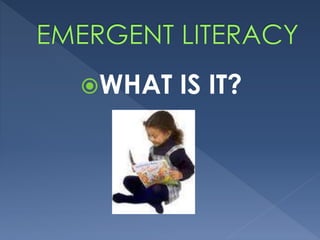
WHAT IS IT?
To describe how young
children interact with
books and when reading or
writing, even though they
could not read or write in
the conventional sense
DEFINITION OF
EMERGENT LITERACY
 Literacy is a wonderful
process where children
are on the verge of
acquiring reading and
writing knowledge
HOW EARLY SHOULD A
CHILD START READING
& WRITING?
Emergent Literacy
 Emergent literacy is the developmental
process that begins at birth whereby children
acquire the foundation for reading and writing.
 “The term ‘emergent literacy’ is used to
denote the idea that the acquisition of literacy
is best conceptualized as a developmental
continuum, with its origins early in the life of a
child, rather than as an all-or-none
phenomenon that begins when children start
school” (p. 848).
Whitehurst & Lonigan, 1998
LITERACY starts at birth (0-
4/5 years).
It is nurtured and not
nature.
Literacy skills build and
grow a little at a time.
LITERACY skills build on each other,
but they are not necessarily
sequential.
Every skill is integrated at the same
time.
- It requires the involvement of an adult
to stimulate a child’s interest, scaffold
experiences and responds to a child’s
earnest attempts to learn a skill.
WHY IS IT IMPORTANT TO START EARLY?
“ Children who get off to a good start in early
reading rarely fall behind (Reutzel and
Cooter, 2008 p.80)
On the other hand, children who start out with a
shakier foundation get further behind.
WHY IS IT IMPORTANT TO START EARLY?
“Emergent literacy forms a foundation upon
which children will gage their future reading”
(Schirmer, 1998).
In other words, if emerging literacy was fun, exciting
and explosive for a child, that child will probably
continue to feel that way about reading throughout
life.
WHY IS IT IMPORTANT TO START EARLY?
“Many pediatricians believe that a child who
has never held a book or listened to a story is
not a fully healthy child” (Klass, 1998).
WHY IS IT IMPORTANT TO START EARLY?
“As parents talk, sing and read to children,
the children’s brain cells are developed.
Existing links among brain cells are
strengthened and new cells and links are
formed” (Shore, 1997).
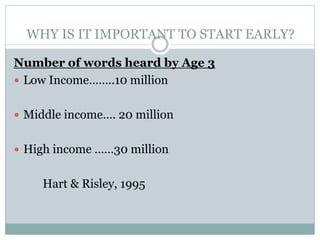
WHY IS IT IMPORTANT TO START EARLY?
Number of words heard by Age 3
 Low Income……..10 million
 Middle income…. 20 million
 High income ……30 million
Hart & Risley, 1995
1) Cognitive and/or language impairments
(Scarborough, 1998).
2)Lack of access to early literacy activities,
3)Poor quality or limited participation in early
literacy activities,
4)Lower social economic status (Hart, 1995).
Intrinsic and Extrinsic Factors for
Emergent Literacy Issues
Emphasis :
1) Preparation for kindergarten.
2) Preventing academic & reading difficulty – ultimate
academic failure.
WHY IS IT IMPORTANT TO START EARLY?
“The rich get richer, and the poor
get poorer”
SOME INDICATORS OF EMERGENT
LITERACY DEVELOPMENT
• Pretend writing
• Pretend reading from favourite books
• Listening to stories
• Producing fictional narratives
• Detecting rhymes
• Identifying major elements of a book
• Acting out stories
• Pointing out familiar words in the environment
• Producing nursery rhymes
BASIC COMPONENTS OF
EMERGENT LITERACY
 RECEPTIVE LANGUAGE
EXPRESSIVE
LANGUAGE/NARRATIVE SKILLS
VOCABULARY
PRINT AWARENESS
PHONOLOGICAL AWARENESS
LETTER KNOWLEDGE
PRINT MOTIVATION
BASIC COMPONENTS
1)RECEPTIVE LANGUAGE
- understanding the language
2) EXPRESSIVE LANGUAGE/NARRATIVE
SKILLS
- How they express themselves through
language
3) VOCABULARY
- Knowing the name of things
BASIC COMPONENTS
4) PRINT AWARENESS
- Noticing print, knowing how to handle a book,
and knowing how to follow words on a page
5) PHONOLOGICAL AWARENESS
- being able to hear and play with the smaller
sounds in words.
BASIC COMPONENTS
6) LETTER KNOWLEDGE
- Understanding letters are different from each
other, knowing their names and sounds, and
recognizing letters everywhere.
7) PRINT MOTIVATION
- Being interested in and enjoying books.
1) EXPRESSIVE LANGUAGE
- DESCRIBING SOMETHING THAT HAPPENED
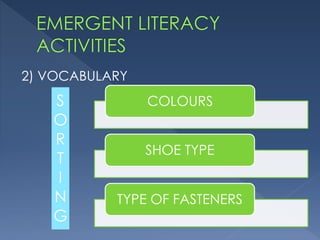
2) VOCABULARY
S
O
R
T
I
N
G
COLOURS
SHOE TYPE
TYPE OF FASTENERS
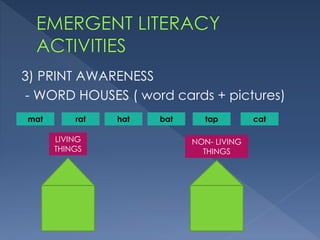
3) PRINT AWARENESS
- WORD HOUSES ( word cards + pictures)
LIVING
THINGS
NON- LIVING
THINGS
mat hatrat bat tap cat
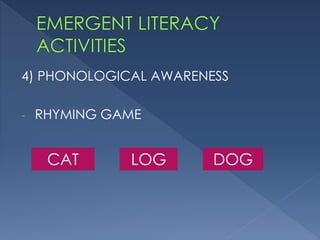
4) PHONOLOGICAL AWARENESS
- RHYMING GAME
CAT LOG DOG
5) LETTER KNOWLEDGE
- REARRANGING WORD CARDS IN
ALPHABETICAL ORDER
6) PRINT MOTIVATION
 Read often and make it enjoyable
 Read when you and the child are in a good
mood, so the experience is a positive one.
 Change your voice when you read aloud.
 Keep books accessible to children
 Stop reading when a child becomes tired
or loses interest
CONCEPTS ABOUT PRINT
 Child can:
Point to front and back of book
Demonstrate awareness that print contains a
message
Indicate where to start reading on a page
Indicate the directions to read words
Indicate that at the end of a line you sweep left
to the next lower line
Demonstrate an understanding of the concepts
of first and last
CONCEPTS OF PRINT
 Child can:
Indicate that you stop at a period
Indicate that you pause at a comma
Count words in a line
Point to one letter
Point to an uppercase letter
Point to the top and the bottom of a page
Point to the top and the bottom of a picture
SKILLS
LITERACY IS NOT A SET OF
AN ISOLATED SKILLS, BUT
RATHER A SET OF
PROCESSES THAT
CHILDREN SEE AS A MEANS
TO ACHIEVE GOALS
- LITERACY includes four basic areas:
•Language
•Listening
•Writing
•Reading
- All skills are learned or gained at the
same time.
READING
1) READ
2) TELL – AUTHOR, TITLE, FAMOUS BEGINNING AND
ENDING SENTENCES IN STORIES
e.g. Once upon a time
e.g. they lived happily ever after
TELL – Beginning, middle and end
Reading to Students
• One of the best ways to develop students’
emergent literacy is to read interesting books to
them.
• It helps…
– Develop children’s vocabulary.
– Develop their experiential background.
– Make them aware of the language of books.
– Introduce them to concepts of print and how books are
read.
– Provide them with an enjoyment of reading.
LISTENING
1)Help children listen for the beginning
sound of a word.
2)Look at how a word is broken into
syllables.
3)Explain how different words rhyme
with each other.
WRITING
Teach the children about different
styles of writing – depending on
the purpose.
* poem
* signs
Effective Writing Activities
• Write letters to each other
• Create invitations for events
• Write stories about what is happening in their
lives
• Write stories about special events
• Make connections to books they are reading
• Encourage children to make lists
IMPORTANT ELEMENTS IN EMERGENT
LITERACY:
a) Responsive adults
b) Active play
c) Quality, responsive, developmentally
appropriate materials
d) Real experiences
e) Teaching in context
f) Talking about reading, writing, listening
and language
A) RESPONSIVE ADULTS
- A critical skill that all adults must develop.
- Adults who just use language to direct,
instruct, control and punish will not help
children develop complex language skills.
- Parents are the first critical adult in child’s
reading process.
- In other words, literacy development at home
is very important.
- All new skills and concepts must be used again and
again by a child until they become fully integrated in
his or her mind and behaviour.
- E.g. learn how to drive
- Play allows children to internalize new ideas and skills,
integrate them with other knowledge and begin to use
them in their daily lives.
- Play also provides an essential environment for literacy
learning.
- To learn new literacy skills, children must be risk-
takers.
- ONE OF THE WAYS TO TRIGGER HIS OR
HER INTEREST IN LITERACY IS THROUGH
HIGH QUALITY TOYS AND MATERIALS.
- THEY HELP CHILDREN TO BE ACTIVELY
INVOLVED.
- E.G. PLAYING LEGO
- E.G. PAINTING
C) QUALITY, RESPONSIVE, DEVELOPMENTALLY
APPROPRIATE MATERIALS
D) REAL EXPERIENCES
 Begin with what children know
 What we know about how children learn
 What if the children don’t know much?
 Solutions: Provide children with lots and lots
of real life, genuine, emotionally charged, multi
sensory experiences.
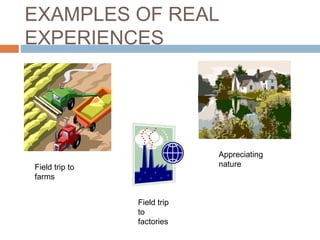
EXAMPLES OF REAL
EXPERIENCES
Field trip to
farms
Field trip
to
factories
Appreciating
nature
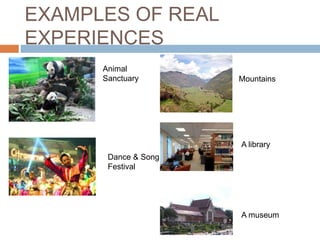
EXAMPLES OF REAL
EXPERIENCES
Animal
Sanctuary
Dance & Song
Festival
A library
Mountains
A museum
 Listening, reading, writing and language skills
should be taught in the context of everyday
activities.
 E.g. (to develop children’s writing skills) A
teacher can help children creating a shopping
list of things to be purchased for an art activity.
F) TALK ABOUT READING,
WRITING, LISTENING AND
LANGUAGE
 Help children to learn their reading skills by
talking about literacy-related ideas and activities.
 E.g. Explain to children that “ We need to write
your baby sister’s birthday on the calendar, so we
won’t forget”.
Children understand that writing plays an
important role in daily life.
 E.g. Tell them to listen carefully to hear what
sound the word ends with “I don’t know how
much flour I need to make the cookies”.
PROMOTING
EMERGENT
LITERACY
PROMOTING EARLY LITERACY
DEVELOPMENT FOR CHILDREN
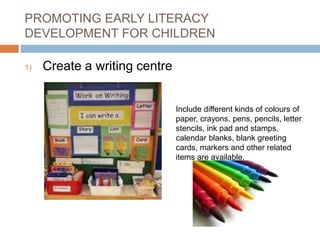
1) Create a writing centre
Include different kinds of colours of
paper, crayons, pens, pencils, letter
stencils, ink pad and stamps,
calendar blanks, blank greeting
cards, markers and other related
items are available.
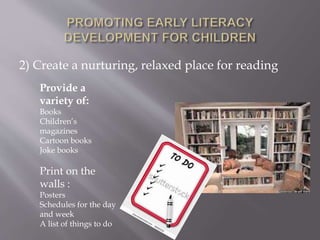
2) Create a nurturing, relaxed place for reading
Provide a
variety of:
Books
Children’s
magazines
Cartoon books
Joke books
Print on the
walls :
Posters
Schedules for the day
and week
A list of things to do
PROMOTING EARLY LITERACY DEVELOPMENT
FOR CHILDREN
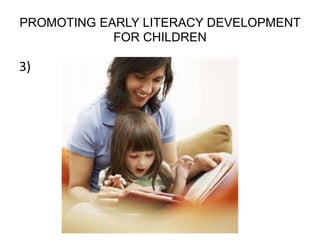
3)
PROMOTING EARLY LITERACY
DEVELOPMENT FOR CHILDREN
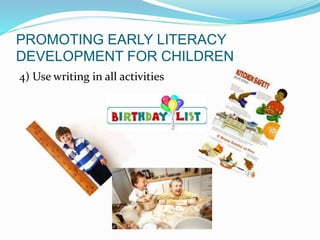
4) Use writing in all activities
PROMOTING EARLY LITERACY DEVELOPMENT
FOR CHILDREN
5) Use a child’s name to generate activities.
Children learn to correctly write their name before
any other word.
e.g. write their name when they come to a program
when entering a learning centre
create a game where children match photos
with a written name.
PROMOTING EARLY LITERACY
DEVELOPMENT FOR CHILDREN
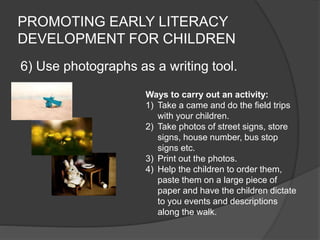
6) Use photographs as a writing tool.
Ways to carry out an activity:
1) Take a came and do the field trips
with your children.
2) Take photos of street signs, store
signs, house number, bus stop
signs etc.
3) Print out the photos.
4) Help the children to order them,
paste them on a large piece of
paper and have the children dictate
to you events and descriptions
along the walk.
PROMOTING EARLY LITERACY
DEVELOPMENT FOR CHILDREN
8) Develop a listening centre.
- Children can listen with earphones to music,
songs and tapes of books.
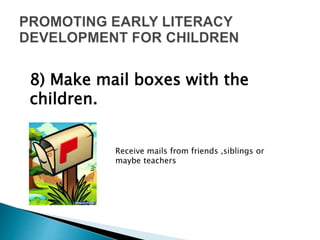
Receive mails from friends ,siblings or
maybe teachers
8) Make mail boxes with the
children.
 PROMOTING EARLY LITERACY
DEVELOPMENT FOR CHILDREN
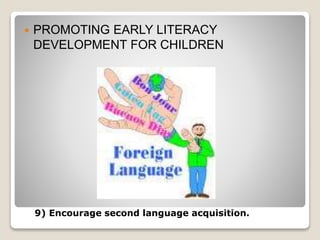
9) Encourage second language acquisition.
10) Encourage art activities.
- Activities that involve using crayons, chalk,
pens, paint brushes, and sticks in the sand and
mud.
PROMOTING EARLY LITERACY
DEVELOPMENT FOR CHILDREN
11) PLAY
 Many emergent literacy interventions can be
encouraged through play.
 Play is process oriented, not product oriented.
 Children learn through the process of playing,
not by creating a product or accomplishing a
task.
 Play provides a developmentally appropriate
context for learning about the functions of
reading and writing.
McLane & McNamee, 1991
Roskos, Christie, & Richgels, 2003
PROMOTING EARLY LITERACY
DEVELOPMENT FOR CHILDREN
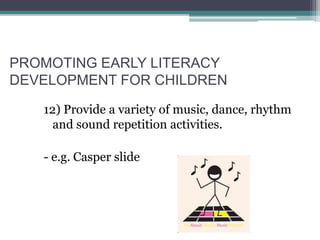
12) Provide a variety of music, dance, rhythm
and sound repetition activities.
- e.g. Casper slide
Eliteracy

Eliteracy

  • 2.
  • 3.
    To describe howyoung children interact with books and when reading or writing, even though they could not read or write in the conventional sense DEFINITION OF EMERGENT LITERACY
  • 4.
     Literacy isa wonderful process where children are on the verge of acquiring reading and writing knowledge
  • 5.
    HOW EARLY SHOULDA CHILD START READING & WRITING?
  • 6.
    Emergent Literacy  Emergentliteracy is the developmental process that begins at birth whereby children acquire the foundation for reading and writing.  “The term ‘emergent literacy’ is used to denote the idea that the acquisition of literacy is best conceptualized as a developmental continuum, with its origins early in the life of a child, rather than as an all-or-none phenomenon that begins when children start school” (p. 848). Whitehurst & Lonigan, 1998
  • 7.
    LITERACY starts atbirth (0- 4/5 years). It is nurtured and not nature. Literacy skills build and grow a little at a time.
  • 8.
    LITERACY skills buildon each other, but they are not necessarily sequential. Every skill is integrated at the same time.
  • 9.
    - It requiresthe involvement of an adult to stimulate a child’s interest, scaffold experiences and responds to a child’s earnest attempts to learn a skill.
  • 11.
    WHY IS ITIMPORTANT TO START EARLY? “ Children who get off to a good start in early reading rarely fall behind (Reutzel and Cooter, 2008 p.80) On the other hand, children who start out with a shakier foundation get further behind.
  • 12.
    WHY IS ITIMPORTANT TO START EARLY? “Emergent literacy forms a foundation upon which children will gage their future reading” (Schirmer, 1998). In other words, if emerging literacy was fun, exciting and explosive for a child, that child will probably continue to feel that way about reading throughout life.
  • 13.
    WHY IS ITIMPORTANT TO START EARLY? “Many pediatricians believe that a child who has never held a book or listened to a story is not a fully healthy child” (Klass, 1998).
  • 14.
    WHY IS ITIMPORTANT TO START EARLY? “As parents talk, sing and read to children, the children’s brain cells are developed. Existing links among brain cells are strengthened and new cells and links are formed” (Shore, 1997).
  • 15.
    WHY IS ITIMPORTANT TO START EARLY? Number of words heard by Age 3  Low Income……..10 million  Middle income…. 20 million  High income ……30 million Hart & Risley, 1995
  • 16.
    1) Cognitive and/orlanguage impairments (Scarborough, 1998). 2)Lack of access to early literacy activities, 3)Poor quality or limited participation in early literacy activities, 4)Lower social economic status (Hart, 1995). Intrinsic and Extrinsic Factors for Emergent Literacy Issues
  • 17.
    Emphasis : 1) Preparationfor kindergarten. 2) Preventing academic & reading difficulty – ultimate academic failure. WHY IS IT IMPORTANT TO START EARLY?
  • 18.
    “The rich getricher, and the poor get poorer”
  • 19.
    SOME INDICATORS OFEMERGENT LITERACY DEVELOPMENT • Pretend writing • Pretend reading from favourite books • Listening to stories • Producing fictional narratives • Detecting rhymes • Identifying major elements of a book • Acting out stories • Pointing out familiar words in the environment • Producing nursery rhymes
  • 20.
    BASIC COMPONENTS OF EMERGENTLITERACY  RECEPTIVE LANGUAGE EXPRESSIVE LANGUAGE/NARRATIVE SKILLS VOCABULARY PRINT AWARENESS PHONOLOGICAL AWARENESS LETTER KNOWLEDGE PRINT MOTIVATION
  • 21.
    BASIC COMPONENTS 1)RECEPTIVE LANGUAGE -understanding the language 2) EXPRESSIVE LANGUAGE/NARRATIVE SKILLS - How they express themselves through language 3) VOCABULARY - Knowing the name of things
  • 22.
    BASIC COMPONENTS 4) PRINTAWARENESS - Noticing print, knowing how to handle a book, and knowing how to follow words on a page 5) PHONOLOGICAL AWARENESS - being able to hear and play with the smaller sounds in words.
  • 23.
    BASIC COMPONENTS 6) LETTERKNOWLEDGE - Understanding letters are different from each other, knowing their names and sounds, and recognizing letters everywhere. 7) PRINT MOTIVATION - Being interested in and enjoying books.
  • 24.
    1) EXPRESSIVE LANGUAGE -DESCRIBING SOMETHING THAT HAPPENED
  • 25.
  • 26.
    3) PRINT AWARENESS -WORD HOUSES ( word cards + pictures) LIVING THINGS NON- LIVING THINGS mat hatrat bat tap cat
  • 27.
    4) PHONOLOGICAL AWARENESS -RHYMING GAME CAT LOG DOG
  • 28.
    5) LETTER KNOWLEDGE -REARRANGING WORD CARDS IN ALPHABETICAL ORDER
  • 29.
    6) PRINT MOTIVATION Read often and make it enjoyable  Read when you and the child are in a good mood, so the experience is a positive one.  Change your voice when you read aloud.  Keep books accessible to children  Stop reading when a child becomes tired or loses interest
  • 30.
    CONCEPTS ABOUT PRINT Child can: Point to front and back of book Demonstrate awareness that print contains a message Indicate where to start reading on a page Indicate the directions to read words Indicate that at the end of a line you sweep left to the next lower line Demonstrate an understanding of the concepts of first and last
  • 31.
    CONCEPTS OF PRINT Child can: Indicate that you stop at a period Indicate that you pause at a comma Count words in a line Point to one letter Point to an uppercase letter Point to the top and the bottom of a page Point to the top and the bottom of a picture
  • 32.
  • 33.
    LITERACY IS NOTA SET OF AN ISOLATED SKILLS, BUT RATHER A SET OF PROCESSES THAT CHILDREN SEE AS A MEANS TO ACHIEVE GOALS
  • 34.
    - LITERACY includesfour basic areas: •Language •Listening •Writing •Reading - All skills are learned or gained at the same time.
  • 35.
    READING 1) READ 2) TELL– AUTHOR, TITLE, FAMOUS BEGINNING AND ENDING SENTENCES IN STORIES e.g. Once upon a time e.g. they lived happily ever after TELL – Beginning, middle and end
  • 36.
    Reading to Students •One of the best ways to develop students’ emergent literacy is to read interesting books to them. • It helps… – Develop children’s vocabulary. – Develop their experiential background. – Make them aware of the language of books. – Introduce them to concepts of print and how books are read. – Provide them with an enjoyment of reading.
  • 37.
    LISTENING 1)Help children listenfor the beginning sound of a word. 2)Look at how a word is broken into syllables. 3)Explain how different words rhyme with each other.
  • 38.
    WRITING Teach the childrenabout different styles of writing – depending on the purpose. * poem * signs
  • 39.
    Effective Writing Activities •Write letters to each other • Create invitations for events • Write stories about what is happening in their lives • Write stories about special events • Make connections to books they are reading • Encourage children to make lists
  • 40.
    IMPORTANT ELEMENTS INEMERGENT LITERACY: a) Responsive adults b) Active play c) Quality, responsive, developmentally appropriate materials d) Real experiences e) Teaching in context f) Talking about reading, writing, listening and language
  • 41.
    A) RESPONSIVE ADULTS -A critical skill that all adults must develop. - Adults who just use language to direct, instruct, control and punish will not help children develop complex language skills. - Parents are the first critical adult in child’s reading process. - In other words, literacy development at home is very important.
  • 42.
    - All newskills and concepts must be used again and again by a child until they become fully integrated in his or her mind and behaviour. - E.g. learn how to drive - Play allows children to internalize new ideas and skills, integrate them with other knowledge and begin to use them in their daily lives. - Play also provides an essential environment for literacy learning. - To learn new literacy skills, children must be risk- takers.
  • 43.
    - ONE OFTHE WAYS TO TRIGGER HIS OR HER INTEREST IN LITERACY IS THROUGH HIGH QUALITY TOYS AND MATERIALS. - THEY HELP CHILDREN TO BE ACTIVELY INVOLVED. - E.G. PLAYING LEGO - E.G. PAINTING C) QUALITY, RESPONSIVE, DEVELOPMENTALLY APPROPRIATE MATERIALS
  • 44.
    D) REAL EXPERIENCES Begin with what children know  What we know about how children learn  What if the children don’t know much?  Solutions: Provide children with lots and lots of real life, genuine, emotionally charged, multi sensory experiences.
  • 45.
    EXAMPLES OF REAL EXPERIENCES Fieldtrip to farms Field trip to factories Appreciating nature
  • 46.
    EXAMPLES OF REAL EXPERIENCES Animal Sanctuary Dance& Song Festival A library Mountains A museum
  • 47.
     Listening, reading,writing and language skills should be taught in the context of everyday activities.  E.g. (to develop children’s writing skills) A teacher can help children creating a shopping list of things to be purchased for an art activity.
  • 48.
    F) TALK ABOUTREADING, WRITING, LISTENING AND LANGUAGE  Help children to learn their reading skills by talking about literacy-related ideas and activities.  E.g. Explain to children that “ We need to write your baby sister’s birthday on the calendar, so we won’t forget”. Children understand that writing plays an important role in daily life.  E.g. Tell them to listen carefully to hear what sound the word ends with “I don’t know how much flour I need to make the cookies”.
  • 49.
  • 50.
    PROMOTING EARLY LITERACY DEVELOPMENTFOR CHILDREN 1) Create a writing centre Include different kinds of colours of paper, crayons, pens, pencils, letter stencils, ink pad and stamps, calendar blanks, blank greeting cards, markers and other related items are available.
  • 51.
    2) Create anurturing, relaxed place for reading Provide a variety of: Books Children’s magazines Cartoon books Joke books Print on the walls : Posters Schedules for the day and week A list of things to do
  • 52.
    PROMOTING EARLY LITERACYDEVELOPMENT FOR CHILDREN 3)
  • 53.
    PROMOTING EARLY LITERACY DEVELOPMENTFOR CHILDREN 4) Use writing in all activities
  • 54.
    PROMOTING EARLY LITERACYDEVELOPMENT FOR CHILDREN 5) Use a child’s name to generate activities. Children learn to correctly write their name before any other word. e.g. write their name when they come to a program when entering a learning centre create a game where children match photos with a written name.
  • 55.
    PROMOTING EARLY LITERACY DEVELOPMENTFOR CHILDREN 6) Use photographs as a writing tool. Ways to carry out an activity: 1) Take a came and do the field trips with your children. 2) Take photos of street signs, store signs, house number, bus stop signs etc. 3) Print out the photos. 4) Help the children to order them, paste them on a large piece of paper and have the children dictate to you events and descriptions along the walk.
  • 56.
    PROMOTING EARLY LITERACY DEVELOPMENTFOR CHILDREN 8) Develop a listening centre. - Children can listen with earphones to music, songs and tapes of books.
  • 57.
    Receive mails fromfriends ,siblings or maybe teachers 8) Make mail boxes with the children.
  • 58.
     PROMOTING EARLYLITERACY DEVELOPMENT FOR CHILDREN 9) Encourage second language acquisition.
  • 59.
    10) Encourage artactivities. - Activities that involve using crayons, chalk, pens, paint brushes, and sticks in the sand and mud.
  • 60.
    PROMOTING EARLY LITERACY DEVELOPMENTFOR CHILDREN 11) PLAY  Many emergent literacy interventions can be encouraged through play.  Play is process oriented, not product oriented.  Children learn through the process of playing, not by creating a product or accomplishing a task.  Play provides a developmentally appropriate context for learning about the functions of reading and writing. McLane & McNamee, 1991 Roskos, Christie, & Richgels, 2003
  • 61.
    PROMOTING EARLY LITERACY DEVELOPMENTFOR CHILDREN 12) Provide a variety of music, dance, rhythm and sound repetition activities. - e.g. Casper slide