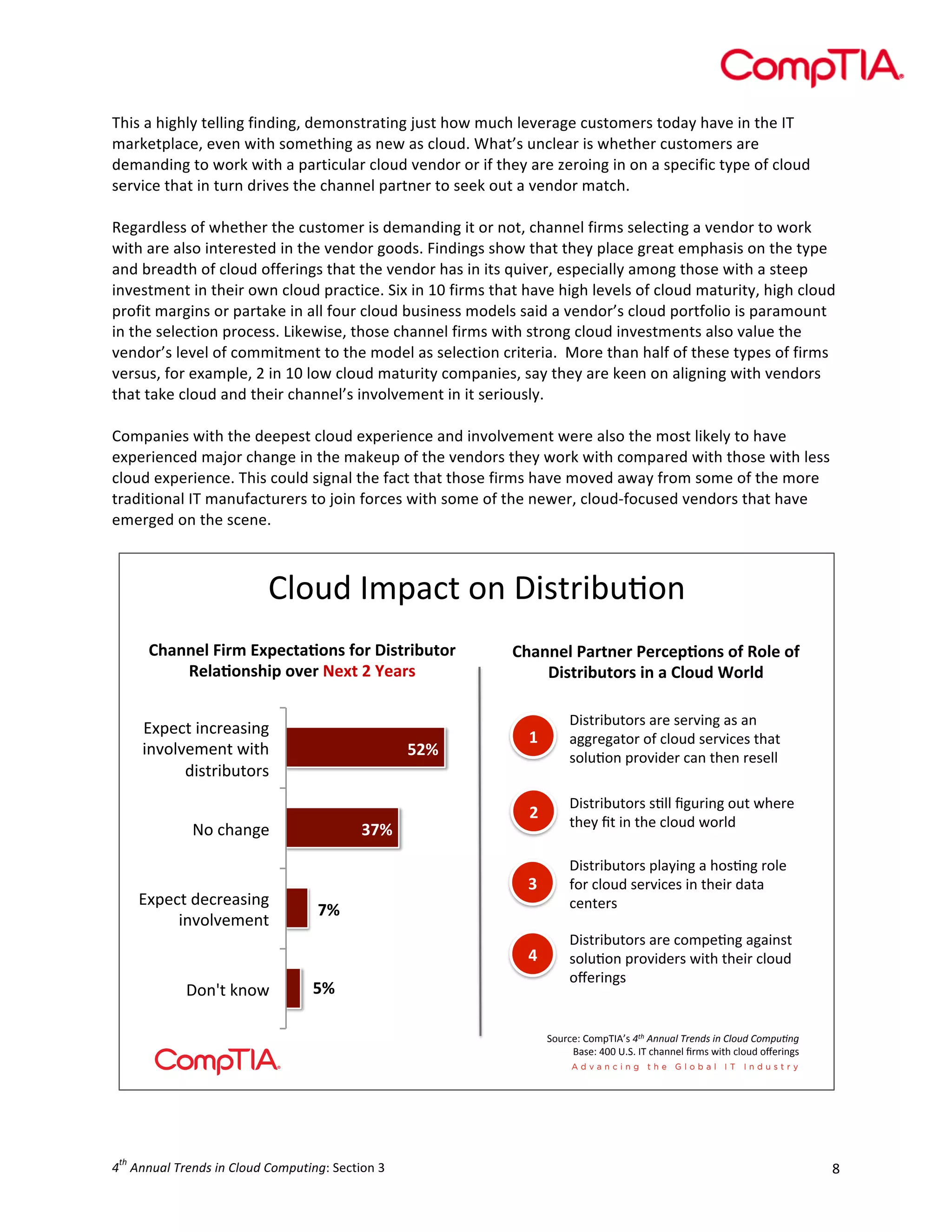
TRENDS IN CLOUD COMPUTING

RESEARCH

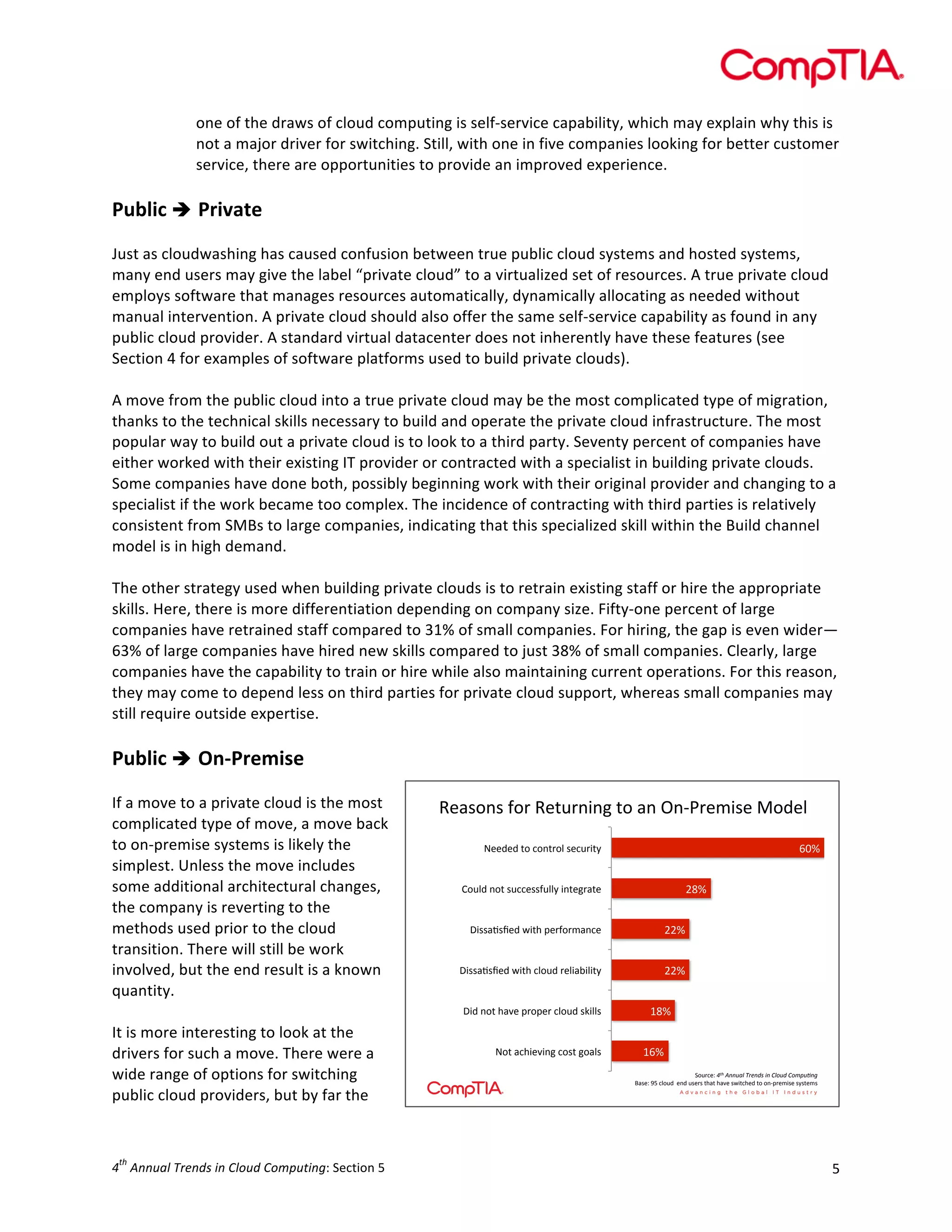
FULL REPORT

FOURTH ANNUAL • AUGUST 2013

www.comptia.org
 

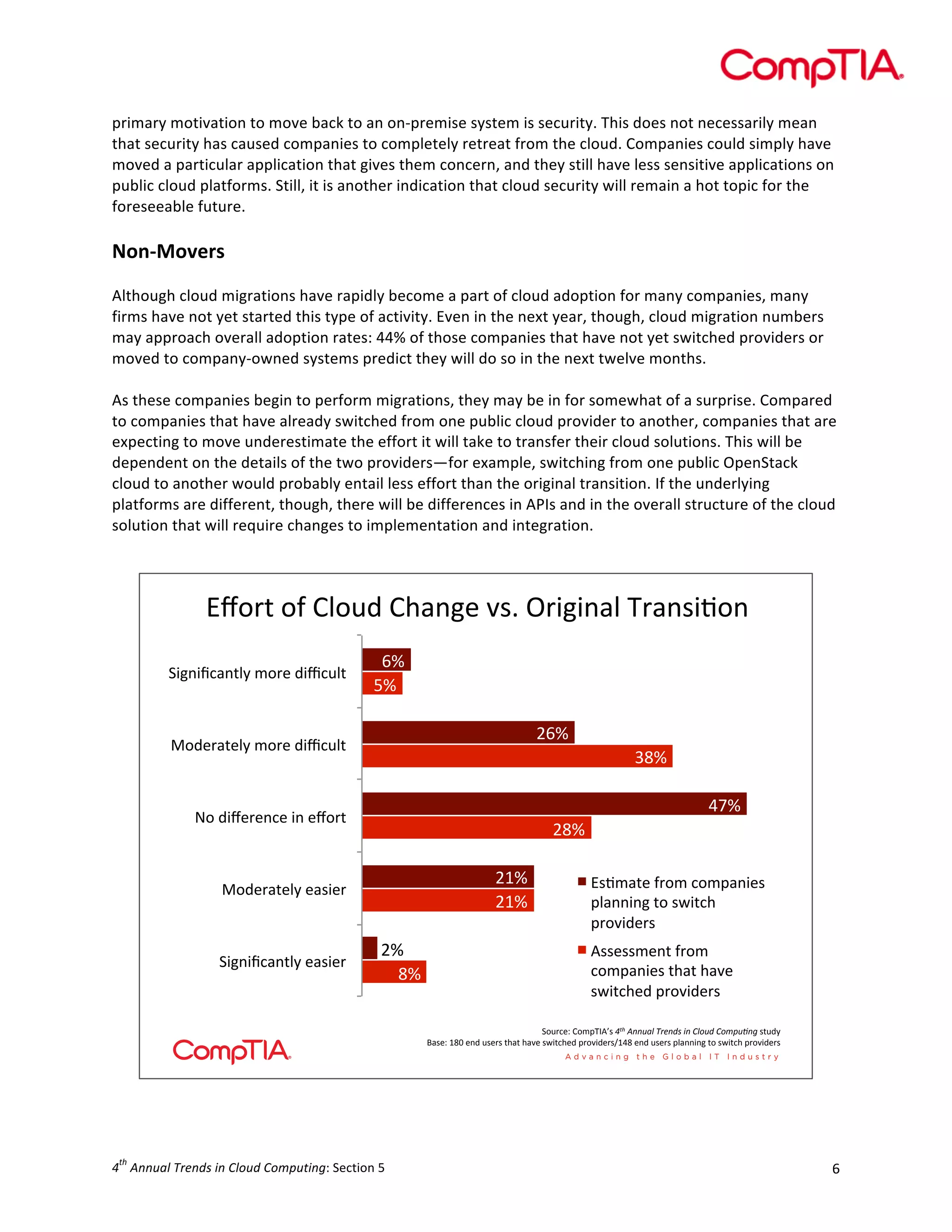
About	
  this	
  Research	


CompTIA’s	
  4th	
  Annual	
  Trends	
  in	
  Cloud	
  Computing	
  study	
  builds	
  on	
  previous	
  CompTIA	
  research	
  in	
  the	
  
cloud	
  computing	
  space,	
  further	
  exploring	
  trends,	
  challenges,	
  and	
  opportunities.	
  The	
  objectives	
  of	
  this	
  
study	
  include:	


-­‐ Collect	
  information	
  on	
  end-­‐user	
  purchase	
  drivers	
  and/or	
  inhibitors	
  
-­‐ Assess	
  depth	
  of	
  cloud	
  usage	
  and	
  ways	
  in	
  which	
  it	
  is	
  changing	
  IT	
  behavior	
  
-­‐ Track	
  the	
  experience	
  of	
  channel	
  partners	
  offering	
  cloud	
  solutions,	
  building	
  cloud	
  practices	
  
-­‐ Gauge	
  channel	
  perceptions	
  of	
  end-­‐user	
  purchase	
  drivers	
  and	
  or	
  inhibitors	
  
-­‐ Measure	
  impact	
  of	
  cloud	
  computing	
  on	
  channel	
  roles/vendor	
  relationships	
  
-­‐ Assess	
  the	
  need	
  for	
  training	
  and/or	
  standards	


This	
  study	
  consists	
  of	
  six	
  sections,	
  which	
  can	
  be	
  viewed	
  independently	
  or	
  together	
  as	
  sections	
  of	
  a	
  
comprehensive	
  report.	
  The	
  individual	
  sections	
  and	
  full	
  report	
  can	
  be	
  viewed	
  at	
  the	
  cloud	
  computing	
  
research	
  page	
  on	
  the	
  CompTIA	
  website.	


Section	
  1:	
  Market	
  Overview	
  
Section	
  2:	
  Channel	
  Business	
  Model	
  Analysis	
  
Section	
  3:	
  Channel	
  Relationships:	
  Vendors,	
  Customers,	
  and	
  Distributors	
  
Section	
  4:	
  End	
  User	
  Business	
  Model	
  Analysis	
  
Section	
  5:	
  End	
  User	
  Cloud	
  Migration	
  Issues	
  
Section	
  6:	
  Cloud	
  Challenges	
  and	
  Opportunities	


This	
  study	
  was	
  conducted	
  in	
  two	
  parts.	


Part	
  I:	
  quantitative	
  online	
  survey	
  of	
  501	
  IT	
  and	
  business	
  professionals	
  in	
  the	
  United	
  States	
  involved	
  in	
  IT	
  
decision-­‐making	
  (aka	
  end	
  users).	
  Data	
  collection	
  occurred	
  during	
  June	
  2013.	
  The	
  margin	
  of	
  sampling	
  
error	
  at	
  the	
  95%	
  confidence	
  level	
  for	
  the	
  U.S.	
  results	
  is	
  +/-­‐	
  4.5	
  percentage	
  points.	
  Sampling	
  error	
  is	
  larger	
  
for	
  subgroups	
  of	
  the	
  data.	


Part	
  II:	
  quantitative	
  online	
  survey	
  of	
  400	
  IT	
  firms	
  in	
  the	
  United	
  States	
  (aka	
  channel).	
  Data	
  collection	
  
occurred	
  during	
  June	
  2013.	
  The	
  margin	
  of	
  sampling	
  error	
  at	
  the	
  95%	
  confidence	
  level	
  for	
  the	
  U.S.	
  results	
  
is	
  +/-­‐	
  5.0	
  percentage	
  points.	
  Sampling	
  error	
  is	
  larger	
  for	
  subgroups	
  of	
  the	
  data.	


For	
  both	
  surveys,	
  CompTIA	
  worked	
  with	
  the	
  research	
  firm	
  Research	
  Now	
  to	
  facilitate	
  data	
  collection	
  
using	
  an	
  independent	
  panel.	
  As	
  with	
  any	
  survey,	
  sampling	
  error	
  is	
  only	
  one	
  source	
  of	
  possible	
  error.	
  
While	
  non-­‐sampling	
  error	
  cannot	
  be	
  accurately	
  calculated,	
  precautionary	
  steps	
  were	
  taken	
  in	
  all	
  phases	
  
of	
  the	
  survey	
  design,	
  collection	
  and	
  processing	
  of	
  the	
  data	
  to	
  minimize	
  its	
  influence.	


CompTIA	
  is	
  responsible	
  for	
  all	
  content	
  contained	
  in	
  this	
  series.	
  Any	
  questions	
  regarding	
  the	
  study	
  should	
  
be	
  directed	
  to	
  CompTIA	
  Market	
  Research	
  staff	
  at	
  research@comptia.org.	


CompTIA	
  is	
  a	
  member	
  of	
  the	
  Marketing	
  Research	
  Association	
  (MRA)	
  and	
  adheres	
  to	
  the	
  MRA’s	
  Code	
  of	
  
Market	
  Research	
  Standards.	


th

4 	
  Annual	
  Trends	
  in	
  Cloud	
  Computing:	
  Section	
  1	
  

1	
  
TRENDS IN CLOUD COMPUTING

RESEARCH

S E C T I O N 1 : M A R K E T OV E RV I E W

FOURTH ANNUAL • AUGUST 2013

www.comptia.org
 

Key	
  Points	


•

•


•

As	
  cloud	
  components	
  are	
  becoming	
  more	
  prevalent	
  in	
  IT	
  architectures,	
  more	
  companies	
  are	
  relying	
  
on	
  cloud	
  computing	
  for	
  business	
  processes	
  such	
  as	
  storage	
  (59%),	
  business	
  continuity/disaster	
  
recovery	
  (48%),	
  and	
  security	
  (44%).	
  This	
  strong	
  usage	
  and	
  strong	
  market	
  indicators	
  show	
  that	
  cloud	
  
computing	
  is	
  becoming	
  a	
  default	
  part	
  of	
  the	
  IT	
  landscape.	


Although	
  adoption	
  rates	
  are	
  high	
  and	
  market	
  numbers	
  are	
  positive,	
  there	
  is	
  still	
  confusion	
  related	
  to	
  
cloud	
  computing.	
  This	
  confusion	
  will	
  hinder	
  end	
  users	
  and	
  channel	
  firms	
  from	
  fully	
  transforming	
  
their	
  IT	
  practices	
  and	
  offerings.	
  Only	
  46%	
  of	
  channel	
  firms	
  with	
  cloud	
  offerings	
  described	
  their	
  cloud	
  
business	
  as	
  completely	
  mature—an	
  established,	
  strategic	
  part	
  of	
  business	
  plans.	
  
The	
  impact	
  of	
  cloud	
  computing	
  will	
  continue	
  to	
  drive	
  companies	
  to	
  clarify	
  issues	
  around	
  usage	
  and	
  
move	
  towards	
  greater	
  maturity	
  with	
  the	
  model.	
  End	
  users	
  still	
  report	
  a	
  wide	
  range	
  of	
  benefits,	
  led	
  
by	
  the	
  ability	
  to	
  cut	
  costs.	
  Approximately	
  half	
  of	
  channel	
  firms	
  see	
  faster	
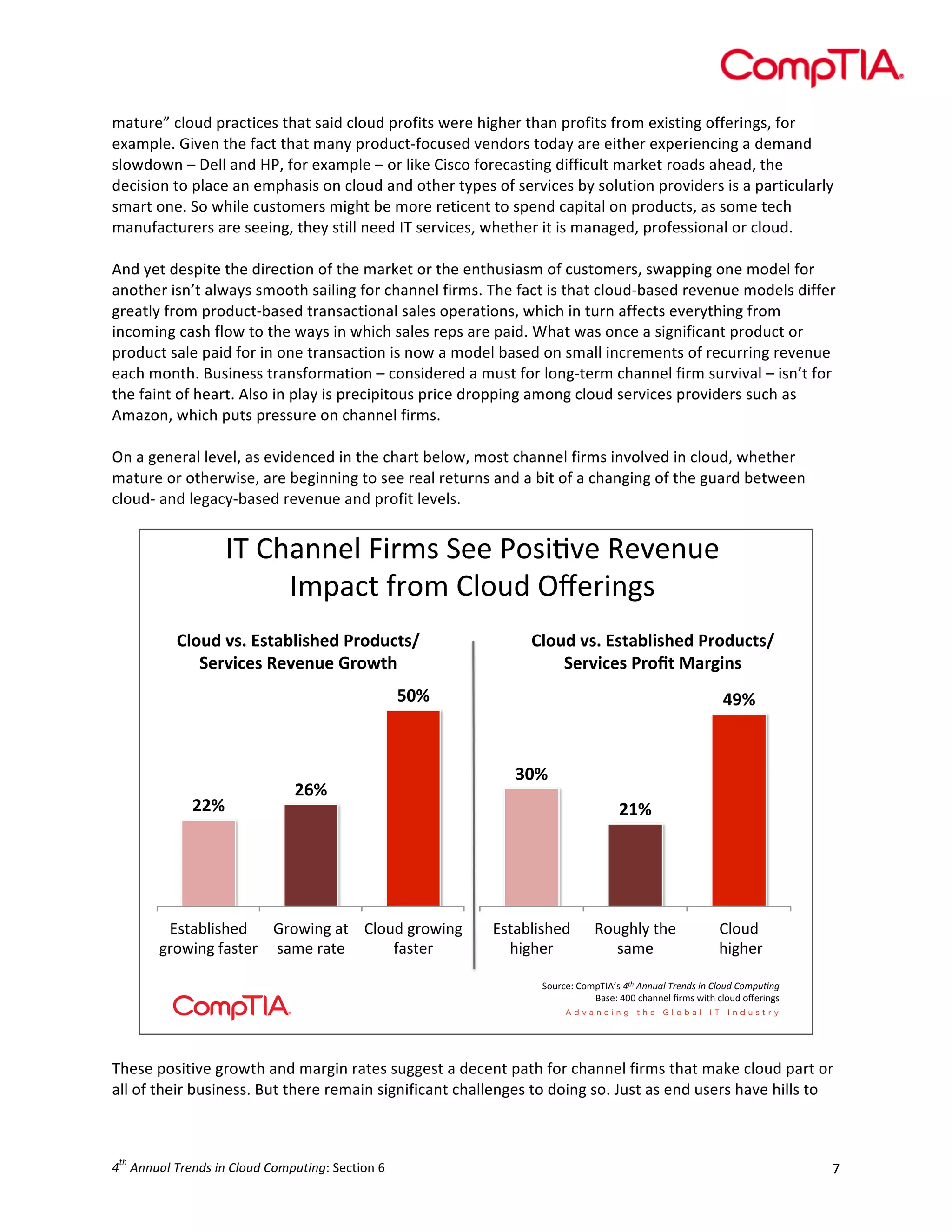
  revenue	
  growth	
  and	
  larger	
  
profits	
  from	
  cloud	
  offerings	
  than	
  from	
  traditional	
  offerings.	


th

4 	
  Annual	
  Trends	
  in	
  Cloud	
  Computing:	
  Section	
  1	
  

2	


Cloud	
  Technology	
  Moving	
  Into	
  the	
  Mainstream	


In	
  CompTIA’s	
  IT	
  Industry	
  Outlook	
  2013	
  report,	
  the	
  trend	
  for	
  cloud	
  computing	
  was	
  that	
  companies	
  would	
  
begin	
  taking	
  the	
  technology	
  for	
  granted.	
  This	
  projection	
  meant	
  that	
  companies	
  would	
  begin	
  moving	
  
away	
  from	
  cloud	
  transitions	
  as	
  standalone	
  projects	
  and	
  begin	
  viewing	
  cloud	
  components	
  as	
  pieces	
  
within	
  their	
  overall	
  IT	
  architecture.	


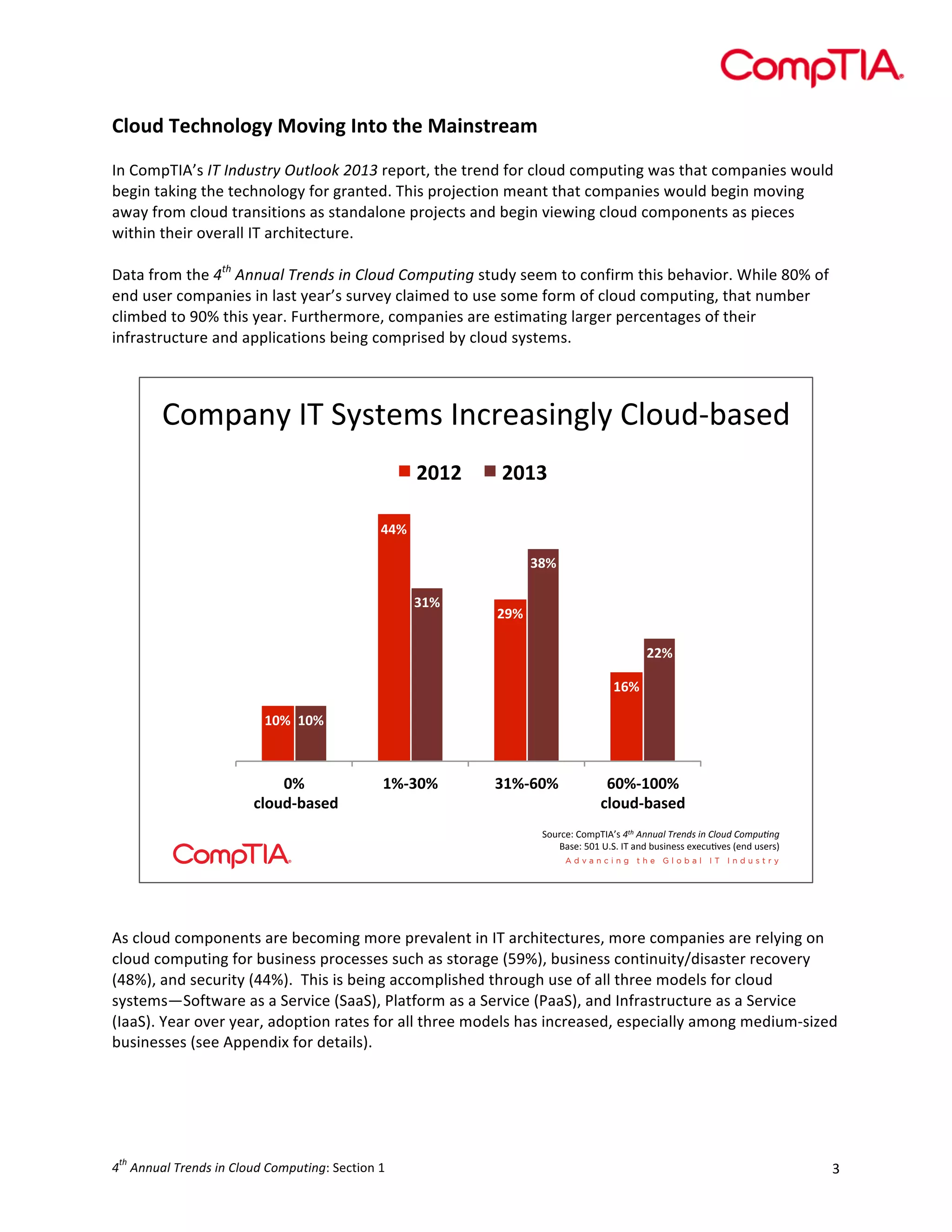
Data	
  from	
  the	
  4th	
  Annual	
  Trends	
  in	
  Cloud	
  Computing	
  study	
  seem	
  to	
  confirm	
  this	
  behavior.	
  While	
  80%	
  of	
  
end	
  user	
  companies	
  in	
  last	
  year’s	
  survey	
  claimed	
  to	
  use	
  some	
  form	
  of	
  cloud	
  computing,	
  that	
  number	
  
climbed	
  to	
  90%	
  this	
  year.	
  Furthermore,	
  companies	
  are	
  estimating	
  larger	
  percentages	
  of	
  their	
  
infrastructure	
  and	
  applications	
  being	
  comprised	
  by	
  cloud	
  systems.	


!"#$%&'()*(+',-.#,()&/0.%,1&23'(!3"4567%,.5
(
&"!&$

&"!)$

%%#$
)*#$
)!#$

&'#$
&&#$
!(#$

!"#$ !"#$

"#$
$+,-./01234/$

!#0)"#$

)!#0("#$

("#0!""#$
+,-./01234/$

+"40/.8(!"#$*)9:,(!"#$%&&'()$*+,&-.$/&$0)1'-$0123'4&5(
;%,.8(<=>(?@+@()*(%&5(74,1&.,,(.A./4BC.,(D.&5(4,.0,E(


As	
  cloud	
  components	
  are	
  becoming	
  more	
  prevalent	
  in	
  IT	
  architectures,	
  more	
  companies	
  are	
  relying	
  on	
  
cloud	
  computing	
  for	
  business	
  processes	
  such	
  as	
  storage	
  (59%),	
  business	
  continuity/disaster	
  recovery	
  
(48%),	
  and	
  security	
  (44%).	
  	
  This	
  is	
  being	
  accomplished	
  through	
  use	
  of	
  all	
  three	
  models	
  for	
  cloud	
  
systems—Software	
  as	
  a	
  Service	
  (SaaS),	
  Platform	
  as	
  a	
  Service	
  (PaaS),	
  and	
  Infrastructure	
  as	
  a	
  Service	
  
(IaaS).	
  Year	
  over	
  year,	
  adoption	
  rates	
  for	
  all	
  three	
  models	
  has	
  increased,	
  especially	
  among	
  medium-­‐sized	
  
businesses	
  (see	
  Appendix	
  for	
  details).	


th

4 	
  Annual	
  Trends	
  in	
  Cloud	
  Computing:	
  Section	
  1	
  

3	


While	
  future	
  outlooks	
  on	
  the	
  use	
  of	
  IaaS/PaaS	
  indicate	
  that	
  momentum	
  is	
  slowing,	
  this	
  is	
  indicative	
  that	
  
the	
  market	
  is	
  reaching	
  a	
  saturation	
  plateau,	
  not	
  a	
  sign	
  that	
  cloud	
  computing	
  is	
  falling	
  out	
  of	
  favor.	
  Only	
  3	
  
out	
  of	
  10	
  businesses	
  that	
  are	
  not	
  currently	
  using	
  those	
  models	
  plan	
  to	
  do	
  so	
  in	
  the	
  future,	
  a	
  10%	
  drop	
  
from	
  last	
  year.	
  The	
  drop	
  comes	
  mostly	
  among	
  small	
  and	
  medium	
  businesses—large	
  business	
  interest	
  
remained	
  flat	
  at	
  33%.	
  These	
  companies	
  have	
  extensive	
  infrastructure	
  and	
  greater	
  requirements	
  for	
  
test/dev	
  environments,	
  so	
  continued	
  interest	
  here	
  shows	
  that	
  late	
  adopters	
  clearly	
  see	
  potential	
  in	
  
moving	
  to	
  a	
  cloud	
  model.	


Market	
  sizing	
  estimates	
  also	
  indicate	
  stability	
  and	
  maturity.	
  The	
  following	
  data	
  points	
  all	
  suggest	
  robust	
  
spending	
  on	
  cloud	
  services:	


• Gartner	
  estimates	
  that	
  the	
  global	
  public	
  cloud	
  services	
  market	
  will	
  account	
  for	
  $131	
  billion	
  
in	
  revenue	
  in	
  2013,	
  an	
  18.5%	
  increase	
  from	
  2012.	
  This	
  includes	
  direct	
  spending	
  on	
  the	
  three	
  
primary	
  cloud	
  models	
  as	
  well	
  as	
  indirect	
  spending	
  on	
  business	
  process	
  outsourcing	
  that	
  is	
  
offered	
  from	
  a	
  cloud	
  foundation.	


• According	
  to	
  IDC,	
  worldwide	
  spending	
  on	
  hosted	
  private	
  cloud	
  solutions	
  will	
  grow	
  at	
  a	
  
compound	
  annual	
  growth	
  rate	
  of	
  over	
  50%	
  during	
  2012-­‐2016,	
  eventually	
  totaling	
  $24	
  billion	
  
in	
  revenue	
  by	
  2016.	
  The	
  solutions	
  include	
  both	
  dedicated	
  private	
  clouds,	
  where	
  physical	
  
infrastructure	
  is	
  assigned	
  to	
  a	
  single	
  user,	
  and	
  virtual	
  private	
  clouds,	
  where	
  private	
  clouds	
  
for	
  a	
  single	
  user	
  are	
  built	
  virtually	
  within	
  a	
  public	
  cloud	
  provider.	


• Analysys	
  Mason—a	
  research	
  consultancy	
  focused	
  on	
  telecom,	
  media,	
  and	
  technology—
predicts	
  that	
  enterprise	
  cloud	
  services	
  revenue	
  will	
  reach	
  $31.9	
  billion	
  by	
  2017.	
  They	
  include	
  
only	
  SaaS	
  and	
  IaaS	
  in	
  this	
  projection.	
  In	
  their	
  study	
  year-­‐over-­‐year	
  growth	
  slows	
  from	
  17%	
  in	
  
2013	
  to	
  less	
  than	
  5%	
  by	
  2017,	
  but	
  emerging	
  markets	
  will	
  experience	
  greater	
  growth,	
  
accounting	
  for	
  slightly	
  more	
  than	
  10%	
  of	
  the	
  overall	
  cloud	
  spend	
  by	
  2017.	


• Individual	
  cloud	
  providers	
  differ	
  in	
  their	
  approach	
  to	
  releasing	
  financial	
  information	
  as	
  they	
  
contend	
  for	
  market	
  position,	
  but	
  cloud	
  services	
  are	
  clearly	
  playing	
  significant	
  roles	
  in	
  overall	
  
operations.	
  Amazon	
  chooses	
  to	
  place	
  Amazon	
  Web	
  Services	
  under	
  “other	
  operating	
  
segments”	
  rather	
  than	
  break	
  out	
  the	
  details	
  separately,	
  and	
  McQuarrie	
  Capital	
  estimates	
  
that	
  AWS	
  will	
  generate	
  $3.8	
  billion	
  in	
  revenue	
  in	
  2013.	
  In	
  contrast,	
  Microsoft	
  publicly	
  touted	
  
their	
  cloud	
  services	
  as	
  a	
  $1	
  billion	
  business,	
  and	
  IBM	
  reported	
  that	
  cloud	
  revenue	
  grew	
  over	
  
70	
  percent	
  from	
  1Q	
  2012	
  to	
  1Q	
  2013	
  (without	
  disclosing	
  the	
  actual	
  revenue	
  number).	


It	
  seems,	
  then,	
  that	
  cloud	
  computing	
  has	
  become	
  well	
  established	
  as	
  an	
  option	
  for	
  IT	
  operations.	
  
Twenty-­‐seven	
  percent	
  of	
  companies	
  with	
  cloud	
  as	
  part	
  of	
  their	
  architecture	
  have	
  been	
  using	
  cloud	
  
solutions	
  for	
  three	
  years	
  or	
  more,	
  and	
  they	
  have	
  moved	
  past	
  experiments	
  and	
  towards	
  a	
  view	
  of	
  cloud	
  
technology	
  as	
  a	
  given	
  piece	
  of	
  their	
  overall	
  infrastructure.	


th

4 	
  Annual	
  Trends	
  in	
  Cloud	
  Computing:	
  Section	
  1	
  

4	


Cloud	
  Business	
  Models	
  Still	
  Elusive	


The	
  impressive	
  market	
  numbers	
  and	
  high	
  
adoption	
  rates	
  may	
  not	
  tell	
  the	
  whole	
  
story,	
  though.	
  There	
  are	
  many	
  factors	
  
that	
  could	
  still	
  be	
  contributing	
  to	
  
confusion	
  about	
  cloud	
  computing	
  (see	
  
sidebar).	
  Companies	
  may	
  not	
  actually	
  be	
  
using	
  cloud	
  solutions	
  to	
  the	
  extent	
  they	
  
believe,	
  and	
  true	
  business	
  
transformation	
  will	
  certainly	
  lag	
  simpler	
  
technology	
  adoption.	
  Companies	
  that	
  
are	
  completely	
  comfortable	
  with	
  cloud	
  
computing	
  concepts	
  such	
  as	
  self-­‐service	
  
and	
  dynamic	
  resource	
  allocation	
  will	
  
adopt	
  operational	
  models	
  that	
  differ	
  
greatly	
  from	
  models	
  that	
  rely	
  on	
  more	
  
traditional	
  IT	
  systems.	
  Moving	
  towards	
  
these	
  new	
  models	
  is	
  more	
  of	
  a	
  challenge	
  
than	
  transitioning	
  selected	
  systems	
  into	
  
cloud	
  technology.	


CompTIA’s	
  data	
  from	
  channel	
  firms	
  
demonstrates	
  this	
  difficulty.	
  Of	
  400	
  firms	
  
who	
  offer	
  cloud	
  solutions,	
  only	
  46%	
  
described	
  their	
  cloud	
  business	
  as	
  
completely	
  mature—an	
  established,	
  
strategic	
  part	
  of	
  business	
  plans.	
  The	
  
remainder	
  described	
  their	
  cloud	
  business	
  
either	
  as	
  a	
  portion	
  of	
  the	
  business	
  
running	
  alongside	
  other	
  offerings	
  or	
  as	
  
pilot/evaluation	
  initiatives.	
  As	
  both	
  
channel	
  firms	
  and	
  end	
  users	
  truly	
  
embrace	
  cloud	
  operations,	
  there	
  will	
  
be	
  less	
  distinction	
  between	
  cloud	
  
offerings	
  and	
  non-­‐cloud	
  offerings,	
  and	
  
the	
  final	
  solution	
  will	
  simply	
  be	
  
produced	
  regardless	
  of	
  the	
  
infrastructure	
  used.	


Confusion	
  among	
  end	
  users	
  will	
  delay	
  
their	
  move	
  to	
  a	
  complete	
  cloud	
  
business	
  model.	
  If	
  a	
  company’s	
  IT	
  
solutions	
  are	
  meeting	
  their	
  needs,	
  it	
  
may	
  not	
  be	
  critically	
  important	
  to	
  know	
  
the	
  differences	
  between	
  hosted	
  
offerings	
  vs.	
  cloud	
  offerings.	
  If	
  the	
  

th

4 	
  Annual	
  Trends	
  in	
  Cloud	
  Computing:	
  Section	
  1	
  

Sources	
  of	
  Confusion	
  in	
  the	
  Cloud	
  Market	
  
•


•


•


Cloudwashing:	
  As	
  products	
  and	
  services	
  are	
  
increasingly	
  labeled	
  with	
  “cloud”	
  in	
  order	
  to	
  
capture	
  the	
  growing	
  market,	
  the	
  characteristics	
  of	
  
a	
  true	
  cloud	
  offering	
  become	
  less	
  distinct.	
  
Downplaying	
  the	
  cloud	
  trend:	
  Many	
  IT	
  
professionals	
  or	
  industry	
  watchers	
  are	
  quick	
  to	
  
dismiss	
  cloud	
  as	
  “nothing	
  new.”	
  While	
  there	
  are	
  
aspects	
  of	
  cloud	
  that	
  can	
  be	
  found	
  in	
  computing	
  
models	
  d ating	
  back	
  to	
  the	
  introduction	
  of	
  the	
  
mainframe,	
  there	
  are	
  also	
  unique	
  aspects	
  that	
  may	
  
get	
  overlooked	
  without	
  the	
  proper	
  education.	
  
Hype	
  and	
  fatigue:	
  Some	
  end	
  users	
  may	
  be	
  overly	
  
eager	
  to	
  describe	
  their	
  infrastructure	
  as	
  cloud-­‐
based	
  to	
  have	
  the	
  appearance	
  of	
  keeping	
  up	
  with	
  
the	
  trend.	
  Similarly,	
  some	
  users	
  may	
  simply	
  apply	
  
the	
  label	
  to	
  their	
  systems	
  without	
  much	
  thought	
  in	
  
an	
  effort	
  to	
  avoid	
  any	
  further	
  discussion	
  on	
  the	
  
topic.	


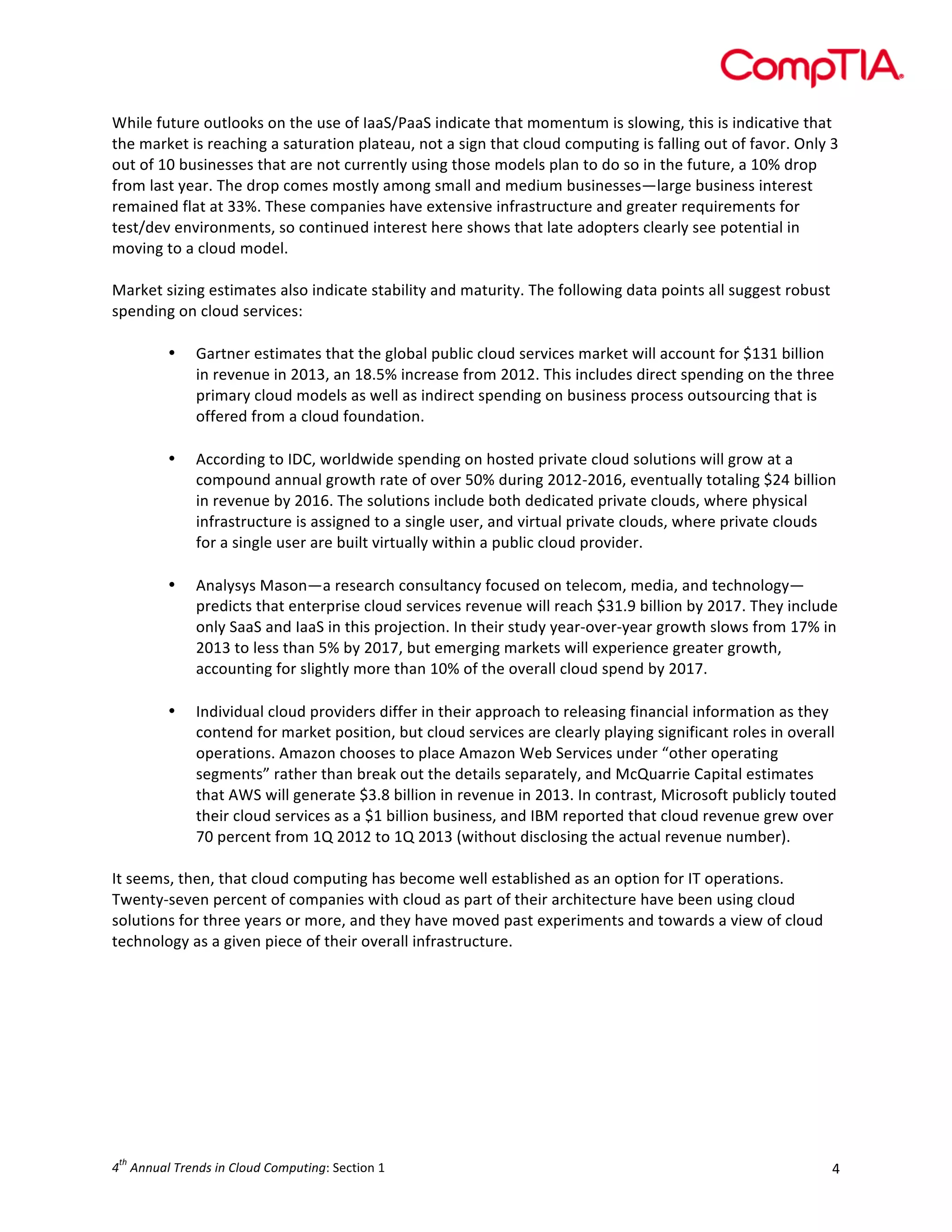
!"#$%&'"#()*+,**#(!-"%./0"&+*.(1".*-&(2*3&'&+&
(
%%#$

1:;"3(.'5*3*#6*&(

&"#$

%%#$

1'#"3(.'5*3*#6*&(

4"(.'5*3*#6*&/7"#8+(9#",(

%"#$

!'#$
!"#$

'"!($
'"!'$
<"%36*=(!"#$%&&'()$*+,&-.$/&$0)1'-$0123'4&5(
):&*=(>??(@A<A(BC(:#.(D%&'#*&&(*E*6%FG*&(H*#.(%&*3&I(

5	


company	
  decides	
  to	
  pursue	
  cloud-­‐specific	
  benefits,	
  though,	
  they	
  may	
  be	
  surprised	
  to	
  find	
  that	
  their	
  
systems	
  are	
  not	
  as	
  cloud-­‐enabled	
  as	
  they	
  might	
  have	
  imagined.	


This	
  confusion	
  is	
  also	
  present	
  in	
  the	
  general	
  ecosystem,	
  as	
  evidenced	
  by	
  cloud	
  provider	
  brand	
  
awareness.	
  More	
  than	
  9	
  in	
  10	
  end	
  users	
  believe	
  there	
  is	
  a	
  high	
  or	
  moderate	
  degree	
  of	
  differentiation	
  
among	
  cloud	
  providers,	
  but	
  the	
  perception	
  of	
  top	
  providers	
  favors	
  traditional	
  IT	
  companies	
  (such	
  as	
  
Microsoft,	
  IBM,	
  and	
  HP)	
  over	
  companies	
  that	
  are	
  generally	
  regarded	
  as	
  leaders	
  within	
  the	
  cloud	
  industry	
  
(such	
  as	
  Amazon	
  and	
  Rackspace).	
  While	
  the	
  traditional	
  companies	
  do	
  offer	
  cloud	
  solutions	
  (and	
  the	
  
awareness	
  levels	
  may	
  be	
  a	
  good	
  indicator	
  for	
  their	
  future	
  prospects),	
  lower	
  awareness	
  of	
  leading	
  cloud	
  
providers	
  likely	
  implies	
  lower	
  awareness	
  of	
  leading-­‐edge	
  innovations.	


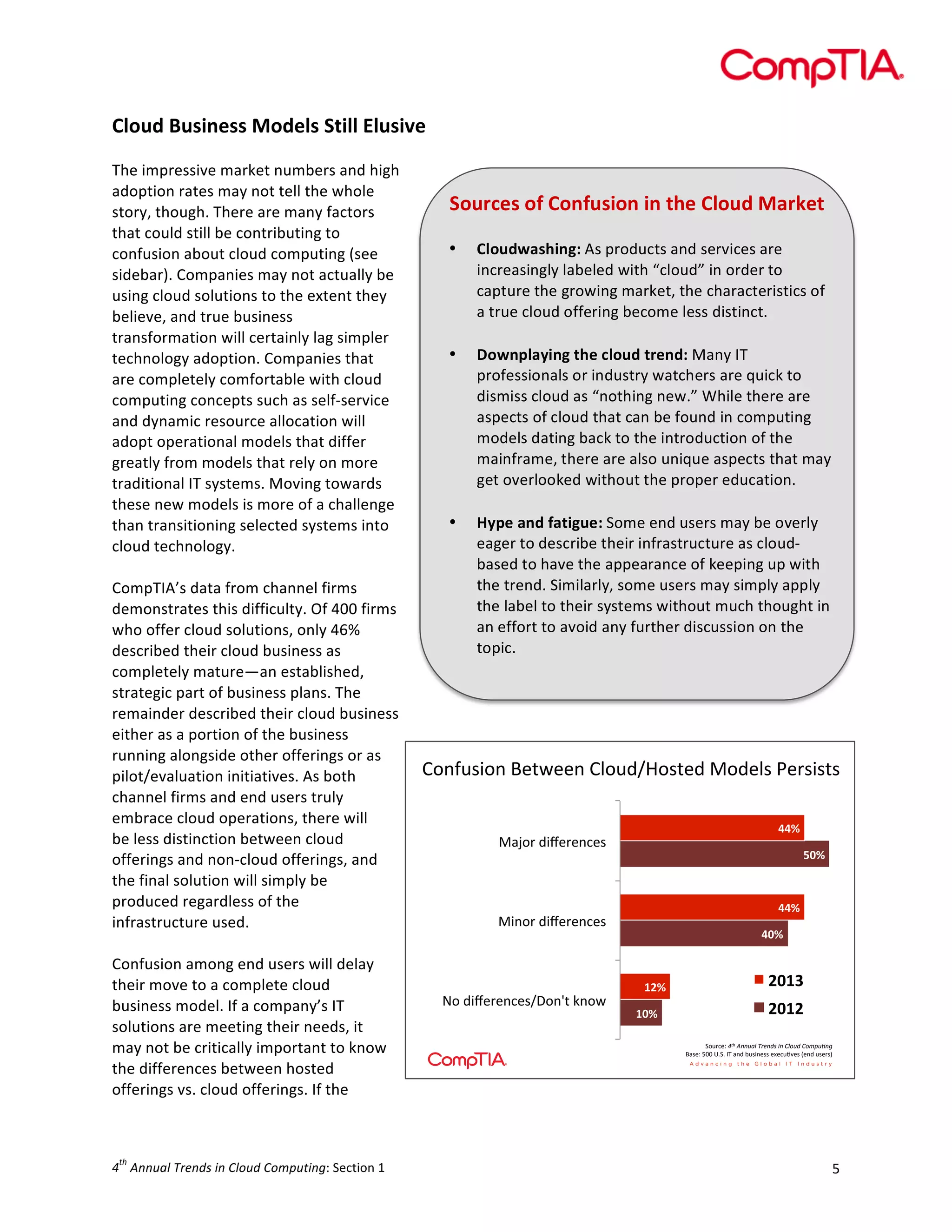
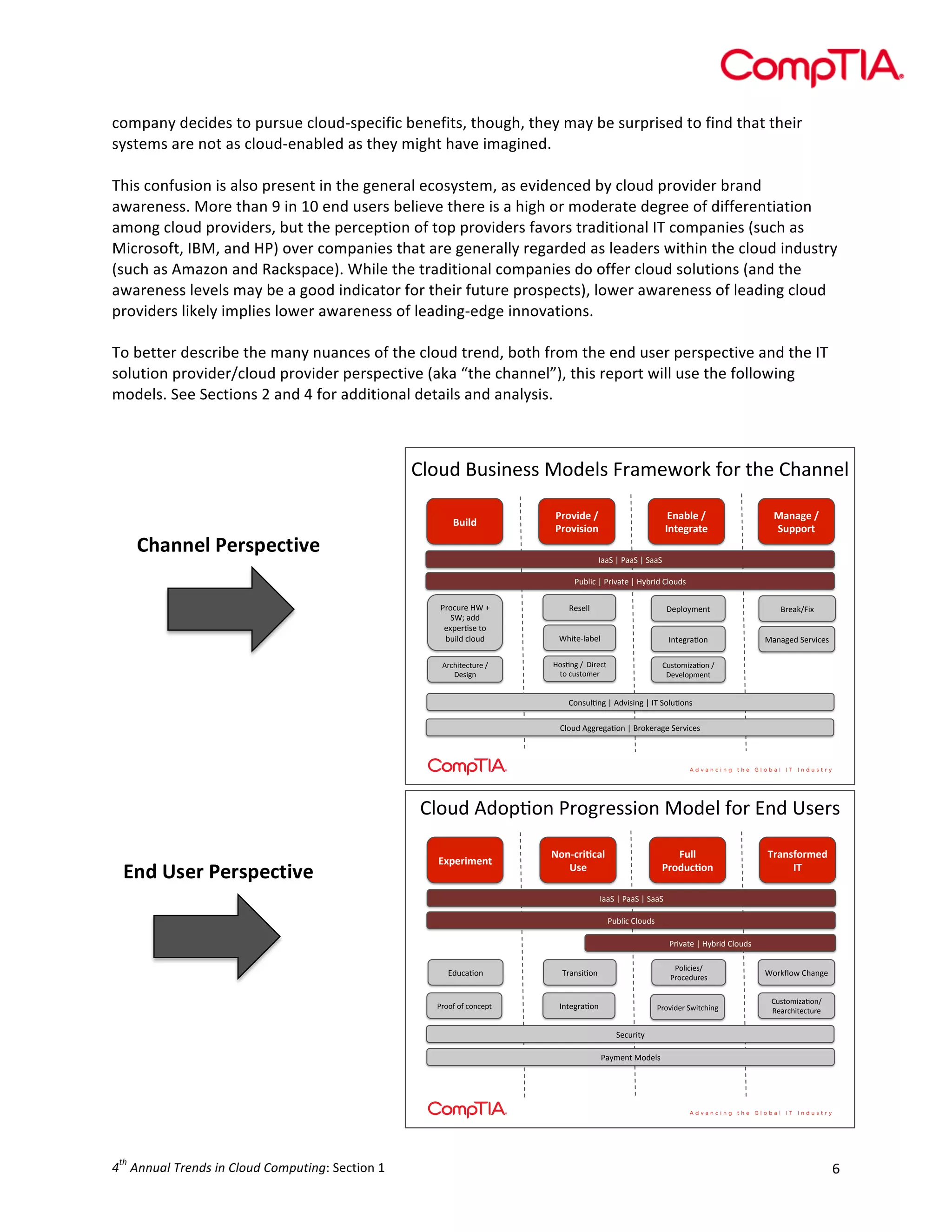
To	
  better	
  describe	
  the	
  many	
  nuances	
  of	
  the	
  cloud	
  trend,	
  both	
  from	
  the	
  end	
  user	
  perspective	
  and	
  the	
  IT	
  
solution	
  provider/cloud	
  provider	
  perspective	
  (aka	
  “the	
  channel”),	
  this	
  report	
  will	
  use	
  the	
  following	
  
models.	
  See	
  Sections	
  2	
  and	
  4	
  for	
  additional	
  details	
  and	
  analysis.	


3)4'2$:'5*9/55$I42/)5$H,"F/K4,;$L4,$.B/$3B"99/)
$


!"#$%&

Channel	
  Perspective	
  

'()*#%+&,&
'()*#-#).&

/.01$+&,&
2.3+4(03+&

50.04+&,&
6"77)(3&

!""#$%$&""#$%$#""#$
&'()*+$%$&,*-"./$%$01(,*2$3)4'25$
&,4+',/$0<$=$
#<>$"22$
/?@/,85/$.4$
('*)2$+)4'2$

E/@)41F/9.$

:,/";DH*?$

<B*./C)"(/)$

!9./7,"849$

I"9"7/2$#/,-*+/5$

6,+B*./+.',/$D$
E/5*79$


A/5/))$

045897$D$$E*,/+.$
.4$+'5.4F/,$

3'5.4F*J"849$D$
E/-/)4@F/9.$

3495')897$%$62-*5*97$%$!G$#4)'8495$
3)4'2$677,/7"849$%$:,4;/,"7/$#/,-*+/5$

0123/$G/2F:26$&'2<'+44(26$72/+1$E2'$86/$H4+'4$

End	
  User	
  Perspective	


!"#$%&'$()*

+,(-.%&/.01*
23$*

4511*
6%,75./,(*

8%0(39,%'$7*
:8*

!""#$%$&""#$%$#""#$
&3.1(9$0123/4$
&'()"*+$%$,-.'(/$0123/4$
8/39":26$

;'"64(:26$

&21(9(+4C
&'29+/3'+4$

=2'>?2@$0A"6<+$

&'22E$2E$9269+F*$

!6*+<'":26$

&'2)(/+'$#@(*9A(6<$

034*25(B":26C$
D+"'9A(*+9*3'+$

#+93'(*-$
&"-5+6*$72/+14$

th

4 	
  Annual	
  Trends	
  in	
  Cloud	
  Computing:	
  Section	
  1	
  

6	


Impact	
  of	
  Cloud	
  Computing	


As	
  companies	
  gain	
  more	
  clarity	
  about	
  cloud	
  systems	
  and	
  move	
  towards	
  a	
  mainstream	
  view	
  of	
  cloud	
  as	
  
an	
  IT	
  option,	
  the	
  impacts	
  of	
  moving	
  to	
  a	
  cloud	
  model	
  are	
  being	
  seen	
  across	
  the	
  technology	
  and	
  business	
  
landscape.	
  Continuing	
  a	
  trend	
  from	
  previous	
  years,	
  many	
  respondents	
  view	
  cloud	
  as	
  the	
  best	
  option	
  for	
  
a	
  variety	
  of	
  reasons,	
  with	
  no	
  single	
  reason	
  standing	
  out	
  as	
  the	
  lone	
  driver	
  or	
  benefit.	
  Also,	
  the	
  realized	
  
benefits	
  are	
  tightly	
  clustered	
  together,	
  lending	
  weight	
  to	
  the	
  argument	
  that	
  cloud	
  computing	
  offers	
  
many	
  advantages.	


Research	
  from	
  cloud	
  management	
  
company	
  Rightscale	
  shows	
  that	
  cloud	
  
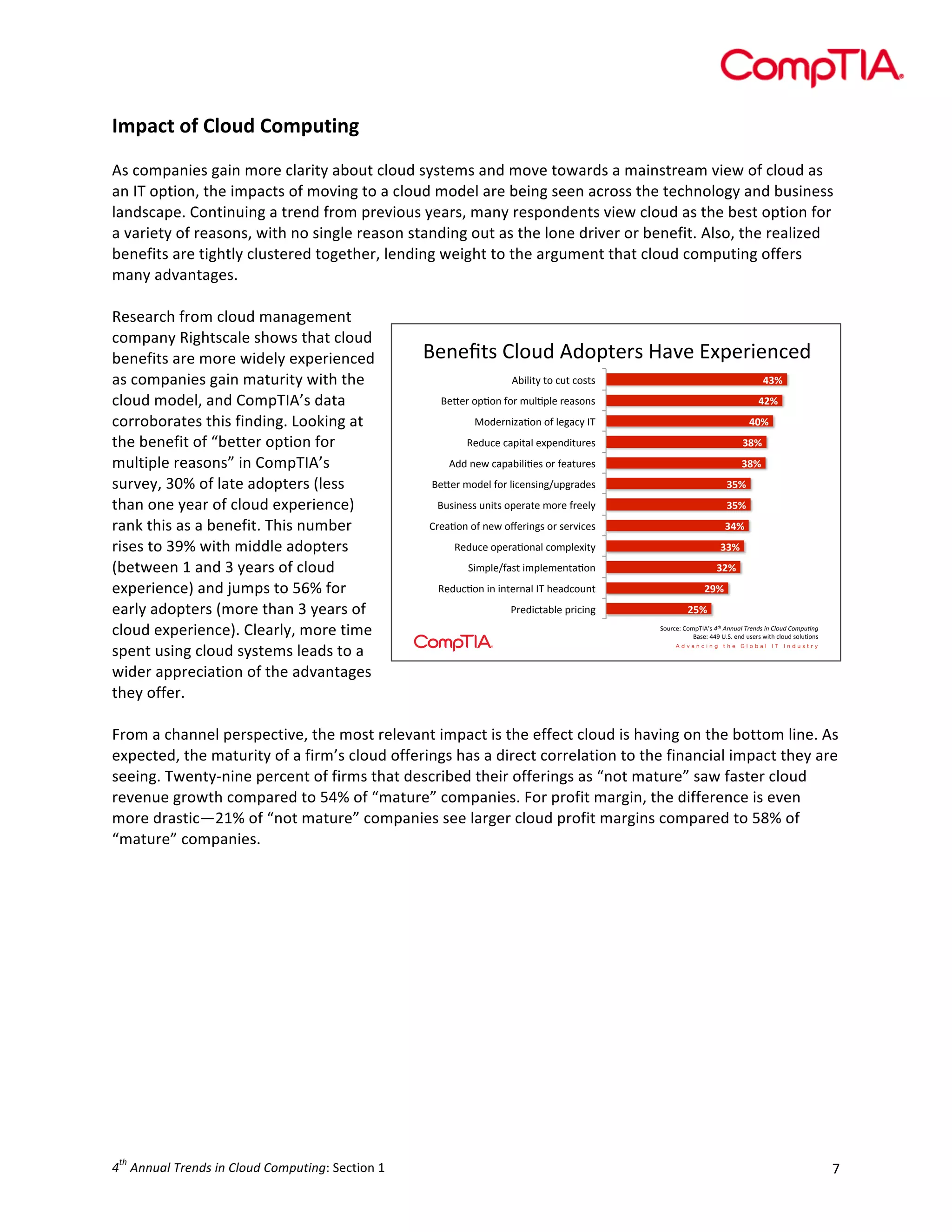
!"#"$%&'()*+,'-,*.%"/&'012"'34."/5"#6",
'
benefits	
  are	
  more	
  widely	
  experienced	
  
-85)5%C'%*'6+%'6*&%&'
'&#$
as	
  companies	
  gain	
  maturity	
  with	
  the	
  
!"F"/'*.;*#'B*/'@+);.)"'/"1&*#&'
'!#$
cloud	
  model,	
  and	
  CompTIA’s	
  data	
  
G*,"/#5H1;*#'*B')"916C'<='
')#$
corroborates	
  this	
  finding.	
  Looking	
  at	
  
:",+6"'61.5%1)'"4."#,5%+/"&'
&(#$
the	
  benefit	
  of	
  “better	
  option	
  for	
  
-,,'#"D'61.185)5;"&'*/'B"1%+/"&'
&(#$
multiple	
  reasons”	
  in	
  CompTIA’s	
  
!"F"/'@*,")'B*/')56"#&5#9A+.9/1,"&'
&"#$
survey,	
  30%	
  of	
  late	
  adopters	
  (less	
  
!+&5#"&&'+#5%&'*."/1%"'@*/"'B/"")C'
&"#$
than	
  one	
  year	
  of	
  cloud	
  experience)	
  
(/"1;*#'*B'#"D'*E"/5#9&'*/'&"/256"&'
&'#$
rank	
  this	
  as	
  a	
  benefit.	
  This	
  number	
  
:",+6"'*."/1;*#1)'6*@.)"45%C'
&&#$
rises	
  to	
  39%	
  with	
  middle	
  adopters	
  
?5@.)"AB1&%'5@.)"@"#%1;*#'
&!#$
(between	
  1	
  and	
  3	
  years	
  of	
  cloud	
  
:",+6;*#'5#'5#%"/#1)'<='>"1,6*+#%'
!%#$
experience)	
  and	
  jumps	
  to	
  56%	
  for	
  
7/",56%18)"'./565#9'
!"#$
early	
  adopters	
  (more	
  than	
  3	
  years	
  of	
  
?*+/6"I'(*@.=<-J&'! $%&&'()$*+,&-.$/&$0)1'-$0123'4&5'
cloud	
  experience).	
  Clearly,	
  more	
  time	
  
!1&"I'KKL'MN?N'"#,'+&"/&'D5%>'6)*+,'&*)+;*#&'
spent	
  using	
  cloud	
  systems	
  leads	
  to	
  a	
  
wider	
  appreciation	
  of	
  the	
  advantages	
  
they	
  offer.	


From	
  a	
  channel	
  perspective,	
  the	
  most	
  relevant	
  impact	
  is	
  the	
  effect	
  cloud	
  is	
  having	
  on	
  the	
  bottom	
  line.	
  As	
  
expected,	
  the	
  maturity	
  of	
  a	
  firm’s	
  cloud	
  offerings	
  has	
  a	
  direct	
  correlation	
  to	
  the	
  financial	
  impact	
  they	
  are	
  
seeing.	
  Twenty-­‐nine	
  percent	
  of	
  firms	
  that	
  described	
  their	
  offerings	
  as	
  “not	
  mature”	
  saw	
  faster	
  cloud	
  
revenue	
  growth	
  compared	
  to	
  54%	
  of	
  “mature”	
  companies.	
  For	
  profit	
  margin,	
  the	
  difference	
  is	
  even	
  
more	
  drastic—21%	
  of	
  “not	
  mature”	
  companies	
  see	
  larger	
  cloud	
  profit	
  margins	
  compared	
  to	
  58%	
  of	
  
“mature”	
  companies.	
  
"#

th

4 	
  Annual	
  Trends	
  in	
  Cloud	
  Computing:	
  Section	
  1	
  

7	


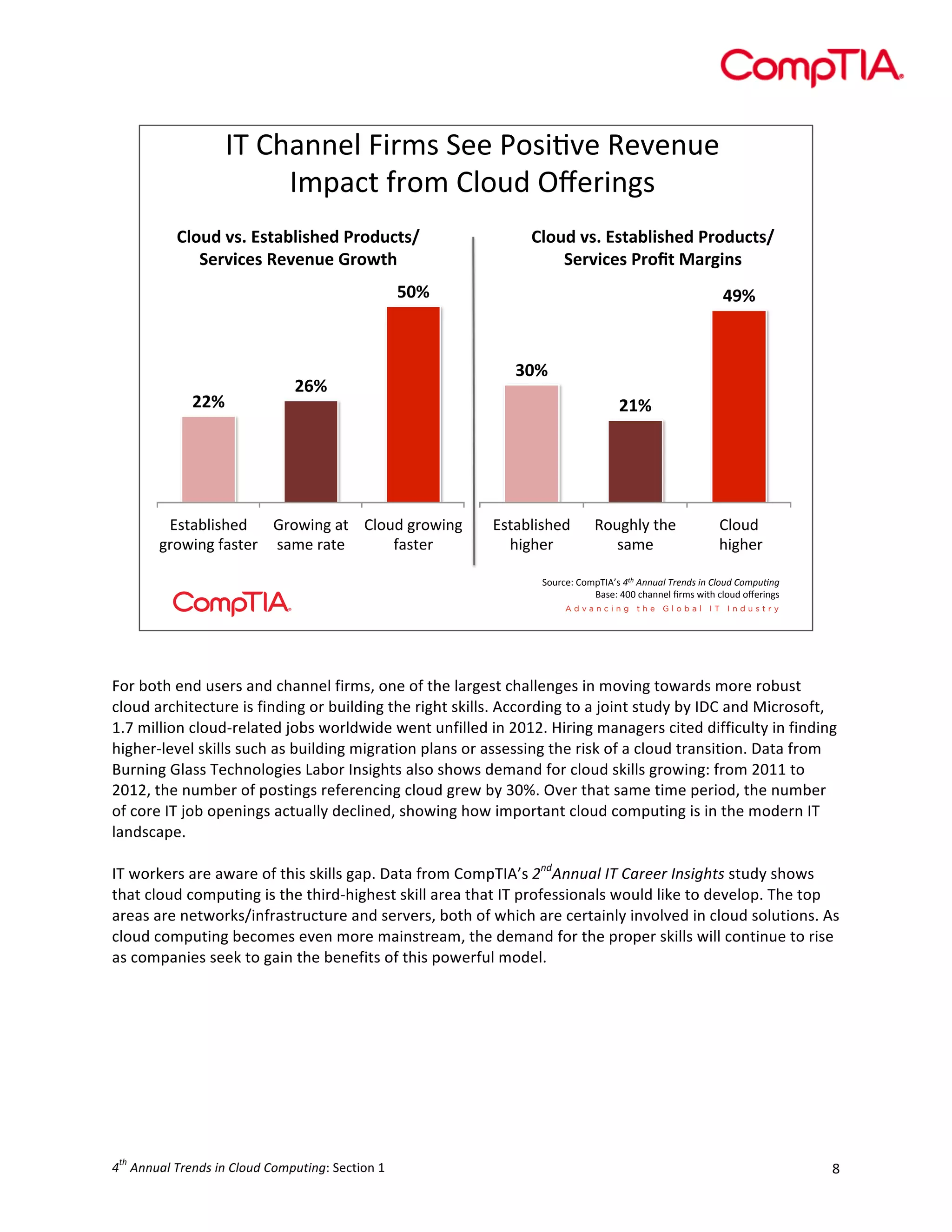
!"#$%&''()#*+,-.#/((#01.+23(#4(3('5(#
!-6&78#9,1-#$)15:#;<(,+'=.##
!"#$%&'()&*(+,-".(/0%&12#%$3+(4
502'.30(&60'07$0&82#9+/&

!"#$%&'()&*(+,-".(/0%&12#%$3+(4
502'.30(&12#?+&@,2A.7(&

=>;&

::;&

DE;&

B>;&

:<;&

:C;&

>.8&?)+.%(:# A,1@+'=#&8# $)15:#=,1@+'=#
=,1@+'=#9&.8(,# .&-(#,&8(#
9&.8(,#

>.8&?)+.%(:#
%+=%(,#

415=%)I#8%(#
.&-(#

$)15:#
#%+=%(,#

/15,7(B#$1-6"!CD.#!"#$%&&'()$*+,&-.$/&$0)1'-$0123'4&5#
E&.(B#FGG#7%&''()#H,-.#@+8%#7)15:#1<(,+'=.#


For	
  both	
  end	
  users	
  and	
  channel	
  firms,	
  one	
  of	
  the	
  largest	
  challenges	
  in	
  moving	
  towards	
  more	
  robust	
  
cloud	
  architecture	
  is	
  finding	
  or	
  building	
  the	
  right	
  skills.	
  According	
  to	
  a	
  joint	
  study	
  by	
  IDC	
  and	
  Microsoft,	
  
1.7	
  million	
  cloud-­‐related	
  jobs	
  worldwide	
  went	
  unfilled	
  in	
  2012.	
  Hiring	
  managers	
  cited	
  difficulty	
  in	
  finding	
  
higher-­‐level	
  skills	
  such	
  as	
  building	
  migration	
  plans	
  or	
  assessing	
  the	
  risk	
  of	
  a	
  cloud	
  transition.	
  Data	
  from	
  
Burning	
  Glass	
  Technologies	
  Labor	
  Insights	
  also	
  shows	
  demand	
  for	
  cloud	
  skills	
  growing:	
  from	
  2011	
  to	
  
2012,	
  the	
  number	
  of	
  postings	
  referencing	
  cloud	
  grew	
  by	
  30%.	
  Over	
  that	
  same	
  time	
  period,	
  the	
  number	
  
of	
  core	
  IT	
  job	
  openings	
  actually	
  declined,	
  showing	
  how	
  important	
  cloud	
  computing	
  is	
  in	
  the	
  modern	
  IT	
  
landscape.	


IT	
  workers	
  are	
  aware	
  of	
  this	
  skills	
  gap.	
  Data	
  from	
  CompTIA’s	
  2ndAnnual	
  IT	
  Career	
  Insights	
  study	
  shows	
  
that	
  cloud	
  computing	
  is	
  the	
  third-­‐highest	
  skill	
  area	
  that	
  IT	
  professionals	
  would	
  like	
  to	
  develop.	
  The	
  top	
  
areas	
  are	
  networks/infrastructure	
  and	
  servers,	
  both	
  of	
  which	
  are	
  certainly	
  involved	
  in	
  cloud	
  solutions.	
  As	
  
cloud	
  computing	
  becomes	
  even	
  more	
  mainstream,	
  the	
  demand	
  for	
  the	
  proper	
  skills	
  will	
  continue	
  to	
  rise	
  
as	
  companies	
  seek	
  to	
  gain	
  the	
  benefits	
  of	
  this	
  powerful	
  model.	


th

4 	
  Annual	
  Trends	
  in	
  Cloud	
  Computing:	
  Section	
  1	
  

8	


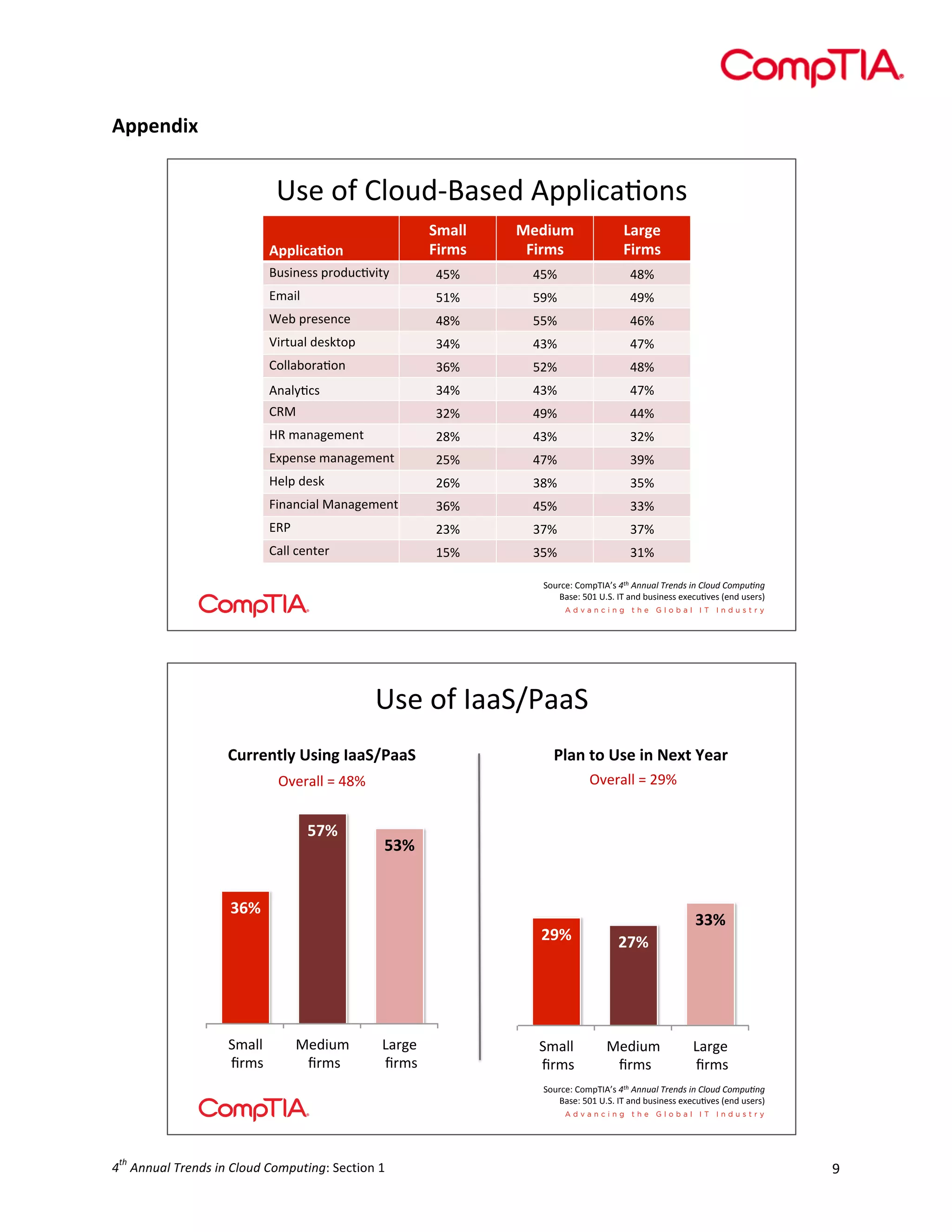
Appendix	


R#&'*V'B8*"+W!7#&+'D((8$,7-*%#'
+,&##**
-$.,/*

012$3,*
-$.,/*

4&.51**
-$.,/*

!"#$%&##'()*+",-.$/0'

123'

123'

143'

567$8'

293'

2:3'

1:3'

;&<'()&#&%,&'

143'

223'

1=3'

>$)/"78'+&#?/*('

@13'

1@3'

1A3'

B*887<*)7-*%'

@=3'

2C3'

143'

D%780-,#'

@13'

1@3'

1A3'

BEF'

@C3'

1:3'

113'

GE'67%7H&6&%/'

C43'

1@3'

@C3'

5I(&%#&'67%7H&6&%/'

C23'

1A3'

@:3'

G&8('+&#?'

C=3'

@43'

@23'

J$%7%,$78'F7%7H&6&%/'

@=3'

123'

@@3'

5EK'

C@3'

@A3'

@A3'

B788',&%/&)'

923'

@23'

@93'

!""#$%&'()*

L*"),&M'B*6(NODP#'!"#$%&&'()$*+,&-.$/&$0)1'-$0123'4&5'
!7#&M'2Q9'RSLS'ON'7%+'<"#$%&##'&I&,"-.&#'T&%+'"#&)#U'

!"#$%&$'(()*+(()$
!"##$%&'()*+,%-).//012//0)

2'/%)&8)*+$),%)9$:&);$/#)
IF#/(--$J$NOM$

IF#/(--$J$KLM$

675)

635)

345)

335)

<=5)

),(--$
$./,"$

0#123,$
$./,"$

4(/5#$
$./,"$

<75)

),(--$
$./,"$

0#123,$
$./,"$

4(/5#$
$./,"$

)%3/6#7$8%,9:';<"$!"#$%&&'()$*+,&-.$/&$0)1'-$0123'4&5$
=("#7$>?@$!A)A$':$(B1$C3"2B#""$#D#63EF#"$G#B1$3"#/"H$

th

4 	
  Annual	
  Trends	
  in	
  Cloud	
  Computing:	
  Section	
  1	
  

9	
  
TRENDS IN CLOUD COMPUTING

RESEARCH

S E C T I O N 2 : C H A N N E L B U S I N E S S M O D E L A N A LY S I S

FOURTH ANNUAL • AUGUST 2013

www.comptia.org
 

Key	
  Points	


•
	
  
•


•

Half	
  of	
  channel	
  firms	
  today	
  describe	
  their	
  cloud	
  business	
  as	
  “mature,”	
  while	
  another	
  4	
  in	
  10	
  claim	
  to	
  
have	
  reached	
  at	
  least	
  a	
  degree	
  of	
  cloud	
  services’	
  maturity	
  alongside	
  their	
  more	
  established	
  lines	
  of	
  
business.	
  By	
  contrast,	
  just	
  13%	
  said	
  their	
  current	
  cloud	
  business	
  is	
  not	
  mature	
  at	
  all	
  today.	
  
CompTIA	
  has	
  identified	
  four	
  primary	
  cloud	
  business	
  models	
  for	
  the	
  channel:	
  Build,	
  
Provide/Provision,	
  Enable/Integrate	
  and	
  Manage/Support.	
  Seven	
  in	
  10	
  solution	
  providers	
  involved	
  in	
  
cloud	
  started	
  with	
  the	
  Build	
  business	
  model	
  but	
  are	
  now	
  involved	
  with	
  one	
  or	
  more	
  of	
  the	
  other	
  
three	
  frameworks.	
  Twenty-­‐six	
  percent	
  of	
  them	
  are	
  conducting	
  business	
  across	
  all	
  four	
  areas.	
  
Six	
  in	
  10	
  channel	
  firms	
  involved	
  in	
  the	
  Manage/Support	
  business	
  model	
  have	
  created	
  IT	
  dashboards	
  
that	
  allow	
  customers	
  to	
  track	
  their	
  cloud	
  utilization,	
  costs	
  and	
  other	
  metrics	
  to	
  understand	
  their	
  
investments.	


th

4 	
  Annual	
  Trends	
  in	
  Cloud	
  Computing:	
  Section	
  2	
  

2	


Business	
  Transformation	
  within	
  the	
  Channel:	
  Path	
  to	
  the	
  Cloud	


For	
  the	
  channel’s	
  part,	
  the	
  topic	
  of	
  cloud	
  business	
  models	
  has	
  been	
  one	
  of	
  the	
  most	
  heavily	
  debated	
  
among	
  industry	
  firms.	
  The	
  discussion	
  has	
  moved	
  from	
  early-­‐day	
  concerns	
  that	
  shifting	
  IT	
  to	
  the	
  cloud	
  
would	
  threaten	
  the	
  channel’s	
  very	
  existence	
  to	
  today’s	
  realization	
  that	
  cloud	
  has	
  in	
  fact	
  spawned	
  a	
  wide	
  
variety	
  of	
  business	
  models	
  from	
  which	
  to	
  gain	
  a	
  foothold	
  in	
  this	
  arena.	


Perhaps	
  the	
  spate	
  of	
  business	
  model	
  options	
  is	
  helping	
  to	
  drive	
  cloud’s	
  continued	
  acceleration	
  across	
  
the	
  IT	
  channel	
  both	
  in	
  terms	
  of	
  adoption	
  and	
  strategic	
  value.	
  CompTIA’s	
  4th	
  Annual	
  Trends	
  in	
  Cloud	
  
Computing	
  study	
  found	
  that	
  half	
  of	
  solution	
  provider	
  firms	
  today	
  describe	
  their	
  cloud	
  business	
  as	
  
“mature,”	
  while	
  another	
  4	
  in	
  10	
  claim	
  to	
  have	
  reached	
  at	
  least	
  a	
  degree	
  of	
  cloud	
  services’	
  maturity	
  
alongside	
  their	
  more	
  established	
  lines	
  of	
  business.	
  By	
  contrast,	
  just	
  13%	
  said	
  their	
  current	
  cloud	
  business	
  
is	
  not	
  mature	
  at	
  all	
  today.	
  Smaller	
  firms	
  (47%),	
  interestingly,	
  were	
  more	
  likely	
  to	
  self-­‐select	
  as	
  having	
  a	
  
cloud	
  operation	
  that	
  is	
  mature	
  and	
  established,	
  compared	
  with	
  the	
  largest	
  companies	
  (40%).	
  This	
  is	
  
likely	
  due	
  to	
  the	
  fact	
  that	
  many	
  of	
  the	
  smaller	
  firms	
  could	
  very	
  well	
  be	
  “born	
  in	
  the	
  cloud”	
  versus	
  larger	
  
and	
  more	
  traditional	
  solution	
  providers	
  that	
  will	
  need	
  time	
  to	
  pivot	
  to	
  a	
  new	
  model.	
  	
  
The	
  growing	
  business	
  acumen	
  around	
  cloud	
  also	
  correlates	
  to	
  the	
  
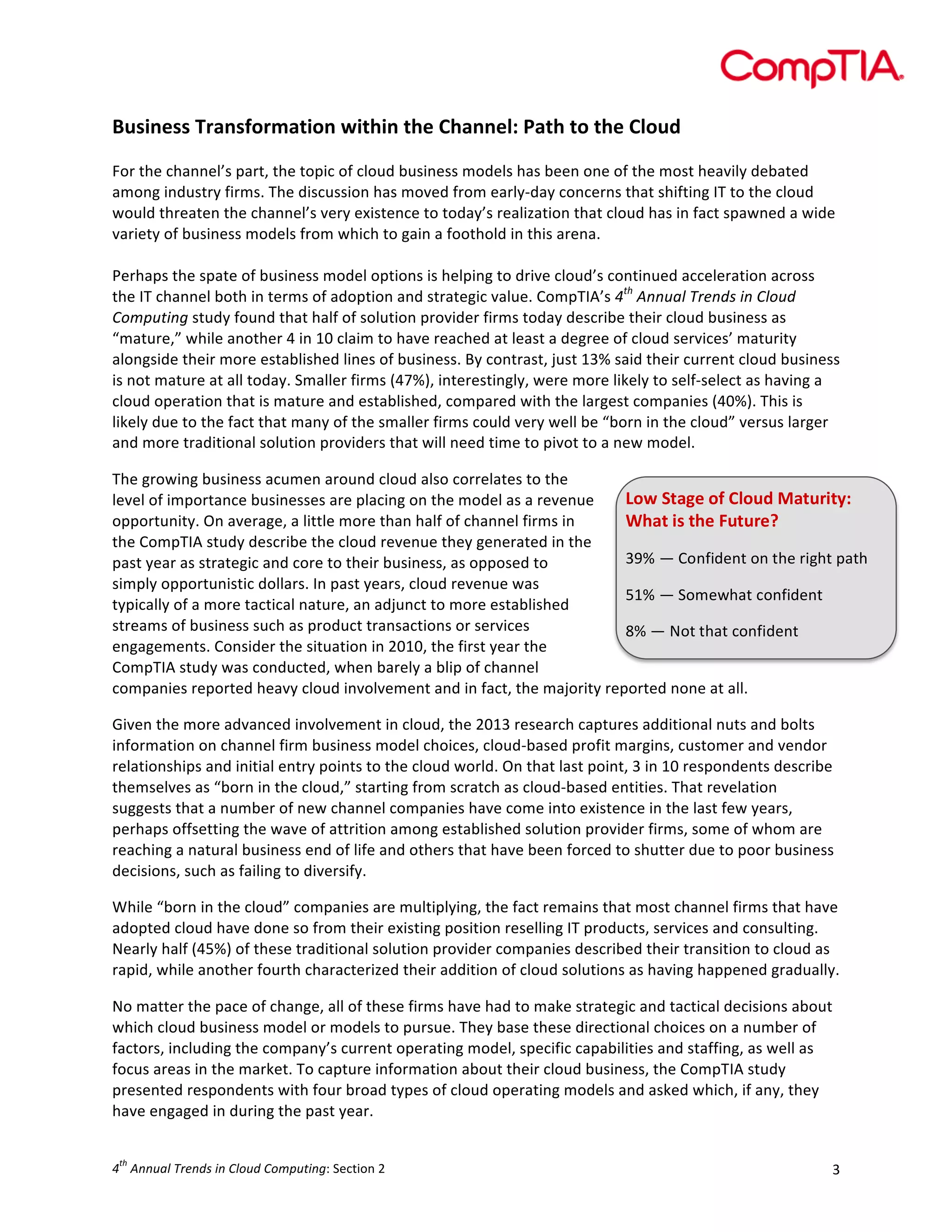
Low	
  Stage	
  of	
  Cloud	
  Maturity:	
  
level	
  of	
  importance	
  businesses	
  are	
  placing	
  on	
  the	
  model	
  as	
  a	
  revenue	
  
opportunity.	
  On	
  average,	
  a	
  little	
  more	
  than	
  half	
  of	
  channel	
  firms	
  in	
  
What	
  is	
  the	
  Future?	
  
the	
  CompTIA	
  study	
  describe	
  the	
  cloud	
  revenue	
  they	
  generated	
  in	
  the	
  
39%	
  —	
  Confident	
  on	
  the	
  right	
  path	
  
past	
  year	
  as	
  strategic	
  and	
  core	
  to	
  their	
  business,	
  as	
  opposed	
  to	
  
simply	
  opportunistic	
  dollars.	
  In	
  past	
  years,	
  cloud	
  revenue	
  was	
  
51%	
  —	
  Somewhat	
  confident	
  
typically	
  of	
  a	
  more	
  tactical	
  nature,	
  an	
  adjunct	
  to	
  more	
  established	
  
streams	
  of	
  business	
  such	
  as	
  product	
  transactions	
  or	
  services	
  
8%	
  —	
  Not	
  that	
  confident	
  
engagements.	
  Consider	
  the	
  situation	
  in	
  2010,	
  the	
  first	
  year	
  the	
  
CompTIA	
  study	
  was	
  conducted,	
  when	
  barely	
  a	
  blip	
  of	
  channel	
  
companies	
  reported	
  heavy	
  cloud	
  involvement	
  and	
  in	
  fact,	
  the	
  majority	
  reported	
  none	
  at	
  all.	
  
Given	
  the	
  more	
  advanced	
  involvement	
  in	
  cloud,	
  the	
  2013	
  research	
  captures	
  additional	
  nuts	
  and	
  bolts	
  
information	
  on	
  channel	
  firm	
  business	
  model	
  choices,	
  cloud-­‐based	
  profit	
  margins,	
  customer	
  and	
  vendor	
  
relationships	
  and	
  initial	
  entry	
  points	
  to	
  the	
  cloud	
  world.	
  On	
  that	
  last	
  point,	
  3	
  in	
  10	
  respondents	
  describe	
  
themselves	
  as	
  “born	
  in	
  the	
  cloud,”	
  starting	
  from	
  scratch	
  as	
  cloud-­‐based	
  entities.	
  That	
  revelation	
  
suggests	
  that	
  a	
  number	
  of	
  new	
  channel	
  companies	
  have	
  come	
  into	
  existence	
  in	
  the	
  last	
  few	
  years,	
  
perhaps	
  offsetting	
  the	
  wave	
  of	
  attrition	
  among	
  established	
  solution	
  provider	
  firms,	
  some	
  of	
  whom	
  are	
  
reaching	
  a	
  natural	
  business	
  end	
  of	
  life	
  and	
  others	
  that	
  have	
  been	
  forced	
  to	
  shutter	
  due	
  to	
  poor	
  business	
  
decisions,	
  such	
  as	
  failing	
  to	
  diversify.	
  
While	
  “born	
  in	
  the	
  cloud”	
  companies	
  are	
  multiplying,	
  the	
  fact	
  remains	
  that	
  most	
  channel	
  firms	
  that	
  have	
  
adopted	
  cloud	
  have	
  done	
  so	
  from	
  their	
  existing	
  position	
  reselling	
  IT	
  products,	
  services	
  and	
  consulting.	
  
Nearly	
  half	
  (45%)	
  of	
  these	
  traditional	
  solution	
  provider	
  companies	
  described	
  their	
  transition	
  to	
  cloud	
  as	
  
rapid,	
  while	
  another	
  fourth	
  characterized	
  their	
  addition	
  of	
  cloud	
  solutions	
  as	
  having	
  happened	
  gradually.	
  
No	
  matter	
  the	
  pace	
  of	
  change,	
  all	
  of	
  these	
  firms	
  have	
  had	
  to	
  make	
  strategic	
  and	
  tactical	
  decisions	
  about	
  
which	
  cloud	
  business	
  model	
  or	
  models	
  to	
  pursue.	
  They	
  base	
  these	
  directional	
  choices	
  on	
  a	
  number	
  of	
  
factors,	
  including	
  the	
  company’s	
  current	
  operating	
  model,	
  specific	
  capabilities	
  and	
  staffing,	
  as	
  well	
  as	
  
focus	
  areas	
  in	
  the	
  market.	
  To	
  capture	
  information	
  about	
  their	
  cloud	
  business,	
  the	
  CompTIA	
  study	
  
presented	
  respondents	
  with	
  four	
  broad	
  types	
  of	
  cloud	
  operating	
  models	
  and	
  asked	
  which,	
  if	
  any,	
  they	
  
have	
  engaged	
  in	
  during	
  the	
  past	
  year.	
  	
  
th

4 	
  Annual	
  Trends	
  in	
  Cloud	
  Computing:	
  Section	
  2	
  

3	


Business	
  model	
  decisions	
  pose	
  a	
  tricky	
  task	
  for	
  channel	
  firms	
  making	
  –	
  or	
  having	
  made	
  –	
  a	
  cloud	
  
transition.	
  Primary	
  considerations	
  depend	
  on	
  where	
  a	
  company	
  wants	
  to	
  go	
  with	
  cloud:	
  Resell	
  a	
  
vendor’s	
  cloud	
  solutions?	
  Aggregate	
  and	
  broker	
  cloud	
  services	
  from	
  a	
  variety	
  of	
  different	
  sources?	
  
Integrate	
  and	
  customize	
  cloud-­‐based	
  apps	
  and	
  services,	
  or	
  simply	
  sell	
  the	
  infrastructure	
  to	
  an	
  end	
  user	
  
and	
  provide	
  consulting?	
  Each	
  of	
  these	
  paths	
  and	
  more	
  are	
  possibilities,	
  as	
  are	
  varying	
  revenue	
  models	
  
available	
  for	
  all.	
  Forty-­‐five	
  percent	
  of	
  channel	
  companies	
  from	
  CompTIA’s	
  4th	
  Annual	
  Trends	
  in	
  Cloud	
  
Computing	
  say	
  determining	
  the	
  appropriate	
  business	
  model	
  around	
  cloud	
  presented	
  a	
  significant	
  
challenge	
  in	
  the	
  past	
  year.	
  That	
  assertion	
  falls	
  just	
  behind	
  the	
  most	
  difficult	
  challenge	
  cited	
  in	
  the	
  
findings:	
  Developing	
  cloud	
  expertise	
  across	
  both	
  technical	
  and	
  sales	
  arms	
  within	
  a	
  company,	
  a	
  task	
  that	
  
logically	
  flows	
  after	
  the	
  initial	
  business	
  model	
  decision	
  is	
  made.	
  

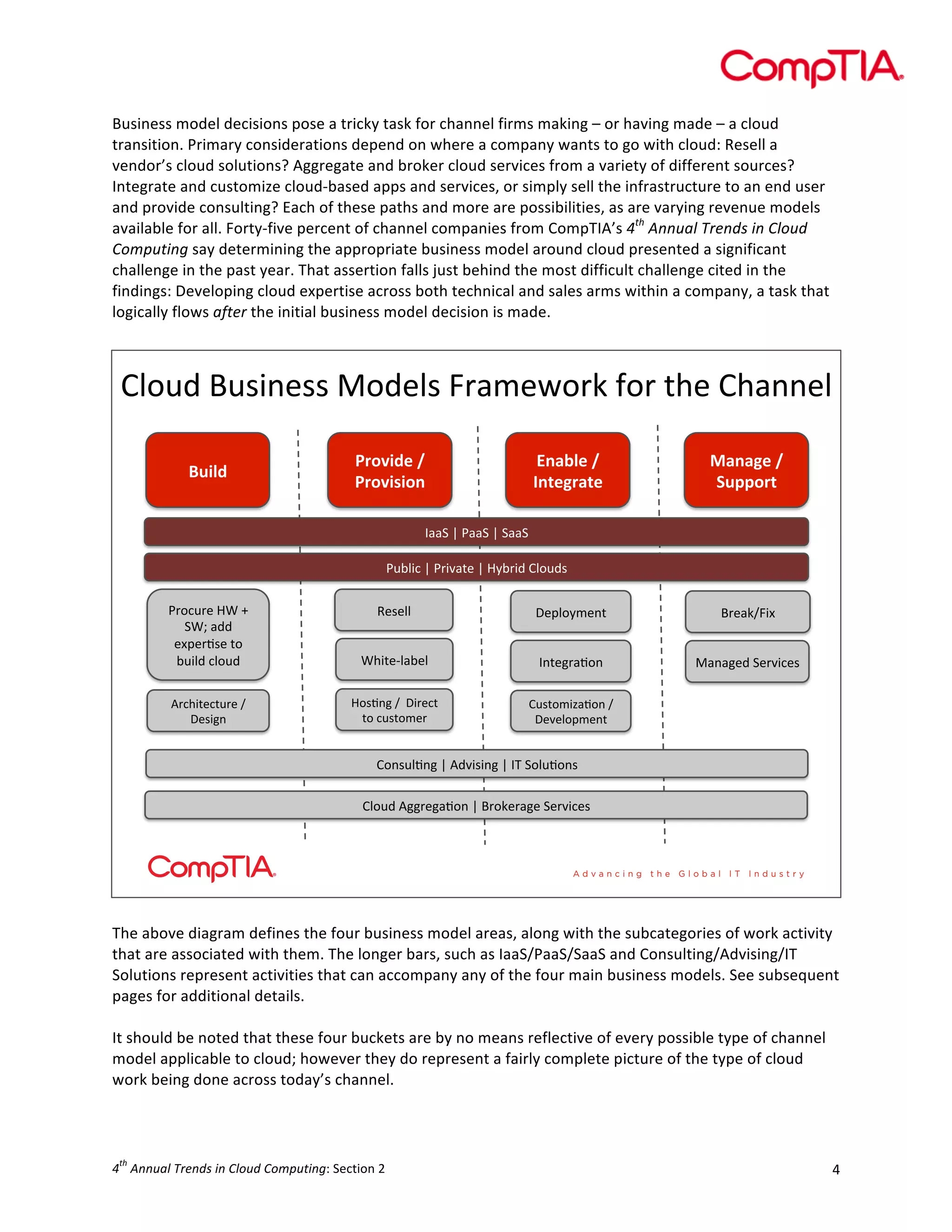
Cloud$Business$Models$Framework$for$the$Channel
$
Build&

Provide&/&
Provision&

Enable&/&
Integrate&

Manage&/&
Support&

IaaS$|$PaaS$|$SaaS$
Public$|$Private$|$Hybrid$Clouds$
Procure$HW$+$
SW;$add$
exper8se$to$
build$cloud$

Resell$

Deployment$

Break/Fix$

WhiteClabel$

Integra8on$

Managed$Services$

Architecture$/$
Design$

Hos8ng$/$$Direct$
to$customer$

Customiza8on$/$
Development$

Consul8ng$|$Advising$|$IT$Solu8ons$
Cloud$Aggrega8on$|$Brokerage$Services$


The	
  above	
  diagram	
  defines	
  the	
  four	
  business	
  model	
  areas,	
  along	
  with	
  the	
  subcategories	
  of	
  work	
  activity	
  
that	
  are	
  associated	
  with	
  them.	
  The	
  longer	
  bars,	
  such	
  as	
  IaaS/PaaS/SaaS	
  and	
  Consulting/Advising/IT	
  
Solutions	
  represent	
  activities	
  that	
  can	
  accompany	
  any	
  of	
  the	
  four	
  main	
  business	
  models.	
  See	
  subsequent	
  
pages	
  for	
  additional	
  details.	


It	
  should	
  be	
  noted	
  that	
  these	
  four	
  buckets	
  are	
  by	
  no	
  means	
  reflective	
  of	
  every	
  possible	
  type	
  of	
  channel	
  
model	
  applicable	
  to	
  cloud;	
  however	
  they	
  do	
  represent	
  a	
  fairly	
  complete	
  picture	
  of	
  the	
  type	
  of	
  cloud	
  
work	
  being	
  done	
  across	
  today’s	
  channel.	


th

4 	
  Annual	
  Trends	
  in	
  Cloud	
  Computing:	
  Section	
  2	
  

4	


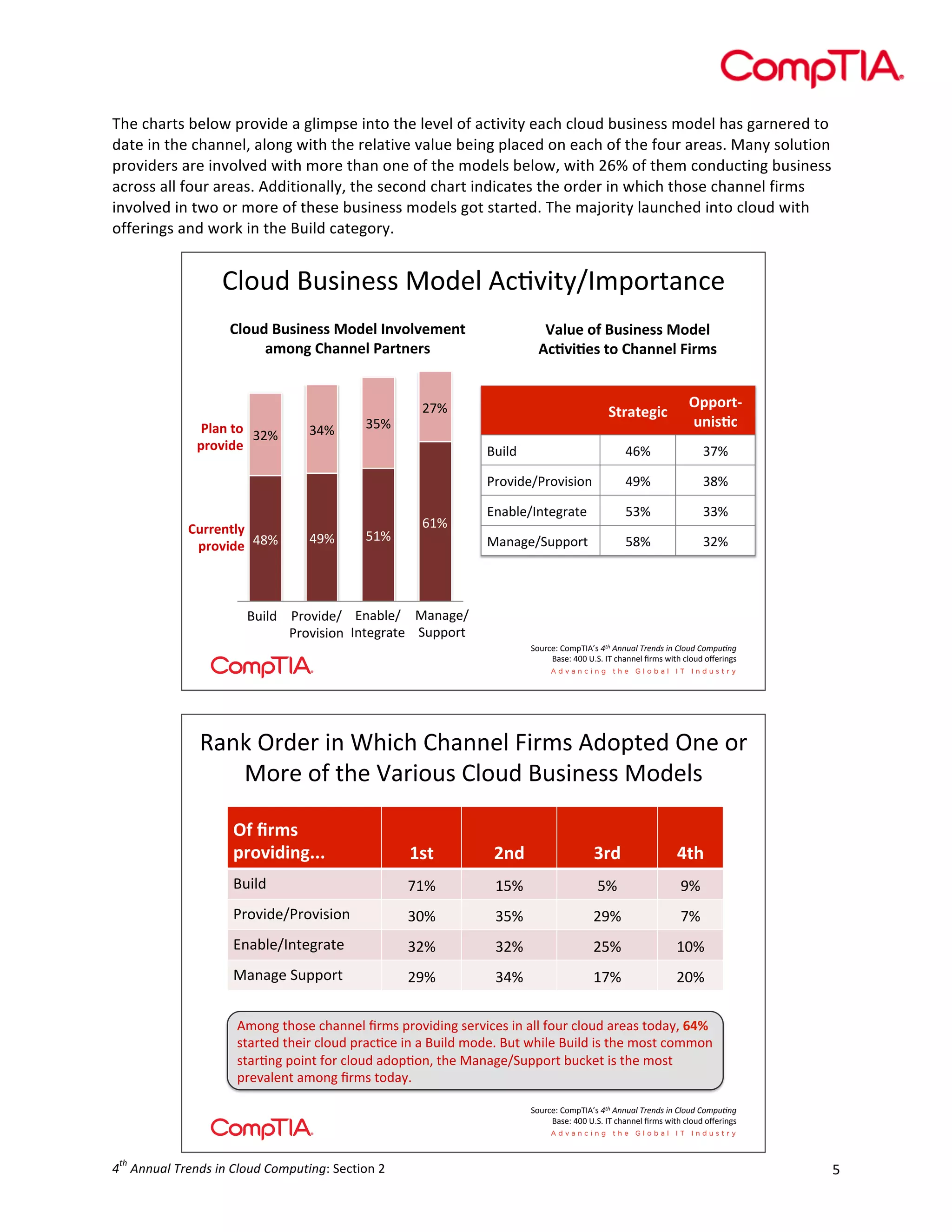
The	
  charts	
  below	
  provide	
  a	
  glimpse	
  into	
  the	
  level	
  of	
  activity	
  each	
  cloud	
  business	
  model	
  has	
  garnered	
  to	
  
date	
  in	
  the	
  channel,	
  along	
  with	
  the	
  relative	
  value	
  being	
  placed	
  on	
  each	
  of	
  the	
  four	
  areas.	
  Many	
  solution	
  
providers	
  are	
  involved	
  with	
  more	
  than	
  one	
  of	
  the	
  models	
  below,	
  with	
  26%	
  of	
  them	
  conducting	
  business	
  
across	
  all	
  four	
  areas.	
  Additionally,	
  the	
  second	
  chart	
  indicates	
  the	
  order	
  in	
  which	
  those	
  channel	
  firms	
  
involved	
  in	
  two	
  or	
  more	
  of	
  these	
  business	
  models	
  got	
  started.	
  The	
  majority	
  launched	
  into	
  cloud	
  with	
  
offerings	
  and	
  work	
  in	
  the	
  Build	
  category.	


Cloud&Business&Model&Ac/vity/Importance
&


Cloud&Business&Model&Involvement&
among&Channel&Partners&

Value&of&Business&Model&
Ac1vi1es&to&Channel&Firms&

Currently&
provide& 48%&

49%&

51%&

Opport=
unis1c&

Build&

34%&

Strategic&
46%&

37%&

Provide/Provision&

Plan&to& 32%&
provide&

35%&

49%&

38%&

Enable/Integrate&

53%&

33%&

Manage/Support&

58%&

32%&

27%&

61%&

Build& Provide/& Enable/ Manage/&
Provision& Integrate& Support&
Source:&CompTIA’s&4th$Annual$Trends$in$Cloud$Compu4ng&
Base:&400&U.S.&IT&channel&firms&with&cloud&offerings&

Rank&Order&in&Which&Channel&Firms&Adopted&One&or&
More&of&the&Various&Cloud&Business&Models&
Of#firms#
providing...#

1st#

2nd#

3rd#

4th#

Build&

71%&

15%&

5%&

9%&

Provide/Provision&

30%&

35%&

29%&

7%&

Enable/Integrate&

32%&

32%&

25%&

10%&

Manage&Support&

29%&

34%&

17%&

20%&

Among&those&channel&firms&providing&services&in&all&four&cloud&areas&today,&64%#
started&their&cloud&pracWce&in&a&Build&mode.&But&while&Build&is&the&most&common&
starWng&point&for&cloud&adopWon,&the&Manage/Support&bucket&is&the&most&
prevalent&among&firms&today.&


Source:&CompTIA’s&4th$Annual$Trends$in$Cloud$Compu4ng&
Base:&400&U.S.&IT&channel&firms&with&cloud&offerings&

th

4 	
  Annual	
  Trends	
  in	
  Cloud	
  Computing:	
  Section	
  2	
  

5	


Cloud	
  Model	
  Element	
  1:	
  Build	


A	
  strong	
  starting	
  point	
  for	
  the	
  cloud	
  for	
  many	
  firms	
  is	
  the	
  category	
  of	
  Build,	
  which	
  is	
  defined	
  in	
  the	
  study	
  
as:	


Typically	
  this	
  involves	
  firms	
  procuring	
  vendor-­‐based	
  hardware	
  and	
  software	
  products	
  to	
  construct	
  private	
  
and/or	
  hybrid	
  clouds	
  for	
  customers.	
  They	
  may	
  also	
  offer	
  consulting	
  guidance	
  on	
  the	
  best	
  IT	
  architecture,	
  
configuration	
  and	
  product	
  choices	
  for	
  the	
  project.	


Roughly	
  half	
  (48%)	
  of	
  channel	
  firms	
  today	
  report	
  currently	
  offering	
  some	
  form	
  of	
  Build	
  services,	
  with	
  
another	
  third	
  planning	
  to	
  add	
  this	
  flavor	
  of	
  cloud	
  to	
  their	
  lineup	
  in	
  the	
  coming	
  year.	
  Build	
  represents	
  a	
  
bit	
  of	
  a	
  cloud	
  launching	
  pad;	
  of	
  those	
  firms	
  that	
  are	
  also	
  operating	
  one	
  of	
  the	
  other	
  three	
  cloud	
  business	
  
models,	
  7	
  in	
  10	
  started	
  with	
  a	
  with	
  Build	
  practice	
  before	
  adding	
  the	
  others.	
  This	
  makes	
  sense	
  if	
  you	
  think	
  
back	
  three	
  to	
  five	
  years	
  ago	
  as	
  the	
  industry	
  and	
  channel	
  began	
  its	
  cloud	
  transition.	
  At	
  the	
  time,	
  many	
  
channel	
  firms	
  were	
  looking	
  for	
  the	
  most	
  obvious	
  place	
  to	
  plug	
  in,	
  with	
  many	
  of	
  them	
  admittedly	
  worried	
  
that	
  cloud	
  would	
  disintermediate	
  them	
  in	
  the	
  market.	
  So	
  where	
  did	
  they	
  turn	
  in	
  conjuring	
  a	
  business	
  
model	
  that	
  made	
  sense?	
  They	
  leveraged	
  traditional	
  solution	
  provider	
  strengths	
  in	
  infrastructure	
  
products	
  sales	
  and	
  implementation	
  work.	
  In	
  doing	
  so	
  in	
  a	
  cloud	
  context,	
  these	
  companies	
  positioned	
  
themselves	
  as	
  builders	
  of	
  private	
  clouds	
  within	
  existing	
  customers’	
  on-­‐premise	
  environments.	


Additionally,	
  a	
  number	
  of	
  vendors	
  including	
  HP,	
  VMware,	
  CA	
  and	
  others	
  have	
  brought	
  to	
  market	
  “cloud-­‐
in-­‐a-­‐box”	
  type	
  products	
  that	
  outfit	
  channel	
  partners	
  with	
  a	
  turnkey	
  way	
  to	
  sell	
  and	
  deploy	
  private	
  cloud	
  
solutions	
  for	
  their	
  end	
  customers.	
  Large-­‐scale	
  enterprise	
  private	
  cloud	
  deployments	
  are	
  not	
  the	
  
mainstay	
  of	
  most	
  of	
  today’s	
  channel,	
  whose	
  bread	
  and	
  butter	
  customers	
  typically	
  reside	
  in	
  the	
  SMB	
  
space.	
  So	
  these	
  cloud-­‐in-­‐a-­‐box	
  solutions	
  and	
  toolsets	
  have	
  allowed	
  many	
  of	
  them	
  to	
  provide	
  Build-­‐type	
  
cloud	
  services	
  within	
  the	
  confines	
  of	
  their	
  skill	
  sets,	
  customer	
  needs	
  and	
  finances.	
  They	
  also	
  allow	
  for	
  
much	
  faster	
  time	
  to	
  completion	
  than	
  a	
  major	
  private	
  cloud	
  enterprise	
  deployment	
  from	
  scratch.	


Further	
  evidence	
  that	
  Build	
  activities	
  seemed	
  a	
  logical	
  jump-­‐on	
  point	
  for	
  channel	
  firms	
  mulling	
  cloud	
  
appears	
  when	
  you	
  look	
  at	
  which	
  types	
  of	
  companies	
  have	
  adopted	
  this	
  model.	
  Six	
  in	
  10	
  channel	
  firms	
  
that	
  identify	
  as	
  resellers	
  are	
  currently	
  offering	
  Build	
  services	
  vs.	
  47%	
  of	
  channel	
  companies	
  that	
  align	
  
more	
  in	
  the	
  services	
  bucket	
  (break/fix,	
  managed	
  services,	
  consulting).	
  It’s	
  not	
  an	
  overwhelming	
  
difference,	
  but	
  the	
  resellers,	
  with	
  their	
  foothold	
  in	
  infrastructure	
  product	
  sales,	
  would	
  find	
  Build	
  a	
  
natural	
  entry	
  point	
  to	
  cloud.	


In	
  terms	
  of	
  focus	
  areas	
  within	
  the	
  Build	
  framework,	
  31%	
  of	
  respondents	
  characterized	
  what	
  they	
  do	
  as	
  
mostly	
  procuring	
  hardware	
  and	
  software	
  tools,	
  then	
  reselling	
  to	
  customers	
  to	
  build	
  private	
  clouds.	
  
Another	
  2	
  in	
  10	
  say	
  their	
  Build	
  business	
  is	
  primarily	
  about	
  leveraging	
  an	
  existing	
  customer’s	
  on-­‐premise	
  
hardware	
  and	
  layering	
  software	
  and	
  management	
  tools	
  to	
  build	
  a	
  private	
  or	
  hybrid	
  cloud	
  solution.	
  
What’s	
  more	
  common	
  than	
  either	
  of	
  these	
  activities	
  in	
  isolation	
  is	
  a	
  model	
  in	
  which	
  channel	
  firms	
  do	
  
both,	
  which	
  roughly	
  half	
  of	
  respondents	
  said	
  they	
  did.	


Thirty-­‐eight	
  percent	
  of	
  small	
  firms	
  participated	
  in	
  both	
  types	
  of	
  Build	
  activities	
  compared	
  with	
  55%	
  of	
  
medium	
  and	
  large	
  companies	
  that	
  did.	


th

4 	
  Annual	
  Trends	
  in	
  Cloud	
  Computing:	
  Section	
  2	
  

6	


Cloud	
  Model	
  Element	
  2:	
  Provide/Provision	


This	
  business	
  model	
  for	
  cloud	
  positions	
  the	
  solution	
  provider	
  as	
  the	
  hub	
  for	
  provisioning	
  various	
  vendor-­‐
based	
  and	
  homegrown	
  cloud	
  services	
  to	
  the	
  end	
  customer.	
  Half	
  of	
  channel	
  firms	
  doing	
  cloud	
  today	
  are	
  
participating	
  in	
  the	
  Provide/Provision	
  model,	
  with	
  a	
  third	
  of	
  all	
  respondents	
  in	
  the	
  study	
  believing	
  that	
  
this	
  business	
  model	
  for	
  cloud	
  has	
  the	
  most	
  growth	
  potential	
  in	
  the	
  next	
  two	
  years	
  –	
  regardless	
  of	
  
whether	
  they	
  are	
  involved	
  in	
  it	
  or	
  not	
  today.	
  That	
  compares	
  with	
  roughly	
  a	
  quarter	
  of	
  firms	
  that	
  deem	
  
each	
  of	
  the	
  other	
  three	
  business	
  models	
  as	
  the	
  fastest	
  growth	
  drivers.	


A	
  quick	
  definition:	


Typically	
  these	
  firms	
  are	
  reselling	
  and	
  provisioning	
  IaaS	
  offerings	
  such	
  as	
  storage	
  and	
  compute	
  capacity	
  
from	
  Amazon	
  Web	
  Services	
  or	
  SaaS	
  offerings	
  such	
  as	
  Google	
  Apps.	
  They	
  are	
  also	
  evaluating	
  and	
  
aggregating	
  various	
  cloud	
  services	
  for	
  customers.	


Within	
  this	
  model,	
  there	
  are	
  several	
  subcategories	
  of	
  activities	
  that	
  channel	
  firms	
  pursue	
  today.	
  Many	
  
participate	
  in	
  a	
  number	
  of	
  these	
  areas.	
  Six	
  in	
  10	
  channel	
  firms	
  involved	
  in	
  cloud	
  report	
  white	
  labeling	
  a	
  
vendor’s	
  cloud	
  offerings,	
  in	
  effect	
  leading	
  with	
  their	
  own	
  brand	
  on	
  what	
  is	
  typically	
  a	
  SaaS	
  deal.	
  Another	
  
six	
  in	
  10	
  said	
  they	
  operate	
  their	
  own	
  data	
  center	
  and	
  sell	
  homegrown	
  cloud	
  services,	
  while	
  just	
  more	
  
than	
  half	
  (54%)	
  are	
  reselling	
  vendor-­‐based	
  cloud	
  services	
  that	
  can	
  include	
  SaaS	
  and	
  IaaS	
  offerings	
  in	
  
most	
  cases.	
  Think	
  Microsoft	
  Office	
  365	
  or	
  Google	
  Apps,	
  as	
  mentioned	
  above.	


Not	
  surprisingly,	
  resellers	
  are	
  much	
  more	
  likely	
  among	
  channel	
  
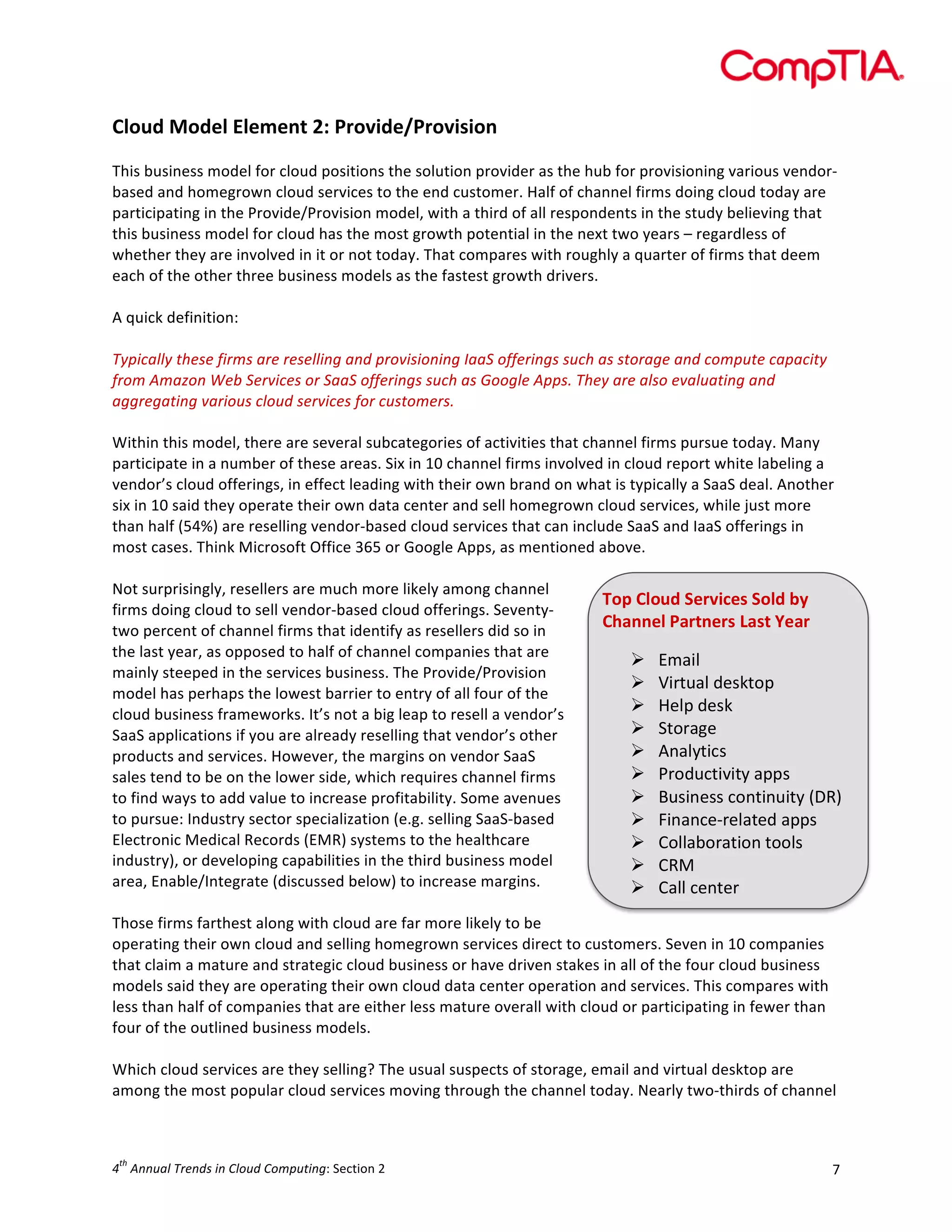
Top	
  Cloud	
  Services	
  Sold	
  by	
  
firms	
  doing	
  cloud	
  to	
  sell	
  vendor-­‐based	
  cloud	
  offerings.	
  Seventy-­‐
Channel	
  Partners	
  Last	
  Year	
  
two	
  percent	
  of	
  channel	
  firms	
  that	
  identify	
  as	
  resellers	
  did	
  so	
  in	
  
the	
  last	
  year,	
  as	
  opposed	
  to	
  half	
  of	
  channel	
  companies	
  that	
  are	
  
Ø Email	
  
mainly	
  steeped	
  in	
  the	
  services	
  business.	
  The	
  Provide/Provision	
  
Ø Virtual	
  desktop	
  
model	
  has	
  perhaps	
  the	
  lowest	
  barrier	
  to	
  entry	
  of	
  all	
  four	
  of	
  the	
  
Ø Help	
  desk	
  
cloud	
  business	
  frameworks.	
  It’s	
  not	
  a	
  big	
  leap	
  to	
  resell	
  a	
  vendor’s	
  
Ø Storage	
  
SaaS	
  applications	
  if	
  you	
  are	
  already	
  reselling	
  that	
  vendor’s	
  other	
  
Ø Analytics	
  
products	
  and	
  services.	
  However,	
  the	
  margins	
  on	
  vendor	
  SaaS	
  
Ø Productivity	
  apps	
  
sales	
  tend	
  to	
  be	
  on	
  the	
  lower	
  side,	
  which	
  requires	
  channel	
  firms	
  
Ø Business	
  continuity	
  (DR)	
  
to	
  find	
  ways	
  to	
  add	
  value	
  to	
  increase	
  profitability.	
  Some	
  avenues	
  
to	
  pursue:	
  Industry	
  sector	
  specialization	
  (e.g.	
  selling	
  SaaS-­‐based	
  
Ø Finance-­‐related	
  apps	
  
Electronic	
  Medical	
  Records	
  (EMR)	
  systems	
  to	
  the	
  healthcare	
  
Ø Collaboration	
  tools	
  
industry),	
  or	
  developing	
  capabilities	
  in	
  the	
  third	
  business	
  model	
  
Ø CRM	
  
area,	
  Enable/Integrate	
  (discussed	
  below)	
  to	
  increase	
  margins.	
  
Ø Call	
  center	


Those	
  firms	
  farthest	
  along	
  with	
  cloud	
  are	
  far	
  more	
  likely	
  to	
  be	
  
operating	
  their	
  own	
  cloud	
  and	
  selling	
  homegrown	
  services	
  direct	
  to	
  customers.	
  Seven	
  in	
  10	
  companies	
  
that	
  claim	
  a	
  mature	
  and	
  strategic	
  cloud	
  business	
  or	
  have	
  driven	
  stakes	
  in	
  all	
  of	
  the	
  four	
  cloud	
  business	
  
models	
  said	
  they	
  are	
  operating	
  their	
  own	
  cloud	
  data	
  center	
  operation	
  and	
  services.	
  This	
  compares	
  with	
  
less	
  than	
  half	
  of	
  companies	
  that	
  are	
  either	
  less	
  mature	
  overall	
  with	
  cloud	
  or	
  participating	
  in	
  fewer	
  than	
  
four	
  of	
  the	
  outlined	
  business	
  models.	


Which	
  cloud	
  services	
  are	
  they	
  selling?	
  The	
  usual	
  suspects	
  of	
  storage,	
  email	
  and	
  virtual	
  desktop	
  are	
  
among	
  the	
  most	
  popular	
  cloud	
  services	
  moving	
  through	
  the	
  channel	
  today.	
  Nearly	
  two-­‐thirds	
  of	
  channel	
  

th

4 	
  Annual	
  Trends	
  in	
  Cloud	
  Computing:	
  Section	
  2	
  

7	


firms	
  have	
  these	
  services	
  in	
  their	
  cloud	
  portfolio.	
  One	
  surprise?	
  Sixty-­‐two	
  percent	
  also	
  said	
  they	
  sold	
  
cloud-­‐based	
  business	
  intelligence	
  and	
  data	
  analytics	
  in	
  the	
  past	
  year,	
  a	
  major	
  leap	
  from	
  previous	
  years	
  
of	
  this	
  study	
  when	
  that	
  tech	
  category	
  landed	
  low	
  on	
  the	
  channel	
  offerings	
  list.	
  In	
  fact,	
  73%	
  of	
  reseller-­‐
based	
  channel	
  firms	
  are	
  offering	
  BI	
  and	
  data	
  analytics	
  as	
  a	
  cloud	
  service	
  to	
  customers.	
  Now	
  it	
  should	
  be	
  
noted	
  that	
  the	
  sample	
  size	
  for	
  the	
  BI	
  responses	
  is	
  smaller	
  than	
  other	
  areas	
  of	
  the	
  CompTIA	
  study,	
  but	
  
directionally	
  speaking	
  the	
  rise	
  in	
  cloud-­‐based	
  analytics	
  in	
  the	
  channel	
  indicates	
  a	
  new	
  level	
  of	
  
sophistication	
  among	
  these	
  firms	
  and	
  quite	
  likely	
  belies	
  the	
  influence	
  of	
  Big	
  Data.	
  With	
  cloud	
  versions	
  of	
  
analytics	
  tools	
  now	
  available,	
  solution	
  providers	
  have	
  an	
  opportunity	
  to	
  sell	
  their	
  predominantly	
  SMB	
  
customers	
  solutions	
  that	
  may	
  have	
  been	
  beyond	
  financial	
  reach	
  in	
  the	
  on-­‐premises	
  form.	


Cloud	
  Model	
  Element	
  3:	
  Enable/Integrate	


The	
  Enable/Integrate	
  business	
  framework	
  for	
  cloud	
  has	
  been	
  a	
  sweet	
  spot	
  for	
  channel	
  firms	
  over	
  the	
  
past	
  several	
  years.	
  It	
  makes	
  sense.	
  Beyond	
  the	
  reselling	
  of	
  products,	
  channel	
  firms	
  have	
  made	
  their	
  
name	
  providing	
  integration	
  and	
  implementation	
  work	
  that	
  links	
  customers’	
  various	
  hardware	
  and	
  
software	
  solutions,	
  as	
  well	
  as	
  offering	
  vertical	
  industry	
  and	
  other	
  types	
  of	
  customization.	
  Cloud	
  solutions	
  
and	
  multicloud	
  environments	
  only	
  add	
  more	
  layers	
  of	
  technology	
  to	
  connect	
  into	
  that	
  infrastructure.	
  
Consider	
  the	
  following	
  definition	
  for	
  the	
  model:	


Typically	
  they	
  are	
  providing	
  integration	
  and	
  implementation	
  services	
  that	
  may	
  include	
  tying	
  a	
  customer’s	
  
on-­‐premise	
  IT	
  solutions	
  to	
  its	
  cloud-­‐based	
  solutions	
  or	
  customizing	
  cloud-­‐based	
  solutions	
  to	
  fit	
  a	
  
particular	
  business	
  need	
  or	
  vertical.	


For	
  the	
  past	
  three	
  years	
  of	
  CompTIA	
  cloud	
  studies,	
  the	
  number	
  one	
  source	
  of	
  post-­‐sale	
  dollars	
  has	
  been	
  
integration	
  work.	
  This	
  area	
  has	
  routinely	
  been	
  a	
  place	
  where	
  the	
  channel	
  cushions	
  its	
  overall	
  profit	
  
margins.	
  Since	
  most	
  solution	
  providers	
  charge	
  customers	
  on	
  a	
  recurring	
  revenue	
  basis	
  for	
  cloud	
  
solutions	
  (by	
  consumption	
  or	
  by	
  number	
  of	
  users	
  etc.),	
  the	
  project	
  work	
  associated	
  with	
  the	
  
Enable/Integrate	
  category	
  allows	
  them	
  to	
  add	
  revenue	
  not	
  included	
  in	
  the	
  base	
  contract.	


The	
  business	
  model	
  encapsulates	
  a	
  
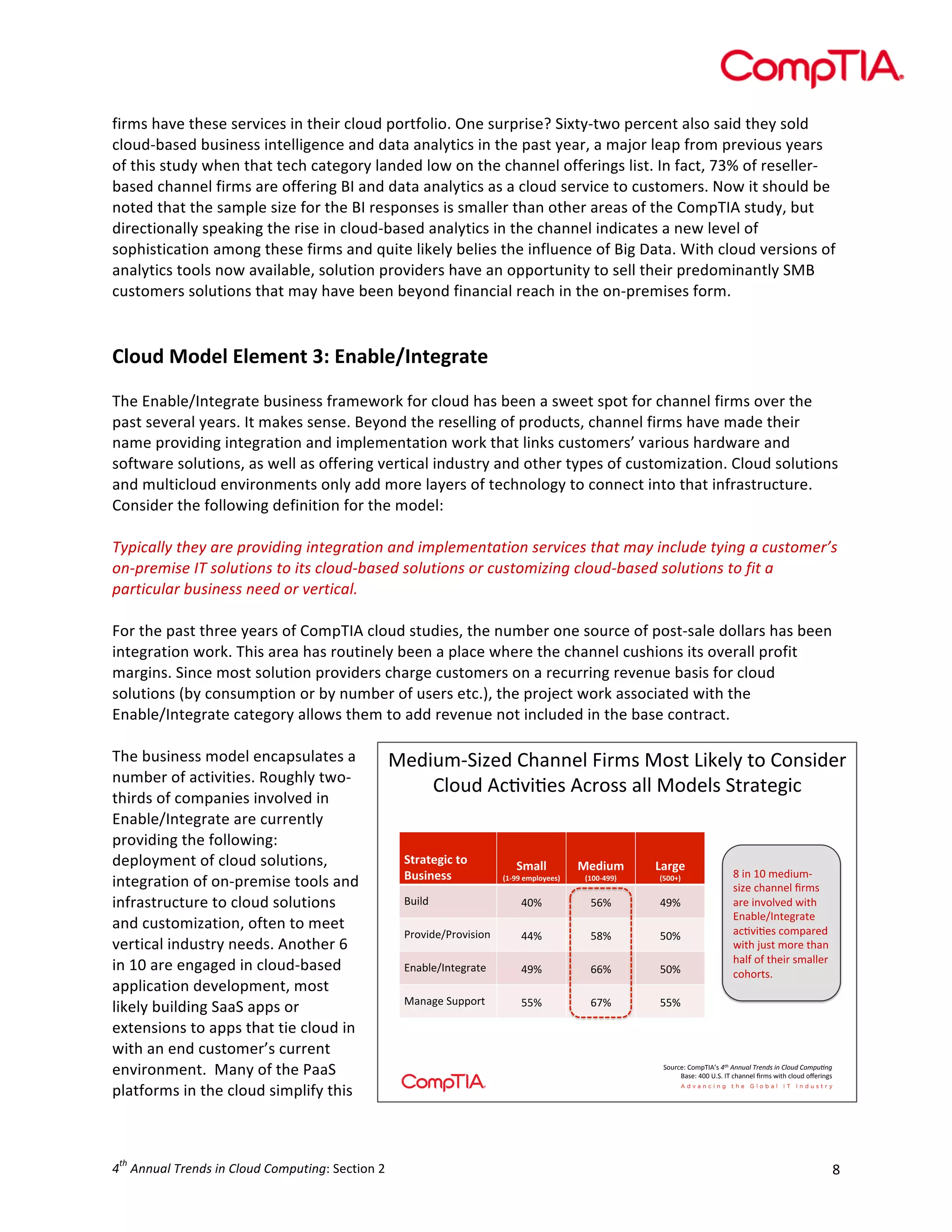
MediumASized&Channel&Firms&Most&Likely&to&Consider&
number	
  of	
  activities.	
  Roughly	
  two-­‐
Cloud&AcKviKes&Across&all&Models&Strategic&
thirds	
  of	
  companies	
  involved	
  in	
  
Enable/Integrate	
  are	
  currently	
  
providing	
  the	
  following:	
  
Strategic)to)
deployment	
  of	
  cloud	
  solutions,	
  
Small)
Medium)
Large)
8&in&10&mediumA
Business)
(1399)employees))
(1003499))
(500+))
integration	
  of	
  on-­‐premise	
  tools	
  and	
  
size&channel&firms&
Build&
are&involved&with&
40%&
56%&
49%&
infrastructure	
  to	
  cloud	
  solutions	
  
Enable/Integrate&
and	
  customization,	
  often	
  to	
  meet	
  
acKviKes&compared&
Provide/Provision&
44%&
58%&
50%&
with&just&more&than&
vertical	
  industry	
  needs.	
  Another	
  6	
  
half&of&their&smaller&
in	
  10	
  are	
  engaged	
  in	
  cloud-­‐based	
  
Enable/Integrate&
49%&
66%&
50%&
cohorts.&
application	
  development,	
  most	
  
Manage&Support&
55%&
67%&
55%&
likely	
  building	
  SaaS	
  apps	
  or	
  
extensions	
  to	
  apps	
  that	
  tie	
  cloud	
  in	
  
with	
  an	
  end	
  customer’s	
  current	
  
Source:&CompTIA’s&4 $Annual$Trends$in$Cloud$Compu4ng&
environment.	
  	
  Many	
  of	
  the	
  PaaS	
  
Base:&400&U.S.&IT&channel&firms&with&cloud&offerings&
platforms	
  in	
  the	
  cloud	
  simplify	
  this	
  
th

th

4 	
  Annual	
  Trends	
  in	
  Cloud	
  Computing:	
  Section	
  2	
  

8	


type	
  of	
  work.	
  Meanwhile,	
  a	
  smaller	
  percentage	
  (54%)	
  of	
  companies	
  have	
  gone	
  down	
  the	
  road	
  of	
  mobile	
  
application	
  development	
  to	
  synch	
  and	
  interact	
  with	
  cloud	
  solutions.	
  As	
  mobile	
  continues	
  to	
  grow	
  in	
  
stature	
  across	
  all	
  types	
  of	
  applications,	
  expect	
  that	
  category	
  to	
  accelerate.	
  Consider	
  resellers	
  alone:	
  the	
  
data	
  find	
  that	
  75%	
  of	
  them	
  are	
  doing	
  some	
  work	
  in	
  this	
  mobile	
  application	
  development	
  versus	
  57%	
  of	
  
channel	
  firms	
  that	
  identify	
  more	
  strongly	
  as	
  service	
  providers.	


In	
  terms	
  of	
  other	
  segmentation	
  differences,	
  firms	
  that	
  consider	
  themselves	
  mature	
  with	
  cloud	
  are	
  more	
  
likely	
  than	
  those	
  with	
  moderate	
  to	
  no	
  maturity	
  to	
  provide	
  work	
  in	
  the	
  Enable/Integrate	
  category.	
  Nearly	
  
8	
  in	
  10	
  companies	
  with	
  strategic	
  cloud	
  business	
  acumen	
  are	
  planted	
  in	
  this	
  category	
  compared	
  with	
  just	
  
29%	
  of	
  those	
  with	
  little	
  cloud	
  experience.	


Cloud	
  Model	
  Element	
  4:	
  Manage/Support	


The	
  glue	
  binding	
  a	
  channel	
  firm	
  to	
  its	
  customers	
  often	
  hinges	
  on	
  the	
  management	
  of	
  IT	
  after	
  the	
  initial	
  
sale	
  and	
  implementation.	
  Many	
  customers	
  need	
  post-­‐sales	
  attention	
  frankly,	
  especially	
  smaller	
  
businesses	
  with	
  no	
  IT	
  staff.	
  This	
  is	
  one	
  reason	
  that	
  managed	
  services	
  is	
  viewed	
  as	
  a	
  must-­‐enter	
  market	
  
for	
  today’s	
  solution	
  providers;	
  not	
  only	
  does	
  it	
  provide	
  a	
  more	
  predictable	
  stream	
  of	
  recurring	
  revenue,	
  
but	
  also	
  creates	
  a	
  contractual	
  arrangement	
  for	
  ongoing	
  IT	
  service	
  and	
  support.	
  The	
  management	
  and	
  
support	
  of	
  cloud	
  solutions	
  is	
  no	
  different	
  and	
  offers	
  a	
  compelling	
  business	
  model	
  for	
  the	
  channel,	
  as	
  
defined	
  below:	


Typically	
  they	
  are	
  delivering	
  the	
  ongoing	
  management	
  and	
  support	
  of	
  cloud-­‐based	
  services	
  as	
  project	
  
work	
  or	
  in	
  a	
  contractual,	
  recurring	
  revenue	
  model.	
  They	
  are	
  also	
  adding,	
  scaling	
  or	
  troubleshooting	
  cloud	
  
services	
  as	
  needed.	


Management	
  of	
  cloud	
  solutions	
  includes	
  the	
  basic	
  services,	
  such	
  as	
  troubleshooting	
  or	
  repairing	
  of	
  
cloud-­‐based	
  IT	
  on	
  a	
  project	
  basis,	
  which	
  a	
  third	
  of	
  channel	
  firms	
  in	
  this	
  model	
  did	
  last	
  year.	
  Another	
  6	
  in	
  
10	
  are	
  conducting	
  remote	
  monitoring	
  of	
  cloud	
  solutions	
  for	
  customers	
  and/or	
  managing	
  solutions	
  that	
  
reside	
  in	
  a	
  multicloud	
  environment.	
  Multicloud	
  management	
  is	
  a	
  solid	
  opportunity	
  area	
  for	
  the	
  channel	
  
as	
  myriad	
  cloud	
  apps	
  and	
  other	
  solutions	
  mushroom	
  in	
  the	
  market.	
  Customers	
  are	
  accessing	
  solutions	
  
from	
  an	
  array	
  of	
  different	
  providers	
  and	
  data	
  center	
  locations,	
  often	
  with	
  little	
  real	
  handle	
  on	
  the	
  source	
  
of	
  these	
  services.	
  Channel	
  firms	
  are	
  optimally	
  positioned	
  to	
  serve	
  as	
  a	
  gatekeeper.	
  Along	
  a	
  similar	
  vein,	
  
cloud-­‐to-­‐cloud	
  migration	
  is	
  becoming	
  more	
  prevalent	
  as	
  customers	
  experiment	
  with	
  different	
  cloud	
  
providers	
  to	
  gauge	
  performance	
  levels	
  and	
  satisfaction	
  rates.	
  Just	
  more	
  than	
  half	
  of	
  channel	
  firms	
  are	
  
engaged	
  in	
  this	
  type	
  of	
  activity	
  today.	


Likewise,	
  the	
  channel	
  is	
  wisely	
  developing	
  ways	
  to	
  demonstrate	
  cloud	
  ROI	
  to	
  customers.	
  In	
  fact,	
  6	
  in	
  10	
  
channel	
  firms	
  involved	
  in	
  Manage/Support	
  have	
  created	
  IT	
  dashboards	
  that	
  allow	
  customers	
  to	
  track	
  
their	
  cloud	
  utilization,	
  costs	
  and	
  other	
  metrics	
  to	
  understand	
  their	
  investment.	
  	
  Seventy-­‐two	
  percent	
  of	
  
medium-­‐sized	
  solution	
  providers	
  are	
  building	
  these	
  types	
  of	
  dashboards,	
  a	
  clear	
  value-­‐add.	


Another	
  reason	
  that	
  the	
  Manage/Support	
  model	
  is	
  likely	
  to	
  flourish	
  is	
  the	
  fact	
  that	
  while	
  cloud	
  often	
  
abstracts	
  complexity	
  from	
  the	
  customer’s	
  view,	
  the	
  solutions	
  typically	
  enable	
  more	
  connections,	
  more	
  
end	
  points	
  and	
  reliance	
  on	
  networks.	
  These	
  are	
  all	
  areas	
  needing	
  ongoing	
  support.	


th

4 	
  Annual	
  Trends	
  in	
  Cloud	
  Computing:	
  Section	
  2	
  

9	


Appendix	


Channel'Partner'Cloud'Growth'Expecta4ons''
Percentage)of)revenue)from)
cloud)sales)in)last)12)months)
among)channel)partners)

>75%'
50%'>'75%'

8%'

Cloud)revenue)growth)
expecta:ons)among)channel)
partners)over)next)12)months)

Grow'significantly'
(15%+)'

26%'

29%'

Grow'modestly'
25%'>'49%'

35%'

Flat/shrinking'
<25%'

56%'

17%'

24%'

Source:'CompTIA’s'4th$Annual$Trends$in$Cloud$Compu4ng'
Base:'400'U.S.'IT'channel'firms'with'cloud'offerings'


th

4 	
  Annual	
  Trends	
  in	
  Cloud	
  Computing:	
  Section	
  2	
  

10	
  
TRENDS IN CLOUD COMPUTING

RESEARCH

S E C T I O N 3 : C H A N N E L R E L AT I O N S H I P S :
VENDORS, CUSTOMERS, AND DISTRIBUTORS

FOURTH ANNUAL • AUGUST 2013

www.comptia.org
 

Key	
  Points	


•
	
  
•


•

Two	
  thirds	
  (63%)	
  of	
  channel	
  firms	
  characterize	
  customer	
  demand	
  for	
  cloud-­‐based	
  IT	
  solutions	
  and	
  
services	
  as	
  either	
  very	
  high	
  or	
  high,	
  with	
  another	
  3	
  in	
  10	
  describing	
  demand	
  as	
  somewhat	
  high.	
  Just	
  
9%	
  said	
  demand	
  for	
  these	
  solutions	
  was	
  low.	
  	
  
Six	
  in	
  10	
  channel	
  firms	
  say	
  that	
  cloud	
  has	
  generally	
  strengthened	
  their	
  customer	
  relationships,	
  with	
  
just	
  15%	
  claiming	
  it	
  has	
  weakened	
  them	
  and	
  roughly	
  a	
  quarter	
  that	
  said	
  that	
  their	
  client	
  bonds	
  have	
  
remained	
  the	
  same.	
  That	
  said,	
  not	
  all	
  channel	
  firms	
  that	
  adopt	
  cloud	
  will	
  engender	
  more	
  good	
  will	
  
with	
  customers;	
  some	
  may	
  simply	
  have	
  a	
  customer	
  set	
  that	
  is	
  not	
  cloud-­‐friendly,	
  others	
  may	
  not	
  
gain	
  sufficient	
  expertise	
  to	
  provide	
  value.	
  
Four	
  in	
  10	
  channel	
  firms	
  said	
  they	
  experienced	
  cases	
  where	
  customer	
  demand	
  for	
  cloud	
  solutions	
  
outstripped	
  their	
  capacity	
  to	
  deliver,	
  while	
  another	
  20%	
  lost	
  a	
  deal	
  because	
  a	
  customer	
  desired	
  a	
  
cloud	
  solution	
  they	
  did	
  not	
  offer.	


th

4 	
  Annual	
  Trends	
  in	
  Cloud	
  Computing:	
  Section	
  3	
  

2	


Cloud	
  Demand	
  and	
  the	
  Customer	
  Relationship	


Cementing	
  a	
  successful	
  customer	
  relationship	
  requires	
  channel	
  firms	
  to	
  possess	
  a	
  keen	
  understanding	
  of	
  
their	
  customer’s	
  business	
  goals,	
  needs	
  and	
  pain	
  points,	
  and	
  also	
  have	
  the	
  ability	
  to	
  apply	
  that	
  knowledge	
  
to	
  the	
  solutions	
  recommended	
  and	
  sold.	
  This	
  basic	
  business	
  reality	
  is	
  no	
  different	
  whether	
  you	
  are	
  
selling	
  traditional	
  on-­‐premise	
  hardware	
  and	
  software	
  or	
  cloud-­‐based	
  solutions.	
  In	
  fact,	
  the	
  options	
  that	
  
cloud	
  provides	
  have	
  only	
  upped	
  the	
  ante	
  when	
  it	
  comes	
  to	
  channel	
  business	
  relationships	
  with	
  all	
  of	
  
their	
  constituents:	
  customers,	
  vendors	
  and	
  distributors.	
  In	
  this	
  section,	
  we	
  will	
  explore	
  the	
  impact	
  cloud	
  
has	
  had	
  on	
  all	
  three	
  affiliations.	


First	
  let’s	
  take	
  a	
  look	
  at	
  customer	
  demand	
  for	
  cloud,	
  which	
  in	
  many	
  ways	
  drives	
  channel	
  behavior.	
  
Consider	
  the	
  following:	


Gartner	
  forecasts	
  the	
  public	
  cloud	
  services	
  market	
  to	
  grow	
  18.5	
  percent	
  in	
  2013	
  to	
  total	
  $131	
  
billion	
  worldwide,	
  up	
  from	
  $111	
  billion	
  in	
  2012.	


IDC	
   research	
   shows	
   that	
   worldwide	
   spending	
   on	
   public	
   IT	
   cloud	
   services	
   is	
   expected	
   to	
  
approach	
  $100	
  billion	
  in	
  2016.	
  Over	
  the	
  2012–2016	
  forecast	
  period,	
  public	
  IT	
  cloud	
  services	
  
will	
  enjoy	
  a	
  compound	
  annual	
  growth	
  rate	
  of	
  26.4%,	
  five	
  times	
  that	
  of	
  the	
  IT	
  industry	
  overall.,	
  
and	
   by	
   2015,	
   one	
   of	
   every	
   seven	
   dollars	
   spent	
   on	
   packaged	
   software,	
   server,	
   and	
   storage	
  
offerings	
  will	
  be	
  through	
  the	
  public	
  cloud	
  model.	


Cloud	
  demand	
  acceleration	
  extends	
  to	
  the	
  channel	
  as	
  well,	
  according	
  to	
  the	
  CompTIA	
  study.	
  Two	
  thirds	
  
(63%)	
  of	
  channel	
  firms	
  characterize	
  customer	
  demand	
  for	
  cloud-­‐based	
  IT	
  solutions	
  and	
  services	
  as	
  either	
  
very	
  high	
  or	
  high,	
  with	
  another	
  3	
  in	
  10	
  describing	
  demand	
  as	
  somewhat	
  high.	
  Just	
  9%	
  said	
  demand	
  for	
  
these	
  solutions	
  was	
  low.	


Among	
  channel	
  firm	
  types,	
  resellers	
  in	
  the	
  study	
  cited	
  the	
  highest	
  demand.	
  Seventy-­‐four	
  percent	
  of	
  
these	
  companies	
  said	
  demand	
  was	
  either	
  very	
  high	
  or	
  high,	
  compared	
  with	
  62%	
  of	
  services-­‐oriented	
  
channel	
  firms	
  that	
  did	
  so.	
  One	
  explanation	
  is	
  that	
  resellers	
  as	
  a	
  group	
  tend	
  to	
  be	
  invested	
  heavily	
  in	
  
selling	
  vendor-­‐based	
  cloud	
  solutions,	
  in	
  particular	
  SaaS	
  applications	
  such	
  as	
  Microsoft	
  Office	
  365	
  and	
  
Google	
  Apps.	
  This	
  is	
  an	
  activity	
  that	
  fits	
  into	
  the	
  cloud	
  business	
  model	
  framework	
  called	
  
Provide/Provision,	
  and	
  across	
  all	
  frameworks	
  in	
  the	
  CompTIA	
  study	
  the	
  Provide/Provision	
  cloud	
  model	
  
was	
  predicted	
  to	
  experience	
  the	
  greatest	
  growth	
  potential	
  for	
  the	
  channel	
  in	
  the	
  next	
  two	
  years.	
  (See	
  
Section	
  2	
  of	
  this	
  report	
  for	
  more	
  details	
  on	
  the	
  various	
  cloud	
  business	
  model	
  frameworks)	


Indeed,	
  channel	
  firms	
  reported	
  high	
  demand	
  for	
  cloud	
  services	
  in	
  general.	
  Considering	
  the	
  four	
  business	
  
models	
  outlined	
  in	
  this	
  report,	
  IT	
  companies	
  with	
  a	
  Build	
  practice	
  report	
  the	
  highest	
  levels	
  of	
  customer	
  
interest	
  in	
  cloud	
  solutions.	
  Presumably,	
  these	
  are	
  customers	
  engaging	
  in	
  Build	
  projects,	
  such	
  as	
  
deploying	
  a	
  private	
  cloud,	
  but	
  since	
  many	
  channel	
  partners	
  are	
  involved	
  in	
  multiple	
  cloud	
  offerings,	
  it	
  
could	
  be	
  demand	
  stemming	
  from	
  a	
  range	
  of	
  customer	
  cloud	
  needs.	
  
Additionally,	
  the	
  demand	
  levels	
  for	
  each	
  distinct	
  business	
  model	
  also	
  map	
  to	
  the	
  rank	
  order	
  in	
  which	
  
many	
  channel	
  firms	
  entered	
  these	
  four	
  spaces.	
  Most	
  of	
  the	
  companies	
  that	
  are	
  offering	
  two	
  or	
  more	
  
types	
  of	
  cloud	
  frameworks	
  started	
  with	
  the	
  Build	
  category,	
  then	
  moved	
  along	
  adding	
  Provide/Provision,	
  

th

4 	
  Annual	
  Trends	
  in	
  Cloud	
  Computing:	
  Section	
  3	
  

3	


Enable/Integrate	
  and	
  finally	
  Manage/Support.	
  It’s	
  unsurprising	
  then	
  that	
  demand	
  is	
  reported	
  to	
  be	
  
highest	
  in	
  the	
  first	
  two	
  categories,	
  as	
  they	
  are	
  the	
  most	
  prevalently	
  practiced	
  across	
  the	
  channel	
  today.	
  
Expect	
  customer	
  demand	
  for	
  the	
  management	
  and	
  support	
  of	
  cloud	
  services	
  –	
  the	
  fourth	
  business	
  
model	
  category	
  -­‐-­‐	
  to	
  grow	
  in	
  coming	
  years	
  as	
  more	
  end	
  users	
  migrate	
  from	
  the	
  purchase	
  of	
  cloud	
  
solutions	
  to	
  the	
  need	
  to	
  tend	
  and	
  monitor	
  the	
  services	
  over	
  their	
  lifecycle.	
  

()*+,-./$0.-123$4,/$(5,)3$6,5)7,2*
$
!"#$%&'()*'&+,-).%()!/%"-)0%/"1%,#)

2+3,)4'+#%,#)$%)4'5%&&',-)
!/%"-)%6'()7,89('&3#')0%/"1%,#)

P./<$Q8?@$
0.-123$

!  ()*+,-./$3.*8/.$+,$/.3)9.$9,-:5.;8+<$

Q8?@$
0.-123$

6,-.C@1+$
Q8?@$,/$R,C$
0.-123$

''#$

%&#$

!"#$

4+1,A)%.)*'&+,-).(%&)
!B+,,'/)C+($,'()C'(#9'516')

:;<)=>?)
@3AB)
*'&+,-)
(@122.5$:1/+2./*$
C8+@$1$95,)3$6'/)-$
:/1979.$,/$1$
3+17/-,83+17/./1&$
:/1979.$1/.$-,*+$
=)558*@$,2$9)*+,-./$
3.-123$4,/$95,)3$
*,5)7,2*M$$

!  ()*+,-./$3.*8/.$+,$829/.1*.$-,=85.>
/.-,+.$199.**$+,$9,-:12<$31+1$
!  ()*+,-./$.<.82?$9,*+$/.3)97,2*$,/$
+@.<$1/.$:/89.$*.2*87A.$
!  ()*+,-./$@1*$=)*82.**$,=B.97A.*$=.*+$
-.$C8+@$95,)3$*,5)7,2*$
!  D=858+<$+,$,2E/1-:$123$*915.$2.C$
4.1+)/.*>*./A89.*$41*+./$
!  ()*+,-./$@1*$2,$82E@,)*.$FG$
-121?.-.2+$
6,)/9.H$(,-:GFDI*$!"#$%&&'()$*+,&-.$/&$0)1'-$0123'4&5$
J1*.H$%KK$LM6M$FG$9@122.5$N/-*$C8+@$95,)3$,O./82?*$


With	
  customers	
  curious	
  about	
  cloud	
  and	
  demand	
  up,	
  fresh	
  conversations	
  have	
  been	
  sparked	
  between	
  
channel	
  firms	
  and	
  their	
  existing	
  clients,	
  while	
  doors	
  are	
  opening	
  to	
  potential	
  new	
  customers	
  seeking,	
  in	
  
some	
  instances,	
  a	
  better	
  mousetrap	
  to	
  meet	
  their	
  technology	
  needs.	


Case	
  in	
  point?	
  Six	
  in	
  10	
  channel	
  firms	
  say	
  that	
  cloud	
  has	
  generally	
  strengthened	
  their	
  customer	
  
relationships,	
  with	
  just	
  15%	
  claiming	
  it	
  has	
  weakened	
  them	
  and	
  roughly	
  a	
  quarter	
  that	
  said	
  that	
  their	
  
client	
  bonds	
  have	
  remained	
  the	
  same.	
  This	
  is	
  encouraging	
  news	
  given	
  the	
  fact	
  that	
  many	
  in	
  the	
  channel	
  
have	
  feared	
  publicly	
  that	
  cloud	
  would	
  drive	
  a	
  wedge	
  between	
  them	
  and	
  their	
  customers.	
  There’s	
  been	
  
rampant	
  apprehension	
  about	
  such	
  ill	
  effects	
  as	
  a	
  resurgence	
  in	
  vendor	
  direct	
  sales	
  and	
  end	
  user	
  
customers	
  choosing	
  a	
  self-­‐service	
  model	
  for	
  their	
  IT	
  solutions,	
  i.e.	
  procuring	
  SaaS	
  applications	
  over	
  the	
  
Internet.	
  And	
  while	
  both	
  of	
  these	
  trends	
  are	
  happening	
  to	
  a	
  certain	
  extent,	
  CompTIA	
  data	
  suggest	
  not	
  at	
  
such	
  dire	
  expense	
  to	
  most	
  of	
  the	
  channel,	
  especially	
  those	
  that	
  have	
  reached	
  a	
  high	
  level	
  of	
  cloud	
  
maturity	
  today	
  and	
  intend	
  to	
  remain	
  committed.	
  That	
  said,	
  not	
  all	
  channel	
  firms	
  that	
  adopt	
  cloud	
  will	
  
engender	
  more	
  good	
  will	
  with	
  customers;	
  some	
  may	
  simply	
  have	
  a	
  customer	
  set	
  that	
  is	
  not	
  cloud-­‐
friendly,	
  others	
  may	
  not	
  gain	
  sufficient	
  expertise	
  to	
  provide	
  value,	
  etc.	


th

4 	
  Annual	
  Trends	
  in	
  Cloud	
  Computing:	
  Section	
  3	
  

4	


In	
  fact,	
  channel	
  firms	
  can	
  play	
  a	
  critical	
  role	
  in	
  determining	
  when	
  cloud	
  versus	
  on-­‐premise	
  works	
  best	
  for	
  
their	
  customers.	
  The	
  savvy	
  ‘trusted	
  advisor’	
  should	
  be	
  moving	
  far	
  beyond	
  a	
  product	
  speeds-­‐and-­‐feeds	
  
sales	
  pitch	
  to	
  a	
  business-­‐oriented	
  consulting	
  approach	
  to	
  the	
  engagement.	
  Respondents	
  to	
  the	
  CompTIA	
  
study	
  said	
  the	
  primary	
  reasons	
  that	
  they	
  are	
  recommending	
  cloud	
  typically	
  map	
  to	
  a	
  customer’s	
  
business	
  priorities.	
  They	
  also	
  fall	
  in	
  line	
  with	
  macro	
  realities	
  such	
  as	
  the	
  growth	
  of	
  the	
  remote	
  work	
  
force.	
  	
  As	
  one	
  example,	
  the	
  percentage	
  of	
  channel	
  firms	
  that	
  said	
  their	
  customers’	
  desire	
  to	
  increase	
  
mobile/remote	
  access	
  to	
  company	
  data	
  sparked	
  the	
  reason	
  to	
  recommend	
  cloud	
  jumped	
  to	
  46%	
  of	
  
respondents	
  compared	
  with	
  38%	
  last	
  year.	
  This	
  underscores	
  the	
  surge	
  in	
  mobility	
  solutions,	
  as	
  well	
  as	
  
BYOD	
  and	
  telecommuting	
  trends	
  that	
  are	
  happening	
  in	
  the	
  marketplace.	
  It	
  also	
  demonstrates	
  the	
  
channel’s	
  ability	
  to	
  tie	
  the	
  value	
  of	
  cloud	
  into	
  these	
  burgeoning	
  areas.	


A	
  customer’s	
  desire	
  to	
  reduce	
  complexity	
  across	
  their	
  IT	
  environment	
  remains	
  the	
  No.	
  1	
  reason	
  that	
  
solution	
  providers	
  recommend	
  cloud	
  offerings	
  in	
  place	
  of	
  on-­‐premise.	
  Six	
  in	
  10	
  medium-­‐sized	
  channel	
  
firms	
  cited	
  this	
  as	
  the	
  primary	
  cloud	
  recommendation	
  driver.	
  Over	
  the	
  next	
  several	
  years,	
  more	
  proof	
  
points	
  will	
  emerge	
  on	
  TCO	
  and	
  true	
  cost	
  savings	
  enabled	
  by	
  cloud,	
  however.	
  But	
  today,	
  customers	
  
increasingly	
  are	
  open	
  to	
  exploring	
  cloud	
  solutions	
  in	
  lieu	
  of	
  spending	
  on	
  new	
  hardware,	
  packaged	
  
software	
  and	
  other	
  in-­‐house	
  infrastructure.	
  The	
  challenge	
  for	
  the	
  channel	
  is	
  going	
  to	
  be	
  demonstrating	
  
those	
  cost	
  savings	
  over	
  time	
  to	
  the	
  customers	
  while	
  warding	
  off	
  competition	
  from	
  giants	
  like	
  Amazon,	
  
whose	
  cloud	
  pricing	
  has	
  continued	
  to	
  drop	
  quarter	
  over	
  quarter.	


!"#$%&'(%&)*+&!$,)#-+.&/+"'0#(,*12
&
!"#$%&"'($)*+$
,-.*/01($%'+0"-12$341+$

819*:;1$<*&1+$='0/"-1+$
#40)$%'+0"-12+$

@#&3*'(A+&

?+(+.'""4&
<+':+(+%&

>A?$

6@?$

5>?$

5$

!$,)#-+.&%+-'(%&#$),).122+%&
3'2'31)4&)#&%+"15+.&3"#$%&,#"$0#(,&

6$

?+(+.'""4&
,).+(A)*+(+%&

6#,)&3"#$%&,'"+&)#&5+(%#.7&%1,)4&#.&
#)*+.&(#(8,#"$0#(&2.#51%+.&

7$

6#,)&'&,'"+&9+3'$,+&3$,)#-+.&
',:+%&;#.&,#"$0#(&<+&%#(=)&#>+.&

!*'((+"&3#-2'(1+,&<1)*&'&*1A*&%+A.++&#;&3"#$%&
-')$.1)4&'(%&1(5#"5+-+()&'.+&21+,$)/6,)7$)#&
.+2#.)&,#-+&)42+&#;&(+A'05+&3$,)#-+.&#$)3#-+&
)*'(&3*'((+"&2'.)(+.,&<1)*&"#<+.&"+5+",&#;&3"#$%&
-')$.1)4K&&
B#$.3+C&!#-2DEF=,&!"#$%&&'()$*+,&-.$/&$0)1'-$0123'4&5&
G',+C&HII&JKBK&ED&3*'((+"&L.-,&<1)*&3"#$%&#>+.1(A,&


Another	
  challenge	
  lies	
  in	
  the	
  ability	
  to	
  deliver	
  cloud	
  services	
  in	
  lockstep	
  with	
  demand.	
  It	
  sounds	
  like	
  a	
  
problem	
  you	
  shouldn’t	
  mind	
  having:	
  too	
  much	
  demand	
  for	
  your	
  services.	
  But	
  unless	
  a	
  channel	
  firm	
  has	
  

th

4 	
  Annual	
  Trends	
  in	
  Cloud	
  Computing:	
  Section	
  3	
  

5	


adequate	
  capacity	
  and	
  skills	
  to	
  meet	
  that	
  demand,	
  they	
  will	
  have	
  to	
  either	
  turn	
  away	
  or	
  lose	
  business.	
  In	
  
fact,	
  4	
  in	
  10	
  channel	
  firms	
  said	
  they	
  experienced	
  cases	
  where	
  customer	
  demand	
  for	
  cloud	
  solutions	
  
outstripped	
  their	
  capacity	
  to	
  deliver,	
  while	
  20%	
  lost	
  a	
  deal	
  because	
  a	
  customer	
  desired	
  a	
  cloud	
  solution	
  
they	
  did	
  not	
  offer.	
  Another	
  negative	
  sales	
  outcome	
  involved	
  losing	
  a	
  cloud	
  deal	
  to	
  another	
  solution	
  
provider,	
  vendor	
  or	
  distributor,	
  which	
  a	
  third	
  of	
  respondents	
  said	
  occurred	
  last	
  year.	
  This	
  latter	
  issue	
  is	
  
not	
  confined	
  to	
  cloud	
  obviously,	
  and	
  happens	
  with	
  regularity	
  in	
  the	
  on-­‐premise	
  sales	
  arena	
  as	
  well.	


Interestingly,	
  channel	
  firms	
  with	
  high	
  levels	
  of	
  maturity	
  with	
  cloud	
  and	
  those	
  that	
  are	
  involved	
  in	
  four	
  of	
  
the	
  outlined	
  cloud	
  business	
  models	
  were	
  more	
  likely	
  to	
  experience	
  capacity	
  or	
  inability	
  to	
  deliver	
  issues	
  
around	
  cloud.	
  More	
  than	
  half	
  of	
  these	
  types	
  of	
  companies,	
  for	
  example,	
  experienced	
  demand	
  for	
  cloud	
  
solutions	
  beyond	
  what	
  they	
  were	
  able	
  to	
  execute	
  on	
  versus	
  an	
  average	
  around	
  4	
  in	
  10	
  of	
  all	
  other	
  
categories	
  of	
  channel	
  firms.	
  This	
  is	
  most	
  likely	
  explained	
  by	
  the	
  fact	
  that	
  they	
  are	
  so	
  heavily	
  involved	
  in	
  
cloud	
  –	
  cloud	
  experts,	
  as	
  it	
  were	
  –	
  that	
  demand	
  naturally	
  gravitates	
  their	
  way,	
  and	
  in	
  some	
  cases	
  is	
  
beyond	
  their	
  means.	


The	
  emphasis	
  on	
  demand	
  should	
  not	
  overshadow	
  the	
  fact	
  that	
  not	
  all	
  end	
  user	
  companies	
  are	
  buying	
  
into	
  cloud	
  yet.	
  Today’s	
  channel	
  firms	
  continue	
  to	
  encounter	
  some	
  difficulty	
  selling	
  to	
  certain	
  customers.	
  
A	
  perennial	
  concern	
  is	
  security	
  wariness,	
  which	
  continues	
  to	
  rank	
  as	
  the	
  chief	
  roadblock	
  to	
  cloud	
  
acceptance	
  based	
  on	
  what	
  channel	
  companies	
  of	
  all	
  sizes	
  say	
  they	
  are	
  hearing	
  from	
  customers.	
  On	
  
average,	
  more	
  than	
  half	
  of	
  respondents	
  cited	
  security	
  as	
  the	
  chief	
  hurdle	
  to	
  a	
  cloud	
  sale.	
  Concern	
  about	
  
Internet	
  downtime	
  moved	
  up	
  the	
  list	
  of	
  customer	
  objections	
  to	
  cloud	
  this	
  year,	
  which	
  may	
  be	
  the	
  result	
  
of	
  the	
  past	
  year’s	
  very	
  public	
  outages.	
  There	
  are	
  many	
  examples,	
  some	
  involving	
  financial	
  institutions	
  as	
  
well	
  as	
  one	
  that	
  took	
  down	
  portions	
  of	
  Microsoft’s	
  Outlook	
  services	
  for	
  several	
  days	
  or	
  a	
  more	
  recent,	
  
albeit	
  very	
  brief,	
  outage	
  at	
  Google.	


Top	
  Customer	
  Objections	
  to	
  Adopting	
  Cloud	


56%	
   Security	
  concerns	


44%	
   Internet	
  downtime	
  
40%	
   Integration	
  concerns	
  with	
  on-­‐premise	
  infrastructure	
  
39%	
   Data	
  portability	
  issues	
  
37%	
   Total	
  cost	
  of	
  ownership	
  concerns	
  
36%	
   Lack	
  of	
  understanding	
  of	
  options/tradeoffs	
  of	
  cloud	
  
31%	
   Resistance	
  to	
  change	
  by	
  internal	
  IT	


Two	
  of	
  the	
  main	
  customer	
  objections	
  actually	
  pose	
  potential	
  opportunities	
  for	
  channel	
  firms	
  if	
  they	
  are	
  
handled	
  well.	
  Integration	
  concerns	
  about	
  tying	
  cloud	
  into	
  existing	
  infrastructure	
  and	
  worries	
  about	
  data	
  
portability	
  need	
  not	
  be	
  deal	
  breakers	
  –	
  instead	
  they	
  provide	
  a	
  chance	
  for	
  the	
  solution	
  provider	
  to	
  flex	
  
their	
  value,	
  knowledge	
  and	
  skill	
  set.	
  Being	
  able	
  to	
  explain	
  to	
  a	
  potential	
  customer	
  in	
  detail	
  which	
  party	
  
ultimately	
  “owns”	
  data	
  placed	
  in	
  the	
  cloud,	
  particularly	
  in	
  a	
  situation	
  where	
  a	
  cloud	
  provider	
  might	
  go	
  
out	
  of	
  business	
  or	
  the	
  customer	
  falls	
  behind	
  on	
  payments,	
  demonstrates	
  the	
  channel	
  firm’s	
  knowledge	
  
of	
  cloud-­‐based	
  models.	
  Data	
  portability	
  moves	
  from	
  a	
  sales	
  obstacle	
  to	
  overcome	
  to	
  a	
  value-­‐added	
  
service	
  to	
  sell.	
  Likewise	
  with	
  integration.	
  For	
  channel	
  firms	
  selling	
  cloud	
  today,	
  the	
  greatest	
  source	
  of	
  
revenue	
  after	
  the	
  sale	
  lies	
  in	
  integration	
  work	
  –	
  cloud	
  to	
  on-­‐premise	
  and	
  cloud	
  to	
  cloud.	
  A	
  proven	
  track	
  
record	
  here	
  with	
  existing	
  customers	
  can	
  serve	
  as	
  a	
  blueprint	
  or	
  proof	
  point	
  to	
  persuade	
  more	
  reluctant	
  
customer	
  prospects,	
  much	
  like	
  case	
  studies	
  are	
  used.	


th

4 	
  Annual	
  Trends	
  in	
  Cloud	
  Computing:	
  Section	
  3	
  

6	


Total	
  cost	
  of	
  ownership	
  is	
  creating	
  some	
  doubt	
  in	
  the	
  minds	
  of	
  customers	
  initially	
  looking	
  at	
  cloud	
  as	
  a	
  
cost-­‐reducer	
  of	
  IT.	
  While	
  the	
  barrier	
  to	
  entry	
  for	
  cloud	
  –	
  depending	
  on	
  the	
  solution	
  –	
  will	
  often	
  appear	
  
far	
  more	
  affordable	
  than	
  the	
  expense	
  for	
  new	
  IT	
  equipment	
  or	
  software	
  on-­‐premise,	
  the	
  longer-­‐term	
  
costs	
  associated	
  with	
  cloud	
  solutions	
  and	
  their	
  management	
  are	
  not	
  entirely	
  transparent.	


Vendors	
  and	
  Distributors	


Customers	
  aren’t	
  the	
  only	
  relationship	
  that	
  channel	
  firms	
  need	
  to	
  reconsider	
  after	
  diving	
  into	
  cloud.	
  
Vendors	
  and	
  distributors,	
  key	
  elements	
  to	
  the	
  IT	
  supply	
  chain	
  and	
  fundamental	
  business	
  partners	
  to	
  the	
  
channel,	
  must	
  also	
  be	
  considered.	


With	
  respect	
  to	
  vendors,	
  channel	
  firms	
  are	
  evaluating	
  them	
  on	
  their	
  cloud	
  strategies,	
  including	
  such	
  
considerations	
  as	
  a	
  vendor’s	
  cloud	
  offerings,	
  business	
  model,	
  routes	
  to	
  market	
  (direct	
  or	
  indirect)	
  and	
  
compensation	
  plan	
  for	
  partners	
  selling	
  cloud.	
  This	
  evaluation	
  could	
  result	
  in	
  continued	
  alignment	
  with	
  
existing	
  vendors	
  that	
  have	
  added	
  cloud,	
  or	
  it	
  could	
  mean	
  a	
  switch	
  to	
  vendors	
  either	
  more	
  invested	
  in	
  
cloud	
  or	
  more	
  channel-­‐friendly	
  in	
  how	
  they	
  deliver	
  cloud	
  offerings.	


On	
  what	
  basis	
  are	
  channel	
  companies	
  choosing	
  cloud	
  vendors	
  to	
  work	
  with?	
  Last	
  year,	
  vendor	
  brand	
  
reputation	
  was	
  the	
  main	
  reason,	
  despite	
  predictions	
  that	
  the	
  cloud	
  model	
  will	
  erase	
  the	
  importance	
  of	
  
vendor	
  branding	
  in	
  the	
  sales	
  process	
  because	
  services	
  are	
  intangible	
  and	
  invisible	
  to	
  the	
  customer.	
  Not	
  
so	
  this	
  year.	
  The	
  chief	
  reason	
  to	
  select	
  a	
  vendor	
  to	
  work	
  with	
  related	
  to	
  cloud	
  is	
  customer	
  preference.	


!"#$%&'("$()*"+(,-(./%%',-0(.*%12(34-2%&()"&$-4&'
(
!&%8(94&'94#=64(%;(#/"--4*(9"&$-4&'(J,$/("(#*%12(9&"#=#4(

=98#
1234256748#

19:.;<78#
1234256748#

.1'$%84&(9&4;4&4-#47248"-2(

$$"#

>+9476"&,4$+(%;(#*%12('4&6,#4'(%?4&42(

$%"#

%'"#

34-2%&(<&"-2(&491$"=%-(

$$"#

&("#

&*"#

:199%&$'("**(;%1&(#*%12(<1',-4'(8%24*'(

$$"#

&&"#

&'"#

.%88,$84-$($%(#*%12(

$$"#

&&"#

&)"#

!"#

&'"#

&&"#

5464-147#%89(8%24*(9&%6,242(

%!"#

-./0#
1234256748#
+("#
+,"#

:%1&#4@(.%89>ABC'(!"#$%&&'()$*+,&-.$/&$0)1'-$0123'4&5(
D"'4@(EFF(GH:H(A>(#/"--4*(I&8'(J,$/(#*%12(%?4&,-0'(

th

4 	
  Annual	
  Trends	
  in	
  Cloud	
  Computing:	
  Section	
  3	
  

7	


This	
  a	
  highly	
  telling	
  finding,	
  demonstrating	
  just	
  how	
  much	
  leverage	
  customers	
  today	
  have	
  in	
  the	
  IT	
  
marketplace,	
  even	
  with	
  something	
  as	
  new	
  as	
  cloud.	
  What’s	
  unclear	
  is	
  whether	
  customers	
  are	
  
demanding	
  to	
  work	
  with	
  a	
  particular	
  cloud	
  vendor	
  or	
  if	
  they	
  are	
  zeroing	
  in	
  on	
  a	
  specific	
  type	
  of	
  cloud	
  
service	
  that	
  in	
  turn	
  drives	
  the	
  channel	
  partner	
  to	
  seek	
  out	
  a	
  vendor	
  match.	


Regardless	
  of	
  whether	
  the	
  customer	
  is	
  demanding	
  it	
  or	
  not,	
  channel	
  firms	
  selecting	
  a	
  vendor	
  to	
  work	
  
with	
  are	
  also	
  interested	
  in	
  the	
  vendor	
  goods.	
  Findings	
  show	
  that	
  they	
  place	
  great	
  emphasis	
  on	
  the	
  type	
  
and	
  breadth	
  of	
  cloud	
  offerings	
  that	
  the	
  vendor	
  has	
  in	
  its	
  quiver,	
  especially	
  among	
  those	
  with	
  a	
  steep	
  
investment	
  in	
  their	
  own	
  cloud	
  practice.	
  Six	
  in	
  10	
  firms	
  that	
  have	
  high	
  levels	
  of	
  cloud	
  maturity,	
  high	
  cloud	
  
profit	
  margins	
  or	
  partake	
  in	
  all	
  four	
  cloud	
  business	
  models	
  said	
  a	
  vendor’s	
  cloud	
  portfolio	
  is	
  paramount	
  
in	
  the	
  selection	
  process.	
  Likewise,	
  those	
  channel	
  firms	
  with	
  strong	
  cloud	
  investments	
  also	
  value	
  the	
  
vendor’s	
  level	
  of	
  commitment	
  to	
  the	
  model	
  as	
  selection	
  criteria.	
  	
  More	
  than	
  half	
  of	
  these	
  types	
  of	
  firms	
  
versus,	
  for	
  example,	
  2	
  in	
  10	
  low	
  cloud	
  maturity	
  companies,	
  say	
  they	
  are	
  keen	
  on	
  aligning	
  with	
  vendors	
  
that	
  take	
  cloud	
  and	
  their	
  channel’s	
  involvement	
  in	
  it	
  seriously.	


Companies	
  with	
  the	
  deepest	
  cloud	
  experience	
  and	
  involvement	
  were	
  also	
  the	
  most	
  likely	
  to	
  have	
  
experienced	
  major	
  change	
  in	
  the	
  makeup	
  of	
  the	
  vendors	
  they	
  work	
  with	
  compared	
  with	
  those	
  with	
  less	
  
cloud	
  experience.	
  This	
  could	
  signal	
  the	
  fact	
  that	
  those	
  firms	
  have	
  moved	
  away	
  from	
  some	
  of	
  the	
  more	
  
traditional	
  IT	
  manufacturers	
  to	
  join	
  forces	
  with	
  some	
  of	
  the	
  newer,	
  cloud-­‐focused	
  vendors	
  that	
  have	
  
emerged	
  on	
  the	
  scene.	


!"#$%&'()*+,&#-&./0,1/2$3#&
!"#$$%&'()*+',-.%/0#12$3'42*'5)30*)6702*'
8%&#12$3").'29%*':%-0';'<%#*3'

!"#$$%&'@#*0$%*'@%*/%.12$3'24'82&%'24'
5)30*)6702*3')$'#'!&27A'B2*&A'

A#&+8*-64&

?@)4+,&%4+14*0/-6&
/-5#"54(4-,&

.#-=,&>-#:&

>ED'

./0,1/2$,#10&*14&0415/-6&*0&*-&
*66146*,#1&#7&+"#$%&0415/+40&,8*,&
0#"$3#-&)1#5/%41&+*-&,84-&1404""&

;'

./0,1/2$,#10&03""&96$1/-6&#$,&:8414&
,84;&9,&/-&,84&+"#$%&:#1"%&
./0,1/2$,#10&)"*;/-6&*&8#03-6&1#"4&
7#1&+"#$%&0415/+40&/-&,84/1&%*,*&
+4-,410&

?'

C;D'

='

>'

?@)4+,&/-+14*0/-6&
/-5#"54(4-,&:/,8&
%/0,1/2$,#10&

./0,1/2$,#10&*14&+#()43-6&*6*/-0,&
0#"$3#-&)1#5/%410&:/,8&,84/1&+"#$%&
#<41/-60&

ED'

CD'

B#$1+4C&!#()D'EF0&!"#$%&&'()$*+,&-.$/&$0)1'-$0123'4&5&
G*04C&HII&JKBK&'D&+8*--4"&91(0&:/,8&+"#$%&#<41/-60&


th

4 	
  Annual	
  Trends	
  in	
  Cloud	
  Computing:	
  Section	
  3	
  

8	


Meantime,	
  the	
  other	
  piece	
  of	
  the	
  value	
  chain	
  to	
  consider	
  is	
  distribution.	
  Most	
  channel	
  firms	
  have	
  well-­‐
established	
  relationships	
  with	
  broadline	
  distributors	
  such	
  as	
  Tech	
  Data,	
  Ingram	
  Micro	
  and	
  Synnex,	
  as	
  
well	
  as	
  working	
  with	
  value-­‐added	
  distributors	
  such	
  as	
  D&H.	
  Just	
  as	
  channel	
  firms	
  have	
  wondered	
  what	
  
role	
  they	
  would	
  have	
  in	
  a	
  cloud-­‐based	
  world,	
  distributors	
  –	
  long	
  the	
  fulfillment	
  arms	
  for	
  the	
  channel	
  in	
  
terms	
  of	
  products	
  –	
  have	
  had	
  their	
  share	
  of	
  angst	
  about	
  where	
  they	
  fit	
  in.	


Based	
  on	
  what	
  the	
  channel	
  has	
  to	
  say,	
  distributors	
  will	
  assume	
  just	
  as	
  central	
  of	
  a	
  role	
  in	
  the	
  delivery	
  
and	
  packaging	
  of	
  cloud	
  services	
  as	
  they	
  do	
  in	
  the	
  product-­‐based	
  world.	
  In	
  fact,	
  half	
  of	
  channel	
  firms	
  
expect	
  to	
  see	
  increased	
  involvement	
  with	
  distributors	
  as	
  a	
  result	
  of	
  offering	
  cloud,	
  while	
  only	
  7%	
  plan	
  to	
  
decrease	
  their	
  alliances.	
  Where	
  most	
  channel	
  firms	
  see	
  value	
  coming	
  from	
  distribution	
  is	
  in	
  their	
  ability	
  
to	
  serve	
  as	
  aggregators	
  of	
  cloud	
  services,	
  effectively	
  packaging	
  up	
  offerings	
  and	
  solutions	
  from	
  various	
  
vendors	
  in	
  an	
  easily	
  consumable	
  way	
  for	
  solution	
  providers	
  to	
  resell.	
  It’s	
  a	
  logical	
  extension	
  of	
  what	
  
distribution	
  already	
  does	
  for	
  product-­‐related	
  solutions.	


That	
  said,	
  the	
  positive	
  data	
  might	
  belie	
  some	
  potential	
  realities	
  around	
  distribution	
  and	
  the	
  cloud.	
  First	
  
off,	
  channel	
  firms	
  could	
  be	
  hedging	
  their	
  bets	
  in	
  predicting	
  a	
  stronger	
  engagement	
  with	
  distributors	
  
brought	
  on	
  by	
  cloud.	
  It	
  doesn’t	
  cost	
  solution	
  providers	
  much	
  to	
  work	
  with	
  a	
  distributor,	
  so	
  it’s	
  not	
  a	
  
stretch	
  for	
  them	
  to	
  wax	
  positively	
  about	
  the	
  future	
  potential	
  around	
  cloud	
  and	
  these	
  alliances.	
  But	
  from	
  
the	
  distributor	
  perspective,	
  success	
  in	
  cloud	
  is	
  going	
  to	
  require	
  some	
  reengineering	
  of	
  operations	
  and	
  
financial	
  investment	
  –	
  likely	
  significant.	
  How	
  nimbly	
  and	
  successfully	
  distributors	
  execute	
  on	
  this	
  
transition	
  is	
  what	
  will	
  ultimately	
  determine	
  how	
  well	
  their	
  channel	
  partners	
  view	
  them.	
  And	
  will	
  their	
  
investment	
  in	
  cloud	
  deliver	
  enough	
  revenue	
  to	
  offset	
  losses	
  in	
  more	
  established	
  parts	
  of	
  their	
  business?	


th

4 	
  Annual	
  Trends	
  in	
  Cloud	
  Computing:	
  Section	
  3	
  

9	
  
TRENDS IN CLOUD COMPUTING

RESEARCH

S E C T I O N 4 : E N D U S E R B U S I N E S S M O D E L A N A LY S I S

FOURTH ANNUAL • AUGUST 2013

www.comptia.org
 

Key	
  Points	


•

•


•

As	
  end	
  users	
  mature	
  in	
  their	
  adoption	
  of	
  cloud	
  technologies,	
  they	
  will	
  progress	
  through	
  phases	
  of	
  
increasing	
  competence	
  and	
  complexity.	
  Beginning	
  with	
  an	
  Experiment	
  phase	
  where	
  companies	
  will	
  
learn	
  about	
  cloud	
  concepts	
  and	
  build	
  proof-­‐of-­‐concept	
  models,	
  firms	
  will	
  pass	
  through	
  stages	
  of	
  
Non-­‐critical	
  Use	
  and	
  Full	
  Production	
  while	
  aiming	
  to	
  have	
  fully	
  Transformed	
  IT	
  practices.	


In	
  moving	
  towards	
  Transformed	
  IT,	
  businesses	
  will	
  experience	
  many	
  changes	
  to	
  their	
  IT	
  operations.	
  
Primary	
  examples	
  include	
  changes	
  to	
  policies	
  and	
  procedures	
  regarding	
  technology	
  (which	
  require	
  
some	
  level	
  of	
  enforcement	
  to	
  be	
  effective)	
  and	
  changes	
  to	
  the	
  IT	
  department	
  (which	
  may	
  involve	
  
retraining	
  or	
  hiring	
  for	
  specific	
  skills).	
  
Surprisingly,	
  the	
  number	
  of	
  companies	
  that	
  contracted	
  with	
  outside	
  firms	
  for	
  cloud	
  work	
  dropped	
  
from	
  21%	
  in	
  2012	
  to	
  11%	
  in	
  2013.	
  While	
  this	
  is	
  partly	
  due	
  to	
  large	
  companies	
  building	
  their	
  own	
  
capabilities	
  in-­‐house,	
  channel	
  firms	
  should	
  also	
  be	
  alert	
  to	
  ways	
  of	
  describing	
  the	
  value	
  of	
  their	
  
cloud	
  services	
  and	
  building	
  capacity	
  for	
  increased	
  cloud	
  demand.	


th

4 	
  Annual	
  Trends	
  in	
  Cloud	
  Computing:	
  Section	
  4	
  

2	


End	
  User	
  Progression	


With	
  at	
  least	
  five	
  years	
  of	
  cloud	
  adoption	
  history,	
  distinct	
  phases	
  are	
  beginning	
  to	
  emerge	
  as	
  businesses	
  
become	
  more	
  comfortable	
  with	
  the	
  cloud	
  model.	
  In	
  each	
  phase,	
  there	
  are	
  certain	
  concepts	
  that	
  must	
  be	
  
learned	
  or	
  activities	
  that	
  must	
  be	
  mastered	
  in	
  order	
  to	
  gain	
  the	
  full	
  benefits	
  available	
  through	
  cloud	
  
usage.	


0123/$G/2F:26$&'2<'+44(26$72/+1$E2'$86/$H4+'4$
!"#$%&'$()*

+,(-.%&/.01*
23$*

4511*
6%,75./,(*

8%0(39,%'$7*
:8*

!""#$%$&""#$%$#""#$
&3.1(9$0123/4$
&'()"*+$%$,-.'(/$0123/4$
8/39":26$

;'"64(:26$

&21(9(+4C
&'29+/3'+4$

=2'>?2@$0A"6<+$

&'22E$2E$9269+F*$

!6*+<'":26$

&'2)(/+'$#@(*9A(6<$

034*25(B":26C$
D+"'9A(*+9*3'+$

#+93'(*-$
&"-5+6*$72/+14$


In	
  the	
  Experiment	
  phase,	
  companies	
  are	
  simply	
  building	
  familiarity	
  with	
  the	
  cloud	
  model,	
  including	
  
terminology	
  and	
  basic	
  working	
  principles.	
  Companies	
  that	
  were	
  early	
  cloud	
  adopters	
  passed	
  through	
  
this	
  phase	
  several	
  years	
  ago,	
  but	
  it	
  is	
  important	
  to	
  remember	
  that	
  those	
  companies	
  represent	
  a	
  small	
  
percentage	
  of	
  overall	
  business	
  adoption,	
  and	
  many	
  firms	
  are	
  still	
  entering	
  this	
  stage	
  as	
  mass	
  adoption	
  
takes	
  place.	


During	
  this	
  stage,	
  a	
  company	
  may	
  test	
  out	
  cloud	
  systems	
  by	
  building	
  sample	
  virtual	
  instances	
  or	
  using	
  
software	
  on	
  a	
  free	
  trial	
  basis.	
  These	
  proof-­‐of-­‐concept	
  undertakings	
  will	
  most	
  often	
  be	
  performed	
  on	
  
public	
  cloud	
  systems,	
  since	
  they	
  are	
  readily	
  available	
  and	
  require	
  minimal	
  investment.	
  Companies	
  may	
  
investigate	
  the	
  pros	
  and	
  cons	
  of	
  private	
  clouds,	
  but	
  very	
  few	
  will	
  begin	
  building	
  out	
  those	
  systems	
  at	
  this	
  
time.	


th

4 	
  Annual	
  Trends	
  in	
  Cloud	
  Computing:	
  Section	
  4	
  

3	


Next,	
  companies	
  will	
  move	
  into	
  a	
  Non-­‐critical	
  Use	
  stage.	
  Here,	
  cloud	
  systems	
  will	
  actually	
  be	
  used	
  for	
  
operational	
  workflow,	
  though	
  businesses	
  will	
  not	
  choose	
  to	
  migrate	
  their	
  most	
  important	
  systems	
  or	
  
most	
  sensitive	
  data.	
  Typically,	
  a	
  peripheral	
  system	
  will	
  be	
  chosen	
  or	
  testing	
  and	
  development	
  work	
  will	
  
be	
  moved,	
  with	
  the	
  full	
  production	
  systems	
  still	
  maintained	
  in-­‐house.	


By	
  moving	
  an	
  operational	
  system	
  or	
  application	
  to	
  the	
  cloud,	
  companies	
  can	
  learn	
  the	
  fine	
  details	
  
behind	
  a	
  cloud	
  transition	
  and	
  also	
  gain	
  a	
  first-­‐hand	
  appreciation	
  for	
  the	
  integration	
  challenges.	
  Through	
  
regular	
  use,	
  the	
  true	
  costs	
  of	
  a	
  cloud	
  solution	
  will	
  become	
  apparent,	
  and	
  companies	
  may	
  find	
  areas	
  of	
  
unexpected	
  expenditure,	
  such	
  as	
  network	
  upgrades.	
  Those	
  businesses	
  that	
  plan	
  on	
  pursuing	
  private	
  
clouds	
  may	
  begin	
  building	
  those	
  at	
  the	
  end	
  of	
  this	
  stage	
  in	
  order	
  to	
  gain	
  experience	
  with	
  managing	
  cloud	
  
infrastructure.	


Once	
  a	
  certain	
  level	
  of	
  comfort	
  with	
  the	
  
Options	
  for	
  Private	
  Cloud	
  Construction	
  
cloud	
  model	
  has	
  been	
  achieved,	
  
companies	
  will	
  move	
  into	
  Full	
  Production.	
  
As	
  interest	
  grows	
  in	
  building	
  private	
  clouds	
  as	
  part	
  of	
  an	
  
Businesses	
  at	
  this	
  stage	
  have	
  understood	
  
overall	
  IT	
  infrastructure,	
  there	
  are	
  several	
  options	
  that	
  can	
  be	
  
and	
  mitigated	
  their	
  security	
  concerns	
  and	
  
considered	
  for	
  the	
  underlying	
  technology.	
  These	
  software	
  
view	
  cloud	
  systems	
  as	
  a	
  viable	
  option	
  for	
  IT	
  
packages	
  provide	
  the	
  m echanisms	
  for	
  turning	
  hardware	
  into	
  
operations.	
  Policies	
  and	
  procedures	
  will	
  be	
  
cloud	
  components,	
  including	
  virtualization	
  support,	
  APIs	
  for	
  
end	
  users,	
  and	
  fabric	
  controllers	
  that	
  manage	
  aspects	
  such	
  as	
  
built	
  and	
  modified	
  as	
  firms	
  change	
  the	
  way	
  
dynamic	
  allocation.	
  These	
  examples	
  demonstrate	
  the	
  range	
  
they	
  procure	
  and	
  utilize	
  technology.	
  
of	
  options	
  available.	


Another	
  activity	
  that	
  begins	
  taking	
  place	
  in	
  
• OpenStack:	
  Originally	
  a	
  collaboration	
  between	
  NASA	
  
this	
  stage	
  is	
  cloud	
  provider	
  switching.	
  For	
  a	
  
and	
  Rackspace,	
  this	
  open	
  source	
  software	
  has	
  
variety	
  of	
  reasons,	
  companies	
  may	
  move	
  
backing	
  from	
  companies	
  such	
  as	
  HP,	
  IBM,	
  and	
  AT&T,	
  
from	
  one	
  public	
  cloud	
  provider	
  to	
  another,	
  
who	
  have	
  all	
  stated	
  that	
  they	
  will	
  use	
  this	
  platform	
  
move	
  from	
  a	
  public	
  cloud	
  into	
  a	
  private	
  
for	
  their	
  private	
  cloud	
  offerings.	
  
cloud,	
  or	
  even	
  move	
  from	
  a	
  public	
  cloud	
  
• CloudStack:	
  Citrix	
  acquired	
  this	
  technology	
  as	
  part	
  
of	
  their	
  2011	
  purchase	
  of	
  Cloud.com	
  and	
  released	
  it	
  
back	
  to	
  an	
  on-­‐premise	
  system.	
  As	
  more	
  
as	
  an	
  open	
  source	
  project	
  in	
  2012.	
  Thanks	
  to	
  the	
  
organizations	
  begin	
  to	
  employ	
  this	
  
previous	
  user	
  base,	
  CloudStack	
  claims	
  that	
  $1	
  billion	
  
“multicloud”	
  approach,	
  there	
  will	
  be	
  new	
  
worth	
  of	
  business	
  transactions	
  take	
  place	
  annually	
  
areas	
  of	
  opportunity.	
  Section	
  5	
  of	
  this	
  
on	
  their	
  platforms.	
  
report	
  examines	
  migrations	
  in	
  more	
  detail.	
  
• Eucalyptus:	
  While	
  OpenStack	
  and	
  CloudStack	
  both	


provide	
  some	
  level	
  of	
  compatibility	
  with	
  Amazon	
  
Many	
  companies	
  with	
  legacy	
  IT	
  
APIs	
  through	
  translation	
  mechanisms,	
  Eucalyptus	
  
architecture	
  are	
  currently	
  in	
  the	
  full	
  
has	
  licensed	
  the	
  APIs	
  directly.	
  This	
  provides	
  the	
  m ost	
  
production	
  phase,	
  with	
  very	
  few	
  having	
  
direct	
  link	
  between	
  a	
  private	
  cloud	
  and	
  Amazon	
  
moved	
  to	
  a	
  model	
  of	
  Transformed	
  IT.	
  
Web	
  Services,	
  though	
  it	
  also	
  increases	
  the	
  risk	
  of	
  
vendor	
  lock-­‐in.	
  
Those	
  companies	
  that	
  are	
  born	
  in	
  the	
  
• vCloud:	
  This	
  offering	
  from	
  VMware	
  m ay	
  hold	
  appeal	
  
cloud,	
  having	
  completely	
  built	
  their	
  
for	
  customers	
  who	
  have	
  heavily	
  virtualized	
  using	
  
business	
  systems	
  around	
  cloud	
  solutions,	
  
VMware	
  tools,	
  but	
  they	
  m ay	
  find	
  that	
  there	
  is	
  a	
  
are	
  the	
  primary	
  residents	
  of	
  this	
  category	
  
tradeoff	
  in	
  seamless	
  interoperability	
  with	
  a	
  variety	
  
at	
  this	
  point	
  in	
  time.	
  Here,	
  companies	
  are	
  
of	
  other	
  cloud	
  vendors.	
  
not	
  simply	
  moving	
  existing	
  systems	
  or	
  
applications	
  into	
  the	
  cloud;	
  they	
  are	
  
changing	
  the	
  way	
  they	
  work	
  in	
  order	
  to	
  reap	
  the	
  
full	
  benefit.	


th

4 	
  Annual	
  Trends	
  in	
  Cloud	
  Computing:	
  Section	
  4	
  

4	


The	
  key	
  to	
  Transformed	
  IT	
  is	
  optimization.	
  Rather	
  than	
  using	
  the	
  same	
  workflow	
  and	
  incorporating	
  
cloud-­‐based	
  systems,	
  workflows	
  will	
  be	
  altered	
  to	
  take	
  advantage	
  of	
  unique	
  cloud	
  characteristics.	
  
Similarly,	
  existing	
  applications	
  that	
  do	
  not	
  have	
  built-­‐in	
  monitoring	
  or	
  security	
  features	
  will	
  be	
  rebuilt	
  or	
  
replaced	
  with	
  software	
  that	
  is	
  more	
  cloud-­‐enabled.	
  This	
  is	
  not	
  to	
  say	
  that	
  a	
  company	
  will	
  have	
  their	
  
entire	
  IT	
  architecture	
  in	
  the	
  cloud;	
  Transformed	
  IT	
  will	
  usually	
  still	
  employ	
  on-­‐premise	
  models	
  along	
  with	
  
public	
  cloud	
  and	
  private	
  cloud	
  options,	
  and	
  workflows	
  may	
  be	
  individually	
  optimized	
  as	
  a	
  company	
  
moves	
  towards	
  a	
  holistic	
  transformation.	


The	
  transition	
  to	
  Transformed	
  IT	
  is	
  challenging,	
  and	
  the	
  conversion	
  may	
  take	
  place	
  over	
  several	
  years	
  
since	
  many	
  companies	
  are	
  realizing	
  benefits	
  just	
  by	
  reaching	
  the	
  Full	
  Production	
  stage.	
  As	
  competition	
  
increases,	
  though,	
  businesses	
  will	
  need	
  to	
  claim	
  any	
  advantage	
  they	
  can	
  gain	
  and	
  will	
  become	
  more	
  
interested	
  in	
  the	
  investment	
  required	
  to	
  fully	
  utilize	
  cloud	
  computing.	


New	
  Cloud	
  Models	
  Drive	
  New	
  Behavior	


As	
  companies	
  progress	
  from	
  experimentation	
  with	
  cloud	
  models	
  to	
  a	
  full	
  transformation	
  of	
  enterprise	
  IT	
  
practices,	
  they	
  will	
  increasingly	
  find	
  that	
  there	
  must	
  be	
  changes	
  to	
  the	
  overall	
  IT	
  approach.	
  Rather	
  than	
  
simply	
  transferring	
  a	
  given	
  IT	
  system	
  to	
  the	
  cloud	
  and	
  allowing	
  work	
  practices	
  to	
  continue	
  as	
  before,	
  a	
  
business	
  can	
  gain	
  further	
  benefits	
  and	
  more	
  properly	
  secure	
  its	
  assets	
  by	
  undertaking	
  some	
  behavioral	
  
changes.	


For	
  certain	
  use	
  cases	
  and	
  early	
  stages	
  of	
  adoption,	
  cloud	
  computing	
  may	
  present	
  only	
  a	
  slight	
  change	
  to	
  
the	
  operations	
  of	
  an	
  IT	
  team.	
  For	
  others,	
  the	
  change	
  can	
  be	
  much	
  larger,	
  impacting	
  not	
  only	
  the	
  IT	
  team	
  
but	
  also	
  the	
  business	
  processes	
  of	
  an	
  entire	
  company.	
  This	
  is	
  the	
  reason	
  for	
  the	
  momentum	
  behind	
  IT	
  
becoming	
  more	
  of	
  a	
  partner	
  to	
  the	
  lines	
  of	
  business	
  rather	
  than	
  simply	
  a	
  supplier.	
  The	
  ability	
  to	
  use	
  
technology	
  through	
  the	
  cloud	
  can	
  streamline	
  the	
  way	
  IT	
  is	
  provided,	
  but	
  it	
  can	
  also	
  streamline	
  general	
  
workflows.	
  By	
  combining	
  thorough	
  technical	
  knowledge	
  with	
  operational	
  procedure	
  and	
  strategic	
  
objectives,	
  IT	
  can	
  be	
  a	
  major	
  player	
  in	
  moving	
  a	
  business	
  forward.	


That	
  transformation	
  does	
  not	
  come	
  from	
  a	
  business	
  simply	
  applying	
  the	
  current	
  knowledge	
  and	
  skills	
  of	
  
an	
  IT	
  department	
  to	
  the	
  task	
  at	
  hand.	
  The	
  IT	
  department	
  itself	
  should	
  be	
  carefully	
  examined	
  to	
  
determine	
  how	
  well	
  it	
  is	
  equipped	
  to	
  understand	
  and	
  utilize	
  cloud	
  technology.	
  In	
  addition,	
  
organizational	
  policies	
  and	
  procedures	
  may	
  have	
  to	
  be	
  modified	
  or	
  created	
  to	
  define	
  the	
  proper	
  
interaction	
  with	
  cloud	
  providers	
  or	
  the	
  IT	
  team.	


Small	
  businesses	
  especially	
  should	
  take	
  care	
  to	
  examine	
  their	
  IT	
  and	
  business	
  operations.	
  Twenty-­‐three	
  
percent	
  of	
  small	
  businesses	
  (1-­‐99	
  employees)	
  using	
  cloud	
  solutions	
  have	
  not	
  undertaken	
  any	
  operational	
  
changes	
  at	
  this	
  point,	
  compared	
  to	
  just	
  7%	
  of	
  medium-­‐sized	
  businesses	
  (100-­‐499	
  employees)	
  and	
  7%	
  of	
  
large	
  businesses	
  (500+	
  employees).	
  Partly,	
  this	
  is	
  due	
  to	
  the	
  amount	
  of	
  time	
  spent	
  in	
  the	
  cloud	
  so	
  far—
operational	
  changes	
  are	
  less	
  common	
  among	
  late	
  adopters,	
  where	
  there	
  is	
  a	
  heavier	
  concentration	
  of	
  
small	
  businesses.	
  It	
  is	
  also	
  likely	
  that	
  many	
  small	
  businesses	
  have	
  less	
  bandwidth	
  to	
  review	
  their	
  
operational	
  procedures.	
  With	
  cloud	
  computing	
  being	
  a	
  less	
  direct	
  method	
  for	
  building	
  and	
  using	
  IT,	
  it	
  
may	
  be	
  advisable	
  for	
  smaller	
  companies	
  to	
  begin	
  building	
  more	
  operational	
  aptitude	
  in	
  order	
  to	
  
optimize	
  their	
  workflow	
  with	
  cloud	
  systems.	


th

4 	
  Annual	
  Trends	
  in	
  Cloud	
  Computing:	
  Section	
  4	
  

5	


!"#$%&'(%)*+,'-.%/*0123%-*45*+&67)
*
>;9*

K72&(*-%@*B6&2?2%/FB16?%)71%/*

=>9*

+,'-.%)*%I2/J-.*B6&2?2%/FB16?%)71%/*
H)'B(%)*A6-2(612-.FA'-'.%A%-(*(66&/*

;:9*

E%@*B6&2?2%/*C61*!"*)%?2/26-*A'G2-.*

;:9*
;<9*

$%/(17?(71%)*!"*)%B'1(A%-(*

;89*

E%@*A6-2(612-.FA'-'.%A%-(*(66&/*

8:9*

$%)7?%)*-7A4%1*6C*!"*/('D*
+6-(1'?(%)*@2(,*67(/2)%*?6AB'-5*

889*
L671?%M*!"#$%&&'()$*+,&-.$/&$0)1'-$0123'4&5*
K'/%M*==:*NOLO*%-)*7/%1/*@2(,*?&67)*/6&7J6-/*


There	
  is	
  an	
  unfortunate	
  side	
  to	
  this	
  disruption	
  and	
  streamlining.	
  Cloud	
  computing	
  has	
  caused	
  some	
  
amount	
  of	
  trepidation	
  among	
  IT	
  staff	
  thanks	
  to	
  the	
  possibility	
  of	
  outsourcing	
  compute	
  resource	
  (and	
  the	
  
subsequent	
  maintenance).	
  Nearly	
  one	
  in	
  five	
  companies	
  reports	
  reducing	
  the	
  number	
  of	
  IT	
  staff,	
  
showing	
  that	
  this	
  may	
  be	
  a	
  logical	
  step	
  for	
  some	
  businesses.	
  However,	
  it	
  should	
  be	
  noted	
  that	
  this	
  is	
  
near	
  the	
  bottom	
  of	
  the	
  list	
  of	
  changes	
  a	
  company	
  may	
  have	
  undertaken,	
  just	
  as	
  it	
  is	
  near	
  the	
  bottom	
  of	
  
the	
  list	
  of	
  benefits	
  listed	
  by	
  cloud	
  users.	
  As	
  the	
  job	
  market	
  adjusts	
  to	
  the	
  realities	
  of	
  cloud,	
  proactive	
  IT	
  
workers	
  can	
  get	
  involved	
  in	
  a	
  variety	
  of	
  other	
  actions	
  their	
  business	
  may	
  be	
  taking	
  to	
  better	
  utilize	
  cloud	
  
resources.	


Policies	
  and	
  Procedures	


Changes	
  to	
  policy	
  or	
  procedure	
  are	
  the	
  most	
  common	
  action	
  taken	
  by	
  companies	
  who	
  have	
  moved	
  into	
  
a	
  cloud	
  environment.	
  Whether	
  it	
  is	
  redefining	
  steps	
  that	
  the	
  IT	
  team	
  must	
  take	
  as	
  they	
  administer	
  IT	
  
solutions	
  or	
  building	
  new	
  processes	
  for	
  making	
  decisions	
  on	
  technology,	
  actions	
  related	
  to	
  policy	
  and	
  
procedure	
  occupy	
  three	
  of	
  the	
  top	
  four	
  spots	
  on	
  the	
  list	
  of	
  changes	
  driven	
  by	
  cloud	
  computing.	


For	
  the	
  second	
  year,	
  security	
  tops	
  the	
  list	
  of	
  items	
  that	
  companies	
  are	
  addressing	
  as	
  they	
  modify	
  
policies.	
  Through	
  the	
  early	
  days	
  of	
  cloud	
  adoption,	
  security	
  has	
  been	
  commonly	
  cited	
  as	
  the	
  prime	
  factor	
  
preventing	
  companies	
  from	
  moving	
  to	
  cloud	
  solutions.	
  With	
  the	
  vast	
  majority	
  of	
  companies	
  having	
  
started	
  some	
  form	
  of	
  cloud	
  adoption,	
  it	
  is	
  apparent	
  that	
  companies	
  are	
  either	
  accepting	
  some	
  level	
  of	
  
risk	
  or	
  finding	
  ways	
  to	
  mitigate	
  cloud	
  security	
  concerns—at	
  least	
  for	
  the	
  applications	
  they	
  are	
  placing	
  in	
  

th

4 	
  Annual	
  Trends	
  in	
  Cloud	
  Computing:	
  Section	
  4	
  

6	


the	
  cloud.	
  However,	
  the	
  
!"#$%$&'()*+(!,"%&+-,&'($*()(.#"-+(/*0$,"*1&*2(
discussion	
  around	
  security	
  has	
  
now	
  shifted	
  from	
  addressing	
  
basic	
  concerns	
  (which	
  drives	
  
!"#"$%&'%()'&*+",")-%
C*"?>%C@@*">>"@%B;%<&$6+;%
initial	
  adoption)	
  to	
  focusing	
  on	
  
!  9"+:*6-;%
finer	
  details	
  (which	
  drives	
  full	
  
D&@"*?-"%
%
production	
  use).	
  
!  <*&="*%>-&*?7"%&'%+&,=?);%@?-?%
	
  
%
Another	
  area	
  frequently	
  
120%
!  A>"%&'%,&B6$"%@"#6+">%
addressed	
  in	
  policy	
  changes	
  is	
  
./0%
the	
  proper	
  storage	
  of	
  company	
  
%
data.	
  CompTIA’s	
  studies	
  on	
  the	
  
!  9:==&*-%'&*%+$&:@%>"*#6+">%
!&4%
.30%
Big	
  Data	
  trend	
  show	
  that	
  many	
  
companies	
  feel	
  that	
  their	
  use	
  
!  C==*&#"@%#")@&*>%
5678%
of	
  data	
  is	
  less	
  than	
  optimal,	
  in	
  
3"-,%&4(."156789'(! ($%%&'()*+,%-.)/%)0(1&-)0123&4%5)'2-+:(
part	
  because	
  they	
  do	
  not	
  have	
  
;)'&4(<=<(%#"-+(&*+(-'&,'(2>)2(%>)*?&+(5"#$%:@5,"%&+-,&(
strong	
  overarching	
  data	
  
management	
  practices.	
  The	
  
use	
  of	
  cloud	
  systems	
  for	
  storage	
  and	
  backup	
  only	
  complicates	
  an	
  already	
  complex	
  situation,	
  and	
  many	
  
companies	
  may	
  benefit	
  from	
  a	
  data	
  audit	
  and	
  education	
  on	
  best	
  practices	
  in	
  managing	
  data	
  in	
  a	
  cloud	
  
environment.	


Security	
  and	
  data	
  management	
  are	
  examples	
  of	
  policies	
  that	
  are	
  broader	
  in	
  nature	
  and	
  apply	
  to	
  the	
  
entire	
  company.	
  These	
  may	
  be	
  less	
  frequent	
  than	
  changes	
  that	
  apply	
  only	
  to	
  an	
  IT	
  department,	
  but	
  
organization-­‐wide	
  changes	
  are	
  more	
  likely	
  to	
  be	
  truly	
  disruptive	
  and	
  may	
  be	
  more	
  necessary.	
  As	
  lines	
  of	
  
business	
  gain	
  more	
  understanding	
  of	
  cloud	
  solutions	
  and	
  the	
  potential	
  benefits,	
  there	
  is	
  an	
  increased	
  
chance	
  that	
  they	
  will	
  use	
  their	
  own	
  budget	
  for	
  procurement.	
  The	
  intent	
  may	
  not	
  be	
  malicious,	
  but	
  the	
  
result	
  can	
  be	
  detrimental	
  if	
  they	
  put	
  company	
  data	
  at	
  risk	
  or	
  cause	
  a	
  work	
  stoppage	
  when	
  the	
  solution	
  
goes	
  down.	


Building	
  policies	
  that	
  address	
  these	
  issues	
  will	
  be	
  a	
  cross-­‐departmental	
  effort,	
  but	
  should	
  still	
  involve	
  
significant	
  input	
  from	
  the	
  IT	
  team.	
  The	
  IT	
  team	
  must	
  learn	
  how	
  to	
  meet	
  the	
  needs	
  of	
  the	
  business	
  with	
  
minimal	
  delay,	
  and	
  they	
  also	
  must	
  properly	
  understand	
  and	
  convey	
  the	
  need	
  to	
  maintain	
  a	
  company’s	
  
risk	
  posture.	
  The	
  best	
  policies	
  will	
  represent	
  an	
  agreement	
  at	
  all	
  levels	
  of	
  the	
  company	
  on	
  how	
  cloud	
  
resources	
  will	
  be	
  procured	
  and	
  used.	
  This	
  will	
  not	
  necessarily	
  mean	
  that	
  all	
  information	
  flows	
  through	
  
the	
  IT	
  team	
  for	
  approval,	
  but	
  the	
  IT	
  team	
  should	
  be	
  comfortable	
  with	
  their	
  level	
  of	
  awareness	
  and	
  
responsibility	
  in	
  the	
  process.	


Policies	
  are	
  only	
  effective	
  if	
  they	
  are	
  enforceable,	
  and	
  it	
  appears	
  that	
  companies	
  are	
  moving	
  more	
  
towards	
  that	
  model.	
  Compared	
  to	
  last	
  year,	
  there	
  is	
  an	
  even	
  higher	
  incidence	
  of	
  companies	
  claiming	
  a	
  
high	
  or	
  moderate	
  level	
  of	
  enforcement.	
  Many	
  companies	
  enforce	
  policy	
  by	
  performing	
  periodic	
  reviews	
  
to	
  ensure	
  compliance,	
  and	
  some	
  also	
  use	
  monitoring	
  tools	
  to	
  track	
  IT	
  activity	
  across	
  the	
  company	
  or	
  
require	
  the	
  approval	
  process	
  for	
  cloud	
  resources	
  to	
  come	
  through	
  IT.	


"#


th

4 	
  Annual	
  Trends	
  in	
  Cloud	
  Computing:	
  Section	
  4	
  

7	


Internal	
  IT	
  Department	
  Changes	


Aside	
  from	
  policies	
  and	
  procedures	
  that	
  get	
  created	
  or	
  altered	
  within	
  an	
  IT	
  department,	
  other	
  changes	
  
may	
  take	
  place	
  that	
  allow	
  IT	
  to	
  be	
  better	
  equipped	
  to	
  deal	
  with	
  a	
  cloud	
  environment.	
  These	
  changes	
  
may	
  be	
  peripheral	
  to	
  the	
  specific	
  cloud	
  solutions	
  being	
  put	
  in	
  place,	
  but	
  they	
  still	
  have	
  an	
  effect	
  on	
  the	
  
overall	
  implementation	
  cost.	
  Companies	
  pursuing	
  cloud	
  projects	
  should	
  consider	
  whether	
  these	
  actions	
  
would	
  be	
  a	
  worthwhile	
  part	
  of	
  their	
  cloud	
  investment	
  given	
  their	
  business	
  objectives.	


!""#$%&'()*&+$,&&-&-$."*$/#")$
D&*."*<'78&$<"7@("*@7E$

562$

=)>>"*($A"(B$8#")-$'7-$"7C>*&<@+&$$

562$

/'>'A@#@9&+$."*$')("<'9"7$$
/'>'A@#@9&+$."*$+&8)*@(;$')-@(+$

142$
032$

=)>>"*($."*$<)#98#")-$&7?@*"7<&7(+$

012$

/"77&89"7$("$:7'78&$+;+(&<$

012$
=")*8&F$/"<>!GHI+$!"#$%&&'()$*+,&-.$/&$0)1'-$0123'4&5$+()-;$
J'+&F$K10$8#")-$&7-$)+&*+$LB"$B'?&$<'-&$(""#$8B'7E&+$


The	
  first	
  area	
  to	
  consider	
  is	
  the	
  need	
  for	
  new	
  or	
  improved	
  tools	
  to	
  control	
  or	
  monitor	
  a	
  cloud	
  solution.	
  In	
  	
  
some	
  cases,	
  this	
  could	
  be	
  a	
  simple	
  extension.	
  For	
  example,	
  a	
  system	
  administrator	
  may	
  use	
  software	
  
provided	
  by	
  his	
  virtualization	
  vendor	
  to	
  spin	
  up	
  new	
  virtual	
  machines.	
  In	
  a	
  cloud	
  situation,	
  this	
  will	
  likely	
  
be	
  handled	
  through	
  a	
  web	
  front	
  end,	
  and	
  there	
  may	
  be	
  little	
  training	
  required	
  to	
  create	
  new	
  servers.	
  
There	
  may	
  even	
  be	
  generic	
  machine	
  images	
  that	
  have	
  been	
  saved	
  by	
  other	
  users	
  to	
  eliminate	
  the	
  more	
  
tedious	
  steps	
  involved	
  in	
  getting	
  a	
  VM	
  or	
  instance	
  up	
  and	
  running.	


Other	
  tools	
  will	
  be	
  new	
  additions	
  to	
  the	
  IT	
  toolbox.	
  Third	
  party	
  software	
  may	
  be	
  needed	
  that	
  can	
  
provide	
  a	
  comprehensive	
  view	
  of	
  an	
  architecture,	
  allowing	
  administrators	
  to	
  see	
  vital	
  information	
  from	
  
both	
  cloud	
  systems	
  and	
  on-­‐premise	
  systems	
  in	
  a	
  single	
  pane	
  of	
  glass.	
  There	
  may	
  be	
  a	
  requirement	
  to	
  tie	
  
a	
  company’s	
  financial	
  system	
  to	
  a	
  cloud	
  provider	
  to	
  determine	
  usage	
  for	
  billing	
  purposes.	
  These	
  are	
  
examples	
  of	
  tools	
  that	
  can	
  be	
  major	
  projects	
  on	
  their	
  own,	
  driving	
  costs	
  higher	
  and	
  necessitating	
  a	
  heavy	
  
time	
  investment	
  as	
  well.	


th

4 	
  Annual	
  Trends	
  in	
  Cloud	
  Computing:	
  Section	
  4	
  

8	


The	
  other	
  primary	
  area	
  to	
  consider	
  within	
  the	
  IT	
  department	
  is	
  the	
  personnel.	
  As	
  mentioned	
  before,	
  
staff	
  reduction	
  may	
  be	
  an	
  aftereffect	
  of	
  a	
  cloud	
  transition,	
  but	
  the	
  more	
  likely	
  scenario	
  is	
  that	
  companies	
  
will	
  restructure	
  the	
  IT	
  department	
  in	
  some	
  way.	
  In	
  fact,	
  30%	
  of	
  companies	
  that	
  have	
  performed	
  IT	
  
restructuring	
  have	
  hired	
  new	
  workers	
  to	
  bolster	
  IT	
  efforts—a	
  slight	
  bump	
  from	
  last	
  year.	
  This	
  may	
  be	
  
especially	
  true	
  where	
  cloud	
  computing	
  is	
  used	
  to	
  add	
  new	
  capabilities	
  to	
  a	
  business,	
  and	
  a	
  sizable	
  of	
  
amount	
  of	
  equipment	
  remains	
  on-­‐premise.	


At	
  an	
  organizational	
  level,	
  the	
  movement	
  towards	
  
Types	
  of	
  Skills/Roles	
  Companies	
  
transitioning	
  the	
  IT	
  department	
  from	
  supplier	
  to	
  
Have	
  Added	
  to	
  IT	
  Departments	
  
partner	
  seems	
  to	
  be	
  making	
  good	
  progress.	
  Half	
  of	
  
the	
  companies	
  in	
  the	
  survey	
  say	
  that	
  the	
  IT	
  team	
  has	
  
73%	
  
Cloud	
  architect	
  
been	
  able	
  to	
  move	
  away	
  from	
  maintenance	
  tasks	
  and	
  
become	
  involved	
  in	
  more	
  innovative	
  work.	
  An	
  even	
  
72%	
  
Skills	
  to	
  build	
  private	
  clouds	
  
greater	
  number	
  (57%)	
  say	
  that	
  the	
  IT	
  department	
  has	
  
become	
  more	
  integrated	
  with	
  other	
  lines	
  of	
  business	
  
58%	
  
Departmental	
  liaisons	
  
to	
  understand	
  how	
  to	
  meet	
  their	
  needs	
  through	
  
47%	
  
Integration	
  specialists	
  
cloud	
  solutions.	
  The	
  implication	
  is	
  that	
  the	
  technical	
  
knowledge	
  held	
  by	
  these	
  workers	
  is	
  still	
  valuable,	
  
32%	
  
Compliance	
  specialist	
  
and	
  new	
  roles	
  are	
  being	
  developed	
  that	
  require	
  new	
  
skills.	


IT	
  staff	
  are	
  taking	
  action	
  to	
  build	
  these	
  new	
  skills.	
  Two	
  thirds	
  of	
  companies	
  in	
  the	
  survey	
  who	
  reported	
  IT	
  
department	
  restructuring	
  also	
  reported	
  that	
  their	
  IT	
  staff	
  had	
  taken	
  training	
  to	
  build	
  new	
  skills.	
  This	
  
training	
  may	
  often	
  be	
  initiated	
  by	
  the	
  employees.	
  Data	
  from	
  CompTIA’s	
  State	
  of	
  the	
  IT	
  Skills	
  Gap	
  study	
  
shows	
  that	
  while	
  57%	
  of	
  companies	
  train	
  or	
  retrain	
  existing	
  staff	
  to	
  build	
  new	
  skills,	
  56%	
  of	
  companies	
  
had	
  no	
  formal	
  process	
  for	
  identifying	
  IT	
  skills	
  gaps.	
  A	
  fast-­‐moving	
  field	
  such	
  as	
  cloud	
  computing	
  requires	
  
a	
  proactive	
  approach,	
  and	
  employees	
  may	
  be	
  more	
  adept	
  at	
  understanding	
  which	
  technical	
  skills	
  they	
  
need	
  to	
  learn.	
  To	
  make	
  sure	
  these	
  skills	
  are	
  complemented	
  with	
  the	
  business	
  skills	
  to	
  drive	
  priorities,	
  a	
  
company	
  must	
  take	
  an	
  active	
  role	
  in	
  defining	
  the	
  skills	
  needed	
  and	
  supporting	
  training.	


Use	
  of	
  Outside	
  Companies	


One	
  of	
  the	
  biggest	
  surprises	
  with	
  IT-­‐related	
  changes	
  is	
  that	
  only	
  11%	
  of	
  companies	
  have	
  contracted	
  with	
  
an	
  outside	
  firm	
  for	
  their	
  cloud	
  initiatives.	
  In	
  2012,	
  21%	
  of	
  companies	
  had	
  contracted	
  with	
  outside	
  firms,	
  
and	
  the	
  expectation	
  was	
  for	
  this	
  number	
  to	
  rise	
  as	
  more	
  businesses	
  (especially	
  SMBs)	
  adopted	
  cloud	
  
solutions	
  and	
  became	
  more	
  mature	
  in	
  cloud	
  usage.	


One	
  of	
  the	
  factors	
  contributing	
  to	
  the	
  decline	
  is	
  that	
  large	
  companies	
  have	
  experienced	
  a	
  significant	
  
dropoff	
  in	
  their	
  use	
  of	
  third	
  parties.	
  While	
  these	
  enterprises	
  may	
  have	
  initially	
  used	
  a	
  consulting	
  firm	
  or	
  
a	
  specialist	
  to	
  get	
  their	
  project	
  started,	
  they	
  have	
  likely	
  built	
  the	
  skills	
  internally	
  that	
  are	
  needed	
  to	
  
maintain	
  their	
  projects	
  and	
  push	
  into	
  new	
  areas.	


Still,	
  the	
  number	
  of	
  small	
  companies	
  that	
  have	
  contracted	
  with	
  an	
  outside	
  firm	
  has	
  not	
  risen	
  
dramatically,	
  and	
  there	
  are	
  several	
  reasons	
  that	
  this	
  partnering	
  has	
  not	
  taken	
  off.	
  Among	
  companies	
  
that	
  did	
  partner	
  with	
  a	
  solution	
  provider,	
  the	
  top	
  reason	
  that	
  they	
  eliminated	
  potential	
  candidates	
  was	
  
that	
  the	
  costs	
  were	
  too	
  high.	
  Although	
  lower	
  costs	
  is	
  still	
  the	
  top	
  driver	
  for	
  cloud	
  solutions,	
  many	
  
companies	
  find	
  that	
  particular	
  applications	
  do	
  not	
  actually	
  have	
  lower	
  costs,	
  mainly	
  due	
  to	
  unexpected	
  

th

4 	
  Annual	
  Trends	
  in	
  Cloud	
  Computing:	
  Section	
  4	
  

9	


expenses.	
  As	
  companies	
  more	
  closely	
  examine	
  their	
  transition	
  cost,	
  the	
  additional	
  overhead	
  required	
  to	
  
contract	
  the	
  work	
  might	
  be	
  enough	
  to	
  deter	
  them	
  completely	
  from	
  outsourcing.	


Looking	
  at	
  channel	
  firms	
  that	
  are	
  providing	
  cloud	
  services,	
  42%	
  say	
  that	
  they	
  experienced	
  a	
  demand	
  for	
  
cloud	
  services	
  that	
  outstripped	
  their	
  capacity	
  to	
  supply	
  a	
  solution.	
  This	
  could	
  be	
  a	
  statement	
  of	
  technical	
  
capability	
  or	
  simply	
  raw	
  bandwidth.	
  In	
  addition,	
  33%	
  said	
  that	
  they	
  lost	
  a	
  sale	
  to	
  a	
  non-­‐traditional	
  IT	
  
solution	
  provider,	
  such	
  as	
  a	
  vendor,	
  distributor,	
  or	
  telecom	
  carrier.	


Taken	
  together,	
  these	
  data	
  points	
  suggest	
  that	
  there	
  are	
  some	
  gaps—either	
  real	
  or	
  perceived—in	
  the	
  
ability	
  of	
  solution	
  providers	
  to	
  adequately	
  support	
  cloud	
  services.	
  For	
  SMBs,	
  the	
  hurdles	
  of	
  additional	
  
overhead	
  cost	
  and	
  struggles	
  with	
  solution	
  provider	
  capacity	
  may	
  be	
  too	
  large	
  to	
  overcome.	
  As	
  a	
  result,	
  
these	
  companies	
  may	
  work	
  directly	
  with	
  cloud	
  providers	
  in	
  many	
  instances.	
  Even	
  though	
  they	
  may	
  
receive	
  services	
  beyond	
  the	
  actual	
  product	
  being	
  procured,	
  this	
  is	
  likely	
  not	
  considered	
  “contracting”	
  by	
  
the	
  end	
  user	
  since	
  it	
  all	
  comes	
  directly	
  from	
  the	
  provider.	


Solution	
  providers	
  should	
  be	
  aware	
  that	
  these	
  perceptions	
  may	
  exist	
  and	
  should	
  take	
  action	
  to	
  address	
  
them.	
  For	
  the	
  issue	
  of	
  cost,	
  solution	
  providers	
  will	
  need	
  to	
  be	
  prepared	
  to	
  fully	
  explain	
  the	
  value	
  of	
  a	
  
cloud	
  solution	
  and	
  the	
  added	
  benefit	
  that	
  the	
  provider	
  is	
  able	
  to	
  deliver.	
  The	
  issue	
  of	
  capacity	
  may	
  be	
  
more	
  challenging.	
  If	
  a	
  customer	
  desires	
  a	
  solution	
  beyond	
  the	
  technical	
  capability	
  of	
  a	
  provider	
  or	
  if	
  the	
  
provider	
  is	
  fully	
  booked,	
  hiring	
  or	
  training	
  can	
  solve	
  the	
  problem	
  but	
  are	
  not	
  immediate	
  fixes.	
  One	
  
suggestion	
  for	
  solution	
  providers	
  is	
  to	
  look	
  for	
  partners	
  with	
  specialized	
  expertise,	
  then	
  act	
  as	
  a	
  focal	
  
point	
  with	
  the	
  customer	
  to	
  provide	
  a	
  complete	
  solution.	


th

4 	
  Annual	
  Trends	
  in	
  Cloud	
  Computing:	
  Section	
  4	
  

10	
  
TRENDS IN CLOUD COMPUTING

RESEARCH

S E C T I O N 5 : E N D U S E R C L O U D M I G R AT I O N I S S U E S

FOURTH ANNUAL • AUGUST 2013

www.comptia.org
 

Key	
  Points	


•

•
	
  
•


•

Cloud	
  migrations	
  are	
  picking	
  up	
  steam	
  as	
  companies	
  become	
  more	
  familiar	
  with	
  the	
  cloud	
  model	
  
and	
  seek	
  to	
  optimize	
  their	
  cloud	
  usage.	
  A	
  healthy	
  percentage	
  of	
  companies	
  are	
  either	
  moving	
  from	
  
one	
  public	
  cloud	
  provider	
  to	
  another,	
  moving	
  from	
  a	
  public	
  cloud	
  provider	
  to	
  their	
  own	
  private	
  
cloud,	
  or	
  moving	
  applications	
  back	
  on-­‐premise.	


Switching	
  public	
  cloud	
  providers	
  could	
  involve	
  either	
  migration	
  of	
  infrastructure	
  or	
  of	
  applications.	
  
There	
  are	
  a	
  wide	
  variety	
  of	
  reasons	
  that	
  companies	
  switch	
  providers,	
  including	
  security	
  concerns	
  
(45%),	
  costs	
  (42%),	
  and	
  feature	
  sets	
  (41%).	
  	
  
Moving	
  to	
  a	
  true	
  private	
  cloud	
  is	
  a	
  complicated	
  task	
  involving	
  specialized	
  skills.	
  Many	
  companies	
  
elect	
  to	
  work	
  with	
  an	
  outside	
  firm,	
  but	
  building	
  internal	
  skills	
  is	
  also	
  a	
  popular	
  option.	
  Fifty-­‐one	
  
percent	
  of	
  large	
  companies	
  have	
  retrained	
  staff	
  compared	
  to	
  31%	
  of	
  small	
  companies.	
  For	
  hiring,	
  
the	
  gap	
  is	
  even	
  wider—63%	
  of	
  large	
  companies	
  have	
  hired	
  new	
  skills	
  compared	
  to	
  just	
  38%	
  of	
  small	
  
companies.	
  
Cloud	
  migration	
  will	
  become	
  an	
  even	
  greater	
  focus	
  area	
  in	
  the	
  future,	
  as	
  44%	
  of	
  companies	
  that	
  
have	
  not	
  yet	
  performed	
  a	
  secondary	
  migration	
  plan	
  to	
  do	
  so	
  in	
  the	
  next	
  12	
  months.	
  These	
  
companies	
  will	
  want	
  to	
  carefully	
  examine	
  the	
  effort	
  required,	
  as	
  the	
  data	
  shows	
  that	
  they	
  may	
  be	
  
underestimating	
  the	
  challenges.	


th

4 	
  Annual	
  Trends	
  in	
  Cloud	
  Computing:	
  Section	
  5	
  

2	


Migration	
  Patterns	
  Signal	
  New	
  Adoption	
  Phase	


Once	
  companies	
  hit	
  a	
  stage	
  where	
  they	
  are	
  using	
  cloud	
  systems	
  as	
  a	
  standard	
  part	
  of	
  IT	
  architecture,	
  it	
  is	
  
natural	
  to	
  assume	
  that	
  they	
  will	
  begin	
  weighing	
  the	
  pros	
  and	
  cons	
  of	
  various	
  providers	
  and	
  various	
  
models	
  and	
  continually	
  shift	
  to	
  achieve	
  the	
  optimal	
  mix.	
  Up	
  to	
  this	
  point,	
  there	
  has	
  been	
  a	
  great	
  deal	
  of	
  
focus	
  on	
  the	
  hurdles	
  to	
  cloud	
  adoption	
  (such	
  as	
  security)	
  and	
  the	
  challenges	
  in	
  the	
  initial	
  transition	
  of	
  
functional	
  systems	
  into	
  the	
  cloud.	
  Many	
  companies	
  are	
  still	
  concerned	
  with	
  these	
  areas,	
  but	
  early	
  
adopters	
  are	
  beginning	
  to	
  explore	
  further	
  issues	
  related	
  to	
  cloud	
  migration.	
  

!"#$%&'($)*+,#$-./(01+"$203'("&
$
9ID$GJ"K(0&:(,5:,('H$

2,4*.5$)*+,#$
2(+6.#'($78$

9FD$
GA==&H$
2,4*.5$)*+,#$
2(+6.#'($79$

9ED$
9CD$
;"<=('>.&'$
?@&:'>$

2(.60:'$
)*+,#$
)+>=0"@$AB)$

?+,(5'L$)+>=MJAN&$!"#$%&&'()$
*+,&-.$/&$0)1'-$0123'4&5$&:,#@$
B0&'L$CE9$5*+,#$'"#$,&'(&$


CompTIA’s	
  study	
  found	
  that	
  a	
  healthy	
  percentage	
  of	
  companies	
  have	
  begun	
  shifting	
  infrastructure	
  or	
  
applications	
  following	
  their	
  original	
  transition	
  to	
  the	
  cloud.	
  While	
  there	
  are	
  some	
  companies	
  that	
  have	
  
made	
  multiple	
  moves,	
  approximately	
  10%-­‐15%	
  of	
  the	
  sample	
  have	
  only	
  made	
  one	
  of	
  the	
  moves	
  in	
  the	
  
chart	
  above,	
  so	
  that	
  more	
  than	
  six	
  in	
  ten	
  cloud	
  users	
  have	
  made	
  a	
  secondary	
  move	
  of	
  some	
  type.	


It	
  should	
  also	
  be	
  noted	
  that	
  migrations	
  indicate	
  a	
  spate	
  of	
  acceptable	
  options	
  for	
  IT	
  systems.	
  This	
  has	
  
implications	
  for	
  the	
  future	
  approach	
  to	
  building	
  out	
  architecture.	
  While	
  the	
  term	
  “hybrid	
  cloud”	
  has	
  
been	
  in	
  use	
  since	
  the	
  early	
  days	
  of	
  the	
  cloud	
  era,	
  it	
  has	
  carried	
  a	
  connotation	
  of	
  a	
  single	
  application	
  that	
  
resides	
  in	
  both	
  a	
  private	
  cloud	
  and	
  public	
  cloud.	
  Examples	
  might	
  include	
  a	
  production	
  system	
  on	
  a	
  
private	
  cloud	
  with	
  backup	
  in	
  a	
  public	
  cloud	
  or	
  a	
  private	
  cloud	
  application	
  that	
  uses	
  a	
  public	
  cloud	
  for	
  
cloudbursting.	


th

4 	
  Annual	
  Trends	
  in	
  Cloud	
  Computing:	
  Section	
  5	
  

3	


Going	
  forward,	
  the	
  reality	
  is	
  that	
  companies	
  will	
  have	
  their	
  systems	
  spread	
  across	
  multiple	
  clouds,	
  
choosing	
  the	
  option	
  that	
  best	
  suits	
  their	
  needs	
  for	
  a	
  particular	
  application.	
  This	
  is	
  no	
  different	
  than	
  a	
  
traditional	
  data	
  center	
  with	
  servers	
  that	
  are	
  configured	
  for	
  different	
  purposes,	
  but	
  the	
  management	
  
challenges	
  are	
  much	
  greater.	
  As	
  the	
  industry	
  moves	
  toward	
  a	
  multicloud	
  paradigm,	
  there	
  will	
  be	
  ample	
  
opportunity	
  to	
  help	
  manage	
  the	
  growing	
  complexity.	


Public	
  è 	
  Public	


Each	
  of	
  the	
  individual	
  migration	
  
styles	
  has	
  particular	
  characteristics.	
  
!"#$%&$'(%)'*+,-./,&0'1234,.'54%26'1)%7,6")$
'
The	
  most	
  popular	
  type	
  of	
  move	
  is	
  
*".2),-M'.%&.")&$'+,-/'%),0,&#4'G)%7,6")'
from	
  one	
  public	
  cloud	
  provider	
  to	
  
?A:'
another.	
  Here,	
  there	
  can	
  be	
  two	
  
5%$-$'-%%'/,0/'+,-/'%),0,&#4'G)%7,6")'
?8:'
different	
  components	
  involved:	
  
infrastructure	
  and	
  applications	
  
I"J")'%K"),&0$L("#-2)"$'
?@:'
(infrastructure	
  is	
  implied	
  in	
  the	
  other	
  
two	
  styles).	
  There	
  are	
  many	
  reasons	
  
H%7"'-%'E%)"'%G"&'$-#&6#)6$'
=>:'
that	
  customers	
  are	
  switching	
  cloud	
  
F2-#0"$'+,-/'%),0,&#4'G)%7,6")'
8<:'
providers,	
  each	
  of	
  which	
  is	
  worth	
  
consideration	
  for	
  both	
  cloud	
  vendors	
  
B,$$#C$D"6'+,-/'-")E$'%('$")7,."'
8;:'
and	
  solution	
  providers	
  managing	
  
clients’	
  cloud	
  systems.	
  
B,$$#C$D"6'+,-/'.2$-%E")'$")7,."'
89:'
	
  
*%2)."N'! $%&&'()$*+,&-.$/&$0)1'-$0123'4&5'
I#$"N'@>9'.4%26''"&6'2$")$'-/#-'/#7"'$+,-./"6'G234,.'.4%26'G)%7,6")$'
• Security:	
  With	
  over	
  90%	
  
of	
  companies	
  reporting	
  
some	
  form	
  of	
  cloud	
  usage,	
  the	
  hurdle	
  of	
  security	
  in	
  making	
  an	
  initial	
  cloud	
  transition	
  seems	
  
to	
  be	
  mostly	
  cleared.	
  However,	
  it	
  is	
  obviously	
  still	
  a	
  general	
  concern	
  once	
  the	
  transition	
  has	
  
been	
  made.	
  As	
  companies	
  desire	
  to	
  have	
  more	
  critical	
  and	
  sensitive	
  data	
  in	
  the	
  cloud,	
  they	
  
may	
  continue	
  to	
  have	
  questions	
  around	
  security	
  and	
  seek	
  out	
  providers	
  with	
  the	
  most	
  up-­‐
to-­‐date	
  technologies	
  and	
  practices.	
  
• Cost:	
  One	
  of	
  the	
  primary	
  characteristics	
  of	
  Amazon	
  Web	
  Services	
  has	
  been	
  frequent	
  price	
  
cuts—in	
  June	
  2013,	
  Amazon	
  lowered	
  prices	
  on	
  dedicated	
  servers,	
  racking	
  up	
  the	
  37th	
  price	
  
cut	
  across	
  all	
  services	
  since	
  the	
  AWS	
  launch	
  in	
  2006.	
  Amazon	
  enjoyed	
  a	
  first	
  mover	
  
advantage	
  in	
  pricing	
  for	
  several	
  years,	
  but	
  new	
  entries	
  in	
  the	
  marketplace	
  such	
  as	
  Google	
  
Compute	
  Engine	
  and	
  Microsoft	
  Azure	
  are	
  creating	
  downward	
  pressure	
  on	
  prices.	
  
• Offerings/features/open	
  standards:	
  Large	
  cloud	
  providers	
  can	
  provide	
  a	
  wide	
  array	
  of	
  
services	
  to	
  suit	
  an	
  equally	
  wide	
  range	
  of	
  needs,	
  but	
  there	
  can	
  still	
  be	
  instances	
  where	
  a	
  
cloud	
  provider	
  stands	
  out.	
  A	
  provider’s	
  cloud	
  services	
  may	
  tie	
  very	
  well	
  to	
  on-­‐premise	
  
equipment	
  from	
  the	
  same	
  vendor.	
  Conversely,	
  open	
  standards	
  may	
  be	
  appealing	
  to	
  
customers	
  wishing	
  to	
  avoid	
  vendor	
  lock-­‐in.	
  
• Outages:	
  Much	
  is	
  made	
  of	
  cloud	
  outages,	
  but	
  the	
  reality	
  is	
  that	
  systems	
  fail.	
  Whether	
  in	
  the	
  
cloud	
  or	
  in	
  an	
  on-­‐premise	
  datacenter,	
  downtime	
  must	
  be	
  accounted	
  for.	
  Cloud	
  outages	
  tend	
  
to	
  make	
  headlines	
  thanks	
  to	
  the	
  widespread	
  impact	
  if	
  a	
  popular	
  service	
  goes	
  down.	
  Outages	
  
are	
  unlikely	
  to	
  be	
  greatly	
  improved	
  from	
  one	
  provider	
  to	
  another—a	
  better	
  solution	
  is	
  to	
  
build	
  resiliency	
  and	
  redundancy	
  directly	
  into	
  applications.	
  
• Dissatisfaction	
  with	
  service:	
  As	
  with	
  outages,	
  terms	
  of	
  service	
  are	
  unlikely	
  to	
  differ	
  greatly	
  
from	
  one	
  cloud	
  provider	
  to	
  another,	
  especially	
  in	
  the	
  long	
  term.	
  As	
  for	
  customer	
  service,	
  
"#

th

4 	
  Annual	
  Trends	
  in	
  Cloud	
  Computing:	
  Section	
  5	
  

4	


one	
  of	
  the	
  draws	
  of	
  cloud	
  computing	
  is	
  self-­‐service	
  capability,	
  which	
  may	
  explain	
  why	
  this	
  is	
  
not	
  a	
  major	
  driver	
  for	
  switching.	
  Still,	
  with	
  one	
  in	
  five	
  companies	
  looking	
  for	
  better	
  customer	
  
service,	
  there	
  are	
  opportunities	
  to	
  provide	
  an	
  improved	
  experience.	


Public	
  è 	
  Private	


Just	
  as	
  cloudwashing	
  has	
  caused	
  confusion	
  between	
  true	
  public	
  cloud	
  systems	
  and	
  hosted	
  systems,	
  
many	
  end	
  users	
  may	
  give	
  the	
  label	
  “private	
  cloud”	
  to	
  a	
  virtualized	
  set	
  of	
  resources.	
  A	
  true	
  private	
  cloud	
  
employs	
  software	
  that	
  manages	
  resources	
  automatically,	
  dynamically	
  allocating	
  as	
  needed	
  without	
  
manual	
  intervention.	
  A	
  private	
  cloud	
  should	
  also	
  offer	
  the	
  same	
  self-­‐service	
  capability	
  as	
  found	
  in	
  any	
  
public	
  cloud	
  provider.	
  A	
  standard	
  virtual	
  datacenter	
  does	
  not	
  inherently	
  have	
  these	
  features	
  (see	
  
Section	
  4	
  for	
  examples	
  of	
  software	
  platforms	
  used	
  to	
  build	
  private	
  clouds).	


A	
  move	
  from	
  the	
  public	
  cloud	
  into	
  a	
  true	
  private	
  cloud	
  may	
  be	
  the	
  most	
  complicated	
  type	
  of	
  migration,	
  
thanks	
  to	
  the	
  technical	
  skills	
  necessary	
  to	
  build	
  and	
  operate	
  the	
  private	
  cloud	
  infrastructure.	
  The	
  most	
  
popular	
  way	
  to	
  build	
  out	
  a	
  private	
  cloud	
  is	
  to	
  look	
  to	
  a	
  third	
  party.	
  Seventy	
  percent	
  of	
  companies	
  have	
  
either	
  worked	
  with	
  their	
  existing	
  IT	
  provider	
  or	
  contracted	
  with	
  a	
  specialist	
  in	
  building	
  private	
  clouds.	
  
Some	
  companies	
  have	
  done	
  both,	
  possibly	
  beginning	
  work	
  with	
  their	
  original	
  provider	
  and	
  changing	
  to	
  a	
  
specialist	
  if	
  the	
  work	
  became	
  too	
  complex.	
  The	
  incidence	
  of	
  contracting	
  with	
  third	
  parties	
  is	
  relatively	
  
consistent	
  from	
  SMBs	
  to	
  large	
  companies,	
  indicating	
  that	
  this	
  specialized	
  skill	
  within	
  the	
  Build	
  channel	
  
model	
  is	
  in	
  high	
  demand.	


The	
  other	
  strategy	
  used	
  when	
  building	
  private	
  clouds	
  is	
  to	
  retrain	
  existing	
  staff	
  or	
  hire	
  the	
  appropriate	
  
skills.	
  Here,	
  there	
  is	
  more	
  differentiation	
  depending	
  on	
  company	
  size.	
  Fifty-­‐one	
  percent	
  of	
  large	
  
companies	
  have	
  retrained	
  staff	
  compared	
  to	
  31%	
  of	
  small	
  companies.	
  For	
  hiring,	
  the	
  gap	
  is	
  even	
  wider—
63%	
  of	
  large	
  companies	
  have	
  hired	
  new	
  skills	
  compared	
  to	
  just	
  38%	
  of	
  small	
  companies.	
  Clearly,	
  large	
  
companies	
  have	
  the	
  capability	
  to	
  train	
  or	
  hire	
  while	
  also	
  maintaining	
  current	
  operations.	
  For	
  this	
  reason,	
  
they	
  may	
  come	
  to	
  depend	
  less	
  on	
  third	
  parties	
  for	
  private	
  cloud	
  support,	
  whereas	
  small	
  companies	
  may	
  
still	
  require	
  outside	
  expertise.	


Public	
  è 	
  On-­‐Premise	


If	
  a	
  move	
  to	
  a	
  private	
  cloud	
  is	
  the	
  most	
  
complicated	
  type	
  of	
  move,	
  a	
  move	
  back	
  
to	
  on-­‐premise	
  systems	
  is	
  likely	
  the	
  
simplest.	
  Unless	
  the	
  move	
  includes	
  
some	
  additional	
  architectural	
  changes,	
  
the	
  company	
  is	
  reverting	
  to	
  the	
  
methods	
  used	
  prior	
  to	
  the	
  cloud	
  
transition.	
  There	
  will	
  still	
  be	
  work	
  
involved,	
  but	
  the	
  end	
  result	
  is	
  a	
  known	
  
quantity.	


It	
  is	
  more	
  interesting	
  to	
  look	
  at	
  the	
  
drivers	
  for	
  such	
  a	
  move.	
  There	
  were	
  a	
  
wide	
  range	
  of	
  options	
  for	
  switching	
  
public	
  cloud	
  providers,	
  but	
  by	
  far	
  the	
  

th

4 	
  Annual	
  Trends	
  in	
  Cloud	
  Computing:	
  Section	
  5	
  

!"#$%&$'(%)'!"*+)&,&-'*%'#&'.&/0)"1,$"'2%3"4
'
6:7'

;""3"3'*%'<%&*)%4'$"<+),*F'

987'

G%+43'&%*'$+<<"$$(+44F',&*"-)#*"'

?,$$#B$C"3'D,*='@")(%)1#&<"'

997'

?,$$#B$C"3'D,*='<4%+3')"4,#E,4,*F'

997'

?,3'&%*'=#>"'@)%@")'<4%+3'$A,44$'

;%*'#<=,">,&-'<%$*'-%#4$'

587'
567'
H%+)<"I'!"#$%&&'()$*+,&-.$/&$0)1'-$0123'4&5'
J#$"I'KL'<4%+3''"&3'+$")$'*=#*'=#>"'$D,*<="3'*%'%&/@)"1,$"'$F$*"1$'

5	


primary	
  motivation	
  to	
  move	
  back	
  to	
  an	
  on-­‐premise	
  system	
  is	
  security.	
  This	
  does	
  not	
  necessarily	
  mean	
  
that	
  security	
  has	
  caused	
  companies	
  to	
  completely	
  retreat	
  from	
  the	
  cloud.	
  Companies	
  could	
  simply	
  have	
  
moved	
  a	
  particular	
  application	
  that	
  gives	
  them	
  concern,	
  and	
  they	
  still	
  have	
  less	
  sensitive	
  applications	
  on	
  
public	
  cloud	
  platforms.	
  Still,	
  it	
  is	
  another	
  indication	
  that	
  cloud	
  security	
  will	
  remain	
  a	
  hot	
  topic	
  for	
  the	
  
foreseeable	
  future.	


Non-­‐Movers	


Although	
  cloud	
  migrations	
  have	
  rapidly	
  become	
  a	
  part	
  of	
  cloud	
  adoption	
  for	
  many	
  companies,	
  many	
  
firms	
  have	
  not	
  yet	
  started	
  this	
  type	
  of	
  activity.	
  Even	
  in	
  the	
  next	
  year,	
  though,	
  cloud	
  migration	
  numbers	
  
may	
  approach	
  overall	
  adoption	
  rates:	
  44%	
  of	
  those	
  companies	
  that	
  have	
  not	
  yet	
  switched	
  providers	
  or	
  
moved	
  to	
  company-­‐owned	
  systems	
  predict	
  they	
  will	
  do	
  so	
  in	
  the	
  next	
  twelve	
  months.	


As	
  these	
  companies	
  begin	
  to	
  perform	
  migrations,	
  they	
  may	
  be	
  in	
  for	
  somewhat	
  of	
  a	
  surprise.	
  Compared	
  
to	
  companies	
  that	
  have	
  already	
  switched	
  from	
  one	
  public	
  cloud	
  provider	
  to	
  another,	
  companies	
  that	
  are	
  
expecting	
  to	
  move	
  underestimate	
  the	
  effort	
  it	
  will	
  take	
  to	
  transfer	
  their	
  cloud	
  solutions.	
  This	
  will	
  be	
  
dependent	
  on	
  the	
  details	
  of	
  the	
  two	
  providers—for	
  example,	
  switching	
  from	
  one	
  public	
  OpenStack	
  
cloud	
  to	
  another	
  would	
  probably	
  entail	
  less	
  effort	
  than	
  the	
  original	
  transition.	
  If	
  the	
  underlying	
  
platforms	
  are	
  different,	
  though,	
  there	
  will	
  be	
  differences	
  in	
  APIs	
  and	
  in	
  the	
  overall	
  structure	
  of	
  the	
  cloud	
  
solution	
  that	
  will	
  require	
  changes	
  to	
  implementation	
  and	
  integration.	


!"#$%&#'&()#*+&(,-./0&123&4$5/5.-)&6$-.257#.
&
A5/.5BC-.%)D&G#$0&+5HC*)%&

@9&
=9&
:@9&

E#+0$-%0)D&G#$0&+5HC*)%&

<89&
>?9&

F#&+5"0$0.C0&5.&0"#$%&

:89&
:;9&
:;9&

E#+0$-%0)D&0-250$&

A5/.5BC-.%)D&0-250$&

:9&
89&

!27G-%0&'$#G&C#GI-.502&
I)-..5./&%#&2J5%C,&
I$#15+0$2&
K22022G0.%&'$#G&
C#GI-.502&%,-%&,-10&
2J5%C,0+&I$#15+0$2&

A#*$C0L&(#GI6MKN2&!"#$%&&'()$*+,&-.$/&$0)1'-$0123'4&5$2%*+D&
O-20L&;8P&0.+&*20$2&%,-%&,-10&2J5%C,0+&I$#15+0$2Q;>8&0.+&*20$2&I)-..5./&%#&2J5%C,&I$#15+0$2&


th

4 	
  Annual	
  Trends	
  in	
  Cloud	
  Computing:	
  Section	
  5	
  

6	
  
TRENDS IN CLOUD COMPUTING

RESEARCH

SECTION 6: CLOUD CHALLENGES & OPPORTUNITIES

FOURTH ANNUAL • AUGUST 2013

www.comptia.org
 

Key	
  Points	
  
•

•


While	
  cloud	
  computing	
  is	
  becoming	
  highly	
  adopted	
  and	
  well	
  accepted,	
  there	
  are	
  still	
  many	
  
challenges	
  to	
  be	
  dealt	
  with	
  as	
  companies	
  transform	
  themselves.	
  The	
  first	
  hurdle	
  is	
  procurement.	
  
The	
  incidence	
  of	
  rogue	
  IT—where	
  lines	
  of	
  business	
  are	
  procuring	
  their	
  own	
  cloud	
  solutions	
  
without	
  necessarily	
  involving	
  the	
  IT	
  department—has	
  dropped	
  slightly,	
  but	
  companies	
  must	
  still	
  
find	
  ways	
  to	
  ensure	
  that	
  both	
  business	
  needs	
  and	
  IT	
  concerns	
  are	
  being	
  addressed.	


Cost	
  tracking	
  is	
  the	
  second	
  hurdle,	
  with	
  9%	
  of	
  companies	
  not	
  even	
  tracking	
  costs	
  and	
  another	
  
12%	
  finding	
  savings	
  to	
  be	
  lower	
  than	
  estimated.	
  Higher	
  usage	
  costs,	
  staff	
  training,	
  and	
  network	
  
upgrades	
  can	
  all	
  contribute	
  to	
  cost	
  surprises.	


•

End	
  users	
  continue	
  to	
  have	
  a	
  spate	
  of	
  challenges	
  in	
  the	
  implementation	
  stages,	
  led	
  by	
  
integration	
  with	
  existing	
  systems.	
  However,	
  companies	
  that	
  have	
  3+	
  years	
  of	
  adoption	
  history	
  
find	
  that	
  modifying	
  policy	
  has	
  become	
  a	
  greater	
  challenge	
  than	
  integration,	
  showing	
  that	
  
transforming	
  business	
  practices	
  is	
  just	
  as	
  difficult	
  as	
  a	
  technical	
  migration.	
  

•

Transformation	
  can	
  be	
  even	
  more	
  challenging	
  for	
  channel	
  firms,	
  whose	
  livelihood	
  depends	
  on	
  
successfully	
  transitioning	
  to	
  a	
  new	
  model	
  for	
  offering	
  services.	
  The	
  top	
  challenge	
  cited	
  by	
  
channel	
  firms	
  is	
  developing	
  expertise	
  among	
  their	
  technical	
  and	
  sales	
  staff—clearly	
  an	
  important	
  
piece	
  in	
  building	
  service	
  offerings	
  and	
  communicating	
  value.	


th

4 	
  Annual	
  Trends	
  in	
  Cloud	
  Computing:	
  Section	
  6	
  

2	


Procurement:	
  The	
  First	
  Logistical	
  Hurdle	


While	
  business	
  model	
  transformation	
  and	
  multicloud	
  strategies	
  may	
  signal	
  the	
  shape	
  of	
  things	
  to	
  come	
  
in	
  the	
  cloud	
  era,	
  many	
  companies	
  are	
  still	
  dealing	
  with	
  more	
  basic	
  logistical	
  issues.	
  Partly,	
  this	
  is	
  due	
  to	
  
the	
  large	
  number	
  of	
  companies	
  that	
  are	
  starting	
  cloud	
  adoption	
  after	
  waiting	
  for	
  the	
  early	
  adopters	
  to	
  
blaze	
  a	
  trail.	
  Partly,	
  it	
  is	
  due	
  to	
  the	
  fact	
  that	
  the	
  logistics	
  of	
  cloud	
  computing	
  transitions	
  are	
  complicated	
  
and	
  require	
  significant	
  time	
  and	
  energy	
  from	
  companies	
  as	
  they	
  sort	
  through	
  the	
  issues.	


The	
  hurdles	
  begin	
  with	
  procurement.	
  
!"#$%#&'&"()$*)!+)+&,')-.&/&)01"&2)$*)
Compared	
  to	
  last	
  year,	
  the	
  incidence	
  of	
  
3421"&22)5/$64/&)7%$48)9$%4:$"2)
rogue	
  IT—where	
  lines	
  of	
  business	
  are	
  
procuring	
  their	
  own	
  cloud	
  solutions	
  
)**+,-./$
=,4>275./$?95@,25$
without	
  necessarily	
  involving	
  the	
  IT	
  
0+,12+.3.45$
A4B7$B**+,-B7$
department—has	
  dropped	
  slightly.	
  
Companies	
  may	
  have	
  experienced	
  issues	
  
%&#$
with	
  systems	
  procured	
  without	
  IT	
  
!"#$
involvement,	
  such	
  as	
  security	
  breaches,	
  
downtime,	
  or	
  integration	
  problems.	
  
These	
  complications,	
  which	
  end	
  up	
  
'(#$
costing	
  the	
  company	
  more	
  than	
  installing	
  
6478$94:,+3./;$
<,5$94-,7-./$
the	
  proper	
  solution	
  to	
  begin	
  with,	
  could	
  
be	
  leading	
  to	
  mandates	
  from	
  executive	
  
management	
  to	
  better	
  centralize	
  
technology	
  decisions.	


!""#$%&'()*
+$),*(-*
12*
Centralizing	
  technology	
  decisions	
  does	
  
./0$),00*
not	
  necessarily	
  mean	
  giving	
  the	
  IT	
  
department	
  full	
  control	
  and	
  final	
  approval	
   !"#$#%"$&'($#$)*+*#,'
-./'
01/'
in	
  every	
  situation.	
  The	
  applications	
  that	
  
23'($#$)*+*#,'
-0/'
0-/'
are	
  currently	
  most	
  likely	
  to	
  be	
  procured	
  
by	
  a	
  line	
  of	
  business	
  are	
  those	
  
456*#7*'($#$)*+*#,'
-8/'
0-/'
applications	
  with	
  specific	
  business	
  use	
  
9$&&'9*#,*:'
-;/'
0</'
cases—finances,	
  HR,	
  or	
  customer	
  
relations.	
  The	
  business	
  owners	
  will	
  have	
  
93('
1=/'
0=/'
the	
  best	
  sense	
  of	
  which	
  technology	
  meets	
  
their	
  needs,	
  and	
  they	
  need	
  to	
  be	
  able	
  to	
  
43>'
1./'
.1/'
communicate	
  those	
  needs	
  just	
  as	
  much	
  as	
  
2*&6'?*7@'
1./'
.1/'
IT	
  needs	
  to	
  be	
  able	
  to	
  raise	
  a	
  flag	
  over	
  
security	
  or	
  integration	
  concerns.	


AB7"#*77'>:CDB%EF",G'
1H/'
.8/'
	
  
I*J'>:*7*#%*'
18/'
.H/'
For	
  now,	
  the	
  IT	
  department	
  is	
  primarily	
  
the	
  procurement	
  agent	
  for	
  applications	
  
9C&&$JC:$EC#'
11/'
.0/'
that	
  have	
  more	
  company-­‐wide	
  impact,	
  
4+$"&'
11/'
../'
such	
  as	
  email,	
  collaboration,	
  or	
  business	
  
productivity.	
  As	
  lines	
  of	
  business	
  become	
  
K#$&GE%7'
L=/'
.=/'
more	
  technically	
  savvy,	
  they	
  may	
  show	
  
greater	
  interest	
  in	
  building	
  out	
  their	
  own	
  
M":,B$&'?*7@,C6'
L./'
<1/'
9$4/6&;)7$'<+!=>2)!"#$%&&'()$*+,&-.$/&$0)1'-$0123'4&5$2(48?)
3,2&;)@AB)CD9D)E/'2)F.&/&)G421"&22)2(,H)</$64/&8)6%$48)2$%4:$"2)

N"#*'CO'AB7"#*77'>:C%B:*+*#,'

th

4 	
  Annual	
  Trends	
  in	
  Cloud	
  Computing:	
  Section	
  6	
  

3	


versions	
  of	
  these	
  applications,	
  leading	
  to	
  fragmentation	
  across	
  departments.	


Coming	
  up	
  with	
  a	
  procurement	
  and	
  usage	
  plan	
  that	
  meets	
  the	
  needs	
  of	
  all	
  parties	
  is	
  one	
  of	
  the	
  great	
  
challenges	
  not	
  just	
  for	
  cloud	
  computing,	
  but	
  also	
  for	
  many	
  technologies	
  that	
  are	
  entering	
  businesses	
  
today.	
  Companies	
  need	
  to	
  build	
  a	
  top-­‐down	
  understanding	
  of	
  how	
  needs	
  will	
  be	
  presented,	
  how	
  
tradeoffs	
  will	
  be	
  made,	
  and	
  how	
  risks	
  will	
  be	
  accepted	
  or	
  mitigated.	
  The	
  data	
  shows	
  that	
  organizations	
  
are	
  moving	
  in	
  the	
  right	
  direction,	
  but	
  this	
  remains	
  an	
  area	
  where	
  best	
  practices	
  can	
  be	
  established	
  and	
  
shared.	


Cost:	
  The	
  Followup	
  to	
  Procurement	


With	
  a	
  solution	
  procured,	
  most	
  businesses	
  will	
  want	
  to	
  track	
  costs	
  in	
  order	
  to	
  justify	
  the	
  investment,	
  
especially	
  with	
  cost	
  savings	
  being	
  a	
  top	
  driver	
  for	
  adoption.	
  This	
  tracking	
  alone	
  can	
  present	
  a	
  challenge.	
  
Nearly	
  one	
  in	
  ten	
  companies	
  state	
  that	
  they	
  have	
  not	
  tracked	
  costs	
  closely	
  enough	
  to	
  validate	
  the	
  
original	
  estimates.	
  Cost	
  tracking	
  could	
  be	
  a	
  lower	
  priority	
  for	
  some	
  firms,	
  especially	
  if	
  they	
  are	
  
experimenting	
  or	
  placing	
  low-­‐impact	
  applications	
  in	
  the	
  cloud.	
  Other	
  firms	
  may	
  not	
  have	
  the	
  proper	
  
tools	
  needed	
  to	
  monitor	
  usage	
  and	
  costs.	
  

!"#$%&'()*+,-)+.)*/+01)2+/03+',)
!""#""$#%&'()'*("&'*($+,-#.'&('
/-010%,2'3"4$,&#"'
897'
A+-5<)BC)+.)
$+79#'&5,)
6#D5)'+-)
-"#$%51)$+,-,)

567'
:57'
4"5#-5")-6#')
5,37#-51)

8')9#"):&-6)
5,37#-5,)

;+:5")-6#')
5,37#-51)

;#,"(%"')(-'*("&'3<=##.0%1'3"4$,&#'
•  E$-0#/)0,#(5)$+,-,)6&(65")-6#')
5,37#-51)
)
•  E11&3+'#/)-"#&'&'().+"),-#F)
)
•  G9("#15,)-+)'5-:+"%)
&'."#,-"0$-0"5)
)
•  G'9/#''51)0,5)+.)-6&"1)9#"-H)
.+")$/+01)-"#',&3+')
•  E1151),5$+'1)$/+01)9"+D&15")
.+")"5/&#I&/&-H)
2+0"$5<)!"#$%&&'()$*+,&-.$/&$0)1'-$0123'4&5)
=#,5<)>?@)$/+01)5'1)0,5",)


th

4 	
  Annual	
  Trends	
  in	
  Cloud	
  Computing:	
  Section	
  6	
  

4	


For	
  those	
  companies	
  that	
  have	
  tracked	
  costs,	
  most	
  say	
  that	
  the	
  costs	
  have	
  met	
  or	
  exceeded	
  original	
  
estimates.	
  However,	
  a	
  number	
  of	
  companies	
  have	
  experienced	
  complications	
  or	
  surprises	
  that	
  have	
  led	
  
to	
  costs	
  being	
  higher	
  than	
  anticipated.	


It	
  should	
  also	
  be	
  noted	
  that	
  the	
  cost	
  equation	
  for	
  many	
  cloud	
  solutions	
  is	
  becoming	
  better	
  understood,	
  
and	
  many	
  companies	
  may	
  be	
  setting	
  their	
  expectations	
  based	
  on	
  what	
  they	
  are	
  seeing	
  in	
  the	
  market.	
  
For	
  example,	
  an	
  application	
  that	
  has	
  dramatic	
  peaks	
  and	
  valleys	
  in	
  its	
  workload	
  may	
  indeed	
  be	
  more	
  
cost-­‐effective	
  in	
  a	
  cloud	
  setting,	
  whereas	
  an	
  application	
  with	
  a	
  relatively	
  steady	
  workload	
  may	
  be	
  cost-­‐
neutral	
  or	
  even	
  more	
  expensive.	
  However,	
  a	
  company	
  may	
  still	
  prefer	
  the	
  cloud	
  solution	
  for	
  the	
  steady	
  
workload	
  thanks	
  to	
  other	
  benefits,	
  such	
  as	
  self-­‐service	
  or	
  automatic	
  upgrades.	
  Companies	
  entering	
  this	
  
type	
  of	
  arrangement	
  may	
  be	
  well	
  aware	
  of	
  the	
  cost	
  issues,	
  so	
  they	
  are	
  not	
  surprised	
  even	
  though	
  they	
  
were	
  not	
  necessarily	
  anticipating	
  huge	
  savings.	


Implementation:	
  A	
  Host	
  of	
  Challenges	
  for	
  End	
  Users	


Beyond	
  cost	
  tracking,	
  there	
  continue	
  to	
  be	
  a	
  number	
  of	
  implementation	
  challenges	
  that	
  are	
  more	
  
technical	
  or	
  business-­‐related	
  in	
  nature.	
  	
  At	
  a	
  top	
  level,	
  there	
  is	
  not	
  much	
  change	
  year	
  over	
  year	
  in	
  the	
  
variety	
  or	
  impact	
  of	
  challenges.	
  However,	
  there	
  are	
  differences	
  in	
  the	
  details	
  that	
  provide	
  insight	
  into	
  
the	
  dynamics	
  behind	
  these	
  issues.	
  

!"#$$%&'%()*+),(-&')!$*./
)
M&>%';#F*&):->")%@-(F&')(?(>%C()

182)

!"#&'%()>*)MN)A*$-B?)

162)

9%#;&-&')B.;<%)+*;)B$*./)C*/%$)

582)

!*(>()"-'"%;)>"#&)*;-'-&#$$?)%(FC#>%/)

572)

G%H&-&'IJ.(F+?-&')KLM)
E#-&+.$)>;#&(-F*&)+;*C)$%'#B?)(?(>%C()

562)
042)

9*BD%/)-&)>*)B$*./)A;*<-/%;)

032)

9*:%;)A%;+*;C#&B%)>"#&)%@A%B>%/)

032)

9*:%;)#<#-$#=-$->?)>"#&)%@A%B>%/)

012)
O*.;B%P)!"#$%&&'()$*+,&-.$/&$0)1'-$0123'4&5)
Q#(%P)118),ROR)%&/).(%;():->")B$*./)(*$.F*&()


th

4 	
  Annual	
  Trends	
  in	
  Cloud	
  Computing:	
  Section	
  6	
  

5	


Once	
  again,	
  integration	
  tops	
  the	
  list	
  of	
  challenges	
  across	
  all	
  companies.	
  The	
  difficulties	
  in	
  enabling	
  
operation	
  between	
  cloud	
  systems	
  and	
  legacy	
  systems	
  involve	
  learning	
  and	
  fine-­‐tuning	
  APIs,	
  typically	
  on	
  
the	
  client	
  side	
  for	
  SaaS	
  applications	
  and	
  both	
  client	
  and	
  server	
  side	
  for	
  IaaS/PaaS.	
  End	
  users	
  must	
  learn	
  
how	
  to	
  hook	
  systems	
  together	
  and	
  also	
  react	
  quickly	
  when	
  there	
  are	
  unexpected	
  results.	


However,	
  integration	
  has	
  slipped	
  to	
  the	
  second	
  largest	
  issue	
  for	
  early	
  adopters,	
  trailing	
  changes	
  to	
  IT	
  
policy.	
  On	
  one	
  hand,	
  it	
  is	
  somewhat	
  surprising	
  to	
  see	
  how	
  strongly	
  integration	
  struggles	
  persist	
  as	
  
companies	
  mature	
  in	
  their	
  cloud	
  usage.	
  Newer	
  and	
  more	
  business-­‐critical	
  applications	
  certainly	
  bring	
  a	
  
different	
  set	
  of	
  challenges,	
  forcing	
  IT	
  teams	
  to	
  constantly	
  learn	
  and	
  innovate.	
  On	
  the	
  other	
  hand,	
  this	
  is	
  
an	
  indication	
  of	
  the	
  difficulty	
  in	
  forming	
  new	
  policies	
  around	
  cloud	
  models.	
  The	
  step	
  to	
  a	
  fully	
  
transformed	
  business	
  appears	
  to	
  be	
  at	
  least	
  as	
  difficult	
  as	
  the	
  step	
  to	
  a	
  first-­‐time	
  cloud	
  user.	


Similarly,	
  significantly	
  more	
  early	
  adopters	
  experience	
  the	
  problems	
  listed	
  towards	
  the	
  bottom	
  of	
  the	
  
list:	
  vendor	
  lock-­‐in,	
  availability,	
  and	
  performance.	
  Vendor	
  lock-­‐in	
  is	
  not	
  surprising,	
  since	
  early	
  adopters	
  
have	
  reached	
  a	
  stage	
  where	
  they	
  are	
  exploring	
  other	
  cloud	
  options	
  to	
  find	
  the	
  best	
  fit	
  for	
  their	
  business	
  
(see	
  Section	
  5	
  for	
  more	
  details	
  on	
  cloud	
  migration).	
  Availability	
  and	
  performance,	
  though,	
  are	
  slightly	
  
more	
  surprising.	
  One	
  might	
  expect	
  that	
  companies	
  would	
  set	
  their	
  expectations	
  in	
  these	
  areas	
  early	
  in	
  
the	
  adoption	
  process	
  and	
  adjust	
  as	
  they	
  build	
  out	
  more	
  robust	
  systems.	
  It	
  seems	
  that	
  the	
  opposite	
  is	
  
happening—companies	
  become	
  more	
  concerned	
  as	
  they	
  spend	
  more	
  time	
  with	
  cloud	
  systems	
  and	
  
consider	
  placing	
  more	
  business-­‐critical	
  applications	
  in	
  the	
  cloud.	
  Clearly,	
  mitigating	
  risk	
  around	
  
downtime	
  or	
  performance	
  is	
  not	
  a	
  task	
  limited	
  to	
  companies	
  just	
  beginning	
  their	
  cloud	
  journey.	


Transition:	
  Challenges	
  Faced	
  by	
  Channel	
  Firms	


While	
  end	
  users	
  grapple	
  with	
  procurement	
  decisions	
  and	
  financial	
  proof	
  points	
  around	
  using	
  cloud,	
  IT	
  
channel	
  firms	
  similarly	
  face	
  a	
  range	
  of	
  their	
  own	
  challenges	
  in	
  either	
  launching	
  a	
  cloud	
  practice	
  or	
  trying	
  
to	
  scale	
  and	
  grow	
  an	
  existing	
  one.	


One	
  of	
  the	
  critical	
  questions	
  for	
  channel	
  companies	
  to	
  answer	
  is	
  whether	
  or	
  not	
  cloud	
  makes	
  sense	
  from	
  
an	
  ROI	
  perspective	
  and	
  if	
  so,	
  in	
  what	
  capacity	
  and	
  in	
  which	
  customer	
  scenarios.	
  This	
  basic	
  “economics	
  of	
  
the	
  cloud”	
  discussion	
  has	
  been	
  front-­‐and-­‐center	
  in	
  the	
  channel	
  for	
  the	
  better	
  part	
  of	
  the	
  last	
  three	
  to	
  
five	
  years.	
  The	
  conversation	
  is	
  complicated,	
  due	
  in	
  large	
  part	
  to	
  the	
  wide	
  variety	
  of	
  cloud	
  business	
  model	
  
options	
  and	
  potential	
  revenue	
  structures	
  to	
  explore	
  as	
  well	
  as	
  differing	
  customer	
  needs.	
  And	
  yet,	
  we	
  are	
  
seeing	
  solution	
  providers	
  move	
  more	
  decisively.	
  Nearly	
  6	
  in	
  10	
  said	
  they	
  proactively	
  pursued	
  multiple	
  
segments	
  of	
  the	
  various	
  cloud	
  business	
  models	
  in	
  an	
  attempt	
  to	
  quickly	
  and	
  comprehensively	
  enter	
  the	
  
cloud	
  market,	
  with	
  medium	
  and	
  larger	
  firms	
  more	
  likely	
  to	
  have	
  gone	
  this	
  route	
  than	
  the	
  smallest	
  
channel	
  player	
  (see	
  Section	
  3	
  of	
  this	
  report	
  for	
  a	
  detailed	
  discussion	
  of	
  business	
  models).	
  As	
  a	
  result,	
  a	
  
segment	
  of	
  companies	
  have	
  assembled	
  quantifiable	
  tracking	
  metrics	
  on	
  revenue	
  and	
  profit	
  margin,	
  
which	
  can	
  serve	
  as	
  a	
  guidepost	
  for	
  channel	
  companies	
  moving	
  more	
  slowly	
  into	
  cloud.	


Some	
  details:	
  Roughly	
  6	
  in	
  10	
  channel	
  firms	
  that	
  described	
  the	
  state	
  of	
  their	
  cloud	
  business	
  as	
  mature	
  
and	
  strategic	
  said	
  that	
  cloud-­‐based	
  profit	
  margins	
  are	
  generally	
  higher	
  than	
  their	
  legacy-­‐based	
  profit	
  
margins.	
  Another	
  6	
  in	
  10	
  companies	
  that	
  are	
  involved	
  in	
  four	
  different	
  cloud-­‐based	
  business	
  models	
  
(and	
  therefore	
  one	
  can	
  assume	
  cloud	
  is	
  strategic	
  to	
  them)	
  said	
  that	
  their	
  revenue	
  from	
  cloud	
  was	
  
growing	
  faster	
  than	
  their	
  legacy	
  sales.	
  These	
  metrics	
  compare	
  against	
  just	
  2	
  in	
  10	
  firms	
  with	
  “non-­‐

th

4 	
  Annual	
  Trends	
  in	
  Cloud	
  Computing:	
  Section	
  6	
  

6	


mature”	
  cloud	
  practices	
  that	
  said	
  cloud	
  profits	
  were	
  higher	
  than	
  profits	
  from	
  existing	
  offerings,	
  for	
  
example.	
  Given	
  the	
  fact	
  that	
  many	
  product-­‐focused	
  vendors	
  today	
  are	
  either	
  experiencing	
  a	
  demand	
  
slowdown	
  –	
  Dell	
  and	
  HP,	
  for	
  example	
  –	
  or	
  like	
  Cisco	
  forecasting	
  difficult	
  market	
  roads	
  ahead,	
  the	
  
decision	
  to	
  place	
  an	
  emphasis	
  on	
  cloud	
  and	
  other	
  types	
  of	
  services	
  by	
  solution	
  providers	
  is	
  a	
  particularly	
  
smart	
  one.	
  So	
  while	
  customers	
  might	
  be	
  more	
  reticent	
  to	
  spend	
  capital	
  on	
  products,	
  as	
  some	
  tech	
  
manufacturers	
  are	
  seeing,	
  they	
  still	
  need	
  IT	
  services,	
  whether	
  it	
  is	
  managed,	
  professional	
  or	
  cloud.	


And	
  yet	
  despite	
  the	
  direction	
  of	
  the	
  market	
  or	
  the	
  enthusiasm	
  of	
  customers,	
  swapping	
  one	
  model	
  for	
  
another	
  isn’t	
  always	
  smooth	
  sailing	
  for	
  channel	
  firms.	
  The	
  fact	
  is	
  that	
  cloud-­‐based	
  revenue	
  models	
  differ	
  
greatly	
  from	
  product-­‐based	
  transactional	
  sales	
  operations,	
  which	
  in	
  turn	
  affects	
  everything	
  from	
  
incoming	
  cash	
  flow	
  to	
  the	
  ways	
  in	
  which	
  sales	
  reps	
  are	
  paid.	
  What	
  was	
  once	
  a	
  significant	
  product	
  or	
  
product	
  sale	
  paid	
  for	
  in	
  one	
  transaction	
  is	
  now	
  a	
  model	
  based	
  on	
  small	
  increments	
  of	
  recurring	
  revenue	
  
each	
  month.	
  Business	
  transformation	
  –	
  considered	
  a	
  must	
  for	
  long-­‐term	
  channel	
  firm	
  survival	
  –	
  isn’t	
  for	
  
the	
  faint	
  of	
  heart.	
  Also	
  in	
  play	
  is	
  precipitous	
  price	
  dropping	
  among	
  cloud	
  services	
  providers	
  such	
  as	
  
Amazon,	
  which	
  puts	
  pressure	
  on	
  channel	
  firms.	


On	
  a	
  general	
  level,	
  as	
  evidenced	
  in	
  the	
  chart	
  below,	
  most	
  channel	
  firms	
  involved	
  in	
  cloud,	
  whether	
  
mature	
  or	
  otherwise,	
  are	
  beginning	
  to	
  see	
  real	
  returns	
  and	
  a	
  bit	
  of	
  a	
  changing	
  of	
  the	
  guard	
  between	
  
cloud-­‐	
  and	
  legacy-­‐based	
  revenue	
  and	
  profit	
  levels.	


!"#$%&''()#*+,-.#/((#01.+23(#4(3('5(#
!-6&78#9,1-#$)15:#;<(,+'=.##
!"#$%&'()&*(+,-".(/0%&12#%$3+(4
502'.30(&60'07$0&82#9+/&

!"#$%&'()&*(+,-".(/0%&12#%$3+(4
502'.30(&12#?+&@,2A.7(&

=>;&

::;&

:<;&

>.8&?)+.%(:# A,1@+'=#&8# $)15:#=,1@+'=#
=,1@+'=#9&.8(,# .&-(#,&8(#
9&.8(,#

DE;&

B>;&
:C;&

>.8&?)+.%(:#
%+=%(,#

415=%)I#8%(#
.&-(#

$)15:#
#%+=%(,#

/15,7(B#$1-6"!CD.#!"#$%&&'()$*+,&-.$/&$0)1'-$0123'4&5#
E&.(B#FGG#7%&''()#H,-.#@+8%#7)15:#1<(,+'=.#


These	
  positive	
  growth	
  and	
  margin	
  rates	
  suggest	
  a	
  decent	
  path	
  for	
  channel	
  firms	
  that	
  make	
  cloud	
  part	
  or	
  
all	
  of	
  their	
  business.	
  But	
  there	
  remain	
  significant	
  challenges	
  to	
  doing	
  so.	
  Just	
  as	
  end	
  users	
  have	
  hills	
  to	
  

th

4 	
  Annual	
  Trends	
  in	
  Cloud	
  Computing:	
  Section	
  6	
  

7	


climb	
  when	
  they	
  decide	
  to	
  try	
  cloud-­‐based	
  solutions	
  for	
  their	
  IT	
  needs,	
  solution	
  providers	
  face	
  internal	
  
business	
  challenges	
  in	
  adding	
  cloud	
  to	
  their	
  portfolio.	
  Operational	
  hurdles	
  exist	
  alongside	
  external	
  
obstacles	
  such	
  as	
  customer	
  skepticism	
  and	
  the	
  need	
  in	
  many	
  cases	
  to	
  rethink	
  relationships	
  with	
  vendors,	
  
distributors	
  and	
  other	
  supply	
  chain	
  partners	
  (see	
  Section	
  4	
  for	
  detailed	
  analysis	
  of	
  the	
  cloud’s	
  impact	
  on	
  
channel	
  partnerships	
  with	
  vendors,	
  customers	
  and	
  distributors).	


The	
  types	
  of	
  internal	
  issues	
  that	
  channel	
  firms	
  are	
  navigating	
  through	
  have	
  evolved	
  somewhat	
  over	
  the	
  
past	
  year,	
  reflective	
  of	
  a	
  growing	
  adoption	
  rate	
  and	
  maturity	
  of	
  cloud	
  use.	
  New	
  to	
  the	
  top	
  of	
  the	
  list	
  of	
  
challenges	
  include	
  two	
  highly	
  specific	
  entries	
  pertaining	
  to	
  human	
  resources.	
  Half	
  of	
  channel	
  firms	
  cited	
  
the	
  need	
  to	
  develop	
  cloud	
  expertise	
  in	
  both	
  technical	
  and	
  sales	
  areas	
  as	
  their	
  primary	
  challenge	
  to	
  
adopting	
  a	
  cloud	
  focus,	
  while	
  another	
  half	
  (49%)	
  highlighted	
  the	
  effort	
  necessary	
  to	
  optimize	
  their	
  sales	
  
and	
  marketing	
  messages	
  around	
  cloud.	


The	
  emphasis	
  on	
  sales	
  transition	
  is	
  an	
  important	
  one.	
  Cloud	
  services	
  can	
  be	
  an	
  amorphous	
  concept	
  for	
  
customers,	
  which	
  lends	
  itself	
  to	
  sales	
  complexity.	
  Companies	
  that	
  have	
  transitioned	
  to	
  a	
  cloud	
  model	
  

!"#$$%&'%()!"#&&%$)*#+%,)-&).,/01&')!$/2,)
/78,9:56$
;76$
/012034526$ /012034526$

+,-.$
/012034526$

3%4%$/0-&')+$/2,)6%+"@(#$%()%D0%51(%)

!!#$

"(#$

)(#$

B01>-C-&')+$/2,)>#58%1&'@(#$%()>%((#'-&')

!%#$

&'#$

"'#$

!#(")?/7@A&#&+-#$)+/&(-,%5#1/&()

!%#$

"%#$

"*#$

3%6%5>-&-&')=2(-&%(()>/,%$)

!%#$

"&#$

")#$

:#$#&+-&')&%%,()/;)$%'#+<)=2(-&%(()

!%#$

""#$

""#$

9&-1#$)(6#5620)+/(6()

!"#$

"%#$

""#$

3%+-,-&')4%&,/5()6/)7/58)7-6")

!"#$

"&#$

"&#$

E/25+%F)!/>0G9.H()!"#$%&&'()$*+,&-.$/&$0)1'-$0123'4&5$(62,<)
:#(%F)IJJ)KLEL)9G)/5):2(-&%(()%D%+214%()M#8#)%&,)2(%5(N)2(-&')+$/2,)(/$21/&()


in	
  part	
  or	
  full	
  have	
  discovered	
  that	
  training	
  is	
  paramount	
  to	
  getting	
  an	
  existing	
  sales	
  force	
  or	
  new	
  hires	
  
to	
  effectively	
  peddle	
  cloud	
  offerings.	
  Similarly,	
  solution	
  providers	
  are	
  recognizing	
  that	
  they	
  need	
  to	
  
make	
  adjustments	
  to	
  their	
  marketing	
  messaging.	
  Typically	
  they	
  have	
  marketed	
  their	
  businesses	
  with	
  a	
  
strong	
  promotion	
  of	
  the	
  vendor	
  brands	
  they	
  specialize	
  in.	
  It’s	
  not	
  uncommon	
  for	
  marketing	
  material,	
  
web	
  sites	
  and	
  other	
  collateral	
  to	
  tout	
  a	
  channel	
  firm’s	
  status	
  as	
  a	
  Microsoft	
  Gold	
  Certified	
  or	
  HP	
  Alliance	
  
partner,	
  for	
  example.	
  But	
  cloud	
  services	
  are	
  different	
  in	
  that	
  the	
  vendor	
  identification	
  is	
  less	
  visible	
  to	
  

th

4 	
  Annual	
  Trends	
  in	
  Cloud	
  Computing:	
  Section	
  6	
  

8	


the	
  end	
  customer.	
  The	
  solution	
  provider	
  is	
  the	
  vendor	
  in	
  a	
  sense,	
  especially	
  in	
  cases	
  where	
  the	
  channel	
  
firm	
  is	
  white-­‐labeling	
  the	
  offering	
  using	
  its	
  own	
  name	
  and	
  brand.	
  As	
  a	
  result,	
  companies	
  are	
  tinkering	
  
with	
  both	
  marketing	
  and	
  sales	
  messaging	
  to	
  reflect	
  a	
  more	
  accurate	
  picture	
  of	
  the	
  value	
  that	
  they	
  bring	
  
versus	
  the	
  source	
  of	
  the	
  offering	
  itself.	


Nearly	
  equal	
  in	
  significance	
  level	
  are	
  the	
  rest	
  of	
  the	
  challenges	
  cited	
  by	
  channel	
  firms	
  making	
  the	
  move	
  
to	
  cloud,	
  with	
  most	
  of	
  those	
  hurdles	
  centered	
  on	
  financial	
  decisions.	
  Initial	
  start	
  up	
  costs,	
  for	
  example,	
  
can	
  be	
  minimal	
  or	
  quite	
  large,	
  depending	
  on	
  whether	
  or	
  not	
  they	
  involved	
  building	
  a	
  data	
  center	
  to	
  
provide	
  cloud	
  services.	
  Interestingly,	
  the	
  largest	
  channel	
  firms	
  cited	
  this	
  as	
  a	
  major	
  challenge,	
  though	
  
they	
  are	
  most	
  likely	
  to	
  have	
  the	
  deeper	
  pockets	
  needed	
  to	
  outfit	
  a	
  new	
  data	
  center	
  if	
  they	
  don’t	
  already	
  
have	
  one	
  in	
  existence.	
  Meantime,	
  cash	
  flow	
  and	
  other	
  financial	
  considerations	
  ranked	
  highest	
  among	
  
channel	
  firms	
  (63%)	
  involved	
  in	
  all	
  four	
  types	
  of	
  cloud	
  business	
  models	
  outlined	
  in	
  this	
  study.	
  This	
  
suggests	
  that	
  the	
  level	
  of	
  commitment	
  they	
  have	
  made	
  to	
  cloud	
  has	
  complicated	
  financial	
  fundamentals;	
  
one	
  example	
  would	
  be	
  the	
  effects	
  of	
  a	
  decreased	
  reliance	
  on	
  legacy	
  streams	
  of	
  revenue,	
  which	
  in	
  the	
  
short-­‐term	
  could	
  create	
  cash	
  flow	
  concerns	
  as	
  they	
  ramp	
  cloud	
  sales.	


How	
  have	
  channel	
  firms	
  handled	
  these	
  challenges?	
  The	
  results	
  are	
  straightforward:	


46%	
   Invested	
  in	
  technical,	
  sales	
  and	
  business	
  training	
  
42%	
   Transitioned	
  just	
  a	
  portion	
  of	
  their	
  business	
  to	
  cloud,	
  with	
  plans	
  to	
  scale	
  later	
  
40%	
   Pursued	
  vendor-­‐based	
  business	
  training	
  
39%	
   Partnered	
  with	
  other	
  solution	
  providers	
  to	
  combine	
  skill	
  sets	
  
38%	
   Hired	
  new	
  sales	
  reps	
  with	
  cloud	
  experience	
  
32%	
   Pursued	
  new	
  lines	
  of	
  capital/credit	


Channel	
  firms	
  with	
  high	
  maturity	
  around	
  cloud	
  were	
  most	
  likely	
  to	
  have	
  partnered	
  with	
  another	
  solution	
  
provider	
  to	
  take	
  advantage	
  of	
  complementary	
  skill	
  sets.	
  Forty-­‐six	
  percent	
  of	
  these	
  firms	
  entered	
  into	
  this	
  
kind	
  of	
  collaborative	
  relationship	
  compared	
  with	
  a	
  third	
  of	
  those	
  with	
  either	
  some	
  level	
  of	
  cloud	
  
maturity	
  or	
  those	
  with	
  a	
  low	
  degree	
  of	
  cloud	
  expertise.	
  The	
  same	
  held	
  for	
  medium	
  and	
  larger	
  channel	
  
firms,	
  nearly	
  half	
  of	
  which	
  partnered	
  with	
  another	
  company	
  to	
  enhance	
  cloud	
  skills.	
  This	
  compared	
  to	
  
less	
  than	
  a	
  third	
  of	
  the	
  smallest	
  channel	
  firms	
  that	
  have	
  done	
  so.	


This	
  partnering	
  is	
  an	
  example	
  of	
  the	
  strategy	
  needed	
  to	
  get	
  on	
  the	
  radar	
  screen	
  for	
  more	
  end	
  users	
  (see	
  
Section	
  4	
  for	
  details).	
  As	
  end	
  users	
  progress	
  from	
  the	
  Experiment	
  phase	
  towards	
  Transformed	
  IT,	
  
channel	
  firms	
  of	
  all	
  models	
  (Build,	
  Provide/Provision,	
  Enable/Integrate,	
  and	
  Manage/Support)	
  can	
  assist	
  
with	
  the	
  various	
  steps	
  in	
  the	
  process.	
  From	
  consulting	
  to	
  building	
  private	
  clouds	
  to	
  enabling	
  new	
  
workflows,	
  channel	
  firms	
  should	
  take	
  a	
  proactive	
  view	
  of	
  where	
  they	
  can	
  lead	
  their	
  customers	
  using	
  
cloud	
  tools.	


The	
  biggest	
  challenge	
  may	
  be	
  in	
  cutting	
  through	
  all	
  the	
  confusion	
  surrounding	
  this	
  powerful	
  new	
  model.	
  
For	
  many	
  end	
  users,	
  hosted	
  computing	
  models	
  may	
  completely	
  fulfill	
  their	
  needs	
  today,	
  and	
  providers	
  
offering	
  these	
  solutions	
  under	
  a	
  cloud	
  label	
  may	
  be	
  experiencing	
  success	
  in	
  the	
  marketplace.	
  As	
  the	
  
focus	
  shifts	
  more	
  and	
  more	
  from	
  the	
  delivery	
  methods	
  to	
  the	
  services	
  provided,	
  IT	
  firms	
  will	
  want	
  to	
  
make	
  sure	
  they	
  are	
  ahead	
  of	
  the	
  curve	
  in	
  utilizing	
  the	
  technology	
  components	
  at	
  their	
  disposal.	
  

th

4 	
  Annual	
  Trends	
  in	
  Cloud	
  Computing:	
  Section	
  6	
  

9	
  
www.comptia.org

© 2013 CompTIA Properties, LLC, used under license by CompTIA Member Services, LLC. All rights reserved. All membership activities and offerings to members of CompTIA, Inc. are
operated exclusively by CompTIA Member Services, LLC. CompTIA is a registered trademark of CompTIA Properties, LLC in the U.S. and internationally. Other brands and company names
mentioned herein may be trademarks or service marks of CompTIA Properties, LLC or of their respective owners. Reproduction or dissemination prohibited without written consent of
CompTIA Properties, LLC. Printed in the U.S. August 2013 00304-US.

[CompTIA] 4th Annual Trends in Cloud Computing - Full Report

  • 1.
    TRENDS IN CLOUDCOMPUTING RESEARCH FULL REPORT FOURTH ANNUAL • AUGUST 2013 www.comptia.org
  • 2.
      About  this  Research     CompTIA’s  4th  Annual  Trends  in  Cloud  Computing  study  builds  on  previous  CompTIA  research  in  the   cloud  computing  space,  further  exploring  trends,  challenges,  and  opportunities.  The  objectives  of  this   study  include:     -­‐ Collect  information  on  end-­‐user  purchase  drivers  and/or  inhibitors   -­‐ Assess  depth  of  cloud  usage  and  ways  in  which  it  is  changing  IT  behavior   -­‐ Track  the  experience  of  channel  partners  offering  cloud  solutions,  building  cloud  practices   -­‐ Gauge  channel  perceptions  of  end-­‐user  purchase  drivers  and  or  inhibitors   -­‐ Measure  impact  of  cloud  computing  on  channel  roles/vendor  relationships   -­‐ Assess  the  need  for  training  and/or  standards     This  study  consists  of  six  sections,  which  can  be  viewed  independently  or  together  as  sections  of  a   comprehensive  report.  The  individual  sections  and  full  report  can  be  viewed  at  the  cloud  computing   research  page  on  the  CompTIA  website.     Section  1:  Market  Overview   Section  2:  Channel  Business  Model  Analysis   Section  3:  Channel  Relationships:  Vendors,  Customers,  and  Distributors   Section  4:  End  User  Business  Model  Analysis   Section  5:  End  User  Cloud  Migration  Issues   Section  6:  Cloud  Challenges  and  Opportunities     This  study  was  conducted  in  two  parts.     Part  I:  quantitative  online  survey  of  501  IT  and  business  professionals  in  the  United  States  involved  in  IT   decision-­‐making  (aka  end  users).  Data  collection  occurred  during  June  2013.  The  margin  of  sampling   error  at  the  95%  confidence  level  for  the  U.S.  results  is  +/-­‐  4.5  percentage  points.  Sampling  error  is  larger   for  subgroups  of  the  data.       Part  II:  quantitative  online  survey  of  400  IT  firms  in  the  United  States  (aka  channel).  Data  collection   occurred  during  June  2013.  The  margin  of  sampling  error  at  the  95%  confidence  level  for  the  U.S.  results   is  +/-­‐  5.0  percentage  points.  Sampling  error  is  larger  for  subgroups  of  the  data.       For  both  surveys,  CompTIA  worked  with  the  research  firm  Research  Now  to  facilitate  data  collection   using  an  independent  panel.  As  with  any  survey,  sampling  error  is  only  one  source  of  possible  error.   While  non-­‐sampling  error  cannot  be  accurately  calculated,  precautionary  steps  were  taken  in  all  phases   of  the  survey  design,  collection  and  processing  of  the  data  to  minimize  its  influence.     CompTIA  is  responsible  for  all  content  contained  in  this  series.  Any  questions  regarding  the  study  should   be  directed  to  CompTIA  Market  Research  staff  at  research@comptia.org.       CompTIA  is  a  member  of  the  Marketing  Research  Association  (MRA)  and  adheres  to  the  MRA’s  Code  of   Market  Research  Standards.     th 4  Annual  Trends  in  Cloud  Computing:  Section  1   1  
  • 3.
    TRENDS IN CLOUDCOMPUTING RESEARCH S E C T I O N 1 : M A R K E T OV E RV I E W FOURTH ANNUAL • AUGUST 2013 www.comptia.org
  • 4.
      Key  Points     • •   • As  cloud  components  are  becoming  more  prevalent  in  IT  architectures,  more  companies  are  relying   on  cloud  computing  for  business  processes  such  as  storage  (59%),  business  continuity/disaster   recovery  (48%),  and  security  (44%).  This  strong  usage  and  strong  market  indicators  show  that  cloud   computing  is  becoming  a  default  part  of  the  IT  landscape.     Although  adoption  rates  are  high  and  market  numbers  are  positive,  there  is  still  confusion  related  to   cloud  computing.  This  confusion  will  hinder  end  users  and  channel  firms  from  fully  transforming   their  IT  practices  and  offerings.  Only  46%  of  channel  firms  with  cloud  offerings  described  their  cloud   business  as  completely  mature—an  established,  strategic  part  of  business  plans.   The  impact  of  cloud  computing  will  continue  to  drive  companies  to  clarify  issues  around  usage  and   move  towards  greater  maturity  with  the  model.  End  users  still  report  a  wide  range  of  benefits,  led   by  the  ability  to  cut  costs.  Approximately  half  of  channel  firms  see  faster  revenue  growth  and  larger   profits  from  cloud  offerings  than  from  traditional  offerings.                                                     th 4  Annual  Trends  in  Cloud  Computing:  Section  1   2  
  • 5.
      Cloud  Technology  Moving  Into  the  Mainstream     In  CompTIA’s  IT  Industry  Outlook  2013  report,  the  trend  for  cloud  computing  was  that  companies  would   begin  taking  the  technology  for  granted.  This  projection  meant  that  companies  would  begin  moving   away  from  cloud  transitions  as  standalone  projects  and  begin  viewing  cloud  components  as  pieces   within  their  overall  IT  architecture.       Data  from  the  4th  Annual  Trends  in  Cloud  Computing  study  seem  to  confirm  this  behavior.  While  80%  of   end  user  companies  in  last  year’s  survey  claimed  to  use  some  form  of  cloud  computing,  that  number   climbed  to  90%  this  year.  Furthermore,  companies  are  estimating  larger  percentages  of  their   infrastructure  and  applications  being  comprised  by  cloud  systems.       !"#$%&'()*(+',-.#,()&/0.%,1&23'(!3"4567%,.5 ( &"!&$ &"!)$ %%#$ )*#$ )!#$ &'#$ &&#$ !(#$ !"#$ !"#$ "#$ $+,-./01234/$ !#0)"#$ )!#0("#$ ("#0!""#$ +,-./01234/$ +"40/.8(!"#$*)9:,(!"#$%&&'()$*+,&-.$/&$0)1'-$0123'4&5( ;%,.8(<=>(?@+@()*(%&5(74,1&.,,(.A./4BC.,(D.&5(4,.0,E(     As  cloud  components  are  becoming  more  prevalent  in  IT  architectures,  more  companies  are  relying  on   cloud  computing  for  business  processes  such  as  storage  (59%),  business  continuity/disaster  recovery   (48%),  and  security  (44%).    This  is  being  accomplished  through  use  of  all  three  models  for  cloud   systems—Software  as  a  Service  (SaaS),  Platform  as  a  Service  (PaaS),  and  Infrastructure  as  a  Service   (IaaS).  Year  over  year,  adoption  rates  for  all  three  models  has  increased,  especially  among  medium-­‐sized   businesses  (see  Appendix  for  details).       th 4  Annual  Trends  in  Cloud  Computing:  Section  1   3  
  • 6.
      While  future  outlooks  on  the  use  of  IaaS/PaaS  indicate  that  momentum  is  slowing,  this  is  indicative  that   the  market  is  reaching  a  saturation  plateau,  not  a  sign  that  cloud  computing  is  falling  out  of  favor.  Only  3   out  of  10  businesses  that  are  not  currently  using  those  models  plan  to  do  so  in  the  future,  a  10%  drop   from  last  year.  The  drop  comes  mostly  among  small  and  medium  businesses—large  business  interest   remained  flat  at  33%.  These  companies  have  extensive  infrastructure  and  greater  requirements  for   test/dev  environments,  so  continued  interest  here  shows  that  late  adopters  clearly  see  potential  in   moving  to  a  cloud  model.     Market  sizing  estimates  also  indicate  stability  and  maturity.  The  following  data  points  all  suggest  robust   spending  on  cloud  services:     • Gartner  estimates  that  the  global  public  cloud  services  market  will  account  for  $131  billion   in  revenue  in  2013,  an  18.5%  increase  from  2012.  This  includes  direct  spending  on  the  three   primary  cloud  models  as  well  as  indirect  spending  on  business  process  outsourcing  that  is   offered  from  a  cloud  foundation.     • According  to  IDC,  worldwide  spending  on  hosted  private  cloud  solutions  will  grow  at  a   compound  annual  growth  rate  of  over  50%  during  2012-­‐2016,  eventually  totaling  $24  billion   in  revenue  by  2016.  The  solutions  include  both  dedicated  private  clouds,  where  physical   infrastructure  is  assigned  to  a  single  user,  and  virtual  private  clouds,  where  private  clouds   for  a  single  user  are  built  virtually  within  a  public  cloud  provider.     • Analysys  Mason—a  research  consultancy  focused  on  telecom,  media,  and  technology— predicts  that  enterprise  cloud  services  revenue  will  reach  $31.9  billion  by  2017.  They  include   only  SaaS  and  IaaS  in  this  projection.  In  their  study  year-­‐over-­‐year  growth  slows  from  17%  in   2013  to  less  than  5%  by  2017,  but  emerging  markets  will  experience  greater  growth,   accounting  for  slightly  more  than  10%  of  the  overall  cloud  spend  by  2017.     • Individual  cloud  providers  differ  in  their  approach  to  releasing  financial  information  as  they   contend  for  market  position,  but  cloud  services  are  clearly  playing  significant  roles  in  overall   operations.  Amazon  chooses  to  place  Amazon  Web  Services  under  “other  operating   segments”  rather  than  break  out  the  details  separately,  and  McQuarrie  Capital  estimates   that  AWS  will  generate  $3.8  billion  in  revenue  in  2013.  In  contrast,  Microsoft  publicly  touted   their  cloud  services  as  a  $1  billion  business,  and  IBM  reported  that  cloud  revenue  grew  over   70  percent  from  1Q  2012  to  1Q  2013  (without  disclosing  the  actual  revenue  number).     It  seems,  then,  that  cloud  computing  has  become  well  established  as  an  option  for  IT  operations.   Twenty-­‐seven  percent  of  companies  with  cloud  as  part  of  their  architecture  have  been  using  cloud   solutions  for  three  years  or  more,  and  they  have  moved  past  experiments  and  towards  a  view  of  cloud   technology  as  a  given  piece  of  their  overall  infrastructure.           th 4  Annual  Trends  in  Cloud  Computing:  Section  1   4  
  • 7.
      Cloud  Business  Models  Still  Elusive     The  impressive  market  numbers  and  high   adoption  rates  may  not  tell  the  whole   story,  though.  There  are  many  factors   that  could  still  be  contributing  to   confusion  about  cloud  computing  (see   sidebar).  Companies  may  not  actually  be   using  cloud  solutions  to  the  extent  they   believe,  and  true  business   transformation  will  certainly  lag  simpler   technology  adoption.  Companies  that   are  completely  comfortable  with  cloud   computing  concepts  such  as  self-­‐service   and  dynamic  resource  allocation  will   adopt  operational  models  that  differ   greatly  from  models  that  rely  on  more   traditional  IT  systems.  Moving  towards   these  new  models  is  more  of  a  challenge   than  transitioning  selected  systems  into   cloud  technology.     CompTIA’s  data  from  channel  firms   demonstrates  this  difficulty.  Of  400  firms   who  offer  cloud  solutions,  only  46%   described  their  cloud  business  as   completely  mature—an  established,   strategic  part  of  business  plans.  The   remainder  described  their  cloud  business   either  as  a  portion  of  the  business   running  alongside  other  offerings  or  as   pilot/evaluation  initiatives.  As  both   channel  firms  and  end  users  truly   embrace  cloud  operations,  there  will   be  less  distinction  between  cloud   offerings  and  non-­‐cloud  offerings,  and   the  final  solution  will  simply  be   produced  regardless  of  the   infrastructure  used.     Confusion  among  end  users  will  delay   their  move  to  a  complete  cloud   business  model.  If  a  company’s  IT   solutions  are  meeting  their  needs,  it   may  not  be  critically  important  to  know   the  differences  between  hosted   offerings  vs.  cloud  offerings.  If  the   th 4  Annual  Trends  in  Cloud  Computing:  Section  1   Sources  of  Confusion  in  the  Cloud  Market   •   •   •   Cloudwashing:  As  products  and  services  are   increasingly  labeled  with  “cloud”  in  order  to   capture  the  growing  market,  the  characteristics  of   a  true  cloud  offering  become  less  distinct.   Downplaying  the  cloud  trend:  Many  IT   professionals  or  industry  watchers  are  quick  to   dismiss  cloud  as  “nothing  new.”  While  there  are   aspects  of  cloud  that  can  be  found  in  computing   models  d ating  back  to  the  introduction  of  the   mainframe,  there  are  also  unique  aspects  that  may   get  overlooked  without  the  proper  education.   Hype  and  fatigue:  Some  end  users  may  be  overly   eager  to  describe  their  infrastructure  as  cloud-­‐ based  to  have  the  appearance  of  keeping  up  with   the  trend.  Similarly,  some  users  may  simply  apply   the  label  to  their  systems  without  much  thought  in   an  effort  to  avoid  any  further  discussion  on  the   topic.     !"#$%&'"#()*+,**#(!-"%./0"&+*.(1".*-&(2*3&'&+& ( %%#$ 1:;"3(.'5*3*#6*&( &"#$ %%#$ 1'#"3(.'5*3*#6*&( 4"(.'5*3*#6*&/7"#8+(9#",( %"#$ !'#$ !"#$ '"!($ '"!'$ <"%36*=(!"#$%&&'()$*+,&-.$/&$0)1'-$0123'4&5( ):&*=(>??(@A<A(BC(:#.(D%&'#*&&(*E*6%FG*&(H*#.(%&*3&I( 5  
  • 8.
      company  decides  to  pursue  cloud-­‐specific  benefits,  though,  they  may  be  surprised  to  find  that  their   systems  are  not  as  cloud-­‐enabled  as  they  might  have  imagined.     This  confusion  is  also  present  in  the  general  ecosystem,  as  evidenced  by  cloud  provider  brand   awareness.  More  than  9  in  10  end  users  believe  there  is  a  high  or  moderate  degree  of  differentiation   among  cloud  providers,  but  the  perception  of  top  providers  favors  traditional  IT  companies  (such  as   Microsoft,  IBM,  and  HP)  over  companies  that  are  generally  regarded  as  leaders  within  the  cloud  industry   (such  as  Amazon  and  Rackspace).  While  the  traditional  companies  do  offer  cloud  solutions  (and  the   awareness  levels  may  be  a  good  indicator  for  their  future  prospects),  lower  awareness  of  leading  cloud   providers  likely  implies  lower  awareness  of  leading-­‐edge  innovations.     To  better  describe  the  many  nuances  of  the  cloud  trend,  both  from  the  end  user  perspective  and  the  IT   solution  provider/cloud  provider  perspective  (aka  “the  channel”),  this  report  will  use  the  following   models.  See  Sections  2  and  4  for  additional  details  and  analysis.         3)4'2$:'5*9/55$I42/)5$H,"F/K4,;$L4,$.B/$3B"99/) $     !"#$%& Channel  Perspective   '()*#%+&,& '()*#-#).& /.01$+&,& 2.3+4(03+& 50.04+&,& 6"77)(3& !""#$%$&""#$%$#""#$ &'()*+$%$&,*-"./$%$01(,*2$3)4'25$ &,4+',/$0<$=$ #<>$"22$ /?@/,85/$.4$ ('*)2$+)4'2$ E/@)41F/9.$ :,/";DH*?$ <B*./C)"(/)$ !9./7,"849$ I"9"7/2$#/,-*+/5$ 6,+B*./+.',/$D$ E/5*79$                 A/5/))$ 045897$D$$E*,/+.$ .4$+'5.4F/,$ 3'5.4F*J"849$D$ E/-/)4@F/9.$ 3495')897$%$62-*5*97$%$!G$#4)'8495$ 3)4'2$677,/7"849$%$:,4;/,"7/$#/,-*+/5$ 0123/$G/2F:26$&'2<'+44(26$72/+1$E2'$86/$H4+'4$ End  User  Perspective                             !"#$%&'$()* +,(-.%&/.01* 23$* 4511* 6%,75./,(* 8%0(39,%'$7* :8* !""#$%$&""#$%$#""#$ &3.1(9$0123/4$ &'()"*+$%$,-.'(/$0123/4$ 8/39":26$ ;'"64(:26$ &21(9(+4C &'29+/3'+4$ =2'>?2@$0A"6<+$ &'22E$2E$9269+F*$ !6*+<'":26$ &'2)(/+'$#@(*9A(6<$ 034*25(B":26C$ D+"'9A(*+9*3'+$ #+93'(*-$ &"-5+6*$72/+14$ th 4  Annual  Trends  in  Cloud  Computing:  Section  1   6  
  • 9.
      Impact  of  Cloud  Computing     As  companies  gain  more  clarity  about  cloud  systems  and  move  towards  a  mainstream  view  of  cloud  as   an  IT  option,  the  impacts  of  moving  to  a  cloud  model  are  being  seen  across  the  technology  and  business   landscape.  Continuing  a  trend  from  previous  years,  many  respondents  view  cloud  as  the  best  option  for   a  variety  of  reasons,  with  no  single  reason  standing  out  as  the  lone  driver  or  benefit.  Also,  the  realized   benefits  are  tightly  clustered  together,  lending  weight  to  the  argument  that  cloud  computing  offers   many  advantages.     Research  from  cloud  management   company  Rightscale  shows  that  cloud   !"#"$%&'()*+,'-,*.%"/&'012"'34."/5"#6", ' benefits  are  more  widely  experienced   -85)5%C'%*'6+%'6*&%&' '&#$ as  companies  gain  maturity  with  the   !"F"/'*.;*#'B*/'@+);.)"'/"1&*#&' '!#$ cloud  model,  and  CompTIA’s  data   G*,"/#5H1;*#'*B')"916C'<=' ')#$ corroborates  this  finding.  Looking  at   :",+6"'61.5%1)'"4."#,5%+/"&' &(#$ the  benefit  of  “better  option  for   -,,'#"D'61.185)5;"&'*/'B"1%+/"&' &(#$ multiple  reasons”  in  CompTIA’s   !"F"/'@*,")'B*/')56"#&5#9A+.9/1,"&' &"#$ survey,  30%  of  late  adopters  (less   !+&5#"&&'+#5%&'*."/1%"'@*/"'B/"")C' &"#$ than  one  year  of  cloud  experience)   (/"1;*#'*B'#"D'*E"/5#9&'*/'&"/256"&' &'#$ rank  this  as  a  benefit.  This  number   :",+6"'*."/1;*#1)'6*@.)"45%C' &&#$ rises  to  39%  with  middle  adopters   ?5@.)"AB1&%'5@.)"@"#%1;*#' &!#$ (between  1  and  3  years  of  cloud   :",+6;*#'5#'5#%"/#1)'<='>"1,6*+#%' !%#$ experience)  and  jumps  to  56%  for   7/",56%18)"'./565#9' !"#$ early  adopters  (more  than  3  years  of   ?*+/6"I'(*@.=<-J&'! $%&&'()$*+,&-.$/&$0)1'-$0123'4&5' cloud  experience).  Clearly,  more  time   !1&"I'KKL'MN?N'"#,'+&"/&'D5%>'6)*+,'&*)+;*#&' spent  using  cloud  systems  leads  to  a   wider  appreciation  of  the  advantages   they  offer.     From  a  channel  perspective,  the  most  relevant  impact  is  the  effect  cloud  is  having  on  the  bottom  line.  As   expected,  the  maturity  of  a  firm’s  cloud  offerings  has  a  direct  correlation  to  the  financial  impact  they  are   seeing.  Twenty-­‐nine  percent  of  firms  that  described  their  offerings  as  “not  mature”  saw  faster  cloud   revenue  growth  compared  to  54%  of  “mature”  companies.  For  profit  margin,  the  difference  is  even   more  drastic—21%  of  “not  mature”  companies  see  larger  cloud  profit  margins  compared  to  58%  of   “mature”  companies.   "# th 4  Annual  Trends  in  Cloud  Computing:  Section  1   7  
  • 10.
      !"#$%&''()#*+,-.#/((#01.+23(#4(3('5(# !-6&78#9,1-#$)15:#;<(,+'=.## !"#$%&'()&*(+,-".(/0%&12#%$3+(4 502'.30(&60'07$0&82#9+/& !"#$%&'()&*(+,-".(/0%&12#%$3+(4 502'.30(&12#?+&@,2A.7(& =>;& ::;& DE;& B>;& :<;& :C;& >.8&?)+.%(:# A,1@+'=#&8# $)15:#=,1@+'=# =,1@+'=#9&.8(,#.&-(#,&8(# 9&.8(,# >.8&?)+.%(:# %+=%(,# 415=%)I#8%(# .&-(# $)15:# #%+=%(,# /15,7(B#$1-6"!CD.#!"#$%&&'()$*+,&-.$/&$0)1'-$0123'4&5# E&.(B#FGG#7%&''()#H,-.#@+8%#7)15:#1<(,+'=.#     For  both  end  users  and  channel  firms,  one  of  the  largest  challenges  in  moving  towards  more  robust   cloud  architecture  is  finding  or  building  the  right  skills.  According  to  a  joint  study  by  IDC  and  Microsoft,   1.7  million  cloud-­‐related  jobs  worldwide  went  unfilled  in  2012.  Hiring  managers  cited  difficulty  in  finding   higher-­‐level  skills  such  as  building  migration  plans  or  assessing  the  risk  of  a  cloud  transition.  Data  from   Burning  Glass  Technologies  Labor  Insights  also  shows  demand  for  cloud  skills  growing:  from  2011  to   2012,  the  number  of  postings  referencing  cloud  grew  by  30%.  Over  that  same  time  period,  the  number   of  core  IT  job  openings  actually  declined,  showing  how  important  cloud  computing  is  in  the  modern  IT   landscape.     IT  workers  are  aware  of  this  skills  gap.  Data  from  CompTIA’s  2ndAnnual  IT  Career  Insights  study  shows   that  cloud  computing  is  the  third-­‐highest  skill  area  that  IT  professionals  would  like  to  develop.  The  top   areas  are  networks/infrastructure  and  servers,  both  of  which  are  certainly  involved  in  cloud  solutions.  As   cloud  computing  becomes  even  more  mainstream,  the  demand  for  the  proper  skills  will  continue  to  rise   as  companies  seek  to  gain  the  benefits  of  this  powerful  model.         th 4  Annual  Trends  in  Cloud  Computing:  Section  1   8  
  • 11.
      Appendix           R#&'*V'B8*"+W!7#&+'D((8$,7-*%#' +,&##** -$.,/* 012$3,* -$.,/* 4&.51** -$.,/* !"#$%&##'()*+",-.$/0' 123' 123' 143' 567$8' 293' 2:3' 1:3' ;&<'()&#&%,&' 143' 223' 1=3' >$)/"78'+&#?/*(' @13' 1@3' 1A3' B*887<*)7-*%' @=3' 2C3' 143' D%780-,#' @13' 1@3' 1A3' BEF' @C3' 1:3' 113' GE'67%7H&6&%/' C43' 1@3' @C3' 5I(&%#&'67%7H&6&%/' C23' 1A3' @:3' G&8('+&#?' C=3' @43' @23' J$%7%,$78'F7%7H&6&%/' @=3' 123' @@3' 5EK' C@3' @A3' @A3' B788',&%/&)' 923' @23' @93' !""#$%&'()* L*"),&M'B*6(NODP#'!"#$%&&'()$*+,&-.$/&$0)1'-$0123'4&5' !7#&M'2Q9'RSLS'ON'7%+'<"#$%&##'&I&,"-.&#'T&%+'"#&)#U' !"#$%&$'(()*+(()$ !"##$%&'()*+,%-).//012//0) 2'/%)&8)*+$),%)9$:&);$/#) IF#/(--$J$NOM$ IF#/(--$J$KLM$ 675) 635) 345) 335) <=5) ),(--$ $./,"$ 0#123,$ $./,"$ 4(/5#$ $./,"$ <75) ),(--$ $./,"$ 0#123,$ $./,"$ 4(/5#$ $./,"$ )%3/6#7$8%,9:';<"$!"#$%&&'()$*+,&-.$/&$0)1'-$0123'4&5$ =("#7$>?@$!A)A$':$(B1$C3"2B#""$#D#63EF#"$G#B1$3"#/"H$ th 4  Annual  Trends  in  Cloud  Computing:  Section  1   9  
  • 12.
    TRENDS IN CLOUDCOMPUTING RESEARCH S E C T I O N 2 : C H A N N E L B U S I N E S S M O D E L A N A LY S I S FOURTH ANNUAL • AUGUST 2013 www.comptia.org
  • 13.
      Key  Points     •   •   • Half  of  channel  firms  today  describe  their  cloud  business  as  “mature,”  while  another  4  in  10  claim  to   have  reached  at  least  a  degree  of  cloud  services’  maturity  alongside  their  more  established  lines  of   business.  By  contrast,  just  13%  said  their  current  cloud  business  is  not  mature  at  all  today.   CompTIA  has  identified  four  primary  cloud  business  models  for  the  channel:  Build,   Provide/Provision,  Enable/Integrate  and  Manage/Support.  Seven  in  10  solution  providers  involved  in   cloud  started  with  the  Build  business  model  but  are  now  involved  with  one  or  more  of  the  other   three  frameworks.  Twenty-­‐six  percent  of  them  are  conducting  business  across  all  four  areas.   Six  in  10  channel  firms  involved  in  the  Manage/Support  business  model  have  created  IT  dashboards   that  allow  customers  to  track  their  cloud  utilization,  costs  and  other  metrics  to  understand  their   investments.                                                           th 4  Annual  Trends  in  Cloud  Computing:  Section  2   2  
  • 14.
      Business  Transformation  within  the  Channel:  Path  to  the  Cloud     For  the  channel’s  part,  the  topic  of  cloud  business  models  has  been  one  of  the  most  heavily  debated   among  industry  firms.  The  discussion  has  moved  from  early-­‐day  concerns  that  shifting  IT  to  the  cloud   would  threaten  the  channel’s  very  existence  to  today’s  realization  that  cloud  has  in  fact  spawned  a  wide   variety  of  business  models  from  which  to  gain  a  foothold  in  this  arena.     Perhaps  the  spate  of  business  model  options  is  helping  to  drive  cloud’s  continued  acceleration  across   the  IT  channel  both  in  terms  of  adoption  and  strategic  value.  CompTIA’s  4th  Annual  Trends  in  Cloud   Computing  study  found  that  half  of  solution  provider  firms  today  describe  their  cloud  business  as   “mature,”  while  another  4  in  10  claim  to  have  reached  at  least  a  degree  of  cloud  services’  maturity   alongside  their  more  established  lines  of  business.  By  contrast,  just  13%  said  their  current  cloud  business   is  not  mature  at  all  today.  Smaller  firms  (47%),  interestingly,  were  more  likely  to  self-­‐select  as  having  a   cloud  operation  that  is  mature  and  established,  compared  with  the  largest  companies  (40%).  This  is   likely  due  to  the  fact  that  many  of  the  smaller  firms  could  very  well  be  “born  in  the  cloud”  versus  larger   and  more  traditional  solution  providers  that  will  need  time  to  pivot  to  a  new  model.     The  growing  business  acumen  around  cloud  also  correlates  to  the   Low  Stage  of  Cloud  Maturity:   level  of  importance  businesses  are  placing  on  the  model  as  a  revenue   opportunity.  On  average,  a  little  more  than  half  of  channel  firms  in   What  is  the  Future?   the  CompTIA  study  describe  the  cloud  revenue  they  generated  in  the   39%  —  Confident  on  the  right  path   past  year  as  strategic  and  core  to  their  business,  as  opposed  to   simply  opportunistic  dollars.  In  past  years,  cloud  revenue  was   51%  —  Somewhat  confident   typically  of  a  more  tactical  nature,  an  adjunct  to  more  established   streams  of  business  such  as  product  transactions  or  services   8%  —  Not  that  confident   engagements.  Consider  the  situation  in  2010,  the  first  year  the   CompTIA  study  was  conducted,  when  barely  a  blip  of  channel   companies  reported  heavy  cloud  involvement  and  in  fact,  the  majority  reported  none  at  all.   Given  the  more  advanced  involvement  in  cloud,  the  2013  research  captures  additional  nuts  and  bolts   information  on  channel  firm  business  model  choices,  cloud-­‐based  profit  margins,  customer  and  vendor   relationships  and  initial  entry  points  to  the  cloud  world.  On  that  last  point,  3  in  10  respondents  describe   themselves  as  “born  in  the  cloud,”  starting  from  scratch  as  cloud-­‐based  entities.  That  revelation   suggests  that  a  number  of  new  channel  companies  have  come  into  existence  in  the  last  few  years,   perhaps  offsetting  the  wave  of  attrition  among  established  solution  provider  firms,  some  of  whom  are   reaching  a  natural  business  end  of  life  and  others  that  have  been  forced  to  shutter  due  to  poor  business   decisions,  such  as  failing  to  diversify.   While  “born  in  the  cloud”  companies  are  multiplying,  the  fact  remains  that  most  channel  firms  that  have   adopted  cloud  have  done  so  from  their  existing  position  reselling  IT  products,  services  and  consulting.   Nearly  half  (45%)  of  these  traditional  solution  provider  companies  described  their  transition  to  cloud  as   rapid,  while  another  fourth  characterized  their  addition  of  cloud  solutions  as  having  happened  gradually.   No  matter  the  pace  of  change,  all  of  these  firms  have  had  to  make  strategic  and  tactical  decisions  about   which  cloud  business  model  or  models  to  pursue.  They  base  these  directional  choices  on  a  number  of   factors,  including  the  company’s  current  operating  model,  specific  capabilities  and  staffing,  as  well  as   focus  areas  in  the  market.  To  capture  information  about  their  cloud  business,  the  CompTIA  study   presented  respondents  with  four  broad  types  of  cloud  operating  models  and  asked  which,  if  any,  they   have  engaged  in  during  the  past  year.     th 4  Annual  Trends  in  Cloud  Computing:  Section  2   3  
  • 15.
      Business  model  decisions  pose  a  tricky  task  for  channel  firms  making  –  or  having  made  –  a  cloud   transition.  Primary  considerations  depend  on  where  a  company  wants  to  go  with  cloud:  Resell  a   vendor’s  cloud  solutions?  Aggregate  and  broker  cloud  services  from  a  variety  of  different  sources?   Integrate  and  customize  cloud-­‐based  apps  and  services,  or  simply  sell  the  infrastructure  to  an  end  user   and  provide  consulting?  Each  of  these  paths  and  more  are  possibilities,  as  are  varying  revenue  models   available  for  all.  Forty-­‐five  percent  of  channel  companies  from  CompTIA’s  4th  Annual  Trends  in  Cloud   Computing  say  determining  the  appropriate  business  model  around  cloud  presented  a  significant   challenge  in  the  past  year.  That  assertion  falls  just  behind  the  most  difficult  challenge  cited  in  the   findings:  Developing  cloud  expertise  across  both  technical  and  sales  arms  within  a  company,  a  task  that   logically  flows  after  the  initial  business  model  decision  is  made.   Cloud$Business$Models$Framework$for$the$Channel $ Build& Provide&/& Provision& Enable&/& Integrate& Manage&/& Support& IaaS$|$PaaS$|$SaaS$ Public$|$Private$|$Hybrid$Clouds$ Procure$HW$+$ SW;$add$ exper8se$to$ build$cloud$ Resell$ Deployment$ Break/Fix$ WhiteClabel$ Integra8on$ Managed$Services$ Architecture$/$ Design$ Hos8ng$/$$Direct$ to$customer$ Customiza8on$/$ Development$ Consul8ng$|$Advising$|$IT$Solu8ons$ Cloud$Aggrega8on$|$Brokerage$Services$   The  above  diagram  defines  the  four  business  model  areas,  along  with  the  subcategories  of  work  activity   that  are  associated  with  them.  The  longer  bars,  such  as  IaaS/PaaS/SaaS  and  Consulting/Advising/IT   Solutions  represent  activities  that  can  accompany  any  of  the  four  main  business  models.  See  subsequent   pages  for  additional  details.       It  should  be  noted  that  these  four  buckets  are  by  no  means  reflective  of  every  possible  type  of  channel   model  applicable  to  cloud;  however  they  do  represent  a  fairly  complete  picture  of  the  type  of  cloud   work  being  done  across  today’s  channel.       th 4  Annual  Trends  in  Cloud  Computing:  Section  2   4  
  • 16.
      The  charts  below  provide  a  glimpse  into  the  level  of  activity  each  cloud  business  model  has  garnered  to   date  in  the  channel,  along  with  the  relative  value  being  placed  on  each  of  the  four  areas.  Many  solution   providers  are  involved  with  more  than  one  of  the  models  below,  with  26%  of  them  conducting  business   across  all  four  areas.  Additionally,  the  second  chart  indicates  the  order  in  which  those  channel  firms   involved  in  two  or  more  of  these  business  models  got  started.  The  majority  launched  into  cloud  with   offerings  and  work  in  the  Build  category.         Cloud&Business&Model&Ac/vity/Importance &                                                           Cloud&Business&Model&Involvement& among&Channel&Partners& Value&of&Business&Model& Ac1vi1es&to&Channel&Firms& Currently& provide& 48%& 49%& 51%& Opport= unis1c& Build& 34%& Strategic& 46%& 37%& Provide/Provision& Plan&to& 32%& provide& 35%& 49%& 38%& Enable/Integrate& 53%& 33%& Manage/Support& 58%& 32%& 27%& 61%& Build& Provide/& Enable/ Manage/& Provision& Integrate& Support& Source:&CompTIA’s&4th$Annual$Trends$in$Cloud$Compu4ng& Base:&400&U.S.&IT&channel&firms&with&cloud&offerings& Rank&Order&in&Which&Channel&Firms&Adopted&One&or& More&of&the&Various&Cloud&Business&Models& Of#firms# providing...# 1st# 2nd# 3rd# 4th# Build& 71%& 15%& 5%& 9%& Provide/Provision& 30%& 35%& 29%& 7%& Enable/Integrate& 32%& 32%& 25%& 10%& Manage&Support& 29%& 34%& 17%& 20%& Among&those&channel&firms&providing&services&in&all&four&cloud&areas&today,&64%# started&their&cloud&pracWce&in&a&Build&mode.&But&while&Build&is&the&most&common& starWng&point&for&cloud&adopWon,&the&Manage/Support&bucket&is&the&most& prevalent&among&firms&today.&     Source:&CompTIA’s&4th$Annual$Trends$in$Cloud$Compu4ng& Base:&400&U.S.&IT&channel&firms&with&cloud&offerings& th 4  Annual  Trends  in  Cloud  Computing:  Section  2   5  
  • 17.
      Cloud  Model  Element  1:  Build     A  strong  starting  point  for  the  cloud  for  many  firms  is  the  category  of  Build,  which  is  defined  in  the  study   as:       Typically  this  involves  firms  procuring  vendor-­‐based  hardware  and  software  products  to  construct  private   and/or  hybrid  clouds  for  customers.  They  may  also  offer  consulting  guidance  on  the  best  IT  architecture,   configuration  and  product  choices  for  the  project.       Roughly  half  (48%)  of  channel  firms  today  report  currently  offering  some  form  of  Build  services,  with   another  third  planning  to  add  this  flavor  of  cloud  to  their  lineup  in  the  coming  year.  Build  represents  a   bit  of  a  cloud  launching  pad;  of  those  firms  that  are  also  operating  one  of  the  other  three  cloud  business   models,  7  in  10  started  with  a  with  Build  practice  before  adding  the  others.  This  makes  sense  if  you  think   back  three  to  five  years  ago  as  the  industry  and  channel  began  its  cloud  transition.  At  the  time,  many   channel  firms  were  looking  for  the  most  obvious  place  to  plug  in,  with  many  of  them  admittedly  worried   that  cloud  would  disintermediate  them  in  the  market.  So  where  did  they  turn  in  conjuring  a  business   model  that  made  sense?  They  leveraged  traditional  solution  provider  strengths  in  infrastructure   products  sales  and  implementation  work.  In  doing  so  in  a  cloud  context,  these  companies  positioned   themselves  as  builders  of  private  clouds  within  existing  customers’  on-­‐premise  environments.     Additionally,  a  number  of  vendors  including  HP,  VMware,  CA  and  others  have  brought  to  market  “cloud-­‐ in-­‐a-­‐box”  type  products  that  outfit  channel  partners  with  a  turnkey  way  to  sell  and  deploy  private  cloud   solutions  for  their  end  customers.  Large-­‐scale  enterprise  private  cloud  deployments  are  not  the   mainstay  of  most  of  today’s  channel,  whose  bread  and  butter  customers  typically  reside  in  the  SMB   space.  So  these  cloud-­‐in-­‐a-­‐box  solutions  and  toolsets  have  allowed  many  of  them  to  provide  Build-­‐type   cloud  services  within  the  confines  of  their  skill  sets,  customer  needs  and  finances.  They  also  allow  for   much  faster  time  to  completion  than  a  major  private  cloud  enterprise  deployment  from  scratch.     Further  evidence  that  Build  activities  seemed  a  logical  jump-­‐on  point  for  channel  firms  mulling  cloud   appears  when  you  look  at  which  types  of  companies  have  adopted  this  model.  Six  in  10  channel  firms   that  identify  as  resellers  are  currently  offering  Build  services  vs.  47%  of  channel  companies  that  align   more  in  the  services  bucket  (break/fix,  managed  services,  consulting).  It’s  not  an  overwhelming   difference,  but  the  resellers,  with  their  foothold  in  infrastructure  product  sales,  would  find  Build  a   natural  entry  point  to  cloud.     In  terms  of  focus  areas  within  the  Build  framework,  31%  of  respondents  characterized  what  they  do  as   mostly  procuring  hardware  and  software  tools,  then  reselling  to  customers  to  build  private  clouds.   Another  2  in  10  say  their  Build  business  is  primarily  about  leveraging  an  existing  customer’s  on-­‐premise   hardware  and  layering  software  and  management  tools  to  build  a  private  or  hybrid  cloud  solution.   What’s  more  common  than  either  of  these  activities  in  isolation  is  a  model  in  which  channel  firms  do   both,  which  roughly  half  of  respondents  said  they  did.     Thirty-­‐eight  percent  of  small  firms  participated  in  both  types  of  Build  activities  compared  with  55%  of   medium  and  large  companies  that  did.           th 4  Annual  Trends  in  Cloud  Computing:  Section  2   6  
  • 18.
      Cloud  Model  Element  2:  Provide/Provision     This  business  model  for  cloud  positions  the  solution  provider  as  the  hub  for  provisioning  various  vendor-­‐ based  and  homegrown  cloud  services  to  the  end  customer.  Half  of  channel  firms  doing  cloud  today  are   participating  in  the  Provide/Provision  model,  with  a  third  of  all  respondents  in  the  study  believing  that   this  business  model  for  cloud  has  the  most  growth  potential  in  the  next  two  years  –  regardless  of   whether  they  are  involved  in  it  or  not  today.  That  compares  with  roughly  a  quarter  of  firms  that  deem   each  of  the  other  three  business  models  as  the  fastest  growth  drivers.       A  quick  definition:     Typically  these  firms  are  reselling  and  provisioning  IaaS  offerings  such  as  storage  and  compute  capacity   from  Amazon  Web  Services  or  SaaS  offerings  such  as  Google  Apps.  They  are  also  evaluating  and   aggregating  various  cloud  services  for  customers.     Within  this  model,  there  are  several  subcategories  of  activities  that  channel  firms  pursue  today.  Many   participate  in  a  number  of  these  areas.  Six  in  10  channel  firms  involved  in  cloud  report  white  labeling  a   vendor’s  cloud  offerings,  in  effect  leading  with  their  own  brand  on  what  is  typically  a  SaaS  deal.  Another   six  in  10  said  they  operate  their  own  data  center  and  sell  homegrown  cloud  services,  while  just  more   than  half  (54%)  are  reselling  vendor-­‐based  cloud  services  that  can  include  SaaS  and  IaaS  offerings  in   most  cases.  Think  Microsoft  Office  365  or  Google  Apps,  as  mentioned  above.     Not  surprisingly,  resellers  are  much  more  likely  among  channel   Top  Cloud  Services  Sold  by   firms  doing  cloud  to  sell  vendor-­‐based  cloud  offerings.  Seventy-­‐ Channel  Partners  Last  Year   two  percent  of  channel  firms  that  identify  as  resellers  did  so  in   the  last  year,  as  opposed  to  half  of  channel  companies  that  are   Ø Email   mainly  steeped  in  the  services  business.  The  Provide/Provision   Ø Virtual  desktop   model  has  perhaps  the  lowest  barrier  to  entry  of  all  four  of  the   Ø Help  desk   cloud  business  frameworks.  It’s  not  a  big  leap  to  resell  a  vendor’s   Ø Storage   SaaS  applications  if  you  are  already  reselling  that  vendor’s  other   Ø Analytics   products  and  services.  However,  the  margins  on  vendor  SaaS   Ø Productivity  apps   sales  tend  to  be  on  the  lower  side,  which  requires  channel  firms   Ø Business  continuity  (DR)   to  find  ways  to  add  value  to  increase  profitability.  Some  avenues   to  pursue:  Industry  sector  specialization  (e.g.  selling  SaaS-­‐based   Ø Finance-­‐related  apps   Electronic  Medical  Records  (EMR)  systems  to  the  healthcare   Ø Collaboration  tools   industry),  or  developing  capabilities  in  the  third  business  model   Ø CRM   area,  Enable/Integrate  (discussed  below)  to  increase  margins.   Ø Call  center     Those  firms  farthest  along  with  cloud  are  far  more  likely  to  be   operating  their  own  cloud  and  selling  homegrown  services  direct  to  customers.  Seven  in  10  companies   that  claim  a  mature  and  strategic  cloud  business  or  have  driven  stakes  in  all  of  the  four  cloud  business   models  said  they  are  operating  their  own  cloud  data  center  operation  and  services.  This  compares  with   less  than  half  of  companies  that  are  either  less  mature  overall  with  cloud  or  participating  in  fewer  than   four  of  the  outlined  business  models.     Which  cloud  services  are  they  selling?  The  usual  suspects  of  storage,  email  and  virtual  desktop  are   among  the  most  popular  cloud  services  moving  through  the  channel  today.  Nearly  two-­‐thirds  of  channel   th 4  Annual  Trends  in  Cloud  Computing:  Section  2   7  
  • 19.
      firms  have  these  services  in  their  cloud  portfolio.  One  surprise?  Sixty-­‐two  percent  also  said  they  sold   cloud-­‐based  business  intelligence  and  data  analytics  in  the  past  year,  a  major  leap  from  previous  years   of  this  study  when  that  tech  category  landed  low  on  the  channel  offerings  list.  In  fact,  73%  of  reseller-­‐ based  channel  firms  are  offering  BI  and  data  analytics  as  a  cloud  service  to  customers.  Now  it  should  be   noted  that  the  sample  size  for  the  BI  responses  is  smaller  than  other  areas  of  the  CompTIA  study,  but   directionally  speaking  the  rise  in  cloud-­‐based  analytics  in  the  channel  indicates  a  new  level  of   sophistication  among  these  firms  and  quite  likely  belies  the  influence  of  Big  Data.  With  cloud  versions  of   analytics  tools  now  available,  solution  providers  have  an  opportunity  to  sell  their  predominantly  SMB   customers  solutions  that  may  have  been  beyond  financial  reach  in  the  on-­‐premises  form.       Cloud  Model  Element  3:  Enable/Integrate     The  Enable/Integrate  business  framework  for  cloud  has  been  a  sweet  spot  for  channel  firms  over  the   past  several  years.  It  makes  sense.  Beyond  the  reselling  of  products,  channel  firms  have  made  their   name  providing  integration  and  implementation  work  that  links  customers’  various  hardware  and   software  solutions,  as  well  as  offering  vertical  industry  and  other  types  of  customization.  Cloud  solutions   and  multicloud  environments  only  add  more  layers  of  technology  to  connect  into  that  infrastructure.   Consider  the  following  definition  for  the  model:     Typically  they  are  providing  integration  and  implementation  services  that  may  include  tying  a  customer’s   on-­‐premise  IT  solutions  to  its  cloud-­‐based  solutions  or  customizing  cloud-­‐based  solutions  to  fit  a   particular  business  need  or  vertical.     For  the  past  three  years  of  CompTIA  cloud  studies,  the  number  one  source  of  post-­‐sale  dollars  has  been   integration  work.  This  area  has  routinely  been  a  place  where  the  channel  cushions  its  overall  profit   margins.  Since  most  solution  providers  charge  customers  on  a  recurring  revenue  basis  for  cloud   solutions  (by  consumption  or  by  number  of  users  etc.),  the  project  work  associated  with  the   Enable/Integrate  category  allows  them  to  add  revenue  not  included  in  the  base  contract.       The  business  model  encapsulates  a   MediumASized&Channel&Firms&Most&Likely&to&Consider& number  of  activities.  Roughly  two-­‐ Cloud&AcKviKes&Across&all&Models&Strategic& thirds  of  companies  involved  in   Enable/Integrate  are  currently   providing  the  following:   Strategic)to) deployment  of  cloud  solutions,   Small) Medium) Large) 8&in&10&mediumA Business) (1399)employees)) (1003499)) (500+)) integration  of  on-­‐premise  tools  and   size&channel&firms& Build& are&involved&with& 40%& 56%& 49%& infrastructure  to  cloud  solutions   Enable/Integrate& and  customization,  often  to  meet   acKviKes&compared& Provide/Provision& 44%& 58%& 50%& with&just&more&than& vertical  industry  needs.  Another  6   half&of&their&smaller& in  10  are  engaged  in  cloud-­‐based   Enable/Integrate& 49%& 66%& 50%& cohorts.& application  development,  most   Manage&Support& 55%& 67%& 55%& likely  building  SaaS  apps  or   extensions  to  apps  that  tie  cloud  in   with  an  end  customer’s  current   Source:&CompTIA’s&4 $Annual$Trends$in$Cloud$Compu4ng& environment.    Many  of  the  PaaS   Base:&400&U.S.&IT&channel&firms&with&cloud&offerings& platforms  in  the  cloud  simplify  this   th th 4  Annual  Trends  in  Cloud  Computing:  Section  2   8  
  • 20.
      type  of  work.  Meanwhile,  a  smaller  percentage  (54%)  of  companies  have  gone  down  the  road  of  mobile   application  development  to  synch  and  interact  with  cloud  solutions.  As  mobile  continues  to  grow  in   stature  across  all  types  of  applications,  expect  that  category  to  accelerate.  Consider  resellers  alone:  the   data  find  that  75%  of  them  are  doing  some  work  in  this  mobile  application  development  versus  57%  of   channel  firms  that  identify  more  strongly  as  service  providers.     In  terms  of  other  segmentation  differences,  firms  that  consider  themselves  mature  with  cloud  are  more   likely  than  those  with  moderate  to  no  maturity  to  provide  work  in  the  Enable/Integrate  category.  Nearly   8  in  10  companies  with  strategic  cloud  business  acumen  are  planted  in  this  category  compared  with  just   29%  of  those  with  little  cloud  experience.       Cloud  Model  Element  4:  Manage/Support     The  glue  binding  a  channel  firm  to  its  customers  often  hinges  on  the  management  of  IT  after  the  initial   sale  and  implementation.  Many  customers  need  post-­‐sales  attention  frankly,  especially  smaller   businesses  with  no  IT  staff.  This  is  one  reason  that  managed  services  is  viewed  as  a  must-­‐enter  market   for  today’s  solution  providers;  not  only  does  it  provide  a  more  predictable  stream  of  recurring  revenue,   but  also  creates  a  contractual  arrangement  for  ongoing  IT  service  and  support.  The  management  and   support  of  cloud  solutions  is  no  different  and  offers  a  compelling  business  model  for  the  channel,  as   defined  below:     Typically  they  are  delivering  the  ongoing  management  and  support  of  cloud-­‐based  services  as  project   work  or  in  a  contractual,  recurring  revenue  model.  They  are  also  adding,  scaling  or  troubleshooting  cloud   services  as  needed.     Management  of  cloud  solutions  includes  the  basic  services,  such  as  troubleshooting  or  repairing  of   cloud-­‐based  IT  on  a  project  basis,  which  a  third  of  channel  firms  in  this  model  did  last  year.  Another  6  in   10  are  conducting  remote  monitoring  of  cloud  solutions  for  customers  and/or  managing  solutions  that   reside  in  a  multicloud  environment.  Multicloud  management  is  a  solid  opportunity  area  for  the  channel   as  myriad  cloud  apps  and  other  solutions  mushroom  in  the  market.  Customers  are  accessing  solutions   from  an  array  of  different  providers  and  data  center  locations,  often  with  little  real  handle  on  the  source   of  these  services.  Channel  firms  are  optimally  positioned  to  serve  as  a  gatekeeper.  Along  a  similar  vein,   cloud-­‐to-­‐cloud  migration  is  becoming  more  prevalent  as  customers  experiment  with  different  cloud   providers  to  gauge  performance  levels  and  satisfaction  rates.  Just  more  than  half  of  channel  firms  are   engaged  in  this  type  of  activity  today.     Likewise,  the  channel  is  wisely  developing  ways  to  demonstrate  cloud  ROI  to  customers.  In  fact,  6  in  10   channel  firms  involved  in  Manage/Support  have  created  IT  dashboards  that  allow  customers  to  track   their  cloud  utilization,  costs  and  other  metrics  to  understand  their  investment.    Seventy-­‐two  percent  of   medium-­‐sized  solution  providers  are  building  these  types  of  dashboards,  a  clear  value-­‐add.     Another  reason  that  the  Manage/Support  model  is  likely  to  flourish  is  the  fact  that  while  cloud  often   abstracts  complexity  from  the  customer’s  view,  the  solutions  typically  enable  more  connections,  more   end  points  and  reliance  on  networks.  These  are  all  areas  needing  ongoing  support.           th 4  Annual  Trends  in  Cloud  Computing:  Section  2   9  
  • 21.
  • 22.
    TRENDS IN CLOUDCOMPUTING RESEARCH S E C T I O N 3 : C H A N N E L R E L AT I O N S H I P S : VENDORS, CUSTOMERS, AND DISTRIBUTORS FOURTH ANNUAL • AUGUST 2013 www.comptia.org
  • 23.
      Key  Points     •   •   • Two  thirds  (63%)  of  channel  firms  characterize  customer  demand  for  cloud-­‐based  IT  solutions  and   services  as  either  very  high  or  high,  with  another  3  in  10  describing  demand  as  somewhat  high.  Just   9%  said  demand  for  these  solutions  was  low.     Six  in  10  channel  firms  say  that  cloud  has  generally  strengthened  their  customer  relationships,  with   just  15%  claiming  it  has  weakened  them  and  roughly  a  quarter  that  said  that  their  client  bonds  have   remained  the  same.  That  said,  not  all  channel  firms  that  adopt  cloud  will  engender  more  good  will   with  customers;  some  may  simply  have  a  customer  set  that  is  not  cloud-­‐friendly,  others  may  not   gain  sufficient  expertise  to  provide  value.   Four  in  10  channel  firms  said  they  experienced  cases  where  customer  demand  for  cloud  solutions   outstripped  their  capacity  to  deliver,  while  another  20%  lost  a  deal  because  a  customer  desired  a   cloud  solution  they  did  not  offer.                                                       th 4  Annual  Trends  in  Cloud  Computing:  Section  3   2  
  • 24.
      Cloud  Demand  and  the  Customer  Relationship     Cementing  a  successful  customer  relationship  requires  channel  firms  to  possess  a  keen  understanding  of   their  customer’s  business  goals,  needs  and  pain  points,  and  also  have  the  ability  to  apply  that  knowledge   to  the  solutions  recommended  and  sold.  This  basic  business  reality  is  no  different  whether  you  are   selling  traditional  on-­‐premise  hardware  and  software  or  cloud-­‐based  solutions.  In  fact,  the  options  that   cloud  provides  have  only  upped  the  ante  when  it  comes  to  channel  business  relationships  with  all  of   their  constituents:  customers,  vendors  and  distributors.  In  this  section,  we  will  explore  the  impact  cloud   has  had  on  all  three  affiliations.     First  let’s  take  a  look  at  customer  demand  for  cloud,  which  in  many  ways  drives  channel  behavior.   Consider  the  following:     Gartner  forecasts  the  public  cloud  services  market  to  grow  18.5  percent  in  2013  to  total  $131   billion  worldwide,  up  from  $111  billion  in  2012.     IDC   research   shows   that   worldwide   spending   on   public   IT   cloud   services   is   expected   to   approach  $100  billion  in  2016.  Over  the  2012–2016  forecast  period,  public  IT  cloud  services   will  enjoy  a  compound  annual  growth  rate  of  26.4%,  five  times  that  of  the  IT  industry  overall.,   and   by   2015,   one   of   every   seven   dollars   spent   on   packaged   software,   server,   and   storage   offerings  will  be  through  the  public  cloud  model.       Cloud  demand  acceleration  extends  to  the  channel  as  well,  according  to  the  CompTIA  study.  Two  thirds   (63%)  of  channel  firms  characterize  customer  demand  for  cloud-­‐based  IT  solutions  and  services  as  either   very  high  or  high,  with  another  3  in  10  describing  demand  as  somewhat  high.  Just  9%  said  demand  for   these  solutions  was  low.       Among  channel  firm  types,  resellers  in  the  study  cited  the  highest  demand.  Seventy-­‐four  percent  of   these  companies  said  demand  was  either  very  high  or  high,  compared  with  62%  of  services-­‐oriented   channel  firms  that  did  so.  One  explanation  is  that  resellers  as  a  group  tend  to  be  invested  heavily  in   selling  vendor-­‐based  cloud  solutions,  in  particular  SaaS  applications  such  as  Microsoft  Office  365  and   Google  Apps.  This  is  an  activity  that  fits  into  the  cloud  business  model  framework  called   Provide/Provision,  and  across  all  frameworks  in  the  CompTIA  study  the  Provide/Provision  cloud  model   was  predicted  to  experience  the  greatest  growth  potential  for  the  channel  in  the  next  two  years.  (See   Section  2  of  this  report  for  more  details  on  the  various  cloud  business  model  frameworks)     Indeed,  channel  firms  reported  high  demand  for  cloud  services  in  general.  Considering  the  four  business   models  outlined  in  this  report,  IT  companies  with  a  Build  practice  report  the  highest  levels  of  customer   interest  in  cloud  solutions.  Presumably,  these  are  customers  engaging  in  Build  projects,  such  as   deploying  a  private  cloud,  but  since  many  channel  partners  are  involved  in  multiple  cloud  offerings,  it   could  be  demand  stemming  from  a  range  of  customer  cloud  needs.   Additionally,  the  demand  levels  for  each  distinct  business  model  also  map  to  the  rank  order  in  which   many  channel  firms  entered  these  four  spaces.  Most  of  the  companies  that  are  offering  two  or  more   types  of  cloud  frameworks  started  with  the  Build  category,  then  moved  along  adding  Provide/Provision,   th 4  Annual  Trends  in  Cloud  Computing:  Section  3   3  
  • 25.
      Enable/Integrate  and  finally  Manage/Support.  It’s  unsurprising  then  that  demand  is  reported  to  be   highest  in  the  first  two  categories,  as  they  are  the  most  prevalently  practiced  across  the  channel  today.   Expect  customer  demand  for  the  management  and  support  of  cloud  services  –  the  fourth  business   model  category  -­‐-­‐  to  grow  in  coming  years  as  more  end  users  migrate  from  the  purchase  of  cloud   solutions  to  the  need  to  tend  and  monitor  the  services  over  their  lifecycle.   ()*+,-./$0.-123$4,/$(5,)3$6,5)7,2* $ !"#$%&'()*'&+,-).%()!/%"-)0%/"1%,#) 2+3,)4'+#%,#)$%)4'5%&&',-) !/%"-)%6'()7,89('&3#')0%/"1%,#) P./<$Q8?@$ 0.-123$ !  ()*+,-./$3.*8/.$+,$/.3)9.$9,-:5.;8+<$ Q8?@$ 0.-123$ 6,-.C@1+$ Q8?@$,/$R,C$ 0.-123$ ''#$ %&#$ !"#$ 4+1,A)%.)*'&+,-).(%&) !B+,,'/)C+($,'()C'(#9'516') :;<)=>?) @3AB) *'&+,-) (@122.5$:1/+2./*$ C8+@$1$95,)3$6'/)-$ :/1979.$,/$1$ 3+17/-,83+17/./1&$ :/1979.$1/.$-,*+$ =)558*@$,2$9)*+,-./$ 3.-123$4,/$95,)3$ *,5)7,2*M$$ !  ()*+,-./$3.*8/.$+,$829/.1*.$-,=85.> /.-,+.$199.**$+,$9,-:12<$31+1$ !  ()*+,-./$.<.82?$9,*+$/.3)97,2*$,/$ +@.<$1/.$:/89.$*.2*87A.$ !  ()*+,-./$@1*$=)*82.**$,=B.97A.*$=.*+$ -.$C8+@$95,)3$*,5)7,2*$ !  D=858+<$+,$,2E/1-:$123$*915.$2.C$ 4.1+)/.*>*./A89.*$41*+./$ !  ()*+,-./$@1*$2,$82E@,)*.$FG$ -121?.-.2+$ 6,)/9.H$(,-:GFDI*$!"#$%&&'()$*+,&-.$/&$0)1'-$0123'4&5$ J1*.H$%KK$LM6M$FG$9@122.5$N/-*$C8+@$95,)3$,O./82?*$   With  customers  curious  about  cloud  and  demand  up,  fresh  conversations  have  been  sparked  between   channel  firms  and  their  existing  clients,  while  doors  are  opening  to  potential  new  customers  seeking,  in   some  instances,  a  better  mousetrap  to  meet  their  technology  needs.     Case  in  point?  Six  in  10  channel  firms  say  that  cloud  has  generally  strengthened  their  customer   relationships,  with  just  15%  claiming  it  has  weakened  them  and  roughly  a  quarter  that  said  that  their   client  bonds  have  remained  the  same.  This  is  encouraging  news  given  the  fact  that  many  in  the  channel   have  feared  publicly  that  cloud  would  drive  a  wedge  between  them  and  their  customers.  There’s  been   rampant  apprehension  about  such  ill  effects  as  a  resurgence  in  vendor  direct  sales  and  end  user   customers  choosing  a  self-­‐service  model  for  their  IT  solutions,  i.e.  procuring  SaaS  applications  over  the   Internet.  And  while  both  of  these  trends  are  happening  to  a  certain  extent,  CompTIA  data  suggest  not  at   such  dire  expense  to  most  of  the  channel,  especially  those  that  have  reached  a  high  level  of  cloud   maturity  today  and  intend  to  remain  committed.  That  said,  not  all  channel  firms  that  adopt  cloud  will   engender  more  good  will  with  customers;  some  may  simply  have  a  customer  set  that  is  not  cloud-­‐ friendly,  others  may  not  gain  sufficient  expertise  to  provide  value,  etc.     th 4  Annual  Trends  in  Cloud  Computing:  Section  3   4  
  • 26.
      In  fact,  channel  firms  can  play  a  critical  role  in  determining  when  cloud  versus  on-­‐premise  works  best  for   their  customers.  The  savvy  ‘trusted  advisor’  should  be  moving  far  beyond  a  product  speeds-­‐and-­‐feeds   sales  pitch  to  a  business-­‐oriented  consulting  approach  to  the  engagement.  Respondents  to  the  CompTIA   study  said  the  primary  reasons  that  they  are  recommending  cloud  typically  map  to  a  customer’s   business  priorities.  They  also  fall  in  line  with  macro  realities  such  as  the  growth  of  the  remote  work   force.    As  one  example,  the  percentage  of  channel  firms  that  said  their  customers’  desire  to  increase   mobile/remote  access  to  company  data  sparked  the  reason  to  recommend  cloud  jumped  to  46%  of   respondents  compared  with  38%  last  year.  This  underscores  the  surge  in  mobility  solutions,  as  well  as   BYOD  and  telecommuting  trends  that  are  happening  in  the  marketplace.  It  also  demonstrates  the   channel’s  ability  to  tie  the  value  of  cloud  into  these  burgeoning  areas.     A  customer’s  desire  to  reduce  complexity  across  their  IT  environment  remains  the  No.  1  reason  that   solution  providers  recommend  cloud  offerings  in  place  of  on-­‐premise.  Six  in  10  medium-­‐sized  channel   firms  cited  this  as  the  primary  cloud  recommendation  driver.  Over  the  next  several  years,  more  proof   points  will  emerge  on  TCO  and  true  cost  savings  enabled  by  cloud,  however.  But  today,  customers   increasingly  are  open  to  exploring  cloud  solutions  in  lieu  of  spending  on  new  hardware,  packaged   software  and  other  in-­‐house  infrastructure.  The  challenge  for  the  channel  is  going  to  be  demonstrating   those  cost  savings  over  time  to  the  customers  while  warding  off  competition  from  giants  like  Amazon,   whose  cloud  pricing  has  continued  to  drop  quarter  over  quarter.     !"#$%&'(%&)*+&!$,)#-+.&/+"'0#(,*12 & !"#$%&"'($)*+$ ,-.*/01($%'+0"-12$341+$ 819*:;1$<*&1+$='0/"-1+$ #40)$%'+0"-12+$ @#&3*'(A+& ?+(+.'""4& <+':+(+%& >A?$ 6@?$ 5>?$ 5$ !$,)#-+.&%+-'(%&#$),).122+%& 3'2'31)4&)#&%+"15+.&3"#$%&,#"$0#(,& 6$ ?+(+.'""4& ,).+(A)*+(+%& 6#,)&3"#$%&,'"+&)#&5+(%#.7&%1,)4&#.& #)*+.&(#(8,#"$0#(&2.#51%+.& 7$ 6#,)&'&,'"+&9+3'$,+&3$,)#-+.& ',:+%&;#.&,#"$0#(&<+&%#(=)&#>+.& !*'((+"&3#-2'(1+,&<1)*&'&*1A*&%+A.++&#;&3"#$%& -')$.1)4&'(%&1(5#"5+-+()&'.+&21+,$)/6,)7$)#& .+2#.)&,#-+&)42+&#;&(+A'05+&3$,)#-+.&#$)3#-+& )*'(&3*'((+"&2'.)(+.,&<1)*&"#<+.&"+5+",&#;&3"#$%& -')$.1)4K&& B#$.3+C&!#-2DEF=,&!"#$%&&'()$*+,&-.$/&$0)1'-$0123'4&5& G',+C&HII&JKBK&ED&3*'((+"&L.-,&<1)*&3"#$%&#>+.1(A,&   Another  challenge  lies  in  the  ability  to  deliver  cloud  services  in  lockstep  with  demand.  It  sounds  like  a   problem  you  shouldn’t  mind  having:  too  much  demand  for  your  services.  But  unless  a  channel  firm  has   th 4  Annual  Trends  in  Cloud  Computing:  Section  3   5  
  • 27.
      adequate  capacity  and  skills  to  meet  that  demand,  they  will  have  to  either  turn  away  or  lose  business.  In   fact,  4  in  10  channel  firms  said  they  experienced  cases  where  customer  demand  for  cloud  solutions   outstripped  their  capacity  to  deliver,  while  20%  lost  a  deal  because  a  customer  desired  a  cloud  solution   they  did  not  offer.  Another  negative  sales  outcome  involved  losing  a  cloud  deal  to  another  solution   provider,  vendor  or  distributor,  which  a  third  of  respondents  said  occurred  last  year.  This  latter  issue  is   not  confined  to  cloud  obviously,  and  happens  with  regularity  in  the  on-­‐premise  sales  arena  as  well.     Interestingly,  channel  firms  with  high  levels  of  maturity  with  cloud  and  those  that  are  involved  in  four  of   the  outlined  cloud  business  models  were  more  likely  to  experience  capacity  or  inability  to  deliver  issues   around  cloud.  More  than  half  of  these  types  of  companies,  for  example,  experienced  demand  for  cloud   solutions  beyond  what  they  were  able  to  execute  on  versus  an  average  around  4  in  10  of  all  other   categories  of  channel  firms.  This  is  most  likely  explained  by  the  fact  that  they  are  so  heavily  involved  in   cloud  –  cloud  experts,  as  it  were  –  that  demand  naturally  gravitates  their  way,  and  in  some  cases  is   beyond  their  means.     The  emphasis  on  demand  should  not  overshadow  the  fact  that  not  all  end  user  companies  are  buying   into  cloud  yet.  Today’s  channel  firms  continue  to  encounter  some  difficulty  selling  to  certain  customers.   A  perennial  concern  is  security  wariness,  which  continues  to  rank  as  the  chief  roadblock  to  cloud   acceptance  based  on  what  channel  companies  of  all  sizes  say  they  are  hearing  from  customers.  On   average,  more  than  half  of  respondents  cited  security  as  the  chief  hurdle  to  a  cloud  sale.  Concern  about   Internet  downtime  moved  up  the  list  of  customer  objections  to  cloud  this  year,  which  may  be  the  result   of  the  past  year’s  very  public  outages.  There  are  many  examples,  some  involving  financial  institutions  as   well  as  one  that  took  down  portions  of  Microsoft’s  Outlook  services  for  several  days  or  a  more  recent,   albeit  very  brief,  outage  at  Google.     Top  Customer  Objections  to  Adopting  Cloud     56%   Security  concerns     44%   Internet  downtime   40%   Integration  concerns  with  on-­‐premise  infrastructure   39%   Data  portability  issues   37%   Total  cost  of  ownership  concerns   36%   Lack  of  understanding  of  options/tradeoffs  of  cloud   31%   Resistance  to  change  by  internal  IT     Two  of  the  main  customer  objections  actually  pose  potential  opportunities  for  channel  firms  if  they  are   handled  well.  Integration  concerns  about  tying  cloud  into  existing  infrastructure  and  worries  about  data   portability  need  not  be  deal  breakers  –  instead  they  provide  a  chance  for  the  solution  provider  to  flex   their  value,  knowledge  and  skill  set.  Being  able  to  explain  to  a  potential  customer  in  detail  which  party   ultimately  “owns”  data  placed  in  the  cloud,  particularly  in  a  situation  where  a  cloud  provider  might  go   out  of  business  or  the  customer  falls  behind  on  payments,  demonstrates  the  channel  firm’s  knowledge   of  cloud-­‐based  models.  Data  portability  moves  from  a  sales  obstacle  to  overcome  to  a  value-­‐added   service  to  sell.  Likewise  with  integration.  For  channel  firms  selling  cloud  today,  the  greatest  source  of   revenue  after  the  sale  lies  in  integration  work  –  cloud  to  on-­‐premise  and  cloud  to  cloud.  A  proven  track   record  here  with  existing  customers  can  serve  as  a  blueprint  or  proof  point  to  persuade  more  reluctant   customer  prospects,  much  like  case  studies  are  used.     th 4  Annual  Trends  in  Cloud  Computing:  Section  3   6  
  • 28.
      Total  cost  of  ownership  is  creating  some  doubt  in  the  minds  of  customers  initially  looking  at  cloud  as  a   cost-­‐reducer  of  IT.  While  the  barrier  to  entry  for  cloud  –  depending  on  the  solution  –  will  often  appear   far  more  affordable  than  the  expense  for  new  IT  equipment  or  software  on-­‐premise,  the  longer-­‐term   costs  associated  with  cloud  solutions  and  their  management  are  not  entirely  transparent.         Vendors  and  Distributors     Customers  aren’t  the  only  relationship  that  channel  firms  need  to  reconsider  after  diving  into  cloud.   Vendors  and  distributors,  key  elements  to  the  IT  supply  chain  and  fundamental  business  partners  to  the   channel,  must  also  be  considered.     With  respect  to  vendors,  channel  firms  are  evaluating  them  on  their  cloud  strategies,  including  such   considerations  as  a  vendor’s  cloud  offerings,  business  model,  routes  to  market  (direct  or  indirect)  and   compensation  plan  for  partners  selling  cloud.  This  evaluation  could  result  in  continued  alignment  with   existing  vendors  that  have  added  cloud,  or  it  could  mean  a  switch  to  vendors  either  more  invested  in   cloud  or  more  channel-­‐friendly  in  how  they  deliver  cloud  offerings.       On  what  basis  are  channel  companies  choosing  cloud  vendors  to  work  with?  Last  year,  vendor  brand   reputation  was  the  main  reason,  despite  predictions  that  the  cloud  model  will  erase  the  importance  of   vendor  branding  in  the  sales  process  because  services  are  intangible  and  invisible  to  the  customer.  Not   so  this  year.  The  chief  reason  to  select  a  vendor  to  work  with  related  to  cloud  is  customer  preference.     !"#$%&'("$()*"+(,-(./%%',-0(.*%12(34-2%&()"&$-4&' ( !&%8(94&'94#=64(%;(#/"--4*(9"&$-4&'(J,$/("(#*%12(9&"#=#4( =98# 1234256748# 19:.;<78# 1234256748# .1'$%84&(9&4;4&4-#47248"-2( $$"# >+9476"&,4$+(%;(#*%12('4&6,#4'(%?4&42( $%"# %'"# 34-2%&(<&"-2(&491$"=%-( $$"# &("# &*"# :199%&$'("**(;%1&(#*%12(<1',-4'(8%24*'( $$"# &&"# &'"# .%88,$84-$($%(#*%12( $$"# &&"# &)"# !"# &'"# &&"# 5464-147#%89(8%24*(9&%6,242( %!"# -./0# 1234256748# +("# +,"# :%1&#4@(.%89>ABC'(!"#$%&&'()$*+,&-.$/&$0)1'-$0123'4&5( D"'4@(EFF(GH:H(A>(#/"--4*(I&8'(J,$/(#*%12(%?4&,-0'( th 4  Annual  Trends  in  Cloud  Computing:  Section  3   7  
  • 29.
      This  a  highly  telling  finding,  demonstrating  just  how  much  leverage  customers  today  have  in  the  IT   marketplace,  even  with  something  as  new  as  cloud.  What’s  unclear  is  whether  customers  are   demanding  to  work  with  a  particular  cloud  vendor  or  if  they  are  zeroing  in  on  a  specific  type  of  cloud   service  that  in  turn  drives  the  channel  partner  to  seek  out  a  vendor  match.     Regardless  of  whether  the  customer  is  demanding  it  or  not,  channel  firms  selecting  a  vendor  to  work   with  are  also  interested  in  the  vendor  goods.  Findings  show  that  they  place  great  emphasis  on  the  type   and  breadth  of  cloud  offerings  that  the  vendor  has  in  its  quiver,  especially  among  those  with  a  steep   investment  in  their  own  cloud  practice.  Six  in  10  firms  that  have  high  levels  of  cloud  maturity,  high  cloud   profit  margins  or  partake  in  all  four  cloud  business  models  said  a  vendor’s  cloud  portfolio  is  paramount   in  the  selection  process.  Likewise,  those  channel  firms  with  strong  cloud  investments  also  value  the   vendor’s  level  of  commitment  to  the  model  as  selection  criteria.    More  than  half  of  these  types  of  firms   versus,  for  example,  2  in  10  low  cloud  maturity  companies,  say  they  are  keen  on  aligning  with  vendors   that  take  cloud  and  their  channel’s  involvement  in  it  seriously.     Companies  with  the  deepest  cloud  experience  and  involvement  were  also  the  most  likely  to  have   experienced  major  change  in  the  makeup  of  the  vendors  they  work  with  compared  with  those  with  less   cloud  experience.  This  could  signal  the  fact  that  those  firms  have  moved  away  from  some  of  the  more   traditional  IT  manufacturers  to  join  forces  with  some  of  the  newer,  cloud-­‐focused  vendors  that  have   emerged  on  the  scene.     !"#$%&'()*+,&#-&./0,1/2$3#& !"#$$%&'()*+',-.%/0#12$3'42*'5)30*)6702*' 8%&#12$3").'29%*':%-0';'<%#*3' !"#$$%&'@#*0$%*'@%*/%.12$3'24'82&%'24' 5)30*)6702*3')$'#'!&27A'B2*&A' A#&+8*-64& ?@)4+,&%4+14*0/-6& /-5#"54(4-,& .#-=,&>-#:& >ED' ./0,1/2$,#10&*14&0415/-6&*0&*-& *66146*,#1&#7&+"#$%&0415/+40&,8*,& 0#"$3#-&)1#5/%41&+*-&,84-&1404""& ;' ./0,1/2$,#10&03""&96$1/-6&#$,&:8414& ,84;&9,&/-&,84&+"#$%&:#1"%& ./0,1/2$,#10&)"*;/-6&*&8#03-6&1#"4& 7#1&+"#$%&0415/+40&/-&,84/1&%*,*& +4-,410& ?' C;D' =' >' ?@)4+,&/-+14*0/-6& /-5#"54(4-,&:/,8& %/0,1/2$,#10& ./0,1/2$,#10&*14&+#()43-6&*6*/-0,& 0#"$3#-&)1#5/%410&:/,8&,84/1&+"#$%& #<41/-60& ED' CD' B#$1+4C&!#()D'EF0&!"#$%&&'()$*+,&-.$/&$0)1'-$0123'4&5& G*04C&HII&JKBK&'D&+8*--4"&91(0&:/,8&+"#$%&#<41/-60&     th 4  Annual  Trends  in  Cloud  Computing:  Section  3   8  
  • 30.
        Meantime,  the  other  piece  of  the  value  chain  to  consider  is  distribution.  Most  channel  firms  have  well-­‐ established  relationships  with  broadline  distributors  such  as  Tech  Data,  Ingram  Micro  and  Synnex,  as   well  as  working  with  value-­‐added  distributors  such  as  D&H.  Just  as  channel  firms  have  wondered  what   role  they  would  have  in  a  cloud-­‐based  world,  distributors  –  long  the  fulfillment  arms  for  the  channel  in   terms  of  products  –  have  had  their  share  of  angst  about  where  they  fit  in.     Based  on  what  the  channel  has  to  say,  distributors  will  assume  just  as  central  of  a  role  in  the  delivery   and  packaging  of  cloud  services  as  they  do  in  the  product-­‐based  world.  In  fact,  half  of  channel  firms   expect  to  see  increased  involvement  with  distributors  as  a  result  of  offering  cloud,  while  only  7%  plan  to   decrease  their  alliances.  Where  most  channel  firms  see  value  coming  from  distribution  is  in  their  ability   to  serve  as  aggregators  of  cloud  services,  effectively  packaging  up  offerings  and  solutions  from  various   vendors  in  an  easily  consumable  way  for  solution  providers  to  resell.  It’s  a  logical  extension  of  what   distribution  already  does  for  product-­‐related  solutions.     That  said,  the  positive  data  might  belie  some  potential  realities  around  distribution  and  the  cloud.  First   off,  channel  firms  could  be  hedging  their  bets  in  predicting  a  stronger  engagement  with  distributors   brought  on  by  cloud.  It  doesn’t  cost  solution  providers  much  to  work  with  a  distributor,  so  it’s  not  a   stretch  for  them  to  wax  positively  about  the  future  potential  around  cloud  and  these  alliances.  But  from   the  distributor  perspective,  success  in  cloud  is  going  to  require  some  reengineering  of  operations  and   financial  investment  –  likely  significant.  How  nimbly  and  successfully  distributors  execute  on  this   transition  is  what  will  ultimately  determine  how  well  their  channel  partners  view  them.  And  will  their   investment  in  cloud  deliver  enough  revenue  to  offset  losses  in  more  established  parts  of  their  business?           th 4  Annual  Trends  in  Cloud  Computing:  Section  3   9  
  • 31.
    TRENDS IN CLOUDCOMPUTING RESEARCH S E C T I O N 4 : E N D U S E R B U S I N E S S M O D E L A N A LY S I S FOURTH ANNUAL • AUGUST 2013 www.comptia.org
  • 32.
      Key  Points     • •   • As  end  users  mature  in  their  adoption  of  cloud  technologies,  they  will  progress  through  phases  of   increasing  competence  and  complexity.  Beginning  with  an  Experiment  phase  where  companies  will   learn  about  cloud  concepts  and  build  proof-­‐of-­‐concept  models,  firms  will  pass  through  stages  of   Non-­‐critical  Use  and  Full  Production  while  aiming  to  have  fully  Transformed  IT  practices.     In  moving  towards  Transformed  IT,  businesses  will  experience  many  changes  to  their  IT  operations.   Primary  examples  include  changes  to  policies  and  procedures  regarding  technology  (which  require   some  level  of  enforcement  to  be  effective)  and  changes  to  the  IT  department  (which  may  involve   retraining  or  hiring  for  specific  skills).   Surprisingly,  the  number  of  companies  that  contracted  with  outside  firms  for  cloud  work  dropped   from  21%  in  2012  to  11%  in  2013.  While  this  is  partly  due  to  large  companies  building  their  own   capabilities  in-­‐house,  channel  firms  should  also  be  alert  to  ways  of  describing  the  value  of  their   cloud  services  and  building  capacity  for  increased  cloud  demand.                                                     th 4  Annual  Trends  in  Cloud  Computing:  Section  4   2  
  • 33.
      End  User  Progression     With  at  least  five  years  of  cloud  adoption  history,  distinct  phases  are  beginning  to  emerge  as  businesses   become  more  comfortable  with  the  cloud  model.  In  each  phase,  there  are  certain  concepts  that  must  be   learned  or  activities  that  must  be  mastered  in  order  to  gain  the  full  benefits  available  through  cloud   usage.     0123/$G/2F:26$&'2<'+44(26$72/+1$E2'$86/$H4+'4$ !"#$%&'$()* +,(-.%&/.01* 23$* 4511* 6%,75./,(* 8%0(39,%'$7* :8* !""#$%$&""#$%$#""#$ &3.1(9$0123/4$ &'()"*+$%$,-.'(/$0123/4$ 8/39":26$ ;'"64(:26$ &21(9(+4C &'29+/3'+4$ =2'>?2@$0A"6<+$ &'22E$2E$9269+F*$ !6*+<'":26$ &'2)(/+'$#@(*9A(6<$ 034*25(B":26C$ D+"'9A(*+9*3'+$ #+93'(*-$ &"-5+6*$72/+14$   In  the  Experiment  phase,  companies  are  simply  building  familiarity  with  the  cloud  model,  including   terminology  and  basic  working  principles.  Companies  that  were  early  cloud  adopters  passed  through   this  phase  several  years  ago,  but  it  is  important  to  remember  that  those  companies  represent  a  small   percentage  of  overall  business  adoption,  and  many  firms  are  still  entering  this  stage  as  mass  adoption   takes  place.     During  this  stage,  a  company  may  test  out  cloud  systems  by  building  sample  virtual  instances  or  using   software  on  a  free  trial  basis.  These  proof-­‐of-­‐concept  undertakings  will  most  often  be  performed  on   public  cloud  systems,  since  they  are  readily  available  and  require  minimal  investment.  Companies  may   investigate  the  pros  and  cons  of  private  clouds,  but  very  few  will  begin  building  out  those  systems  at  this   time.     th 4  Annual  Trends  in  Cloud  Computing:  Section  4   3    
  • 34.
      Next,  companies  will  move  into  a  Non-­‐critical  Use  stage.  Here,  cloud  systems  will  actually  be  used  for   operational  workflow,  though  businesses  will  not  choose  to  migrate  their  most  important  systems  or   most  sensitive  data.  Typically,  a  peripheral  system  will  be  chosen  or  testing  and  development  work  will   be  moved,  with  the  full  production  systems  still  maintained  in-­‐house.     By  moving  an  operational  system  or  application  to  the  cloud,  companies  can  learn  the  fine  details   behind  a  cloud  transition  and  also  gain  a  first-­‐hand  appreciation  for  the  integration  challenges.  Through   regular  use,  the  true  costs  of  a  cloud  solution  will  become  apparent,  and  companies  may  find  areas  of   unexpected  expenditure,  such  as  network  upgrades.  Those  businesses  that  plan  on  pursuing  private   clouds  may  begin  building  those  at  the  end  of  this  stage  in  order  to  gain  experience  with  managing  cloud   infrastructure.     Once  a  certain  level  of  comfort  with  the   Options  for  Private  Cloud  Construction   cloud  model  has  been  achieved,   companies  will  move  into  Full  Production.   As  interest  grows  in  building  private  clouds  as  part  of  an   Businesses  at  this  stage  have  understood   overall  IT  infrastructure,  there  are  several  options  that  can  be   and  mitigated  their  security  concerns  and   considered  for  the  underlying  technology.  These  software   view  cloud  systems  as  a  viable  option  for  IT   packages  provide  the  m echanisms  for  turning  hardware  into   operations.  Policies  and  procedures  will  be   cloud  components,  including  virtualization  support,  APIs  for   end  users,  and  fabric  controllers  that  manage  aspects  such  as   built  and  modified  as  firms  change  the  way   dynamic  allocation.  These  examples  demonstrate  the  range   they  procure  and  utilize  technology.   of  options  available.     Another  activity  that  begins  taking  place  in   • OpenStack:  Originally  a  collaboration  between  NASA   this  stage  is  cloud  provider  switching.  For  a   and  Rackspace,  this  open  source  software  has   variety  of  reasons,  companies  may  move   backing  from  companies  such  as  HP,  IBM,  and  AT&T,   from  one  public  cloud  provider  to  another,   who  have  all  stated  that  they  will  use  this  platform   move  from  a  public  cloud  into  a  private   for  their  private  cloud  offerings.   cloud,  or  even  move  from  a  public  cloud   • CloudStack:  Citrix  acquired  this  technology  as  part   of  their  2011  purchase  of  Cloud.com  and  released  it   back  to  an  on-­‐premise  system.  As  more   as  an  open  source  project  in  2012.  Thanks  to  the   organizations  begin  to  employ  this   previous  user  base,  CloudStack  claims  that  $1  billion   “multicloud”  approach,  there  will  be  new   worth  of  business  transactions  take  place  annually   areas  of  opportunity.  Section  5  of  this   on  their  platforms.   report  examines  migrations  in  more  detail.   • Eucalyptus:  While  OpenStack  and  CloudStack  both     provide  some  level  of  compatibility  with  Amazon   Many  companies  with  legacy  IT   APIs  through  translation  mechanisms,  Eucalyptus   architecture  are  currently  in  the  full   has  licensed  the  APIs  directly.  This  provides  the  m ost   production  phase,  with  very  few  having   direct  link  between  a  private  cloud  and  Amazon   moved  to  a  model  of  Transformed  IT.   Web  Services,  though  it  also  increases  the  risk  of   vendor  lock-­‐in.   Those  companies  that  are  born  in  the   • vCloud:  This  offering  from  VMware  m ay  hold  appeal   cloud,  having  completely  built  their   for  customers  who  have  heavily  virtualized  using   business  systems  around  cloud  solutions,   VMware  tools,  but  they  m ay  find  that  there  is  a   are  the  primary  residents  of  this  category   tradeoff  in  seamless  interoperability  with  a  variety   at  this  point  in  time.  Here,  companies  are   of  other  cloud  vendors.   not  simply  moving  existing  systems  or   applications  into  the  cloud;  they  are   changing  the  way  they  work  in  order  to  reap  the   full  benefit.     th 4  Annual  Trends  in  Cloud  Computing:  Section  4   4  
  • 35.
      The  key  to  Transformed  IT  is  optimization.  Rather  than  using  the  same  workflow  and  incorporating   cloud-­‐based  systems,  workflows  will  be  altered  to  take  advantage  of  unique  cloud  characteristics.   Similarly,  existing  applications  that  do  not  have  built-­‐in  monitoring  or  security  features  will  be  rebuilt  or   replaced  with  software  that  is  more  cloud-­‐enabled.  This  is  not  to  say  that  a  company  will  have  their   entire  IT  architecture  in  the  cloud;  Transformed  IT  will  usually  still  employ  on-­‐premise  models  along  with   public  cloud  and  private  cloud  options,  and  workflows  may  be  individually  optimized  as  a  company   moves  towards  a  holistic  transformation.     The  transition  to  Transformed  IT  is  challenging,  and  the  conversion  may  take  place  over  several  years   since  many  companies  are  realizing  benefits  just  by  reaching  the  Full  Production  stage.  As  competition   increases,  though,  businesses  will  need  to  claim  any  advantage  they  can  gain  and  will  become  more   interested  in  the  investment  required  to  fully  utilize  cloud  computing.       New  Cloud  Models  Drive  New  Behavior       As  companies  progress  from  experimentation  with  cloud  models  to  a  full  transformation  of  enterprise  IT   practices,  they  will  increasingly  find  that  there  must  be  changes  to  the  overall  IT  approach.  Rather  than   simply  transferring  a  given  IT  system  to  the  cloud  and  allowing  work  practices  to  continue  as  before,  a   business  can  gain  further  benefits  and  more  properly  secure  its  assets  by  undertaking  some  behavioral   changes.     For  certain  use  cases  and  early  stages  of  adoption,  cloud  computing  may  present  only  a  slight  change  to   the  operations  of  an  IT  team.  For  others,  the  change  can  be  much  larger,  impacting  not  only  the  IT  team   but  also  the  business  processes  of  an  entire  company.  This  is  the  reason  for  the  momentum  behind  IT   becoming  more  of  a  partner  to  the  lines  of  business  rather  than  simply  a  supplier.  The  ability  to  use   technology  through  the  cloud  can  streamline  the  way  IT  is  provided,  but  it  can  also  streamline  general   workflows.  By  combining  thorough  technical  knowledge  with  operational  procedure  and  strategic   objectives,  IT  can  be  a  major  player  in  moving  a  business  forward.     That  transformation  does  not  come  from  a  business  simply  applying  the  current  knowledge  and  skills  of   an  IT  department  to  the  task  at  hand.  The  IT  department  itself  should  be  carefully  examined  to   determine  how  well  it  is  equipped  to  understand  and  utilize  cloud  technology.  In  addition,   organizational  policies  and  procedures  may  have  to  be  modified  or  created  to  define  the  proper   interaction  with  cloud  providers  or  the  IT  team.       Small  businesses  especially  should  take  care  to  examine  their  IT  and  business  operations.  Twenty-­‐three   percent  of  small  businesses  (1-­‐99  employees)  using  cloud  solutions  have  not  undertaken  any  operational   changes  at  this  point,  compared  to  just  7%  of  medium-­‐sized  businesses  (100-­‐499  employees)  and  7%  of   large  businesses  (500+  employees).  Partly,  this  is  due  to  the  amount  of  time  spent  in  the  cloud  so  far— operational  changes  are  less  common  among  late  adopters,  where  there  is  a  heavier  concentration  of   small  businesses.  It  is  also  likely  that  many  small  businesses  have  less  bandwidth  to  review  their   operational  procedures.  With  cloud  computing  being  a  less  direct  method  for  building  and  using  IT,  it   may  be  advisable  for  smaller  companies  to  begin  building  more  operational  aptitude  in  order  to   optimize  their  workflow  with  cloud  systems.     th 4  Annual  Trends  in  Cloud  Computing:  Section  4   5  
  • 36.
      !"#$%&'(%)*+,'-.%/*0123%-*45*+&67) * >;9* K72&(*-%@*B6&2?2%/FB16?%)71%/* =>9* +,'-.%)*%I2/J-.*B6&2?2%/FB16?%)71%/* H)'B(%)*A6-2(612-.FA'-'.%A%-(*(66&/* ;:9* E%@*B6&2?2%/*C61*!"*)%?2/26-*A'G2-.* ;:9* ;<9* $%/(17?(71%)*!"*)%B'1(A%-(* ;89* E%@*A6-2(612-.FA'-'.%A%-(*(66&/* 8:9* $%)7?%)*-7A4%1*6C*!"*/('D* +6-(1'?(%)*@2(,*67(/2)%*?6AB'-5* 889* L671?%M*!"#$%&&'()$*+,&-.$/&$0)1'-$0123'4&5* K'/%M*==:*NOLO*%-)*7/%1/*@2(,*?&67)*/6&7J6-/*     There  is  an  unfortunate  side  to  this  disruption  and  streamlining.  Cloud  computing  has  caused  some   amount  of  trepidation  among  IT  staff  thanks  to  the  possibility  of  outsourcing  compute  resource  (and  the   subsequent  maintenance).  Nearly  one  in  five  companies  reports  reducing  the  number  of  IT  staff,   showing  that  this  may  be  a  logical  step  for  some  businesses.  However,  it  should  be  noted  that  this  is   near  the  bottom  of  the  list  of  changes  a  company  may  have  undertaken,  just  as  it  is  near  the  bottom  of   the  list  of  benefits  listed  by  cloud  users.  As  the  job  market  adjusts  to  the  realities  of  cloud,  proactive  IT   workers  can  get  involved  in  a  variety  of  other  actions  their  business  may  be  taking  to  better  utilize  cloud   resources.     Policies  and  Procedures       Changes  to  policy  or  procedure  are  the  most  common  action  taken  by  companies  who  have  moved  into   a  cloud  environment.  Whether  it  is  redefining  steps  that  the  IT  team  must  take  as  they  administer  IT   solutions  or  building  new  processes  for  making  decisions  on  technology,  actions  related  to  policy  and   procedure  occupy  three  of  the  top  four  spots  on  the  list  of  changes  driven  by  cloud  computing.       For  the  second  year,  security  tops  the  list  of  items  that  companies  are  addressing  as  they  modify   policies.  Through  the  early  days  of  cloud  adoption,  security  has  been  commonly  cited  as  the  prime  factor   preventing  companies  from  moving  to  cloud  solutions.  With  the  vast  majority  of  companies  having   started  some  form  of  cloud  adoption,  it  is  apparent  that  companies  are  either  accepting  some  level  of   risk  or  finding  ways  to  mitigate  cloud  security  concerns—at  least  for  the  applications  they  are  placing  in   th 4  Annual  Trends  in  Cloud  Computing:  Section  4   6  
  • 37.
      the  cloud.  However,  the   !"#$%$&'()*+(!,"%&+-,&'($*()(.#"-+(/*0$,"*1&*2( discussion  around  security  has   now  shifted  from  addressing   basic  concerns  (which  drives   !"#"$%&'%()'&*+",")-% C*"?>%C@@*">>"@%B;%<&$6+;% initial  adoption)  to  focusing  on   !  9"+:*6-;% finer  details  (which  drives  full   D&@"*?-"% % production  use).   !  <*&="*%>-&*?7"%&'%+&,=?);%@?-?%   % Another  area  frequently   120% !  A>"%&'%,&B6$"%@"#6+">% addressed  in  policy  changes  is   ./0% the  proper  storage  of  company   % data.  CompTIA’s  studies  on  the   !  9:==&*-%'&*%+$&:@%>"*#6+">% !&4% .30% Big  Data  trend  show  that  many   companies  feel  that  their  use   !  C==*&#"@%#")@&*>% 5678% of  data  is  less  than  optimal,  in   3"-,%&4(."156789'(! ($%%&'()*+,%-.)/%)0(1&-)0123&4%5)'2-+:( part  because  they  do  not  have   ;)'&4(<=<(%#"-+(&*+(-'&,'(2>)2(%>)*?&+(5"#$%:@5,"%&+-,&( strong  overarching  data   management  practices.  The   use  of  cloud  systems  for  storage  and  backup  only  complicates  an  already  complex  situation,  and  many   companies  may  benefit  from  a  data  audit  and  education  on  best  practices  in  managing  data  in  a  cloud   environment.     Security  and  data  management  are  examples  of  policies  that  are  broader  in  nature  and  apply  to  the   entire  company.  These  may  be  less  frequent  than  changes  that  apply  only  to  an  IT  department,  but   organization-­‐wide  changes  are  more  likely  to  be  truly  disruptive  and  may  be  more  necessary.  As  lines  of   business  gain  more  understanding  of  cloud  solutions  and  the  potential  benefits,  there  is  an  increased   chance  that  they  will  use  their  own  budget  for  procurement.  The  intent  may  not  be  malicious,  but  the   result  can  be  detrimental  if  they  put  company  data  at  risk  or  cause  a  work  stoppage  when  the  solution   goes  down.       Building  policies  that  address  these  issues  will  be  a  cross-­‐departmental  effort,  but  should  still  involve   significant  input  from  the  IT  team.  The  IT  team  must  learn  how  to  meet  the  needs  of  the  business  with   minimal  delay,  and  they  also  must  properly  understand  and  convey  the  need  to  maintain  a  company’s   risk  posture.  The  best  policies  will  represent  an  agreement  at  all  levels  of  the  company  on  how  cloud   resources  will  be  procured  and  used.  This  will  not  necessarily  mean  that  all  information  flows  through   the  IT  team  for  approval,  but  the  IT  team  should  be  comfortable  with  their  level  of  awareness  and   responsibility  in  the  process.     Policies  are  only  effective  if  they  are  enforceable,  and  it  appears  that  companies  are  moving  more   towards  that  model.  Compared  to  last  year,  there  is  an  even  higher  incidence  of  companies  claiming  a   high  or  moderate  level  of  enforcement.  Many  companies  enforce  policy  by  performing  periodic  reviews   to  ensure  compliance,  and  some  also  use  monitoring  tools  to  track  IT  activity  across  the  company  or   require  the  approval  process  for  cloud  resources  to  come  through  IT.       "#     th 4  Annual  Trends  in  Cloud  Computing:  Section  4   7  
  • 38.
      Internal  IT  Department  Changes     Aside  from  policies  and  procedures  that  get  created  or  altered  within  an  IT  department,  other  changes   may  take  place  that  allow  IT  to  be  better  equipped  to  deal  with  a  cloud  environment.  These  changes   may  be  peripheral  to  the  specific  cloud  solutions  being  put  in  place,  but  they  still  have  an  effect  on  the   overall  implementation  cost.  Companies  pursuing  cloud  projects  should  consider  whether  these  actions   would  be  a  worthwhile  part  of  their  cloud  investment  given  their  business  objectives.     !""#$%&'()*&+$,&&-&-$."*$/#")$ D&*."*<'78&$<"7@("*@7E$ 562$ =)>>"*($A"(B$8#")-$'7-$"7C>*&<@+&$$ 562$ /'>'A@#@9&+$."*$')("<'9"7$$ /'>'A@#@9&+$."*$+&8)*@(;$')-@(+$ 142$ 032$ =)>>"*($."*$<)#98#")-$&7?@*"7<&7(+$ 012$ /"77&89"7$("$:7'78&$+;+(&<$ 012$ =")*8&F$/"<>!GHI+$!"#$%&&'()$*+,&-.$/&$0)1'-$0123'4&5$+()-;$ J'+&F$K10$8#")-$&7-$)+&*+$LB"$B'?&$<'-&$(""#$8B'7E&+$     The  first  area  to  consider  is  the  need  for  new  or  improved  tools  to  control  or  monitor  a  cloud  solution.  In     some  cases,  this  could  be  a  simple  extension.  For  example,  a  system  administrator  may  use  software   provided  by  his  virtualization  vendor  to  spin  up  new  virtual  machines.  In  a  cloud  situation,  this  will  likely   be  handled  through  a  web  front  end,  and  there  may  be  little  training  required  to  create  new  servers.   There  may  even  be  generic  machine  images  that  have  been  saved  by  other  users  to  eliminate  the  more   tedious  steps  involved  in  getting  a  VM  or  instance  up  and  running.     Other  tools  will  be  new  additions  to  the  IT  toolbox.  Third  party  software  may  be  needed  that  can   provide  a  comprehensive  view  of  an  architecture,  allowing  administrators  to  see  vital  information  from   both  cloud  systems  and  on-­‐premise  systems  in  a  single  pane  of  glass.  There  may  be  a  requirement  to  tie   a  company’s  financial  system  to  a  cloud  provider  to  determine  usage  for  billing  purposes.  These  are   examples  of  tools  that  can  be  major  projects  on  their  own,  driving  costs  higher  and  necessitating  a  heavy   time  investment  as  well.     th 4  Annual  Trends  in  Cloud  Computing:  Section  4   8  
  • 39.
      The  other  primary  area  to  consider  within  the  IT  department  is  the  personnel.  As  mentioned  before,   staff  reduction  may  be  an  aftereffect  of  a  cloud  transition,  but  the  more  likely  scenario  is  that  companies   will  restructure  the  IT  department  in  some  way.  In  fact,  30%  of  companies  that  have  performed  IT   restructuring  have  hired  new  workers  to  bolster  IT  efforts—a  slight  bump  from  last  year.  This  may  be   especially  true  where  cloud  computing  is  used  to  add  new  capabilities  to  a  business,  and  a  sizable  of   amount  of  equipment  remains  on-­‐premise.     At  an  organizational  level,  the  movement  towards   Types  of  Skills/Roles  Companies   transitioning  the  IT  department  from  supplier  to   Have  Added  to  IT  Departments   partner  seems  to  be  making  good  progress.  Half  of   the  companies  in  the  survey  say  that  the  IT  team  has   73%   Cloud  architect   been  able  to  move  away  from  maintenance  tasks  and   become  involved  in  more  innovative  work.  An  even   72%   Skills  to  build  private  clouds   greater  number  (57%)  say  that  the  IT  department  has   become  more  integrated  with  other  lines  of  business   58%   Departmental  liaisons   to  understand  how  to  meet  their  needs  through   47%   Integration  specialists   cloud  solutions.  The  implication  is  that  the  technical   knowledge  held  by  these  workers  is  still  valuable,   32%   Compliance  specialist   and  new  roles  are  being  developed  that  require  new   skills.       IT  staff  are  taking  action  to  build  these  new  skills.  Two  thirds  of  companies  in  the  survey  who  reported  IT   department  restructuring  also  reported  that  their  IT  staff  had  taken  training  to  build  new  skills.  This   training  may  often  be  initiated  by  the  employees.  Data  from  CompTIA’s  State  of  the  IT  Skills  Gap  study   shows  that  while  57%  of  companies  train  or  retrain  existing  staff  to  build  new  skills,  56%  of  companies   had  no  formal  process  for  identifying  IT  skills  gaps.  A  fast-­‐moving  field  such  as  cloud  computing  requires   a  proactive  approach,  and  employees  may  be  more  adept  at  understanding  which  technical  skills  they   need  to  learn.  To  make  sure  these  skills  are  complemented  with  the  business  skills  to  drive  priorities,  a   company  must  take  an  active  role  in  defining  the  skills  needed  and  supporting  training.     Use  of  Outside  Companies     One  of  the  biggest  surprises  with  IT-­‐related  changes  is  that  only  11%  of  companies  have  contracted  with   an  outside  firm  for  their  cloud  initiatives.  In  2012,  21%  of  companies  had  contracted  with  outside  firms,   and  the  expectation  was  for  this  number  to  rise  as  more  businesses  (especially  SMBs)  adopted  cloud   solutions  and  became  more  mature  in  cloud  usage.     One  of  the  factors  contributing  to  the  decline  is  that  large  companies  have  experienced  a  significant   dropoff  in  their  use  of  third  parties.  While  these  enterprises  may  have  initially  used  a  consulting  firm  or   a  specialist  to  get  their  project  started,  they  have  likely  built  the  skills  internally  that  are  needed  to   maintain  their  projects  and  push  into  new  areas.     Still,  the  number  of  small  companies  that  have  contracted  with  an  outside  firm  has  not  risen   dramatically,  and  there  are  several  reasons  that  this  partnering  has  not  taken  off.  Among  companies   that  did  partner  with  a  solution  provider,  the  top  reason  that  they  eliminated  potential  candidates  was   that  the  costs  were  too  high.  Although  lower  costs  is  still  the  top  driver  for  cloud  solutions,  many   companies  find  that  particular  applications  do  not  actually  have  lower  costs,  mainly  due  to  unexpected   th 4  Annual  Trends  in  Cloud  Computing:  Section  4   9  
  • 40.
      expenses.  As  companies  more  closely  examine  their  transition  cost,  the  additional  overhead  required  to   contract  the  work  might  be  enough  to  deter  them  completely  from  outsourcing.     Looking  at  channel  firms  that  are  providing  cloud  services,  42%  say  that  they  experienced  a  demand  for   cloud  services  that  outstripped  their  capacity  to  supply  a  solution.  This  could  be  a  statement  of  technical   capability  or  simply  raw  bandwidth.  In  addition,  33%  said  that  they  lost  a  sale  to  a  non-­‐traditional  IT   solution  provider,  such  as  a  vendor,  distributor,  or  telecom  carrier.       Taken  together,  these  data  points  suggest  that  there  are  some  gaps—either  real  or  perceived—in  the   ability  of  solution  providers  to  adequately  support  cloud  services.  For  SMBs,  the  hurdles  of  additional   overhead  cost  and  struggles  with  solution  provider  capacity  may  be  too  large  to  overcome.  As  a  result,   these  companies  may  work  directly  with  cloud  providers  in  many  instances.  Even  though  they  may   receive  services  beyond  the  actual  product  being  procured,  this  is  likely  not  considered  “contracting”  by   the  end  user  since  it  all  comes  directly  from  the  provider.     Solution  providers  should  be  aware  that  these  perceptions  may  exist  and  should  take  action  to  address   them.  For  the  issue  of  cost,  solution  providers  will  need  to  be  prepared  to  fully  explain  the  value  of  a   cloud  solution  and  the  added  benefit  that  the  provider  is  able  to  deliver.  The  issue  of  capacity  may  be   more  challenging.  If  a  customer  desires  a  solution  beyond  the  technical  capability  of  a  provider  or  if  the   provider  is  fully  booked,  hiring  or  training  can  solve  the  problem  but  are  not  immediate  fixes.  One   suggestion  for  solution  providers  is  to  look  for  partners  with  specialized  expertise,  then  act  as  a  focal   point  with  the  customer  to  provide  a  complete  solution.     th 4  Annual  Trends  in  Cloud  Computing:  Section  4   10  
  • 41.
    TRENDS IN CLOUDCOMPUTING RESEARCH S E C T I O N 5 : E N D U S E R C L O U D M I G R AT I O N I S S U E S FOURTH ANNUAL • AUGUST 2013 www.comptia.org
  • 42.
      Key  Points     • •   •   • Cloud  migrations  are  picking  up  steam  as  companies  become  more  familiar  with  the  cloud  model   and  seek  to  optimize  their  cloud  usage.  A  healthy  percentage  of  companies  are  either  moving  from   one  public  cloud  provider  to  another,  moving  from  a  public  cloud  provider  to  their  own  private   cloud,  or  moving  applications  back  on-­‐premise.     Switching  public  cloud  providers  could  involve  either  migration  of  infrastructure  or  of  applications.   There  are  a  wide  variety  of  reasons  that  companies  switch  providers,  including  security  concerns   (45%),  costs  (42%),  and  feature  sets  (41%).     Moving  to  a  true  private  cloud  is  a  complicated  task  involving  specialized  skills.  Many  companies   elect  to  work  with  an  outside  firm,  but  building  internal  skills  is  also  a  popular  option.  Fifty-­‐one   percent  of  large  companies  have  retrained  staff  compared  to  31%  of  small  companies.  For  hiring,   the  gap  is  even  wider—63%  of  large  companies  have  hired  new  skills  compared  to  just  38%  of  small   companies.   Cloud  migration  will  become  an  even  greater  focus  area  in  the  future,  as  44%  of  companies  that   have  not  yet  performed  a  secondary  migration  plan  to  do  so  in  the  next  12  months.  These   companies  will  want  to  carefully  examine  the  effort  required,  as  the  data  shows  that  they  may  be   underestimating  the  challenges.                                             th 4  Annual  Trends  in  Cloud  Computing:  Section  5   2  
  • 43.
      Migration  Patterns  Signal  New  Adoption  Phase     Once  companies  hit  a  stage  where  they  are  using  cloud  systems  as  a  standard  part  of  IT  architecture,  it  is   natural  to  assume  that  they  will  begin  weighing  the  pros  and  cons  of  various  providers  and  various   models  and  continually  shift  to  achieve  the  optimal  mix.  Up  to  this  point,  there  has  been  a  great  deal  of   focus  on  the  hurdles  to  cloud  adoption  (such  as  security)  and  the  challenges  in  the  initial  transition  of   functional  systems  into  the  cloud.  Many  companies  are  still  concerned  with  these  areas,  but  early   adopters  are  beginning  to  explore  further  issues  related  to  cloud  migration.   !"#$%&'($)*+,#$-./(01+"$203'("& $ 9ID$GJ"K(0&:(,5:,('H$ 2,4*.5$)*+,#$ 2(+6.#'($78$ 9FD$ GA==&H$ 2,4*.5$)*+,#$ 2(+6.#'($79$ 9ED$ 9CD$ ;"<=('>.&'$ ?@&:'>$ 2(.60:'$ )*+,#$ )+>=0"@$AB)$ ?+,(5'L$)+>=MJAN&$!"#$%&&'()$ *+,&-.$/&$0)1'-$0123'4&5$&:,#@$ B0&'L$CE9$5*+,#$'"#$,&'(&$   CompTIA’s  study  found  that  a  healthy  percentage  of  companies  have  begun  shifting  infrastructure  or   applications  following  their  original  transition  to  the  cloud.  While  there  are  some  companies  that  have   made  multiple  moves,  approximately  10%-­‐15%  of  the  sample  have  only  made  one  of  the  moves  in  the   chart  above,  so  that  more  than  six  in  ten  cloud  users  have  made  a  secondary  move  of  some  type.     It  should  also  be  noted  that  migrations  indicate  a  spate  of  acceptable  options  for  IT  systems.  This  has   implications  for  the  future  approach  to  building  out  architecture.  While  the  term  “hybrid  cloud”  has   been  in  use  since  the  early  days  of  the  cloud  era,  it  has  carried  a  connotation  of  a  single  application  that   resides  in  both  a  private  cloud  and  public  cloud.  Examples  might  include  a  production  system  on  a   private  cloud  with  backup  in  a  public  cloud  or  a  private  cloud  application  that  uses  a  public  cloud  for   cloudbursting.     th 4  Annual  Trends  in  Cloud  Computing:  Section  5   3  
  • 44.
      Going  forward,  the  reality  is  that  companies  will  have  their  systems  spread  across  multiple  clouds,   choosing  the  option  that  best  suits  their  needs  for  a  particular  application.  This  is  no  different  than  a   traditional  data  center  with  servers  that  are  configured  for  different  purposes,  but  the  management   challenges  are  much  greater.  As  the  industry  moves  toward  a  multicloud  paradigm,  there  will  be  ample   opportunity  to  help  manage  the  growing  complexity.     Public  è  Public     Each  of  the  individual  migration   styles  has  particular  characteristics.   !"#$%&$'(%)'*+,-./,&0'1234,.'54%26'1)%7,6")$ ' The  most  popular  type  of  move  is   *".2),-M'.%&.")&$'+,-/'%),0,&#4'G)%7,6")' from  one  public  cloud  provider  to   ?A:' another.  Here,  there  can  be  two   5%$-$'-%%'/,0/'+,-/'%),0,&#4'G)%7,6")' ?8:' different  components  involved:   infrastructure  and  applications   I"J")'%K"),&0$L("#-2)"$' ?@:' (infrastructure  is  implied  in  the  other   two  styles).  There  are  many  reasons   H%7"'-%'E%)"'%G"&'$-#&6#)6$' =>:' that  customers  are  switching  cloud   F2-#0"$'+,-/'%),0,&#4'G)%7,6")' 8<:' providers,  each  of  which  is  worth   consideration  for  both  cloud  vendors   B,$$#C$D"6'+,-/'-")E$'%('$")7,."' 8;:' and  solution  providers  managing   clients’  cloud  systems.   B,$$#C$D"6'+,-/'.2$-%E")'$")7,."' 89:'   *%2)."N'! $%&&'()$*+,&-.$/&$0)1'-$0123'4&5' I#$"N'@>9'.4%26''"&6'2$")$'-/#-'/#7"'$+,-./"6'G234,.'.4%26'G)%7,6")$' • Security:  With  over  90%   of  companies  reporting   some  form  of  cloud  usage,  the  hurdle  of  security  in  making  an  initial  cloud  transition  seems   to  be  mostly  cleared.  However,  it  is  obviously  still  a  general  concern  once  the  transition  has   been  made.  As  companies  desire  to  have  more  critical  and  sensitive  data  in  the  cloud,  they   may  continue  to  have  questions  around  security  and  seek  out  providers  with  the  most  up-­‐ to-­‐date  technologies  and  practices.   • Cost:  One  of  the  primary  characteristics  of  Amazon  Web  Services  has  been  frequent  price   cuts—in  June  2013,  Amazon  lowered  prices  on  dedicated  servers,  racking  up  the  37th  price   cut  across  all  services  since  the  AWS  launch  in  2006.  Amazon  enjoyed  a  first  mover   advantage  in  pricing  for  several  years,  but  new  entries  in  the  marketplace  such  as  Google   Compute  Engine  and  Microsoft  Azure  are  creating  downward  pressure  on  prices.   • Offerings/features/open  standards:  Large  cloud  providers  can  provide  a  wide  array  of   services  to  suit  an  equally  wide  range  of  needs,  but  there  can  still  be  instances  where  a   cloud  provider  stands  out.  A  provider’s  cloud  services  may  tie  very  well  to  on-­‐premise   equipment  from  the  same  vendor.  Conversely,  open  standards  may  be  appealing  to   customers  wishing  to  avoid  vendor  lock-­‐in.   • Outages:  Much  is  made  of  cloud  outages,  but  the  reality  is  that  systems  fail.  Whether  in  the   cloud  or  in  an  on-­‐premise  datacenter,  downtime  must  be  accounted  for.  Cloud  outages  tend   to  make  headlines  thanks  to  the  widespread  impact  if  a  popular  service  goes  down.  Outages   are  unlikely  to  be  greatly  improved  from  one  provider  to  another—a  better  solution  is  to   build  resiliency  and  redundancy  directly  into  applications.   • Dissatisfaction  with  service:  As  with  outages,  terms  of  service  are  unlikely  to  differ  greatly   from  one  cloud  provider  to  another,  especially  in  the  long  term.  As  for  customer  service,   "# th 4  Annual  Trends  in  Cloud  Computing:  Section  5   4  
  • 45.
      one  of  the  draws  of  cloud  computing  is  self-­‐service  capability,  which  may  explain  why  this  is   not  a  major  driver  for  switching.  Still,  with  one  in  five  companies  looking  for  better  customer   service,  there  are  opportunities  to  provide  an  improved  experience.       Public  è  Private     Just  as  cloudwashing  has  caused  confusion  between  true  public  cloud  systems  and  hosted  systems,   many  end  users  may  give  the  label  “private  cloud”  to  a  virtualized  set  of  resources.  A  true  private  cloud   employs  software  that  manages  resources  automatically,  dynamically  allocating  as  needed  without   manual  intervention.  A  private  cloud  should  also  offer  the  same  self-­‐service  capability  as  found  in  any   public  cloud  provider.  A  standard  virtual  datacenter  does  not  inherently  have  these  features  (see   Section  4  for  examples  of  software  platforms  used  to  build  private  clouds).     A  move  from  the  public  cloud  into  a  true  private  cloud  may  be  the  most  complicated  type  of  migration,   thanks  to  the  technical  skills  necessary  to  build  and  operate  the  private  cloud  infrastructure.  The  most   popular  way  to  build  out  a  private  cloud  is  to  look  to  a  third  party.  Seventy  percent  of  companies  have   either  worked  with  their  existing  IT  provider  or  contracted  with  a  specialist  in  building  private  clouds.   Some  companies  have  done  both,  possibly  beginning  work  with  their  original  provider  and  changing  to  a   specialist  if  the  work  became  too  complex.  The  incidence  of  contracting  with  third  parties  is  relatively   consistent  from  SMBs  to  large  companies,  indicating  that  this  specialized  skill  within  the  Build  channel   model  is  in  high  demand.     The  other  strategy  used  when  building  private  clouds  is  to  retrain  existing  staff  or  hire  the  appropriate   skills.  Here,  there  is  more  differentiation  depending  on  company  size.  Fifty-­‐one  percent  of  large   companies  have  retrained  staff  compared  to  31%  of  small  companies.  For  hiring,  the  gap  is  even  wider— 63%  of  large  companies  have  hired  new  skills  compared  to  just  38%  of  small  companies.  Clearly,  large   companies  have  the  capability  to  train  or  hire  while  also  maintaining  current  operations.  For  this  reason,   they  may  come  to  depend  less  on  third  parties  for  private  cloud  support,  whereas  small  companies  may   still  require  outside  expertise.     Public  è  On-­‐Premise     If  a  move  to  a  private  cloud  is  the  most   complicated  type  of  move,  a  move  back   to  on-­‐premise  systems  is  likely  the   simplest.  Unless  the  move  includes   some  additional  architectural  changes,   the  company  is  reverting  to  the   methods  used  prior  to  the  cloud   transition.  There  will  still  be  work   involved,  but  the  end  result  is  a  known   quantity.       It  is  more  interesting  to  look  at  the   drivers  for  such  a  move.  There  were  a   wide  range  of  options  for  switching   public  cloud  providers,  but  by  far  the   th 4  Annual  Trends  in  Cloud  Computing:  Section  5   !"#$%&$'(%)'!"*+)&,&-'*%'#&'.&/0)"1,$"'2%3"4 ' 6:7' ;""3"3'*%'<%&*)%4'$"<+),*F' 987' G%+43'&%*'$+<<"$$(+44F',&*"-)#*"' ?,$$#B$C"3'D,*='@")(%)1#&<"' 997' ?,$$#B$C"3'D,*='<4%+3')"4,#E,4,*F' 997' ?,3'&%*'=#>"'@)%@")'<4%+3'$A,44$' ;%*'#<=,">,&-'<%$*'-%#4$' 587' 567' H%+)<"I'!"#$%&&'()$*+,&-.$/&$0)1'-$0123'4&5' J#$"I'KL'<4%+3''"&3'+$")$'*=#*'=#>"'$D,*<="3'*%'%&/@)"1,$"'$F$*"1$' 5  
  • 46.
      primary  motivation  to  move  back  to  an  on-­‐premise  system  is  security.  This  does  not  necessarily  mean   that  security  has  caused  companies  to  completely  retreat  from  the  cloud.  Companies  could  simply  have   moved  a  particular  application  that  gives  them  concern,  and  they  still  have  less  sensitive  applications  on   public  cloud  platforms.  Still,  it  is  another  indication  that  cloud  security  will  remain  a  hot  topic  for  the   foreseeable  future.     Non-­‐Movers       Although  cloud  migrations  have  rapidly  become  a  part  of  cloud  adoption  for  many  companies,  many   firms  have  not  yet  started  this  type  of  activity.  Even  in  the  next  year,  though,  cloud  migration  numbers   may  approach  overall  adoption  rates:  44%  of  those  companies  that  have  not  yet  switched  providers  or   moved  to  company-­‐owned  systems  predict  they  will  do  so  in  the  next  twelve  months.     As  these  companies  begin  to  perform  migrations,  they  may  be  in  for  somewhat  of  a  surprise.  Compared   to  companies  that  have  already  switched  from  one  public  cloud  provider  to  another,  companies  that  are   expecting  to  move  underestimate  the  effort  it  will  take  to  transfer  their  cloud  solutions.  This  will  be   dependent  on  the  details  of  the  two  providers—for  example,  switching  from  one  public  OpenStack   cloud  to  another  would  probably  entail  less  effort  than  the  original  transition.  If  the  underlying   platforms  are  different,  though,  there  will  be  differences  in  APIs  and  in  the  overall  structure  of  the  cloud   solution  that  will  require  changes  to  implementation  and  integration.     !"#$%&#'&()#*+&(,-./0&123&4$5/5.-)&6$-.257#. & A5/.5BC-.%)D&G#$0&+5HC*)%& @9& =9& :@9& E#+0$-%0)D&G#$0&+5HC*)%& <89& >?9& F#&+5"0$0.C0&5.&0"#$%& :89& :;9& :;9& E#+0$-%0)D&0-250$& A5/.5BC-.%)D&0-250$& :9& 89& !27G-%0&'$#G&C#GI-.502& I)-..5./&%#&2J5%C,& I$#15+0$2& K22022G0.%&'$#G& C#GI-.502&%,-%&,-10& 2J5%C,0+&I$#15+0$2& A#*$C0L&(#GI6MKN2&!"#$%&&'()$*+,&-.$/&$0)1'-$0123'4&5$2%*+D& O-20L&;8P&0.+&*20$2&%,-%&,-10&2J5%C,0+&I$#15+0$2Q;>8&0.+&*20$2&I)-..5./&%#&2J5%C,&I$#15+0$2&   th 4  Annual  Trends  in  Cloud  Computing:  Section  5   6  
  • 47.
    TRENDS IN CLOUDCOMPUTING RESEARCH SECTION 6: CLOUD CHALLENGES & OPPORTUNITIES FOURTH ANNUAL • AUGUST 2013 www.comptia.org
  • 48.
      Key  Points   • •   While  cloud  computing  is  becoming  highly  adopted  and  well  accepted,  there  are  still  many   challenges  to  be  dealt  with  as  companies  transform  themselves.  The  first  hurdle  is  procurement.   The  incidence  of  rogue  IT—where  lines  of  business  are  procuring  their  own  cloud  solutions   without  necessarily  involving  the  IT  department—has  dropped  slightly,  but  companies  must  still   find  ways  to  ensure  that  both  business  needs  and  IT  concerns  are  being  addressed.     Cost  tracking  is  the  second  hurdle,  with  9%  of  companies  not  even  tracking  costs  and  another   12%  finding  savings  to  be  lower  than  estimated.  Higher  usage  costs,  staff  training,  and  network   upgrades  can  all  contribute  to  cost  surprises.     • End  users  continue  to  have  a  spate  of  challenges  in  the  implementation  stages,  led  by   integration  with  existing  systems.  However,  companies  that  have  3+  years  of  adoption  history   find  that  modifying  policy  has  become  a  greater  challenge  than  integration,  showing  that   transforming  business  practices  is  just  as  difficult  as  a  technical  migration.   • Transformation  can  be  even  more  challenging  for  channel  firms,  whose  livelihood  depends  on   successfully  transitioning  to  a  new  model  for  offering  services.  The  top  challenge  cited  by   channel  firms  is  developing  expertise  among  their  technical  and  sales  staff—clearly  an  important   piece  in  building  service  offerings  and  communicating  value.     th 4  Annual  Trends  in  Cloud  Computing:  Section  6   2  
  • 49.
      Procurement:  The  First  Logistical  Hurdle       While  business  model  transformation  and  multicloud  strategies  may  signal  the  shape  of  things  to  come   in  the  cloud  era,  many  companies  are  still  dealing  with  more  basic  logistical  issues.  Partly,  this  is  due  to   the  large  number  of  companies  that  are  starting  cloud  adoption  after  waiting  for  the  early  adopters  to   blaze  a  trail.  Partly,  it  is  due  to  the  fact  that  the  logistics  of  cloud  computing  transitions  are  complicated   and  require  significant  time  and  energy  from  companies  as  they  sort  through  the  issues.     The  hurdles  begin  with  procurement.   !"#$%#&'&"()$*)!+)+&,')-.&/&)01"&2)$*) Compared  to  last  year,  the  incidence  of   3421"&22)5/$64/&)7%$48)9$%4:$"2) rogue  IT—where  lines  of  business  are   procuring  their  own  cloud  solutions   )**+,-./$ =,4>275./$?95@,25$ without  necessarily  involving  the  IT   0+,12+.3.45$ A4B7$B**+,-B7$ department—has  dropped  slightly.   Companies  may  have  experienced  issues   %&#$ with  systems  procured  without  IT   !"#$ involvement,  such  as  security  breaches,   downtime,  or  integration  problems.   These  complications,  which  end  up   '(#$ costing  the  company  more  than  installing   6478$94:,+3./;$ <,5$94-,7-./$ the  proper  solution  to  begin  with,  could   be  leading  to  mandates  from  executive   management  to  better  centralize   technology  decisions.     !""#$%&'()* +$),*(-* 12* Centralizing  technology  decisions  does   ./0$),00* not  necessarily  mean  giving  the  IT   department  full  control  and  final  approval   !"#$#%"$&'($#$)*+*#,' -./' 01/' in  every  situation.  The  applications  that   23'($#$)*+*#,' -0/' 0-/' are  currently  most  likely  to  be  procured   by  a  line  of  business  are  those   456*#7*'($#$)*+*#,' -8/' 0-/' applications  with  specific  business  use   9$&&'9*#,*:' -;/' 0</' cases—finances,  HR,  or  customer   relations.  The  business  owners  will  have   93(' 1=/' 0=/' the  best  sense  of  which  technology  meets   their  needs,  and  they  need  to  be  able  to   43>' 1./' .1/' communicate  those  needs  just  as  much  as   2*&6'?*7@' 1./' .1/' IT  needs  to  be  able  to  raise  a  flag  over   security  or  integration  concerns.       AB7"#*77'>:CDB%EF",G' 1H/' .8/'   I*J'>:*7*#%*' 18/' .H/' For  now,  the  IT  department  is  primarily   the  procurement  agent  for  applications   9C&&$JC:$EC#' 11/' .0/' that  have  more  company-­‐wide  impact,   4+$"&' 11/' ../' such  as  email,  collaboration,  or  business   productivity.  As  lines  of  business  become   K#$&GE%7' L=/' .=/' more  technically  savvy,  they  may  show   greater  interest  in  building  out  their  own   M":,B$&'?*7@,C6' L./' <1/' 9$4/6&;)7$'<+!=>2)!"#$%&&'()$*+,&-.$/&$0)1'-$0123'4&5$2(48?) 3,2&;)@AB)CD9D)E/'2)F.&/&)G421"&22)2(,H)</$64/&8)6%$48)2$%4:$"2) N"#*'CO'AB7"#*77'>:C%B:*+*#,' th 4  Annual  Trends  in  Cloud  Computing:  Section  6   3  
  • 50.
      versions  of  these  applications,  leading  to  fragmentation  across  departments.     Coming  up  with  a  procurement  and  usage  plan  that  meets  the  needs  of  all  parties  is  one  of  the  great   challenges  not  just  for  cloud  computing,  but  also  for  many  technologies  that  are  entering  businesses   today.  Companies  need  to  build  a  top-­‐down  understanding  of  how  needs  will  be  presented,  how   tradeoffs  will  be  made,  and  how  risks  will  be  accepted  or  mitigated.  The  data  shows  that  organizations   are  moving  in  the  right  direction,  but  this  remains  an  area  where  best  practices  can  be  established  and   shared.       Cost:  The  Followup  to  Procurement     With  a  solution  procured,  most  businesses  will  want  to  track  costs  in  order  to  justify  the  investment,   especially  with  cost  savings  being  a  top  driver  for  adoption.  This  tracking  alone  can  present  a  challenge.   Nearly  one  in  ten  companies  state  that  they  have  not  tracked  costs  closely  enough  to  validate  the   original  estimates.  Cost  tracking  could  be  a  lower  priority  for  some  firms,  especially  if  they  are   experimenting  or  placing  low-­‐impact  applications  in  the  cloud.  Other  firms  may  not  have  the  proper   tools  needed  to  monitor  usage  and  costs.   !"#$%&'()*+,-)+.)*/+01)2+/03+',) !""#""$#%&'()'*("&'*($+,-#.'&(' /-010%,2'3"4$,&#"' 897' A+-5<)BC)+.) $+79#'&5,) 6#D5)'+-) -"#$%51)$+,-,) 567' :57' 4"5#-5")-6#') 5,37#-51) 8')9#"):&-6) 5,37#-5,) ;+:5")-6#') 5,37#-51) ;#,"(%"')(-'*("&'3<=##.0%1'3"4$,&#' •  E$-0#/)0,#(5)$+,-,)6&(65")-6#') 5,37#-51) ) •  E11&3+'#/)-"#&'&'().+"),-#F) ) •  G9("#15,)-+)'5-:+"%) &'."#,-"0$-0"5) ) •  G'9/#''51)0,5)+.)-6&"1)9#"-H) .+")$/+01)-"#',&3+') •  E1151),5$+'1)$/+01)9"+D&15") .+")"5/&#I&/&-H) 2+0"$5<)!"#$%&&'()$*+,&-.$/&$0)1'-$0123'4&5) =#,5<)>?@)$/+01)5'1)0,5",)       th 4  Annual  Trends  in  Cloud  Computing:  Section  6   4  
  • 51.
      For  those  companies  that  have  tracked  costs,  most  say  that  the  costs  have  met  or  exceeded  original   estimates.  However,  a  number  of  companies  have  experienced  complications  or  surprises  that  have  led   to  costs  being  higher  than  anticipated.       It  should  also  be  noted  that  the  cost  equation  for  many  cloud  solutions  is  becoming  better  understood,   and  many  companies  may  be  setting  their  expectations  based  on  what  they  are  seeing  in  the  market.   For  example,  an  application  that  has  dramatic  peaks  and  valleys  in  its  workload  may  indeed  be  more   cost-­‐effective  in  a  cloud  setting,  whereas  an  application  with  a  relatively  steady  workload  may  be  cost-­‐ neutral  or  even  more  expensive.  However,  a  company  may  still  prefer  the  cloud  solution  for  the  steady   workload  thanks  to  other  benefits,  such  as  self-­‐service  or  automatic  upgrades.  Companies  entering  this   type  of  arrangement  may  be  well  aware  of  the  cost  issues,  so  they  are  not  surprised  even  though  they   were  not  necessarily  anticipating  huge  savings.       Implementation:  A  Host  of  Challenges  for  End  Users     Beyond  cost  tracking,  there  continue  to  be  a  number  of  implementation  challenges  that  are  more   technical  or  business-­‐related  in  nature.    At  a  top  level,  there  is  not  much  change  year  over  year  in  the   variety  or  impact  of  challenges.  However,  there  are  differences  in  the  details  that  provide  insight  into   the  dynamics  behind  these  issues.   !"#$$%&'%()*+),(-&')!$*./ ) M&>%';#F*&):->")%@-(F&')(?(>%C() 182) !"#&'%()>*)MN)A*$-B?) 162) 9%#;&-&')B.;<%)+*;)B$*./)C*/%$) 582) !*(>()"-'"%;)>"#&)*;-'-&#$$?)%(FC#>%/) 572) G%H&-&'IJ.(F+?-&')KLM) E#-&+.$)>;#&(-F*&)+;*C)$%'#B?)(?(>%C() 562) 042) 9*BD%/)-&)>*)B$*./)A;*<-/%;) 032) 9*:%;)A%;+*;C#&B%)>"#&)%@A%B>%/) 032) 9*:%;)#<#-$#=-$->?)>"#&)%@A%B>%/) 012) O*.;B%P)!"#$%&&'()$*+,&-.$/&$0)1'-$0123'4&5) Q#(%P)118),ROR)%&/).(%;():->")B$*./)(*$.F*&()     th 4  Annual  Trends  in  Cloud  Computing:  Section  6   5  
  • 52.
        Once  again,  integration  tops  the  list  of  challenges  across  all  companies.  The  difficulties  in  enabling   operation  between  cloud  systems  and  legacy  systems  involve  learning  and  fine-­‐tuning  APIs,  typically  on   the  client  side  for  SaaS  applications  and  both  client  and  server  side  for  IaaS/PaaS.  End  users  must  learn   how  to  hook  systems  together  and  also  react  quickly  when  there  are  unexpected  results.     However,  integration  has  slipped  to  the  second  largest  issue  for  early  adopters,  trailing  changes  to  IT   policy.  On  one  hand,  it  is  somewhat  surprising  to  see  how  strongly  integration  struggles  persist  as   companies  mature  in  their  cloud  usage.  Newer  and  more  business-­‐critical  applications  certainly  bring  a   different  set  of  challenges,  forcing  IT  teams  to  constantly  learn  and  innovate.  On  the  other  hand,  this  is   an  indication  of  the  difficulty  in  forming  new  policies  around  cloud  models.  The  step  to  a  fully   transformed  business  appears  to  be  at  least  as  difficult  as  the  step  to  a  first-­‐time  cloud  user.     Similarly,  significantly  more  early  adopters  experience  the  problems  listed  towards  the  bottom  of  the   list:  vendor  lock-­‐in,  availability,  and  performance.  Vendor  lock-­‐in  is  not  surprising,  since  early  adopters   have  reached  a  stage  where  they  are  exploring  other  cloud  options  to  find  the  best  fit  for  their  business   (see  Section  5  for  more  details  on  cloud  migration).  Availability  and  performance,  though,  are  slightly   more  surprising.  One  might  expect  that  companies  would  set  their  expectations  in  these  areas  early  in   the  adoption  process  and  adjust  as  they  build  out  more  robust  systems.  It  seems  that  the  opposite  is   happening—companies  become  more  concerned  as  they  spend  more  time  with  cloud  systems  and   consider  placing  more  business-­‐critical  applications  in  the  cloud.  Clearly,  mitigating  risk  around   downtime  or  performance  is  not  a  task  limited  to  companies  just  beginning  their  cloud  journey.       Transition:  Challenges  Faced  by  Channel  Firms     While  end  users  grapple  with  procurement  decisions  and  financial  proof  points  around  using  cloud,  IT   channel  firms  similarly  face  a  range  of  their  own  challenges  in  either  launching  a  cloud  practice  or  trying   to  scale  and  grow  an  existing  one.       One  of  the  critical  questions  for  channel  companies  to  answer  is  whether  or  not  cloud  makes  sense  from   an  ROI  perspective  and  if  so,  in  what  capacity  and  in  which  customer  scenarios.  This  basic  “economics  of   the  cloud”  discussion  has  been  front-­‐and-­‐center  in  the  channel  for  the  better  part  of  the  last  three  to   five  years.  The  conversation  is  complicated,  due  in  large  part  to  the  wide  variety  of  cloud  business  model   options  and  potential  revenue  structures  to  explore  as  well  as  differing  customer  needs.  And  yet,  we  are   seeing  solution  providers  move  more  decisively.  Nearly  6  in  10  said  they  proactively  pursued  multiple   segments  of  the  various  cloud  business  models  in  an  attempt  to  quickly  and  comprehensively  enter  the   cloud  market,  with  medium  and  larger  firms  more  likely  to  have  gone  this  route  than  the  smallest   channel  player  (see  Section  3  of  this  report  for  a  detailed  discussion  of  business  models).  As  a  result,  a   segment  of  companies  have  assembled  quantifiable  tracking  metrics  on  revenue  and  profit  margin,   which  can  serve  as  a  guidepost  for  channel  companies  moving  more  slowly  into  cloud.       Some  details:  Roughly  6  in  10  channel  firms  that  described  the  state  of  their  cloud  business  as  mature   and  strategic  said  that  cloud-­‐based  profit  margins  are  generally  higher  than  their  legacy-­‐based  profit   margins.  Another  6  in  10  companies  that  are  involved  in  four  different  cloud-­‐based  business  models   (and  therefore  one  can  assume  cloud  is  strategic  to  them)  said  that  their  revenue  from  cloud  was   growing  faster  than  their  legacy  sales.  These  metrics  compare  against  just  2  in  10  firms  with  “non-­‐ th 4  Annual  Trends  in  Cloud  Computing:  Section  6   6  
  • 53.
      mature”  cloud  practices  that  said  cloud  profits  were  higher  than  profits  from  existing  offerings,  for   example.  Given  the  fact  that  many  product-­‐focused  vendors  today  are  either  experiencing  a  demand   slowdown  –  Dell  and  HP,  for  example  –  or  like  Cisco  forecasting  difficult  market  roads  ahead,  the   decision  to  place  an  emphasis  on  cloud  and  other  types  of  services  by  solution  providers  is  a  particularly   smart  one.  So  while  customers  might  be  more  reticent  to  spend  capital  on  products,  as  some  tech   manufacturers  are  seeing,  they  still  need  IT  services,  whether  it  is  managed,  professional  or  cloud.       And  yet  despite  the  direction  of  the  market  or  the  enthusiasm  of  customers,  swapping  one  model  for   another  isn’t  always  smooth  sailing  for  channel  firms.  The  fact  is  that  cloud-­‐based  revenue  models  differ   greatly  from  product-­‐based  transactional  sales  operations,  which  in  turn  affects  everything  from   incoming  cash  flow  to  the  ways  in  which  sales  reps  are  paid.  What  was  once  a  significant  product  or   product  sale  paid  for  in  one  transaction  is  now  a  model  based  on  small  increments  of  recurring  revenue   each  month.  Business  transformation  –  considered  a  must  for  long-­‐term  channel  firm  survival  –  isn’t  for   the  faint  of  heart.  Also  in  play  is  precipitous  price  dropping  among  cloud  services  providers  such  as   Amazon,  which  puts  pressure  on  channel  firms.     On  a  general  level,  as  evidenced  in  the  chart  below,  most  channel  firms  involved  in  cloud,  whether   mature  or  otherwise,  are  beginning  to  see  real  returns  and  a  bit  of  a  changing  of  the  guard  between   cloud-­‐  and  legacy-­‐based  revenue  and  profit  levels.     !"#$%&''()#*+,-.#/((#01.+23(#4(3('5(# !-6&78#9,1-#$)15:#;<(,+'=.## !"#$%&'()&*(+,-".(/0%&12#%$3+(4 502'.30(&60'07$0&82#9+/& !"#$%&'()&*(+,-".(/0%&12#%$3+(4 502'.30(&12#?+&@,2A.7(& =>;& ::;& :<;& >.8&?)+.%(:# A,1@+'=#&8# $)15:#=,1@+'=# =,1@+'=#9&.8(,# .&-(#,&8(# 9&.8(,# DE;& B>;& :C;& >.8&?)+.%(:# %+=%(,# 415=%)I#8%(# .&-(# $)15:# #%+=%(,# /15,7(B#$1-6"!CD.#!"#$%&&'()$*+,&-.$/&$0)1'-$0123'4&5# E&.(B#FGG#7%&''()#H,-.#@+8%#7)15:#1<(,+'=.#   These  positive  growth  and  margin  rates  suggest  a  decent  path  for  channel  firms  that  make  cloud  part  or   all  of  their  business.  But  there  remain  significant  challenges  to  doing  so.  Just  as  end  users  have  hills  to   th 4  Annual  Trends  in  Cloud  Computing:  Section  6   7  
  • 54.
      climb  when  they  decide  to  try  cloud-­‐based  solutions  for  their  IT  needs,  solution  providers  face  internal   business  challenges  in  adding  cloud  to  their  portfolio.  Operational  hurdles  exist  alongside  external   obstacles  such  as  customer  skepticism  and  the  need  in  many  cases  to  rethink  relationships  with  vendors,   distributors  and  other  supply  chain  partners  (see  Section  4  for  detailed  analysis  of  the  cloud’s  impact  on   channel  partnerships  with  vendors,  customers  and  distributors).     The  types  of  internal  issues  that  channel  firms  are  navigating  through  have  evolved  somewhat  over  the   past  year,  reflective  of  a  growing  adoption  rate  and  maturity  of  cloud  use.  New  to  the  top  of  the  list  of   challenges  include  two  highly  specific  entries  pertaining  to  human  resources.  Half  of  channel  firms  cited   the  need  to  develop  cloud  expertise  in  both  technical  and  sales  areas  as  their  primary  challenge  to   adopting  a  cloud  focus,  while  another  half  (49%)  highlighted  the  effort  necessary  to  optimize  their  sales   and  marketing  messages  around  cloud.     The  emphasis  on  sales  transition  is  an  important  one.  Cloud  services  can  be  an  amorphous  concept  for   customers,  which  lends  itself  to  sales  complexity.  Companies  that  have  transitioned  to  a  cloud  model   !"#$$%&'%()!"#&&%$)*#+%,)-&).,/01&')!$/2,) /78,9:56$ ;76$ /012034526$ /012034526$ +,-.$ /012034526$ 3%4%$/0-&')+$/2,)6%+"@(#$%()%D0%51(%) !!#$ "(#$ )(#$ B01>-C-&')+$/2,)>#58%1&'@(#$%()>%((#'-&') !%#$ &'#$ "'#$ !#(")?/7@A&#&+-#$)+/&(-,%5#1/&() !%#$ "%#$ "*#$ 3%6%5>-&-&')=2(-&%(()>/,%$) !%#$ "&#$ ")#$ :#$#&+-&')&%%,()/;)$%'#+<)=2(-&%(() !%#$ ""#$ ""#$ 9&-1#$)(6#5620)+/(6() !"#$ "%#$ ""#$ 3%+-,-&')4%&,/5()6/)7/58)7-6") !"#$ "&#$ "&#$ E/25+%F)!/>0G9.H()!"#$%&&'()$*+,&-.$/&$0)1'-$0123'4&5$(62,<) :#(%F)IJJ)KLEL)9G)/5):2(-&%(()%D%+214%()M#8#)%&,)2(%5(N)2(-&')+$/2,)(/$21/&()   in  part  or  full  have  discovered  that  training  is  paramount  to  getting  an  existing  sales  force  or  new  hires   to  effectively  peddle  cloud  offerings.  Similarly,  solution  providers  are  recognizing  that  they  need  to   make  adjustments  to  their  marketing  messaging.  Typically  they  have  marketed  their  businesses  with  a   strong  promotion  of  the  vendor  brands  they  specialize  in.  It’s  not  uncommon  for  marketing  material,   web  sites  and  other  collateral  to  tout  a  channel  firm’s  status  as  a  Microsoft  Gold  Certified  or  HP  Alliance   partner,  for  example.  But  cloud  services  are  different  in  that  the  vendor  identification  is  less  visible  to   th 4  Annual  Trends  in  Cloud  Computing:  Section  6   8  
  • 55.
      the  end  customer.  The  solution  provider  is  the  vendor  in  a  sense,  especially  in  cases  where  the  channel   firm  is  white-­‐labeling  the  offering  using  its  own  name  and  brand.  As  a  result,  companies  are  tinkering   with  both  marketing  and  sales  messaging  to  reflect  a  more  accurate  picture  of  the  value  that  they  bring   versus  the  source  of  the  offering  itself.     Nearly  equal  in  significance  level  are  the  rest  of  the  challenges  cited  by  channel  firms  making  the  move   to  cloud,  with  most  of  those  hurdles  centered  on  financial  decisions.  Initial  start  up  costs,  for  example,   can  be  minimal  or  quite  large,  depending  on  whether  or  not  they  involved  building  a  data  center  to   provide  cloud  services.  Interestingly,  the  largest  channel  firms  cited  this  as  a  major  challenge,  though   they  are  most  likely  to  have  the  deeper  pockets  needed  to  outfit  a  new  data  center  if  they  don’t  already   have  one  in  existence.  Meantime,  cash  flow  and  other  financial  considerations  ranked  highest  among   channel  firms  (63%)  involved  in  all  four  types  of  cloud  business  models  outlined  in  this  study.  This   suggests  that  the  level  of  commitment  they  have  made  to  cloud  has  complicated  financial  fundamentals;   one  example  would  be  the  effects  of  a  decreased  reliance  on  legacy  streams  of  revenue,  which  in  the   short-­‐term  could  create  cash  flow  concerns  as  they  ramp  cloud  sales.     How  have  channel  firms  handled  these  challenges?  The  results  are  straightforward:       46%   Invested  in  technical,  sales  and  business  training   42%   Transitioned  just  a  portion  of  their  business  to  cloud,  with  plans  to  scale  later   40%   Pursued  vendor-­‐based  business  training   39%   Partnered  with  other  solution  providers  to  combine  skill  sets   38%   Hired  new  sales  reps  with  cloud  experience   32%   Pursued  new  lines  of  capital/credit     Channel  firms  with  high  maturity  around  cloud  were  most  likely  to  have  partnered  with  another  solution   provider  to  take  advantage  of  complementary  skill  sets.  Forty-­‐six  percent  of  these  firms  entered  into  this   kind  of  collaborative  relationship  compared  with  a  third  of  those  with  either  some  level  of  cloud   maturity  or  those  with  a  low  degree  of  cloud  expertise.  The  same  held  for  medium  and  larger  channel   firms,  nearly  half  of  which  partnered  with  another  company  to  enhance  cloud  skills.  This  compared  to   less  than  a  third  of  the  smallest  channel  firms  that  have  done  so.     This  partnering  is  an  example  of  the  strategy  needed  to  get  on  the  radar  screen  for  more  end  users  (see   Section  4  for  details).  As  end  users  progress  from  the  Experiment  phase  towards  Transformed  IT,   channel  firms  of  all  models  (Build,  Provide/Provision,  Enable/Integrate,  and  Manage/Support)  can  assist   with  the  various  steps  in  the  process.  From  consulting  to  building  private  clouds  to  enabling  new   workflows,  channel  firms  should  take  a  proactive  view  of  where  they  can  lead  their  customers  using   cloud  tools.     The  biggest  challenge  may  be  in  cutting  through  all  the  confusion  surrounding  this  powerful  new  model.   For  many  end  users,  hosted  computing  models  may  completely  fulfill  their  needs  today,  and  providers   offering  these  solutions  under  a  cloud  label  may  be  experiencing  success  in  the  marketplace.  As  the   focus  shifts  more  and  more  from  the  delivery  methods  to  the  services  provided,  IT  firms  will  want  to   make  sure  they  are  ahead  of  the  curve  in  utilizing  the  technology  components  at  their  disposal.   th 4  Annual  Trends  in  Cloud  Computing:  Section  6   9  
  • 56.
    www.comptia.org © 2013 CompTIAProperties, LLC, used under license by CompTIA Member Services, LLC. All rights reserved. All membership activities and offerings to members of CompTIA, Inc. are operated exclusively by CompTIA Member Services, LLC. CompTIA is a registered trademark of CompTIA Properties, LLC in the U.S. and internationally. Other brands and company names mentioned herein may be trademarks or service marks of CompTIA Properties, LLC or of their respective owners. Reproduction or dissemination prohibited without written consent of CompTIA Properties, LLC. Printed in the U.S. August 2013 00304-US.