T
ShoreTel’s
Enterprise Contact
Center Version 9
ShoreTel just made
available its newest
Contact Center
release with new
features. Some
highlights:
• The Multi-
interaction
capability will allow
agents to handle
simultaneous
interactions
• Agents can now
enter multiple
Wrap Codes on a
single transaction
Current customers
can directly upgrade
to ECC 9 from ECC 7
or 8.
COLLABORATION
ver the course of the last decade, especially
with the emergence of SIP, we can say
unified communications have been
propelled to the forefront. Still, many enterprises
are still resistant to this major evolution in the
telecommunications industry. So, faced with this
surprising fact, we should question ourselves as to
the reasons for this apparent “resistance”. Why?
Where does the telecommunications industry stand
on this issue? And in which direction is the
situation evolving? Most of all, how are an
organisation and its members and executives
supposed to find their way and position themselves,
with regard to their respective needs, at the heart of
this industry which evolves so quickly that it’s hard
to keep up, even at the simpler levels, for example
terminology-wise. Unified communications? UC?
Collaboration? Immersive communications? Here’s
a topic that warrants reflection...
It is nevertheless a well-established fact that, at this
stage of technological evolution, everything each
one of us uses to communicate could be “unified
into a single, unique user interface”. However, we
currently realize that this vision, which, at first
glance, seems so simple and theoretically so
efficient, is difficult to implement since efforts
within the industry are divided and remain
basically focused on equipment per se, too often at
the expense of the user’s experience!
The user
Up until now, we have observed in the
telecommunications industry that each equipment
manufacturer has developed its own unified
communications solution which interacts only
within the same organisation: We can see a
minimum of compatibility with other platforms.
There still does not exist today an unified
communications platform that is perfectly adapted
to inter-company e-commerce.
Unfortunately, such a context distances us from the
user’s daily reality. And though it may be relevant to
look at communications in their “global” sense,
sooner or later, it will become imperative to “unify”
everything in order to better adapt to the real needs
of each individual (major element for the enterprise),
in line with and in consideration of one’s personal,
professional and social organisation.
Technology: open?
Before choosing a solution, a serious evaluation of the
compatibility between different manufacturers is
required. In fact, in almost every case, compatibility
requires adding equipment whose role it is to
translate and harmonize the different technologies
developed by each manufacturer. However, the
adoption of cloud computing services efficiently closes
this gap and ultimately provides the organisation with
access to reliable, safe content. Such a solution allows
the user to access unified communications
applications to accomplish any task, whenever
needed, anytime and from any location, by choosing
the most appropriate method.
Especially in the area of videoconferencing, the
majority of manufacturers use encoders and
proprietary algorithms that require one or more
bridges to offer video compatibility. It still remains
difficult to predict when we will be able to benefit
from a complete line of devices offering video,
without having to invest in multiple infrastructure
components to obtain safe, reliable connections with
users outside the enterprise.
The solution?
More and more, “unified” communications are set
forth as the ideal solution to eventually make all the
existent barriers between devices, operating systems
and networks disappear. From my viewpoint
specialized in visual communications, it is obvious
that adding presence, unified messaging and voice
improves the video experience, making it almost real.
It is now possible for users to maximize a business
meeting by using high definition videoconferencing
devices, without having to resort to the use of
independent devices for voice and messaging.
One thing is certain, considering the multitude of
options available today in the unified and mobility
communications sector, creating a proper
environment for the team to be successful, thus
contributing to the success of the enterprise, has
never been so close at hand!
What about your organisation?
What would be the best option for your enterprise?
14 MARCH 2014
COMMUNICATIONS…
Unified or Not?
MAURICE DUCHESNE
Maurice Duchesne has been working in
telecommunications since 1987, and has
presented at numerous conferences on the
advantages of IP telephony for
enterprises. Since 2008, he has helped
organizations to implement videoconferencing and
collaboration solutions. He is also a member of the
Community of Telecommunications Consultants
(CTC). Maurice can be reached (514) 317-9391 or at
Maurice_Duchesne@cgoCable.ca.
O
42825zx_infotel-9 3/12/14 11:22 AM Page 14
COLLABORATION
• Internal: This option allows employees to have complete
control over the communications infrastructure within the
enterprise. This means, however, that a budget must be allotted
for the purchase of equipment, maintenance fees, including
upgrades, as well as training with regard to management of
such solution.
• Outsourcing: This solution frees computer specialists who can
then focus on well-defined internal projects rather than
administer or manage unified communications infrastructures.
It is also an advantage should there be a lack of expertise
associated with this technology. Moreover, outsourcing lets you
eliminate the inherent costs of a user support system.
• Hosting solution: This option is appropriate to minimize the
time invested in computer resource management and lets you
reduce costs related to servers, upgrades, and maintenance, as
well as fees related to equipment rooms, air conditioning,
security, etc.
• Cloud computing: This solution, which seems to be the
new trend, allows for unification of communications and hence
benefit from all of these advantages without having to maintain
heavy infrastructures on site; the budget can then be dedicated
to operations. This service lets you eliminate costs related to
equipment and their installation, as well as licence fees for
software and maintenance. Also, many personalized solutions
are now available.
• Hybrid solution: An interesting avenue for an enterprise using
an old TDM-type telephone system but wishing to benefit from
the advantages of unified communications, without adding
management complexity. This solution lets you keep a PBX all
the while taking advantage of all the benefits and advantages of
a cloud computing service.
Conclusion
It is true that technology plays a key role in choosing your unified
communications solution when the time comes... that of being the
best adapted to the needs of your organisation. And this is the
manufacturers’ main preoccupation. But it will take a well-defined
strategy to make a real difference with regard to rapid assimilation
and the integration necessary, for the users concerned to quickly
adapt and adopt the new technology that will let them remain
efficient and competitive.
In other words, your project’s adoption strategy must be focused on
performance, profitability and obtaining quick, concrete results
within your enterprise... according to your users’ reality!
The challenge telecom and IT managers face are choosing the right
platform for their enterprise. Currently, a multitude of platforms,
equipment and a whole range of software are available for their
enterprise, not to mention cloud computing. Not easy to find your
way around!
This first article is the basis of a reflection I intend to pursue over
the course of the next issues of InfoTelecom. Stay tuned!
MARCH 2014 15
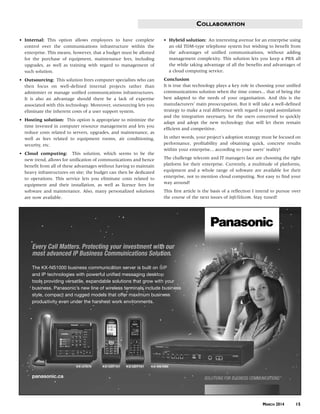
Every Call Matters. Protecting your investment with our
most advanced IP Business Communications Solution.
The KX-NS1000 business communication server is built on SIP
and IP technologies with powerful unified messaging desktop
tools providing versatile, expandable solutions that grow with your
business. Panasonic’s new line of wireless terminals include business
style, compact and rugged models that offer maximum business
productivity even under the harshest work environments.
panasonic.ca SOLUTIONS FOR BUSINESS COMMUNICATIONS
KX-UDT131KX-UDT121 KX-NS1000KX-UT670
42825zx_infotel-9 3/12/14 9:14 AM Page 15

Communications... Unified or Not?

  • 1.
    T ShoreTel’s Enterprise Contact Center Version9 ShoreTel just made available its newest Contact Center release with new features. Some highlights: • The Multi- interaction capability will allow agents to handle simultaneous interactions • Agents can now enter multiple Wrap Codes on a single transaction Current customers can directly upgrade to ECC 9 from ECC 7 or 8. COLLABORATION ver the course of the last decade, especially with the emergence of SIP, we can say unified communications have been propelled to the forefront. Still, many enterprises are still resistant to this major evolution in the telecommunications industry. So, faced with this surprising fact, we should question ourselves as to the reasons for this apparent “resistance”. Why? Where does the telecommunications industry stand on this issue? And in which direction is the situation evolving? Most of all, how are an organisation and its members and executives supposed to find their way and position themselves, with regard to their respective needs, at the heart of this industry which evolves so quickly that it’s hard to keep up, even at the simpler levels, for example terminology-wise. Unified communications? UC? Collaboration? Immersive communications? Here’s a topic that warrants reflection... It is nevertheless a well-established fact that, at this stage of technological evolution, everything each one of us uses to communicate could be “unified into a single, unique user interface”. However, we currently realize that this vision, which, at first glance, seems so simple and theoretically so efficient, is difficult to implement since efforts within the industry are divided and remain basically focused on equipment per se, too often at the expense of the user’s experience! The user Up until now, we have observed in the telecommunications industry that each equipment manufacturer has developed its own unified communications solution which interacts only within the same organisation: We can see a minimum of compatibility with other platforms. There still does not exist today an unified communications platform that is perfectly adapted to inter-company e-commerce. Unfortunately, such a context distances us from the user’s daily reality. And though it may be relevant to look at communications in their “global” sense, sooner or later, it will become imperative to “unify” everything in order to better adapt to the real needs of each individual (major element for the enterprise), in line with and in consideration of one’s personal, professional and social organisation. Technology: open? Before choosing a solution, a serious evaluation of the compatibility between different manufacturers is required. In fact, in almost every case, compatibility requires adding equipment whose role it is to translate and harmonize the different technologies developed by each manufacturer. However, the adoption of cloud computing services efficiently closes this gap and ultimately provides the organisation with access to reliable, safe content. Such a solution allows the user to access unified communications applications to accomplish any task, whenever needed, anytime and from any location, by choosing the most appropriate method. Especially in the area of videoconferencing, the majority of manufacturers use encoders and proprietary algorithms that require one or more bridges to offer video compatibility. It still remains difficult to predict when we will be able to benefit from a complete line of devices offering video, without having to invest in multiple infrastructure components to obtain safe, reliable connections with users outside the enterprise. The solution? More and more, “unified” communications are set forth as the ideal solution to eventually make all the existent barriers between devices, operating systems and networks disappear. From my viewpoint specialized in visual communications, it is obvious that adding presence, unified messaging and voice improves the video experience, making it almost real. It is now possible for users to maximize a business meeting by using high definition videoconferencing devices, without having to resort to the use of independent devices for voice and messaging. One thing is certain, considering the multitude of options available today in the unified and mobility communications sector, creating a proper environment for the team to be successful, thus contributing to the success of the enterprise, has never been so close at hand! What about your organisation? What would be the best option for your enterprise? 14 MARCH 2014 COMMUNICATIONS… Unified or Not? MAURICE DUCHESNE Maurice Duchesne has been working in telecommunications since 1987, and has presented at numerous conferences on the advantages of IP telephony for enterprises. Since 2008, he has helped organizations to implement videoconferencing and collaboration solutions. He is also a member of the Community of Telecommunications Consultants (CTC). Maurice can be reached (514) 317-9391 or at Maurice_Duchesne@cgoCable.ca. O 42825zx_infotel-9 3/12/14 11:22 AM Page 14
  • 2.
    COLLABORATION • Internal: Thisoption allows employees to have complete control over the communications infrastructure within the enterprise. This means, however, that a budget must be allotted for the purchase of equipment, maintenance fees, including upgrades, as well as training with regard to management of such solution. • Outsourcing: This solution frees computer specialists who can then focus on well-defined internal projects rather than administer or manage unified communications infrastructures. It is also an advantage should there be a lack of expertise associated with this technology. Moreover, outsourcing lets you eliminate the inherent costs of a user support system. • Hosting solution: This option is appropriate to minimize the time invested in computer resource management and lets you reduce costs related to servers, upgrades, and maintenance, as well as fees related to equipment rooms, air conditioning, security, etc. • Cloud computing: This solution, which seems to be the new trend, allows for unification of communications and hence benefit from all of these advantages without having to maintain heavy infrastructures on site; the budget can then be dedicated to operations. This service lets you eliminate costs related to equipment and their installation, as well as licence fees for software and maintenance. Also, many personalized solutions are now available. • Hybrid solution: An interesting avenue for an enterprise using an old TDM-type telephone system but wishing to benefit from the advantages of unified communications, without adding management complexity. This solution lets you keep a PBX all the while taking advantage of all the benefits and advantages of a cloud computing service. Conclusion It is true that technology plays a key role in choosing your unified communications solution when the time comes... that of being the best adapted to the needs of your organisation. And this is the manufacturers’ main preoccupation. But it will take a well-defined strategy to make a real difference with regard to rapid assimilation and the integration necessary, for the users concerned to quickly adapt and adopt the new technology that will let them remain efficient and competitive. In other words, your project’s adoption strategy must be focused on performance, profitability and obtaining quick, concrete results within your enterprise... according to your users’ reality! The challenge telecom and IT managers face are choosing the right platform for their enterprise. Currently, a multitude of platforms, equipment and a whole range of software are available for their enterprise, not to mention cloud computing. Not easy to find your way around! This first article is the basis of a reflection I intend to pursue over the course of the next issues of InfoTelecom. Stay tuned! MARCH 2014 15 Every Call Matters. Protecting your investment with our most advanced IP Business Communications Solution. The KX-NS1000 business communication server is built on SIP and IP technologies with powerful unified messaging desktop tools providing versatile, expandable solutions that grow with your business. Panasonic’s new line of wireless terminals include business style, compact and rugged models that offer maximum business productivity even under the harshest work environments. panasonic.ca SOLUTIONS FOR BUSINESS COMMUNICATIONS KX-UDT131KX-UDT121 KX-NS1000KX-UT670 42825zx_infotel-9 3/12/14 9:14 AM Page 15