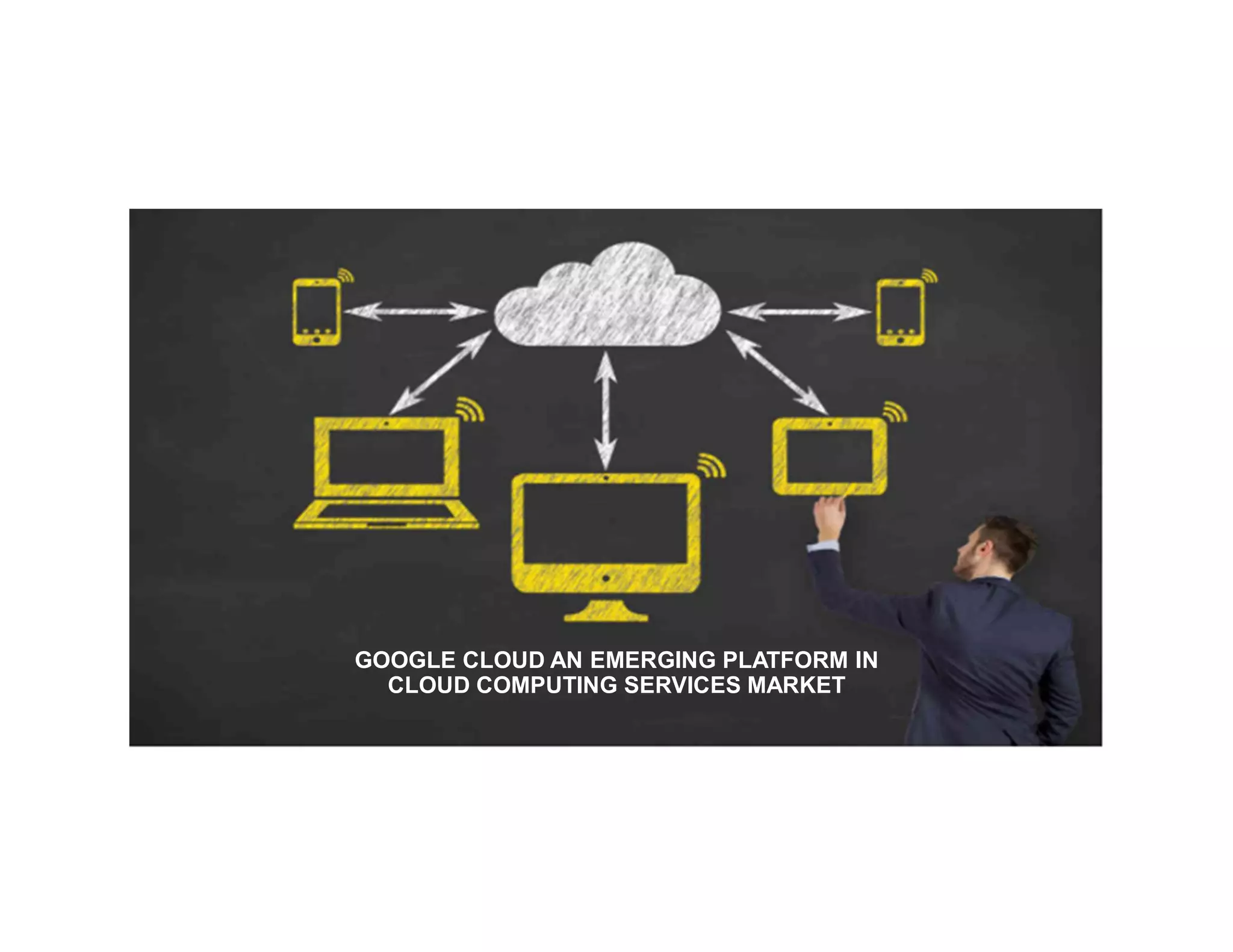
GOOGLE CLOUD AN EMERGING PLATFORM IN
CLOUD COMPUTING SERVICES MARKET
Table of Contents
• Cloud Computing Services Market Overview
• Key Trends in Cloud Computing Services Market
• Google Cloud Platform Overview
• Google Cloud Platform Solutions
• Microsoft Azure Cloud Overview
• Advantages of Google Cloud over Microsoft Azure
GOOGLE CLOUD AN EMERGING PLATFORM IN CLOUD COMPUTING SERVICES MARKET
CLOUD COMPUTING SERVICES MARKET OVERVIEW
• Cloud Computing is the practice of sharing a network of remote servers which are hosted on the Internet to store, process, and manage
data rather than on a local server or a personal computer. It specifically refers to a common storage space through which all the devices in the
network can access data simultaneously. The cloud services market size was valued at $264.80 billion in 2019, and is projected to reach $927.51
billion by 2027, growing at a CAGR of 16.4% from 2020 to 2027.
Sources: Allied Market Research > Cloud Computing Services Market; Kinsta > Cloud Market Share; Allied Market Research > Industry Forecast, 2020–2027
• Cloud Computing Technology Market Analysis by Services: The major services
provided by cloud computing technology are Infrastructure as a Service (IaaS), Platform
as a Service (PaaS), and Software as a Service (SaaS).
 Infrastructure as a Service (IaaS): IaaS is an offering of cloud computing where the
provider supplies you on-demand access to computing resources such as networking,
storage, and servers. Within the providers’ infrastructure, you run your own platforms
and applications.
 Platform as a Service (PaaS): PaaS is an offering of cloud computing where the
provider gives you access to a cloud environment in which to develop, manage, and
host applications. You will have access to a range of tools through the platform to
support testing and development.
 Software as a Service (SaaS): SaaS is an offering of cloud computing where the
provider gives you access to their cloud-based software. Instead of installing the
software application on your local device, you access the provider’s application using
the web or an API.
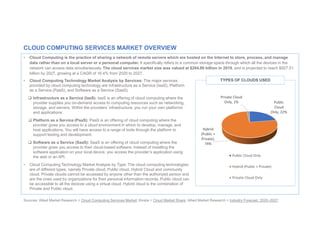
• Cloud Computing Technology Market Analysis by Type: The cloud computing technologies
are of different types, namely Private cloud, Public cloud, Hybrid Cloud and community
cloud. Private clouds cannot be accessed by anyone other than the authorized person and
are the ones used by organizations for their personal information records. Public cloud can
be accessible to all the devices using a virtual cloud. Hybrid cloud is the combination of
Private and Public cloud.
Public
Cloud
Only, 22%
Hybrid
(Public +
Private),
74%
Private Cloud
Only, 2%
Public Cloud Only
Hybrid (Public + Private)
Private Cloud Only
TYPES OF CLOUDS USED
CLOUD COMPUTING SERVICES MARKET OVERVIEW (CONTD.)
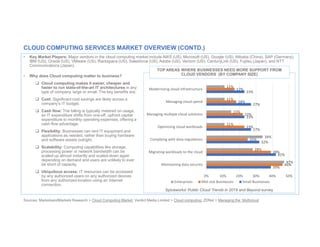
• Key Market Players: Major vendors in the cloud computing market include AWS (US), Microsoft (US), Google (US), Alibaba (China), SAP (Germany),
IBM (US), Oracle (US), VMware (US), Rackspace (US), Salesforce (US), Adobe (US), Verizon (US), CenturyLink (US), Fujitsu (Japan), and NTT
Communications (Japan).
Sources: MarketsandMarkets Research > Cloud Computing Market; Verdict Media Limited > Cloud computing; ZDNet > Managing the Multicloud
• Why does Cloud computing matter to business?
 Cloud computing makes it easier, cheaper and
faster to run state-of-the-art IT architectures in any
type of company, large or small. The key benefits are:
 Cost: Significant cost savings are likely across a
company’s IT budget.
 Cash flow: The billing is typically metered on usage,
so IT expenditure shifts from one-off, upfront capital
expenditure to monthly operating expenses, offering a
cash flow advantage.
 Flexibility: Businesses can rent IT equipment and
applications as needed, rather than buying hardware
and software assets outright.
 Scalability: Computing capabilities like storage,
processing power or network bandwidth can be
scaled-up almost instantly and scaled-down again
depending on demand and users are unlikely to ever
be short of capacity.
 Ubiquitous access: IT resources can be accessed
by any authorized users on any authorized devices
from any authorized location using an Internet
connection.
TOP AREAS WHERE BUSINESSES NEED MORE SUPPORT FROM
CLOUD VENDORS (BY COMPANY SIZE)
39%
42%
32%
27%
23%
27%
23%
46%
39%
25%
23%
22%
18%
17%
47%
28%
34%
11%
15%
11%
11%
0% 10% 20% 30% 40% 50%
Maintaining data security
Migrating workloads to the cloud
Complying with data regulations
Optimizing cloud workloads
Managing multiple cloud solutions
Managing cloud spend
Modernizing cloud infrastructure
Spiceworks' Public Cloud Trends in 2019 and Beyond survey
Enterprises Mid-size Businesses Small Businesses
• A few key trends are emerging for cloud computing in 2020 that have shifted from 2019, 2018, and 2017. At a high level:
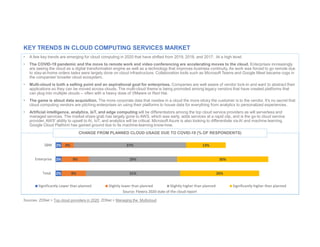
• The COVID-19 pandemic and the move to remote work and video conferencing are accelerating moves to the cloud. Enterprises increasingly
are seeing the cloud as a digital transformation engine as well as a technology that improves business continuity. As work was forced to go remote due
to stay-at-home orders tasks were largely done on cloud infrastructure. Collaboration tools such as Microsoft Teams and Google Meet became cogs in
the companies' broader cloud ecosystem.
• Multi-cloud is both a selling point and an aspirational goal for enterprises. Companies are well aware of vendor lock-in and want to abstract their
applications so they can be moved across clouds. The multi-cloud theme is being promoted among legacy vendors that have created platforms that
can plug into multiple clouds -- often with a heavy dose of VMware or Red Hat.
• The game is about data acquisition. The more corporate data that resides in a cloud the more sticky the customer is to the vendor. It's no secret that
cloud computing vendors are pitching enterprises on using their platforms to house data for everything from analytics to personalized experiences.
• Artificial intelligence, analytics, IoT, and edge computing will be differentiators among the top cloud service providers as will serverless and
managed services. The market share grab has largely gone to AWS, which was early, adds services at a rapid clip, and is the go-to cloud service
provider. AWS' ability to upsell to AI, IoT, and analytics will be critical. Microsoft Azure is also looking to differentiate via AI and machine learning.
Google Cloud Platform has gained ground due to its machine-learning know-how.
KEY TRENDS IN CLOUD COMPUTING SERVICES MARKET
Sources: ZDNet > Top cloud providers in 2020; ZDNet > Managing the Multicloud
CHANGE FROM PLANNED CLOUD USAGE DUE TO COVID-19 (% OF RESPONDENTS)
2%
2%
2%
8%
9%
4%
31%
29%
37%
26%
30%
13%
Total
Enterprise
SBM
Source: Flexera 2020 state of the cloud report
Significantly Lower than planned Slightly lower than planned Slightly higher than planned Significantly higher than planned
GOOGLE CLOUD PLATFORM
GOOGLE CLOUD PLATFORM OVERVIEW
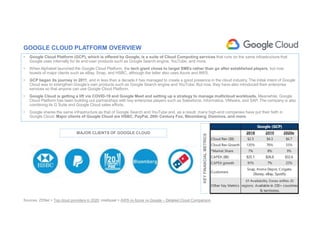
• Google Cloud Platform (GCP), which is offered by Google, is a suite of Cloud Computing services that runs on the same infrastructure that
Google uses internally for its end-user products such as Google Search engine, YouTube, and more.
• When Alphabet launched the Google Cloud Platform, the tech giant chose to target SMEs rather than go after established players, but now
boasts of major clients such as eBay, Snap, and HSBC, although the latter also uses Azure and AWS.
• GCP began its journey in 2011, and in less than a decade it has managed to create a good presence in the cloud industry. The initial intent of Google
Cloud was to strengthen Google’s own products such as Google Search engine and YouTube. But now, they have also introduced their enterprise
services so that anyone can use Google Cloud Platform.
• Google Cloud is getting a lift via COVID-19 and Google Meet and setting up a strategy to manage multicloud workloads. Meanwhile, Google
Cloud Platform has been building out partnerships with key enterprise players such as Salesforce, Informatica, VMware, and SAP. The company is also
combining its G Suite and Google Cloud sales efforts.
• Google shares the same infrastructure as that of Google Search and YouTube and, as a result, many high-end companies have put their faith in
Google Cloud. Major clients of Google Cloud are HSBC, PayPal, 20th Century Fox, Bloomberg, Dominos, and more.
Sources: ZDNet > Top cloud providers in 2020; intellipaat > AWS vs Azure vs Google – Detailed Cloud Comparison
MAJOR CLIENTS OF GOOGLE CLOUD
KEYFINANCIALMETRICS
Sources: TechRepublic > Google Cloud Platform: A cheat sheet
GOOGLE CLOUD PLATFORM SOLUTIONS
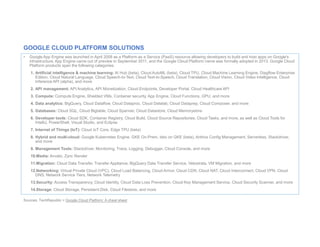
• Google App Engine was launched in April 2008 as a Platform as a Service (PaaS) resource allowing developers to build and host apps on Google's
infrastructure. App Engine came out of preview in September 2011, and the Google Cloud Platform name was formally adopted in 2013. Google Cloud
Platform products span the following categories:
1. Artificial intelligence & machine learning: AI Hub (beta), Cloud AutoML (beta), Cloud TPU, Cloud Machine Learning Engine, Diagflow Enterprise
Edition, Cloud Natural Language, Cloud Speech-to-Text, Cloud Text-to-Speech, Cloud Translation, Cloud Vision, Cloud Video Intelligence, Cloud
Inference API (alpha), and more
2. API management: API Analytics, API Monetization, Cloud Endpoints, Developer Portal, Cloud Healthcare API
3. Compute: Compute Engine, Shielded VMs, Container security, App Engine, Cloud Functions, GPU, and more
4. Data analytics: BigQuery, Cloud Dataflow, Cloud Dataproc, Cloud Datalab, Cloud Dataprep, Cloud Composer, and more
5. Databases: Cloud SQL, Cloud Bigtable, Cloud Spanner, Cloud Datastore, Cloud Memorystore
6. Developer tools: Cloud SDK, Container Registry, Cloud Build, Cloud Source Repositories, Cloud Tasks, and more, as well as Cloud Tools for
IntelliJ, PowerShell, Visual Studio, and Eclipse
7. Internet of Things (IoT): Cloud IoT Core, Edge TPU (beta)
8. Hybrid and multi-cloud: Google Kubernetes Engine, GKE On-Prem, Istio on GKE (beta), Anthos Config Management, Serverless, Stackdriver,
and more
9. Management Tools: Stackdriver, Monitoring, Trace, Logging, Debugger, Cloud Console, and more
10.Media: Anvato, Zync Render
11.Migration: Cloud Data Transfer, Transfer Appliance, BigQuery Data Transfer Service, Velostrata, VM Migration, and more
12.Networking: Virtual Private Cloud (VPC), Cloud Load Balancing, Cloud Armor, Cloud CDN, Cloud NAT, Cloud Interconnect, Cloud VPN, Cloud
DNS, Network Service Tiers, Network Telemetry
13.Security: Access Transparency, Cloud Identity, Cloud Data Loss Prevention, Cloud Key Management Service, Cloud Security Scanner, and more
14.Storage: Cloud Storage, Persistent Disk, Cloud Filestore, and more
MICROSOFT AZURE CLOUD
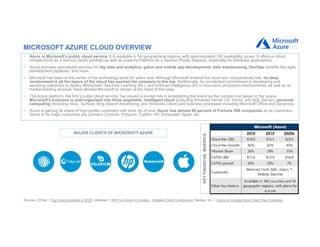
• Azure is Microsoft’s public cloud service. It is available in 54 geographical regions, with approximately 162 availability zones. It offers a robust
Infrastructure as a Service (IaaS) portfolio as well as powerful Platform as a Service (PaaS) features, especially for Windows applications.
• Azure provides specialized services for big data and analytics, game and mobile app development, data warehousing, DevOps benefits like agile
development pipelines, and more.
• Microsoft has been at the center of the technology world for years now. Although Microsoft entered the cloud war comparatively late, its deep
involvement in all the layers of the cloud has pushed the company to the top. Additionally, its unmatched commitment to developing and
assisting customers to deploy Blockchain, Machine Learning (ML), and Artificial Intelligence (AI) in innovative production environments, as well as its
market-leading revenue, have allowed Microsoft to remain at the head of the heap.
• The Azure platform, the firm’s public cloud service, has played a pivotal role in establishing the brand as the number one player in the space.
Microsoft’s business is well-organized into three segments: intelligent cloud (including Windows Server OS, Azure, and SQL Server), personal
computing (including Xbox, Surface, Bing Search Advertising, and Windows Client) and business processes including Microsoft Office and Dynamics.
• Azure is gaining its share of high-profile customers with time. As of now, Azure has almost 80 percent of Fortune 500 companies as its customers.
Some of its major customers are Johnson Controls, Polycom, Fujifilm, HP, Honeywell, Apple, etc.
Sources: ZDNet > Top cloud providers in 2020; intellipaat > AWS vs Azure vs Google – Detailed Cloud Comparison; NetApp, Inc. > Azure vs Google Cloud: How They Compare.
KEYFINANCIALMAERICS
MAJOR CLIENTS OF MICROSOFT AZURE
MICROSOFT AZURE CLOUD OVERVIEW
Sources: Kinsta > Top 7 Advantages of Choosing Google Cloud Hosting; ITPro Today > Google Cloud Platform Benefits: How GCP Differs from Azure
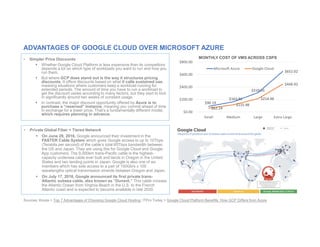
• Simpler Price Discounts
 Whether Google Cloud Platform is less expensive than its competitors
depends a lot on which type of workloads you want to run and how you
run them.
 But where GCP does stand out is the way it structures pricing
discounts. It offers discounts based on what it calls sustained use,
meaning situations where customers keep a workload running for
extended periods. The amount of time you have to run a workload to
get the discount varies according to many factors, but they start to kick
in significantly around two weeks of constant usage.
 In contrast, the major discount opportunity offered by Azure is to
purchase a “reserved” instance, meaning you commit ahead of time
in exchange for a lower price. That’s a fundamentally different model,
which requires planning in advance.
ADVANTAGES OF GOOGLE CLOUD OVER MICROSOFT AZURE
$90.19
$163.92
$310.65
$652.02
$62.24
$115.98
$214.96
$446.92
$0.00
$200.00
$400.00
$600.00
$800.00
Small Medium Large Extra Large
MONTHLY COST OF VMS ACROSS CSPS
Microsoft Azure Google Cloud
• Private Global Fiber + Tiered Network
 On June 29, 2016, Google announced their investment in the
FASTER Cable System which gives Google access to up to 10Tbps
(Terabits per second) of the cable’s total 60Tbps bandwidth between
the US and Japan. They are using this for Google Cloud and Google
App customers. The 9,000km trans-Pacific cable is the highest-
capacity undersea cable ever built and lands in Oregon in the United
States and two landing points in Japan. Google is also one of six
members which has sole access to a pair of 100Gb/s x 100
wavelengths optical transmission strands between Oregon and Japan.
 On July 17, 2018, Google announced its first private trans-
Atlantic subsea cable, also known as “Dunant.” This cable crosses
the Atlantic Ocean from Virginia Beach in the U.S. to the French
Atlantic coast and is expected to become available in late 2020.
Sources: Kinsta > Top 7 Advantages of Choosing Google Cloud Hosting; ITPro Today > Google Cloud Platform Benefits: How GCP Differs from Azure
• State of the Art Security:
• Another big advantage is security. Choosing Google Cloud Platform means you get the benefit of a security model that has been built upon
over the course of 15 years, and currently secures products and services like Gmail, Search, etc. Google currently employs more than 500 full-time
security professionals.
• Some of Google Cloud Platform security features include:
 All data is encrypted in transit between Google, the customers, and data centers; as well as the data in all of the Cloud Platform services.
The data stored on persistent disks is encrypted under 256-bit AES and each encryption key is also encrypted with a set of regularly changed
master keys.
 The layers of the Google application and storage stack require that requests coming from other components are authenticated and
authorized.
 Because Google has relationships with some of the biggest ISPs in the world, this helps improve the security of your data in transit as it
means fewer hops across the public internet.
 Commitment to enterprise security certifications with regular audits for SSAE16, ISO 27001, ISO 27017, ISO 27018, PCI, FedRAMP, and HIPAA
compliance.
ADVANTAGES OF GOOGLE CLOUD OVER MICROSOFT AZURE (CONTD.)
• Redundant Backups:
 Google Cloud Storage is designed for 99.999999999% durability and has 4 different types of storage: Coldline storage, nearline, regional
storage, and multi-regional storage.
 It stores data redundantly, with automatic checksums to ensure data integrity. The beauty of multi-regional storage is that it is also geo-
redundant, which means cloud storage stores your data redundantly in at least two regions within the multi-regional location of the bucket. As it
pertains to Google Cloud hosting, this ensures you will never lose your data, even in the case of a disaster.
Google cloud - solution deck

Google cloud - solution deck

  • 1.
    GOOGLE CLOUD ANEMERGING PLATFORM IN CLOUD COMPUTING SERVICES MARKET
  • 2.
    Table of Contents •Cloud Computing Services Market Overview • Key Trends in Cloud Computing Services Market • Google Cloud Platform Overview • Google Cloud Platform Solutions • Microsoft Azure Cloud Overview • Advantages of Google Cloud over Microsoft Azure GOOGLE CLOUD AN EMERGING PLATFORM IN CLOUD COMPUTING SERVICES MARKET
  • 3.
    CLOUD COMPUTING SERVICESMARKET OVERVIEW • Cloud Computing is the practice of sharing a network of remote servers which are hosted on the Internet to store, process, and manage data rather than on a local server or a personal computer. It specifically refers to a common storage space through which all the devices in the network can access data simultaneously. The cloud services market size was valued at $264.80 billion in 2019, and is projected to reach $927.51 billion by 2027, growing at a CAGR of 16.4% from 2020 to 2027. Sources: Allied Market Research > Cloud Computing Services Market; Kinsta > Cloud Market Share; Allied Market Research > Industry Forecast, 2020–2027 • Cloud Computing Technology Market Analysis by Services: The major services provided by cloud computing technology are Infrastructure as a Service (IaaS), Platform as a Service (PaaS), and Software as a Service (SaaS).  Infrastructure as a Service (IaaS): IaaS is an offering of cloud computing where the provider supplies you on-demand access to computing resources such as networking, storage, and servers. Within the providers’ infrastructure, you run your own platforms and applications.  Platform as a Service (PaaS): PaaS is an offering of cloud computing where the provider gives you access to a cloud environment in which to develop, manage, and host applications. You will have access to a range of tools through the platform to support testing and development.  Software as a Service (SaaS): SaaS is an offering of cloud computing where the provider gives you access to their cloud-based software. Instead of installing the software application on your local device, you access the provider’s application using the web or an API. • Cloud Computing Technology Market Analysis by Type: The cloud computing technologies are of different types, namely Private cloud, Public cloud, Hybrid Cloud and community cloud. Private clouds cannot be accessed by anyone other than the authorized person and are the ones used by organizations for their personal information records. Public cloud can be accessible to all the devices using a virtual cloud. Hybrid cloud is the combination of Private and Public cloud. Public Cloud Only, 22% Hybrid (Public + Private), 74% Private Cloud Only, 2% Public Cloud Only Hybrid (Public + Private) Private Cloud Only TYPES OF CLOUDS USED
  • 4.
    CLOUD COMPUTING SERVICESMARKET OVERVIEW (CONTD.) • Key Market Players: Major vendors in the cloud computing market include AWS (US), Microsoft (US), Google (US), Alibaba (China), SAP (Germany), IBM (US), Oracle (US), VMware (US), Rackspace (US), Salesforce (US), Adobe (US), Verizon (US), CenturyLink (US), Fujitsu (Japan), and NTT Communications (Japan). Sources: MarketsandMarkets Research > Cloud Computing Market; Verdict Media Limited > Cloud computing; ZDNet > Managing the Multicloud • Why does Cloud computing matter to business?  Cloud computing makes it easier, cheaper and faster to run state-of-the-art IT architectures in any type of company, large or small. The key benefits are:  Cost: Significant cost savings are likely across a company’s IT budget.  Cash flow: The billing is typically metered on usage, so IT expenditure shifts from one-off, upfront capital expenditure to monthly operating expenses, offering a cash flow advantage.  Flexibility: Businesses can rent IT equipment and applications as needed, rather than buying hardware and software assets outright.  Scalability: Computing capabilities like storage, processing power or network bandwidth can be scaled-up almost instantly and scaled-down again depending on demand and users are unlikely to ever be short of capacity.  Ubiquitous access: IT resources can be accessed by any authorized users on any authorized devices from any authorized location using an Internet connection. TOP AREAS WHERE BUSINESSES NEED MORE SUPPORT FROM CLOUD VENDORS (BY COMPANY SIZE) 39% 42% 32% 27% 23% 27% 23% 46% 39% 25% 23% 22% 18% 17% 47% 28% 34% 11% 15% 11% 11% 0% 10% 20% 30% 40% 50% Maintaining data security Migrating workloads to the cloud Complying with data regulations Optimizing cloud workloads Managing multiple cloud solutions Managing cloud spend Modernizing cloud infrastructure Spiceworks' Public Cloud Trends in 2019 and Beyond survey Enterprises Mid-size Businesses Small Businesses
  • 5.
    • A fewkey trends are emerging for cloud computing in 2020 that have shifted from 2019, 2018, and 2017. At a high level: • The COVID-19 pandemic and the move to remote work and video conferencing are accelerating moves to the cloud. Enterprises increasingly are seeing the cloud as a digital transformation engine as well as a technology that improves business continuity. As work was forced to go remote due to stay-at-home orders tasks were largely done on cloud infrastructure. Collaboration tools such as Microsoft Teams and Google Meet became cogs in the companies' broader cloud ecosystem. • Multi-cloud is both a selling point and an aspirational goal for enterprises. Companies are well aware of vendor lock-in and want to abstract their applications so they can be moved across clouds. The multi-cloud theme is being promoted among legacy vendors that have created platforms that can plug into multiple clouds -- often with a heavy dose of VMware or Red Hat. • The game is about data acquisition. The more corporate data that resides in a cloud the more sticky the customer is to the vendor. It's no secret that cloud computing vendors are pitching enterprises on using their platforms to house data for everything from analytics to personalized experiences. • Artificial intelligence, analytics, IoT, and edge computing will be differentiators among the top cloud service providers as will serverless and managed services. The market share grab has largely gone to AWS, which was early, adds services at a rapid clip, and is the go-to cloud service provider. AWS' ability to upsell to AI, IoT, and analytics will be critical. Microsoft Azure is also looking to differentiate via AI and machine learning. Google Cloud Platform has gained ground due to its machine-learning know-how. KEY TRENDS IN CLOUD COMPUTING SERVICES MARKET Sources: ZDNet > Top cloud providers in 2020; ZDNet > Managing the Multicloud CHANGE FROM PLANNED CLOUD USAGE DUE TO COVID-19 (% OF RESPONDENTS) 2% 2% 2% 8% 9% 4% 31% 29% 37% 26% 30% 13% Total Enterprise SBM Source: Flexera 2020 state of the cloud report Significantly Lower than planned Slightly lower than planned Slightly higher than planned Significantly higher than planned
  • 6.
  • 7.
    GOOGLE CLOUD PLATFORMOVERVIEW • Google Cloud Platform (GCP), which is offered by Google, is a suite of Cloud Computing services that runs on the same infrastructure that Google uses internally for its end-user products such as Google Search engine, YouTube, and more. • When Alphabet launched the Google Cloud Platform, the tech giant chose to target SMEs rather than go after established players, but now boasts of major clients such as eBay, Snap, and HSBC, although the latter also uses Azure and AWS. • GCP began its journey in 2011, and in less than a decade it has managed to create a good presence in the cloud industry. The initial intent of Google Cloud was to strengthen Google’s own products such as Google Search engine and YouTube. But now, they have also introduced their enterprise services so that anyone can use Google Cloud Platform. • Google Cloud is getting a lift via COVID-19 and Google Meet and setting up a strategy to manage multicloud workloads. Meanwhile, Google Cloud Platform has been building out partnerships with key enterprise players such as Salesforce, Informatica, VMware, and SAP. The company is also combining its G Suite and Google Cloud sales efforts. • Google shares the same infrastructure as that of Google Search and YouTube and, as a result, many high-end companies have put their faith in Google Cloud. Major clients of Google Cloud are HSBC, PayPal, 20th Century Fox, Bloomberg, Dominos, and more. Sources: ZDNet > Top cloud providers in 2020; intellipaat > AWS vs Azure vs Google – Detailed Cloud Comparison MAJOR CLIENTS OF GOOGLE CLOUD KEYFINANCIALMETRICS
  • 8.
    Sources: TechRepublic >Google Cloud Platform: A cheat sheet GOOGLE CLOUD PLATFORM SOLUTIONS • Google App Engine was launched in April 2008 as a Platform as a Service (PaaS) resource allowing developers to build and host apps on Google's infrastructure. App Engine came out of preview in September 2011, and the Google Cloud Platform name was formally adopted in 2013. Google Cloud Platform products span the following categories: 1. Artificial intelligence & machine learning: AI Hub (beta), Cloud AutoML (beta), Cloud TPU, Cloud Machine Learning Engine, Diagflow Enterprise Edition, Cloud Natural Language, Cloud Speech-to-Text, Cloud Text-to-Speech, Cloud Translation, Cloud Vision, Cloud Video Intelligence, Cloud Inference API (alpha), and more 2. API management: API Analytics, API Monetization, Cloud Endpoints, Developer Portal, Cloud Healthcare API 3. Compute: Compute Engine, Shielded VMs, Container security, App Engine, Cloud Functions, GPU, and more 4. Data analytics: BigQuery, Cloud Dataflow, Cloud Dataproc, Cloud Datalab, Cloud Dataprep, Cloud Composer, and more 5. Databases: Cloud SQL, Cloud Bigtable, Cloud Spanner, Cloud Datastore, Cloud Memorystore 6. Developer tools: Cloud SDK, Container Registry, Cloud Build, Cloud Source Repositories, Cloud Tasks, and more, as well as Cloud Tools for IntelliJ, PowerShell, Visual Studio, and Eclipse 7. Internet of Things (IoT): Cloud IoT Core, Edge TPU (beta) 8. Hybrid and multi-cloud: Google Kubernetes Engine, GKE On-Prem, Istio on GKE (beta), Anthos Config Management, Serverless, Stackdriver, and more 9. Management Tools: Stackdriver, Monitoring, Trace, Logging, Debugger, Cloud Console, and more 10.Media: Anvato, Zync Render 11.Migration: Cloud Data Transfer, Transfer Appliance, BigQuery Data Transfer Service, Velostrata, VM Migration, and more 12.Networking: Virtual Private Cloud (VPC), Cloud Load Balancing, Cloud Armor, Cloud CDN, Cloud NAT, Cloud Interconnect, Cloud VPN, Cloud DNS, Network Service Tiers, Network Telemetry 13.Security: Access Transparency, Cloud Identity, Cloud Data Loss Prevention, Cloud Key Management Service, Cloud Security Scanner, and more 14.Storage: Cloud Storage, Persistent Disk, Cloud Filestore, and more
  • 9.
  • 10.
    • Azure isMicrosoft’s public cloud service. It is available in 54 geographical regions, with approximately 162 availability zones. It offers a robust Infrastructure as a Service (IaaS) portfolio as well as powerful Platform as a Service (PaaS) features, especially for Windows applications. • Azure provides specialized services for big data and analytics, game and mobile app development, data warehousing, DevOps benefits like agile development pipelines, and more. • Microsoft has been at the center of the technology world for years now. Although Microsoft entered the cloud war comparatively late, its deep involvement in all the layers of the cloud has pushed the company to the top. Additionally, its unmatched commitment to developing and assisting customers to deploy Blockchain, Machine Learning (ML), and Artificial Intelligence (AI) in innovative production environments, as well as its market-leading revenue, have allowed Microsoft to remain at the head of the heap. • The Azure platform, the firm’s public cloud service, has played a pivotal role in establishing the brand as the number one player in the space. Microsoft’s business is well-organized into three segments: intelligent cloud (including Windows Server OS, Azure, and SQL Server), personal computing (including Xbox, Surface, Bing Search Advertising, and Windows Client) and business processes including Microsoft Office and Dynamics. • Azure is gaining its share of high-profile customers with time. As of now, Azure has almost 80 percent of Fortune 500 companies as its customers. Some of its major customers are Johnson Controls, Polycom, Fujifilm, HP, Honeywell, Apple, etc. Sources: ZDNet > Top cloud providers in 2020; intellipaat > AWS vs Azure vs Google – Detailed Cloud Comparison; NetApp, Inc. > Azure vs Google Cloud: How They Compare. KEYFINANCIALMAERICS MAJOR CLIENTS OF MICROSOFT AZURE MICROSOFT AZURE CLOUD OVERVIEW
  • 12.
    Sources: Kinsta >Top 7 Advantages of Choosing Google Cloud Hosting; ITPro Today > Google Cloud Platform Benefits: How GCP Differs from Azure • Simpler Price Discounts  Whether Google Cloud Platform is less expensive than its competitors depends a lot on which type of workloads you want to run and how you run them.  But where GCP does stand out is the way it structures pricing discounts. It offers discounts based on what it calls sustained use, meaning situations where customers keep a workload running for extended periods. The amount of time you have to run a workload to get the discount varies according to many factors, but they start to kick in significantly around two weeks of constant usage.  In contrast, the major discount opportunity offered by Azure is to purchase a “reserved” instance, meaning you commit ahead of time in exchange for a lower price. That’s a fundamentally different model, which requires planning in advance. ADVANTAGES OF GOOGLE CLOUD OVER MICROSOFT AZURE $90.19 $163.92 $310.65 $652.02 $62.24 $115.98 $214.96 $446.92 $0.00 $200.00 $400.00 $600.00 $800.00 Small Medium Large Extra Large MONTHLY COST OF VMS ACROSS CSPS Microsoft Azure Google Cloud • Private Global Fiber + Tiered Network  On June 29, 2016, Google announced their investment in the FASTER Cable System which gives Google access to up to 10Tbps (Terabits per second) of the cable’s total 60Tbps bandwidth between the US and Japan. They are using this for Google Cloud and Google App customers. The 9,000km trans-Pacific cable is the highest- capacity undersea cable ever built and lands in Oregon in the United States and two landing points in Japan. Google is also one of six members which has sole access to a pair of 100Gb/s x 100 wavelengths optical transmission strands between Oregon and Japan.  On July 17, 2018, Google announced its first private trans- Atlantic subsea cable, also known as “Dunant.” This cable crosses the Atlantic Ocean from Virginia Beach in the U.S. to the French Atlantic coast and is expected to become available in late 2020.
  • 13.
    Sources: Kinsta >Top 7 Advantages of Choosing Google Cloud Hosting; ITPro Today > Google Cloud Platform Benefits: How GCP Differs from Azure • State of the Art Security: • Another big advantage is security. Choosing Google Cloud Platform means you get the benefit of a security model that has been built upon over the course of 15 years, and currently secures products and services like Gmail, Search, etc. Google currently employs more than 500 full-time security professionals. • Some of Google Cloud Platform security features include:  All data is encrypted in transit between Google, the customers, and data centers; as well as the data in all of the Cloud Platform services. The data stored on persistent disks is encrypted under 256-bit AES and each encryption key is also encrypted with a set of regularly changed master keys.  The layers of the Google application and storage stack require that requests coming from other components are authenticated and authorized.  Because Google has relationships with some of the biggest ISPs in the world, this helps improve the security of your data in transit as it means fewer hops across the public internet.  Commitment to enterprise security certifications with regular audits for SSAE16, ISO 27001, ISO 27017, ISO 27018, PCI, FedRAMP, and HIPAA compliance. ADVANTAGES OF GOOGLE CLOUD OVER MICROSOFT AZURE (CONTD.) • Redundant Backups:  Google Cloud Storage is designed for 99.999999999% durability and has 4 different types of storage: Coldline storage, nearline, regional storage, and multi-regional storage.  It stores data redundantly, with automatic checksums to ensure data integrity. The beauty of multi-regional storage is that it is also geo- redundant, which means cloud storage stores your data redundantly in at least two regions within the multi-regional location of the bucket. As it pertains to Google Cloud hosting, this ensures you will never lose your data, even in the case of a disaster.