Trends in
Cloud
Computing
REMINDER: The complete 36-page Trends in Cloud Computing report can be
viewed free of charge at CompTIA.org (with simple registration)
Copyright (c) 2016 CompTIA Properties, LLC. All Rights Reserved. | CompTIA.org
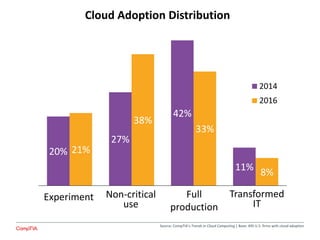
20%
27%
42%
11%
21%
38%
33%
8%
2014
2016
Cloud Adoption Distribution
Experiment Non-critical
use
Transformed
IT
Full
production
Source: CompTIA’s Trends in Cloud Computing | Base: 495 U.S. firms with cloud adoption
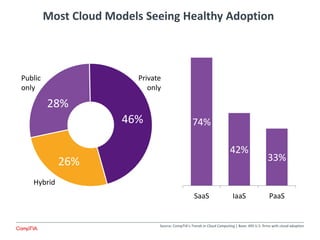
28%
46%
26%
Most Cloud Models Seeing Healthy Adoption
Source: CompTIA’s Trends in Cloud Computing | Base: 495 U.S. firms with cloud adoption
Public
only
Private
only
Hybrid
74%
42%
33%
SaaS IaaS PaaS
Benefits of Cloud
15%
19%
28%
20%
24%
28%
23%
29%
33%
39%
42%
41%
25%
24%
25%
31%
35%
35%
40%
35%
37%
41%
43%
44%
21%
27%
21%
28%
29%
30%
35%
33%
29%
35%
34%
47%
Reduction in internal IT headcount
Creating new offerings or services
Business unit independence
Predictable, subscription-based pricing
New capabilities or features
New software licensing/upgrade model
Modernization of legacy IT environments
Simplicity or speed
Reduce operational complexity
Reduce capital expenditures
Cloud solution was simply better option
Ability to cut costs
Large
Medium
Small
Source: CompTIA’s Trends in Cloud Computing | Base: 495 U.S. firms with cloud adoption
Cloud Adoption Progression
Education
IaaS | PaaS | SaaS
Experiment Non-critical Use Full Production Transformed IT
Public Clouds
Private |Hybrid
Proof of concept
Security
Payment models
Transition
Integration
Policy/Procedure
Provider switching
Workflow change
Customization
Source: CompTIA
24%
44%
25%
8%
22%
30%
40%
8%
16%
36%
39%
9%
Large
Medium
Small
Adoption Progress By Company Size
Experiment Non-critical
Use
Transformed
IT
Full
Production
NET:
21%
NET:
38%
NET:
33%
NET:
8%
Source: CompTIA’s Trends in Cloud Computing | Base: 495 U.S. firms with cloud adoption
Many Companies Making Secondary Migrations
Public Cloud
Provider #1 Public Cloud
Provider #2
Private
Cloud
On-premise
System
Company ABC
21%
18%
43%
Source: CompTIA’s Trends in Cloud Computing | Base: 495 U.S. firms with cloud adoption
Application Locations
Cloud On-premise
Email 51% 47%
Web presence 46% 39%
Business productivity 45% 46%
Collaboration 39% 36%
CRM 37% 33%
Analytics/BI 35% 40%
Financial management 32% 60%
VoIP 31% 41%
Virtual desktop 30% 38%
HR management 29% 45%
Help desk 29% 40%
Expense management 29% 41%
ERP 26% 34%
Call Center 23% 39%
Source: CompTIA’s Trends in Cloud Computing | Base: 495 U.S. firms with cloud adoption
Source: CompTIA’s 5th Annual Trends in Cloud Computing | Base: 366 U.S. firms using cloud computing
29%
29%
29%
Difficulty in Moving from Stage to Stage
Experiment
Non-critical
Use
Non-critical
Use
Full
Production
Full
Production
Transformed
IT
35%52%
40%39%
34%37%
Typical/low effort Moderate effort Significant effort
13%
21%
29%
Source: CompTIA’s Trends in Cloud Computing | Base: 495 U.S. firms with cloud adoption
Procurement of SaaS Applications
IT LOB
Email 67% 28%
Web presence 62% 34%
Business productivity 64% 32%
Collaboration 65% 27%
CRM 61% 35%
Analytics/BI 62% 34%
Financial management 42% 54%
VoIP 68% 26%
Virtual desktop 69% 26%
HR management 44% 51%
Help desk 60% 34%
Expense management 53% 43%
ERP 58% 34%
Call Center 56% 42%
Source: CompTIA’s Trends in Cloud Computing | Base: 440 U.S. firms with SaaS applications
Source: CompTIA’s 5th Annual Trends in Cloud Computing | Base: 366 U.S. firms using cloud computing
40%
36%
14%10%
Final approval Consulting
Informed Not involved
Incidents Causing IT to Become
Involved
1. Integrating cloud solution
2. Security breach
3. Need to centralize technology
4. Availability of cloud solution
5. Incorrect operation
Rogue IT an Area to Watch for Many Companies
Source: CompTIA’s Trends in Cloud Computing | Base: 269 U.S. firms with line of business application procurement
IT Involvement when LOB procures
cloud application
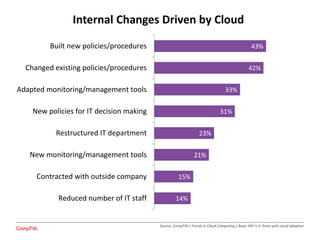
Internal Changes Driven by Cloud
14%
15%
21%
23%
31%
33%
42%
43%
Reduced number of IT staff
Contracted with outside company
New monitoring/management tools
Restructured IT department
New policies for IT decision making
Adapted monitoring/management tools
Changed existing policies/procedures
Built new policies/procedures
Source: CompTIA’s Trends in Cloud Computing | Base: 495 U.S. firms with cloud adoption
Thank You
Copyright (c) 2016 CompTIA Properties, LLC. All Rights Reserved. | CompTIA.org
REMINDER: The complete 36-page Trends in Cloud Computing report can be
viewed free of charge at CompTIA.org (with simple registration)

Trends in Cloud Computing 2016

  • 1.
    Trends in Cloud Computing REMINDER: Thecomplete 36-page Trends in Cloud Computing report can be viewed free of charge at CompTIA.org (with simple registration) Copyright (c) 2016 CompTIA Properties, LLC. All Rights Reserved. | CompTIA.org
  • 2.
    20% 27% 42% 11% 21% 38% 33% 8% 2014 2016 Cloud Adoption Distribution ExperimentNon-critical use Transformed IT Full production Source: CompTIA’s Trends in Cloud Computing | Base: 495 U.S. firms with cloud adoption
  • 3.
    28% 46% 26% Most Cloud ModelsSeeing Healthy Adoption Source: CompTIA’s Trends in Cloud Computing | Base: 495 U.S. firms with cloud adoption Public only Private only Hybrid 74% 42% 33% SaaS IaaS PaaS
  • 4.
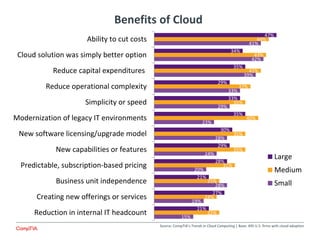
    Benefits of Cloud 15% 19% 28% 20% 24% 28% 23% 29% 33% 39% 42% 41% 25% 24% 25% 31% 35% 35% 40% 35% 37% 41% 43% 44% 21% 27% 21% 28% 29% 30% 35% 33% 29% 35% 34% 47% Reductionin internal IT headcount Creating new offerings or services Business unit independence Predictable, subscription-based pricing New capabilities or features New software licensing/upgrade model Modernization of legacy IT environments Simplicity or speed Reduce operational complexity Reduce capital expenditures Cloud solution was simply better option Ability to cut costs Large Medium Small Source: CompTIA’s Trends in Cloud Computing | Base: 495 U.S. firms with cloud adoption
  • 5.
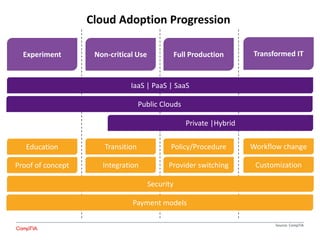
    Cloud Adoption Progression Education IaaS| PaaS | SaaS Experiment Non-critical Use Full Production Transformed IT Public Clouds Private |Hybrid Proof of concept Security Payment models Transition Integration Policy/Procedure Provider switching Workflow change Customization Source: CompTIA
  • 6.
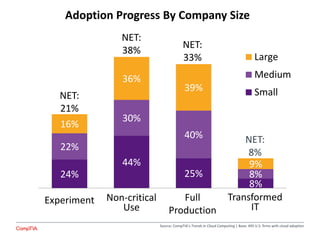
    24% 44% 25% 8% 22% 30% 40% 8% 16% 36% 39% 9% Large Medium Small Adoption Progress ByCompany Size Experiment Non-critical Use Transformed IT Full Production NET: 21% NET: 38% NET: 33% NET: 8% Source: CompTIA’s Trends in Cloud Computing | Base: 495 U.S. firms with cloud adoption
  • 7.
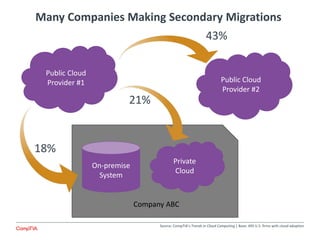
    Many Companies MakingSecondary Migrations Public Cloud Provider #1 Public Cloud Provider #2 Private Cloud On-premise System Company ABC 21% 18% 43% Source: CompTIA’s Trends in Cloud Computing | Base: 495 U.S. firms with cloud adoption
  • 8.
    Application Locations Cloud On-premise Email51% 47% Web presence 46% 39% Business productivity 45% 46% Collaboration 39% 36% CRM 37% 33% Analytics/BI 35% 40% Financial management 32% 60% VoIP 31% 41% Virtual desktop 30% 38% HR management 29% 45% Help desk 29% 40% Expense management 29% 41% ERP 26% 34% Call Center 23% 39% Source: CompTIA’s Trends in Cloud Computing | Base: 495 U.S. firms with cloud adoption Source: CompTIA’s 5th Annual Trends in Cloud Computing | Base: 366 U.S. firms using cloud computing
  • 9.
    29% 29% 29% Difficulty in Movingfrom Stage to Stage Experiment Non-critical Use Non-critical Use Full Production Full Production Transformed IT 35%52% 40%39% 34%37% Typical/low effort Moderate effort Significant effort 13% 21% 29% Source: CompTIA’s Trends in Cloud Computing | Base: 495 U.S. firms with cloud adoption
  • 10.
    Procurement of SaaSApplications IT LOB Email 67% 28% Web presence 62% 34% Business productivity 64% 32% Collaboration 65% 27% CRM 61% 35% Analytics/BI 62% 34% Financial management 42% 54% VoIP 68% 26% Virtual desktop 69% 26% HR management 44% 51% Help desk 60% 34% Expense management 53% 43% ERP 58% 34% Call Center 56% 42% Source: CompTIA’s Trends in Cloud Computing | Base: 440 U.S. firms with SaaS applications Source: CompTIA’s 5th Annual Trends in Cloud Computing | Base: 366 U.S. firms using cloud computing
  • 11.
    40% 36% 14%10% Final approval Consulting InformedNot involved Incidents Causing IT to Become Involved 1. Integrating cloud solution 2. Security breach 3. Need to centralize technology 4. Availability of cloud solution 5. Incorrect operation Rogue IT an Area to Watch for Many Companies Source: CompTIA’s Trends in Cloud Computing | Base: 269 U.S. firms with line of business application procurement IT Involvement when LOB procures cloud application
  • 12.
    Internal Changes Drivenby Cloud 14% 15% 21% 23% 31% 33% 42% 43% Reduced number of IT staff Contracted with outside company New monitoring/management tools Restructured IT department New policies for IT decision making Adapted monitoring/management tools Changed existing policies/procedures Built new policies/procedures Source: CompTIA’s Trends in Cloud Computing | Base: 495 U.S. firms with cloud adoption
  • 13.
    Thank You Copyright (c)2016 CompTIA Properties, LLC. All Rights Reserved. | CompTIA.org REMINDER: The complete 36-page Trends in Cloud Computing report can be viewed free of charge at CompTIA.org (with simple registration)

Editor's Notes

  • #3 Well over 90% of companies still claim to use some form of cloud computing, and 71% of companies are in the middle two stages of CompTIA’s cloud adoption model, compared to 69% in 2014. However, more companies now place themselves in the second stage, rather shifting to the right as one might expect.
  • #4 Aside from ongoing debates over interpretations, there is healthy adoption of the different deployment models and service models. Over time, the segment utilizing a hybrid cloud model will likely grow. Companies will gravitate towards SaaS applications rather than packaged software, and infrastructure will be built in different ways according to different specifications.
  • #5 Ultimately, the thing that drives cloud adoption will be the benefits that companies derive. After several years of companies citing that cloud solutions were simply better for a variety of reasons, cost cutting has returned to the top spot, driven mostly by large companies (500+ employees). These enterprises are the most likely to be moving into later stages of adoption, and they are fine-tuning their cloud solutions.
  • #6 The nature of cloud adoption is changing as companies gain a deeper understanding of cloud principles, but businesses still flow through four basic stages as they transform their architecture and operations. These four stages describe changing behaviors associated with cloud adoption and also provide insight into opportunities for solution providers.
  • #7 Most companies are still in the middle stages, but the spread of systems into cloud resources is not as broad as once imagined. Companies are learning more about how true cloud systems integrate into IT architecture, and the alterations to policies and procedures that signal true operational transformation are lagging.
  • #8 Although the number of companies claiming to have made some type of secondary cloud migration is lower than before, this does not mean that secondary migrations are becoming less critical to maturing adoption. Even as companies are becoming more aware of the exact systems being used, they are still optimizing their workloads across a variety of solutions.
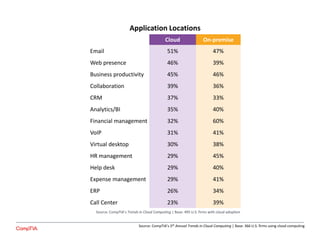
  • #9 Thanks to the wide availability of SaaS applications and a better understanding of cloud components, there is a clearer answer to the question of which regular activities are cloud-based. The most commonly cited cloud applications line up with anecdotal evidence. There still may be inflation in some areas, but this list provides good insight into where companies are today and where they might go in the future.
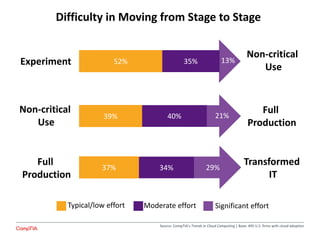
  • #10 Breaking the cloud adoption journey into four stages is helpful not only to understand company behaviors in each stage, but also to see the unique challenges that businesses face as they make progress along the path. Even as they refine their definitions of cloud components and right-size their expectations around cloud efforts, firms find significant growing pains as their adoption matures.
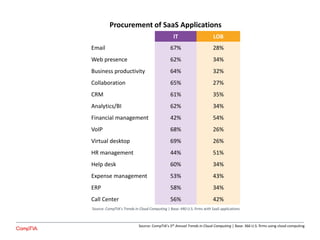
  • #11 On the surface, line-of-business procurement seems to be heating up, but the surface does not tell the entire story. The primary difficulty is that the question of “procurement” may be overly simplified, implying that a single department is responsible for the decision. Practically speaking, most business units recognize that their technical expertise is limited, and procurement of technology is often a team effort.
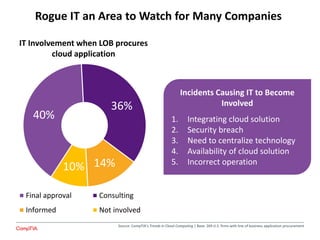
  • #12 Rather than working around IT, 9 out of 10 companies have IT involved to some degree when cloud applications are procured by a line of business department. The responses are fairly similar across companies of different sizes, though smaller companies are less likely to have IT in a consulting role and more likely to have IT not involved at all.
  • #13 Building a collaborative atmosphere is one example of the internal changes that a business must go through as they transform into a digital organization. In general, changes driven by cloud fall into three categories: policies and procedures, internal IT function changes, and use of outside companies.