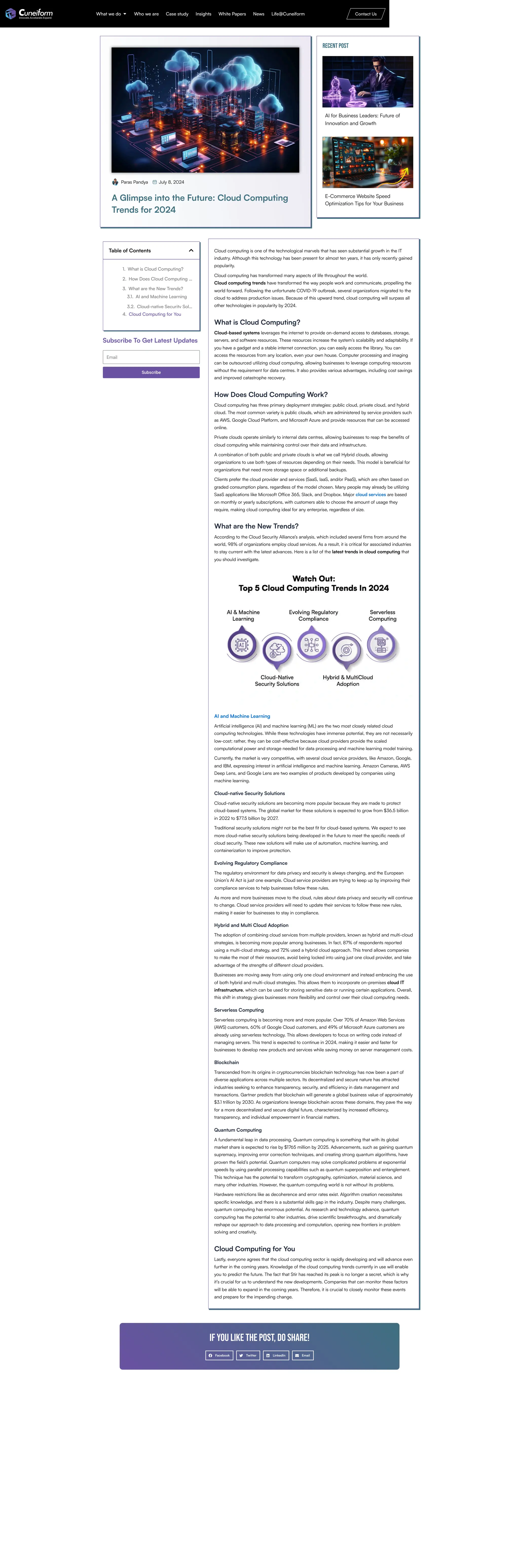
Paras Pandya July 8, 2024
A Glimpse into the Future: Cloud Computing
Trends for 2024
Recent Post
AI for Business Leaders: Future of
Innovation and Growth
E-Commerce Website Speed
Optimization Tips for Your Business
Table of Contents
1. What is Cloud Computing?
2. How Does Cloud Computing …
3. What are the New Trends?
3.1. AI and Machine Learning
3.2. Cloud-native Security Sol…
4. Cloud Computing for You
Subscribe To Get Latest Updates
Email
Subscribe
Cloud computing is one of the technological marvels that has seen substantial growth in the IT
industry. Although this technology has been present for almost ten years, it has only recently gained
popularity.
Cloud computing has transformed many aspects of life throughout the world.
Cloud computing trends have transformed the way people work and communicate, propelling the
world forward. Following the unfortunate COVID-19 outbreak, several organizations migrated to the
cloud to address production issues. Because of this upward trend, cloud computing will surpass all
other technologies in popularity by 2024.
What is Cloud Computing?
Cloud-based systems leverages the internet to provide on-demand access to databases, storage,
servers, and software resources. These resources increase the system’s scalability and adaptability. If
you have a gadget and a stable internet connection, you can easily access the library. You can
access the resources from any location, even your own house. Computer processing and imaging
can be outsourced utilizing cloud computing, allowing businesses to leverage computing resources
without the requirement for data centres. It also provides various advantages, including cost savings
and improved catastrophe recovery.
How Does Cloud Computing Work?
Cloud computing has three primary deployment strategies: public cloud, private cloud, and hybrid
cloud. The most common variety is public clouds, which are administered by service providers such
as AWS, Google Cloud Platform, and Microsoft Azure and provide resources that can be accessed
online.
Private clouds operate similarly to internal data centres, allowing businesses to reap the benefits of
cloud computing while maintaining control over their data and infrastructure.
A combination of both public and private clouds is what we call Hybrid clouds, allowing
organizations to use both types of resources depending on their needs. This model is beneficial for
organizations that need more storage space or additional backups.
Clients prefer the cloud provider and services (SaaS, IaaS, and/or PaaS), which are often based on
graded consumption plans, regardless of the model chosen. Many people may already be utilizing
SaaS applications like Microsoft Office 365, Slack, and Dropbox. Major cloud services are based
on monthly or yearly subscriptions, with customers able to choose the amount of usage they
require, making cloud computing ideal for any enterprise, regardless of size.
What are the New Trends?
According to the Cloud Security Alliance’s analysis, which included several firms from around the
world, 98% of organizations employ cloud services. As a result, it is critical for associated industries
to stay current with the latest advances. Here is a list of the latest trends in cloud computing that
you should investigate.
AI and Machine Learning
Artificial intelligence (AI) and machine learning (ML) are the two most closely related cloud
computing technologies. While these technologies have immense potential, they are not necessarily
low-cost; rather, they can be cost-effective because cloud providers provide the scaled
computational power and storage needed for data processing and machine learning model training.
Currently, the market is very competitive, with several cloud service providers, like Amazon, Google,
and IBM, expressing interest in artificial intelligence and machine learning. Amazon Cameras, AWS
Deep Lens, and Google Lens are two examples of products developed by companies using
machine learning.
Cloud-native Security Solutions
Cloud-native security solutions are becoming more popular because they are made to protect
cloud-based systems. The global market for these solutions is expected to grow from $36.5 billion
in 2022 to $77.5 billion by 2027.
Traditional security solutions might not be the best fit for cloud-based systems. We expect to see
more cloud-native security solutions being developed in the future to meet the specific needs of
cloud security. These new solutions will make use of automation, machine learning, and
containerization to improve protection.
Evolving Regulatory Compliance
The regulatory environment for data privacy and security is always changing, and the European
Union’s AI Act is just one example. Cloud service providers are trying to keep up by improving their
compliance services to help businesses follow these rules.
As more and more businesses move to the cloud, rules about data privacy and security will continue
to change. Cloud service providers will need to update their services to follow these new rules,
making it easier for businesses to stay in compliance.
Hybrid and Multi Cloud Adoption
The adoption of combining cloud services from multiple providers, known as hybrid and multi-cloud
strategies, is becoming more popular among businesses. In fact, 87% of respondents reported
using a multi-cloud strategy, and 72% used a hybrid cloud approach. This trend allows companies
to make the most of their resources, avoid being locked into using just one cloud provider, and take
advantage of the strengths of different cloud providers.
Businesses are moving away from using only one cloud environment and instead embracing the use
of both hybrid and multi-cloud strategies. This allows them to incorporate on-premises cloud IT
infrastructure, which can be used for storing sensitive data or running certain applications. Overall,
this shift in strategy gives businesses more flexibility and control over their cloud computing needs.
Serverless Computing
Serverless computing is becoming more and more popular. Over 70% of Amazon Web Services
(AWS) customers, 60% of Google Cloud customers, and 49% of Microsoft Azure customers are
already using serverless technology. This allows developers to focus on writing code instead of
managing servers. This trend is expected to continue in 2024, making it easier and faster for
businesses to develop new products and services while saving money on server management costs.
Blockchain
Transcended from its origins in cryptocurrencies blockchain technology has now been a part of
diverse applications across multiple sectors. Its decentralized and secure nature has attracted
industries seeking to enhance transparency, security, and efficiency in data management and
transactions. Gartner predicts that blockchain will generate a global business value of approximately
$3.1 trillion by 2030. As organizations leverage blockchain across these domains, they pave the way
for a more decentralized and secure digital future, characterized by increased efficiency,
transparency, and individual empowerment in financial matters.
Quantum Computing
A fundamental leap in data processing, Quantum computing is something that with its global
market share is expected to rise by $1765 million by 2025. Advancements, such as gaining quantum
supremacy, improving error correction techniques, and creating strong quantum algorithms, have
proven the field’s potential. Quantum computers may solve complicated problems at exponential
speeds by using parallel processing capabilities such as quantum superposition and entanglement.
This technique has the potential to transform cryptography, optimization, material science, and
many other industries. However, the quantum computing world is not without its problems.
Hardware restrictions like as decoherence and error rates exist. Algorithm creation necessitates
specific knowledge, and there is a substantial skills gap in the industry. Despite many challenges,
quantum computing has enormous potential. As research and technology advance, quantum
computing has the potential to alter industries, drive scientific breakthroughs, and dramatically
reshape our approach to data processing and computation, opening new frontiers in problem
solving and creativity.
Cloud Computing for You
Lastly, everyone agrees that the cloud computing sector is rapidly developing and will advance even
further in the coming years. Knowledge of the cloud computing trends currently in use will enable
you to predict the future. The fact that Stir has reached its peak is no longer a secret, which is why
it’s crucial for us to understand the new developments. Companies that can monitor these factors
will be able to expand in the coming years. Therefore, it is crucial to closely monitor these events
and prepare for the impending change.
If you like the post, do share!
Facebook Twitter LinkedIn Email
What we do Who we are Case study Insights White Papers News Life@Cuneiform Contact Us
Address
USA
1309 Coffeen Avenue STE 15363,
Sheridan, Wyoming – 82801, USA
India
C – 102, S. G. Business Hub,
Off Gota Flyover, S. G. Highway,
Vasantnagar, Ognaj, Ahmedabad,
Gujarat – 380060
Email: inquiry@thecuneiform.com
Company Services Connect
HR: +91 83208 06209
Sales: +91 98193 83948
Request for quote
Who we are
Case study
Insights
White Papers
FAQ’s
Privacy Policy
Terms & Conditions
Explore
Engineer
Expand
Embrace
Copyright @ 2024 Cuneiform Consulting Private Limited | All Rights Reserved
What we do Who we are Case study Insights White Papers News Life@Cuneiform Contact Us

Cloud Computing Trends Shaping the Future in 2024.pdf

  • 1.
    Paras Pandya July8, 2024 A Glimpse into the Future: Cloud Computing Trends for 2024 Recent Post AI for Business Leaders: Future of Innovation and Growth E-Commerce Website Speed Optimization Tips for Your Business Table of Contents 1. What is Cloud Computing? 2. How Does Cloud Computing … 3. What are the New Trends? 3.1. AI and Machine Learning 3.2. Cloud-native Security Sol… 4. Cloud Computing for You Subscribe To Get Latest Updates Email Subscribe Cloud computing is one of the technological marvels that has seen substantial growth in the IT industry. Although this technology has been present for almost ten years, it has only recently gained popularity. Cloud computing has transformed many aspects of life throughout the world. Cloud computing trends have transformed the way people work and communicate, propelling the world forward. Following the unfortunate COVID-19 outbreak, several organizations migrated to the cloud to address production issues. Because of this upward trend, cloud computing will surpass all other technologies in popularity by 2024. What is Cloud Computing? Cloud-based systems leverages the internet to provide on-demand access to databases, storage, servers, and software resources. These resources increase the system’s scalability and adaptability. If you have a gadget and a stable internet connection, you can easily access the library. You can access the resources from any location, even your own house. Computer processing and imaging can be outsourced utilizing cloud computing, allowing businesses to leverage computing resources without the requirement for data centres. It also provides various advantages, including cost savings and improved catastrophe recovery. How Does Cloud Computing Work? Cloud computing has three primary deployment strategies: public cloud, private cloud, and hybrid cloud. The most common variety is public clouds, which are administered by service providers such as AWS, Google Cloud Platform, and Microsoft Azure and provide resources that can be accessed online. Private clouds operate similarly to internal data centres, allowing businesses to reap the benefits of cloud computing while maintaining control over their data and infrastructure. A combination of both public and private clouds is what we call Hybrid clouds, allowing organizations to use both types of resources depending on their needs. This model is beneficial for organizations that need more storage space or additional backups. Clients prefer the cloud provider and services (SaaS, IaaS, and/or PaaS), which are often based on graded consumption plans, regardless of the model chosen. Many people may already be utilizing SaaS applications like Microsoft Office 365, Slack, and Dropbox. Major cloud services are based on monthly or yearly subscriptions, with customers able to choose the amount of usage they require, making cloud computing ideal for any enterprise, regardless of size. What are the New Trends? According to the Cloud Security Alliance’s analysis, which included several firms from around the world, 98% of organizations employ cloud services. As a result, it is critical for associated industries to stay current with the latest advances. Here is a list of the latest trends in cloud computing that you should investigate. AI and Machine Learning Artificial intelligence (AI) and machine learning (ML) are the two most closely related cloud computing technologies. While these technologies have immense potential, they are not necessarily low-cost; rather, they can be cost-effective because cloud providers provide the scaled computational power and storage needed for data processing and machine learning model training. Currently, the market is very competitive, with several cloud service providers, like Amazon, Google, and IBM, expressing interest in artificial intelligence and machine learning. Amazon Cameras, AWS Deep Lens, and Google Lens are two examples of products developed by companies using machine learning. Cloud-native Security Solutions Cloud-native security solutions are becoming more popular because they are made to protect cloud-based systems. The global market for these solutions is expected to grow from $36.5 billion in 2022 to $77.5 billion by 2027. Traditional security solutions might not be the best fit for cloud-based systems. We expect to see more cloud-native security solutions being developed in the future to meet the specific needs of cloud security. These new solutions will make use of automation, machine learning, and containerization to improve protection. Evolving Regulatory Compliance The regulatory environment for data privacy and security is always changing, and the European Union’s AI Act is just one example. Cloud service providers are trying to keep up by improving their compliance services to help businesses follow these rules. As more and more businesses move to the cloud, rules about data privacy and security will continue to change. Cloud service providers will need to update their services to follow these new rules, making it easier for businesses to stay in compliance. Hybrid and Multi Cloud Adoption The adoption of combining cloud services from multiple providers, known as hybrid and multi-cloud strategies, is becoming more popular among businesses. In fact, 87% of respondents reported using a multi-cloud strategy, and 72% used a hybrid cloud approach. This trend allows companies to make the most of their resources, avoid being locked into using just one cloud provider, and take advantage of the strengths of different cloud providers. Businesses are moving away from using only one cloud environment and instead embracing the use of both hybrid and multi-cloud strategies. This allows them to incorporate on-premises cloud IT infrastructure, which can be used for storing sensitive data or running certain applications. Overall, this shift in strategy gives businesses more flexibility and control over their cloud computing needs. Serverless Computing Serverless computing is becoming more and more popular. Over 70% of Amazon Web Services (AWS) customers, 60% of Google Cloud customers, and 49% of Microsoft Azure customers are already using serverless technology. This allows developers to focus on writing code instead of managing servers. This trend is expected to continue in 2024, making it easier and faster for businesses to develop new products and services while saving money on server management costs. Blockchain Transcended from its origins in cryptocurrencies blockchain technology has now been a part of diverse applications across multiple sectors. Its decentralized and secure nature has attracted industries seeking to enhance transparency, security, and efficiency in data management and transactions. Gartner predicts that blockchain will generate a global business value of approximately $3.1 trillion by 2030. As organizations leverage blockchain across these domains, they pave the way for a more decentralized and secure digital future, characterized by increased efficiency, transparency, and individual empowerment in financial matters. Quantum Computing A fundamental leap in data processing, Quantum computing is something that with its global market share is expected to rise by $1765 million by 2025. Advancements, such as gaining quantum supremacy, improving error correction techniques, and creating strong quantum algorithms, have proven the field’s potential. Quantum computers may solve complicated problems at exponential speeds by using parallel processing capabilities such as quantum superposition and entanglement. This technique has the potential to transform cryptography, optimization, material science, and many other industries. However, the quantum computing world is not without its problems. Hardware restrictions like as decoherence and error rates exist. Algorithm creation necessitates specific knowledge, and there is a substantial skills gap in the industry. Despite many challenges, quantum computing has enormous potential. As research and technology advance, quantum computing has the potential to alter industries, drive scientific breakthroughs, and dramatically reshape our approach to data processing and computation, opening new frontiers in problem solving and creativity. Cloud Computing for You Lastly, everyone agrees that the cloud computing sector is rapidly developing and will advance even further in the coming years. Knowledge of the cloud computing trends currently in use will enable you to predict the future. The fact that Stir has reached its peak is no longer a secret, which is why it’s crucial for us to understand the new developments. Companies that can monitor these factors will be able to expand in the coming years. Therefore, it is crucial to closely monitor these events and prepare for the impending change. If you like the post, do share! Facebook Twitter LinkedIn Email What we do Who we are Case study Insights White Papers News Life@Cuneiform Contact Us
  • 2.
    Address USA 1309 Coffeen AvenueSTE 15363, Sheridan, Wyoming – 82801, USA India C – 102, S. G. Business Hub, Off Gota Flyover, S. G. Highway, Vasantnagar, Ognaj, Ahmedabad, Gujarat – 380060 Email: inquiry@thecuneiform.com Company Services Connect HR: +91 83208 06209 Sales: +91 98193 83948 Request for quote Who we are Case study Insights White Papers FAQ’s Privacy Policy Terms & Conditions Explore Engineer Expand Embrace Copyright @ 2024 Cuneiform Consulting Private Limited | All Rights Reserved What we do Who we are Case study Insights White Papers News Life@Cuneiform Contact Us