PRESENTATION   BY:

                         STEVEN MUGEMA
                          08/U/2904/EED/PD
                           KYU-BEEEM/III
                      0771489406/0703172875
                     semven2000@yahoo.com
The Republic of Uganda is a landlocked country in
 East Africa. Uganda is also known as the "Pearl of
 Africa". It is bordered by Kenya in the east ,
 Republic of Southern Sudan in the north ,
 Democratic Republic of Congo in the west , Rwanda
 in the southwest , and Tanzania in the south .

The southeastern part of the country includes a
 substantial portion of Lake Victoria, which is also
 shared by Kenya and Tanzania.
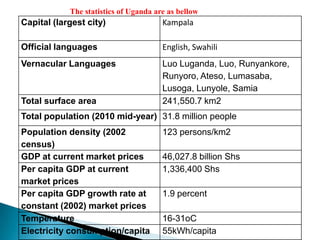
The statistics of Uganda are as bellow
Capital (largest city)                 Kampala

Official languages                     English, Swahili
Vernacular Languages                   Luo Luganda, Luo, Runyankore,
                                       Runyoro, Ateso, Lumasaba,
                                       Lusoga, Lunyole, Samia
Total surface area                     241,550.7 km2
Total population (2010 mid-year) 31.8 million people
Population density (2002               123 persons/km2
census)
GDP at current market prices           46,027.8 billion Shs
Per capita GDP at current              1,336,400 Shs
market prices
Per capita GDP growth rate at          1.9 percent
constant (2002) market prices
Temperature                            16-31oC
Electricity consumption/capita         55kWh/capita
   Renewable energy resources are inexhaustible assets of
    energy. i.e they can’t be depleted.

   Uganda is richly endowed with a variety of renewable
    energy resources which include plentiful woody and non-
    woody biomass, solar, wind, geothermal and hydrological
    resources.

   Presently, with the exception of biomass, only a meager
    fraction of the country’s renewable energy potential is
    exploited.

   It is estimated that other renewable sources of energy,
    excluding large hydropower, contribute less than 2% of
    Uganda’s total energy consumption.
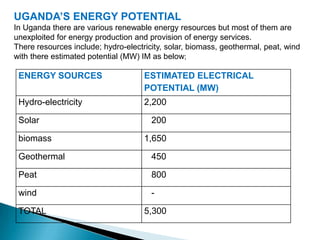
UGANDA’S ENERGY POTENTIAL
In Uganda there are various renewable energy resources but most of them are
unexploited for energy production and provision of energy services.
There resources include; hydro-electricity, solar, biomass, geothermal, peat, wind
with there estimated potential (MW) IM as below;

 ENERGY SOURCES                      ESTIMATED ELECTRICAL
                                     POTENTIAL (MW)
 Hydro-electricity                   2,200

 Solar                                 200

 biomass                             1,650

 Geothermal                            450

 Peat                                  800

 wind                                  -

 TOTAL                               5,300
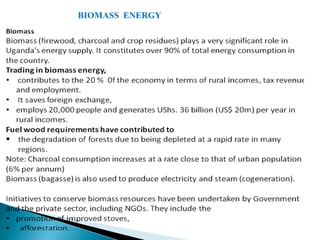
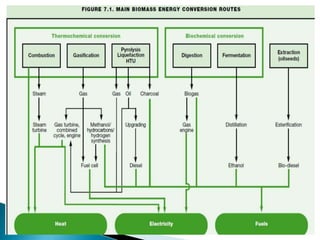
BIOMASS ENERGY
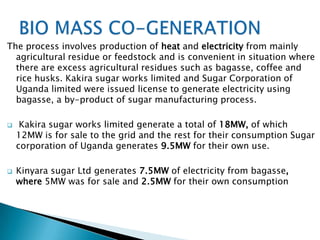
The process involves production of heat and electricity from mainly
  agricultural residue or feedstock and is convenient in situation where
  there are excess agricultural residues such as bagasse, coffee and
  rice husks. Kakira sugar works limited and Sugar Corporation of
  Uganda limited were issued license to generate electricity using
  bagasse, a by-product of sugar manufacturing process.

    Kakira sugar works limited generate a total of 18MW, of which
    12MW is for sale to the grid and the rest for their consumption Sugar
    corporation of Uganda generates 9.5MW for their own use.

   Kinyara sugar Ltd generates 7.5MW of electricity from bagasse,
    where 5MW was for sale and 2.5MW for their own consumption
This is energy that is generated from Partially
 carbonized vegetable matter saturated with water is
 used as a fuel when dried. This can be used to
 produce about 20MW of power.

Peat volume of about 250 Mton exists in Uganda but
 this resource would be adequate for generation of
 about 800 MW of electricity in the next 50 years.

  Available sources are dispersed mainly in western
 Uganda and south-western Uganda, where the
 desired characteristics are better than other regions
 in Uganda
Solar energy is energy that is derived from radiations from the sun. This is
  accomplished by battery storage and a use of a grid-connected solar system. The
  system feeds the grid with energy during day light and draws energy from it during
  night when required.
Uganda has mean solar radiation of 5.1 KWh/m2 per day on a horizontal surface. The
  country has a potential of 11.98 108MWh gross energy resource but the
  conversion efficiency is just 10%. The re exists an average of 5-6 kWh /m2/day of
  solar insolation.

Applications for solar energy.
 Off-grid electrification using photovoltaic solar cells that supply power to users.
 solar cooking and heating foodstuffs through solar ovens , and
 Generating electricity using space solar power satellite in geostationary orbit and
  beaming it down via microwaves.
 Heating water or air for domestic hot water and space. This needs the use of solar
  thermal panels.
 Heat and cool air through use of solar chimneys


   solar panels laid on house top
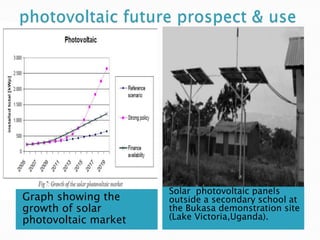
Solar photovoltaic panels
Graph showing the     outside a secondary school at
growth of solar       the Bukasa demonstration site
photovoltaic market   (Lake Victoria,Uganda).
   This is energy that is due to tectonic processes in the earth’s crust, through
    the cracks , the heat from the core heats up the adjacent rocks such that any
    water that comes into contact with them is heated up or turned to steam.
    This can be used to run turbines that produce the energy

   Uganda has an estimated geothermal resource potential of 450 MW, mainly
    located in the Western Rift valley part of the country. Feasibility studies are
    recommended to improve confidence in the resource and promote
    development.

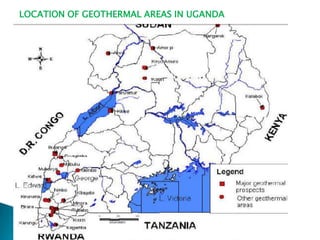
   The major areas under study are Katwe-Kikorongo, Buranga and Kibiro.
    They are all situated in the Western branch of the East African Rift valley
    that runs for most of its length along the border of Uganda with the
    Democratic Republic of Congo (DRC). The three areas were chosen as
    priority areas because of their volcanic and tectonic features that are
    indicators of powerful heat sources and permeability.

   Other geothermal areas are located on the outskirts and/or close to the rift
    valley in SW-Uganda and Northern Uganda. Surface exploration in the three
    areas has reached advanced stages while in the other areas it is still at
    preliminary level.
LOCATION OF GEOTHERMAL AREAS IN UGANDA
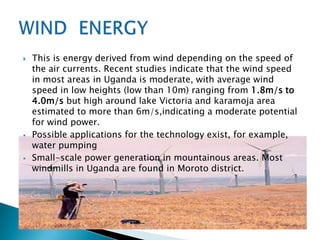
   This is energy derived from wind depending on the speed of
    the air currents. Recent studies indicate that the wind speed
    in most areas in Uganda is moderate, with average wind
    speed in low heights (low than 10m) ranging from 1.8m/s to
    4.0m/s but high around lake Victoria and karamoja area
    estimated to more than 6m/s,indicating a moderate potential
    for wind power.
   Possible applications for the technology exist, for example,
    water pumping
   Small-scale power generation in mountainous areas. Most
    windmills in Uganda are found in Moroto district.
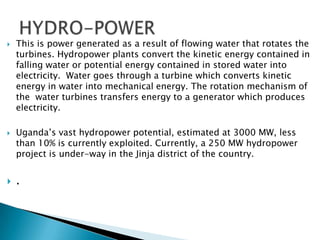
   This is power generated as a result of flowing water that rotates the
    turbines. Hydropower plants convert the kinetic energy contained in
    falling water or potential energy contained in stored water into
    electricity. Water goes through a turbine which converts kinetic
    energy in water into mechanical energy. The rotation mechanism of
    the water turbines transfers energy to a generator which produces
    electricity.

   Uganda’s vast hydropower potential, estimated at 3000 MW, less
    than 10% is currently exploited. Currently, a 250 MW hydropower
    project is under-way in the Jinja district of the country.


   .
     Nalubaale and Kiira Complex

    Currently two large power plants namely Nalubaale in Mukono District and
Kiira in Jinja District have been in operation since 1954 and 2002 respectively.
The installed capacity of Nalubale power station is 180 MW while that of Kiira is
200 MW but due to prolonged drought and the associated low water level in Lake
Victoria, the effective generation lies between 130MW – 180MW

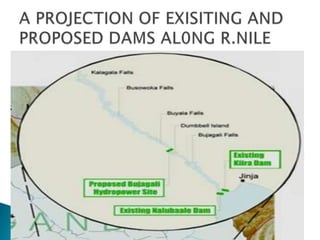
 Bujagali

    Bujagali is the third largest hydropower plant on Nile River in Uganda
currently under construction with anticipated capacity of 250MW and it’s
expected to be fully commissioned this year


 Numerous other hydropower ventures are being investigated by both
 Ugandan and Japanese contractors, as well as the government
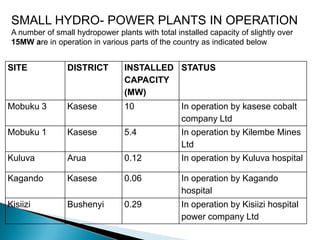
SMALL HYDRO- POWER PLANTS IN OPERATION
 A number of small hydropower plants with total installed capacity of slightly over
 15MW are in operation in various parts of the country as indicated below


SITE             DISTRICT        INSTALLED STATUS
                                 CAPACITY
                                 (MW)
Mobuku 3         Kasese          10               In operation by kasese cobalt
                                                  company Ltd
Mobuku 1         Kasese          5.4              In operation by Kilembe Mines
                                                  Ltd
Kuluva           Arua            0.12             In operation by Kuluva hospital

Kagando          Kasese          0.06             In operation by Kagando
                                                  hospital
Kisiizi          Bushenyi        0.29             In operation by Kisiizi hospital
                                                  power company Ltd
Mr. Davis Bariho Bagamuhunda lecture notes

Energy regulatory authority (www. era.com)

Renewable energy technologies in Uganda by
Geoffrey Kamase

renewable energy resources in Uganda

  • 1.
    PRESENTATION BY: STEVEN MUGEMA 08/U/2904/EED/PD KYU-BEEEM/III 0771489406/0703172875 semven2000@yahoo.com
  • 2.
    The Republic ofUganda is a landlocked country in East Africa. Uganda is also known as the "Pearl of Africa". It is bordered by Kenya in the east , Republic of Southern Sudan in the north , Democratic Republic of Congo in the west , Rwanda in the southwest , and Tanzania in the south . The southeastern part of the country includes a substantial portion of Lake Victoria, which is also shared by Kenya and Tanzania.
  • 3.
    The statistics ofUganda are as bellow Capital (largest city) Kampala Official languages English, Swahili Vernacular Languages Luo Luganda, Luo, Runyankore, Runyoro, Ateso, Lumasaba, Lusoga, Lunyole, Samia Total surface area 241,550.7 km2 Total population (2010 mid-year) 31.8 million people Population density (2002 123 persons/km2 census) GDP at current market prices 46,027.8 billion Shs Per capita GDP at current 1,336,400 Shs market prices Per capita GDP growth rate at 1.9 percent constant (2002) market prices Temperature 16-31oC Electricity consumption/capita 55kWh/capita
  • 4.
    Renewable energy resources are inexhaustible assets of energy. i.e they can’t be depleted.  Uganda is richly endowed with a variety of renewable energy resources which include plentiful woody and non- woody biomass, solar, wind, geothermal and hydrological resources.  Presently, with the exception of biomass, only a meager fraction of the country’s renewable energy potential is exploited.  It is estimated that other renewable sources of energy, excluding large hydropower, contribute less than 2% of Uganda’s total energy consumption.
  • 5.
    UGANDA’S ENERGY POTENTIAL InUganda there are various renewable energy resources but most of them are unexploited for energy production and provision of energy services. There resources include; hydro-electricity, solar, biomass, geothermal, peat, wind with there estimated potential (MW) IM as below; ENERGY SOURCES ESTIMATED ELECTRICAL POTENTIAL (MW) Hydro-electricity 2,200 Solar 200 biomass 1,650 Geothermal 450 Peat 800 wind - TOTAL 5,300
  • 6.
  • 7.
    The process involvesproduction of heat and electricity from mainly agricultural residue or feedstock and is convenient in situation where there are excess agricultural residues such as bagasse, coffee and rice husks. Kakira sugar works limited and Sugar Corporation of Uganda limited were issued license to generate electricity using bagasse, a by-product of sugar manufacturing process.  Kakira sugar works limited generate a total of 18MW, of which 12MW is for sale to the grid and the rest for their consumption Sugar corporation of Uganda generates 9.5MW for their own use.  Kinyara sugar Ltd generates 7.5MW of electricity from bagasse, where 5MW was for sale and 2.5MW for their own consumption
  • 9.
    This is energythat is generated from Partially carbonized vegetable matter saturated with water is used as a fuel when dried. This can be used to produce about 20MW of power. Peat volume of about 250 Mton exists in Uganda but this resource would be adequate for generation of about 800 MW of electricity in the next 50 years. Available sources are dispersed mainly in western Uganda and south-western Uganda, where the desired characteristics are better than other regions in Uganda
  • 10.
    Solar energy isenergy that is derived from radiations from the sun. This is accomplished by battery storage and a use of a grid-connected solar system. The system feeds the grid with energy during day light and draws energy from it during night when required. Uganda has mean solar radiation of 5.1 KWh/m2 per day on a horizontal surface. The country has a potential of 11.98 108MWh gross energy resource but the conversion efficiency is just 10%. The re exists an average of 5-6 kWh /m2/day of solar insolation. Applications for solar energy.  Off-grid electrification using photovoltaic solar cells that supply power to users.  solar cooking and heating foodstuffs through solar ovens , and  Generating electricity using space solar power satellite in geostationary orbit and beaming it down via microwaves.  Heating water or air for domestic hot water and space. This needs the use of solar thermal panels.  Heat and cool air through use of solar chimneys  solar panels laid on house top
  • 11.
    Solar photovoltaic panels Graphshowing the outside a secondary school at growth of solar the Bukasa demonstration site photovoltaic market (Lake Victoria,Uganda).
  • 12.
    This is energy that is due to tectonic processes in the earth’s crust, through the cracks , the heat from the core heats up the adjacent rocks such that any water that comes into contact with them is heated up or turned to steam. This can be used to run turbines that produce the energy  Uganda has an estimated geothermal resource potential of 450 MW, mainly located in the Western Rift valley part of the country. Feasibility studies are recommended to improve confidence in the resource and promote development.  The major areas under study are Katwe-Kikorongo, Buranga and Kibiro. They are all situated in the Western branch of the East African Rift valley that runs for most of its length along the border of Uganda with the Democratic Republic of Congo (DRC). The three areas were chosen as priority areas because of their volcanic and tectonic features that are indicators of powerful heat sources and permeability.  Other geothermal areas are located on the outskirts and/or close to the rift valley in SW-Uganda and Northern Uganda. Surface exploration in the three areas has reached advanced stages while in the other areas it is still at preliminary level.
  • 13.
    LOCATION OF GEOTHERMALAREAS IN UGANDA
  • 14.
    This is energy derived from wind depending on the speed of the air currents. Recent studies indicate that the wind speed in most areas in Uganda is moderate, with average wind speed in low heights (low than 10m) ranging from 1.8m/s to 4.0m/s but high around lake Victoria and karamoja area estimated to more than 6m/s,indicating a moderate potential for wind power.  Possible applications for the technology exist, for example, water pumping  Small-scale power generation in mountainous areas. Most windmills in Uganda are found in Moroto district.
  • 15.
    This is power generated as a result of flowing water that rotates the turbines. Hydropower plants convert the kinetic energy contained in falling water or potential energy contained in stored water into electricity. Water goes through a turbine which converts kinetic energy in water into mechanical energy. The rotation mechanism of the water turbines transfers energy to a generator which produces electricity.  Uganda’s vast hydropower potential, estimated at 3000 MW, less than 10% is currently exploited. Currently, a 250 MW hydropower project is under-way in the Jinja district of the country.  .
  • 16.
    Nalubaale and Kiira Complex Currently two large power plants namely Nalubaale in Mukono District and Kiira in Jinja District have been in operation since 1954 and 2002 respectively. The installed capacity of Nalubale power station is 180 MW while that of Kiira is 200 MW but due to prolonged drought and the associated low water level in Lake Victoria, the effective generation lies between 130MW – 180MW  Bujagali Bujagali is the third largest hydropower plant on Nile River in Uganda currently under construction with anticipated capacity of 250MW and it’s expected to be fully commissioned this year Numerous other hydropower ventures are being investigated by both Ugandan and Japanese contractors, as well as the government
  • 17.
    SMALL HYDRO- POWERPLANTS IN OPERATION A number of small hydropower plants with total installed capacity of slightly over 15MW are in operation in various parts of the country as indicated below SITE DISTRICT INSTALLED STATUS CAPACITY (MW) Mobuku 3 Kasese 10 In operation by kasese cobalt company Ltd Mobuku 1 Kasese 5.4 In operation by Kilembe Mines Ltd Kuluva Arua 0.12 In operation by Kuluva hospital Kagando Kasese 0.06 In operation by Kagando hospital Kisiizi Bushenyi 0.29 In operation by Kisiizi hospital power company Ltd
  • 23.
    Mr. Davis BarihoBagamuhunda lecture notes Energy regulatory authority (www. era.com) Renewable energy technologies in Uganda by Geoffrey Kamase