GEOTHERMAL POWER 
Geothermal power is the use of geothermal heat to generate electricity. It is 
often referred to as a form of renewable energy, but because the heat at 
any location can eventually be depleted it is by definition not strictly 
renewable. Geothermal comes from the Greek words geo, meaning earth, 
and therme, meaning heat. Geothermal literally means "earth heat". 
Geothermal-generated electricity was first produced at Larderello, Italy, in 
1904. 
Capacity 
By the end of 2005 worldwide use of geothermal energy for electricity had 
reached 9.3GWs, with an additional 28 GW used directly for heating. If heat 
recovered by ground source heat pumps is included, the non-electric use of 
geothermal energy is estimated at more than 100 GWt (gigawatts of thermal 
power) and is used commercially in over 70 countries 
During 2005 contracts were placed for an additional 0.5 GW of capacity in 
the United States, while there were also plants under construction in 11 other 
countries. 
Resources 
Estimates of exploitable worldwide geothermal energy resources vary 
considerably. According to a 1999 study, it was thought that this might 
amount to between 65 and 138 GW of electrical generation capacity 'using 
enhanced technology'. 
A 2006 report by MIT that took into account the use of Enhanced 
Geothermal Systems (EGS) concluded that it would be affordable to 
generate 100 GWe (gigawatts of electricity) or more by 2050, just in the 
United States, for a maximum investment of 1 billion US dollars in research and 
development over 15 years. 
The MIT report calculated the world's total EGS resources to be over 13,000 ZJ, 
of which over 200 ZJ would be extractable, with the potential to increase this 
to over 2,000 ZJ with technology improvements - sufficient to provide all the 
world's energy needs for several millennia. 
Although geothermal sites are capable of providing heat for many decades, 
eventually specific locations may cool down. It is likely that in these locations, 
the system was designed too large for the site, since there is only so much 
energy that can be stored and replenished in a given volume of earth. Some 
interpret this as meaning a specific geothermal location can undergo 
depletion, and question whether geothermal energy is truly renewable. 
Although geothermal sites are capable of providing heat for many decades, 
eventually they are depleted as the ground cools. The government of 
Iceland states It should be stressed that the geothermal resource is not strictly 
renewable in the same sense as the hydro resource. It estimates that 
Iceland's geothermal energy could provide 1700 MW for over 100 years, 
compared to the current production of 140 MW. 
1
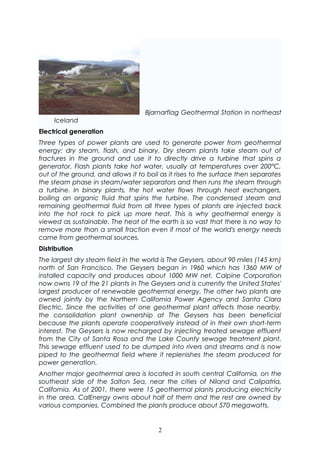
Bjarnarflag Geothermal Station in northeast 
Iceland 
Electrical generation 
Three types of power plants are used to generate power from geothermal 
energy: dry steam, flash, and binary. Dry steam plants take steam out of 
fractures in the ground and use it to directly drive a turbine that spins a 
generator. Flash plants take hot water, usually at temperatures over 200°C, 
out of the ground, and allows it to boil as it rises to the surface then separates 
the steam phase in steam/water separators and then runs the steam through 
a turbine. In binary plants, the hot water flows through heat exchangers, 
boiling an organic fluid that spins the turbine. The condensed steam and 
remaining geothermal fluid from all three types of plants are injected back 
into the hot rock to pick up more heat. This is why geothermal energy is 
viewed as sustainable. The heat of the earth is so vast that there is no way to 
remove more than a small fraction even if most of the world's energy needs 
came from geothermal sources. 
Distribution 
The largest dry steam field in the world is The Geysers, about 90 miles (145 km) 
north of San Francisco. The Geysers began in 1960 which has 1360 MW of 
installed capacity and produces about 1000 MW net. Calpine Corporation 
now owns 19 of the 21 plants in The Geysers and is currently the United States' 
largest producer of renewable geothermal energy. The other two plants are 
owned jointly by the Northern California Power Agency and Santa Clara 
Electric. Since the activities of one geothermal plant affects those nearby, 
the consolidation plant ownership at The Geysers has been beneficial 
because the plants operate cooperatively instead of in their own short-term 
interest. The Geysers is now recharged by injecting treated sewage effluent 
from the City of Santa Rosa and the Lake County sewage treatment plant. 
This sewage effluent used to be dumped into rivers and streams and is now 
piped to the geothermal field where it replenishes the steam produced for 
power generation. 
Another major geothermal area is located in south central California, on the 
southeast side of the Salton Sea, near the cities of Niland and Calipatria, 
California. As of 2001, there were 15 geothermal plants producing electricity 
in the area. CalEnergy owns about half of them and the rest are owned by 
various companies. Combined the plants produce about 570 megawatts. 
2
The Basin and Range geologic province in Nevada, southeastern Oregon, 
southwestern Idaho, Arizona and western Utah is now an area of rapid 
geothermal development. Several small power plants were built during the 
late 1980s during times of high power prices. Rising energy costs have spurred 
new development. Plants in Nevada at Steamboat near Reno, Brady/Desert 
Peak, Dixie Valley, Soda Lake, Stillwater and Beowawe now produce about 
235 MW. New projects are under development across the state. 
Geothermal power is very cost-effective in the Rift area of Africa. Kenya's 
KenGen has built two plants, Olkaria I (45 MW) and Olkaria II (65 MW), with a 
third private plant Olkaria III (48 MW) run by geothermal specialist Ormat. 
Plans are to increase production capacity by another 576 MW by 2017, 
covering 25% of Kenya's electricity needs, and correspondingly reducing 
dependency on imported oil. 
Geothermal power is generated in over 20 countries around the world 
including Iceland (producing 17% of its electricity from geothermal sources), 
the United States, Italy, France, New Zealand, Mexico, Nicaragua, Costa 
Rica, Russia, the Philippines (production output of 1931MW (2nd to US, 27% of 
electricity), Indonesia, the People's Republic of China and Japan. Canada's 
government (which officially notes some 30,000 earth-heat installations for 
providing space heating to Canadian residential and commercial buildings) 
reports a test geothermal-electrical site in the Meager Mountain–Pebble 
Creek area of British Columbia, where a 100 MW facility could be developed. 
Desalination 
Douglas Firestone began working with evaporation/condensation air loop 
desalination about 1998 and proved that geothermal waters could be used 
as process water to produce potable water in 2001. In 2003 Professor Ronald 
A. Newcomb, now at San Diego State University Center for Advanced Water 
Technologies began to work with Firestone to enhance the process of using 
geothermal energy for the purpose of desalination. Geothermal Energy is a 
primary energy source. 
In 2005 some testing was done in the fifth prototype of a device called the 
“Delta T” a closed air loop, atmospheric pressure, evaporation condensation 
loop geothermally powered desalination device. The device used filtered sea 
water from Scripps Institute of Oceanography and reduced the salt 
concentration from 35,000 ppm to 51 ppm. 
Water injection 
In some locations, the natural supply of water producing steam from the hot 
underground magma deposits has been exhausted and processed waste 
water is injected to replenish the supply. Most geothermal fields have more 
fluid recharge than heat, so re-injection can cool the resource, unless it is 
carefully managed. 
3

Geothermal power

  • 1.
    GEOTHERMAL POWER Geothermalpower is the use of geothermal heat to generate electricity. It is often referred to as a form of renewable energy, but because the heat at any location can eventually be depleted it is by definition not strictly renewable. Geothermal comes from the Greek words geo, meaning earth, and therme, meaning heat. Geothermal literally means "earth heat". Geothermal-generated electricity was first produced at Larderello, Italy, in 1904. Capacity By the end of 2005 worldwide use of geothermal energy for electricity had reached 9.3GWs, with an additional 28 GW used directly for heating. If heat recovered by ground source heat pumps is included, the non-electric use of geothermal energy is estimated at more than 100 GWt (gigawatts of thermal power) and is used commercially in over 70 countries During 2005 contracts were placed for an additional 0.5 GW of capacity in the United States, while there were also plants under construction in 11 other countries. Resources Estimates of exploitable worldwide geothermal energy resources vary considerably. According to a 1999 study, it was thought that this might amount to between 65 and 138 GW of electrical generation capacity 'using enhanced technology'. A 2006 report by MIT that took into account the use of Enhanced Geothermal Systems (EGS) concluded that it would be affordable to generate 100 GWe (gigawatts of electricity) or more by 2050, just in the United States, for a maximum investment of 1 billion US dollars in research and development over 15 years. The MIT report calculated the world's total EGS resources to be over 13,000 ZJ, of which over 200 ZJ would be extractable, with the potential to increase this to over 2,000 ZJ with technology improvements - sufficient to provide all the world's energy needs for several millennia. Although geothermal sites are capable of providing heat for many decades, eventually specific locations may cool down. It is likely that in these locations, the system was designed too large for the site, since there is only so much energy that can be stored and replenished in a given volume of earth. Some interpret this as meaning a specific geothermal location can undergo depletion, and question whether geothermal energy is truly renewable. Although geothermal sites are capable of providing heat for many decades, eventually they are depleted as the ground cools. The government of Iceland states It should be stressed that the geothermal resource is not strictly renewable in the same sense as the hydro resource. It estimates that Iceland's geothermal energy could provide 1700 MW for over 100 years, compared to the current production of 140 MW. 1
  • 2.
    Bjarnarflag Geothermal Stationin northeast Iceland Electrical generation Three types of power plants are used to generate power from geothermal energy: dry steam, flash, and binary. Dry steam plants take steam out of fractures in the ground and use it to directly drive a turbine that spins a generator. Flash plants take hot water, usually at temperatures over 200°C, out of the ground, and allows it to boil as it rises to the surface then separates the steam phase in steam/water separators and then runs the steam through a turbine. In binary plants, the hot water flows through heat exchangers, boiling an organic fluid that spins the turbine. The condensed steam and remaining geothermal fluid from all three types of plants are injected back into the hot rock to pick up more heat. This is why geothermal energy is viewed as sustainable. The heat of the earth is so vast that there is no way to remove more than a small fraction even if most of the world's energy needs came from geothermal sources. Distribution The largest dry steam field in the world is The Geysers, about 90 miles (145 km) north of San Francisco. The Geysers began in 1960 which has 1360 MW of installed capacity and produces about 1000 MW net. Calpine Corporation now owns 19 of the 21 plants in The Geysers and is currently the United States' largest producer of renewable geothermal energy. The other two plants are owned jointly by the Northern California Power Agency and Santa Clara Electric. Since the activities of one geothermal plant affects those nearby, the consolidation plant ownership at The Geysers has been beneficial because the plants operate cooperatively instead of in their own short-term interest. The Geysers is now recharged by injecting treated sewage effluent from the City of Santa Rosa and the Lake County sewage treatment plant. This sewage effluent used to be dumped into rivers and streams and is now piped to the geothermal field where it replenishes the steam produced for power generation. Another major geothermal area is located in south central California, on the southeast side of the Salton Sea, near the cities of Niland and Calipatria, California. As of 2001, there were 15 geothermal plants producing electricity in the area. CalEnergy owns about half of them and the rest are owned by various companies. Combined the plants produce about 570 megawatts. 2
  • 3.
    The Basin andRange geologic province in Nevada, southeastern Oregon, southwestern Idaho, Arizona and western Utah is now an area of rapid geothermal development. Several small power plants were built during the late 1980s during times of high power prices. Rising energy costs have spurred new development. Plants in Nevada at Steamboat near Reno, Brady/Desert Peak, Dixie Valley, Soda Lake, Stillwater and Beowawe now produce about 235 MW. New projects are under development across the state. Geothermal power is very cost-effective in the Rift area of Africa. Kenya's KenGen has built two plants, Olkaria I (45 MW) and Olkaria II (65 MW), with a third private plant Olkaria III (48 MW) run by geothermal specialist Ormat. Plans are to increase production capacity by another 576 MW by 2017, covering 25% of Kenya's electricity needs, and correspondingly reducing dependency on imported oil. Geothermal power is generated in over 20 countries around the world including Iceland (producing 17% of its electricity from geothermal sources), the United States, Italy, France, New Zealand, Mexico, Nicaragua, Costa Rica, Russia, the Philippines (production output of 1931MW (2nd to US, 27% of electricity), Indonesia, the People's Republic of China and Japan. Canada's government (which officially notes some 30,000 earth-heat installations for providing space heating to Canadian residential and commercial buildings) reports a test geothermal-electrical site in the Meager Mountain–Pebble Creek area of British Columbia, where a 100 MW facility could be developed. Desalination Douglas Firestone began working with evaporation/condensation air loop desalination about 1998 and proved that geothermal waters could be used as process water to produce potable water in 2001. In 2003 Professor Ronald A. Newcomb, now at San Diego State University Center for Advanced Water Technologies began to work with Firestone to enhance the process of using geothermal energy for the purpose of desalination. Geothermal Energy is a primary energy source. In 2005 some testing was done in the fifth prototype of a device called the “Delta T” a closed air loop, atmospheric pressure, evaporation condensation loop geothermally powered desalination device. The device used filtered sea water from Scripps Institute of Oceanography and reduced the salt concentration from 35,000 ppm to 51 ppm. Water injection In some locations, the natural supply of water producing steam from the hot underground magma deposits has been exhausted and processed waste water is injected to replenish the supply. Most geothermal fields have more fluid recharge than heat, so re-injection can cool the resource, unless it is carefully managed. 3