Selection of Kidney
Transplant donor
Dept of Urology
Govt Royapettah Hospital and Kilpauk Medical College
Chennai
1
Moderators:
Professors:
• Prof. Dr. G. Sivasankar, M.S., M.Ch.,
• Prof. Dr. A. Senthilvel, M.S., M.Ch.,
Asst Professors:
• Dr. J. Sivabalan, M.S., M.Ch.,
• Dr. R. Bhargavi, M.S., M.Ch.,
• Dr. S. Raju, M.S., M.Ch.,
• Dr. K. Muthurathinam, M.S., M.Ch.,
• Dr. D. Tamilselvan, M.S., M.Ch.,
• Dr. K. Senthilkumar, M.S., M.Ch.
Dept Of Urology, KMC and GRH, Chennai 2
Introduction
• Kidney can be obtained from living or deceased donors.
• The demand for kidney transplant is continually increasing, given the
increase in the burden of ESRD.
Dept Of Urology, KMC and GRH, Chennai 3
Deceased Donor Criteria
Dept Of Urology, KMC and GRH, Chennai 4
Deceased Donor-Categories
Three broad categories:
• Standard criteria donor (SCD),
• Extended criteria donor (ECD), and
• Donor after cardiac death (DCD).
Dept Of Urology, KMC and GRH, Chennai 5
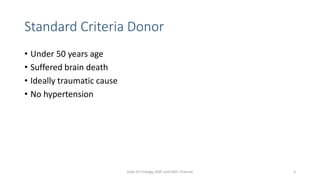
Standard Criteria Donor
• Under 50 years age
• Suffered brain death
• Ideally traumatic cause
• No hypertension
Dept Of Urology, KMC and GRH, Chennai 6
Deceased Donor Process
Dept Of Urology, KMC and GRH, Chennai 7
Brain and Cardiac Deaths
• Traditionally, in the lay, legal, and medical communities, death has
been determined by an irreversible cessation of cardiac and
respiratory function.
• Kidneys can be harvested from patients who are suffering from brain
death and cardiac death.
Dept Of Urology, KMC and GRH, Chennai 8
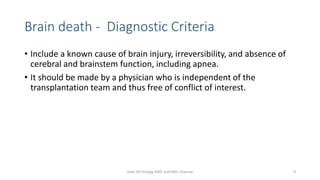
Brain death - Diagnostic Criteria
• Include a known cause of brain injury, irreversibility, and absence of
cerebral and brainstem function, including apnea.
• It should be made by a physician who is independent of the
transplantation team and thus free of conflict of interest.
Dept Of Urology, KMC and GRH, Chennai 9
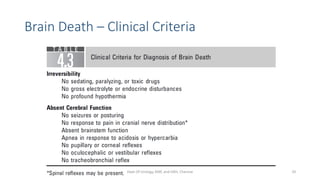
Brain Death – Clinical Criteria
Dept Of Urology, KMC and GRH, Chennai 10
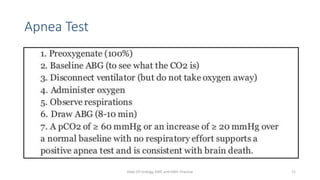
Apnea Test
Dept Of Urology, KMC and GRH, Chennai 11
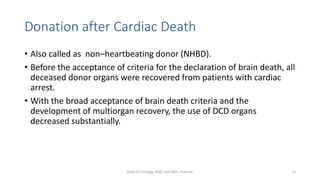
Donation after Cardiac Death
• Also called as non–heartbeating donor (NHBD).
• Before the acceptance of criteria for the declaration of brain death, all
deceased donor organs were recovered from patients with cardiac
arrest.
• With the broad acceptance of brain death criteria and the
development of multiorgan recovery, the use of DCD organs
decreased substantially.
Dept Of Urology, KMC and GRH, Chennai 12
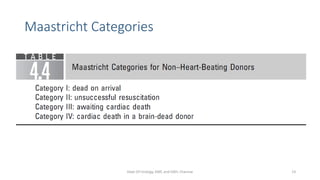
Maastricht Categories
Dept Of Urology, KMC and GRH, Chennai 13
Cat I and II DCD or Uncontrolled Donors
• Pulseless and asystolic after adequate but failed attempts at
resuscitation.
• Protocols to minimize ischemia involves placement of intravenous
cannulas to cool the organs after death has been declared.
• The option to donate is preserved until the family can be informed of
the death and then counseled by the organ procurement staff.
• Organs are recovered after consent.
Dept Of Urology, KMC and GRH, Chennai 14
Cat III DCD or Controlled Donors
• Comatose, irreversibly brain damaged, and respirator dependent, but
are not brain dead by strict definition.
• Decision to withdraw supportive care is made by the family and
primary medical team
• Appropriate consent for organ donation is obtained.
• Ventilator support is discontinued and cardiac function is monitored
• Death is pronounced by standard cardiac criteria after a
predetermined (usually 5-minute) period of asystole.
• Organ recovery then proceeds expeditiously.
Dept Of Urology, KMC and GRH, Chennai 15
Role of Organ Recovery Team
• The organ recovery team plays no part in the diagnosis of death or
medical management of the patient before asystole.
Dept Of Urology, KMC and GRH, Chennai 16
Cat IV DCD or Crashing Donors
• Patients who have often become hemodynamically unstable en route
to organ recovery after a diagnosis of brain death.
Dept Of Urology, KMC and GRH, Chennai 17
Donor Identification and Referral
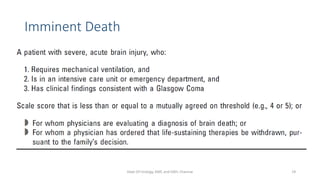
• Potential organ donors may be identified in the emergency
department or in the critical care unit.
• The term ‘imminent death’ has been used to define those patients
who should be referred for organ procurement.
Dept Of Urology, KMC and GRH, Chennai 18
Imminent Death
Dept Of Urology, KMC and GRH, Chennai 19
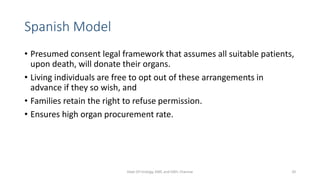
Spanish Model
• Presumed consent legal framework that assumes all suitable patients,
upon death, will donate their organs.
• Living individuals are free to opt out of these arrangements in
advance if they so wish, and
• Families retain the right to refuse permission.
• Ensures high organ procurement rate.
Dept Of Urology, KMC and GRH, Chennai 20
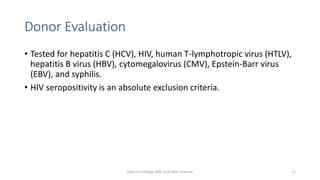
Donor Evaluation
• Tested for hepatitis C (HCV), HIV, human T-lymphotropic virus (HTLV),
hepatitis B virus (HBV), cytomegalovirus (CMV), Epstein-Barr virus
(EBV), and syphilis.
• HIV seropositivity is an absolute exclusion criteria.
Dept Of Urology, KMC and GRH, Chennai 21
Expanded Criteria Donor / Marginal Kidney
• Expanded criteria donor (ECD) kidney is preferable to the term
marginal kidney.
• It is defined as a kidney from a deceased donor older than 60 years or
aged 50 to 59 years with two additional risk factors, including:
• a history of hypertension,
• death as a result of cerebrovascular accident,
• or an elevated terminal serum creatinine.
Dept Of Urology, KMC and GRH, Chennai 22
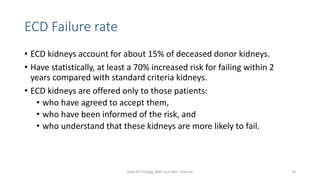
ECD Failure rate
• ECD kidneys account for about 15% of deceased donor kidneys.
• Have statistically, at least a 70% increased risk for failing within 2
years compared with standard criteria kidneys.
• ECD kidneys are offered only to those patients:
• who have agreed to accept them,
• who have been informed of the risk, and
• who understand that these kidneys are more likely to fail.
Dept Of Urology, KMC and GRH, Chennai 23
Living Donor Criteria
Dept Of Urology, KMC and GRH, Chennai 24
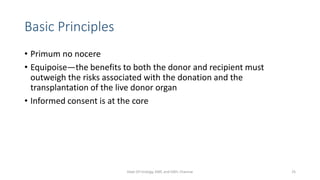
Basic Principles
• Primum no nocere
• Equipoise—the benefits to both the donor and recipient must
outweigh the risks associated with the donation and the
transplantation of the live donor organ
• Informed consent is at the core
Dept Of Urology, KMC and GRH, Chennai 25
Living Donor
• A competent adult (possessing decision- making capacity);
• Willing to donate;
• Free from coercion;
• Medically and psychosocially suitable;
• Fully informed of the risks and benefits of donation; and
• Fully informed of alternative treatments available to the recipient
Dept Of Urology, KMC and GRH, Chennai 26
Living Donor
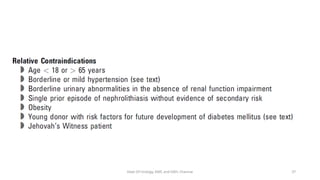
• Age, 18 to 70 years
• BMI below 35
• No cancer or active infection
• Adequate renal function
• ABO compatibility is also a consideration
Dept Of Urology, KMC and GRH, Chennai 27
Dept Of Urology, KMC and GRH, Chennai 28
Psychosocial Evaluation
• Fulfilling the tenets of informed consent.
• Exploring donor motivation, and excluding coercion.
• Ruling out significant psychiatric problems that would impair the
person’s ability to give informed consent or
• That might be negatively affected by the stress of surgery
(Contraindication for transplant donation)
Dept Of Urology, KMC and GRH, Chennai 29
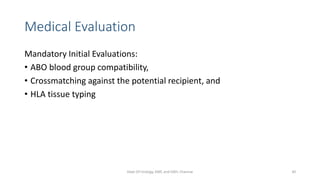
Medical Evaluation
Mandatory Initial Evaluations:
• ABO blood group compatibility,
• Crossmatching against the potential recipient, and
• HLA tissue typing
Dept Of Urology, KMC and GRH, Chennai 30
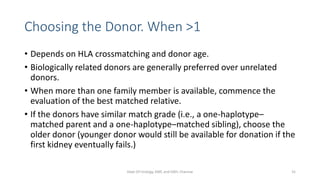
Choosing the Donor. When >1
• Depends on HLA crossmatching and donor age.
• Biologically related donors are generally preferred over unrelated
donors.
• When more than one family member is available, commence the
evaluation of the best matched relative.
• If the donors have similar match grade (i.e., a one-haplotype–
matched parent and a one-haplotype–matched sibling), choose the
older donor (younger donor would still be available for donation if the
first kidney eventually fails.)
Dept Of Urology, KMC and GRH, Chennai 31
Donor Age
• Advanced age can increase the risk for perioperative complications,
but there is no mandated upper age limit for living kidney donation.
• But donation after 70 years is uncommon in USA.
• 18 years is the lower limit for donation.
Dept Of Urology, KMC and GRH, Chennai 32
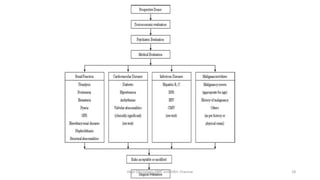
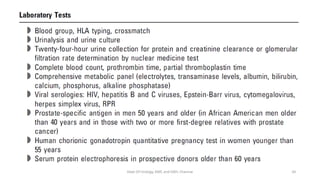
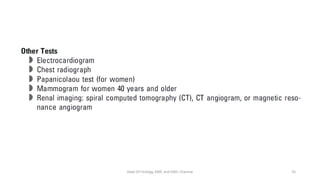
General Assessment - Goals
• Is sufficiently healthy to undergo the surgical procedure?
• Has normal kidney function with minimal future risk for kidney
disease?
• Represents no risk to the recipient in terms of communicable disease
or malignancy transmission?
• Is not at increased risk for medical conditions that might require
treatments that could endanger his or her residual renal function?
Dept Of Urology, KMC and GRH, Chennai 33
Dept Of Urology, KMC and GRH, Chennai 34
Dept Of Urology, KMC and GRH, Chennai 35
Dept Of Urology, KMC and GRH, Chennai 36
Dept Of Urology, KMC and GRH, Chennai 37
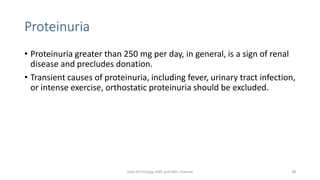
Proteinuria
• Proteinuria greater than 250 mg per day, in general, is a sign of renal
disease and precludes donation.
• Transient causes of proteinuria, including fever, urinary tract infection,
or intense exercise, orthostatic proteinuria should be excluded.
Dept Of Urology, KMC and GRH, Chennai 38
Hematuria
• Donor candidates with persistent isolated microscopic hematuria may
require a complete urologic evaluation.
• Cystoscopy to exclude bladder pathology may be necessary.
• In the absence of any specific abnormalities, a kidney biopsy to rule
out glomerular disease.
• If all are negative, evaluation for donation can be resumed.
Dept Of Urology, KMC and GRH, Chennai 39
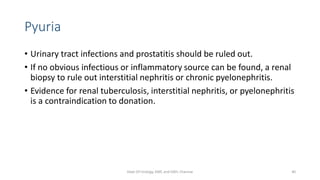
Pyuria
• Urinary tract infections and prostatitis should be ruled out.
• If no obvious infectious or inflammatory source can be found, a renal
biopsy to rule out interstitial nephritis or chronic pyelonephritis.
• Evidence for renal tuberculosis, interstitial nephritis, or pyelonephritis
is a contraindication to donation.
Dept Of Urology, KMC and GRH, Chennai 40
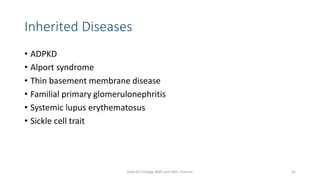
Inherited Diseases
• ADPKD
• Alport syndrome
• Thin basement membrane disease
• Familial primary glomerulonephritis
• Systemic lupus erythematosus
• Sickle cell trait
Dept Of Urology, KMC and GRH, Chennai 41
Nephrolithiasis
• Prospective donors with a distant history of stones (>10 years) but
without metabolic abnormalities associated with stone formation
may be acceptable as living donors.
• Cystinuria, primary or enteric hyperoxaluria, inflammatory bowel
disease, and sarcoidosis contraindicates donation.
• History of Struvite stones contraindicate donation.
Dept Of Urology, KMC and GRH, Chennai 42
Cardiovascular Risk Assessment
• Hypertension
• Diabetes
• Obesity
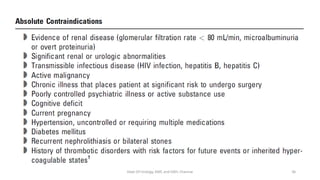
- Contraindications for donation.
Dept Of Urology, KMC and GRH, Chennai 43
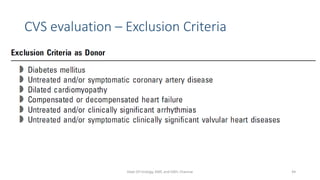
CVS evaluation – Exclusion Criteria
Dept Of Urology, KMC and GRH, Chennai 44
Communicable disease transmission
• HIV, hepatitis B, and hepatitis C, in the donor contraindicates
donation because of the high risk for disease transmission to the
recipient and the risk for virus-induced renal disease in the donor.
• Active HTLV and HHV 8 infection – Contraindicated.
• Fully treated syphilis, tuberculosis, and latent cytomegalovirus (CMV)
do not preclude donation.
Dept Of Urology, KMC and GRH, Chennai 45
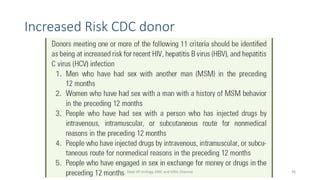
Increased Risk CDC donor
Dept Of Urology, KMC and GRH, Chennai 46
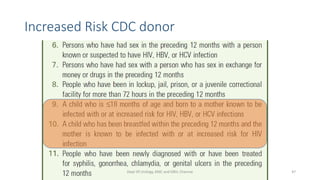
Increased Risk CDC donor
Dept Of Urology, KMC and GRH, Chennai 47
Malignancy Transmission
• Age appropriate screening tests should be done.
• Certain cancers in history are contraindications for living donation.
• Donation may be acceptable in situ squamous cell skin cancer or
cervical carcinoma if deemed cured and the potential for transmission
is excluded.
Dept Of Urology, KMC and GRH, Chennai 48
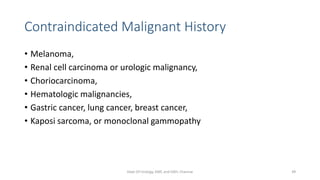
Contraindicated Malignant History
• Melanoma,
• Renal cell carcinoma or urologic malignancy,
• Choriocarcinoma,
• Hematologic malignancies,
• Gastric cancer, lung cancer, breast cancer,
• Kaposi sarcoma, or monoclonal gammopathy
Dept Of Urology, KMC and GRH, Chennai 49
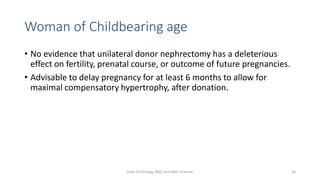
Woman of Childbearing age
• No evidence that unilateral donor nephrectomy has a deleterious
effect on fertility, prenatal course, or outcome of future pregnancies.
• Advisable to delay pregnancy for at least 6 months to allow for
maximal compensatory hypertrophy, after donation.
Dept Of Urology, KMC and GRH, Chennai 50
Incidentalomas in Donor CT
• Adrenal nodules are detected in a small portion of patients and
present a clinical challenge.
• If the adrenal lesions meets CT criteria for benign adenoma and a
functional metabolic workup is negative, proceeding with donation is
reasonable.
Dept Of Urology, KMC and GRH, Chennai 51
Calyceal Calcification in Donor CT
• Do metabolic evaluation
• If found to be normal, it is reasonable donate the affected Kidney.
Dept Of Urology, KMC and GRH, Chennai 52
Renal Lesions in Donor CT
• About 30% of kidneys evaluated using MDCT technology have
incidental renal pathology such as low-density lesions, renal cysts,
and calyceal calcifications.
• This information does not necessarily preclude donation.
• Large or complex renal cysts require attention and may necessitate
removal of the affected kidney.
Dept Of Urology, KMC and GRH, Chennai 53
Biologically Unrelated Donors
• Most of these donors are ‘‘emotionally related’’.
• Have an apparent or easily documented close and long-standing
relationship with the recipient (spouse, significant other, close friend,
adopted sibling).
• It constitutes around 40 % of the living donors.
Dept Of Urology, KMC and GRH, Chennai 54
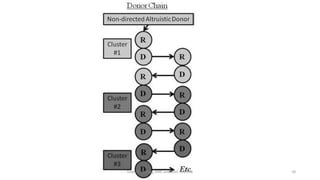
Non directed Donors
• A nondirected donor is one who comes forward to donate a kidney to
someone unknown to them.
• The term altruistic donor (or Good Samaritan donor) is often used to
describe these donors.
• Nondirected donors may also play a critical role in living donor
exchange programs.
Dept Of Urology, KMC and GRH, Chennai 55
HLA sensitized and ABO incompatable donor
and recipient
• Protein A immunoadsorption,
• High-dose intravenous immune globulin (IVIG),
• Low-dose IVIG in combination with plasmapheresis,
• Rituximab, and splenectomy,
• Used alone or in combination, can be useful
Dept Of Urology, KMC and GRH, Chennai 56
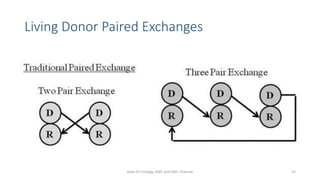
Living Donor Paired Exchanges
Dept Of Urology, KMC and GRH, Chennai 57
Dept Of Urology, KMC and GRH, Chennai 58
Thank You
Dept Of Urology, KMC and GRH, Chennai 59

Renal transplant donor- selection

  • 1.
    Selection of Kidney Transplantdonor Dept of Urology Govt Royapettah Hospital and Kilpauk Medical College Chennai 1
  • 2.
    Moderators: Professors: • Prof. Dr.G. Sivasankar, M.S., M.Ch., • Prof. Dr. A. Senthilvel, M.S., M.Ch., Asst Professors: • Dr. J. Sivabalan, M.S., M.Ch., • Dr. R. Bhargavi, M.S., M.Ch., • Dr. S. Raju, M.S., M.Ch., • Dr. K. Muthurathinam, M.S., M.Ch., • Dr. D. Tamilselvan, M.S., M.Ch., • Dr. K. Senthilkumar, M.S., M.Ch. Dept Of Urology, KMC and GRH, Chennai 2
  • 3.
    Introduction • Kidney canbe obtained from living or deceased donors. • The demand for kidney transplant is continually increasing, given the increase in the burden of ESRD. Dept Of Urology, KMC and GRH, Chennai 3
  • 4.
    Deceased Donor Criteria DeptOf Urology, KMC and GRH, Chennai 4
  • 5.
    Deceased Donor-Categories Three broadcategories: • Standard criteria donor (SCD), • Extended criteria donor (ECD), and • Donor after cardiac death (DCD). Dept Of Urology, KMC and GRH, Chennai 5
  • 6.
    Standard Criteria Donor •Under 50 years age • Suffered brain death • Ideally traumatic cause • No hypertension Dept Of Urology, KMC and GRH, Chennai 6
  • 7.
    Deceased Donor Process DeptOf Urology, KMC and GRH, Chennai 7
  • 8.
    Brain and CardiacDeaths • Traditionally, in the lay, legal, and medical communities, death has been determined by an irreversible cessation of cardiac and respiratory function. • Kidneys can be harvested from patients who are suffering from brain death and cardiac death. Dept Of Urology, KMC and GRH, Chennai 8
  • 9.
    Brain death -Diagnostic Criteria • Include a known cause of brain injury, irreversibility, and absence of cerebral and brainstem function, including apnea. • It should be made by a physician who is independent of the transplantation team and thus free of conflict of interest. Dept Of Urology, KMC and GRH, Chennai 9
  • 10.
    Brain Death –Clinical Criteria Dept Of Urology, KMC and GRH, Chennai 10
  • 11.
    Apnea Test Dept OfUrology, KMC and GRH, Chennai 11
  • 12.
    Donation after CardiacDeath • Also called as non–heartbeating donor (NHBD). • Before the acceptance of criteria for the declaration of brain death, all deceased donor organs were recovered from patients with cardiac arrest. • With the broad acceptance of brain death criteria and the development of multiorgan recovery, the use of DCD organs decreased substantially. Dept Of Urology, KMC and GRH, Chennai 12
  • 13.
    Maastricht Categories Dept OfUrology, KMC and GRH, Chennai 13
  • 14.
    Cat I andII DCD or Uncontrolled Donors • Pulseless and asystolic after adequate but failed attempts at resuscitation. • Protocols to minimize ischemia involves placement of intravenous cannulas to cool the organs after death has been declared. • The option to donate is preserved until the family can be informed of the death and then counseled by the organ procurement staff. • Organs are recovered after consent. Dept Of Urology, KMC and GRH, Chennai 14
  • 15.
    Cat III DCDor Controlled Donors • Comatose, irreversibly brain damaged, and respirator dependent, but are not brain dead by strict definition. • Decision to withdraw supportive care is made by the family and primary medical team • Appropriate consent for organ donation is obtained. • Ventilator support is discontinued and cardiac function is monitored • Death is pronounced by standard cardiac criteria after a predetermined (usually 5-minute) period of asystole. • Organ recovery then proceeds expeditiously. Dept Of Urology, KMC and GRH, Chennai 15
  • 16.
    Role of OrganRecovery Team • The organ recovery team plays no part in the diagnosis of death or medical management of the patient before asystole. Dept Of Urology, KMC and GRH, Chennai 16
  • 17.
    Cat IV DCDor Crashing Donors • Patients who have often become hemodynamically unstable en route to organ recovery after a diagnosis of brain death. Dept Of Urology, KMC and GRH, Chennai 17
  • 18.
    Donor Identification andReferral • Potential organ donors may be identified in the emergency department or in the critical care unit. • The term ‘imminent death’ has been used to define those patients who should be referred for organ procurement. Dept Of Urology, KMC and GRH, Chennai 18
  • 19.
    Imminent Death Dept OfUrology, KMC and GRH, Chennai 19
  • 20.
    Spanish Model • Presumedconsent legal framework that assumes all suitable patients, upon death, will donate their organs. • Living individuals are free to opt out of these arrangements in advance if they so wish, and • Families retain the right to refuse permission. • Ensures high organ procurement rate. Dept Of Urology, KMC and GRH, Chennai 20
  • 21.
    Donor Evaluation • Testedfor hepatitis C (HCV), HIV, human T-lymphotropic virus (HTLV), hepatitis B virus (HBV), cytomegalovirus (CMV), Epstein-Barr virus (EBV), and syphilis. • HIV seropositivity is an absolute exclusion criteria. Dept Of Urology, KMC and GRH, Chennai 21
  • 22.
    Expanded Criteria Donor/ Marginal Kidney • Expanded criteria donor (ECD) kidney is preferable to the term marginal kidney. • It is defined as a kidney from a deceased donor older than 60 years or aged 50 to 59 years with two additional risk factors, including: • a history of hypertension, • death as a result of cerebrovascular accident, • or an elevated terminal serum creatinine. Dept Of Urology, KMC and GRH, Chennai 22
  • 23.
    ECD Failure rate •ECD kidneys account for about 15% of deceased donor kidneys. • Have statistically, at least a 70% increased risk for failing within 2 years compared with standard criteria kidneys. • ECD kidneys are offered only to those patients: • who have agreed to accept them, • who have been informed of the risk, and • who understand that these kidneys are more likely to fail. Dept Of Urology, KMC and GRH, Chennai 23
  • 24.
    Living Donor Criteria DeptOf Urology, KMC and GRH, Chennai 24
  • 25.
    Basic Principles • Primumno nocere • Equipoise—the benefits to both the donor and recipient must outweigh the risks associated with the donation and the transplantation of the live donor organ • Informed consent is at the core Dept Of Urology, KMC and GRH, Chennai 25
  • 26.
    Living Donor • Acompetent adult (possessing decision- making capacity); • Willing to donate; • Free from coercion; • Medically and psychosocially suitable; • Fully informed of the risks and benefits of donation; and • Fully informed of alternative treatments available to the recipient Dept Of Urology, KMC and GRH, Chennai 26
  • 27.
    Living Donor • Age,18 to 70 years • BMI below 35 • No cancer or active infection • Adequate renal function • ABO compatibility is also a consideration Dept Of Urology, KMC and GRH, Chennai 27
  • 28.
    Dept Of Urology,KMC and GRH, Chennai 28
  • 29.
    Psychosocial Evaluation • Fulfillingthe tenets of informed consent. • Exploring donor motivation, and excluding coercion. • Ruling out significant psychiatric problems that would impair the person’s ability to give informed consent or • That might be negatively affected by the stress of surgery (Contraindication for transplant donation) Dept Of Urology, KMC and GRH, Chennai 29
  • 30.
    Medical Evaluation Mandatory InitialEvaluations: • ABO blood group compatibility, • Crossmatching against the potential recipient, and • HLA tissue typing Dept Of Urology, KMC and GRH, Chennai 30
  • 31.
    Choosing the Donor.When >1 • Depends on HLA crossmatching and donor age. • Biologically related donors are generally preferred over unrelated donors. • When more than one family member is available, commence the evaluation of the best matched relative. • If the donors have similar match grade (i.e., a one-haplotype– matched parent and a one-haplotype–matched sibling), choose the older donor (younger donor would still be available for donation if the first kidney eventually fails.) Dept Of Urology, KMC and GRH, Chennai 31
  • 32.
    Donor Age • Advancedage can increase the risk for perioperative complications, but there is no mandated upper age limit for living kidney donation. • But donation after 70 years is uncommon in USA. • 18 years is the lower limit for donation. Dept Of Urology, KMC and GRH, Chennai 32
  • 33.
    General Assessment -Goals • Is sufficiently healthy to undergo the surgical procedure? • Has normal kidney function with minimal future risk for kidney disease? • Represents no risk to the recipient in terms of communicable disease or malignancy transmission? • Is not at increased risk for medical conditions that might require treatments that could endanger his or her residual renal function? Dept Of Urology, KMC and GRH, Chennai 33
  • 34.
    Dept Of Urology,KMC and GRH, Chennai 34
  • 35.
    Dept Of Urology,KMC and GRH, Chennai 35
  • 36.
    Dept Of Urology,KMC and GRH, Chennai 36
  • 37.
    Dept Of Urology,KMC and GRH, Chennai 37
  • 38.
    Proteinuria • Proteinuria greaterthan 250 mg per day, in general, is a sign of renal disease and precludes donation. • Transient causes of proteinuria, including fever, urinary tract infection, or intense exercise, orthostatic proteinuria should be excluded. Dept Of Urology, KMC and GRH, Chennai 38
  • 39.
    Hematuria • Donor candidateswith persistent isolated microscopic hematuria may require a complete urologic evaluation. • Cystoscopy to exclude bladder pathology may be necessary. • In the absence of any specific abnormalities, a kidney biopsy to rule out glomerular disease. • If all are negative, evaluation for donation can be resumed. Dept Of Urology, KMC and GRH, Chennai 39
  • 40.
    Pyuria • Urinary tractinfections and prostatitis should be ruled out. • If no obvious infectious or inflammatory source can be found, a renal biopsy to rule out interstitial nephritis or chronic pyelonephritis. • Evidence for renal tuberculosis, interstitial nephritis, or pyelonephritis is a contraindication to donation. Dept Of Urology, KMC and GRH, Chennai 40
  • 41.
    Inherited Diseases • ADPKD •Alport syndrome • Thin basement membrane disease • Familial primary glomerulonephritis • Systemic lupus erythematosus • Sickle cell trait Dept Of Urology, KMC and GRH, Chennai 41
  • 42.
    Nephrolithiasis • Prospective donorswith a distant history of stones (>10 years) but without metabolic abnormalities associated with stone formation may be acceptable as living donors. • Cystinuria, primary or enteric hyperoxaluria, inflammatory bowel disease, and sarcoidosis contraindicates donation. • History of Struvite stones contraindicate donation. Dept Of Urology, KMC and GRH, Chennai 42
  • 43.
    Cardiovascular Risk Assessment •Hypertension • Diabetes • Obesity - Contraindications for donation. Dept Of Urology, KMC and GRH, Chennai 43
  • 44.
    CVS evaluation –Exclusion Criteria Dept Of Urology, KMC and GRH, Chennai 44
  • 45.
    Communicable disease transmission •HIV, hepatitis B, and hepatitis C, in the donor contraindicates donation because of the high risk for disease transmission to the recipient and the risk for virus-induced renal disease in the donor. • Active HTLV and HHV 8 infection – Contraindicated. • Fully treated syphilis, tuberculosis, and latent cytomegalovirus (CMV) do not preclude donation. Dept Of Urology, KMC and GRH, Chennai 45
  • 46.
    Increased Risk CDCdonor Dept Of Urology, KMC and GRH, Chennai 46
  • 47.
    Increased Risk CDCdonor Dept Of Urology, KMC and GRH, Chennai 47
  • 48.
    Malignancy Transmission • Ageappropriate screening tests should be done. • Certain cancers in history are contraindications for living donation. • Donation may be acceptable in situ squamous cell skin cancer or cervical carcinoma if deemed cured and the potential for transmission is excluded. Dept Of Urology, KMC and GRH, Chennai 48
  • 49.
    Contraindicated Malignant History •Melanoma, • Renal cell carcinoma or urologic malignancy, • Choriocarcinoma, • Hematologic malignancies, • Gastric cancer, lung cancer, breast cancer, • Kaposi sarcoma, or monoclonal gammopathy Dept Of Urology, KMC and GRH, Chennai 49
  • 50.
    Woman of Childbearingage • No evidence that unilateral donor nephrectomy has a deleterious effect on fertility, prenatal course, or outcome of future pregnancies. • Advisable to delay pregnancy for at least 6 months to allow for maximal compensatory hypertrophy, after donation. Dept Of Urology, KMC and GRH, Chennai 50
  • 51.
    Incidentalomas in DonorCT • Adrenal nodules are detected in a small portion of patients and present a clinical challenge. • If the adrenal lesions meets CT criteria for benign adenoma and a functional metabolic workup is negative, proceeding with donation is reasonable. Dept Of Urology, KMC and GRH, Chennai 51
  • 52.
    Calyceal Calcification inDonor CT • Do metabolic evaluation • If found to be normal, it is reasonable donate the affected Kidney. Dept Of Urology, KMC and GRH, Chennai 52
  • 53.
    Renal Lesions inDonor CT • About 30% of kidneys evaluated using MDCT technology have incidental renal pathology such as low-density lesions, renal cysts, and calyceal calcifications. • This information does not necessarily preclude donation. • Large or complex renal cysts require attention and may necessitate removal of the affected kidney. Dept Of Urology, KMC and GRH, Chennai 53
  • 54.
    Biologically Unrelated Donors •Most of these donors are ‘‘emotionally related’’. • Have an apparent or easily documented close and long-standing relationship with the recipient (spouse, significant other, close friend, adopted sibling). • It constitutes around 40 % of the living donors. Dept Of Urology, KMC and GRH, Chennai 54
  • 55.
    Non directed Donors •A nondirected donor is one who comes forward to donate a kidney to someone unknown to them. • The term altruistic donor (or Good Samaritan donor) is often used to describe these donors. • Nondirected donors may also play a critical role in living donor exchange programs. Dept Of Urology, KMC and GRH, Chennai 55
  • 56.
    HLA sensitized andABO incompatable donor and recipient • Protein A immunoadsorption, • High-dose intravenous immune globulin (IVIG), • Low-dose IVIG in combination with plasmapheresis, • Rituximab, and splenectomy, • Used alone or in combination, can be useful Dept Of Urology, KMC and GRH, Chennai 56
  • 57.
    Living Donor PairedExchanges Dept Of Urology, KMC and GRH, Chennai 57
  • 58.
    Dept Of Urology,KMC and GRH, Chennai 58
  • 59.
    Thank You Dept OfUrology, KMC and GRH, Chennai 59