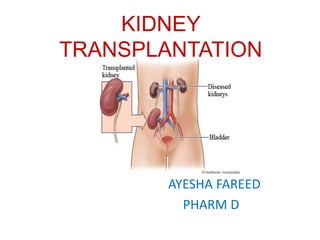
KIDNEY
TRANSPLANTATION
AYESHA FAREED
PHARM D
Topic overview
Introduction
Types of donors
Rejection
Types of rejection
Induction therapy
Maintenance therapy
• Kidney transplantation or renal transplantation is
the organ transplant of a kidney into a patient
with end-stage renal disease.
• It is a surgical procedure to remove a healthy,
functioning kidney from a donor and implant it
into a patient with non-functioning kidneys.
Types of kidney donors
1.Living donors
2.Deceased donors(formerly known as cadaveric)
LIVING DONORS
1.Genetically related(living-related)
2.Non-related(living-unrelated
DECEASED DONOR
• A deceased donor transplant is a transplant where
the donated kidney comes from a person who has
died
There are several classifications of kidneys that come
from deceased donors:
• Standard criteria donor (SCD)
• Extended criteria donor kidneys (ECD)
• Donation after cardiac death donors (DCD)
• High social risk donors
PREPARING FOR A KIDNEY TRANSPLANT
DONOR AND RECIPIENT MATCHING
Donor and recipient matching can be divided into three distinct
areas:
1)blood group matching
2) tissue type matching
3) cross matching.
It applies to living kidney donation and deceased kidne donation.
Blood Typing
There are 4 different blood types. The most common blood type in
the population is type O. The next most common is blood type A,
then B, and the rarest is blood type AB. The blood type of the donor
must be compatible with the recipient.
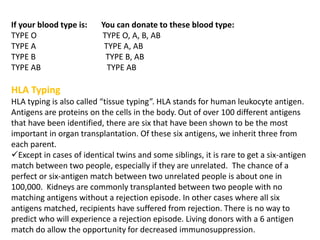
 The chart below shows which blood type can donate to which.
If your blood type is: You can donate to these blood type:
TYPE O TYPE O, A, B, AB
TYPE A TYPE A, AB
TYPE B TYPE B, AB
TYPE AB TYPE AB
HLA Typing
HLA typing is also called “tissue typing”. HLA stands for human leukocyte antigen.
Antigens are proteins on the cells in the body. Out of over 100 different antigens
that have been identified, there are six that have been shown to be the most
important in organ transplantation. Of these six antigens, we inherit three from
each parent.
Except in cases of identical twins and some siblings, it is rare to get a six-antigen
match between two people, especially if they are unrelated. The chance of a
perfect or six-antigen match between two unrelated people is about one in
100,000. Kidneys are commonly transplanted between two people with no
matching antigens without a rejection episode. In other cases where all six
antigens matched, recipients have suffered from rejection. There is no way to
predict who will experience a rejection episode. Living donors with a 6 antigen
match do allow the opportunity for decreased immunosuppression.
Cross-Match Testing
The crossmatch test is a very important part of the living donor work-up and is
repeated again just before the transplant surgery. Blood from the donor and
recipient are mixed. If the recipient’s cells attack and kill the donor cells, the
crossmatch is considered positive. This means the recipient has antibodies
“against” the donor’s cells. If the crossmatch is negative, the pair is considered
compatible.
Rejection
The body resists the presence of foreign cells or tissue of a donor kidney in much
the same way that it fights off bacteria and viruses which cause illness. The
rejection process occurs when the patient’s white blood cells reduce or stop the
function of the transplanted kidney. Some patients experience a rejection episode
in the first few weeks after their operation. Symptoms of rejection may include
fever, decreased urine output, fluid retention and increase in weight, tenderness
over the kidney and elevated blood pressure. Most rejection episodes can be
reversed with drug treatment.
TYPES OF REJECTION
Hyperacute Rejection
• Can occur minutes or hours after the transplant.
• This type of rejection is very rare. It is untreatable and the kidney
is removed immediately
Acute rejection
• Acute rejection can happen any time after a kidney transplant.
During acute rejection, the serum (blood) creatinine rises.
• Acute rejection can usually be treated with a higher dose or a
different type of immunosuppressive medicine until the creatinine
returns to baseline.
Chronic rejection
This is a process that may happen after a kidney transplant. It can
develop over months or even years.
There is no known treatment
DRUGS USED IN KIDNEY TRANSPLANT
INDUCTION THERAPY
1)monoclonal antibodies:
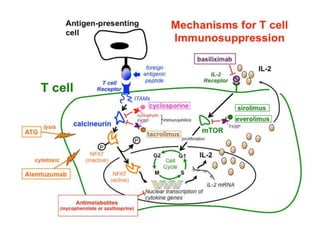
muromonab-CD3,
basiliximab
DaclizumaB
Alemtuzumab
2) polyclonal antibodies:
Antithymocyte globulin
[equine] Antithymocyte
globulin [rabbit])
MAINTENANENCE THERAPY
1)Calcineurin inhibitors
– Cyclosporine
– Tacrolimus
2)Purine synthesis
inhibitors/APA
– Azathioprine
– Mycophenolate mofetil
3)steroids
– prednisone
4)mTOR inhibitors
– Sirolimus
INDUCTION AGENTS
Monoclonal
Daclizumab, Basiliximab, Alemtuzumab,muromonab(OKT3)
Polyclonal
Thymoglobulin, Atgam
DEPLETING AGENTS
Thymoglobulin, Alemtuzumab, OKT3
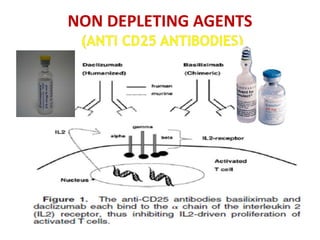
NON DEPLETING AGENTS
Daclizumab, Basiliximab
ANTITHYMOCYTE GLOBULIN(EQUINE)
MOA:T cell destruction
DOSE:10–30 mg/kg i.v. for 4–14 days and is typically infused over
four to six hours per dose.
ANTITHYMOCYTE GLOBULINE(RABBIT)
MOA:T cell suppression
DOSE: 1 to 4 mg/kg/day for 3–10 days after transplantation.
The most common dosage strategy is 1.5 mg/kg/day for 3–5 days.
platelet count: 50,000–75,000 platelets/mm3 OR WBC count:
2,000-3,000cells/mm3
then doses may be halved or administered at less frequent
intervals
Discontinuation of the drug should be considered if these values
drop below 50,000 platelets/mm3 or to <2,000 white blood
cells/mm
SIDE EFFECTS:
• Fever , chills, headache , nausea , diarrhea , malaise ,
dizziness , and pain
• Myelosuppression, specifically leukopenia and
thrombocytopenia, may occur in up to 30% of
patients treated with either preparation.
• Anaphylactic reactions
MUROMONAB- CD3(OKT3)
• OKT3 is a murine monoclonal antibody directed against
the CD3 receptor.
• When OKT3 is bound to CD3, the TCR undergoes
endocytosis resulting in an inert T-cell. T cells are then
removed via opsonization and ultimately, phagocytosis.
• A substantial T-cell loss could occur within the first few
hours after an initial dose.
• As the T-cell counts begin to fall, several T-cell-derived
cytokines (eg,TNF, IL-2, and IFN-γ) are released into the
circulation.
Dosage: 5mg iv bolus, daily for 10 days
Side Effects:
• “Cytokine release syndrome”, typically 45
minutes after the injection.
• Non-cardiogenic pulmonary edema
• Neurologic complications (mild headache,
aseptic meningitis to severe encephalopathy)
• Infections and lymphoma
• Develpoment of neutralizing antibodies (anti-
OKT3 response) seen in 50% of treatments.
ALEMTUZUMAB
• It is a humanized monoclonal antibody directed
against CD52.
• CD52 is present on virtually all B- and T-cells as well
as macrophages, NK cells, and some granulocytes.
• When the alemtuzumab antibody binds to CD52, it is
thought to trigger an antibody-dependent lysis of the
cell.
• The depletion of lymphocytes is so marked that it
takes several months to a year post administration
for the immune system of a patient to be fully
reconstituted.
Dosing:
• 20-30 mg on the day of transplantation. A second
dose on POD 1 or 4 can also be given.
Side Effects:
• The depleting efficiency of alemtuzumab is so
profound that it is invariably associated with side
effects viz. neutropenia (70%),
thrombocytopenia (52%), anemia (47%), nausea
(54%), vomiting (41%), diarrhea (22%), headache
(24%), dysthesias (15%), dizziness (12%), and
AIHA(<5%).
NON DEPLETING AGENTS
Daclizumab
• 1 mg/kg within 24 hours of transplantation plus an
additional four doses of 1 mg/kg at a schedule of
every two weeks after surgery.
• Causes receptor saturation that lasts up to 120 days
• reduced dosing schedule with an initial dose of 1
mg/kg on the day of transplant and POD 4 is equally
efficacious and safe compared with the 5-dose
regimen.
Basiliximab
• 20 mg IV given two hours prior to the transplant,
followed by a second 20 mg dose on POD 4.
• causes a complete saturation of the CD25 receptor
for 5-8 weeks
SIDE EFFECTS
• Extremely safe agents.
• Hypersensitivity reactions is the only
significant side effect (<1%) with both the
agents.
• There is no increased risk of CMV infections
and malignancies.
MAINTENANCE THERAPY
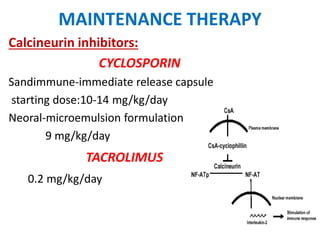
Calcineurin inhibitors:
CYCLOSPORIN
Sandimmune-immediate release capsule
starting dose:10-14 mg/kg/day
Neoral-microemulsion formulation
9 mg/kg/day
TACROLIMUS
0.2 mg/kg/day
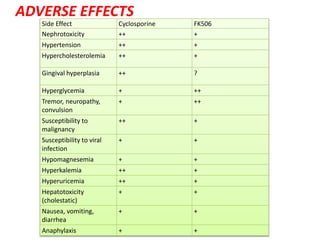
ADVERSE EFFECTS
Side Effect Cyclosporine FK506
Nephrotoxicity ++ +
Hypertension ++ +
Hypercholesterolemia ++ +
Gingival hyperplasia ++ ?
Hyperglycemia + ++
Tremor, neuropathy,
convulsion
+ ++
Susceptibility to
malignancy
++ +
Susceptibility to viral
infection
+ +
Hypomagnesemia + +
Hyperkalemia ++ +
Hyperuricemia ++ +
Hepatotoxicity
(cholestatic)
+ +
Nausea, vomiting,
diarrhea
+ +
Anaphylaxis + +
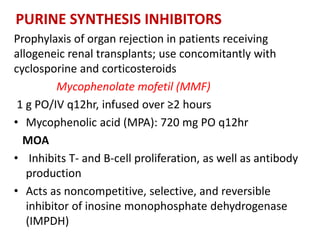
PURINE SYNTHESIS INHIBITORS
Prophylaxis of organ rejection in patients receiving
allogeneic renal transplants; use concomitantly with
cyclosporine and corticosteroids
Mycophenolate mofetil (MMF)
1 g PO/IV q12hr, infused over ≥2 hours
• Mycophenolic acid (MPA): 720 mg PO q12hr
MOA
• Inhibits T- and B-cell proliferation, as well as antibody
production
• Acts as noncompetitive, selective, and reversible
inhibitor of inosine monophosphate dehydrogenase
(IMPDH)
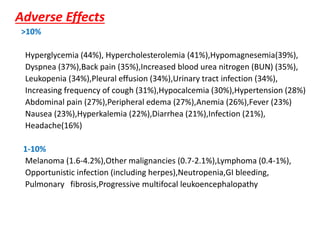
Adverse Effects
>10%
Hyperglycemia (44%), Hypercholesterolemia (41%),Hypomagnesemia(39%),
Dyspnea (37%),Back pain (35%),Increased blood urea nitrogen (BUN) (35%),
Leukopenia (34%),Pleural effusion (34%),Urinary tract infection (34%),
Increasing frequency of cough (31%),Hypocalcemia (30%),Hypertension (28%)
Abdominal pain (27%),Peripheral edema (27%),Anemia (26%),Fever (23%)
Nausea (23%),Hyperkalemia (22%),Diarrhea (21%),Infection (21%),
Headache(16%)
1-10%
Melanoma (1.6-4.2%),Other malignancies (0.7-2.1%),Lymphoma (0.4-1%),
Opportunistic infection (including herpes),Neutropenia,GI bleeding,
Pulmonary fibrosis,Progressive multifocal leukoencephalopathy
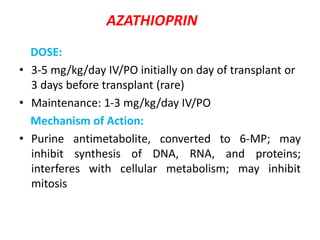
AZATHIOPRIN
DOSE:
• 3-5 mg/kg/day IV/PO initially on day of transplant or
3 days before transplant (rare)
• Maintenance: 1-3 mg/kg/day IV/PO
Mechanism of Action:
• Purine antimetabolite, converted to 6-MP; may
inhibit synthesis of DNA, RNA, and proteins;
interferes with cellular metabolism; may inhibit
mitosis
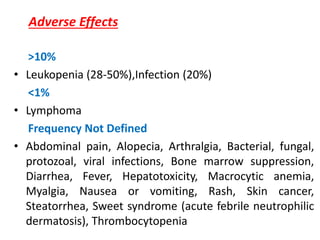
Adverse Effects
>10%
• Leukopenia (28-50%),Infection (20%)
<1%
• Lymphoma
Frequency Not Defined
• Abdominal pain, Alopecia, Arthralgia, Bacterial, fungal,
protozoal, viral infections, Bone marrow suppression,
Diarrhea, Fever, Hepatotoxicity, Macrocytic anemia,
Myalgia, Nausea or vomiting, Rash, Skin cancer,
Steatorrhea, Sweet syndrome (acute febrile neutrophilic
dermatosis), Thrombocytopenia
mTOR inhibitors: sirolimus
DOSE:
• loading dose : 6 mg . maintenance dose: 2 mg given OD
• In pediatric patients, a loading dose of 3 mg/m2 may be
given, with a maintenance dose of 1 mg/m2/day.
• Dosage adjustments should be made to maintain whole
blood sirolimus trough concentrations within the desired
range.
• For patients receiving sirolimus with a calcineurin
inhibitor and a corticosteroid, a therapeutic range of 5-12
ng/mL is recommended. If the regimen does not include a
calcineurin inhibitor, a higher range (12-24 ng/mL) should
be used.
Mechanism of Action:
• Inhibits T-cell activation and proliferation and inhibits
antibody production that occurs in response to antigenic
and cytokine stimulation; inhibits T- cell proliferation by
inhibiting progression from the G1 to the S phase of the
cell cycle.
Side effects:
• Increased serum lipids, decreased hemoglobin, arthralgia,
peripheral edema, gastrointestinal complaints, skin
disorders, stomatitis, electrolyte disturbances (e.g.
hypokalemia and hypophosphatemia), dyspnea, cough,
infectious diseases and a higher incidence of
lymphoceles.
• One of the more serious side effects is the development
of SRL-induced interstitial pneumonitis.
STEROIDS: PREDNISONE
DOSE:
• 5-60 mg/day PO in single daily dose or divided q6-
12hr
Mechanism of Action
• Glucocorticosteroid; elicits mild mineralocorticoid
activity and moderate anti-inflammatory effects;
controls or prevents inflammation by controlling rate
of protein synthesis, suppressing migration of
polymorphonuclear leukocytes (PMNs) and
fibroblasts, reversing capillary permeability, and
stabilizing lysosomes at cellular level; in physiologic
doses, corticosteroids are administered to replace
deficient endogenous hormones; in larger
(pharmacologic) doses, they decrease inflammation
SIDE EFFECTS
Increased susceptibility to infection, Replication of
hepatitis B and C viruses, Weight gain (increased
appetite), Cushingoid appearance, Easy bruising, striae,
acne, Poor wound healing,Sodium retention,
Hypertension, Hypercholesterolemia Accelerated
atherosclerosis, Fatal ventricular arrhythmias (rapid
bolus), Osteoporosis Avascular necrosis, Arthralgia
with rapidly decreasing dose, Myopathy, Diabetes
mellitus, Hyperosmotic nonketotic coma, Behavioral
changes, psychosis Posterior subcapsular cataracts,
Pancreatitis, Peptic ulcer
Kdoqi guidelines
1.1: We recommend starting a combination of
immunosuppressive medications before, or at the
time of, kidney transplantation. (1A)
1.2: We recommend including induction therapy with a
biologic agent as part of the initial
immunosuppressive regimen in KTRs. (1A)
1.2.1: We recommend that an IL2-RA be the firstline
induction therapy. (1B)
1.2.2: We suggest using a lymphocyte-depleting agent,
rather than IL2RA, for KTRs at high immunologic
risk. (2B)
TAKE HOME MESSAGE
• Induction therapy in renal transplantation improves short-term
outcomes in terms of improvement in acute cellular rejection after
transplantation.
• Antithymocyte globulin (rabbit) is the most commonly used agent,
whereas basiliximab appears safer.
• There is no standard immunosuppression regimen that is
considered the most effective; therefore, the agent of choice must
be determined by individual clinicians and institutions.
• The possible benefits of Alemtuzumab needs to be verified with
further trials
References
• http://www.clevelandclinicmeded.com/medic
alpubs/diseasemanagement/nephrology/renal
-transplantation/
KIDNEY TRANSPLANTATION SEMINAR PRESENTATION

KIDNEY TRANSPLANTATION SEMINAR PRESENTATION

  • 1.
  • 2.
    Topic overview Introduction Types ofdonors Rejection Types of rejection Induction therapy Maintenance therapy
  • 3.
    • Kidney transplantationor renal transplantation is the organ transplant of a kidney into a patient with end-stage renal disease. • It is a surgical procedure to remove a healthy, functioning kidney from a donor and implant it into a patient with non-functioning kidneys. Types of kidney donors 1.Living donors 2.Deceased donors(formerly known as cadaveric) LIVING DONORS 1.Genetically related(living-related) 2.Non-related(living-unrelated
  • 4.
    DECEASED DONOR • Adeceased donor transplant is a transplant where the donated kidney comes from a person who has died There are several classifications of kidneys that come from deceased donors: • Standard criteria donor (SCD) • Extended criteria donor kidneys (ECD) • Donation after cardiac death donors (DCD) • High social risk donors
  • 5.
    PREPARING FOR AKIDNEY TRANSPLANT DONOR AND RECIPIENT MATCHING Donor and recipient matching can be divided into three distinct areas: 1)blood group matching 2) tissue type matching 3) cross matching. It applies to living kidney donation and deceased kidne donation. Blood Typing There are 4 different blood types. The most common blood type in the population is type O. The next most common is blood type A, then B, and the rarest is blood type AB. The blood type of the donor must be compatible with the recipient.  The chart below shows which blood type can donate to which.
  • 6.
    If your bloodtype is: You can donate to these blood type: TYPE O TYPE O, A, B, AB TYPE A TYPE A, AB TYPE B TYPE B, AB TYPE AB TYPE AB HLA Typing HLA typing is also called “tissue typing”. HLA stands for human leukocyte antigen. Antigens are proteins on the cells in the body. Out of over 100 different antigens that have been identified, there are six that have been shown to be the most important in organ transplantation. Of these six antigens, we inherit three from each parent. Except in cases of identical twins and some siblings, it is rare to get a six-antigen match between two people, especially if they are unrelated. The chance of a perfect or six-antigen match between two unrelated people is about one in 100,000. Kidneys are commonly transplanted between two people with no matching antigens without a rejection episode. In other cases where all six antigens matched, recipients have suffered from rejection. There is no way to predict who will experience a rejection episode. Living donors with a 6 antigen match do allow the opportunity for decreased immunosuppression.
  • 7.
    Cross-Match Testing The crossmatchtest is a very important part of the living donor work-up and is repeated again just before the transplant surgery. Blood from the donor and recipient are mixed. If the recipient’s cells attack and kill the donor cells, the crossmatch is considered positive. This means the recipient has antibodies “against” the donor’s cells. If the crossmatch is negative, the pair is considered compatible. Rejection The body resists the presence of foreign cells or tissue of a donor kidney in much the same way that it fights off bacteria and viruses which cause illness. The rejection process occurs when the patient’s white blood cells reduce or stop the function of the transplanted kidney. Some patients experience a rejection episode in the first few weeks after their operation. Symptoms of rejection may include fever, decreased urine output, fluid retention and increase in weight, tenderness over the kidney and elevated blood pressure. Most rejection episodes can be reversed with drug treatment.
  • 8.
    TYPES OF REJECTION HyperacuteRejection • Can occur minutes or hours after the transplant. • This type of rejection is very rare. It is untreatable and the kidney is removed immediately Acute rejection • Acute rejection can happen any time after a kidney transplant. During acute rejection, the serum (blood) creatinine rises. • Acute rejection can usually be treated with a higher dose or a different type of immunosuppressive medicine until the creatinine returns to baseline. Chronic rejection This is a process that may happen after a kidney transplant. It can develop over months or even years. There is no known treatment
  • 9.
    DRUGS USED INKIDNEY TRANSPLANT INDUCTION THERAPY 1)monoclonal antibodies: muromonab-CD3, basiliximab DaclizumaB Alemtuzumab 2) polyclonal antibodies: Antithymocyte globulin [equine] Antithymocyte globulin [rabbit]) MAINTENANENCE THERAPY 1)Calcineurin inhibitors – Cyclosporine – Tacrolimus 2)Purine synthesis inhibitors/APA – Azathioprine – Mycophenolate mofetil 3)steroids – prednisone 4)mTOR inhibitors – Sirolimus
  • 10.
    INDUCTION AGENTS Monoclonal Daclizumab, Basiliximab,Alemtuzumab,muromonab(OKT3) Polyclonal Thymoglobulin, Atgam DEPLETING AGENTS Thymoglobulin, Alemtuzumab, OKT3 NON DEPLETING AGENTS Daclizumab, Basiliximab
  • 11.
    ANTITHYMOCYTE GLOBULIN(EQUINE) MOA:T celldestruction DOSE:10–30 mg/kg i.v. for 4–14 days and is typically infused over four to six hours per dose. ANTITHYMOCYTE GLOBULINE(RABBIT) MOA:T cell suppression DOSE: 1 to 4 mg/kg/day for 3–10 days after transplantation. The most common dosage strategy is 1.5 mg/kg/day for 3–5 days. platelet count: 50,000–75,000 platelets/mm3 OR WBC count: 2,000-3,000cells/mm3 then doses may be halved or administered at less frequent intervals Discontinuation of the drug should be considered if these values drop below 50,000 platelets/mm3 or to <2,000 white blood cells/mm
  • 12.
    SIDE EFFECTS: • Fever, chills, headache , nausea , diarrhea , malaise , dizziness , and pain • Myelosuppression, specifically leukopenia and thrombocytopenia, may occur in up to 30% of patients treated with either preparation. • Anaphylactic reactions
  • 13.
    MUROMONAB- CD3(OKT3) • OKT3is a murine monoclonal antibody directed against the CD3 receptor. • When OKT3 is bound to CD3, the TCR undergoes endocytosis resulting in an inert T-cell. T cells are then removed via opsonization and ultimately, phagocytosis. • A substantial T-cell loss could occur within the first few hours after an initial dose. • As the T-cell counts begin to fall, several T-cell-derived cytokines (eg,TNF, IL-2, and IFN-γ) are released into the circulation.
  • 14.
    Dosage: 5mg ivbolus, daily for 10 days Side Effects: • “Cytokine release syndrome”, typically 45 minutes after the injection. • Non-cardiogenic pulmonary edema • Neurologic complications (mild headache, aseptic meningitis to severe encephalopathy) • Infections and lymphoma • Develpoment of neutralizing antibodies (anti- OKT3 response) seen in 50% of treatments.
  • 15.
    ALEMTUZUMAB • It isa humanized monoclonal antibody directed against CD52. • CD52 is present on virtually all B- and T-cells as well as macrophages, NK cells, and some granulocytes. • When the alemtuzumab antibody binds to CD52, it is thought to trigger an antibody-dependent lysis of the cell. • The depletion of lymphocytes is so marked that it takes several months to a year post administration for the immune system of a patient to be fully reconstituted.
  • 16.
    Dosing: • 20-30 mgon the day of transplantation. A second dose on POD 1 or 4 can also be given. Side Effects: • The depleting efficiency of alemtuzumab is so profound that it is invariably associated with side effects viz. neutropenia (70%), thrombocytopenia (52%), anemia (47%), nausea (54%), vomiting (41%), diarrhea (22%), headache (24%), dysthesias (15%), dizziness (12%), and AIHA(<5%).
  • 17.
  • 18.
    Daclizumab • 1 mg/kgwithin 24 hours of transplantation plus an additional four doses of 1 mg/kg at a schedule of every two weeks after surgery. • Causes receptor saturation that lasts up to 120 days • reduced dosing schedule with an initial dose of 1 mg/kg on the day of transplant and POD 4 is equally efficacious and safe compared with the 5-dose regimen. Basiliximab • 20 mg IV given two hours prior to the transplant, followed by a second 20 mg dose on POD 4. • causes a complete saturation of the CD25 receptor for 5-8 weeks
  • 19.
    SIDE EFFECTS • Extremelysafe agents. • Hypersensitivity reactions is the only significant side effect (<1%) with both the agents. • There is no increased risk of CMV infections and malignancies.
  • 21.
    MAINTENANCE THERAPY Calcineurin inhibitors: CYCLOSPORIN Sandimmune-immediaterelease capsule starting dose:10-14 mg/kg/day Neoral-microemulsion formulation 9 mg/kg/day TACROLIMUS 0.2 mg/kg/day
  • 22.
    ADVERSE EFFECTS Side EffectCyclosporine FK506 Nephrotoxicity ++ + Hypertension ++ + Hypercholesterolemia ++ + Gingival hyperplasia ++ ? Hyperglycemia + ++ Tremor, neuropathy, convulsion + ++ Susceptibility to malignancy ++ + Susceptibility to viral infection + + Hypomagnesemia + + Hyperkalemia ++ + Hyperuricemia ++ + Hepatotoxicity (cholestatic) + + Nausea, vomiting, diarrhea + + Anaphylaxis + +
  • 23.
    PURINE SYNTHESIS INHIBITORS Prophylaxisof organ rejection in patients receiving allogeneic renal transplants; use concomitantly with cyclosporine and corticosteroids Mycophenolate mofetil (MMF) 1 g PO/IV q12hr, infused over ≥2 hours • Mycophenolic acid (MPA): 720 mg PO q12hr MOA • Inhibits T- and B-cell proliferation, as well as antibody production • Acts as noncompetitive, selective, and reversible inhibitor of inosine monophosphate dehydrogenase (IMPDH)
  • 24.
    Adverse Effects >10% Hyperglycemia (44%),Hypercholesterolemia (41%),Hypomagnesemia(39%), Dyspnea (37%),Back pain (35%),Increased blood urea nitrogen (BUN) (35%), Leukopenia (34%),Pleural effusion (34%),Urinary tract infection (34%), Increasing frequency of cough (31%),Hypocalcemia (30%),Hypertension (28%) Abdominal pain (27%),Peripheral edema (27%),Anemia (26%),Fever (23%) Nausea (23%),Hyperkalemia (22%),Diarrhea (21%),Infection (21%), Headache(16%) 1-10% Melanoma (1.6-4.2%),Other malignancies (0.7-2.1%),Lymphoma (0.4-1%), Opportunistic infection (including herpes),Neutropenia,GI bleeding, Pulmonary fibrosis,Progressive multifocal leukoencephalopathy
  • 25.
    AZATHIOPRIN DOSE: • 3-5 mg/kg/dayIV/PO initially on day of transplant or 3 days before transplant (rare) • Maintenance: 1-3 mg/kg/day IV/PO Mechanism of Action: • Purine antimetabolite, converted to 6-MP; may inhibit synthesis of DNA, RNA, and proteins; interferes with cellular metabolism; may inhibit mitosis
  • 26.
    Adverse Effects >10% • Leukopenia(28-50%),Infection (20%) <1% • Lymphoma Frequency Not Defined • Abdominal pain, Alopecia, Arthralgia, Bacterial, fungal, protozoal, viral infections, Bone marrow suppression, Diarrhea, Fever, Hepatotoxicity, Macrocytic anemia, Myalgia, Nausea or vomiting, Rash, Skin cancer, Steatorrhea, Sweet syndrome (acute febrile neutrophilic dermatosis), Thrombocytopenia
  • 27.
    mTOR inhibitors: sirolimus DOSE: •loading dose : 6 mg . maintenance dose: 2 mg given OD • In pediatric patients, a loading dose of 3 mg/m2 may be given, with a maintenance dose of 1 mg/m2/day. • Dosage adjustments should be made to maintain whole blood sirolimus trough concentrations within the desired range. • For patients receiving sirolimus with a calcineurin inhibitor and a corticosteroid, a therapeutic range of 5-12 ng/mL is recommended. If the regimen does not include a calcineurin inhibitor, a higher range (12-24 ng/mL) should be used.
  • 28.
    Mechanism of Action: •Inhibits T-cell activation and proliferation and inhibits antibody production that occurs in response to antigenic and cytokine stimulation; inhibits T- cell proliferation by inhibiting progression from the G1 to the S phase of the cell cycle. Side effects: • Increased serum lipids, decreased hemoglobin, arthralgia, peripheral edema, gastrointestinal complaints, skin disorders, stomatitis, electrolyte disturbances (e.g. hypokalemia and hypophosphatemia), dyspnea, cough, infectious diseases and a higher incidence of lymphoceles. • One of the more serious side effects is the development of SRL-induced interstitial pneumonitis.
  • 29.
    STEROIDS: PREDNISONE DOSE: • 5-60mg/day PO in single daily dose or divided q6- 12hr Mechanism of Action • Glucocorticosteroid; elicits mild mineralocorticoid activity and moderate anti-inflammatory effects; controls or prevents inflammation by controlling rate of protein synthesis, suppressing migration of polymorphonuclear leukocytes (PMNs) and fibroblasts, reversing capillary permeability, and stabilizing lysosomes at cellular level; in physiologic doses, corticosteroids are administered to replace deficient endogenous hormones; in larger (pharmacologic) doses, they decrease inflammation
  • 30.
    SIDE EFFECTS Increased susceptibilityto infection, Replication of hepatitis B and C viruses, Weight gain (increased appetite), Cushingoid appearance, Easy bruising, striae, acne, Poor wound healing,Sodium retention, Hypertension, Hypercholesterolemia Accelerated atherosclerosis, Fatal ventricular arrhythmias (rapid bolus), Osteoporosis Avascular necrosis, Arthralgia with rapidly decreasing dose, Myopathy, Diabetes mellitus, Hyperosmotic nonketotic coma, Behavioral changes, psychosis Posterior subcapsular cataracts, Pancreatitis, Peptic ulcer
  • 31.
    Kdoqi guidelines 1.1: Werecommend starting a combination of immunosuppressive medications before, or at the time of, kidney transplantation. (1A) 1.2: We recommend including induction therapy with a biologic agent as part of the initial immunosuppressive regimen in KTRs. (1A) 1.2.1: We recommend that an IL2-RA be the firstline induction therapy. (1B) 1.2.2: We suggest using a lymphocyte-depleting agent, rather than IL2RA, for KTRs at high immunologic risk. (2B)
  • 32.
    TAKE HOME MESSAGE •Induction therapy in renal transplantation improves short-term outcomes in terms of improvement in acute cellular rejection after transplantation. • Antithymocyte globulin (rabbit) is the most commonly used agent, whereas basiliximab appears safer. • There is no standard immunosuppression regimen that is considered the most effective; therefore, the agent of choice must be determined by individual clinicians and institutions. • The possible benefits of Alemtuzumab needs to be verified with further trials
  • 33.