KIDNEY
PRESERVATION
Dr. Praveen. B
Institute of Urology
MMC & RGGGH
Allograft Renal Transplantation
■ Treatment of choice for ESRD.
■ Successful kidney transplantation can be expected to significantly increase a
patient’s quality of life.
■ History
Organ Donation
■ The number of organs required to satisfy the needs of transplantation far
exceeds the number of donor organs available.
Donors
■ Living Donors
■ Deceased Donors
– Donation after Brain death ( Brain stem dead, heart beating donors)
– Donation after Circulatory death
DBD Donors
■ Standard Criteria Donors ( SCD)
– Under 50 yrs old
■ Expanded Criteria Donors (ECD)
– Over 60 yrs old
– 50-69 yrs old with atleast two of the following
■ Hypertension
■ Cerebrovascular cause of brain death
■ Pre retrieval Serum Creatinine >1.5mg/dl
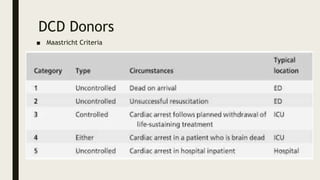
DCD Donors
■ Maastricht Criteria
Overcoming shortage of organs
■ Maximising DBD donation
■ Use of Marginal or Extended criteria DBD donors
■ Use of DCD donor
■ Increased Living donor transplantation
Graft Injury in Transplant
ISCHEMIA
REPERFUSION
Organ damage after Brain death
■ Cerebral injury and brain death are associated with the release of
cytokines and the initiation of inflammatory processes that can directly injure
organs
■ Can lead to further immune damage at reperfusion in the recipient.
■ Hormonal changes after brain death include reduced levels of antidiuretic
hormone and thyroid hormones
■ Myocardial suppression and decreased vascular tone results in hypotension and
inadequate perfusion of organs.
■ Kidneys – Inflammatory cytokines can lead to necrosis of renal tubules and
fibrous proliferation of the arterial intima.
Organ damge after Circulatory Death
■ Organs from DCD are exposed to inflammatory cytokines, but in a less
profound way to DBD
■ Undergo a significant period of warm ischemia before retrieval
Metabolic derangements
■ When a kidney is removed from the donor’s body, perfusion completely ceases,
leading to an absence of oxygen and nutrient delivery to the renal cells, which
will rapidly lead to serious metabolic problems.
■ Suppression of metabolism is therefore essential to maintain organ viability
during the preservation period
Why Preservation?
■ Preservation BUYS TIME!!!
■ Good organ preservation – Major determinant of Graft outcome after
Revascularisation
Key - Suppression of metabolism
■ Suppression of metabolism is essential to maintain organ viability
■ Reduction of the core temperature of the kidney below 4°C will result in a
reduction of metabolism to 5% to 8% and will diminish enzyme activity
■ Cold Storage is the key
Deleterious effects of Cold Storage
Classic unwanted side effects of hypothermia are
■ swelling,
■ acidosis,
■ altered intracellular enzyme activity
■ Production of radical oxygen species upon reperfusion.
– Xanthine oxidase – a well studied generator of ROS
Aims of modern kidney storage
solutions
■ Control of cell-swelling during hypothermic ischaemia
■ maintenance of intra- and extra-cellular electrolyte gradient during ischaemia
■ buffering of acidosis
■ provision of energy reserve
■ minimisation of oxidative reperfusion injury.
■ There is no agreement on which of the mechanisms is most important for post-
ischaemic renal graft function
Modern Storage solutions
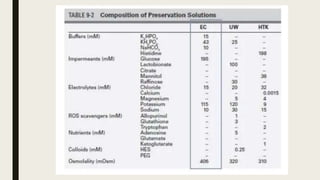
■ Eurocollins solution
■ University of Wisconsin Solution
■ HTK solution
■ Celsior solution
Eurocollins solution
■ Phosphate as pH Buffer
■ Glucose as Osmotic agent
University of Wisconsin solution
■ Cell impermeant agents (lactobionic acid, raffinose, hydroxyethyl starch)
– prevent the cells from swelling during cold ischemic storage
■ Glutathione, adenosine, Allopurinol
– stimulate recovery of normal metabolism upon reperfusion
– Free radical scavenging
HTK – Histidine, Tryptophan,
Ketoglutarate
■ Histidine – as potent buffer
■ Tryptophan – as membrane stabilizer and anti-oxidant
■ Ketoglutarate – improve ATP production during reperfusion
■ K+ - 9
Celsior
Celsior
■ Lactobionic acid, Mannitol – Impermeant
■ Histidine – pH buffer
■ Adenosine – ROS scavenging
■ No storage solution seems to combine all mechanisms.
■ For living donors, in whom immediate kidney transplantation is planned,
perfusion with crystalloid solution is sufficient.
■ Kidneys coming from DCD donors, especially those uncontrolled, are high-risk
marginal organs due to prolonged warm ischaemia periods, and require specific
measures in order to diminish the rate of nonfunction or DGF.
■ Previously, Euro-Collins was widely used, but is no longer recommended.
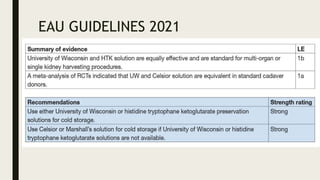
■ Presently, University of Wisconsin (UW), and histidine-tryptophan-ketoglutarate (HTK) solution
are equally effective and are standard for multi-organ or single kidney harvesting procedures.
■ University of Wisconsin solution has been the standard static cold preservation solution for the
procurement of liver, kidney, pancreas, and intestine
■ University of Wisconsin, HTK, and Celsior solutions have provided similar allograft outcomes in
most clinical trials;
■ In experimental studies of kidney preservation, HTK and UW retained a greater capacity to
preserve endothelial structure and pH buffering function during warm ischaemia in comparison
to Celsior, especially in uncontrolled DCD donors
EAU GUIDELINES 2021
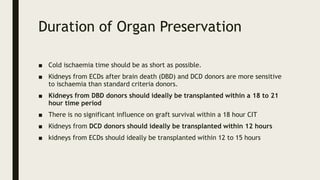
Duration of Organ Preservation
■ Cold ischaemia time should be as short as possible.
■ Kidneys from ECDs after brain death (DBD) and DCD donors are more sensitive
to ischaemia than standard criteria donors.
■ Kidneys from DBD donors should ideally be transplanted within a 18 to 21
hour time period
■ There is no significant influence on graft survival within a 18 hour CIT
■ Kidneys from DCD donors should ideally be transplanted within 12 hours
■ kidneys from ECDs should ideally be transplanted within 12 to 15 hours
Methods of Preservation
■ Static
■ Dynamic
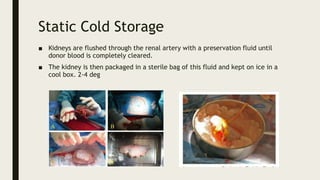
Static Cold Storage
■ Kidneys are flushed through the renal artery with a preservation fluid until
donor blood is completely cleared.
■ The kidney is then packaged in a sterile bag of this fluid and kept on ice in a
cool box. 2-4 deg
Dynamic Preservation
■ Dynamic preservation could allow for organ optimisation, offering a platform
for viability assessment, active organ repair and resuscitation.
■ Ex situ machine perfusion and in situ regional perfusion in the donor are
emerging as potential tools to preserve vulnerable grafts
Hypothermic Machine Perfusion
■ The retrieved kidney is placed within a chamber filled with chilled
preservation solution surrounded by an ice box.
■ The renal artery is cannulated by one end of a system of tubing, and a
pump is used to generate a pulsatile or continuous flow of preservation
solution through the renal vessels.
■ The fluid pours from the renal vein into the reservoir where the pump collects
it again to recirculate it
■ The largest RCT comparing simple CS with HMP of deceased donor kidneys
showed an overall reduced risk of DGF and a survival benefit, most
pronounced in ECD kidneys with HMP
■ HMP from type III DCD donors decreased DGF with no impact on graft survival
■ Reduces the risk of DGF in standard criteria DBD donor kidneys regardless of
CIT
Normothermic Regional Perfusion
■ An extracorporeal circuit via arterial and venous - femoral or distal aortic and
vena cava cannulation to recirculate the donor blood and isolates the
abdominal compartment by occluding the descending aorta
■ The extra-corporeal circuit includes an oxygenator, a heat exchanger, a
centrifugal pump, and an open circuit with a reservoir
■ Optimal duration of NRP is yet to be determined but around 120 minutes
appears to be sufficient to restore the cellular ATP
■ One of the key benefits of NRP is the real-time, in situ, dynamic assessment of
organ function ( via composite measurement of blood gases and biochemistry
every 30 minutes while on the pump)
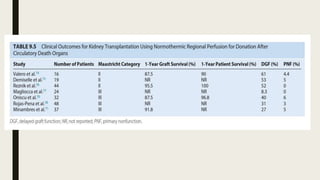
■ High incidence of DGF in category II DCD donors
■ an excellent 1-year Graft survival of 87.5%
■ The use of NRP led to a 27% reduction in the incidence of DGF compared
with in situ cold perfusion.
■ It has been advocated that NRP should become a standard method for
organ recovery from DCD in the future years
Normothermic Machine Perfusion
■ Normothermic machine perfusion (NMP) is based on the assumption that the most
effective means of preserving an organ is to replicate its physiologic milieu.
■ There is limited clinical experience of NMP in kidney transplantation to date
■ postulated benefits of normothermic perfusion as a means of preservation are:
– Restoration of cellular energy, repair of donation/retrieval injury,
minimization of ischemia-reperfusion;
– Measurement of viability;
– Delivery of organ-specific therapies; and
– Prolonged storage.
NATIVE KIDNEY NEPHRECTOMY
■ Careful selection of patients
■ Preservation of residual renal function for patients on dialysis can limit
the need for fluid and dietary restrictions.
■ Preservation Improves the management of hypertension and reduce the
risk for cardiac complication
■ Indication for native nephrectomy must be balanced by the risk of
observation
When to do?
■ If the Potential recipient has a living donor, it is ideal to perform
nephrectomy at least 6 weeks before the scheduled transplant.
■ Some surgeons prefer to do the nephrectomy at the time of transplant,
but this may increase the risk for complications with the transplant
kidney.
■ For patients who do not have a living donor, the timing of pretransplant
nephrectomy should be based on
– the indication,
– residual urine output, and
– accumulated wait list time.
Indications
■ Symptomatic renal stones not cleared by minimally invasive techniques or lithotripsy
■ High-grade solid renal tumors with or without acquired renal cystic disease
■ Polycystic kidneys that are
– symptomatic,
– extend below the iliac crest,
– have been infected, or
– have solid tumors
■ Persistent anti–glomerular basement membrane antibody levels
■ Significant proteinuria not controlled with medical nephrectomy or angioablation
■ Recurrent pyelonephritis
■ Grade 4 or 5 vesicoureteral reflux with urinary tract infections
Thank you

Kidney preservation-1.pptx

  • 1.
  • 2.
    Allograft Renal Transplantation ■Treatment of choice for ESRD. ■ Successful kidney transplantation can be expected to significantly increase a patient’s quality of life. ■ History
  • 3.
    Organ Donation ■ Thenumber of organs required to satisfy the needs of transplantation far exceeds the number of donor organs available.
  • 4.
    Donors ■ Living Donors ■Deceased Donors – Donation after Brain death ( Brain stem dead, heart beating donors) – Donation after Circulatory death
  • 5.
    DBD Donors ■ StandardCriteria Donors ( SCD) – Under 50 yrs old ■ Expanded Criteria Donors (ECD) – Over 60 yrs old – 50-69 yrs old with atleast two of the following ■ Hypertension ■ Cerebrovascular cause of brain death ■ Pre retrieval Serum Creatinine >1.5mg/dl
  • 6.
  • 7.
    Overcoming shortage oforgans ■ Maximising DBD donation ■ Use of Marginal or Extended criteria DBD donors ■ Use of DCD donor ■ Increased Living donor transplantation
  • 8.
    Graft Injury inTransplant ISCHEMIA REPERFUSION
  • 10.
    Organ damage afterBrain death ■ Cerebral injury and brain death are associated with the release of cytokines and the initiation of inflammatory processes that can directly injure organs ■ Can lead to further immune damage at reperfusion in the recipient. ■ Hormonal changes after brain death include reduced levels of antidiuretic hormone and thyroid hormones ■ Myocardial suppression and decreased vascular tone results in hypotension and inadequate perfusion of organs. ■ Kidneys – Inflammatory cytokines can lead to necrosis of renal tubules and fibrous proliferation of the arterial intima.
  • 11.
    Organ damge afterCirculatory Death ■ Organs from DCD are exposed to inflammatory cytokines, but in a less profound way to DBD ■ Undergo a significant period of warm ischemia before retrieval
  • 12.
    Metabolic derangements ■ Whena kidney is removed from the donor’s body, perfusion completely ceases, leading to an absence of oxygen and nutrient delivery to the renal cells, which will rapidly lead to serious metabolic problems. ■ Suppression of metabolism is therefore essential to maintain organ viability during the preservation period
  • 13.
    Why Preservation? ■ PreservationBUYS TIME!!! ■ Good organ preservation – Major determinant of Graft outcome after Revascularisation
  • 14.
    Key - Suppressionof metabolism ■ Suppression of metabolism is essential to maintain organ viability ■ Reduction of the core temperature of the kidney below 4°C will result in a reduction of metabolism to 5% to 8% and will diminish enzyme activity ■ Cold Storage is the key
  • 15.
    Deleterious effects ofCold Storage Classic unwanted side effects of hypothermia are ■ swelling, ■ acidosis, ■ altered intracellular enzyme activity ■ Production of radical oxygen species upon reperfusion. – Xanthine oxidase – a well studied generator of ROS
  • 17.
    Aims of modernkidney storage solutions ■ Control of cell-swelling during hypothermic ischaemia ■ maintenance of intra- and extra-cellular electrolyte gradient during ischaemia ■ buffering of acidosis ■ provision of energy reserve ■ minimisation of oxidative reperfusion injury. ■ There is no agreement on which of the mechanisms is most important for post- ischaemic renal graft function
  • 18.
    Modern Storage solutions ■Eurocollins solution ■ University of Wisconsin Solution ■ HTK solution ■ Celsior solution
  • 20.
    Eurocollins solution ■ Phosphateas pH Buffer ■ Glucose as Osmotic agent
  • 22.
    University of Wisconsinsolution ■ Cell impermeant agents (lactobionic acid, raffinose, hydroxyethyl starch) – prevent the cells from swelling during cold ischemic storage ■ Glutathione, adenosine, Allopurinol – stimulate recovery of normal metabolism upon reperfusion – Free radical scavenging
  • 24.
    HTK – Histidine,Tryptophan, Ketoglutarate ■ Histidine – as potent buffer ■ Tryptophan – as membrane stabilizer and anti-oxidant ■ Ketoglutarate – improve ATP production during reperfusion ■ K+ - 9
  • 25.
  • 26.
    Celsior ■ Lactobionic acid,Mannitol – Impermeant ■ Histidine – pH buffer ■ Adenosine – ROS scavenging
  • 27.
    ■ No storagesolution seems to combine all mechanisms. ■ For living donors, in whom immediate kidney transplantation is planned, perfusion with crystalloid solution is sufficient. ■ Kidneys coming from DCD donors, especially those uncontrolled, are high-risk marginal organs due to prolonged warm ischaemia periods, and require specific measures in order to diminish the rate of nonfunction or DGF. ■ Previously, Euro-Collins was widely used, but is no longer recommended. ■ Presently, University of Wisconsin (UW), and histidine-tryptophan-ketoglutarate (HTK) solution are equally effective and are standard for multi-organ or single kidney harvesting procedures. ■ University of Wisconsin solution has been the standard static cold preservation solution for the procurement of liver, kidney, pancreas, and intestine ■ University of Wisconsin, HTK, and Celsior solutions have provided similar allograft outcomes in most clinical trials; ■ In experimental studies of kidney preservation, HTK and UW retained a greater capacity to preserve endothelial structure and pH buffering function during warm ischaemia in comparison to Celsior, especially in uncontrolled DCD donors
  • 28.
  • 29.
    Duration of OrganPreservation ■ Cold ischaemia time should be as short as possible. ■ Kidneys from ECDs after brain death (DBD) and DCD donors are more sensitive to ischaemia than standard criteria donors. ■ Kidneys from DBD donors should ideally be transplanted within a 18 to 21 hour time period ■ There is no significant influence on graft survival within a 18 hour CIT ■ Kidneys from DCD donors should ideally be transplanted within 12 hours ■ kidneys from ECDs should ideally be transplanted within 12 to 15 hours
  • 30.
    Methods of Preservation ■Static ■ Dynamic
  • 31.
    Static Cold Storage ■Kidneys are flushed through the renal artery with a preservation fluid until donor blood is completely cleared. ■ The kidney is then packaged in a sterile bag of this fluid and kept on ice in a cool box. 2-4 deg
  • 32.
    Dynamic Preservation ■ Dynamicpreservation could allow for organ optimisation, offering a platform for viability assessment, active organ repair and resuscitation. ■ Ex situ machine perfusion and in situ regional perfusion in the donor are emerging as potential tools to preserve vulnerable grafts
  • 33.
    Hypothermic Machine Perfusion ■The retrieved kidney is placed within a chamber filled with chilled preservation solution surrounded by an ice box. ■ The renal artery is cannulated by one end of a system of tubing, and a pump is used to generate a pulsatile or continuous flow of preservation solution through the renal vessels. ■ The fluid pours from the renal vein into the reservoir where the pump collects it again to recirculate it
  • 36.
    ■ The largestRCT comparing simple CS with HMP of deceased donor kidneys showed an overall reduced risk of DGF and a survival benefit, most pronounced in ECD kidneys with HMP ■ HMP from type III DCD donors decreased DGF with no impact on graft survival ■ Reduces the risk of DGF in standard criteria DBD donor kidneys regardless of CIT
  • 37.
    Normothermic Regional Perfusion ■An extracorporeal circuit via arterial and venous - femoral or distal aortic and vena cava cannulation to recirculate the donor blood and isolates the abdominal compartment by occluding the descending aorta ■ The extra-corporeal circuit includes an oxygenator, a heat exchanger, a centrifugal pump, and an open circuit with a reservoir
  • 39.
    ■ Optimal durationof NRP is yet to be determined but around 120 minutes appears to be sufficient to restore the cellular ATP ■ One of the key benefits of NRP is the real-time, in situ, dynamic assessment of organ function ( via composite measurement of blood gases and biochemistry every 30 minutes while on the pump)
  • 41.
    ■ High incidenceof DGF in category II DCD donors ■ an excellent 1-year Graft survival of 87.5% ■ The use of NRP led to a 27% reduction in the incidence of DGF compared with in situ cold perfusion. ■ It has been advocated that NRP should become a standard method for organ recovery from DCD in the future years
  • 42.
    Normothermic Machine Perfusion ■Normothermic machine perfusion (NMP) is based on the assumption that the most effective means of preserving an organ is to replicate its physiologic milieu. ■ There is limited clinical experience of NMP in kidney transplantation to date ■ postulated benefits of normothermic perfusion as a means of preservation are: – Restoration of cellular energy, repair of donation/retrieval injury, minimization of ischemia-reperfusion; – Measurement of viability; – Delivery of organ-specific therapies; and – Prolonged storage.
  • 44.
    NATIVE KIDNEY NEPHRECTOMY ■Careful selection of patients ■ Preservation of residual renal function for patients on dialysis can limit the need for fluid and dietary restrictions. ■ Preservation Improves the management of hypertension and reduce the risk for cardiac complication ■ Indication for native nephrectomy must be balanced by the risk of observation
  • 45.
    When to do? ■If the Potential recipient has a living donor, it is ideal to perform nephrectomy at least 6 weeks before the scheduled transplant. ■ Some surgeons prefer to do the nephrectomy at the time of transplant, but this may increase the risk for complications with the transplant kidney. ■ For patients who do not have a living donor, the timing of pretransplant nephrectomy should be based on – the indication, – residual urine output, and – accumulated wait list time.
  • 46.
    Indications ■ Symptomatic renalstones not cleared by minimally invasive techniques or lithotripsy ■ High-grade solid renal tumors with or without acquired renal cystic disease ■ Polycystic kidneys that are – symptomatic, – extend below the iliac crest, – have been infected, or – have solid tumors ■ Persistent anti–glomerular basement membrane antibody levels ■ Significant proteinuria not controlled with medical nephrectomy or angioablation ■ Recurrent pyelonephritis ■ Grade 4 or 5 vesicoureteral reflux with urinary tract infections
  • 47.