Thyroid: Scan
Ahmed abu hassnah
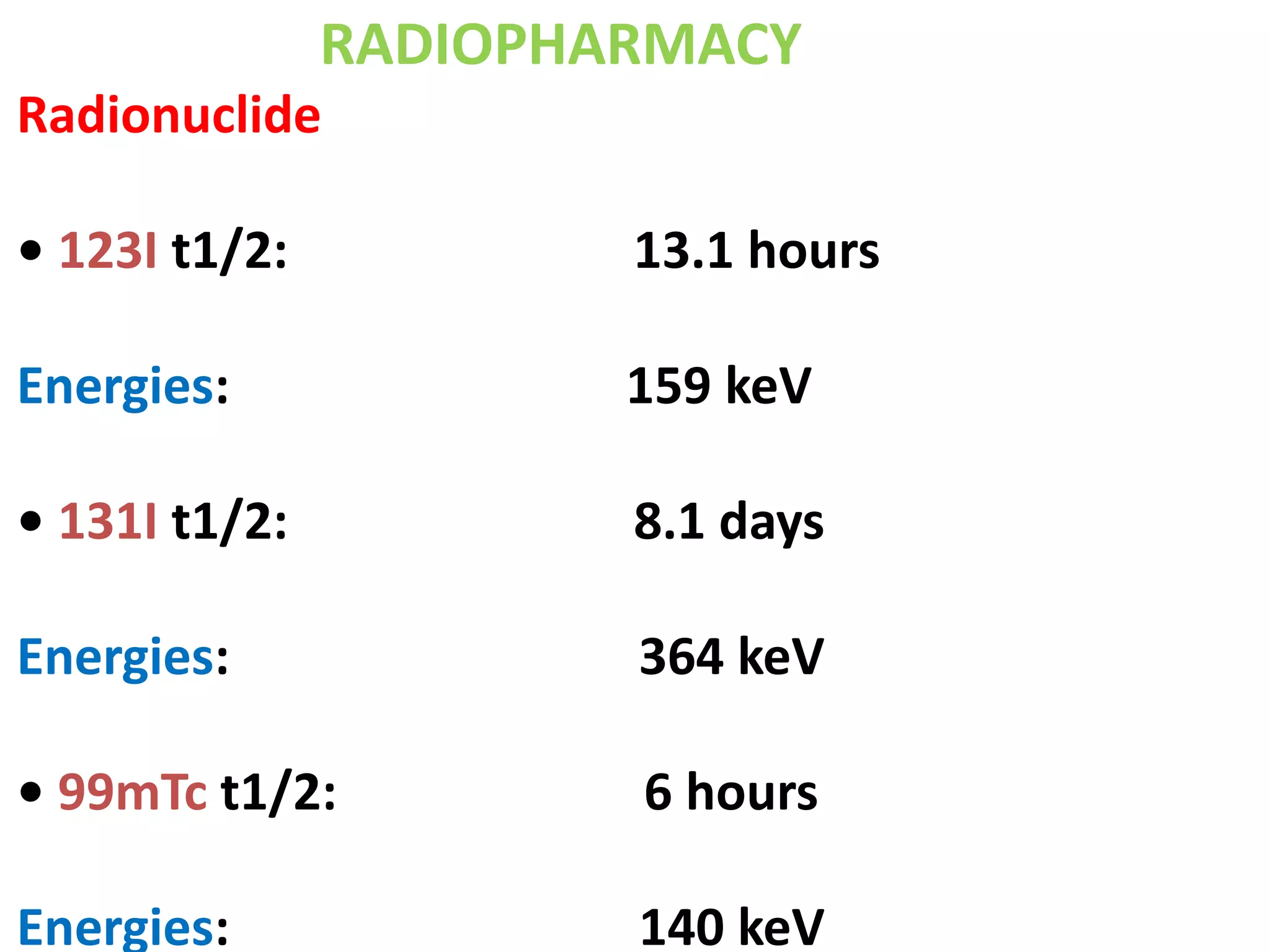
RADIOPHARMACY
Radionuclide
• 123I t1/2: 13.1 hours
Energies: 159 keV
• 131I t1/2: 8.1 days
Energies: 364 keV
• 99mTc t1/2: 6 hours
Energies: 140 keV
Radiopharmaceutical
• 123I and 131I as capsules
• 99mTcO4 − (pertechnetate)
Adult Dose Range
• 131I: 1μCi −10 mCi depending on
patient and reason for scan. Usually
5–30 μCi for uptake and scan, 2–5 mCi
for whole body imaging and/or
treatment of patients.
• 123I: 100–450 μCi.
• 99mTcO4 −: 2–10 mCi.
Method of Administration
• 123I and 131I capsule Oral (PO).
• 99mTc by intravenous injection.
INDICATIONS
• Evaluation of thyroid anatomy, e.g.,
position, goiter (enlarged gland due to
inadequate iodine supply), surgery, cold
or hot nodule(s).
• Detection and evaluation of hyperthyroidism
and hypothyroidism.
• Detection and localization of metastases
from thyroid cancer.
• Differentiation of benign from malignant
nodules.
• Detection, localization, and evaluation of
independent functioning nodule(s).
• Evaluation of heterogeneity of function
within a hyperthyroid gland.
• Detection and localization of benign ectopic
thyroid tissue.
• Evaluation of abnormal thyroid serum
laboratory results.
• Evaluation of subclinical (before appearance
of typical symptoms of disease) and subacute
(between acute and chronic) disease processes,
e.g., toxic goiter, thyroiditis.
• Evaluation of thyroid because of
abnormal findings on other diagnostic
images, e.g., US, x-ray images, PET,
MRI, CT.
CONTRAINDICATIONS
• Allergy to iodine if that is being used.
• With iodine, interfering recent contrast
studies.
• With iodine, patient has not discontinued
thyroid or interfering medication, vitamins,
or iodinated food products.
PATIENT PREPARATION
• Identify the patient. Verify doctor’s order.
Explain the procedure.
• Patient to discontinue thyroid medications
and avoid contrast material, Betadine®, or
amiodarone.
• Refrain from eating foods containing iodine
such as cabbage, turnips, greens, seafood, kelp,
or large amounts of table salt.
• 123I and 131I:
Patient will be returning at 4 to 6 hours
and 24 hours for scan.
131I: Patient will usually be returning
at 24 hours and beyond for imaging.
This iodine is not routinely used for
uptake and scans.
PROCEDURE (USUALLY TWO PARTS; TIME: ~40
MINUTES)
99mTcO4−
• Administer injection to patient; wait 15 to 20
minutes before imaging. Give patient water
(optional lemon to clear salivary glands).
• Place patient in supine position with pillow
under shoulders and chin up.
•Using a pinhole collimator if
available,obtain anterior views with
and without markers as per protocol,
then RAO and LAO.
• are optional images if a pinhole
collimator is not available.
123I Capsule
• without injection. mage 50,000 to 100,000 counts
or 8 to 10 minutes per image. Images can be taken
from 3 to 36 hours after administration of capsule
(usually at 4–6 hours or 24 hours).
131I Capsule
• without injection. Usually used to locate residual
and recurrent cancers. 24-, 48-, and 72-hour pictures
may be the most useful. Collect 100,000 counts over
thyroid and whole body if cancer is suspected.
NORMAL RESULTS
• Euthyroid: Homogeneous uptake of radiotracer.
• Left lobe smaller than right lobe or having pyramidal
lobe.
• Straight or convex outer margins.
• Uptake equal to or greater than that of salivary
glands (water or lemon given to reduce salivary
uptake).
• 99mTc also shows in soft tissue, brain,
stomach mucosa, nasopharynx, bladder.
• 123I and 131I will present in nasopharynx,
salivary glands, stomach, colon, bladder,
lactating breasts.
• The test is usually performed in conjunction
with the thyroid uptake test.
ABNORMAL RESULTS
• Plummer’s disease: Autonomous multinodular
goiter; nodules, solitary or multiple: cold and/or
hot (solitary: adenoma, thyroiditis; multiple:
goiter).
• Non visualization of thyroid gland caused by,
e.g., sub acute thyroiditis, patient on
contraindicated medications.
• Graves’ disease: Enlarged gland, high
uptake (LATS [long-acting thyroid
stimulator, an autoantibody]).
• Hashimoto’s thyroiditis: Enlarged gland,
mottled.
• Thyroid carcinoma: Usually solitary cold
nodule (4% show high uptake).
• Cold nodule on iodine scan can be clarified by
99mTc O4:
− scan Cold on 99mTc O4.
− scan is nonvascular and more than likely
benign though not always.
− scan is vascularized and more likely to be
malignant (20% chance of carcinoma).
Usually followed by biopsy and/or surgery.
Nuclear Medicine - Thyroid - Procedure/Scan

Nuclear Medicine - Thyroid - Procedure/Scan

  • 1.
  • 2.
    RADIOPHARMACY Radionuclide • 123I t1/2:13.1 hours Energies: 159 keV • 131I t1/2: 8.1 days Energies: 364 keV • 99mTc t1/2: 6 hours Energies: 140 keV
  • 3.
    Radiopharmaceutical • 123I and131I as capsules • 99mTcO4 − (pertechnetate)
  • 4.
    Adult Dose Range •131I: 1μCi −10 mCi depending on patient and reason for scan. Usually 5–30 μCi for uptake and scan, 2–5 mCi for whole body imaging and/or treatment of patients. • 123I: 100–450 μCi. • 99mTcO4 −: 2–10 mCi.
  • 5.
    Method of Administration •123I and 131I capsule Oral (PO). • 99mTc by intravenous injection.
  • 6.
    INDICATIONS • Evaluation ofthyroid anatomy, e.g., position, goiter (enlarged gland due to inadequate iodine supply), surgery, cold or hot nodule(s). • Detection and evaluation of hyperthyroidism and hypothyroidism.
  • 7.
    • Detection andlocalization of metastases from thyroid cancer. • Differentiation of benign from malignant nodules. • Detection, localization, and evaluation of independent functioning nodule(s). • Evaluation of heterogeneity of function within a hyperthyroid gland.
  • 8.
    • Detection andlocalization of benign ectopic thyroid tissue. • Evaluation of abnormal thyroid serum laboratory results. • Evaluation of subclinical (before appearance of typical symptoms of disease) and subacute (between acute and chronic) disease processes, e.g., toxic goiter, thyroiditis.
  • 9.
    • Evaluation ofthyroid because of abnormal findings on other diagnostic images, e.g., US, x-ray images, PET, MRI, CT.
  • 10.
    CONTRAINDICATIONS • Allergy toiodine if that is being used. • With iodine, interfering recent contrast studies. • With iodine, patient has not discontinued thyroid or interfering medication, vitamins, or iodinated food products.
  • 11.
    PATIENT PREPARATION • Identifythe patient. Verify doctor’s order. Explain the procedure. • Patient to discontinue thyroid medications and avoid contrast material, Betadine®, or amiodarone. • Refrain from eating foods containing iodine such as cabbage, turnips, greens, seafood, kelp, or large amounts of table salt.
  • 12.
    • 123I and131I: Patient will be returning at 4 to 6 hours and 24 hours for scan. 131I: Patient will usually be returning at 24 hours and beyond for imaging. This iodine is not routinely used for uptake and scans.
  • 13.
    PROCEDURE (USUALLY TWOPARTS; TIME: ~40 MINUTES) 99mTcO4− • Administer injection to patient; wait 15 to 20 minutes before imaging. Give patient water (optional lemon to clear salivary glands). • Place patient in supine position with pillow under shoulders and chin up.
  • 14.
    •Using a pinholecollimator if available,obtain anterior views with and without markers as per protocol, then RAO and LAO. • are optional images if a pinhole collimator is not available.
  • 15.
    123I Capsule • withoutinjection. mage 50,000 to 100,000 counts or 8 to 10 minutes per image. Images can be taken from 3 to 36 hours after administration of capsule (usually at 4–6 hours or 24 hours). 131I Capsule • without injection. Usually used to locate residual and recurrent cancers. 24-, 48-, and 72-hour pictures may be the most useful. Collect 100,000 counts over thyroid and whole body if cancer is suspected.
  • 16.
    NORMAL RESULTS • Euthyroid:Homogeneous uptake of radiotracer. • Left lobe smaller than right lobe or having pyramidal lobe. • Straight or convex outer margins. • Uptake equal to or greater than that of salivary glands (water or lemon given to reduce salivary uptake).
  • 17.
    • 99mTc alsoshows in soft tissue, brain, stomach mucosa, nasopharynx, bladder. • 123I and 131I will present in nasopharynx, salivary glands, stomach, colon, bladder, lactating breasts. • The test is usually performed in conjunction with the thyroid uptake test.
  • 20.
    ABNORMAL RESULTS • Plummer’sdisease: Autonomous multinodular goiter; nodules, solitary or multiple: cold and/or hot (solitary: adenoma, thyroiditis; multiple: goiter). • Non visualization of thyroid gland caused by, e.g., sub acute thyroiditis, patient on contraindicated medications.
  • 21.
    • Graves’ disease:Enlarged gland, high uptake (LATS [long-acting thyroid stimulator, an autoantibody]). • Hashimoto’s thyroiditis: Enlarged gland, mottled. • Thyroid carcinoma: Usually solitary cold nodule (4% show high uptake).
  • 22.
    • Cold noduleon iodine scan can be clarified by 99mTc O4: − scan Cold on 99mTc O4. − scan is nonvascular and more than likely benign though not always. − scan is vascularized and more likely to be malignant (20% chance of carcinoma). Usually followed by biopsy and/or surgery.