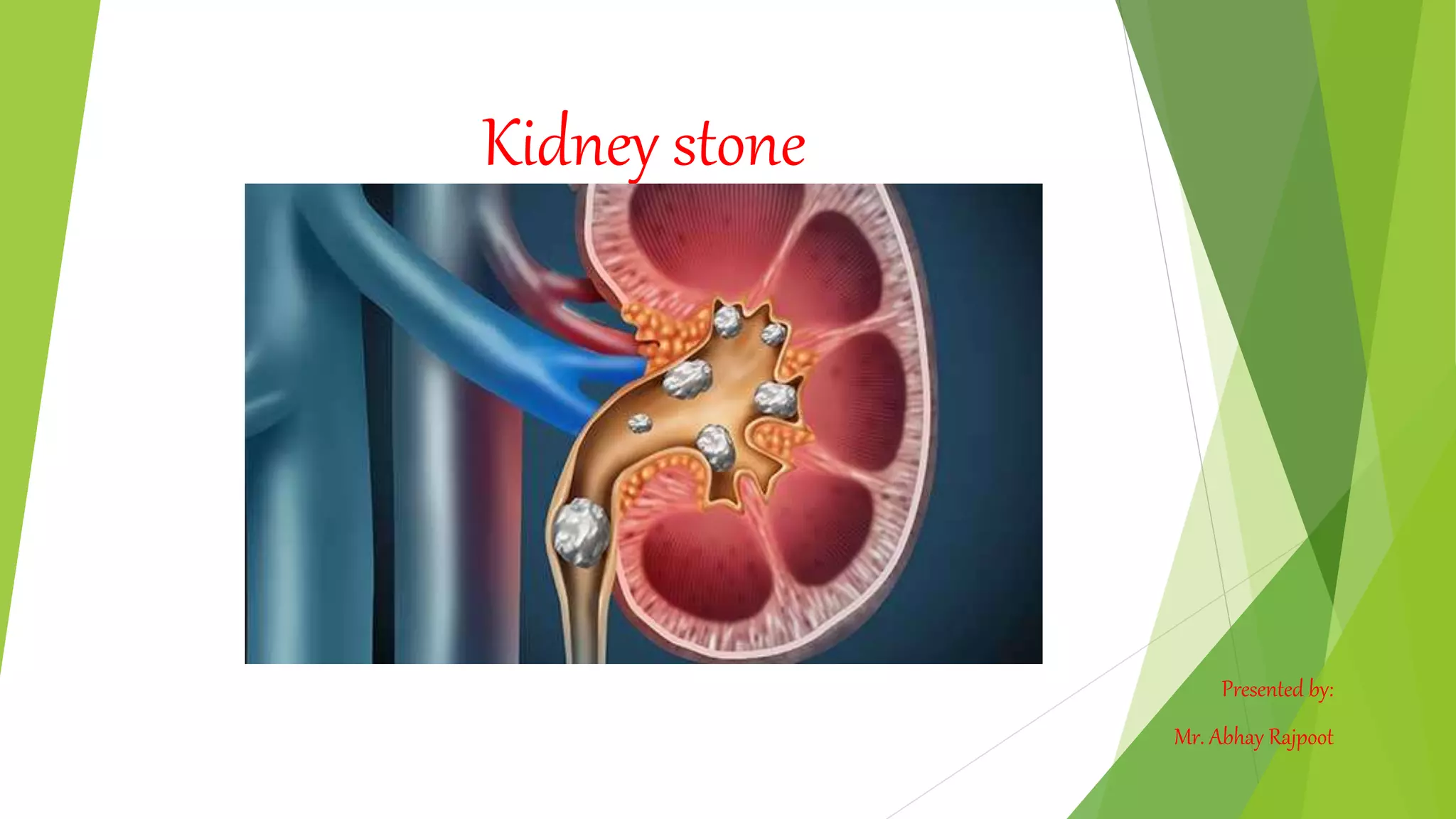

Kidney stone
Presented by:
Mr. Abhay Rajpoot
INTRODUCTION
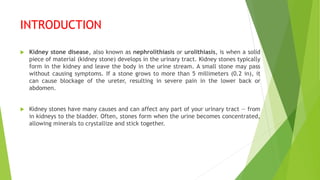
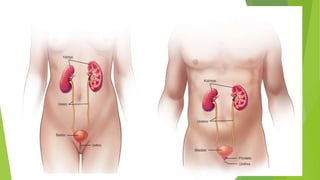
 Kidney stone disease, also known as nephrolithiasis or urolithiasis, is when a solid
piece of material (kidney stone) develops in the urinary tract. Kidney stones typically
form in the kidney and leave the body in the urine stream. A small stone may pass
without causing symptoms. If a stone grows to more than 5 millimeters (0.2 in), it
can cause blockage of the ureter, resulting in severe pain in the lower back or
abdomen.
 Kidney stones have many causes and can affect any part of your urinary tract — from
in kidneys to the bladder. Often, stones form when the urine becomes concentrated,
allowing minerals to crystallize and stick together.
DEFINITION
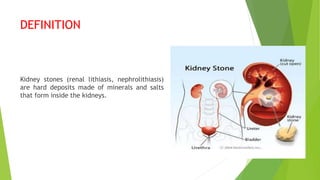
Kidney stones (renal lithiasis, nephrolithiasis)
are hard deposits made of minerals and salts
that form inside the kidneys.
INCIDENCE
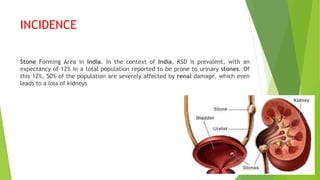
Stone Forming Area in India. In the context of India, KSD is prevalent, with an
expectancy of 12% in a total population reported to be prone to urinary stones. Of
this 12%, 50% of the population are severely affected by renal damage, which even
leads to a loss of kidneys
RISK FACTORS/CAUSES
 Family or personal history. If someone in your family has kidney stones, you're
more likely to develop stones, too. And if you've already had one or more kidney
stones, you're at increased risk of developing another.
 Dehydration. Not drinking enough water each day can increase your risk of
kidney stones. People who live in warm climates and those who sweat a lot may
be at higher risk than others.
 Certain diets. Eating a diet that's high in protein, sodium (salt) and sugar may
increase your risk of some types of kidney stones. This is especially true with a
high-sodium diet. Too much salt in your diet increases the amount of calcium
your kidneys must filter and significantly increases your risk of kidney stones.
CONTI…
 Being obese. High body mass index (BMI), large waist size and weight gain have
been linked to an increased risk of kidney stones.
 Digestive diseases and surgery. Gastric bypass surgery, inflammatory bowel
disease or chronic diarrhea can cause changes in the digestive process that affect
your absorption of calcium and water, increasing the levels of stone-forming
substances in the urine.
 Other medical conditions. Diseases and conditions that may increase the risk of
kidney stones include renal tubular acidosis, cystinuria, hyperparathyroidism,
certain medications and some urinary tract infections.
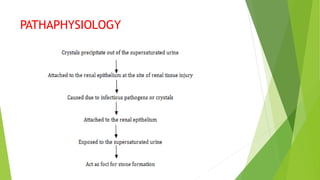
PATHAPHYSIOLOGY
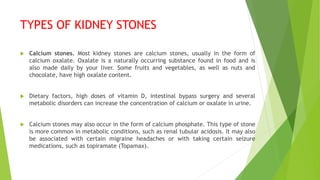
TYPES OF KIDNEY STONES
 Calcium stones. Most kidney stones are calcium stones, usually in the form of
calcium oxalate. Oxalate is a naturally occurring substance found in food and is
also made daily by your liver. Some fruits and vegetables, as well as nuts and
chocolate, have high oxalate content.
 Dietary factors, high doses of vitamin D, intestinal bypass surgery and several
metabolic disorders can increase the concentration of calcium or oxalate in urine.
 Calcium stones may also occur in the form of calcium phosphate. This type of stone
is more common in metabolic conditions, such as renal tubular acidosis. It may also
be associated with certain migraine headaches or with taking certain seizure
medications, such as topiramate (Topamax).
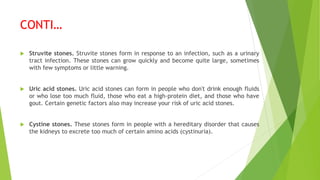
CONTI…
 Struvite stones. Struvite stones form in response to an infection, such as a urinary
tract infection. These stones can grow quickly and become quite large, sometimes
with few symptoms or little warning.
 Uric acid stones. Uric acid stones can form in people who don't drink enough fluids
or who lose too much fluid, those who eat a high-protein diet, and those who have
gout. Certain genetic factors also may increase your risk of uric acid stones.
 Cystine stones. These stones form in people with a hereditary disorder that causes
the kidneys to excrete too much of certain amino acids (cystinuria).
SYMPTOMS
 Severe pain in the side and back, below the ribs
 Pain that radiates to the lower abdomen and groin
 Pain that comes in waves and fluctuates in intensity
 Pain on urination
 Pink, red or brown urine
 Cloudy or foul-smelling urine
 Nausea and vomiting
 Persistent need to urinate
 Urinating more often than usual
 Fever and chills if an infection is present
 Urinating small amounts
DIAGNOSTIC EVALUATION
 Blood testing. Blood tests may reveal too much calcium or uric acid in your blood.
Blood test results help monitor the health of the kidneys.
 Urine testing. The 24-hour urine collection test may show that you're excreting too
many stone-forming minerals or too few stone-preventing substances. For this test,
your doctor may request that you perform two urine collections over two
consecutive days.
 Imaging. Imaging tests may show kidney stones in the urinary tract. Options range
from simple abdominal X-rays, which can miss small kidney stones, to high-speed or
dual energy computerized tomography (CT) that may reveal even tiny stones.
CONTI…
 Other imaging options include an ultrasound, a noninvasive test, and intravenous
urography, which involves injecting dye into an arm vein and taking X-rays
(intravenous pyelogram) or obtaining CT images (CT urogram) as the dye travels
through the kidneys and bladder.
 Analysis of passed stones. You may be asked to urinate through a strainer to
catch stones that you pass. Lab analysis will reveal the makeup of your kidney
stones. Your doctor uses this information to determine what's causing your kidney
stones and to form a plan to prevent more kidney stones
COMPLICATION
PREVENTION
 Drink water throughout the day. For people with a history of kidney stones,
doctors usually recommend passing about 2.6 quarts (2.5 liters) of urine a day.
Your doctor may ask that you measure your urine output to make sure that you're
drinking enough water.
 If you live in a hot, dry climate or you exercise frequently, you may need to drink
even more water to produce enough urine. If your urine is light and clear, you're
likely drinking enough water.
 Eat fewer oxalate-rich foods. If you tend to form calcium oxalate stones, your
doctor may recommend restricting foods rich in oxalates. These include rhubarb,
beets, okra, spinach, Swiss chard, sweet potatoes, nuts, tea, chocolate and soy
products.
 Choose a diet low in salt and animal protein. Reduce the amount of salt you
eat and choose nonanimal protein sources, such as legumes. Consider using a
salt substitute, such as Mrs. Dash.
 Continue eating calcium-rich foods, but use caution with calcium
supplements. Calcium in food doesn't have an effect on your risk of kidney
stones. Continue eating calcium-rich foods unless your doctor advises
otherwise
MANAGEMENT
Small stones with minimal symptoms
Most small kidney stones won't require invasive treatment. You may be able to pass a
small stone by:
 Drinking water. Drinking as much as 2 to 3 quarts (1.9 to 2.8 liters) a day may help
flush out your urinary system. Unless your doctor tells you otherwise, drink enough
fluid — mostly water — to produce clear or nearly clear urine.
 Pain relievers. Passing a small stone can cause some discomfort. To relieve mild
pain, your doctor may recommend pain relievers such as ibuprofen (Advil, Motrin IB,
others), acetaminophen (Tylenol, others) or naproxen sodium (Aleve).
 Medical therapy. Your doctor may give you a medication to help pass your kidney
stone. This type of medication, known as an alpha blocker, relaxes the muscles in
your ureter, helping you pass the kidney stone more quickly and with less pain
 Large stones and those that cause symptoms
 Using sound waves to break up stones. For certain kidney stones —
depending on size and location the doctor may recommend a procedure
called extracorporeal shock wave lithotripsy (ESWL).
 ESWL uses sound waves to create strong vibrations (shock waves) that
break the stones into tiny pieces that can be passed in your urine. The
procedure lasts about 45 to 60 minutes and can cause moderate pain, so
you may be under sedation or light anesthesia to make you comfortable.
 Surgery to remove very large stones in the kidney. A procedure called
percutaneous nephrolithotomy involves surgically removing a kidney stone
using small telescopes and instruments inserted through a small incision in
your back.
 You will receive general anesthesia during the surgery and be in the
hospital for one to two days while you recover. Your doctor may
recommend this surgery if ESWL was unsuccessful.
 Using a scope to remove stones. To remove a smaller stone in your ureter or
kidney, your doctor may pass a thin lighted tube (ureteroscope) equipped with a
camera through your urethra and bladder to your ureter.
 Once the stone is located, special tools can snare the stone or break it into pieces
that will pass in your urine. Your doctor may then place a small tube (stent) in the
ureter to relieve swelling and promote healing. You may need general or local
anesthesia during this procedure.
 Parathyroid gland surgery. Some calcium phosphate stones are caused by
overactive parathyroid glands, which are located on the four corners of your thyroid
gland, just below your Adam's apple. When these glands produce too much
parathyroid hormone (hyperparathyroidism), your calcium levels can become too
high and kidney stones may form as a result.
MEDICATION
 Calcium stones. To help prevent calcium stones from forming, your doctor may
prescribe a thiazide diuretic or a phosphate-containing preparation.
 Uric acid stones. Your doctor may prescribe allopurinol (Zyloprim, Aloprim) to
reduce uric acid levels in your blood and urine and a medicine to keep your urine
alkaline. In some cases, allopurinol and an alkalizing agent may dissolve the uric
acid stones.
 Struvite stones. To prevent struvite stones, your doctor may recommend
strategies to keep your urine free of bacteria that cause infection. Long-term use
of antibiotics in small doses may help achieve this goal. For instance, your doctor
may recommend an antibiotic before and for a while after surgery to treat your
kidney stones.
 Cystine stones. Cystine stones can be difficult to treat. Your doctor may
recommend that you drink more fluids so that you produce a lot more urine. If
that alone doesn't help, your doctor may also prescribe a medication that
decreases the amount of cystine in your urine.
Renal calculus

Renal calculus

  • 1.
  • 2.
    INTRODUCTION  Kidney stonedisease, also known as nephrolithiasis or urolithiasis, is when a solid piece of material (kidney stone) develops in the urinary tract. Kidney stones typically form in the kidney and leave the body in the urine stream. A small stone may pass without causing symptoms. If a stone grows to more than 5 millimeters (0.2 in), it can cause blockage of the ureter, resulting in severe pain in the lower back or abdomen.  Kidney stones have many causes and can affect any part of your urinary tract — from in kidneys to the bladder. Often, stones form when the urine becomes concentrated, allowing minerals to crystallize and stick together.
  • 3.
    DEFINITION Kidney stones (renallithiasis, nephrolithiasis) are hard deposits made of minerals and salts that form inside the kidneys.
  • 5.
    INCIDENCE Stone Forming Areain India. In the context of India, KSD is prevalent, with an expectancy of 12% in a total population reported to be prone to urinary stones. Of this 12%, 50% of the population are severely affected by renal damage, which even leads to a loss of kidneys
  • 6.
    RISK FACTORS/CAUSES  Familyor personal history. If someone in your family has kidney stones, you're more likely to develop stones, too. And if you've already had one or more kidney stones, you're at increased risk of developing another.  Dehydration. Not drinking enough water each day can increase your risk of kidney stones. People who live in warm climates and those who sweat a lot may be at higher risk than others.  Certain diets. Eating a diet that's high in protein, sodium (salt) and sugar may increase your risk of some types of kidney stones. This is especially true with a high-sodium diet. Too much salt in your diet increases the amount of calcium your kidneys must filter and significantly increases your risk of kidney stones.
  • 7.
    CONTI…  Being obese.High body mass index (BMI), large waist size and weight gain have been linked to an increased risk of kidney stones.  Digestive diseases and surgery. Gastric bypass surgery, inflammatory bowel disease or chronic diarrhea can cause changes in the digestive process that affect your absorption of calcium and water, increasing the levels of stone-forming substances in the urine.  Other medical conditions. Diseases and conditions that may increase the risk of kidney stones include renal tubular acidosis, cystinuria, hyperparathyroidism, certain medications and some urinary tract infections.
  • 8.
  • 9.
    TYPES OF KIDNEYSTONES  Calcium stones. Most kidney stones are calcium stones, usually in the form of calcium oxalate. Oxalate is a naturally occurring substance found in food and is also made daily by your liver. Some fruits and vegetables, as well as nuts and chocolate, have high oxalate content.  Dietary factors, high doses of vitamin D, intestinal bypass surgery and several metabolic disorders can increase the concentration of calcium or oxalate in urine.  Calcium stones may also occur in the form of calcium phosphate. This type of stone is more common in metabolic conditions, such as renal tubular acidosis. It may also be associated with certain migraine headaches or with taking certain seizure medications, such as topiramate (Topamax).
  • 10.
    CONTI…  Struvite stones.Struvite stones form in response to an infection, such as a urinary tract infection. These stones can grow quickly and become quite large, sometimes with few symptoms or little warning.  Uric acid stones. Uric acid stones can form in people who don't drink enough fluids or who lose too much fluid, those who eat a high-protein diet, and those who have gout. Certain genetic factors also may increase your risk of uric acid stones.  Cystine stones. These stones form in people with a hereditary disorder that causes the kidneys to excrete too much of certain amino acids (cystinuria).
  • 11.
    SYMPTOMS  Severe painin the side and back, below the ribs  Pain that radiates to the lower abdomen and groin  Pain that comes in waves and fluctuates in intensity  Pain on urination  Pink, red or brown urine  Cloudy or foul-smelling urine  Nausea and vomiting  Persistent need to urinate  Urinating more often than usual  Fever and chills if an infection is present  Urinating small amounts
  • 12.
    DIAGNOSTIC EVALUATION  Bloodtesting. Blood tests may reveal too much calcium or uric acid in your blood. Blood test results help monitor the health of the kidneys.  Urine testing. The 24-hour urine collection test may show that you're excreting too many stone-forming minerals or too few stone-preventing substances. For this test, your doctor may request that you perform two urine collections over two consecutive days.  Imaging. Imaging tests may show kidney stones in the urinary tract. Options range from simple abdominal X-rays, which can miss small kidney stones, to high-speed or dual energy computerized tomography (CT) that may reveal even tiny stones.
  • 13.
    CONTI…  Other imagingoptions include an ultrasound, a noninvasive test, and intravenous urography, which involves injecting dye into an arm vein and taking X-rays (intravenous pyelogram) or obtaining CT images (CT urogram) as the dye travels through the kidneys and bladder.  Analysis of passed stones. You may be asked to urinate through a strainer to catch stones that you pass. Lab analysis will reveal the makeup of your kidney stones. Your doctor uses this information to determine what's causing your kidney stones and to form a plan to prevent more kidney stones
  • 14.
  • 15.
    PREVENTION  Drink waterthroughout the day. For people with a history of kidney stones, doctors usually recommend passing about 2.6 quarts (2.5 liters) of urine a day. Your doctor may ask that you measure your urine output to make sure that you're drinking enough water.  If you live in a hot, dry climate or you exercise frequently, you may need to drink even more water to produce enough urine. If your urine is light and clear, you're likely drinking enough water.  Eat fewer oxalate-rich foods. If you tend to form calcium oxalate stones, your doctor may recommend restricting foods rich in oxalates. These include rhubarb, beets, okra, spinach, Swiss chard, sweet potatoes, nuts, tea, chocolate and soy products.
  • 16.
     Choose adiet low in salt and animal protein. Reduce the amount of salt you eat and choose nonanimal protein sources, such as legumes. Consider using a salt substitute, such as Mrs. Dash.  Continue eating calcium-rich foods, but use caution with calcium supplements. Calcium in food doesn't have an effect on your risk of kidney stones. Continue eating calcium-rich foods unless your doctor advises otherwise
  • 17.
    MANAGEMENT Small stones withminimal symptoms Most small kidney stones won't require invasive treatment. You may be able to pass a small stone by:  Drinking water. Drinking as much as 2 to 3 quarts (1.9 to 2.8 liters) a day may help flush out your urinary system. Unless your doctor tells you otherwise, drink enough fluid — mostly water — to produce clear or nearly clear urine.  Pain relievers. Passing a small stone can cause some discomfort. To relieve mild pain, your doctor may recommend pain relievers such as ibuprofen (Advil, Motrin IB, others), acetaminophen (Tylenol, others) or naproxen sodium (Aleve).  Medical therapy. Your doctor may give you a medication to help pass your kidney stone. This type of medication, known as an alpha blocker, relaxes the muscles in your ureter, helping you pass the kidney stone more quickly and with less pain
  • 18.
     Large stonesand those that cause symptoms  Using sound waves to break up stones. For certain kidney stones — depending on size and location the doctor may recommend a procedure called extracorporeal shock wave lithotripsy (ESWL).  ESWL uses sound waves to create strong vibrations (shock waves) that break the stones into tiny pieces that can be passed in your urine. The procedure lasts about 45 to 60 minutes and can cause moderate pain, so you may be under sedation or light anesthesia to make you comfortable.  Surgery to remove very large stones in the kidney. A procedure called percutaneous nephrolithotomy involves surgically removing a kidney stone using small telescopes and instruments inserted through a small incision in your back.  You will receive general anesthesia during the surgery and be in the hospital for one to two days while you recover. Your doctor may recommend this surgery if ESWL was unsuccessful.
  • 19.
     Using ascope to remove stones. To remove a smaller stone in your ureter or kidney, your doctor may pass a thin lighted tube (ureteroscope) equipped with a camera through your urethra and bladder to your ureter.  Once the stone is located, special tools can snare the stone or break it into pieces that will pass in your urine. Your doctor may then place a small tube (stent) in the ureter to relieve swelling and promote healing. You may need general or local anesthesia during this procedure.  Parathyroid gland surgery. Some calcium phosphate stones are caused by overactive parathyroid glands, which are located on the four corners of your thyroid gland, just below your Adam's apple. When these glands produce too much parathyroid hormone (hyperparathyroidism), your calcium levels can become too high and kidney stones may form as a result.
  • 20.
    MEDICATION  Calcium stones.To help prevent calcium stones from forming, your doctor may prescribe a thiazide diuretic or a phosphate-containing preparation.  Uric acid stones. Your doctor may prescribe allopurinol (Zyloprim, Aloprim) to reduce uric acid levels in your blood and urine and a medicine to keep your urine alkaline. In some cases, allopurinol and an alkalizing agent may dissolve the uric acid stones.  Struvite stones. To prevent struvite stones, your doctor may recommend strategies to keep your urine free of bacteria that cause infection. Long-term use of antibiotics in small doses may help achieve this goal. For instance, your doctor may recommend an antibiotic before and for a while after surgery to treat your kidney stones.  Cystine stones. Cystine stones can be difficult to treat. Your doctor may recommend that you drink more fluids so that you produce a lot more urine. If that alone doesn't help, your doctor may also prescribe a medication that decreases the amount of cystine in your urine.