SHORT-TERM
DECISIONS
• Relevant costs
• Decision-making scenarios
• Make or buy decisions
• Further processing and shutdown
• Joint costs and products
• Qualitative factors
SYLLABUS LEARNING OUTCOMES (1)
• Explain the concept of relevant costing.
• Identify and calculate relevant costs for a specific decision
situation from given data.
• Explain and apply the concept of opportunity costs.
• Explain the issues surrounding make vs. buy and outsourcing
decisions.
• Calculate and compare 'make' costs with 'buy-in' costs.
• Compare in-house costs and outsource costs of completing tasks
and consider other issues surrounding this decision.
SYLLABUS LEARNING OUTCOMES (2)
• Apply relevant costing principles in situations involving shut
down, one-off contracts and the further processing of joint
products.
CHAPTER OVERVIEW
• In this chapter, we look in depth at relevant costs and at how
they should be applied in decision-making situations.
• We look at a variety of common short-run business decisions
and consider how they can be dealt with using relevant costs
as appropriate.
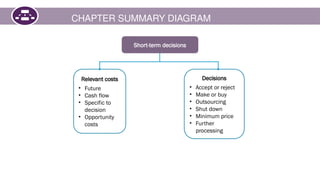
CHAPTER SUMMARY DIAGRAM
Short-term decisions
Relevant costs
• Future
• Cash flow
• Specific to
decision
• Opportunity
costs
Decisions
• Accept or reject
• Make or buy
• Outsourcing
• Shut down
• Minimum price
• Further
processing
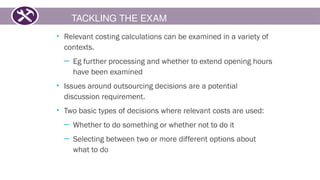
TACKLING THE EXAM
• Relevant costing calculations can be examined in a variety of
contexts.
─ Eg further processing and whether to extend opening hours
have been examined
• Issues around outsourcing decisions are a potential
discussion requirement.
• Two basic types of decisions where relevant costs are used:
─ Whether to do something or whether not to do it
─ Selecting between two or more different options about
what to do
RELEVANT COSTS (1)
• Relevant costs should be used when making business
decisions.
RELEVANT COSTS (2)
• Relevant costs are future costs, incremental costs and cash
flows.
• Avoidable costs are costs which would not be incurred if the
activity to which they relate did not exist.
• A differential cost is the difference in total costs between
alternatives.
• An opportunity cost is the benefit which would have been
earned, but has been given up, by choosing one option
instead of another.
RELEVANT COSTS (3)
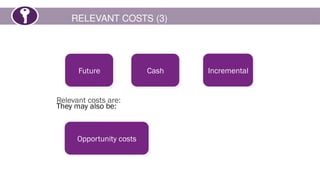
Relevant costs are:
Incremental
Cash
Future
They may also be:
Opportunity costs
RELEVANT COSTS (4)
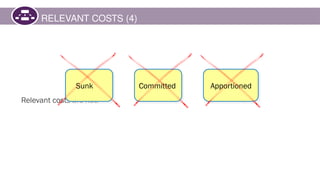
Relevant costs are not:
Apportioned
Committed
Sunk
RELEVANT COSTS (5)
Other costs that are not relevant:
• General overheads
• Joint costs
RELEVANT COSTS (6)
A controllable cost is one which can be directly influenced by a
given manager within a given time span.
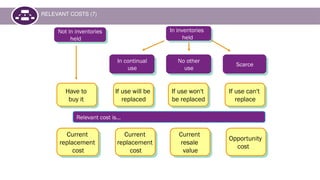
Relevant cost of materials
• Not owned – current replacement cost
• Owned – will be replaced – current replacement cost
• Owned – will not be replaced; higher of current resale value
and value if put to an alternative use
Not in inventories
held
In inventories
held
In continual
use
No other
use
Scarce
Have to
buy it
If use will be
replaced
If use won't
be replaced
If use can't
replace
Relevant cost is...
Current
replacement
cost
Current
replacement
cost
Current
resale
value
Opportunity
cost
RELEVANT COSTS (7)
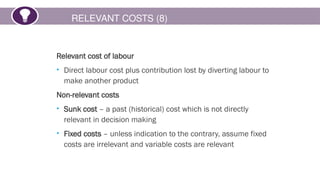
RELEVANT COSTS (8)
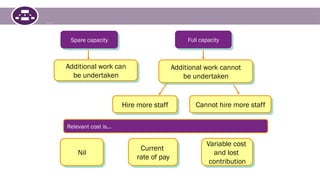
Relevant cost of labour
• Direct labour cost plus contribution lost by diverting labour to
make another product
Non-relevant costs
• Sunk cost – a past (historical) cost which is not directly
relevant in decision making
• Fixed costs – unless indication to the contrary, assume fixed
costs are irrelevant and variable costs are relevant
Spare capacity
Additional work can
be undertaken
Hire more staff Cannot hire more staff
Relevant cost is...
Nil
Current
rate of pay
Variable cost
and lost
contribution
Additional work cannot
be undertaken
RELEVANT COSTS (9)
Full capacity
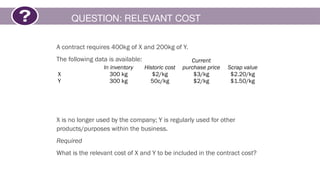
QUESTION: RELEVANT COST
A contract requires 400kg of X and 200kg of Y.
The following data is available:
X is no longer used by the company; Y is regularly used for other
products/purposes within the business.
Required
What is the relevant cost of X and Y to be included in the contract cost?
In inventory Historic cost
Current
purchase price Scrap value
X 300 kg $2/kg $3/kg $2.20/kg
Y 300 kg 50c/kg $2/kg $1.50/kg
ANSWER: RELEVANT COST (CONT'D)
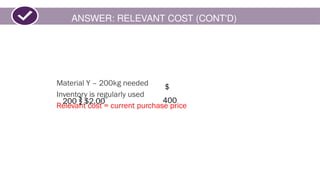
Material Y – 200kg needed
Inventory is regularly used
Relevant cost = current purchase price
200  $2.00
$
400
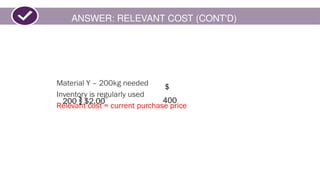
ANSWER: RELEVANT COST (CONT'D)
Material Y – 200kg needed
Inventory is regularly used
Relevant cost = current purchase price
200  $2.00
$
400
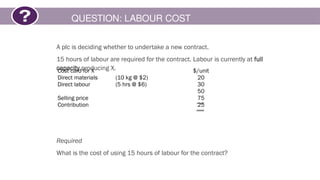
QUESTION: LABOUR COST
A plc is deciding whether to undertake a new contract.
15 hours of labour are required for the contract. Labour is currently at full
capacity producing X.
Required
What is the cost of using 15 hours of labour for the contract?
Cost card for X $/unit
Direct materials (10 kg @ $2) 20
Direct labour (5 hrs @ $6) 30
50
Selling price 75
Contribution 25
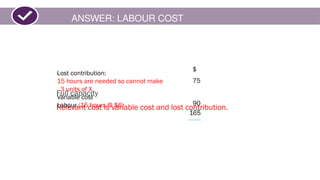
ANSWER: LABOUR COST
Full capacity
Relevant cost is variable cost and lost contribution.
Lost contribution:
15 hours are needed so cannot make
3 units of X
Variable cost
Labour (15 hours @ $6)
$
75
90
165
DECISION MAKING SCENARIOS (1)
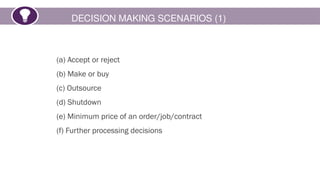
(a) Accept or reject
(b) Make or buy
(c) Outsource
(d) Shutdown
(e) Minimum price of an order/job/contract
(f) Further processing decisions
DECISION MAKING SCENARIOS (2)
Accept projects with positive return. Reject those which are
negative.
However, negative projects may be accepted in order to:
• Undercut a competitor
• Gain market share
• Attract a new customer
MAKE OR BUY DECISIONS (1)
• A make or buy problem is a decision about whether a
company should make a product/carry out an activity with its
own internal resources
or
• Whether it should pay another organisation to make the
product/carry out the activity.
If no scarce resource:
• The relevant costs of the decision are the differential costs
between making and buying.
MAKE OR BUY DECISIONS (2)
Buy in if cost effective. Other key considerations:
• Quality of bought in product
• Reliability of supplier
• Possibility of becoming dependent on supplier
• Likelihood of future price increases
• How to use spare capacity
• Confidentiality issues
MAKE OR BUY DECISIONS (3)
With scarce resources
• If an organisation has to subcontract because of insufficient
in-house resources to produce everything that it needs, then
the decision is not whether to make or buy. Instead, it is
which items to make.
• Total costs are minimised if:
─ The units bought have the lowest extra variable cost of
buying (compared with making) per unit of scarce resource
saved by buying.
MAKE OR BUY DECISIONS (4)
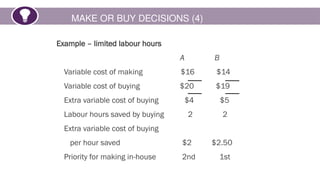
Example – limited labour hours
A B
Variable cost of making $16 $14
Variable cost of buying $20 $19
Extra variable cost of buying $4 $5
Labour hours saved by buying 2 2
Extra variable cost of buying
per hour saved $2 $2.50
Priority for making in-house 2nd 1st
MAKE OR BUY DECISIONS (5)
Outsourcing
• The use of external suppliers for finished products,
components or services
Advantages of outsourcing
• Superior quality and efficiency
• Capital is freed up
• Greater capacity and flexibility to cope with changes in
demand
• Useful if not enough work to keep internal staff fully occupied
MAKE OR BUY DECISIONS (6)
Disadvantages of outsourcing
• Reliability of supplier
• Loss of control and flexibility
• Effect on existing workforce
Note that decisions about outsourcing are a form of 'make or
buy' decision and basic principles are the same.
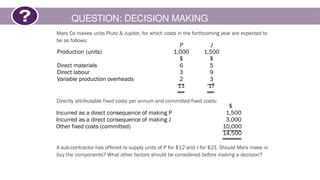
QUESTION: DECISION MAKING
Mars Co makes units Pluto & Jupiter, for which costs in the forthcoming year are expected to
be as follows:
Directly attributable fixed costs per annum and committed fixed costs:
A sub-contractor has offered to supply units of P for $12 and J for $21. Should Mars make or
buy the components? What other factors should be considered before making a decision?
P J
Production (units) 1,000 1,500
$ $
Direct materials 6 5
Direct labour 3 9
Variable production overheads 2 3
11 17
$
Incurred as a direct consequence of making P 1,500
Incurred as a direct consequence of making J 3,000
Other fixed costs (committed) 10,000
14,500
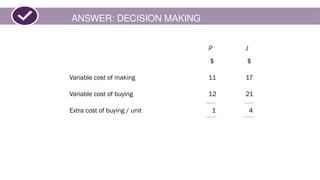
ANSWER: DECISION MAKING
P J
$ $
Variable cost of making 11 17
Variable cost of buying 12 21
Extra cost of buying / unit 1 4
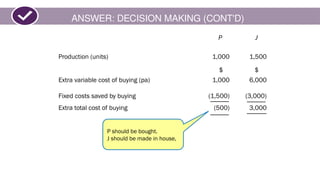
ANSWER: DECISION MAKING (CONT'D)
P J
Production (units) 1,000 1,500
$ $
Extra variable cost of buying (pa) 1,000 6,000
Fixed costs saved by buying (1,500) (3,000)
Extra total cost of buying (500) 3,000
P should be bought.
J should be made in house,
FURTHER PROCESSING AND SHUTDOWN (1)
Further processing decisions
• Decision is whether to sell joint product at split-off or
processed further before selling.
• A joint product should be processed further past the
split-off point if additional sales revenue exceeds the relevant
further processing costs.
• The apportionment of joint processing costs is irrelevant to
the decision.
• Any short-term decision must consider qualitative factors
related to the impact on employees, customers, competitors
and suppliers.
FURTHER PROCESSING AND SHUTDOWN (2)
• Shut down problems involve decisions about whether to close
down a product line, department or other activity, perhaps
because it is making losses or running costs are too
expensive.
• If the decision is to shut down, decide whether the closure
should be permanent or temporary.
FURTHER PROCESSING AND SHUTDOWN (3)
• Calculate what is earned by the process at present (perhaps
in comparison with others).
• Calculate what will be the financial consequences of closing
down (selling machines, redundancy costs etc).
• Compare the results and act accordingly.
• Some fixed costs may no longer be incurred if the decision is
to shutdown and they are therefore relevant to the decision.
QUESTION: SHUTDOWN
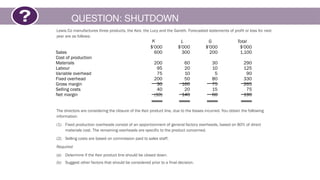
Lewis Co manufactures three products, the Keir, the Lucy and the Gareth. Forecasted statements of profit or loss for next
year are as follows:
The directors are considering the closure of the Keir product line, due to the losses incurred. You obtain the following
information.
(1) Fixed production overheads consist of an apportionment of general factory overheads, based on 80% of direct
materials cost. The remaining overheads are specific to the product concerned.
(2) Selling costs are based on commission paid to sales staff.
Required
(a) Determine if the Keir product line should be closed down.
(b) Suggest other factors that should be considered prior to a final decision.
K L G Total
$'000 $'000 $'000 $'000
Sales 600 300 200 1,100
Cost of production
Materials 200 60 30 290
Labour 95 20 10 125
Variable overhead 75 10 5 90
Fixed overhead 200 50 80 330
Gross margin 30 160 75 265
Selling costs 40 20 15 75
Net margin (10) 140 60 190
ANSWER: SHUTDOWN
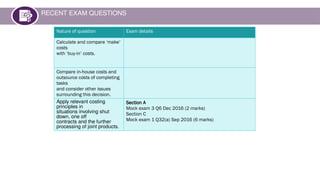
$'000
Lost revenue
600
Saved:
Materials 200
Labour 95
Variable overheads 75
Fixed overheads (20%) 40
Selling costs 40
450
150
Keir should not be
closed.
ANSWER: SHUTDOWN (CONT'D)
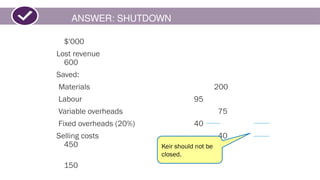
$'000
Loss forecast (10)
Fixed overheads (80%) 160
Net relevant contribution from Keir 150
Keir should not be
closed.
ANSWER: SHUTDOWN (CONT'D)
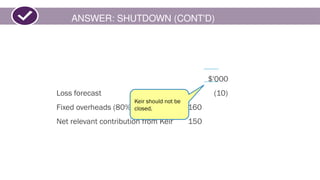
Other factors
• Product interdependencies
• Over 54% revenue lost – impact on customers and costs
• Capital costs such as asset write offs
• Redundancy costs
• Opportunity costs – are other decisions feasible such as
altering commissions or purchases from suppliers
• Timing of decision
QUESTION: FURTHER PROCESSING
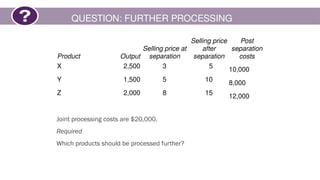
Joint processing costs are $20,000.
Required
Which products should be processed further?
Product Output
Selling price at
separation
Selling price
after
separation
Post
separation
costs
X 2,500 3 5
10,000
Y 1,500 5 10 8,000
Z 2,000 8 15 12,000
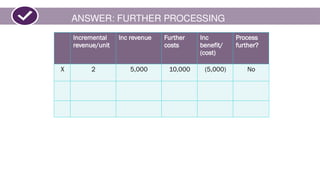
ANSWER: FURTHER PROCESSING
Incremental
revenue/unit
Inc revenue Further
costs
Inc
benefit/
(cost)
Process
further?
X 2 5,000 10,000 (5,000) No
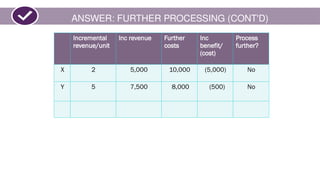
ANSWER: FURTHER PROCESSING (CONT'D)
Incremental
revenue/unit
Inc revenue Further
costs
Inc
benefit/
(cost)
Process
further?
X 2 5,000 10,000 (5,000) No
Y 5 7,500 8,000 (500) No
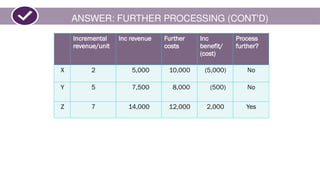
ANSWER: FURTHER PROCESSING (CONT'D)
Incremental
revenue/unit
Inc revenue Further
costs
Inc
benefit/
(cost)
Process
further?
X 2 5,000 10,000 (5,000) No
Y 5 7,500 8,000 (500) No
Z 7 14,000 12,000 2,000 Yes
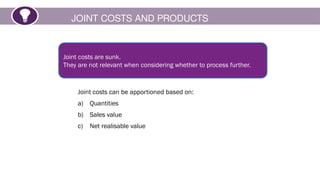
JOINT COSTS AND PRODUCTS
Joint costs are sunk.
They are not relevant when considering whether to process further.
Joint costs can be apportioned based on:
a) Quantities
b) Sales value
c) Net realisable value
QUALITATIVE FACTORS
Don’t forget to consider the
qualitative factors when making
your decision.
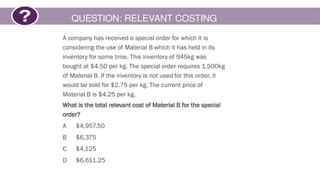
QUESTION: RELEVANT COSTING
A company has received a special order for which it is
considering the use of Material B which it has held in its
inventory for some time. This inventory of 945kg was
bought at $4.50 per kg. The special order requires 1,500kg
of Material B. If the inventory is not used for this order, it
would be sold for $2.75 per kg. The current price of
Material B is $4.25 per kg.
What is the total relevant cost of Material B for the special
order?
A $4,957.50
B $6,375
C $4,125
D $6,611.25
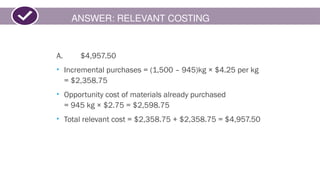
ANSWER: RELEVANT COSTING
A. $4,957.50
• Incremental purchases = (1,500 – 945)kg × $4.25 per kg
= $2,358.75
• Opportunity cost of materials already purchased
= 945 kg × $2.75 = $2,598.75
• Total relevant cost = $2,358.75 + $2,358.75 = $4,957.50
BELTON PARK (Q163 MAR/JUN 2019)
• Belton Park Resort is a new theme park resort located in the country of Beeland.
The resort is made up of a theme park, a hotel and an indoor water park. The resort
opened two months ago and is already very popular.
• As all theme parks in Beeland are required by law to shut down in the colder month
of January because of the risk of accidents, Belton Park Resort must decide
whether to shut down the whole resort or just the theme park. It could choose to
keep open the hotel and/or the water park.
• Since Belton Park Resort has not been open for long, there is limited historical data
available about costs and revenues.
BELTON PARK (CONT)
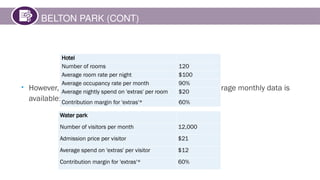
• However, based on the last two months, the following average monthly data is
available:
Hotel
Number of rooms 120
Average room rate per night $100
Average occupancy rate per month 90%
Average nightly spend on 'extras' per room $20
Contribution margin for 'extras'* 60%
Water park
Number of visitors per month 12,000
Admission price per visitor $21
Average spend on 'extras' per visitor $12
Contribution margin for 'extras'* 60%
BELTON PARK (CONT)
• *'Extras' includes anything purchased by the customer not included in the room
rate or admission price.
• Management estimates that, for January, the average room rate per night would
need to decrease by 30% and the admission price for the water park by 20%. With
such reductions, it is estimated that an occupancy rate of 50% would be achieved
for the hotel and that the number of visitors to the water park would be 52% lower
than current levels. The average nightly spend on 'extras' per room of $20 at the
hotel and $12 per customer at the water park is expected to remain unchanged.
BELTON PARK (CONT)
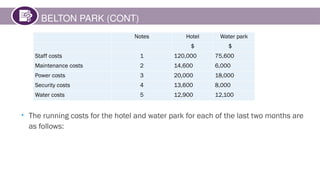
• The running costs for the hotel and water park for each of the last two months are
as follows:
Notes Hotel Water park
$ $
Staff costs 1 120,000 75,600
Maintenance costs 2 14,600 6,000
Power costs 3 20,000 18,000
Security costs 4 13,600 8,000
Water costs 5 12,900 12,100
BELTON PARK (CONT)
Notes
(1) Staff costs
Permanent staff
• Included in the staff costs for the hotel is the salary of $30,000 per annum for the
hotel manager and $24,000 per annum for the head chef. These are both
permanent members of staff who are paid for the full year regardless of their
working hours.
• The water park employs one permanent member of staff, the manager, on a salary
of $24,000 who is also paid for the full year regardless of his working hours.
BELTON PARK (CONT)
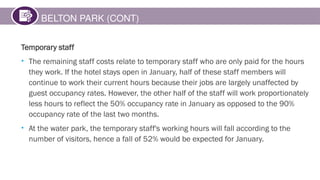
Temporary staff
• The remaining staff costs relate to temporary staff who are only paid for the hours
they work. If the hotel stays open in January, half of these staff members will
continue to work their current hours because their jobs are largely unaffected by
guest occupancy rates. However, the other half of the staff will work proportionately
less hours to reflect the 50% occupancy rate in January as opposed to the 90%
occupancy rate of the last two months.
• At the water park, the temporary staff's working hours will fall according to the
number of visitors, hence a fall of 52% would be expected for January.
BELTON PARK (CONT)
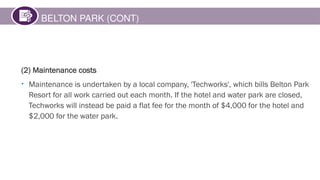
(2) Maintenance costs
• Maintenance is undertaken by a local company, 'Techworks', which bills Belton Park
Resort for all work carried out each month. If the hotel and water park are closed,
Techworks will instead be paid a flat fee for the month of $4,000 for the hotel and
$2,000 for the water park.
BELTON PARK (CONT)
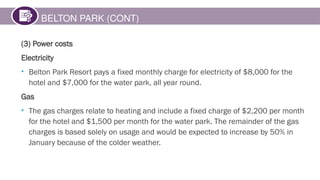
(3) Power costs
Electricity
• Belton Park Resort pays a fixed monthly charge for electricity of $8,000 for the
hotel and $7,000 for the water park, all year round.
Gas
• The gas charges relate to heating and include a fixed charge of $2,200 per month
for the hotel and $1,500 per month for the water park. The remainder of the gas
charges is based solely on usage and would be expected to increase by 50% in
January because of the colder weather.
BELTON PARK (CONT)
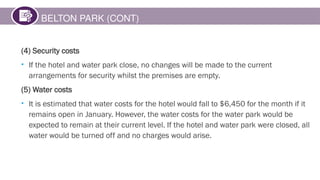
(4) Security costs
• If the hotel and water park close, no changes will be made to the current
arrangements for security whilst the premises are empty.
(5) Water costs
• It is estimated that water costs for the hotel would fall to $6,450 for the month if it
remains open in January. However, the water costs for the water park would be
expected to remain at their current level. If the hotel and water park were closed, all
water would be turned off and no charges would arise.
BELTON PARK (CONT)
Required
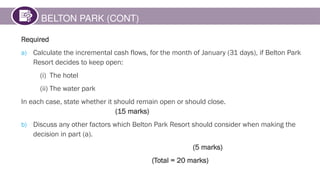
a) Calculate the incremental cash flows, for the month of January (31 days), if Belton Park
Resort decides to keep open:
(i) The hotel
(ii) The water park
In each case, state whether it should remain open or should close.
(15 marks)
b) Discuss any other factors which Belton Park Resort should consider when making the
decision in part (a).
(5 marks)
(Total = 20 marks)
BELTON PARK (CONT)
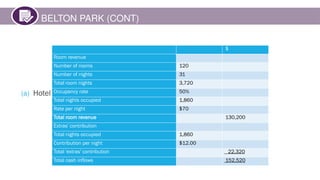
(a) Hotel incremental revenue
$
Room revenue
Number of rooms 120
Number of nights 31
Total room nights 3,720
Occupancy rate 50%
Total nights occupied 1,860
Rate per night $70
Total room revenue 130,200
Extras' contribution
Total nights occupied 1,860
Contribution per night $12.00
Total 'extras' contribution 22,320
Total cash inflows 152,520
BELTON PARK (CONT)
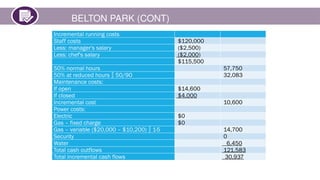
Incremental running costs
Staff costs $120,000
Less: manager's salary ($2,500)
Less: chef's salary ($2,000)
$115,500
50% normal hours 57,750
50% at reduced hours  50/90 32,083
Maintenance costs:
If open $14,600
If closed $4,000
Incremental cost 10,600
Power costs:
Electric $0
Gas – fixed charge $0
Gas – variable ($20,000 – $10,200)  1·5 14,700
Security 0
Water 6,450
Total cash outflows 121,583
Total incremental cash flows 30,937
BELTON PARK (CONT)
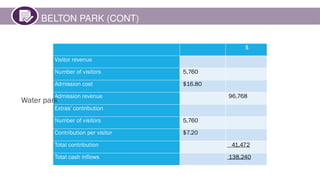
$
Visitor revenue
Number of visitors 5,760
Admission cost $16.80
Admission revenue 96,768
Extras' contribution
Number of visitors 5,760
Contribution per visitor $7.20
Total contribution 41,472
Total cash inflows 138,240
Water park
BELTON PARK (CONT)
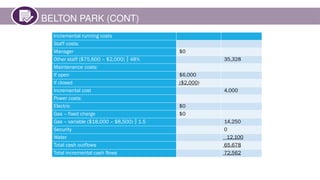
Incremental running costs
Staff costs:
Manager $0
Other staff ($75,600 – $2,000)  48% 35,328
Maintenance costs:
If open $6,000
If closed ($2,000)
Incremental cost 4,000
Power costs:
Electric $0
Gas – fixed charge $0
Gas – variable ($18,000 – $8,500)  1.5 14,250
Security 0
Water 12,100
Total cash outflows 65,678
Total incremental cash flows 72,562
BELTON PARK (CONT)
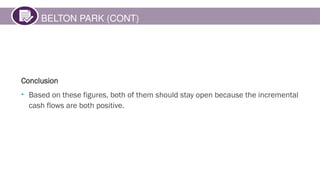
Conclusion
• Based on these figures, both of them should stay open because the incremental
cash flows are both positive.
BELTON PARK (CONT)
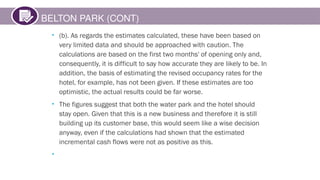
• (b). As regards the estimates calculated, these have been based on
very limited data and should be approached with caution. The
calculations are based on the first two months' of opening only and,
consequently, it is difficult to say how accurate they are likely to be. In
addition, the basis of estimating the revised occupancy rates for the
hotel, for example, has not been given. If these estimates are too
optimistic, the actual results could be far worse.
• The figures suggest that both the water park and the hotel should
stay open. Given that this is a new business and therefore it is still
building up its customer base, this would seem like a wise decision
anyway, even if the calculations had shown that the estimated
incremental cash flows were not as positive as this.
•
BELTON PARK (CONT)
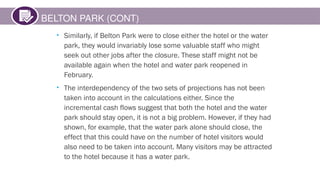
• Similarly, if Belton Park were to close either the hotel or the water
park, they would invariably lose some valuable staff who might
seek out other jobs after the closure. These staff might not be
available again when the hotel and water park reopened in
February.
• The interdependency of the two sets of projections has not been
taken into account in the calculations either. Since the
incremental cash flows suggest that both the hotel and the water
park should stay open, it is not a big problem. However, if they had
shown, for example, that the water park alone should close, the
effect that this could have on the number of hotel visitors would
also need to be taken into account. Many visitors may be attracted
to the hotel because it has a water park.
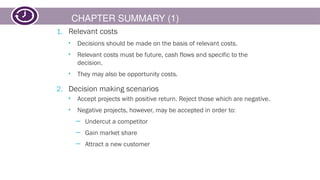
CHAPTER SUMMARY (1)
1. Relevant costs
• Decisions should be made on the basis of relevant costs.
• Relevant costs must be future, cash flows and specific to the
decision.
• They may also be opportunity costs.
2. Decision making scenarios
• Accept projects with positive return. Reject those which are negative.
• Negative projects, however, may be accepted in order to:
─ Undercut a competitor
─ Gain market share
─ Attract a new customer
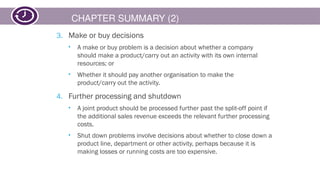
CHAPTER SUMMARY (2)
3. Make or buy decisions
• A make or buy problem is a decision about whether a company
should make a product/carry out an activity with its own internal
resources; or
• Whether it should pay another organisation to make the
product/carry out the activity.
4. Further processing and shutdown
• A joint product should be processed further past the split-off point if
the additional sales revenue exceeds the relevant further processing
costs.
• Shut down problems involve decisions about whether to close down a
product line, department or other activity, perhaps because it is
making losses or running costs are too expensive.
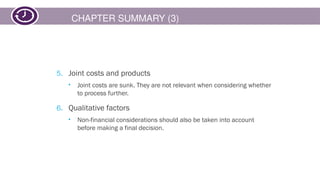
CHAPTER SUMMARY (3)
5. Joint costs and products
• Joint costs are sunk. They are not relevant when considering whether
to process further.
6. Qualitative factors
• Non-financial considerations should also be taken into account
before making a final decision.
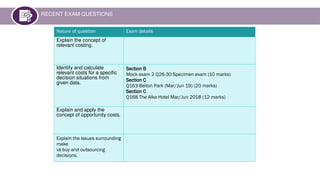
RECENT EXAM QUESTIONS
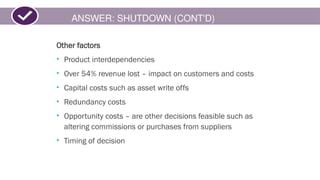
Nature of question Exam details
Explain the concept of
relevant costing.
Identify and calculate
relevant costs for a specific
decision situations from
given data.
Section B
Mock exam 2 Q26-30 Specimen exam (10 marks)
Section C
Q163 Belton Park (Mar/Jun 19) (20 marks)
Section C
Q168 The Alka Hotel Mar/Jun 2018 (12 marks)
Explain and apply the
concept of opportunity costs.
Explain the issues surrounding
make
vs buy and outsourcing
decisions.
RECENT EXAM QUESTIONS
Nature of question Exam details
Calculate and compare ‘make’
costs
with ‘buy-in’ costs.
Compare in-house costs and
outsource costs of completing
tasks
and consider other issues
surrounding this decision.
Apply relevant costing
principles in
situations involving shut
down, one off
contracts and the further
processing of joint products.
Section A
Mock exam 3 Q6 Dec 2016 (2 marks)
Section C
Mock exam 1 Q32(a) Sep 2016 (6 marks)

Short Term Decisions.pptx FDSFWSAFASFASF

  • 1.
    SHORT-TERM DECISIONS • Relevant costs •Decision-making scenarios • Make or buy decisions • Further processing and shutdown • Joint costs and products • Qualitative factors
  • 2.
    SYLLABUS LEARNING OUTCOMES(1) • Explain the concept of relevant costing. • Identify and calculate relevant costs for a specific decision situation from given data. • Explain and apply the concept of opportunity costs. • Explain the issues surrounding make vs. buy and outsourcing decisions. • Calculate and compare 'make' costs with 'buy-in' costs. • Compare in-house costs and outsource costs of completing tasks and consider other issues surrounding this decision.
  • 3.
    SYLLABUS LEARNING OUTCOMES(2) • Apply relevant costing principles in situations involving shut down, one-off contracts and the further processing of joint products.
  • 4.
    CHAPTER OVERVIEW • Inthis chapter, we look in depth at relevant costs and at how they should be applied in decision-making situations. • We look at a variety of common short-run business decisions and consider how they can be dealt with using relevant costs as appropriate.
  • 5.
    CHAPTER SUMMARY DIAGRAM Short-termdecisions Relevant costs • Future • Cash flow • Specific to decision • Opportunity costs Decisions • Accept or reject • Make or buy • Outsourcing • Shut down • Minimum price • Further processing
  • 6.
    TACKLING THE EXAM •Relevant costing calculations can be examined in a variety of contexts. ─ Eg further processing and whether to extend opening hours have been examined • Issues around outsourcing decisions are a potential discussion requirement. • Two basic types of decisions where relevant costs are used: ─ Whether to do something or whether not to do it ─ Selecting between two or more different options about what to do
  • 7.
    RELEVANT COSTS (1) •Relevant costs should be used when making business decisions.
  • 8.
    RELEVANT COSTS (2) •Relevant costs are future costs, incremental costs and cash flows. • Avoidable costs are costs which would not be incurred if the activity to which they relate did not exist. • A differential cost is the difference in total costs between alternatives. • An opportunity cost is the benefit which would have been earned, but has been given up, by choosing one option instead of another.
  • 9.
    RELEVANT COSTS (3) Relevantcosts are: Incremental Cash Future They may also be: Opportunity costs
  • 10.
    RELEVANT COSTS (4) Relevantcosts are not: Apportioned Committed Sunk
  • 11.
    RELEVANT COSTS (5) Othercosts that are not relevant: • General overheads • Joint costs
  • 12.
    RELEVANT COSTS (6) Acontrollable cost is one which can be directly influenced by a given manager within a given time span. Relevant cost of materials • Not owned – current replacement cost • Owned – will be replaced – current replacement cost • Owned – will not be replaced; higher of current resale value and value if put to an alternative use
  • 13.
    Not in inventories held Ininventories held In continual use No other use Scarce Have to buy it If use will be replaced If use won't be replaced If use can't replace Relevant cost is... Current replacement cost Current replacement cost Current resale value Opportunity cost RELEVANT COSTS (7)
  • 14.
    RELEVANT COSTS (8) Relevantcost of labour • Direct labour cost plus contribution lost by diverting labour to make another product Non-relevant costs • Sunk cost – a past (historical) cost which is not directly relevant in decision making • Fixed costs – unless indication to the contrary, assume fixed costs are irrelevant and variable costs are relevant
  • 15.
    Spare capacity Additional workcan be undertaken Hire more staff Cannot hire more staff Relevant cost is... Nil Current rate of pay Variable cost and lost contribution Additional work cannot be undertaken RELEVANT COSTS (9) Full capacity
  • 16.
    QUESTION: RELEVANT COST Acontract requires 400kg of X and 200kg of Y. The following data is available: X is no longer used by the company; Y is regularly used for other products/purposes within the business. Required What is the relevant cost of X and Y to be included in the contract cost? In inventory Historic cost Current purchase price Scrap value X 300 kg $2/kg $3/kg $2.20/kg Y 300 kg 50c/kg $2/kg $1.50/kg
  • 17.
    ANSWER: RELEVANT COST(CONT'D) Material Y – 200kg needed Inventory is regularly used Relevant cost = current purchase price 200  $2.00 $ 400
  • 18.
    ANSWER: RELEVANT COST(CONT'D) Material Y – 200kg needed Inventory is regularly used Relevant cost = current purchase price 200  $2.00 $ 400
  • 19.
    QUESTION: LABOUR COST Aplc is deciding whether to undertake a new contract. 15 hours of labour are required for the contract. Labour is currently at full capacity producing X. Required What is the cost of using 15 hours of labour for the contract? Cost card for X $/unit Direct materials (10 kg @ $2) 20 Direct labour (5 hrs @ $6) 30 50 Selling price 75 Contribution 25
  • 20.
    ANSWER: LABOUR COST Fullcapacity Relevant cost is variable cost and lost contribution. Lost contribution: 15 hours are needed so cannot make 3 units of X Variable cost Labour (15 hours @ $6) $ 75 90 165
  • 21.
    DECISION MAKING SCENARIOS(1) (a) Accept or reject (b) Make or buy (c) Outsource (d) Shutdown (e) Minimum price of an order/job/contract (f) Further processing decisions
  • 22.
    DECISION MAKING SCENARIOS(2) Accept projects with positive return. Reject those which are negative. However, negative projects may be accepted in order to: • Undercut a competitor • Gain market share • Attract a new customer
  • 23.
    MAKE OR BUYDECISIONS (1) • A make or buy problem is a decision about whether a company should make a product/carry out an activity with its own internal resources or • Whether it should pay another organisation to make the product/carry out the activity. If no scarce resource: • The relevant costs of the decision are the differential costs between making and buying.
  • 24.
    MAKE OR BUYDECISIONS (2) Buy in if cost effective. Other key considerations: • Quality of bought in product • Reliability of supplier • Possibility of becoming dependent on supplier • Likelihood of future price increases • How to use spare capacity • Confidentiality issues
  • 25.
    MAKE OR BUYDECISIONS (3) With scarce resources • If an organisation has to subcontract because of insufficient in-house resources to produce everything that it needs, then the decision is not whether to make or buy. Instead, it is which items to make. • Total costs are minimised if: ─ The units bought have the lowest extra variable cost of buying (compared with making) per unit of scarce resource saved by buying.
  • 26.
    MAKE OR BUYDECISIONS (4) Example – limited labour hours A B Variable cost of making $16 $14 Variable cost of buying $20 $19 Extra variable cost of buying $4 $5 Labour hours saved by buying 2 2 Extra variable cost of buying per hour saved $2 $2.50 Priority for making in-house 2nd 1st
  • 27.
    MAKE OR BUYDECISIONS (5) Outsourcing • The use of external suppliers for finished products, components or services Advantages of outsourcing • Superior quality and efficiency • Capital is freed up • Greater capacity and flexibility to cope with changes in demand • Useful if not enough work to keep internal staff fully occupied
  • 28.
    MAKE OR BUYDECISIONS (6) Disadvantages of outsourcing • Reliability of supplier • Loss of control and flexibility • Effect on existing workforce Note that decisions about outsourcing are a form of 'make or buy' decision and basic principles are the same.
  • 29.
    QUESTION: DECISION MAKING MarsCo makes units Pluto & Jupiter, for which costs in the forthcoming year are expected to be as follows: Directly attributable fixed costs per annum and committed fixed costs: A sub-contractor has offered to supply units of P for $12 and J for $21. Should Mars make or buy the components? What other factors should be considered before making a decision? P J Production (units) 1,000 1,500 $ $ Direct materials 6 5 Direct labour 3 9 Variable production overheads 2 3 11 17 $ Incurred as a direct consequence of making P 1,500 Incurred as a direct consequence of making J 3,000 Other fixed costs (committed) 10,000 14,500
  • 30.
    ANSWER: DECISION MAKING PJ $ $ Variable cost of making 11 17 Variable cost of buying 12 21 Extra cost of buying / unit 1 4
  • 31.
    ANSWER: DECISION MAKING(CONT'D) P J Production (units) 1,000 1,500 $ $ Extra variable cost of buying (pa) 1,000 6,000 Fixed costs saved by buying (1,500) (3,000) Extra total cost of buying (500) 3,000 P should be bought. J should be made in house,
  • 32.
    FURTHER PROCESSING ANDSHUTDOWN (1) Further processing decisions • Decision is whether to sell joint product at split-off or processed further before selling. • A joint product should be processed further past the split-off point if additional sales revenue exceeds the relevant further processing costs. • The apportionment of joint processing costs is irrelevant to the decision. • Any short-term decision must consider qualitative factors related to the impact on employees, customers, competitors and suppliers.
  • 33.
    FURTHER PROCESSING ANDSHUTDOWN (2) • Shut down problems involve decisions about whether to close down a product line, department or other activity, perhaps because it is making losses or running costs are too expensive. • If the decision is to shut down, decide whether the closure should be permanent or temporary.
  • 34.
    FURTHER PROCESSING ANDSHUTDOWN (3) • Calculate what is earned by the process at present (perhaps in comparison with others). • Calculate what will be the financial consequences of closing down (selling machines, redundancy costs etc). • Compare the results and act accordingly. • Some fixed costs may no longer be incurred if the decision is to shutdown and they are therefore relevant to the decision.
  • 35.
    QUESTION: SHUTDOWN Lewis Comanufactures three products, the Keir, the Lucy and the Gareth. Forecasted statements of profit or loss for next year are as follows: The directors are considering the closure of the Keir product line, due to the losses incurred. You obtain the following information. (1) Fixed production overheads consist of an apportionment of general factory overheads, based on 80% of direct materials cost. The remaining overheads are specific to the product concerned. (2) Selling costs are based on commission paid to sales staff. Required (a) Determine if the Keir product line should be closed down. (b) Suggest other factors that should be considered prior to a final decision. K L G Total $'000 $'000 $'000 $'000 Sales 600 300 200 1,100 Cost of production Materials 200 60 30 290 Labour 95 20 10 125 Variable overhead 75 10 5 90 Fixed overhead 200 50 80 330 Gross margin 30 160 75 265 Selling costs 40 20 15 75 Net margin (10) 140 60 190
  • 36.
    ANSWER: SHUTDOWN $'000 Lost revenue 600 Saved: Materials200 Labour 95 Variable overheads 75 Fixed overheads (20%) 40 Selling costs 40 450 150 Keir should not be closed.
  • 37.
    ANSWER: SHUTDOWN (CONT'D) $'000 Lossforecast (10) Fixed overheads (80%) 160 Net relevant contribution from Keir 150 Keir should not be closed.
  • 38.
    ANSWER: SHUTDOWN (CONT'D) Otherfactors • Product interdependencies • Over 54% revenue lost – impact on customers and costs • Capital costs such as asset write offs • Redundancy costs • Opportunity costs – are other decisions feasible such as altering commissions or purchases from suppliers • Timing of decision
  • 39.
    QUESTION: FURTHER PROCESSING Jointprocessing costs are $20,000. Required Which products should be processed further? Product Output Selling price at separation Selling price after separation Post separation costs X 2,500 3 5 10,000 Y 1,500 5 10 8,000 Z 2,000 8 15 12,000
  • 40.
    ANSWER: FURTHER PROCESSING Incremental revenue/unit Increvenue Further costs Inc benefit/ (cost) Process further? X 2 5,000 10,000 (5,000) No
  • 41.
    ANSWER: FURTHER PROCESSING(CONT'D) Incremental revenue/unit Inc revenue Further costs Inc benefit/ (cost) Process further? X 2 5,000 10,000 (5,000) No Y 5 7,500 8,000 (500) No
  • 42.
    ANSWER: FURTHER PROCESSING(CONT'D) Incremental revenue/unit Inc revenue Further costs Inc benefit/ (cost) Process further? X 2 5,000 10,000 (5,000) No Y 5 7,500 8,000 (500) No Z 7 14,000 12,000 2,000 Yes
  • 43.
    JOINT COSTS ANDPRODUCTS Joint costs are sunk. They are not relevant when considering whether to process further. Joint costs can be apportioned based on: a) Quantities b) Sales value c) Net realisable value
  • 44.
    QUALITATIVE FACTORS Don’t forgetto consider the qualitative factors when making your decision.
  • 45.
    QUESTION: RELEVANT COSTING Acompany has received a special order for which it is considering the use of Material B which it has held in its inventory for some time. This inventory of 945kg was bought at $4.50 per kg. The special order requires 1,500kg of Material B. If the inventory is not used for this order, it would be sold for $2.75 per kg. The current price of Material B is $4.25 per kg. What is the total relevant cost of Material B for the special order? A $4,957.50 B $6,375 C $4,125 D $6,611.25
  • 46.
    ANSWER: RELEVANT COSTING A.$4,957.50 • Incremental purchases = (1,500 – 945)kg × $4.25 per kg = $2,358.75 • Opportunity cost of materials already purchased = 945 kg × $2.75 = $2,598.75 • Total relevant cost = $2,358.75 + $2,358.75 = $4,957.50
  • 47.
    BELTON PARK (Q163MAR/JUN 2019) • Belton Park Resort is a new theme park resort located in the country of Beeland. The resort is made up of a theme park, a hotel and an indoor water park. The resort opened two months ago and is already very popular. • As all theme parks in Beeland are required by law to shut down in the colder month of January because of the risk of accidents, Belton Park Resort must decide whether to shut down the whole resort or just the theme park. It could choose to keep open the hotel and/or the water park. • Since Belton Park Resort has not been open for long, there is limited historical data available about costs and revenues.
  • 48.
    BELTON PARK (CONT) •However, based on the last two months, the following average monthly data is available: Hotel Number of rooms 120 Average room rate per night $100 Average occupancy rate per month 90% Average nightly spend on 'extras' per room $20 Contribution margin for 'extras'* 60% Water park Number of visitors per month 12,000 Admission price per visitor $21 Average spend on 'extras' per visitor $12 Contribution margin for 'extras'* 60%
  • 49.
    BELTON PARK (CONT) •*'Extras' includes anything purchased by the customer not included in the room rate or admission price. • Management estimates that, for January, the average room rate per night would need to decrease by 30% and the admission price for the water park by 20%. With such reductions, it is estimated that an occupancy rate of 50% would be achieved for the hotel and that the number of visitors to the water park would be 52% lower than current levels. The average nightly spend on 'extras' per room of $20 at the hotel and $12 per customer at the water park is expected to remain unchanged.
  • 50.
    BELTON PARK (CONT) •The running costs for the hotel and water park for each of the last two months are as follows: Notes Hotel Water park $ $ Staff costs 1 120,000 75,600 Maintenance costs 2 14,600 6,000 Power costs 3 20,000 18,000 Security costs 4 13,600 8,000 Water costs 5 12,900 12,100
  • 51.
    BELTON PARK (CONT) Notes (1)Staff costs Permanent staff • Included in the staff costs for the hotel is the salary of $30,000 per annum for the hotel manager and $24,000 per annum for the head chef. These are both permanent members of staff who are paid for the full year regardless of their working hours. • The water park employs one permanent member of staff, the manager, on a salary of $24,000 who is also paid for the full year regardless of his working hours.
  • 52.
    BELTON PARK (CONT) Temporarystaff • The remaining staff costs relate to temporary staff who are only paid for the hours they work. If the hotel stays open in January, half of these staff members will continue to work their current hours because their jobs are largely unaffected by guest occupancy rates. However, the other half of the staff will work proportionately less hours to reflect the 50% occupancy rate in January as opposed to the 90% occupancy rate of the last two months. • At the water park, the temporary staff's working hours will fall according to the number of visitors, hence a fall of 52% would be expected for January.
  • 53.
    BELTON PARK (CONT) (2)Maintenance costs • Maintenance is undertaken by a local company, 'Techworks', which bills Belton Park Resort for all work carried out each month. If the hotel and water park are closed, Techworks will instead be paid a flat fee for the month of $4,000 for the hotel and $2,000 for the water park.
  • 54.
    BELTON PARK (CONT) (3)Power costs Electricity • Belton Park Resort pays a fixed monthly charge for electricity of $8,000 for the hotel and $7,000 for the water park, all year round. Gas • The gas charges relate to heating and include a fixed charge of $2,200 per month for the hotel and $1,500 per month for the water park. The remainder of the gas charges is based solely on usage and would be expected to increase by 50% in January because of the colder weather.
  • 55.
    BELTON PARK (CONT) (4)Security costs • If the hotel and water park close, no changes will be made to the current arrangements for security whilst the premises are empty. (5) Water costs • It is estimated that water costs for the hotel would fall to $6,450 for the month if it remains open in January. However, the water costs for the water park would be expected to remain at their current level. If the hotel and water park were closed, all water would be turned off and no charges would arise.
  • 56.
    BELTON PARK (CONT) Required a)Calculate the incremental cash flows, for the month of January (31 days), if Belton Park Resort decides to keep open: (i) The hotel (ii) The water park In each case, state whether it should remain open or should close. (15 marks) b) Discuss any other factors which Belton Park Resort should consider when making the decision in part (a). (5 marks) (Total = 20 marks)
  • 57.
    BELTON PARK (CONT) (a)Hotel incremental revenue $ Room revenue Number of rooms 120 Number of nights 31 Total room nights 3,720 Occupancy rate 50% Total nights occupied 1,860 Rate per night $70 Total room revenue 130,200 Extras' contribution Total nights occupied 1,860 Contribution per night $12.00 Total 'extras' contribution 22,320 Total cash inflows 152,520
  • 58.
    BELTON PARK (CONT) Incrementalrunning costs Staff costs $120,000 Less: manager's salary ($2,500) Less: chef's salary ($2,000) $115,500 50% normal hours 57,750 50% at reduced hours  50/90 32,083 Maintenance costs: If open $14,600 If closed $4,000 Incremental cost 10,600 Power costs: Electric $0 Gas – fixed charge $0 Gas – variable ($20,000 – $10,200)  1·5 14,700 Security 0 Water 6,450 Total cash outflows 121,583 Total incremental cash flows 30,937
  • 59.
    BELTON PARK (CONT) $ Visitorrevenue Number of visitors 5,760 Admission cost $16.80 Admission revenue 96,768 Extras' contribution Number of visitors 5,760 Contribution per visitor $7.20 Total contribution 41,472 Total cash inflows 138,240 Water park
  • 60.
    BELTON PARK (CONT) Incrementalrunning costs Staff costs: Manager $0 Other staff ($75,600 – $2,000)  48% 35,328 Maintenance costs: If open $6,000 If closed ($2,000) Incremental cost 4,000 Power costs: Electric $0 Gas – fixed charge $0 Gas – variable ($18,000 – $8,500)  1.5 14,250 Security 0 Water 12,100 Total cash outflows 65,678 Total incremental cash flows 72,562
  • 61.
    BELTON PARK (CONT) Conclusion •Based on these figures, both of them should stay open because the incremental cash flows are both positive.
  • 62.
    BELTON PARK (CONT) •(b). As regards the estimates calculated, these have been based on very limited data and should be approached with caution. The calculations are based on the first two months' of opening only and, consequently, it is difficult to say how accurate they are likely to be. In addition, the basis of estimating the revised occupancy rates for the hotel, for example, has not been given. If these estimates are too optimistic, the actual results could be far worse. • The figures suggest that both the water park and the hotel should stay open. Given that this is a new business and therefore it is still building up its customer base, this would seem like a wise decision anyway, even if the calculations had shown that the estimated incremental cash flows were not as positive as this. •
  • 63.
    BELTON PARK (CONT) •Similarly, if Belton Park were to close either the hotel or the water park, they would invariably lose some valuable staff who might seek out other jobs after the closure. These staff might not be available again when the hotel and water park reopened in February. • The interdependency of the two sets of projections has not been taken into account in the calculations either. Since the incremental cash flows suggest that both the hotel and the water park should stay open, it is not a big problem. However, if they had shown, for example, that the water park alone should close, the effect that this could have on the number of hotel visitors would also need to be taken into account. Many visitors may be attracted to the hotel because it has a water park.
  • 64.
    CHAPTER SUMMARY (1) 1.Relevant costs • Decisions should be made on the basis of relevant costs. • Relevant costs must be future, cash flows and specific to the decision. • They may also be opportunity costs. 2. Decision making scenarios • Accept projects with positive return. Reject those which are negative. • Negative projects, however, may be accepted in order to: ─ Undercut a competitor ─ Gain market share ─ Attract a new customer
  • 65.
    CHAPTER SUMMARY (2) 3.Make or buy decisions • A make or buy problem is a decision about whether a company should make a product/carry out an activity with its own internal resources; or • Whether it should pay another organisation to make the product/carry out the activity. 4. Further processing and shutdown • A joint product should be processed further past the split-off point if the additional sales revenue exceeds the relevant further processing costs. • Shut down problems involve decisions about whether to close down a product line, department or other activity, perhaps because it is making losses or running costs are too expensive.
  • 66.
    CHAPTER SUMMARY (3) 5.Joint costs and products • Joint costs are sunk. They are not relevant when considering whether to process further. 6. Qualitative factors • Non-financial considerations should also be taken into account before making a final decision.
  • 67.
    RECENT EXAM QUESTIONS Natureof question Exam details Explain the concept of relevant costing. Identify and calculate relevant costs for a specific decision situations from given data. Section B Mock exam 2 Q26-30 Specimen exam (10 marks) Section C Q163 Belton Park (Mar/Jun 19) (20 marks) Section C Q168 The Alka Hotel Mar/Jun 2018 (12 marks) Explain and apply the concept of opportunity costs. Explain the issues surrounding make vs buy and outsourcing decisions.
  • 68.
    RECENT EXAM QUESTIONS Natureof question Exam details Calculate and compare ‘make’ costs with ‘buy-in’ costs. Compare in-house costs and outsource costs of completing tasks and consider other issues surrounding this decision. Apply relevant costing principles in situations involving shut down, one off contracts and the further processing of joint products. Section A Mock exam 3 Q6 Dec 2016 (2 marks) Section C Mock exam 1 Q32(a) Sep 2016 (6 marks)

Editor's Notes

  • #9 Drum home these ideas one by one use simple examples: Does it matter that your tube ticket cost $2 this morning when you are deciding what to do tomorrow afternoon? Does annual depreciation in the accounts affect the price you can get for selling a car? If head office costs of $100,000 are apportioned to your division, will a change in sales volume or price affect that?
  • #10 Drum home these ideas one by one use simple examples: Does it matter that your tube ticket cost $2 this morning when you are deciding what to do tomorrow afternoon? Does annual depreciation in the accounts affect the price you can get for selling a car? If head office costs of $100,000 are apportioned to your division, will a change in sales volume or price affect that?