When to use: CAADI Psicología, UANL
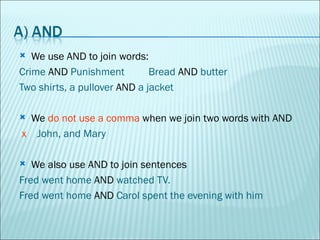
We use AND to join words: Crime  AND  Punishment  Bread  AND  butter Two shirts, a pullover  AND  a jacket  We  do not use a comma  when we join two words with AND x   John, and Mary  We also use AND to join sentences  Fred went home  AND  watched TV. Fred went home  AND  Carol spent the evening with him
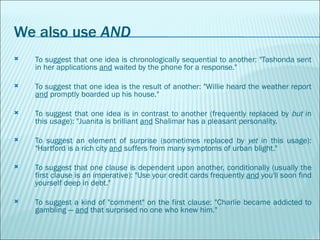
We also use  AND To suggest that one idea is chronologically sequential to another: "Tashonda sent in her applications  and  waited by the phone for a response."  To suggest that one idea is the result of another: "Willie heard the weather report  and  promptly boarded up his house."  To suggest that one idea is in contrast to another (frequently replaced by  but  in this usage): "Juanita is brilliant  and  Shalimar has a pleasant personality.  To suggest an element of surprise (sometimes replaced by  yet  in this usage): "Hartford is a rich city  and  suffers from many symptoms of urban blight."  To suggest that one clause is dependent upon another, conditionally (usually the first clause is an imperative): "Use your credit cards frequently  and  you'll soon find yourself deep in debt."      To suggest a kind of "comment" on the first clause: "Charlie became addicted to gambling —  and  that surprised no one who knew him."
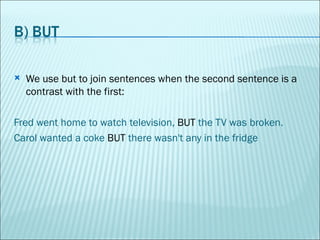
We use but to join sentences when the second sentence is a contrast with the first: Fred went home to watch television,  BUT  the TV was broken. Carol wanted a coke  BUT  there wasn't any in the fridge
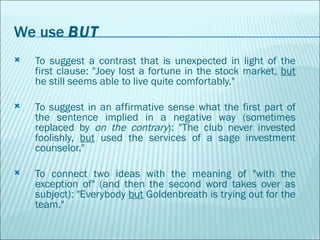
We use  BUT To suggest a contrast that is unexpected in light of the first clause: "Joey lost a fortune in the stock market,  but  he still seems able to live quite comfortably."  To suggest in an affirmative sense what the first part of the sentence implied in a negative way (sometimes replaced by  on the contrary ): "The club never invested foolishly,  but  used the services of a sage investment counselor."  To connect two ideas with the meaning of "with the exception of" (and then the second word takes over as subject): "Everybody  but  Goldenbreath is trying out for the team."
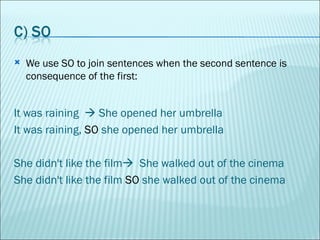
We use SO to join sentences when the second sentence is consequence of the first: It was raining    She opened her umbrella  It was raining,  SO  she opened her umbrella She didn't like the film    She walked out of the cinema She didn't like the film  SO  she walked out of the cinema
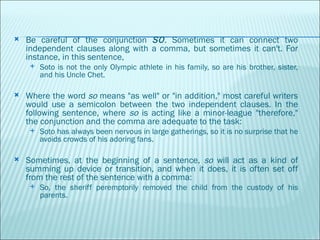
Be careful of the conjunction  SO . Sometimes it can connect two independent clauses along with a comma, but sometimes it can't. For instance, in this sentence, Soto is not the only Olympic athlete in his family, so are his brother, sister, and his Uncle Chet. Where the word  so  means "as well" or "in addition," most careful writers would use a semicolon between the two independent clauses. In the following sentence, where  so  is acting like a minor-league "therefore," the conjunction and the comma are adequate to the task: Soto has always been nervous in large gatherings, so it is no surprise that he avoids crowds of his adoring fans. Sometimes, at the beginning of a sentence,  so  will act as a kind of summing up device or transition, and when it does, it is often set off from the rest of the sentence with a comma: So, the sheriff peremptorily removed the child from the custody of his parents.
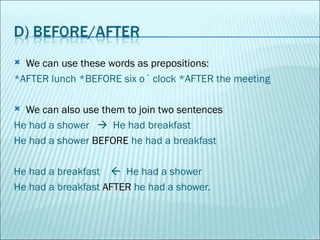
We can use these words as prepositions: *AFTER lunch *BEFORE six o´ clock *AFTER the meeting We can also use them to join two sentences  He had a shower     He had breakfast He had a shower  BEFORE  he had a breakfast He had a breakfast     He had a shower  He had a breakfast  AFTER  he had a shower.
We use WHEN to join two sentences in time. The two actions may happen at about the same time, or at two different time  When the time of the two sentences is (more or less) the same, we use the same tense  for both: I arrived (at 6 am).  He left  (at 6 am). WHEN   I arrived he left When the time of the two sentences is different, we use different  tenses: I arrived (at 6 am).  He left  (at 5:30 am). WHEN  I arrived  he had (already) left.
We us OR To suggest that only one possibility can be realized, excluding one or the other: "You can study hard for this exam  or  you can fail."  To suggest the inclusive combination of alternatives: "We can broil chicken on the grill tonight,  or  we can just eat leftovers.  To suggest a refinement of the first clause: "Smith College is the premier all-women's college in the country,  or  so it seems to most Smith College alumnae."  To suggest a restatement or "correction" of the first part of the sentence: "There are no rattlesnakes in this canyon,  or  so our guide tells us."  To suggest a negative condition: "The New Hampshire state motto is the rather grim "Live free  or  die."      To suggest a negative alternative without the use of an imperative (see use of  and   above ): "They must approve his political style  or  they wouldn't keep electing him mayor."
Now is time to practice Go to the next web site   http://www.english-test.net/esl/learn/english/grammar/ei104/esl-test.php
Shepherd, J. (1995) Multilevel English Grammar Programme Level 2 Student's book. Hong Kong: Phoenix ELT Some information taken from the web site: http://grammar.ccc.commnet.edu/grammar/conjunctions.htm Elaborated by: Carlos Gualberto Salazar Hernández 2009  References

And, But, So, Before,

  • 1.
    When to use:CAADI Psicología, UANL
  • 2.
    We use ANDto join words: Crime AND Punishment Bread AND butter Two shirts, a pullover AND a jacket We do not use a comma when we join two words with AND x John, and Mary We also use AND to join sentences Fred went home AND watched TV. Fred went home AND Carol spent the evening with him
  • 3.
    We also use AND To suggest that one idea is chronologically sequential to another: "Tashonda sent in her applications and waited by the phone for a response." To suggest that one idea is the result of another: "Willie heard the weather report and promptly boarded up his house." To suggest that one idea is in contrast to another (frequently replaced by but in this usage): "Juanita is brilliant and Shalimar has a pleasant personality. To suggest an element of surprise (sometimes replaced by yet in this usage): "Hartford is a rich city and suffers from many symptoms of urban blight." To suggest that one clause is dependent upon another, conditionally (usually the first clause is an imperative): "Use your credit cards frequently and you'll soon find yourself deep in debt." To suggest a kind of "comment" on the first clause: "Charlie became addicted to gambling — and that surprised no one who knew him."
  • 4.
    We use butto join sentences when the second sentence is a contrast with the first: Fred went home to watch television, BUT the TV was broken. Carol wanted a coke BUT there wasn't any in the fridge
  • 5.
    We use BUT To suggest a contrast that is unexpected in light of the first clause: "Joey lost a fortune in the stock market, but he still seems able to live quite comfortably." To suggest in an affirmative sense what the first part of the sentence implied in a negative way (sometimes replaced by on the contrary ): "The club never invested foolishly, but used the services of a sage investment counselor." To connect two ideas with the meaning of "with the exception of" (and then the second word takes over as subject): "Everybody but Goldenbreath is trying out for the team."
  • 6.
    We use SOto join sentences when the second sentence is consequence of the first: It was raining  She opened her umbrella It was raining, SO she opened her umbrella She didn't like the film  She walked out of the cinema She didn't like the film SO she walked out of the cinema
  • 7.
    Be careful ofthe conjunction SO . Sometimes it can connect two independent clauses along with a comma, but sometimes it can't. For instance, in this sentence, Soto is not the only Olympic athlete in his family, so are his brother, sister, and his Uncle Chet. Where the word so means "as well" or "in addition," most careful writers would use a semicolon between the two independent clauses. In the following sentence, where so is acting like a minor-league "therefore," the conjunction and the comma are adequate to the task: Soto has always been nervous in large gatherings, so it is no surprise that he avoids crowds of his adoring fans. Sometimes, at the beginning of a sentence, so will act as a kind of summing up device or transition, and when it does, it is often set off from the rest of the sentence with a comma: So, the sheriff peremptorily removed the child from the custody of his parents.
  • 8.
    We can usethese words as prepositions: *AFTER lunch *BEFORE six o´ clock *AFTER the meeting We can also use them to join two sentences He had a shower  He had breakfast He had a shower BEFORE he had a breakfast He had a breakfast  He had a shower He had a breakfast AFTER he had a shower.
  • 9.
    We use WHENto join two sentences in time. The two actions may happen at about the same time, or at two different time When the time of the two sentences is (more or less) the same, we use the same tense for both: I arrived (at 6 am). He left (at 6 am). WHEN I arrived he left When the time of the two sentences is different, we use different tenses: I arrived (at 6 am). He left (at 5:30 am). WHEN I arrived he had (already) left.
  • 10.
    We us ORTo suggest that only one possibility can be realized, excluding one or the other: "You can study hard for this exam or you can fail." To suggest the inclusive combination of alternatives: "We can broil chicken on the grill tonight, or we can just eat leftovers. To suggest a refinement of the first clause: "Smith College is the premier all-women's college in the country, or so it seems to most Smith College alumnae." To suggest a restatement or "correction" of the first part of the sentence: "There are no rattlesnakes in this canyon, or so our guide tells us." To suggest a negative condition: "The New Hampshire state motto is the rather grim "Live free or die." To suggest a negative alternative without the use of an imperative (see use of and above ): "They must approve his political style or they wouldn't keep electing him mayor."
  • 11.
    Now is timeto practice Go to the next web site http://www.english-test.net/esl/learn/english/grammar/ei104/esl-test.php
  • 12.
    Shepherd, J. (1995)Multilevel English Grammar Programme Level 2 Student's book. Hong Kong: Phoenix ELT Some information taken from the web site: http://grammar.ccc.commnet.edu/grammar/conjunctions.htm Elaborated by: Carlos Gualberto Salazar Hernández 2009 References