RELATIVE CLAUSES
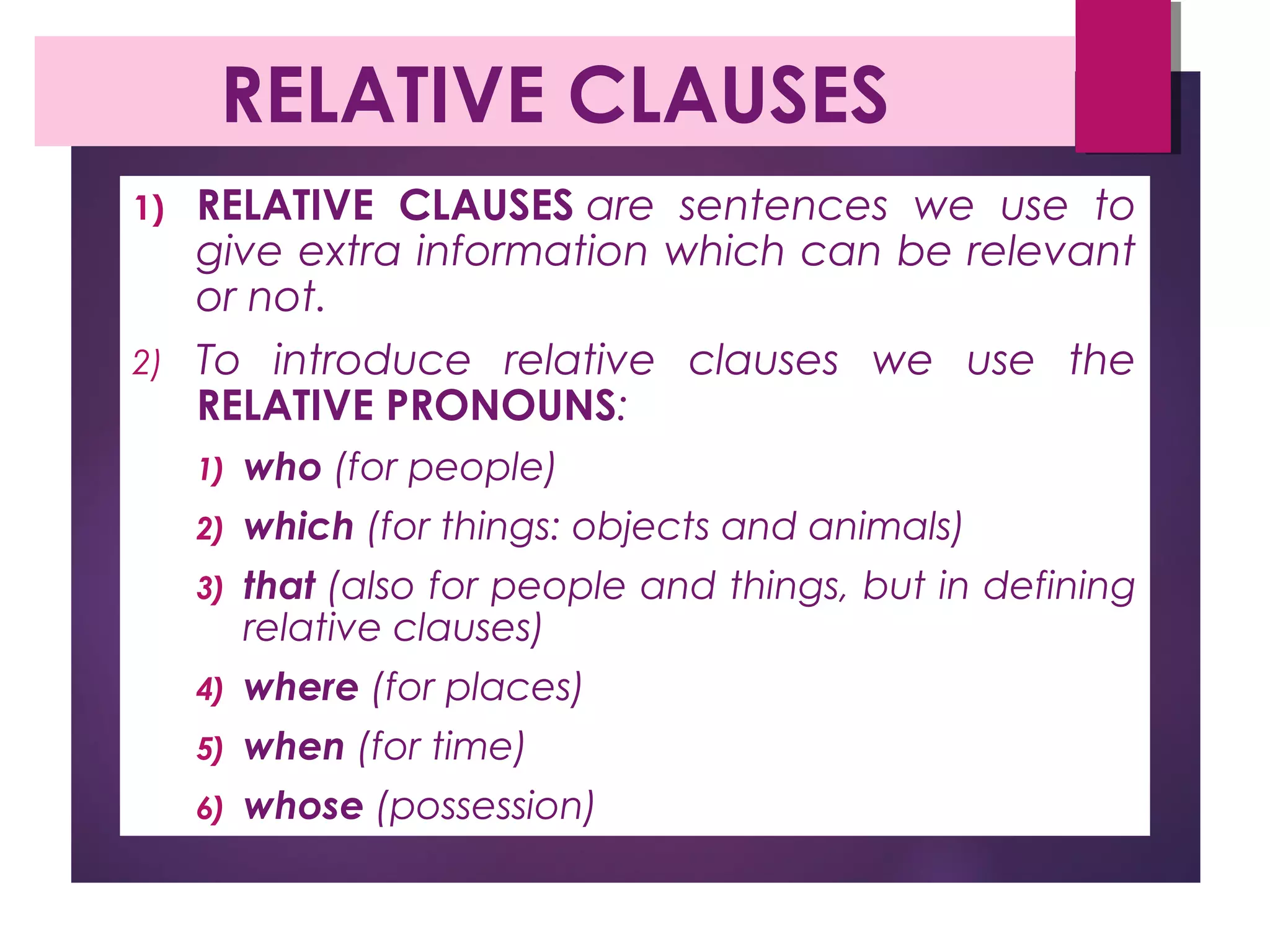
1) RELATIVE CLAUSES are sentences we use to
give extra information which can be relevant
or not.
2) To introduce relative clauses we use the
RELATIVE PRONOUNS:
1) who (for people)
2) which (for things: objects and animals)
3) that (also for people and things, but in defining
relative clauses)
4) where (for places)
5) when (for time)
6) whose (possession)
EXAMPLES
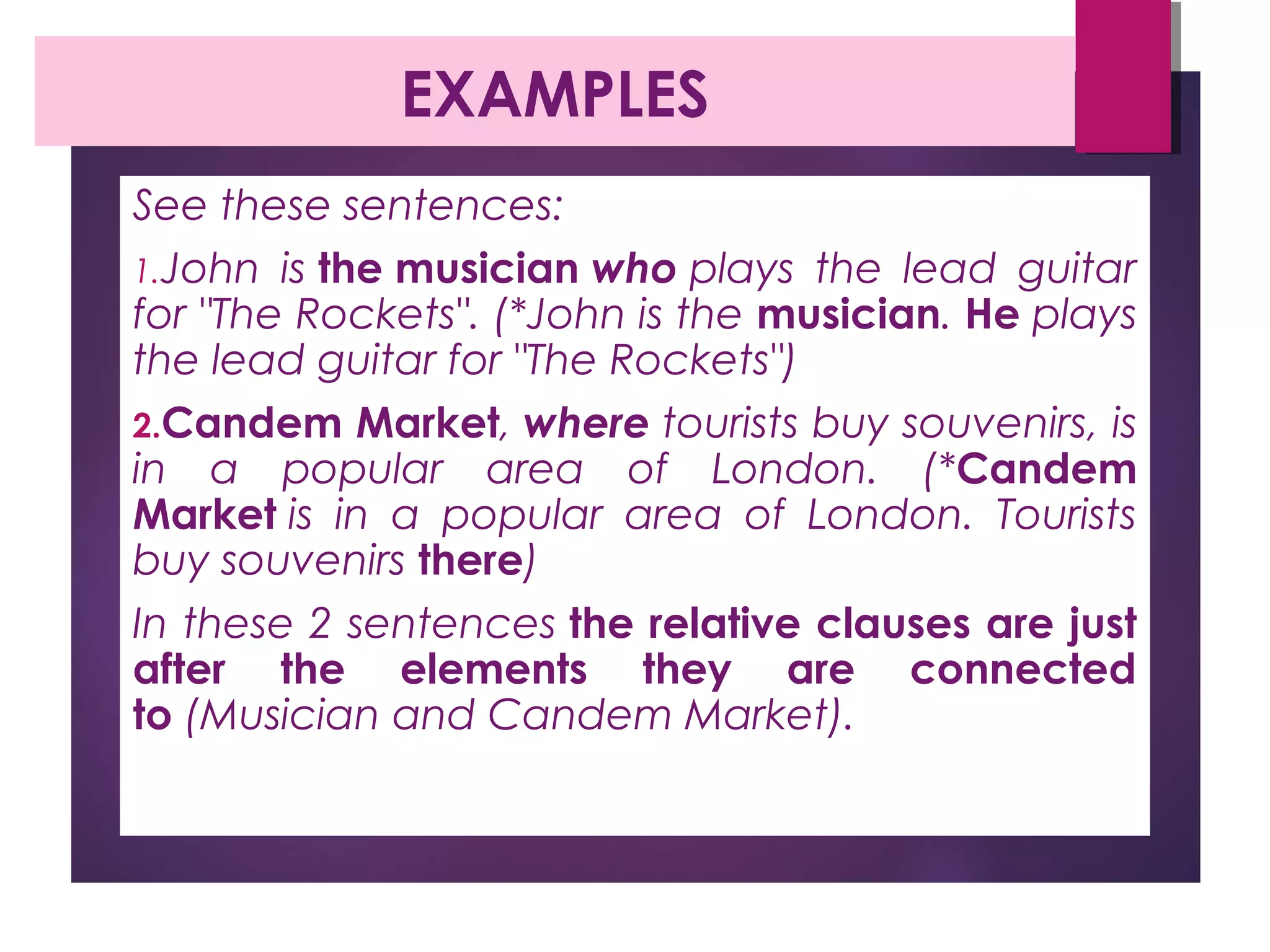
See these sentences:
1.John is the musician who plays the lead guitar
for "The Rockets". (*John is the musician. He plays
the lead guitar for "The Rockets")
2.Candem Market, where tourists buy souvenirs, is
in a popular area of London. (*Candem
Market is in a popular area of London. Tourists
buy souvenirs there)
In these 2 sentences the relative clauses are just
after the elements they are connected
to (Musician and Candem Market).
EXAMPLES
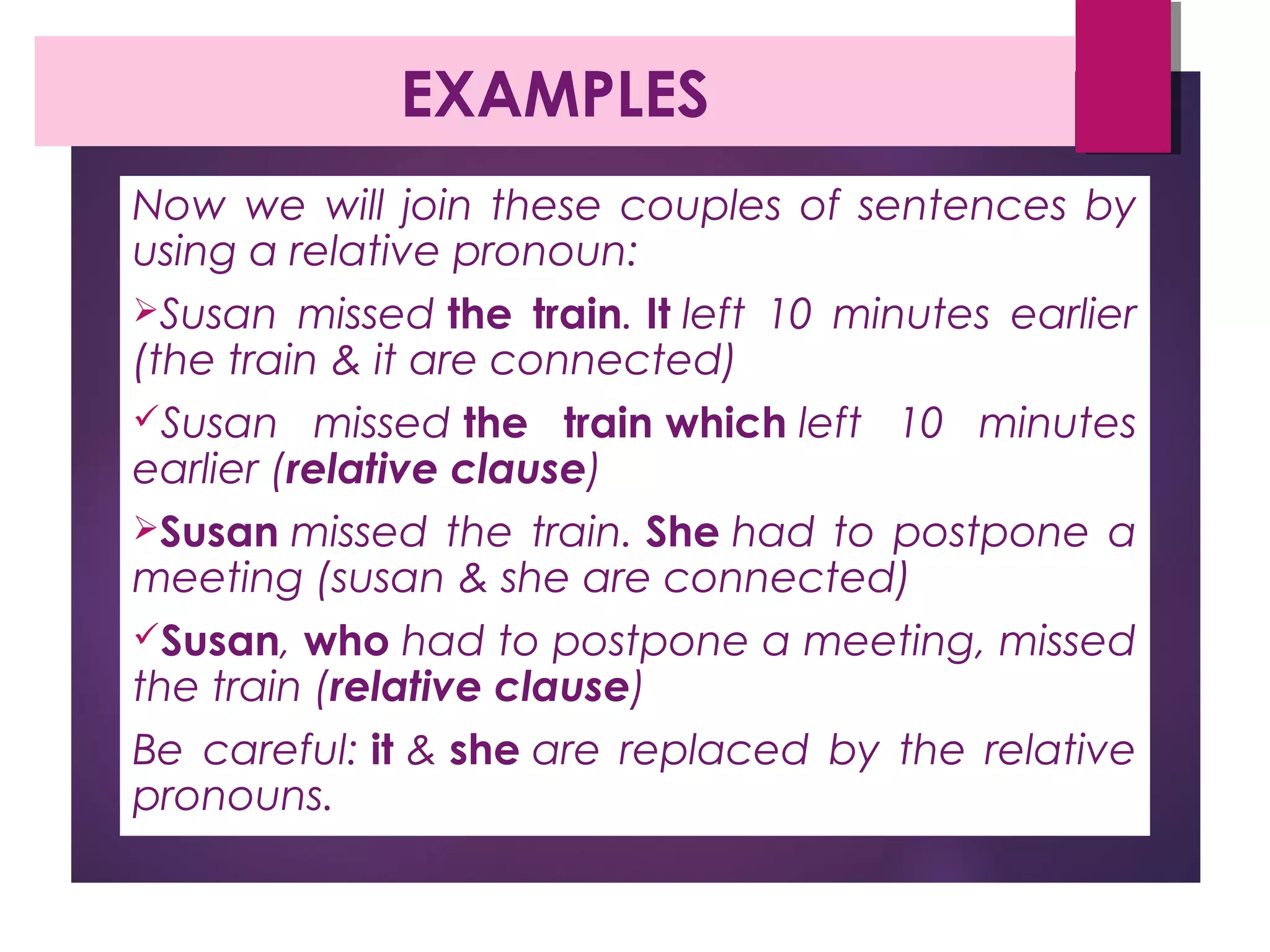
Now we will join these couples of sentences by
using a relative pronoun:
Susan missed the train. It left 10 minutes earlier
(the train & it are connected)
Susan missed the train which left 10 minutes
earlier (relative clause)
Susan missed the train. She had to postpone a
meeting (susan & she are connected)
Susan, who had to postpone a meeting, missed
the train (relative clause)
Be careful: it & she are replaced by the relative
pronouns.
DEFINING & NON-DEFINING
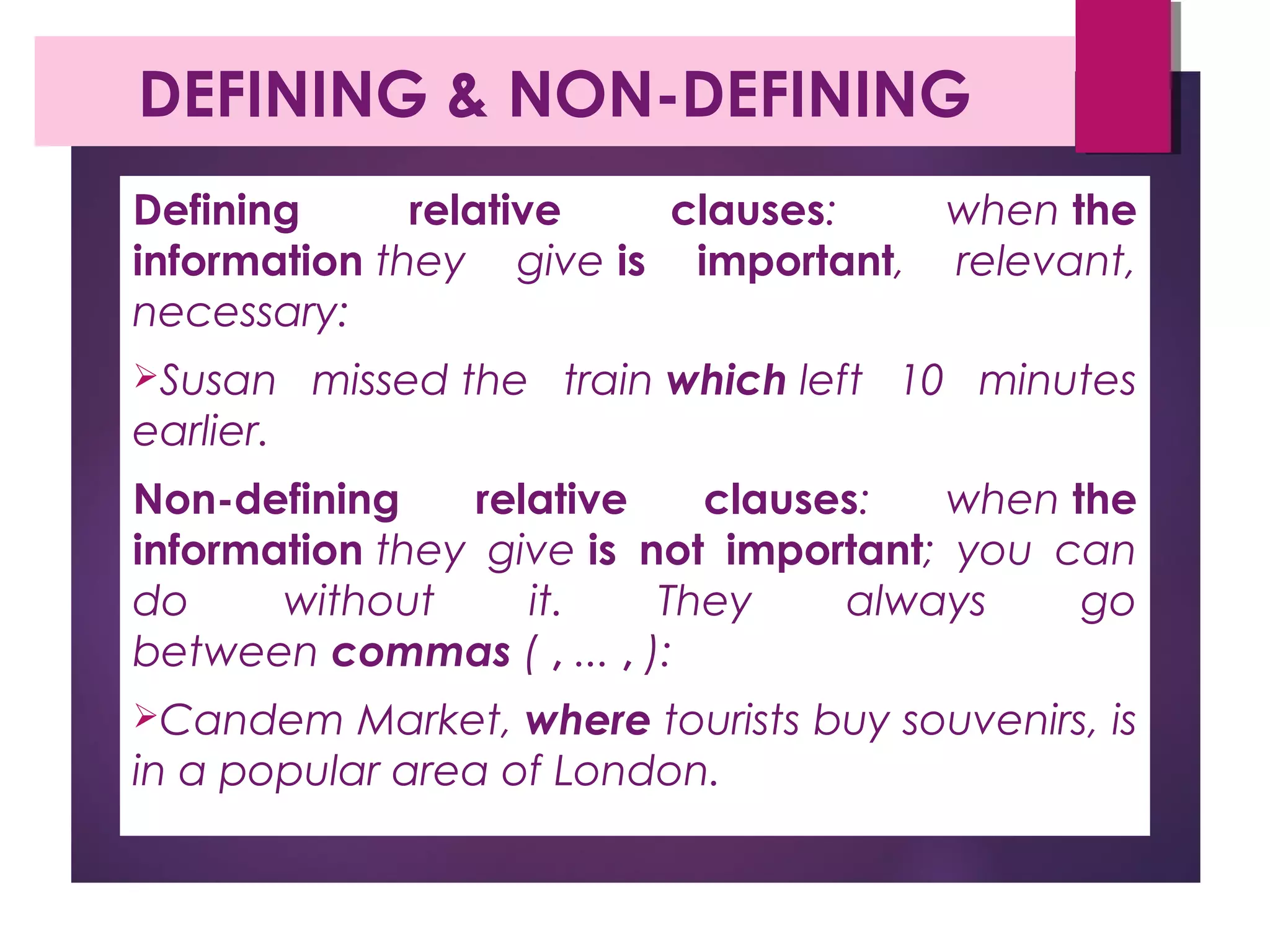
Defining relative clauses: when the
information they give is important, relevant,
necessary:
Susan missed the train which left 10 minutes
earlier.
Non-defining relative clauses: when the
information they give is not important; you can
do without it. They always go
between commas ( , ... , ):
Candem Market, where tourists buy souvenirs, is
in a popular area of London.

Relative clauses

  • 1.
    RELATIVE CLAUSES 1) RELATIVECLAUSES are sentences we use to give extra information which can be relevant or not. 2) To introduce relative clauses we use the RELATIVE PRONOUNS: 1) who (for people) 2) which (for things: objects and animals) 3) that (also for people and things, but in defining relative clauses) 4) where (for places) 5) when (for time) 6) whose (possession)
  • 2.
    EXAMPLES See these sentences: 1.Johnis the musician who plays the lead guitar for "The Rockets". (*John is the musician. He plays the lead guitar for "The Rockets") 2.Candem Market, where tourists buy souvenirs, is in a popular area of London. (*Candem Market is in a popular area of London. Tourists buy souvenirs there) In these 2 sentences the relative clauses are just after the elements they are connected to (Musician and Candem Market).
  • 3.
    EXAMPLES Now we willjoin these couples of sentences by using a relative pronoun: Susan missed the train. It left 10 minutes earlier (the train & it are connected) Susan missed the train which left 10 minutes earlier (relative clause) Susan missed the train. She had to postpone a meeting (susan & she are connected) Susan, who had to postpone a meeting, missed the train (relative clause) Be careful: it & she are replaced by the relative pronouns.
  • 4.
    DEFINING & NON-DEFINING Definingrelative clauses: when the information they give is important, relevant, necessary: Susan missed the train which left 10 minutes earlier. Non-defining relative clauses: when the information they give is not important; you can do without it. They always go between commas ( , ... , ): Candem Market, where tourists buy souvenirs, is in a popular area of London.