Download to read offline
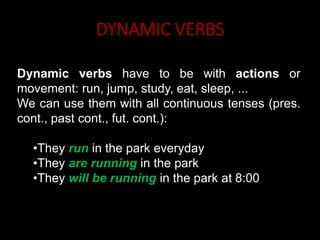
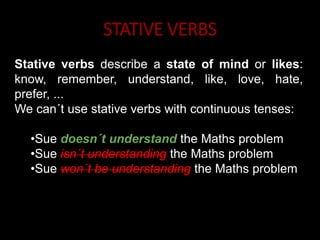
Dynamic verbs describe actions or movement and can be used with continuous tenses like present continuous, past continuous, and future continuous. Examples include run, jump, study, and eat. Stative verbs describe a state of being or mind like know, remember, understand, like, and prefer and cannot be used with continuous tenses. For example, one can say "Sue doesn't understand the math problem" but not "Sue isn't understanding the math problem." The document outlines the differences between dynamic and stative verbs and their usage with progressive or continuous tenses.


![Past tense [compatibility mode]](https://cdn.slidesharecdn.com/ss_thumbnails/past-tensecompatibilitymode-111120224117-phpapp02-thumbnail.jpg?width=640&height=640&fit=bounds)


