+ 
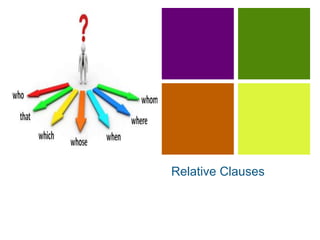
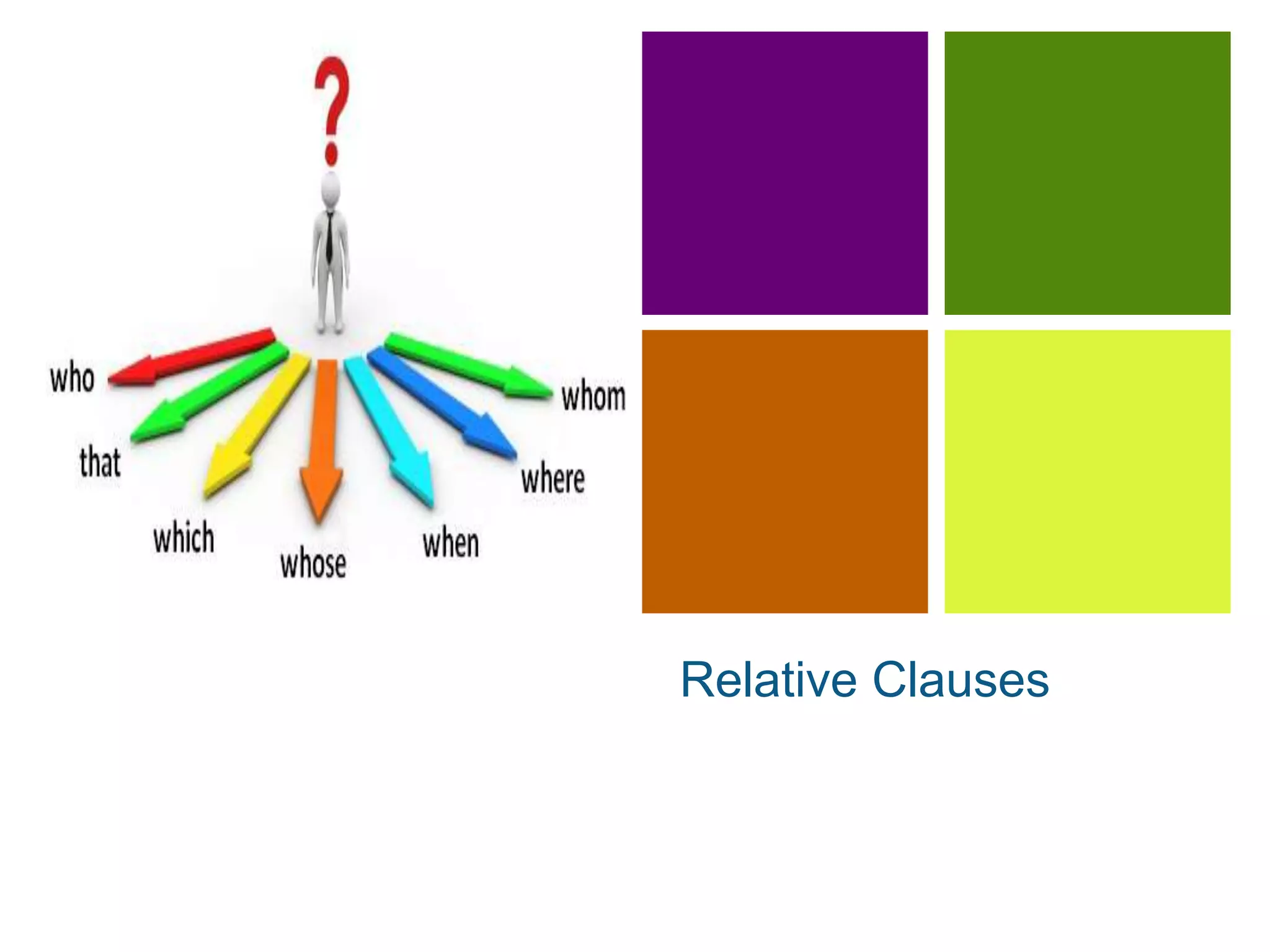
Relative Clauses
+ 
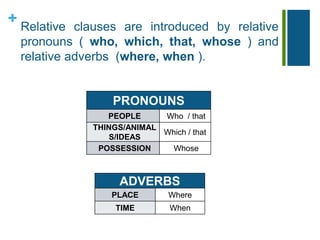
Relative clauses are introduced by relative 
pronouns ( who, which, that, whose ) and 
relative adverbs (where, when ). 
PRONOUNS 
PEOPLE Who / that 
THINGS/ANIMAL 
S/IDEAS 
Which / that 
POSSESSION Whose 
ADVERBS 
PLACE Where 
TIME When
+ 
We have two types of relative 
clauses: 
Defining 
S + V + Relative adverb/pronoun + V 
We can meet at the café which is on Grandview. 
S + Relative adverb/pronoun + S + V + V 
The place where I live is beautiful. 
Non-defining 
S + ,Relative adverb/pronoun + V, + V 
Facebook , which is a social network, is popular.
+ 
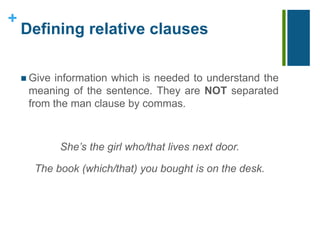
Defining relative clauses 
 Give information which is needed to understand the 
meaning of the sentence. They are NOT separated 
from the man clause by commas. 
She’s the girl who/that lives next door. 
The book (which/that) you bought is on the desk.
+ 
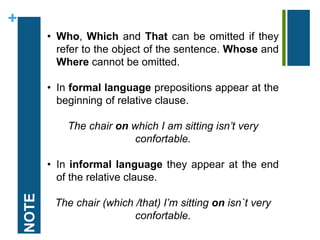
NOTE 
• Who, Which and That can be omitted if they 
refer to the object of the sentence. Whose and 
Where cannot be omitted. 
• In formal language prepositions appear at the 
beginning of relative clause. 
The chair on which I am sitting isn’t very 
confortable. 
• In informal language they appear at the end 
of the relative clause. 
The chair (which /that) I’m sitting on isn`t very 
confortable.
+ 
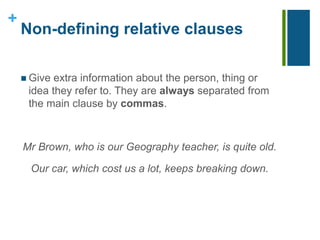
Non-defining relative clauses 
Give extra information about the person, thing or 
idea they refer to. They are always separated from 
the main clause by commas. 
Mr Brown, who is our Geography teacher, is quite old. 
Our car, which cost us a lot, keeps breaking down.
+ 
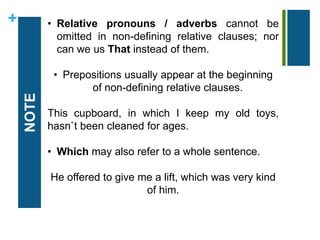
NOTE 
• Relative pronouns / adverbs cannot be 
omitted in non-defining relative clauses; nor 
can we us That instead of them. 
• Prepositions usually appear at the beginning 
of non-defining relative clauses. 
This cupboard, in which I keep my old toys, 
hasn`t been cleaned for ages. 
• Which may also refer to a whole sentence. 
He offered to give me a lift, which was very kind 
of him.

Relative Clauses

  • 1.
  • 2.
    + Relative clausesare introduced by relative pronouns ( who, which, that, whose ) and relative adverbs (where, when ). PRONOUNS PEOPLE Who / that THINGS/ANIMAL S/IDEAS Which / that POSSESSION Whose ADVERBS PLACE Where TIME When
  • 3.
    + We havetwo types of relative clauses: Defining S + V + Relative adverb/pronoun + V We can meet at the café which is on Grandview. S + Relative adverb/pronoun + S + V + V The place where I live is beautiful. Non-defining S + ,Relative adverb/pronoun + V, + V Facebook , which is a social network, is popular.
  • 4.
    + Defining relativeclauses  Give information which is needed to understand the meaning of the sentence. They are NOT separated from the man clause by commas. She’s the girl who/that lives next door. The book (which/that) you bought is on the desk.
  • 5.
    + NOTE •Who, Which and That can be omitted if they refer to the object of the sentence. Whose and Where cannot be omitted. • In formal language prepositions appear at the beginning of relative clause. The chair on which I am sitting isn’t very confortable. • In informal language they appear at the end of the relative clause. The chair (which /that) I’m sitting on isn`t very confortable.
  • 6.
    + Non-defining relativeclauses Give extra information about the person, thing or idea they refer to. They are always separated from the main clause by commas. Mr Brown, who is our Geography teacher, is quite old. Our car, which cost us a lot, keeps breaking down.
  • 7.
    + NOTE •Relative pronouns / adverbs cannot be omitted in non-defining relative clauses; nor can we us That instead of them. • Prepositions usually appear at the beginning of non-defining relative clauses. This cupboard, in which I keep my old toys, hasn`t been cleaned for ages. • Which may also refer to a whole sentence. He offered to give me a lift, which was very kind of him.