
Presented
by :
Lokamruth K.R
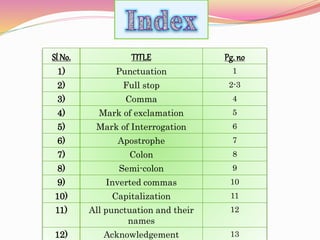
Sl No. TITLE Pg. no
1) Punctuation 1
2) Full stop 2-3
3) Comma 4
4) Mark of exclamation 5
5) Mark of Interrogation 6
6) Apostrophe 7
7) Colon 8
8) Semi-colon 9
9) Inverted commas 10
10) Capitalization 11
11) All punctuation and their
names
12
12) Acknowledgement 13
Punctuation:-
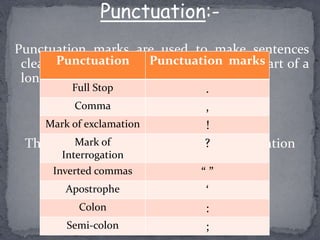
Punctuation marks are used to make sentences
clear, concise and different from another part of a
longer sentence.
The table below gives the different punctuation
marks.
Punctuation Punctuation marks
Full Stop .
Comma ,
Mark of exclamation !
Mark of
Interrogation
?
Inverted commas “ ”
Apostrophe ‘
Colon :
Semi-colon ;
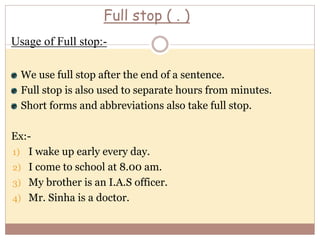
Full stop ( . )
Usage of Full stop:-
We use full stop after the end of a sentence.
Full stop is also used to separate hours from minutes.
Short forms and abbreviations also take full stop.
Ex:-
1) I wake up early every day.
2) I come to school at 8.00 am.
3) My brother is an I.A.S officer.
4) Mr. Sinha is a doctor.
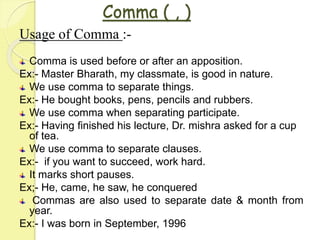
Comma ( , )
Usage of Comma :-
Comma is used before or after an apposition.
Ex:- Master Bharath, my classmate, is good in nature.
We use comma to separate things.
Ex:- He bought books, pens, pencils and rubbers.
We use comma when separating participate.
Ex:- Having finished his lecture, Dr. mishra asked for a cup
of tea.
We use comma to separate clauses.
Ex:- if you want to succeed, work hard.
It marks short pauses.
Ex;- He, came, he saw, he conquered
Commas are also used to separate date & month from
year.
Ex:- I was born in September, 1996
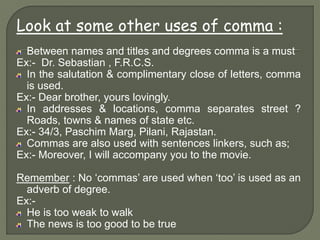
Look at some other uses of comma :
Between names and titles and degrees comma is a must
Ex:- Dr. Sebastian , F.R.C.S.
In the salutation & complimentary close of letters, comma
is used.
Ex:- Dear brother, yours lovingly.
In addresses & locations, comma separates street ?
Roads, towns & names of state etc.
Ex:- 34/3, Paschim Marg, Pilani, Rajastan.
Commas are also used with sentences linkers, such as;
Ex:- Moreover, I will accompany you to the movie.
Remember : No ‘commas’ are used when ‘too’ is used as an
adverb of degree.
Ex:-
He is too weak to walk
The news is too good to be true
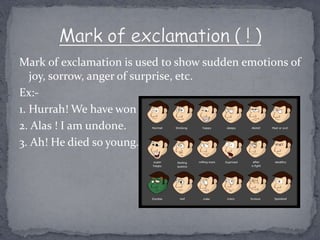
Mark of exclamation is used to show sudden emotions of
joy, sorrow, anger of surprise, etc.
Ex:-
1. Hurrah! We have won the match.
2. Alas ! I am undone.
3. Ah! He died so young.
Mark of Interrogation ( ? )
Mark of interrogation is used to ask questions
and to confirm some statements.
Ex:-
1. Do you enjoy reading grammar ?
2. How do you do ?
3. You want him to see me ?
4. I am a teacher, aren’t I ? (Confirmation)
Apostrophe ( ‘ )
Uses of Apostrophe :-
Apostrophe is used to show possession.
Ex:-Men’s Tailor, Teacher’s Quarters, Baconn’s Essay’s
Sometimes it is also used to show contracted forms or
omission of letters or numerals.
Ex:-Ma’am (for Madam)
Don’t (for Do not)
Apostrophe is also used with some proper names which
end in ‘s’ and in the possessive form of plural nouns.
Ex:- Boys’ performance
Scholars’ views.
Colon is used to indicate additional explanation.
It introduces a quotation and also a series of
clauses.
Ex:- Some famous romantic poets are :
Wordsworth, Shelly, Keats, Marvel and Blake.
Wordsworth says: Child is the father of Man.
Semi colon ( ; )
Uses of Semi colon :-
Semi colon is used when we require a greater
pause than required by a comma.
Ex:- Reading make the full man; speaking a ready
man; writing an exact man.
Usually a semi colon separates clauses and
longer constructions.
Ex :- Wise man learn by other men’s mistakes;
fools by their own.
INVERTED COMMAS (“ ”)
Inverted commas are used to mark off
the actual words used by the speaker.
Ex:- Keats said, “A thing of beauty is a
joy forever”.
The teacher said, “The earth is round”.
Remember : Sentences in direct
narration are put under inverted
commas.
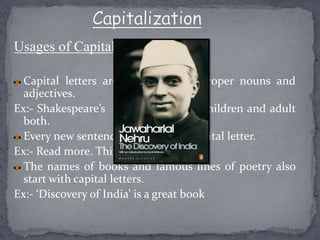
Usages of Capital letters:-
Capital letters are used with all proper nouns and
adjectives.
Ex:- Shakespeare’s plays are read by children and adult
both.
Every new sentence begins with a capital letter.
Ex:- Read more. Think most.
The names of books and famous lines of poetry also
start with capital letters.
Ex:- ‘Discovery of India’ is a great book
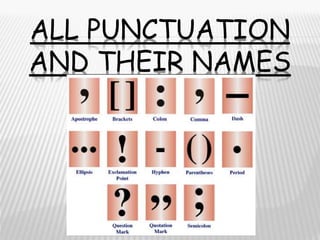
ALL PUNCTUATION
AND THEIR NAMES
I thank CHM, and teachers especially my
English Teacher Nasia mam for giving me a
opportunity to present this Presentation .
I also thank my friends, parents for
supporting and helping me from the
beginning of this presentation.
Punctation

Punctation

  • 1.
  • 2.
    Sl No. TITLEPg. no 1) Punctuation 1 2) Full stop 2-3 3) Comma 4 4) Mark of exclamation 5 5) Mark of Interrogation 6 6) Apostrophe 7 7) Colon 8 8) Semi-colon 9 9) Inverted commas 10 10) Capitalization 11 11) All punctuation and their names 12 12) Acknowledgement 13
  • 3.
    Punctuation:- Punctuation marks areused to make sentences clear, concise and different from another part of a longer sentence. The table below gives the different punctuation marks. Punctuation Punctuation marks Full Stop . Comma , Mark of exclamation ! Mark of Interrogation ? Inverted commas “ ” Apostrophe ‘ Colon : Semi-colon ;
  • 4.
    Full stop (. ) Usage of Full stop:- We use full stop after the end of a sentence. Full stop is also used to separate hours from minutes. Short forms and abbreviations also take full stop. Ex:- 1) I wake up early every day. 2) I come to school at 8.00 am. 3) My brother is an I.A.S officer. 4) Mr. Sinha is a doctor.
  • 5.
    Comma ( ,) Usage of Comma :- Comma is used before or after an apposition. Ex:- Master Bharath, my classmate, is good in nature. We use comma to separate things. Ex:- He bought books, pens, pencils and rubbers. We use comma when separating participate. Ex:- Having finished his lecture, Dr. mishra asked for a cup of tea. We use comma to separate clauses. Ex:- if you want to succeed, work hard. It marks short pauses. Ex;- He, came, he saw, he conquered Commas are also used to separate date & month from year. Ex:- I was born in September, 1996
  • 6.
    Look at someother uses of comma : Between names and titles and degrees comma is a must Ex:- Dr. Sebastian , F.R.C.S. In the salutation & complimentary close of letters, comma is used. Ex:- Dear brother, yours lovingly. In addresses & locations, comma separates street ? Roads, towns & names of state etc. Ex:- 34/3, Paschim Marg, Pilani, Rajastan. Commas are also used with sentences linkers, such as; Ex:- Moreover, I will accompany you to the movie. Remember : No ‘commas’ are used when ‘too’ is used as an adverb of degree. Ex:- He is too weak to walk The news is too good to be true
  • 7.
    Mark of exclamationis used to show sudden emotions of joy, sorrow, anger of surprise, etc. Ex:- 1. Hurrah! We have won the match. 2. Alas ! I am undone. 3. Ah! He died so young.
  • 8.
    Mark of Interrogation( ? ) Mark of interrogation is used to ask questions and to confirm some statements. Ex:- 1. Do you enjoy reading grammar ? 2. How do you do ? 3. You want him to see me ? 4. I am a teacher, aren’t I ? (Confirmation)
  • 9.
    Apostrophe ( ‘) Uses of Apostrophe :- Apostrophe is used to show possession. Ex:-Men’s Tailor, Teacher’s Quarters, Baconn’s Essay’s Sometimes it is also used to show contracted forms or omission of letters or numerals. Ex:-Ma’am (for Madam) Don’t (for Do not) Apostrophe is also used with some proper names which end in ‘s’ and in the possessive form of plural nouns. Ex:- Boys’ performance Scholars’ views.
  • 10.
    Colon is usedto indicate additional explanation. It introduces a quotation and also a series of clauses. Ex:- Some famous romantic poets are : Wordsworth, Shelly, Keats, Marvel and Blake. Wordsworth says: Child is the father of Man.
  • 11.
    Semi colon (; ) Uses of Semi colon :- Semi colon is used when we require a greater pause than required by a comma. Ex:- Reading make the full man; speaking a ready man; writing an exact man. Usually a semi colon separates clauses and longer constructions. Ex :- Wise man learn by other men’s mistakes; fools by their own.
  • 12.
    INVERTED COMMAS (“”) Inverted commas are used to mark off the actual words used by the speaker. Ex:- Keats said, “A thing of beauty is a joy forever”. The teacher said, “The earth is round”. Remember : Sentences in direct narration are put under inverted commas.
  • 13.
    Usages of Capitalletters:- Capital letters are used with all proper nouns and adjectives. Ex:- Shakespeare’s plays are read by children and adult both. Every new sentence begins with a capital letter. Ex:- Read more. Think most. The names of books and famous lines of poetry also start with capital letters. Ex:- ‘Discovery of India’ is a great book
  • 14.
  • 15.
    I thank CHM,and teachers especially my English Teacher Nasia mam for giving me a opportunity to present this Presentation . I also thank my friends, parents for supporting and helping me from the beginning of this presentation.