Acceleration Diagram for a Link
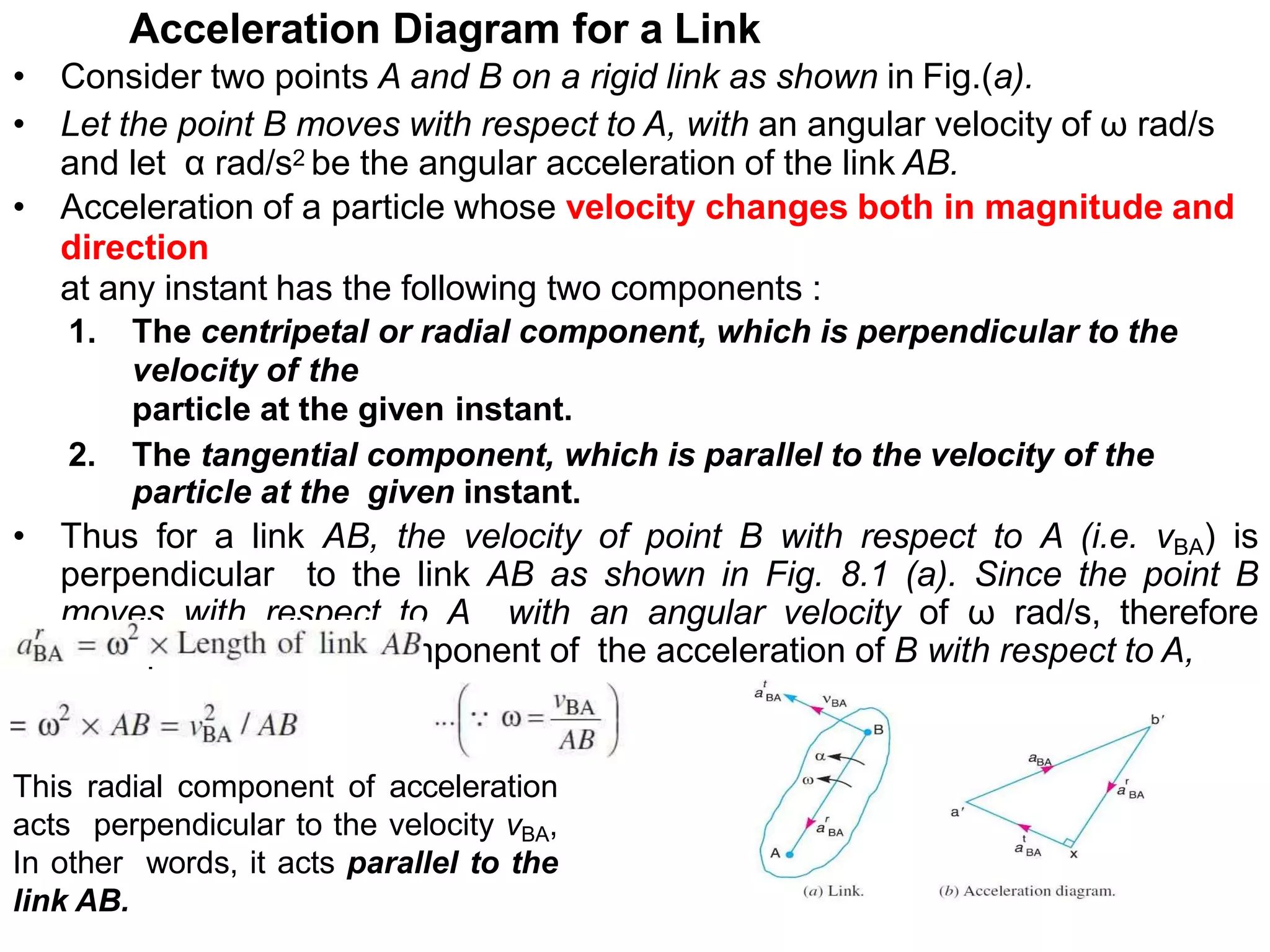
• Consider two points A and B on a rigid link as shown in Fig.(a).
• Let the point B moves with respect to A, with an angular velocity of ω rad/s
and let α rad/s2 be the angular acceleration of the link AB.
• Acceleration of a particle whose velocity changes both in magnitude and
direction
at any instant has the following two components :
1. The centripetal or radial component, which is perpendicular to the
velocity of the
particle at the given instant.
2. The tangential component, which is parallel to the velocity of the
particle at the given instant.
• Thus for a link AB, the velocity of point B with respect to A (i.e. vBA) is
perpendicular to the link AB as shown in Fig. 8.1 (a). Since the point B
moves with respect to A with an angular velocity of ω rad/s, therefore
centripetal or radial component of the acceleration of B with respect to A,
This radial component of acceleration
acts perpendicular to the velocity vBA,
In other words, it acts parallel to the
link AB.
Acceleration of a Point on a Link
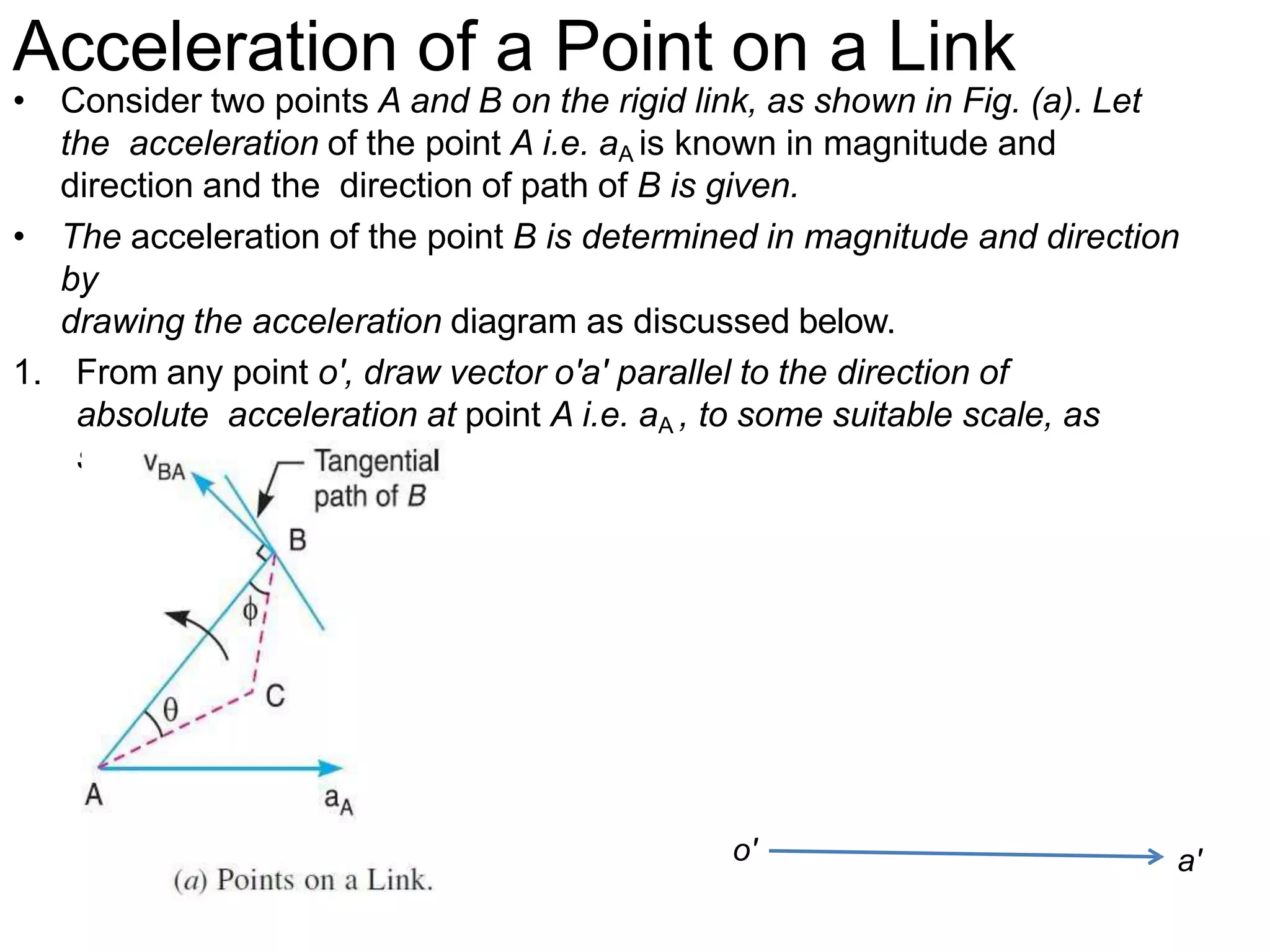
• Consider two points A and B on the rigid link, as shown in Fig. (a). Let
the acceleration of the point A i.e. aA is known in magnitude and
direction and the direction of path of B is given.
• The acceleration of the point B is determined in magnitude and direction
by
drawing the acceleration diagram as discussed below.
1. From any point o', draw vector o'a' parallel to the direction of
absolute acceleration at point A i.e. aA , to some suitable scale, as
shown in Fig.(b).
o' a'
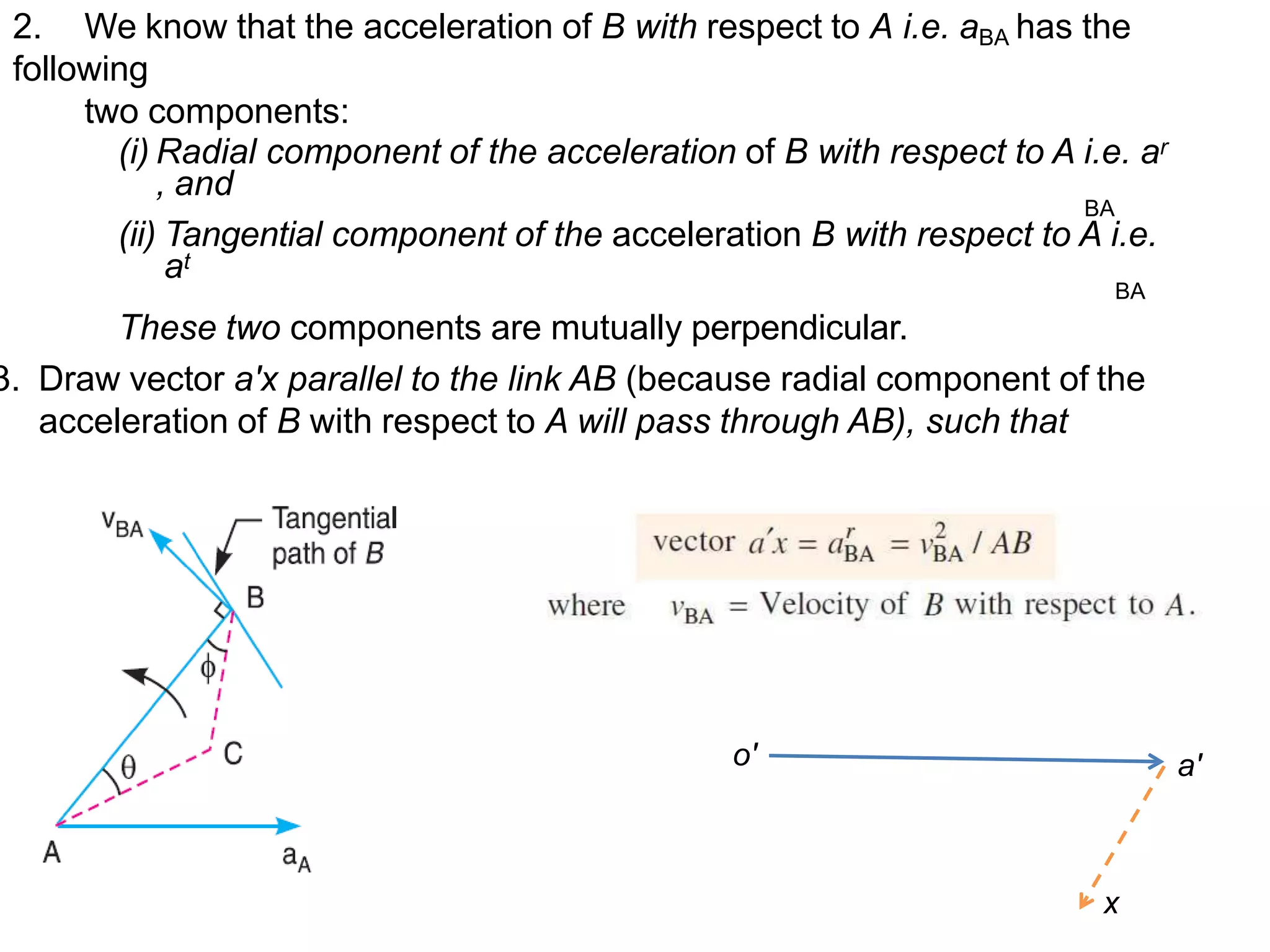
2. We know that the acceleration of B with respect to A i.e. aBA has the
following
two components:
(i) Radial component of the acceleration of B with respect to A i.e. ar
, and
BA
(ii) Tangential component of the acceleration B with respect to A i.e.
at
BA
These two components are mutually perpendicular.
3. Draw vector a'x parallel to the link AB (because radial component of the
acceleration of B with respect to A will pass through AB), such that
o' a'
x
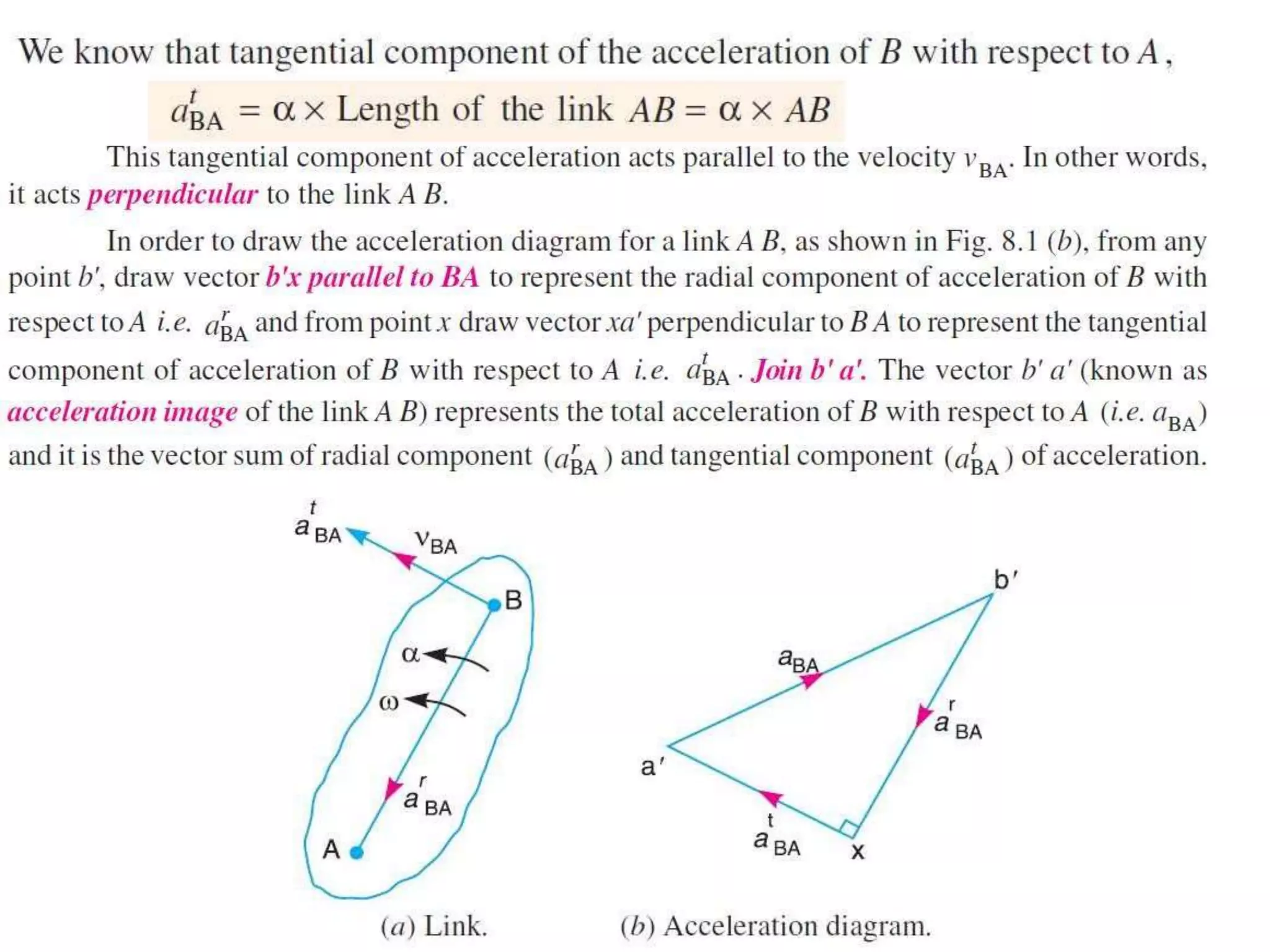
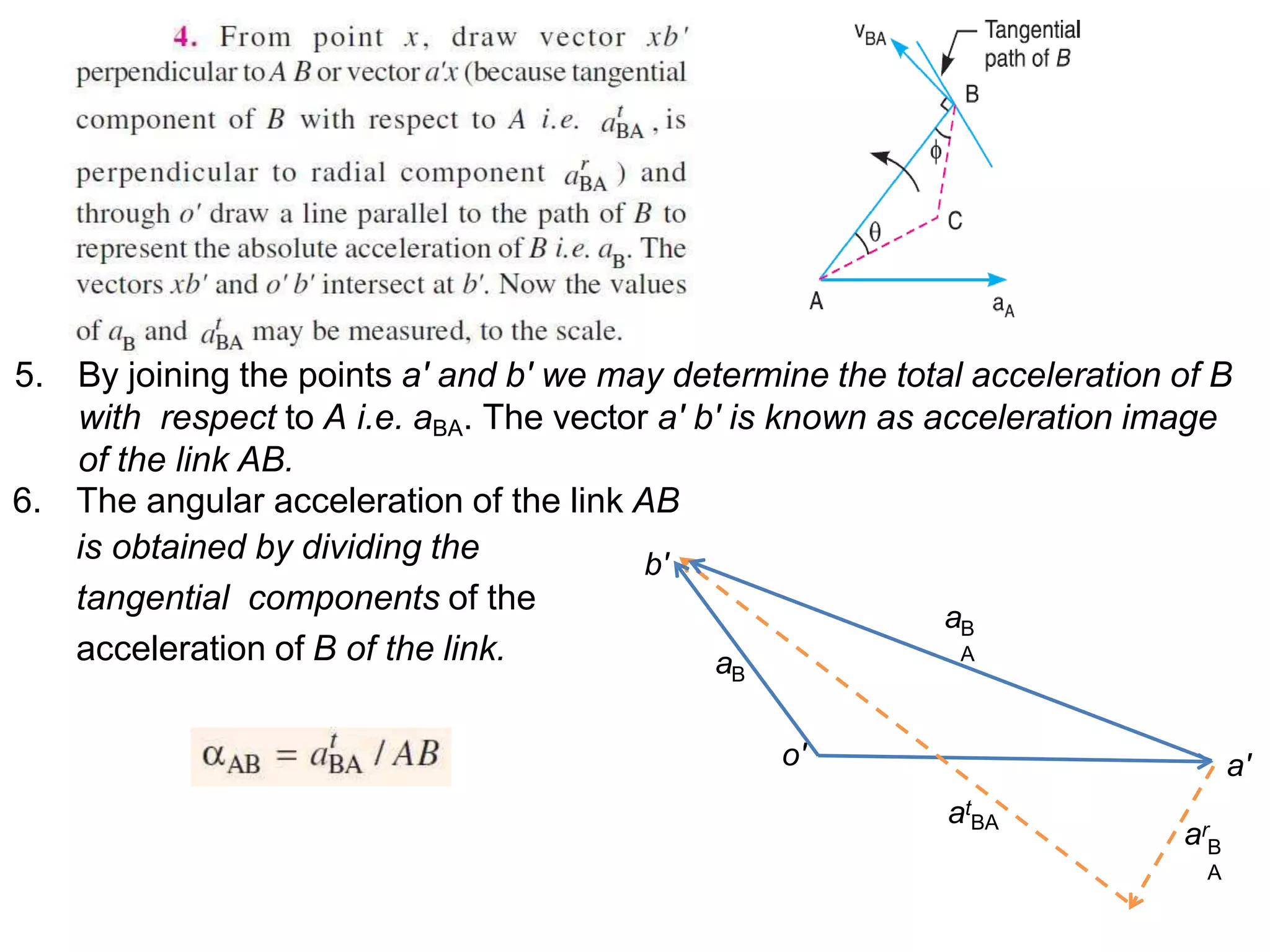
5. By joining the points a' and b' we may determine the total acceleration of B
with respect to A i.e. aBA. The vector a' b' is known as acceleration image
of the link AB.
6. The angular acceleration of the link AB
is obtained by dividing the
tangential components of the
acceleration of B of the link.
o' a'
ar
B
A
at
BA
aB
b'
aB
A

relative acceleration diagram for a link

  • 2.
    Acceleration Diagram fora Link • Consider two points A and B on a rigid link as shown in Fig.(a). • Let the point B moves with respect to A, with an angular velocity of ω rad/s and let α rad/s2 be the angular acceleration of the link AB. • Acceleration of a particle whose velocity changes both in magnitude and direction at any instant has the following two components : 1. The centripetal or radial component, which is perpendicular to the velocity of the particle at the given instant. 2. The tangential component, which is parallel to the velocity of the particle at the given instant. • Thus for a link AB, the velocity of point B with respect to A (i.e. vBA) is perpendicular to the link AB as shown in Fig. 8.1 (a). Since the point B moves with respect to A with an angular velocity of ω rad/s, therefore centripetal or radial component of the acceleration of B with respect to A, This radial component of acceleration acts perpendicular to the velocity vBA, In other words, it acts parallel to the link AB.
  • 4.
    Acceleration of aPoint on a Link • Consider two points A and B on the rigid link, as shown in Fig. (a). Let the acceleration of the point A i.e. aA is known in magnitude and direction and the direction of path of B is given. • The acceleration of the point B is determined in magnitude and direction by drawing the acceleration diagram as discussed below. 1. From any point o', draw vector o'a' parallel to the direction of absolute acceleration at point A i.e. aA , to some suitable scale, as shown in Fig.(b). o' a'
  • 5.
    2. We knowthat the acceleration of B with respect to A i.e. aBA has the following two components: (i) Radial component of the acceleration of B with respect to A i.e. ar , and BA (ii) Tangential component of the acceleration B with respect to A i.e. at BA These two components are mutually perpendicular. 3. Draw vector a'x parallel to the link AB (because radial component of the acceleration of B with respect to A will pass through AB), such that o' a' x
  • 6.
    5. By joiningthe points a' and b' we may determine the total acceleration of B with respect to A i.e. aBA. The vector a' b' is known as acceleration image of the link AB. 6. The angular acceleration of the link AB is obtained by dividing the tangential components of the acceleration of B of the link. o' a' ar B A at BA aB b' aB A