RESOURCE
Concept And Classification
What is Resource?
 A resource is a substance in the environment
that is useful to people is economically and
technologically feasible to access and socially
acceptable to use. Resources include soil,
water, food, plants. animals and mineral. -AP
Human Geography
 Resource is a source of supply, support, or
aid, especially one that can be readily drawn
upon when needed. -Dictionary.com
What is Resource?
 A resource is a source or supply from which
benefit is produced. Typically resources are
materials or other assets that are transformed
to produce benefit and in the process may be
consumed or made unavailable. -Wikipedia
 Resources or natural resources are the
naturally occurring materials that a human
population, at any given state of economic
development and technological awareness,
perceives to be necessary and useful to its
economic and material well-being. -Human
Geography by Fellman- Getis- Getis
Classification of Resource
The resources can be classified in the following
ways:
 On the basis of origin
 On the basis of exhaustibility
 On the basis of ownership
 On basis of the status of development
On the basis of origin
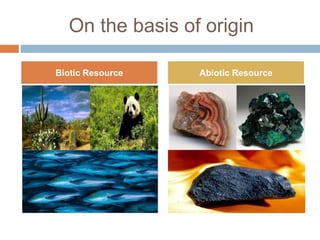
 Biotic Resources are obtained from
biosphere and they have a life such as human
beings, flora and fauna, fisheries, livestock etc.
 Abiotic resources include all those things
which are composed of non-living things like
rocks and metals
On the basis of origin
Biotic Resource Abiotic Resource
On the basis of exhaustibility
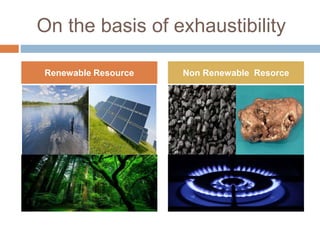
 Renewable Resources are those resources
which can be renewed or reproduced by
physical, chemical or mechanical processes,
e.g., solar and wind energy, water, forests and
wildlife, etc. Renewable resources may further
be divided into
• continuous or flow resources, e.g., wind,
water
• biological resources, which are of 2 types :
− Natural Vegetation (Forests)
− Wildlife
On the basis of exhaustibility
 Non-Renewable Resources are formed over
a substantially long geological time, e.g.,
minerals and fossil fuels. These can
subdivided into
• recyclable resources, e.g. metals,
• non-recyclable resources, e.g. fossil fuels,
which cannot be recycled and get exhausted
with their use
On the basis of exhaustibility
Renewable Resource Non Renewable Resorce
On the basis of ownership
 Individual Resources are resources that are
owned privately by individuals. Examples- land
owned by farmers (allotted by the government
against the payment of revenue), plantations,
pasture lands, ponds, water in wells owned by
individuals, plots, houses and other property
owned by people in the city etc.
 Community Resources are resources accessible
to all the members of a community. Examples
:Village commons (grazing grounds, burial
grounds, village ponds, etc.) public parks, picnic
spots, and playgrounds in urban areas.
On the basis of ownership
 National Resources are all the resources that
belong to a nation. Examples :
• roads, canals, railways, etc.
• minerals, water resources, forests, wildlife,
etc.
• land within the political boundaries,
• territorial water and the resources within
The term territorial water refers to the oceanic
area upto 12 nautical miles (19.2 km) from the
coast.
The country has legal powers to acquire even
private property for public good. Urban
On the basis of ownership
 International resources: there are also
international resources regulating resources.
The oceanic resources beyond 200km of the
Exclusive Economic Zone belong to open
ocean and no individual country can utilize
these without the consensus of international
institutions.
On the basis of the state of
development
 Potential resources are resources found in a
region which have not been utilized. Examples
: wind and solar energy development potential
in the states of Gujarat and Rajasthan.
 Developed resources are those resources
which are surveyed and their quality and
quantity have been determined for utilization.
The development of resources however
depends on technology and level of their
feasibility.
On the basis of the state of
development
 Stock refers to materials in the environment
which have the potential to satisfy human
needs but human beings do not have the
appropriate technology to access these.
Examples : water is a compound of two
inflammable gases; hydrogen and oxygen,
which could be used as a rich source of
energy if we had the required technical ‘know-
how’. Hence, it can be considered as stock.
On the basis of the state of
development
 Reserves are the subset of the stock, which
are yet to be put into use with the help of
existing technical ‘know-how’. These can be
used for meeting future requirements.
Example : River water can be used for
generating hydroelectric power but presently, it
is being utilized only to a limited extent. Thus,
the water in the dams is a reserve which can
be used in the future.

Resource: Concept and Classification

  • 1.
  • 2.
    What is Resource? A resource is a substance in the environment that is useful to people is economically and technologically feasible to access and socially acceptable to use. Resources include soil, water, food, plants. animals and mineral. -AP Human Geography  Resource is a source of supply, support, or aid, especially one that can be readily drawn upon when needed. -Dictionary.com
  • 3.
    What is Resource? A resource is a source or supply from which benefit is produced. Typically resources are materials or other assets that are transformed to produce benefit and in the process may be consumed or made unavailable. -Wikipedia  Resources or natural resources are the naturally occurring materials that a human population, at any given state of economic development and technological awareness, perceives to be necessary and useful to its economic and material well-being. -Human Geography by Fellman- Getis- Getis
  • 4.
    Classification of Resource Theresources can be classified in the following ways:  On the basis of origin  On the basis of exhaustibility  On the basis of ownership  On basis of the status of development
  • 5.
    On the basisof origin  Biotic Resources are obtained from biosphere and they have a life such as human beings, flora and fauna, fisheries, livestock etc.  Abiotic resources include all those things which are composed of non-living things like rocks and metals
  • 6.
    On the basisof origin Biotic Resource Abiotic Resource
  • 7.
    On the basisof exhaustibility  Renewable Resources are those resources which can be renewed or reproduced by physical, chemical or mechanical processes, e.g., solar and wind energy, water, forests and wildlife, etc. Renewable resources may further be divided into • continuous or flow resources, e.g., wind, water • biological resources, which are of 2 types : − Natural Vegetation (Forests) − Wildlife
  • 8.
    On the basisof exhaustibility  Non-Renewable Resources are formed over a substantially long geological time, e.g., minerals and fossil fuels. These can subdivided into • recyclable resources, e.g. metals, • non-recyclable resources, e.g. fossil fuels, which cannot be recycled and get exhausted with their use
  • 9.
    On the basisof exhaustibility Renewable Resource Non Renewable Resorce
  • 10.
    On the basisof ownership  Individual Resources are resources that are owned privately by individuals. Examples- land owned by farmers (allotted by the government against the payment of revenue), plantations, pasture lands, ponds, water in wells owned by individuals, plots, houses and other property owned by people in the city etc.  Community Resources are resources accessible to all the members of a community. Examples :Village commons (grazing grounds, burial grounds, village ponds, etc.) public parks, picnic spots, and playgrounds in urban areas.
  • 11.
    On the basisof ownership  National Resources are all the resources that belong to a nation. Examples : • roads, canals, railways, etc. • minerals, water resources, forests, wildlife, etc. • land within the political boundaries, • territorial water and the resources within The term territorial water refers to the oceanic area upto 12 nautical miles (19.2 km) from the coast. The country has legal powers to acquire even private property for public good. Urban
  • 12.
    On the basisof ownership  International resources: there are also international resources regulating resources. The oceanic resources beyond 200km of the Exclusive Economic Zone belong to open ocean and no individual country can utilize these without the consensus of international institutions.
  • 13.
    On the basisof the state of development  Potential resources are resources found in a region which have not been utilized. Examples : wind and solar energy development potential in the states of Gujarat and Rajasthan.  Developed resources are those resources which are surveyed and their quality and quantity have been determined for utilization. The development of resources however depends on technology and level of their feasibility.
  • 14.
    On the basisof the state of development  Stock refers to materials in the environment which have the potential to satisfy human needs but human beings do not have the appropriate technology to access these. Examples : water is a compound of two inflammable gases; hydrogen and oxygen, which could be used as a rich source of energy if we had the required technical ‘know- how’. Hence, it can be considered as stock.
  • 15.
    On the basisof the state of development  Reserves are the subset of the stock, which are yet to be put into use with the help of existing technical ‘know-how’. These can be used for meeting future requirements. Example : River water can be used for generating hydroelectric power but presently, it is being utilized only to a limited extent. Thus, the water in the dams is a reserve which can be used in the future.