ENVIRONMENT
AWARENESS
VALUE ADDITION COURSE (2 CREDITS)
ENVIRONMENT
• The word ‘ENVIRONMENT ‘ is derived from the French word ‘environner’ which means to
encircle or surround. The biologist Jacob Van Verkal (1864-1944) introduced the term
environment in ecology. All the biological and non-biological entities surrounding us are
included in environment. (Ecology is the study of the interactions between an organism of
some kind and its environment.)
• As per environment protection act 1986 , the environment is thus defined as ,
“ The sum total of water, air and land and the inter relationships that exist among them
and with the human beings ,other living organisms and materials.
• According to boring,” a person’s environment consists of the sum total of the stimulation
which he receives from his conception until his death, indicating that environment comprises
various types of forces such as physical, intellectual ,mental ,economical,
political ,cultural ,social ,moral and emotional”.
• Douglas and Holland define that,” the Term environment is used to describe in aggregate all
the external forces influences and conditions which affect the life nature and behaviour and
maturity of living organisms. “
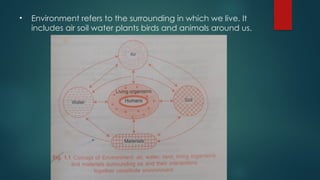
• Environment refers to the surrounding in which we live. It
includes air soil water plants birds and animals around us.
• Environment changes as per time and place.
Environment is highly delicate fragile and so we have
to live in harmony with it To protect our rich biodiversity.
Environment holds the key in the economic growth and
survival of living things.
Why we study Environment
Awareness?
• UGC has instructed its affiliated colleges to introduce a
compulsory course on environmental studies to all branches of
undergraduate courses.
• As Nep 2020 emphasises integration of environmental
education Into curriculum And aims to promote Understanding
and sensitivity towards environmental conservation and
sustainable development principles.
Importance of environmental
awareness
• The environment has a crucial impact on humans as well as in the
continuation of life on the Earth.
• Earth is shelter too Variety of living species and we all rely on it for
food water air and other necessary things for life Hence it is
important to protect the environment not only for this generation but
also for the upcoming generation too.
• By doing this the next generation would also be able to explore the
beauty of nature And live in a clean and healthy environment.
Scope of environment
• The study of environment creates awareness among the people to know about various
renewable and non renewable resources.
• It provides knowledge about ecological systems and Cause and effect relationship.
• It provides necessary information about biodiversity richness and potential dangers to the
species of plants animals and micro organisms.
• Thus the study enables one to understand the causes and consequences Due to natural
and man made disasters like flood earthquake landslide cyclones etc.
• It enables environmentally literate people By knowing the environment acts rights rules
legislations etc To make appropriate judgments and decisions for protection and
improvement of the Earth.
• It teaches the citizens the need for sustainable utilisation of resources as these resources are
inherited from our ancestors to the younger generation Without deteriorating their quality.
Types of Environment
The environment is divided Into two main parts ,
1.geographical environment
2. Man made environment
Geographical Environment:-
It is a type of environment that is uncontrollable by humans. It is also known as natural environment
it consists of all the natural components like mountains lands rivers water desserts storms etc It is
sometimes known as the physical environment because it is directly related to the physical
conditions required for life.
It has elements including natural resources climatic factors land forms and biological structures It
has no human involvement Because it is self automated by the natural phenomenon.
Man made environment:-
Man made environment is also called artificial environment it has a human involvement and is
made by them Is unable to live in geographical environment directly so he creates some of the
environmental conditions to get it just in it It is subdivided into two parts:
INNER ENVIRONMENT
Inner environment is known to be a social environment that is in existence as long as
social human society exists It has a great impact on human lives It is generally called
social heritage because it is crucial for the presence of humankind.
OUTER ENVIRONMENT
Outer environment is that environment which is created by human beings for their own
benefits with the help of technology and science. It consists of several facilities such as
houses, city infrastructure, transport and communication and many more.
COMPONENTS OF ENVIRONMENT
The components of environment includes both living and non living creature present
on the earth.
1. Biotic components
2. Abiotic components
BIOTIC COMPONENTS
All the living organisms in the environment like plants and animals is responble to form biotic
components. Biotic components depend on how they nourish themselves and on the basis of
this living things can be splited into three groups, i.e, producers, consumers and decomposers.
These are as follows:
1. Producers: The green plants who makes their own food with the help of photosynthesis are
known to be producers. Green plants are well known to adapt and utilize solar energy.
Few elements are essential for the formation of food in the process of photosynthesis such
as water, minerals, sunlight and carbon dioxide.
2. Consumers: This category is dependent on producers and other organisms for the food.
Consumers are further divided into two types on the basis of their food taking criteria and
they are primary and secondary consumers. Primary consumers includes snails, rabbits, etc.
And secondary consumers include snakes, frogs, small fish, etc.
3. Decomposers: Decomposers are the microorganisms that feed themselves by living on
dead and decaying matter. It has a saprophytic nature. Examples of decomposers are
bacteria and fungi.
ABIOTIC COMPONENTS
The abiotic components or abiotic factors of the environment are those which
are non-living chemical and physical parts of the environment that somehow
affects the functioning of ecosystems and the living organisms. Examples of
abiotic components are sunlight, water, air, soil, etcetera. Biotic factors have to
depend on abiotic components for their survival and existence on the planet.
RELATIONSHIP BETWEEN MAN AND ENVIRONMENT
• Humans need to interact with the environment to obtain our food, water, fuel, medicines, building
materials and many other things.
• Advances in science and technology have helped us to exploit the environment for our benefit, but
we have also introduced pollution and caused environmental damage.
• The impact of environmental problems on humans is significant, affecting all human activities,
including health and socio-economic development.
• Humans have been interacting with their environment since people first walked the Earth. For
example, humans have been cutting down forests to clear land to grow crops for centuries and by
doing so we have altered the environment. Conversely, the environment affects us in many different
ways as well.
• A good climate, accessible clean water, fertile soil, etc. are aspects of the physical environment that
enable people to live and thrive. However, harsh environments, such as a very hot climate, limited
water and infertile land, make it more difficult for people to survive. We are also affected by major
environmental events such as earthquakes, floods and drought that damage homes, property and
agriculture. These can lead to the displacement of people and can cause injury, loss of life and
destruction of livelihoods. They can also damage water sources and pipelines, causing water
contamination and spreading waterborne diseases.
The links between human activity and the environment are complex and
varied, but can be grouped into two main types of activity:
 use of natural resources such as land, food, water, soils, minerals, plants and
animals
 production of wastes from a range of activities including agriculture, industry
and mining.

Environmental sciences introduction and need

  • 1.
  • 2.
    ENVIRONMENT • The word‘ENVIRONMENT ‘ is derived from the French word ‘environner’ which means to encircle or surround. The biologist Jacob Van Verkal (1864-1944) introduced the term environment in ecology. All the biological and non-biological entities surrounding us are included in environment. (Ecology is the study of the interactions between an organism of some kind and its environment.) • As per environment protection act 1986 , the environment is thus defined as , “ The sum total of water, air and land and the inter relationships that exist among them and with the human beings ,other living organisms and materials. • According to boring,” a person’s environment consists of the sum total of the stimulation which he receives from his conception until his death, indicating that environment comprises various types of forces such as physical, intellectual ,mental ,economical, political ,cultural ,social ,moral and emotional”. • Douglas and Holland define that,” the Term environment is used to describe in aggregate all the external forces influences and conditions which affect the life nature and behaviour and maturity of living organisms. “
  • 3.
    • Environment refersto the surrounding in which we live. It includes air soil water plants birds and animals around us.
  • 4.
    • Environment changesas per time and place. Environment is highly delicate fragile and so we have to live in harmony with it To protect our rich biodiversity. Environment holds the key in the economic growth and survival of living things.
  • 5.
    Why we studyEnvironment Awareness? • UGC has instructed its affiliated colleges to introduce a compulsory course on environmental studies to all branches of undergraduate courses. • As Nep 2020 emphasises integration of environmental education Into curriculum And aims to promote Understanding and sensitivity towards environmental conservation and sustainable development principles.
  • 6.
    Importance of environmental awareness •The environment has a crucial impact on humans as well as in the continuation of life on the Earth. • Earth is shelter too Variety of living species and we all rely on it for food water air and other necessary things for life Hence it is important to protect the environment not only for this generation but also for the upcoming generation too. • By doing this the next generation would also be able to explore the beauty of nature And live in a clean and healthy environment.
  • 7.
    Scope of environment •The study of environment creates awareness among the people to know about various renewable and non renewable resources. • It provides knowledge about ecological systems and Cause and effect relationship. • It provides necessary information about biodiversity richness and potential dangers to the species of plants animals and micro organisms. • Thus the study enables one to understand the causes and consequences Due to natural and man made disasters like flood earthquake landslide cyclones etc. • It enables environmentally literate people By knowing the environment acts rights rules legislations etc To make appropriate judgments and decisions for protection and improvement of the Earth. • It teaches the citizens the need for sustainable utilisation of resources as these resources are inherited from our ancestors to the younger generation Without deteriorating their quality.
  • 8.
    Types of Environment Theenvironment is divided Into two main parts , 1.geographical environment 2. Man made environment Geographical Environment:- It is a type of environment that is uncontrollable by humans. It is also known as natural environment it consists of all the natural components like mountains lands rivers water desserts storms etc It is sometimes known as the physical environment because it is directly related to the physical conditions required for life. It has elements including natural resources climatic factors land forms and biological structures It has no human involvement Because it is self automated by the natural phenomenon. Man made environment:- Man made environment is also called artificial environment it has a human involvement and is made by them Is unable to live in geographical environment directly so he creates some of the environmental conditions to get it just in it It is subdivided into two parts:
  • 9.
    INNER ENVIRONMENT Inner environmentis known to be a social environment that is in existence as long as social human society exists It has a great impact on human lives It is generally called social heritage because it is crucial for the presence of humankind. OUTER ENVIRONMENT Outer environment is that environment which is created by human beings for their own benefits with the help of technology and science. It consists of several facilities such as houses, city infrastructure, transport and communication and many more.
  • 10.
    COMPONENTS OF ENVIRONMENT Thecomponents of environment includes both living and non living creature present on the earth. 1. Biotic components 2. Abiotic components
  • 11.
    BIOTIC COMPONENTS All theliving organisms in the environment like plants and animals is responble to form biotic components. Biotic components depend on how they nourish themselves and on the basis of this living things can be splited into three groups, i.e, producers, consumers and decomposers. These are as follows: 1. Producers: The green plants who makes their own food with the help of photosynthesis are known to be producers. Green plants are well known to adapt and utilize solar energy. Few elements are essential for the formation of food in the process of photosynthesis such as water, minerals, sunlight and carbon dioxide. 2. Consumers: This category is dependent on producers and other organisms for the food. Consumers are further divided into two types on the basis of their food taking criteria and they are primary and secondary consumers. Primary consumers includes snails, rabbits, etc. And secondary consumers include snakes, frogs, small fish, etc. 3. Decomposers: Decomposers are the microorganisms that feed themselves by living on dead and decaying matter. It has a saprophytic nature. Examples of decomposers are bacteria and fungi.
  • 12.
    ABIOTIC COMPONENTS The abioticcomponents or abiotic factors of the environment are those which are non-living chemical and physical parts of the environment that somehow affects the functioning of ecosystems and the living organisms. Examples of abiotic components are sunlight, water, air, soil, etcetera. Biotic factors have to depend on abiotic components for their survival and existence on the planet.
  • 13.
    RELATIONSHIP BETWEEN MANAND ENVIRONMENT • Humans need to interact with the environment to obtain our food, water, fuel, medicines, building materials and many other things. • Advances in science and technology have helped us to exploit the environment for our benefit, but we have also introduced pollution and caused environmental damage. • The impact of environmental problems on humans is significant, affecting all human activities, including health and socio-economic development. • Humans have been interacting with their environment since people first walked the Earth. For example, humans have been cutting down forests to clear land to grow crops for centuries and by doing so we have altered the environment. Conversely, the environment affects us in many different ways as well. • A good climate, accessible clean water, fertile soil, etc. are aspects of the physical environment that enable people to live and thrive. However, harsh environments, such as a very hot climate, limited water and infertile land, make it more difficult for people to survive. We are also affected by major environmental events such as earthquakes, floods and drought that damage homes, property and agriculture. These can lead to the displacement of people and can cause injury, loss of life and destruction of livelihoods. They can also damage water sources and pipelines, causing water contamination and spreading waterborne diseases.
  • 14.
    The links betweenhuman activity and the environment are complex and varied, but can be grouped into two main types of activity:  use of natural resources such as land, food, water, soils, minerals, plants and animals  production of wastes from a range of activities including agriculture, industry and mining.