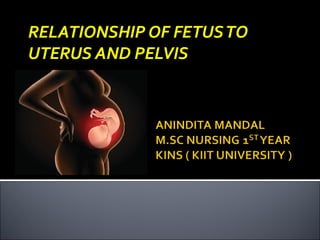
RELATIONSHIP OF FETUSTO
UTERUS AND PELVIS
Lie,
Presentation,
Presenting
part,
Position,
Attitude and
Denominator
 Describe about lie,
presentation, presenting part, position ,
attitude and denominator
 To understand about types of lie.
 Gain knowledge about different presenting
part and it relationship with attitude ,
denominator.
 State the different position of the baby
during the time of birth.
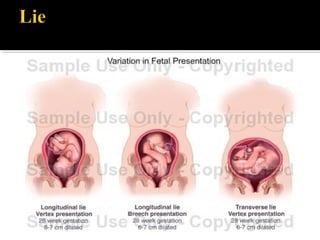
 The lie refers to the relationship of the
longitudinal axis of the fetus to long axis of
maternal spine.
 Lie –
 1.Vertical or Longitudinal(99.5%)
 2.Transverse
 3.Oblique
 Longitudinal:-
 when long axis of the foetus corresponds to the long
axis of the mother. E.g.:- in cephalic and breech
presentation.
 Transverse:-
 When the long axis of the fetus is perpendicular( 900
)
to long axis of mother. e.g.:- in shoulder presentation
 Oblique:-
 When the long axis of fetus crosses the maternal long
axis obliquely at an angle other than right angle.
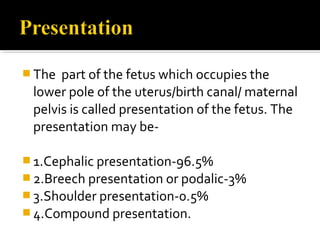
 The part of the fetus which occupies the
lower pole of the uterus/birth canal/ maternal
pelvis is called presentation of the fetus. The
presentation may be-
 1.Cephalic presentation-96.5%
 2.Breech presentation or podalic-3%
 3.Shoulder presentation-0.5%
 4.Compound presentation.
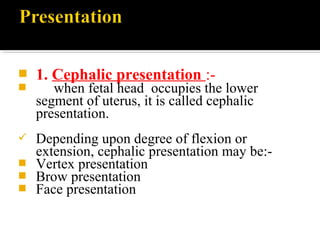
 1. Cephalic presentation :-
 when fetal head occupies the lower
segment of uterus, it is called cephalic
presentation.
 Depending upon degree of flexion or
extension, cephalic presentation may be:-
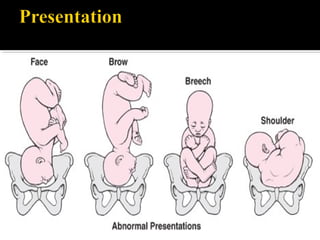
 Vertex presentation
 Brow presentation
 Face presentation
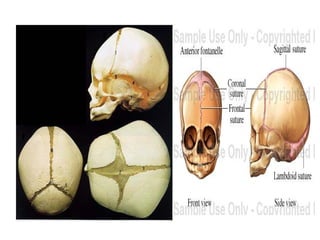
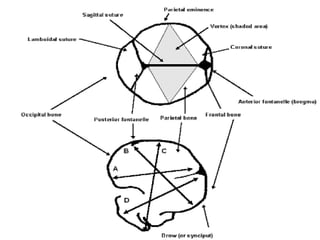
• A. Vertex:-It is the quadrangular area bounded anteriorly
by the bregma (anterior fontanelle) and coronal sutures
behind by the lambda (posterior fontanelle) and the
lambdoid sutures and laterally by the line passing through
the parietal eminences.
 B. Brow:-It is an area bounded on one side by the anterior
fontanelle and the coronal sutures and on the other side
by the root of the nose and supra-orbital ridges of the
either side.
 C. Face:- It is an area bounded on one side by the root of
the nose and the supra-orbital ridges and on the other by
the (chin) junction of the floor of mouth with neck.
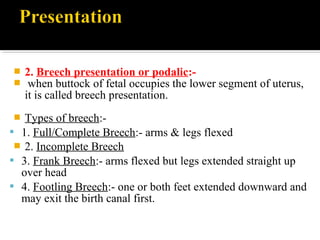
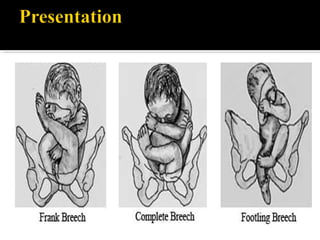
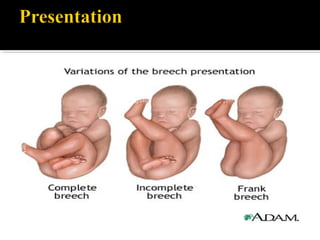
 2. Breech presentation or podalic:-
 when buttock of fetal occupies the lower segment of uterus,
it is called breech presentation.
 Types of breech:-
 1. Full/Complete Breech:- arms & legs flexed
 2. Incomplete Breech
 3. Frank Breech:- arms flexed but legs extended straight up
over head
 4. Footling Breech:- one or both feet extended downward and
may exit the birth canal first.
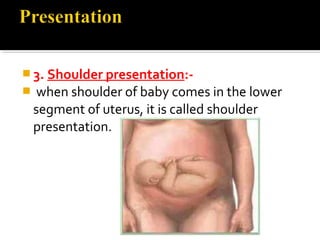
 3. Shoulder presentation:-
 when shoulder of baby comes in the lower
segment of uterus, it is called shoulder
presentation.
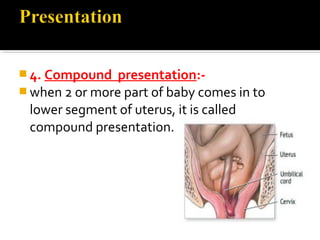
 4. Compound presentation:-
 when 2 or more part of baby comes in to

lower segment of uterus, it is called

compound presentation.
 The presenting part is define as the part of
the presentation which overlies the internal
os.
Presenting part of cephalic-
a. Vertex
b. Brow
c. face
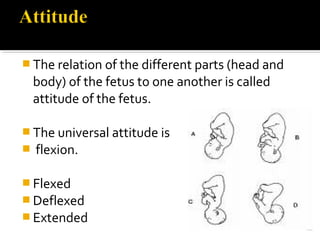
 The relation of the different parts (head and
body) of the fetus to one another is called
attitude of the fetus.
 The universal attitude is
 flexion.
 Flexed
 Deflexed
 Extended
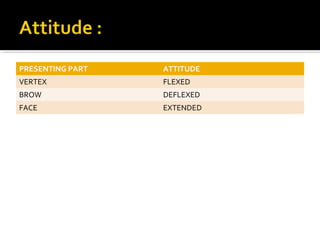
PRESENTING PART ATTITUDE
VERTEX FLEXED
BROW DEFLEXED
FACE EXTENDED
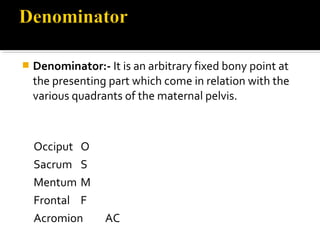
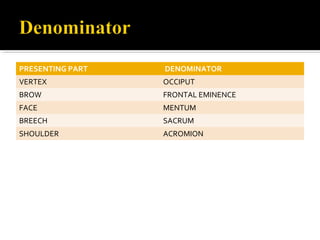
 Denominator:- It is an arbitrary fixed bony point at
the presenting part which come in relation with the
various quadrants of the maternal pelvis.
Occiput O
Sacrum S
Mentum M
Frontal F
Acromion AC
PRESENTING PART DENOMINATOR
VERTEX OCCIPUT
BROW FRONTAL EMINENCE
FACE MENTUM
BREECH SACRUM
SHOULDER ACROMION
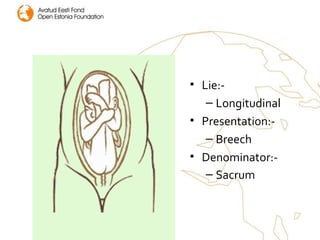
• Lie:-
– Longitudinal
• Presentation:-
– Breech
• Denominator:-
– Sacrum
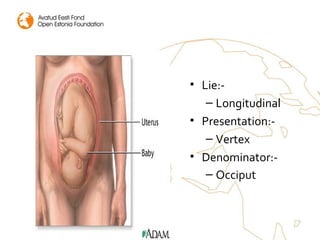
• Lie:-
– Longitudinal
• Presentation:-
– Vertex
• Denominator:-
– Occiput
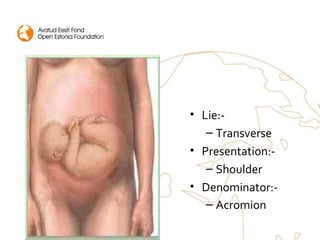
• Lie:-
– Transverse
• Presentation:-
– Shoulder
• Denominator:-
– Acromion
 It is the relation of the denominator to the
different quadrants of the maternal pelvis.
 The pelvis id divided in the equal segments of
450
i.e. it is divided into 8 parts. The positions
are-
 DOA DOP
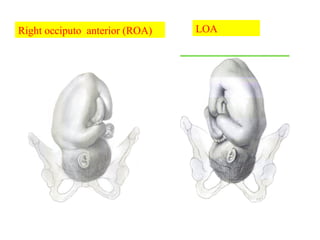
 LOA ROA
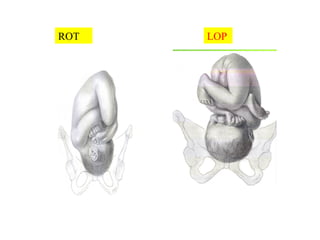
 LOT ROT
 LOP ROP
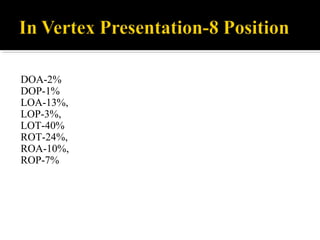
DOA-2%
DOP-1%
LOA-13%,
LOP-3%,
LOT-40%
ROT-24%,
ROA-10%,
ROP-7%
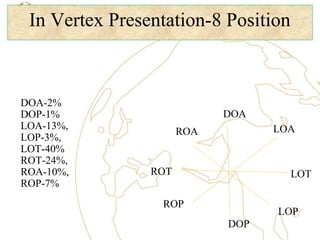
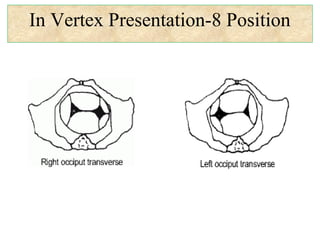
In Vertex Presentation-8 Position
DOP
LOP
LOT
LOAROA
DOA
ROT
ROP
DOA-2%
DOP-1%
LOA-13%,
LOP-3%,
LOT-40%
ROT-24%,
ROA-10%,
ROP-7%
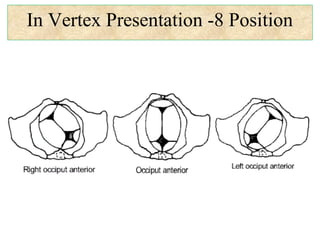
In Vertex Presentation -8 Position
LOARight occiputo anterior (ROA)
In Vertex Presentation-8 Position
LOPROT
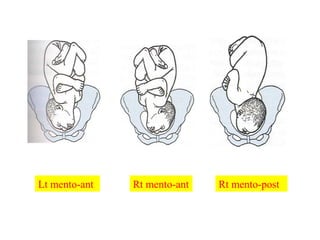
 1. Mento- anterior:-
 Right
 Left
 Direct
 2. Mento- posterior:-
 Right
 Left
 Direct
Lt mento-ant Rt mento-ant Rt mento-post
 1. Sacro - anterior:-
 Right
 Left
 Direct
 2. Sacro- posterior:-
 Right
 Left
 Direct
 The fetus lies inside the uterus in a closed sac
filled with liquor amnii.
 It has enough freedom of movement until the
later months of pregnancy, when it become
relatively fixed.
 Till then , periodic examination is essential
to note its lie,presentation , position
,attitude .
 Incidental idea can can be gained about the
size of the fetus or amount of liquor amnii.
1.Jacob Annamma ,text book of midwifery and
gynocological nursing,3rd edition,jaypee ,New
Delhi,P -
2.Brar Kaur Navdeep ,text book of advanced
nursing practice 3rd edition,jaypee,New Delhi, p
-
3.Baskar Nimma ,Midwifery and Obstetrical
nursing ,2nd edition,jaypee,New Delhi,p -
4. D.C Dutta's ,textbook of Obstetrics ,8th
edition,Hiralal Konar,New Delhi,P- 75 -77
5.http://www.simba.rdg.ac.uk/Dave/Lit %20
review.html
lie presentation-1

lie presentation-1

  • 2.
  • 3.
  • 4.
     Describe aboutlie, presentation, presenting part, position , attitude and denominator  To understand about types of lie.  Gain knowledge about different presenting part and it relationship with attitude , denominator.  State the different position of the baby during the time of birth.
  • 5.
     The lierefers to the relationship of the longitudinal axis of the fetus to long axis of maternal spine.  Lie –  1.Vertical or Longitudinal(99.5%)  2.Transverse  3.Oblique
  • 6.
     Longitudinal:-  whenlong axis of the foetus corresponds to the long axis of the mother. E.g.:- in cephalic and breech presentation.  Transverse:-  When the long axis of the fetus is perpendicular( 900 ) to long axis of mother. e.g.:- in shoulder presentation  Oblique:-  When the long axis of fetus crosses the maternal long axis obliquely at an angle other than right angle.
  • 8.
     The partof the fetus which occupies the lower pole of the uterus/birth canal/ maternal pelvis is called presentation of the fetus. The presentation may be-  1.Cephalic presentation-96.5%  2.Breech presentation or podalic-3%  3.Shoulder presentation-0.5%  4.Compound presentation.
  • 9.
     1. Cephalicpresentation :-  when fetal head occupies the lower segment of uterus, it is called cephalic presentation.  Depending upon degree of flexion or extension, cephalic presentation may be:-  Vertex presentation  Brow presentation  Face presentation
  • 11.
    • A. Vertex:-Itis the quadrangular area bounded anteriorly by the bregma (anterior fontanelle) and coronal sutures behind by the lambda (posterior fontanelle) and the lambdoid sutures and laterally by the line passing through the parietal eminences.  B. Brow:-It is an area bounded on one side by the anterior fontanelle and the coronal sutures and on the other side by the root of the nose and supra-orbital ridges of the either side.  C. Face:- It is an area bounded on one side by the root of the nose and the supra-orbital ridges and on the other by the (chin) junction of the floor of mouth with neck.
  • 14.
     2. Breechpresentation or podalic:-  when buttock of fetal occupies the lower segment of uterus, it is called breech presentation.  Types of breech:-  1. Full/Complete Breech:- arms & legs flexed  2. Incomplete Breech  3. Frank Breech:- arms flexed but legs extended straight up over head  4. Footling Breech:- one or both feet extended downward and may exit the birth canal first.
  • 17.
     3. Shoulderpresentation:-  when shoulder of baby comes in the lower segment of uterus, it is called shoulder presentation.
  • 18.
     4. Compoundpresentation:-  when 2 or more part of baby comes in to lower segment of uterus, it is called compound presentation.
  • 19.
     The presentingpart is define as the part of the presentation which overlies the internal os. Presenting part of cephalic- a. Vertex b. Brow c. face
  • 20.
     The relationof the different parts (head and body) of the fetus to one another is called attitude of the fetus.  The universal attitude is  flexion.  Flexed  Deflexed  Extended
  • 21.
    PRESENTING PART ATTITUDE VERTEXFLEXED BROW DEFLEXED FACE EXTENDED
  • 22.
     Denominator:- Itis an arbitrary fixed bony point at the presenting part which come in relation with the various quadrants of the maternal pelvis. Occiput O Sacrum S Mentum M Frontal F Acromion AC
  • 23.
    PRESENTING PART DENOMINATOR VERTEXOCCIPUT BROW FRONTAL EMINENCE FACE MENTUM BREECH SACRUM SHOULDER ACROMION
  • 24.
    • Lie:- – Longitudinal •Presentation:- – Breech • Denominator:- – Sacrum
  • 25.
    • Lie:- – Longitudinal •Presentation:- – Vertex • Denominator:- – Occiput
  • 26.
    • Lie:- – Transverse •Presentation:- – Shoulder • Denominator:- – Acromion
  • 27.
     It isthe relation of the denominator to the different quadrants of the maternal pelvis.  The pelvis id divided in the equal segments of 450 i.e. it is divided into 8 parts. The positions are-  DOA DOP  LOA ROA  LOT ROT  LOP ROP
  • 28.
  • 29.
    In Vertex Presentation-8Position DOP LOP LOT LOAROA DOA ROT ROP DOA-2% DOP-1% LOA-13%, LOP-3%, LOT-40% ROT-24%, ROA-10%, ROP-7%
  • 30.
  • 31.
  • 32.
  • 33.
  • 34.
     1. Mento-anterior:-  Right  Left  Direct  2. Mento- posterior:-  Right  Left  Direct
  • 35.
    Lt mento-ant Rtmento-ant Rt mento-post
  • 36.
     1. Sacro- anterior:-  Right  Left  Direct  2. Sacro- posterior:-  Right  Left  Direct
  • 39.
     The fetuslies inside the uterus in a closed sac filled with liquor amnii.  It has enough freedom of movement until the later months of pregnancy, when it become relatively fixed.  Till then , periodic examination is essential to note its lie,presentation , position ,attitude .  Incidental idea can can be gained about the size of the fetus or amount of liquor amnii.
  • 40.
    1.Jacob Annamma ,textbook of midwifery and gynocological nursing,3rd edition,jaypee ,New Delhi,P - 2.Brar Kaur Navdeep ,text book of advanced nursing practice 3rd edition,jaypee,New Delhi, p - 3.Baskar Nimma ,Midwifery and Obstetrical nursing ,2nd edition,jaypee,New Delhi,p -
  • 41.
    4. D.C Dutta's,textbook of Obstetrics ,8th edition,Hiralal Konar,New Delhi,P- 75 -77 5.http://www.simba.rdg.ac.uk/Dave/Lit %20 review.html