The Fetal Skull
Learning Outcomes
By the end of this session and following a period
of reflection you will be able to:
1. Identify the external anatomy of the fetal skull
2. Identify the internal structures of the fetal skull
3. Define the diameters of the fetal skull
4. Discuss the relevance of moulding
5. Identify types of injury that can occur to the fetal
skull during labour and birth.
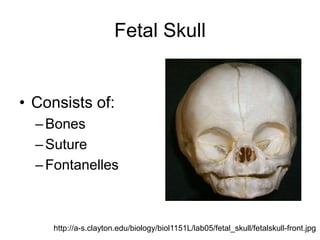
Fetal Skull
• Consists of:
–Bones
–Suture
–Fontanelles
http://a-s.clayton.edu/biology/biol1151L/lab05/fetal_skull/fetalskull-front.jpg
Regions of the Skull
For purpose of measurement and to describe
degrees of flexion and extension the skull is divided
into regions
• Face: extends from the chin to the orbital ridges
• Brow or Sinciput: area of the two frontal bones,
extending from the orbital ridges to the anterior
fontanelle
• Vertx: bounded by the anterior fontanelle, the
posterior fontanelle and two parietal eminences
• Occiput: the area over the occipital bone, extending
from the posterior fontanelle to the nape of the neck
(Stables, 2010, p.341)
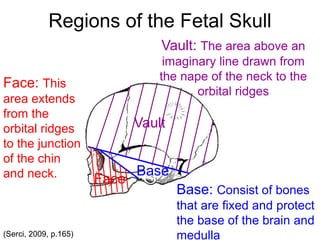
Regions of the Fetal Skull
Vault
Base: Consist of bones
that are fixed and protect
the base of the brain and
medulla
Face
Face: This
area extends
from the
orbital ridges
to the junction
of the chin
and neck.
Vault: The area above an
imaginary line drawn from
the nape of the neck to the
orbital ridges
Base
(Serci, 2009, p.165)
Ossification of the Skull
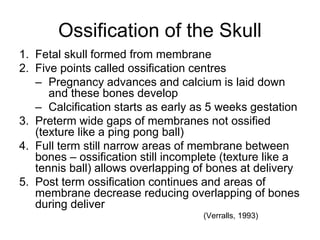
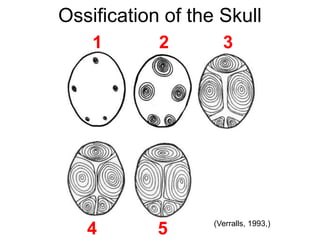
1. Fetal skull formed from membrane
2. Five points called ossification centres
– Pregnancy advances and calcium is laid down
and these bones develop
– Calcification starts as early as 5 weeks gestation
3. Preterm wide gaps of membranes not ossified
(texture like a ping pong ball)
4. Full term still narrow areas of membrane between
bones – ossification still incomplete (texture like a
tennis ball) allows overlapping of bones at delivery
5. Post term ossification continues and areas of
membrane decrease reducing overlapping of bones
during deliver
(Verralls, 1993)
Ossification of the Skull
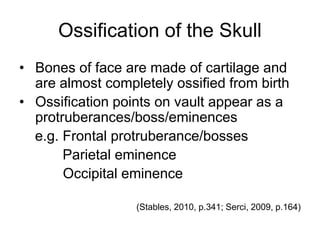
• Bones of face are made of cartilage and
are almost completely ossified from birth
• Ossification points on vault appear as a
protruberances/boss/eminences
e.g. Frontal protruberance/bosses
Parietal eminence
Occipital eminence
(Stables, 2010, p.341; Serci, 2009, p.164)
Ossification of the Skull
1 32
54 (Verralls, 1993,)
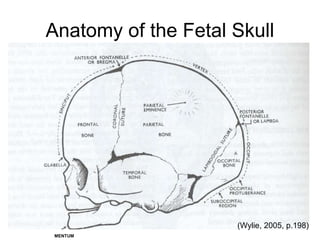
Anatomy of the Fetal Skull
(Wylie, 2005, p.198)
MENTUM
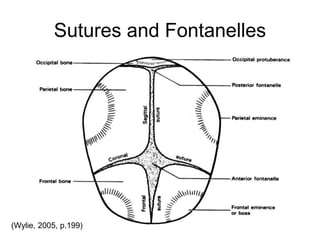
Sutures and Fontanelles
(Wylie, 2005, p.199)
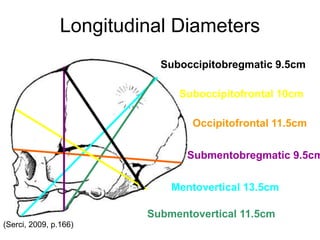
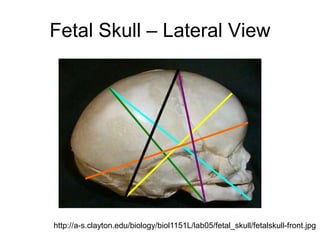
Longitudinal Diameters
Suboccipitobregmatic 9.5cm
Submentobregmatic 9.5cm
Suboccipitofrontal 10cm
Occipitofrontal 11.5cm
Mentovertical 13.5cm
Submentovertical 11.5cm
(Serci, 2009, p.166)
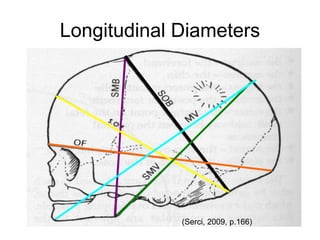
Longitudinal Diameters
(Serci, 2009, p.166)
Fetal Skull – Lateral View
http://a-s.clayton.edu/biology/biol1151L/lab05/fetal_skull/fetalskull-front.jpg
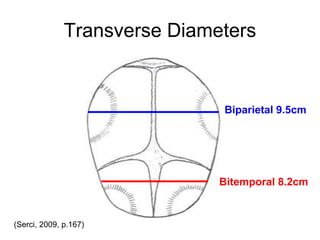
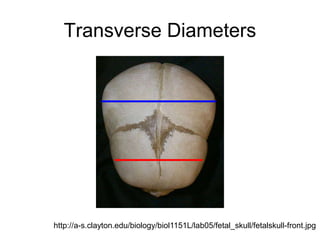
Transverse Diameters
Biparietal 9.5cm
Bitemporal 8.2cm
(Serci, 2009, p.167)
Transverse Diameters
http://a-s.clayton.edu/biology/biol1151L/lab05/fetal_skull/fetalskull-front.jpg
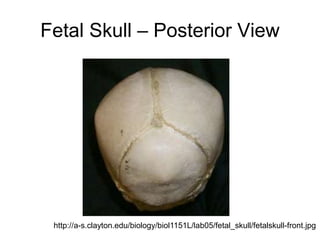
Fetal Skull – Posterior View
http://a-s.clayton.edu/biology/biol1151L/lab05/fetal_skull/fetalskull-front.jpg
Attitude of Fetal Head
• Attitude: the degree of flexion or extension of the
head on the neck. The attitude determines which
diameters will present in labour
(Serci, 2009, p.167)
• Flexed: Occurs in the vertex presentation
• Military or deflexed: Occurs in the
occipitoposterior position
• Partially extended: Occurs in the Brow
presentation
• Extended: Occurs in the face presentation
Circumferences of the Skull
• Suboccipitobregmatic - 33cms
– Presents when the head is well flexed
– Head engages, fits well on the cervix and labour
should be easy
• Occipitofrontal - 35cms
– Presents when the head is deflexed
– Engagement is delayed, membranes may rupture
early and labour may be difficult
• Mentovertical – 39cms
– Presents when the head is fully extended
– Head cannot descend into the pelvis and labour
is obstructed
(Stables, 2010, p.342)
Moulding
• The overlapping of the fetal skull bones at the
suture line
(Wylie, 2005, p.201)
• Bones of vault allow slight bending and override
one another at the sutures
• Skull changes shape from ovoid to cylindrical
• Causes presenting diameter to decrease whilst
increasing the diameter at right angles
• Rationale: smaller diameter to pass through vaginal
canal
(Serci, 2009, p.168; Stables, 2010, p.343)
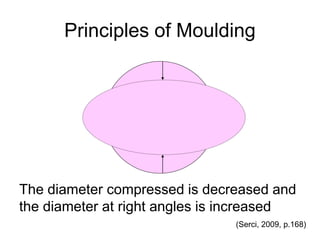
Principles of Moulding
The diameter compressed is decreased and
the diameter at right angles is increased
(Serci, 2009, p.168)
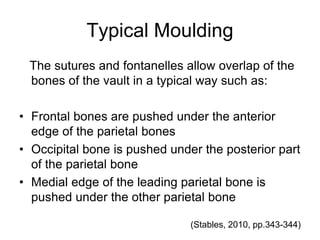
Typical Moulding
The sutures and fontanelles allow overlap of the
bones of the vault in a typical way such as:
• Frontal bones are pushed under the anterior
edge of the parietal bones
• Occipital bone is pushed under the posterior part
of the parietal bone
• Medial edge of the leading parietal bone is
pushed under the other parietal bone
(Stables, 2010, pp.343-344)
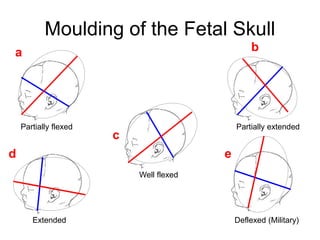
Moulding of the Fetal Skull
a b
c
d e
Partially flexed
Well flexed
Partially extended
Extended Deflexed (Military)
Fetal Skull Injuries
• External
– Caput Succedaneum
– Cephalhaematoma
– Chignon
– Lacerations
• Internal
– Tentorial tears
(Burden and Sapsed, 2011, pp.388-393)
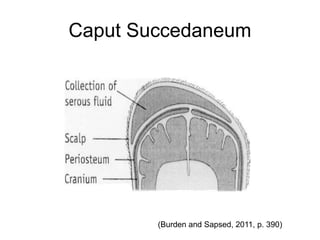
Caput Succedaneum
• Oedematous swelling that occurs on the
presenting part
• Present at birth
• Can cross over the sutures
• Soft swelling and will indent with pressure
• Decreases following delivery
• No treatment is required
• Will disappear approximately 24-48hrs after birth
• Moulding will also be apparent
(Burden and Sapsed, 2011, pp.388-389; Wylie, 2005, p.200)
Caput Succedaneum
(Burden and Sapsed, 2011, p. 390)
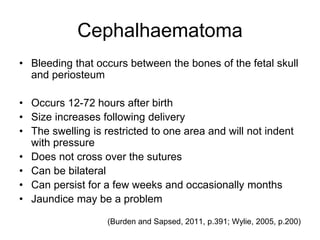
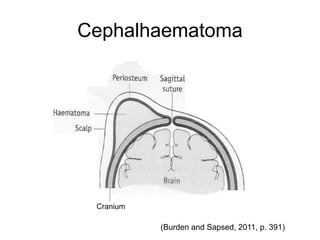
Cephalhaematoma
• Bleeding that occurs between the bones of the fetal skull
and periosteum
• Occurs 12-72 hours after birth
• Size increases following delivery
• The swelling is restricted to one area and will not indent
with pressure
• Does not cross over the sutures
• Can be bilateral
• Can persist for a few weeks and occasionally months
• Jaundice may be a problem
(Burden and Sapsed, 2011, p.391; Wylie, 2005, p.200)
Cephalhaematoma
Cranium
(Burden and Sapsed, 2011, p. 391)
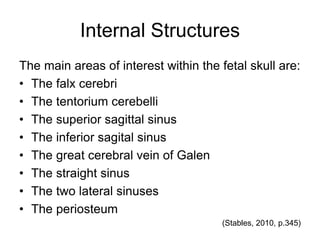
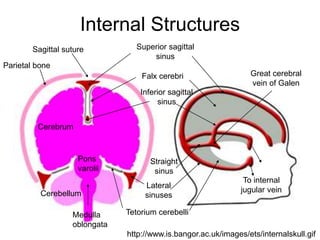
Internal Structures
The main areas of interest within the fetal skull are:
• The falx cerebri
• The tentorium cerebelli
• The superior sagittal sinus
• The inferior sagital sinus
• The great cerebral vein of Galen
• The straight sinus
• The two lateral sinuses
• The periosteum
(Stables, 2010, p.345)
Internal Structures
http://www.is.bangor.ac.uk/images/ets/internalskull.gif
Falx cerebri
Superior sagittal
sinus
Inferior sagittal
sinus
To internal
jugular vein
Tetorium cerebelli
Straight
sinus
Lateral
sinuses
Cerebrum
Parietal bone
Sagittal suture
Pons
varolii
Cerebellum
Medulla
oblongata
Great cerebral
vein of Galen
Self Study
• Obtain a definition or explanation from the midwifery
textbooks for each of the following internal structures:
• The falx cerebri
• The tentorium cerebelli
• The superior sagittal sinus
• The inferior sagital sinus
• The great cerebral vein of Galen
• The straight sinus
• The two lateral sinuses
• The periosteum
Key Points
• It is important to know the anatomical
structure of the fetal skull and the diameters
• The fetal skull diameters influence the
presenting part and therefore the delivery
outcome
• Moulding is a normal occurrence during
labour and delivery to decrease the
presenting diameter
• External and internal injuries can occur to
the fetal skull during labour and birth
References
• Burden, B. and Sapsed, M.S. (2011) The Fetal Skull. In:
Macdonald, S.,Magill-Cuerden (eds.) Mayes’ Midwifery 14th
ed. London: Ballière Tindall.
• Serci, I.G,A. (2009) The Fetus. In: Fraser, D.M. and Cooper,
M.A. (eds.) Myles Textbook for Midwives. 15th ed.
Edinburgh: Churchill Livingstone
• Stables, D. (2010) The Nature of Bone – The Female Pelvis
and Fetal Skull. In: Stables, D. and Rankin, J. (eds.)
Physiology in childbearing with anatomy and related
biosciences. 3rd ed. Edinburgh: Elsevier.
• Verralls, S. (1993) Anatomy and physiology applied to
obstetrics. 3rd ed. Edinburgh: Churchill Livingstone.
• Wylie, L. (2005) Essential anatomy and physiology in
maternity care. 2nd ed. Edinburgh: Elsevier.

Fetal skull

  • 1.
  • 2.
    Learning Outcomes By theend of this session and following a period of reflection you will be able to: 1. Identify the external anatomy of the fetal skull 2. Identify the internal structures of the fetal skull 3. Define the diameters of the fetal skull 4. Discuss the relevance of moulding 5. Identify types of injury that can occur to the fetal skull during labour and birth.
  • 3.
    Fetal Skull • Consistsof: –Bones –Suture –Fontanelles http://a-s.clayton.edu/biology/biol1151L/lab05/fetal_skull/fetalskull-front.jpg
  • 4.
    Regions of theSkull For purpose of measurement and to describe degrees of flexion and extension the skull is divided into regions • Face: extends from the chin to the orbital ridges • Brow or Sinciput: area of the two frontal bones, extending from the orbital ridges to the anterior fontanelle • Vertx: bounded by the anterior fontanelle, the posterior fontanelle and two parietal eminences • Occiput: the area over the occipital bone, extending from the posterior fontanelle to the nape of the neck (Stables, 2010, p.341)
  • 5.
    Regions of theFetal Skull Vault Base: Consist of bones that are fixed and protect the base of the brain and medulla Face Face: This area extends from the orbital ridges to the junction of the chin and neck. Vault: The area above an imaginary line drawn from the nape of the neck to the orbital ridges Base (Serci, 2009, p.165)
  • 6.
    Ossification of theSkull 1. Fetal skull formed from membrane 2. Five points called ossification centres – Pregnancy advances and calcium is laid down and these bones develop – Calcification starts as early as 5 weeks gestation 3. Preterm wide gaps of membranes not ossified (texture like a ping pong ball) 4. Full term still narrow areas of membrane between bones – ossification still incomplete (texture like a tennis ball) allows overlapping of bones at delivery 5. Post term ossification continues and areas of membrane decrease reducing overlapping of bones during deliver (Verralls, 1993)
  • 7.
    Ossification of theSkull • Bones of face are made of cartilage and are almost completely ossified from birth • Ossification points on vault appear as a protruberances/boss/eminences e.g. Frontal protruberance/bosses Parietal eminence Occipital eminence (Stables, 2010, p.341; Serci, 2009, p.164)
  • 8.
    Ossification of theSkull 1 32 54 (Verralls, 1993,)
  • 9.
    Anatomy of theFetal Skull (Wylie, 2005, p.198) MENTUM
  • 10.
  • 11.
    Longitudinal Diameters Suboccipitobregmatic 9.5cm Submentobregmatic9.5cm Suboccipitofrontal 10cm Occipitofrontal 11.5cm Mentovertical 13.5cm Submentovertical 11.5cm (Serci, 2009, p.166)
  • 12.
  • 13.
    Fetal Skull –Lateral View http://a-s.clayton.edu/biology/biol1151L/lab05/fetal_skull/fetalskull-front.jpg
  • 14.
  • 15.
  • 16.
    Fetal Skull –Posterior View http://a-s.clayton.edu/biology/biol1151L/lab05/fetal_skull/fetalskull-front.jpg
  • 17.
    Attitude of FetalHead • Attitude: the degree of flexion or extension of the head on the neck. The attitude determines which diameters will present in labour (Serci, 2009, p.167) • Flexed: Occurs in the vertex presentation • Military or deflexed: Occurs in the occipitoposterior position • Partially extended: Occurs in the Brow presentation • Extended: Occurs in the face presentation
  • 18.
    Circumferences of theSkull • Suboccipitobregmatic - 33cms – Presents when the head is well flexed – Head engages, fits well on the cervix and labour should be easy • Occipitofrontal - 35cms – Presents when the head is deflexed – Engagement is delayed, membranes may rupture early and labour may be difficult • Mentovertical – 39cms – Presents when the head is fully extended – Head cannot descend into the pelvis and labour is obstructed (Stables, 2010, p.342)
  • 19.
    Moulding • The overlappingof the fetal skull bones at the suture line (Wylie, 2005, p.201) • Bones of vault allow slight bending and override one another at the sutures • Skull changes shape from ovoid to cylindrical • Causes presenting diameter to decrease whilst increasing the diameter at right angles • Rationale: smaller diameter to pass through vaginal canal (Serci, 2009, p.168; Stables, 2010, p.343)
  • 20.
    Principles of Moulding Thediameter compressed is decreased and the diameter at right angles is increased (Serci, 2009, p.168)
  • 21.
    Typical Moulding The suturesand fontanelles allow overlap of the bones of the vault in a typical way such as: • Frontal bones are pushed under the anterior edge of the parietal bones • Occipital bone is pushed under the posterior part of the parietal bone • Medial edge of the leading parietal bone is pushed under the other parietal bone (Stables, 2010, pp.343-344)
  • 22.
    Moulding of theFetal Skull a b c d e Partially flexed Well flexed Partially extended Extended Deflexed (Military)
  • 23.
    Fetal Skull Injuries •External – Caput Succedaneum – Cephalhaematoma – Chignon – Lacerations • Internal – Tentorial tears (Burden and Sapsed, 2011, pp.388-393)
  • 24.
    Caput Succedaneum • Oedematousswelling that occurs on the presenting part • Present at birth • Can cross over the sutures • Soft swelling and will indent with pressure • Decreases following delivery • No treatment is required • Will disappear approximately 24-48hrs after birth • Moulding will also be apparent (Burden and Sapsed, 2011, pp.388-389; Wylie, 2005, p.200)
  • 25.
    Caput Succedaneum (Burden andSapsed, 2011, p. 390)
  • 26.
    Cephalhaematoma • Bleeding thatoccurs between the bones of the fetal skull and periosteum • Occurs 12-72 hours after birth • Size increases following delivery • The swelling is restricted to one area and will not indent with pressure • Does not cross over the sutures • Can be bilateral • Can persist for a few weeks and occasionally months • Jaundice may be a problem (Burden and Sapsed, 2011, p.391; Wylie, 2005, p.200)
  • 27.
  • 28.
    Internal Structures The mainareas of interest within the fetal skull are: • The falx cerebri • The tentorium cerebelli • The superior sagittal sinus • The inferior sagital sinus • The great cerebral vein of Galen • The straight sinus • The two lateral sinuses • The periosteum (Stables, 2010, p.345)
  • 29.
    Internal Structures http://www.is.bangor.ac.uk/images/ets/internalskull.gif Falx cerebri Superiorsagittal sinus Inferior sagittal sinus To internal jugular vein Tetorium cerebelli Straight sinus Lateral sinuses Cerebrum Parietal bone Sagittal suture Pons varolii Cerebellum Medulla oblongata Great cerebral vein of Galen
  • 30.
    Self Study • Obtaina definition or explanation from the midwifery textbooks for each of the following internal structures: • The falx cerebri • The tentorium cerebelli • The superior sagittal sinus • The inferior sagital sinus • The great cerebral vein of Galen • The straight sinus • The two lateral sinuses • The periosteum
  • 31.
    Key Points • Itis important to know the anatomical structure of the fetal skull and the diameters • The fetal skull diameters influence the presenting part and therefore the delivery outcome • Moulding is a normal occurrence during labour and delivery to decrease the presenting diameter • External and internal injuries can occur to the fetal skull during labour and birth
  • 32.
    References • Burden, B.and Sapsed, M.S. (2011) The Fetal Skull. In: Macdonald, S.,Magill-Cuerden (eds.) Mayes’ Midwifery 14th ed. London: Ballière Tindall. • Serci, I.G,A. (2009) The Fetus. In: Fraser, D.M. and Cooper, M.A. (eds.) Myles Textbook for Midwives. 15th ed. Edinburgh: Churchill Livingstone • Stables, D. (2010) The Nature of Bone – The Female Pelvis and Fetal Skull. In: Stables, D. and Rankin, J. (eds.) Physiology in childbearing with anatomy and related biosciences. 3rd ed. Edinburgh: Elsevier. • Verralls, S. (1993) Anatomy and physiology applied to obstetrics. 3rd ed. Edinburgh: Churchill Livingstone. • Wylie, L. (2005) Essential anatomy and physiology in maternity care. 2nd ed. Edinburgh: Elsevier.

Editor's Notes

  • #6 Face- 14 small bones, firmly united & non compressible.