REFRACTORY
PERIODONTITIS
Photo courtesy of: Dr. Darika
Saitawee
Refractory periodontitis
 periodontal disease is a chronic infectious
disease of the supporting tissue of the teeth
 Nowadays, a large majority of patients with
periodontitis respond well to conventional
therapies
 However, a small percentage of patients
respond poorly of treatment
“ Refractory periodontitis ”
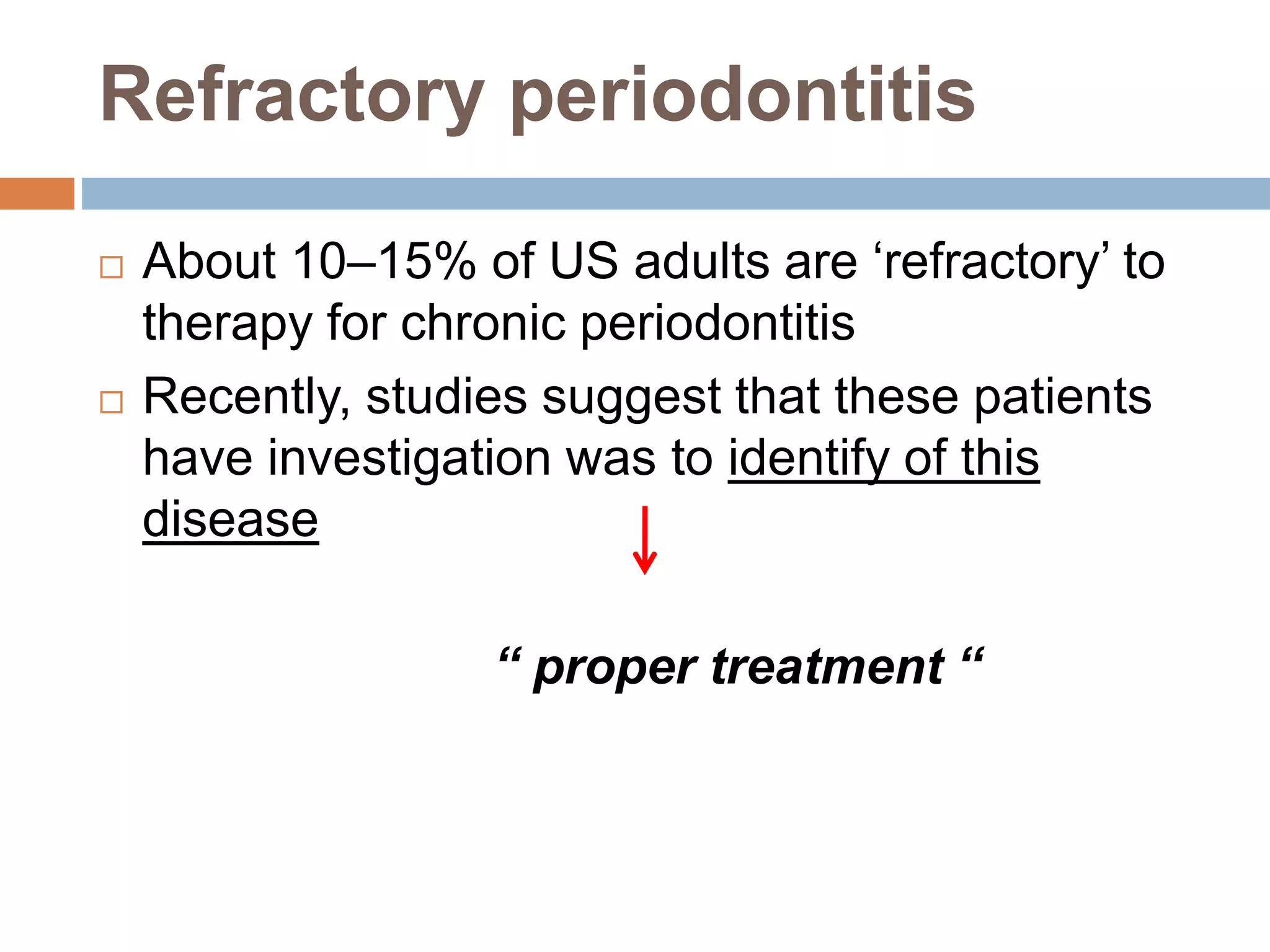
 Characteristic of RP (Haffajee et al, 2004; Colombo et al,
2012)
 Poor responder or refractory of treatment
 AL and/or >3 sites
 AL >2.5 mm from the baseline visit to any
monitoring visit 1 year post-therapy
Refractory periodontitis
Photo courtesy of: Dr. Darika
Saitawee
 About 10–15% of US adults are ‘refractory’ to
therapy for chronic periodontitis
 Recently, studies suggest that these patients
have investigation was to identify of this
disease
“ proper treatment “
Refractory periodontitis
 Clinical and Laboratory
 Antibody response
 Real-Time Quantitative
Polymerase Chain
Reaction
 Human Oral Microbe
Identification
Microarray
Diagnosis for refractory
periodontitis
http://www.bio-rad.com/en-us/applications-technologies/what-real-time-pcr-
qpcr
Clinical and laboratory
parameters
 Colombo et al. 1999
 investigation was to use baseline clinical and
laboratory parameters to distinguish subjects
refractory to conventional periodontal therapy
 Baseline clinical
 microbial
 host parameters
 27 refractory subjects
 poor response after both SRP and surgery with systemic
tetracycline
Clinical and laboratory
parameters
clinic
• Att gain & no site
with new att loss
• Gingival redness
• BOP
• Suppuration
• Supragingival
plaque
accumulation
• PD
• AL
microbial
• Level of 40
subgingival texa
(subging sample)
• Checker board
DNA-DNA
hybridization
Immune
• Serum Ab to 85
subging species
(IgG)
• Checker board
immunoblotting
Clinical and laboratory
parameters
Clinical and laboratory
parameters
Clinical and laboratory
parameters
Ab↑-odd↑  Refractory
 selected by stepwise discriminant analysis:
 namely, number of species exhibiting serum
antibody ±50 mg/ml
 % of S. constellatus in plaque (similar previous study
Colombo 1998)
 % of sites with attachment level ±6 mm
Clinical and laboratory
parameters
Clinical and laboratory
parameters
 Discriminant analysis using these variables provided
 Sensitivity 0.66
 Specificity 0.92
 Positive predictive value 0.80
 Negative predictive values 0.85
 The relatively high sensitivities, specificities
and predictive values of the clinical,
microbiologic and immunologic variables
 these tests may distinguish a relatively
common form of refractory disease
 Refractory periodontitis subjects could be
distinguished using a subset of clinical,
microbiological and immunological parameters
Clinical and laboratory
parameters
Antibody-based diagnostic
Levine et al. 2002
 this study was to determine whether an
elevated IgG Ab response to lysine
decarboxylase, alone or with antibody to
bacterial Ag and baseline clinical
measurements  predict the ‘refractory’
patients
 Gingival microbiota were found to inhibit the
growth of cultured mammalian cells by
depleting them of “lysine”
 Eikenella corrodens and Capnocytophaga spp.
 Are major sources of the responsible enzyme,
lysine decarboxylase
 Lysine decarboxylase  Lysine
 inhibit the turnover of the most coronally situated,
dentally attached (DAT) cells and JE basal cells
that lie remote from capillaries
 cells stop proliferating  causing the intermediate
layer of JE to become attenuated and weaken the
epithelial barrier
Antibody-based diagnostic
Lysine
decarboxylase
activity
Effect of DAT cell
 High - Inhibit DAT cell turnover
 Low - DAT cell can turnover
- Maintaining oral hygiene and
- Low levels of bacteria in the
sulcus or pocket (retard accumulation)
- Stop attachment loss
Antibody-based diagnostic
 IgG antibody contents to a purified antigen
from
 Actinomyces spp. (A-Ab)
 Streptococcal d-alanyl glycerol lipoteichoic acid
(S-Ab)
  related in ‘refractory’ patients
Antibody-based diagnostic
↑
↑
Antibody-based diagnostic
*
*
Antibody-based diagnostic
E. Corrodens : major
sources lysine
decarboxylase
Similar of Colombo (1999)
study
Antibody-based diagnostic
A strong correlation between A-Ab and S-Ab
responses was noted in ‘refractory’
Antibody-based diagnostic
-Prediction of
‘refractory’ response
 moderate
periodontitis, 2–
4mm mean att loss at
baseline
-Sensitivity 86.4%
-Specificity 86.7%
 Subjects with advanced disease need for a
diagnostic test  the immunoassay is
proposed for use in subjects with moderate
periodontitis (mean attachment loss level of
2–4mm)
 HKL-Ab facilitated an accurate prediction of
therapeutic outcome in subjects with moderate
periodontitis
Antibody-based diagnostic
Real-Time Quantitative
Polymerase Chain Reaction
 Marconcini et al. 2011
 “Genetic risk factors” were proposed to influence
the natural history of periodontitis
 The study use this technology  evaluate the
expression levels of leader genes in the
leukocytes of refractory pt
 Blood samples
 PCR efficiencies were calculated with a relative
standard curve derived from a five cDNA dilution
series in triplicate
 The standard curves were obtained using
1. glyceraldehyde-3-phosphate dehydrogenase
(GAPDH)
2. growth factor bound protein (GRB2)
3. casitas B-lineage lymphoma (CBL)
4. nuclear factorKB1 (NFKB1)
5. REL-A (gene for transcription factor p65)
Real-Time Quantitative
Polymerase Chain Reaction
Real-Time Quantitative
Polymerase Chain Reaction
Results : levels of CBL
and GRB2 were statically
significant in patients with
periodontitis compared to
healthy patients
characteristics of GRB2,
CBL and NFKB1 : a
specific role during
inflammation and process
of bone resorption
 CBL oncogene  part of a transforming retrovirus
 GRB2  signal transduction pathwayThis gene has
never been associated with periodontitis
 Molecular studies, our hypothesis
 CBL played during the phase of bone resorption that can be
supposed to be the acute phase of the disease
 GRB2 might play a central role during the inflammation
process that gave the onset at the periodontitis acute phase
 Genes are important role in refractory chronic
periodontitis
 develop a treatment plan
 reduce risk factors and to focus of therapy
Real-Time Quantitative
Polymerase Chain Reaction
Human Oral Microbe
Identification Microarray
(HOMIM)
 Colombo et al. 2012
investigation evaluated the post-therapy
changes on the subgingival microbiota
of periodontitis patients who were RP or
GR as measured by using the HOMIM
technique
Tx: SRP + OHI + MWF + ABT (Amoxy
500 mg+Metro 250 mg)
 The HOMIM methodology used a total of 400 16S
rRNA-based, reverse-capture oligonucleotide probes
targeting >300 bacterial taxa
 16S rRNA genes were PCR amplified from DNA
extracts
 labeled 16S amplicons were hybridized overnight to
probes on the slides
 After washing, the microarray slides were scanned
and crude data were extracted using software for
microarray image analysis
Human Oral Microbe
Identification Microarray
(HOMIM)
Human Oral Microbe
Identification Microarray
(HOMIM)
*
*
*
Human Oral Microbe
Identification Microarray
(HOMIM)
 The majority of species evaluated decreased in
prevalence in both groups after treatment
 Species that increased or persisted in high frequency in
RP but were significantly reduced in GR included
Human Oral Microbe
Identification Microarray
(HOMIM)
Bacteroidetes sp.
Porphyromonas
endodontalis
Porphyromonas
gingivalis
Prevotella spp.
Tannerella forsythia
Dialister spp.
Selenomonas spp.
Catonella morbi
Eubacterium spp.
Filifactor alocis
Parvimonas micra
Peptostreptococcus sp.
OT113
Fusobacterium sp. OT203
Pseudoramibacter
alactolyticus
Streptococcus intermedius
/Streptococcus
constellatus
Shuttlesworthia satelles
 In contrast
 Capnocytophaga sputigena, Cardiobacterium
hominis, Gemella haemolysans, Haemophilus
parainfluenzae, Kingella oralis, Lautropia
mirabilis, Neisseria elongata, Rothia
dentocariosa, Streptococcus australis, and
Veillonella spp.
  associated with therapeutic success
Human Oral Microbe
Identification Microarray
(HOMIM)
 GR patients
 able to maintain low frequency and
proportions of these organisms
 RP patients
 rapidly colonized by these species
 incapable of maintaining low levels of
putative periodontal pathogens attributable to
host impairment and/or colonization by a more
virulent periodontal microbiota
Human Oral Microbe
Identification Microarray
(HOMIM)
 Haffajee et al. 2004
 Clinical and microbiological changes
associated with the use of combined
antimicrobial therapies to treat ‘‘refractory’’
periodontitis 
 Combine therapies
 SRP
 periodontal surgery
 locally delivered tetracycline at pockets ≥ 4 mm
 systemically administered amoxicillin (500 mg, t.i.d. for 14
days) metronidazole (250 mg, t.i.d. for 14 days)
 professional removal of supragingival plaque weekly
for 3 months
 f/u every 3 months post-therapy for 2 years
Treatment of refractory
periodontitis
Combined antimicrobial
therapies to treat ‘‘refractory’’
periodontitis
- 3 mo. plaque, gingival redness, BOP, suppuration
& PD ↓
- 6-24 mo.  AL improved
Combined antimicrobial
therapies to treat ‘‘refractory’’
periodontitis
members of the green, orange and red complexes as well as some of the
species in the other category were significantly elevated in the periodontitis
subjects compared with the refractory subjects
Combined antimicrobial
therapies to treat ‘‘refractory’’
periodontitis
- No sig this time
- Low level of
Combined antimicrobial
therapies to treat ‘‘refractory’’
periodontitis
3 mo Actinos & orange
Combined antimicrobial
therapies to treat ‘‘refractory’’
periodontitis
Mean count of
 conventional periodontal therapies could be
successfully treated using a combination of
mechanical and antimicrobial therapies
 combine therapies that were known to affect the
subgingival microbiota and provide a beneficial
clinical response (synergistic effects)
 Mean PD reduction was 0.83 ± 0.13 mm
 Mean attachment level gain was 0.44 ±0.12 mm
Combined antimicrobial
therapies to treat ‘‘refractory’’
periodontitis
 SRP  lower the biomass on the tooth surface
and PD
 Local drug delivery  directly diminish the
pathogen load in any residual pockets of ≥4 mm
 Systemically administered amoxicillin plus
metronidazole  rapidly lower the level of
pathogens throughout the oral cavity/poor
clinical access, and to attempt to control
pathogenic species that might have entered the
host’s tissues
 Repeated professional supragingival plaque
Combined antimicrobial
therapies to treat ‘‘refractory’’
periodontitis
conclusion
 The combined antibacterial therapy was
successful in controlling disease progression in
refractory periodontitis
 Proposed reasons for ‘‘refractory’’ disease have
included differences in the
 subgingival microbiota
 host response
 Environmental factors (smoking)
 All of these hypotheses were presented with the
understanding that proper home care procedures
and treatment of refractory patients

Refractory periodontitis

  • 1.
  • 2.
    Refractory periodontitis  periodontaldisease is a chronic infectious disease of the supporting tissue of the teeth  Nowadays, a large majority of patients with periodontitis respond well to conventional therapies  However, a small percentage of patients respond poorly of treatment “ Refractory periodontitis ”
  • 3.
     Characteristic ofRP (Haffajee et al, 2004; Colombo et al, 2012)  Poor responder or refractory of treatment  AL and/or >3 sites  AL >2.5 mm from the baseline visit to any monitoring visit 1 year post-therapy Refractory periodontitis Photo courtesy of: Dr. Darika Saitawee
  • 4.
     About 10–15%of US adults are ‘refractory’ to therapy for chronic periodontitis  Recently, studies suggest that these patients have investigation was to identify of this disease “ proper treatment “ Refractory periodontitis
  • 5.
     Clinical andLaboratory  Antibody response  Real-Time Quantitative Polymerase Chain Reaction  Human Oral Microbe Identification Microarray Diagnosis for refractory periodontitis http://www.bio-rad.com/en-us/applications-technologies/what-real-time-pcr- qpcr
  • 6.
    Clinical and laboratory parameters Colombo et al. 1999  investigation was to use baseline clinical and laboratory parameters to distinguish subjects refractory to conventional periodontal therapy  Baseline clinical  microbial  host parameters
  • 7.
     27 refractorysubjects  poor response after both SRP and surgery with systemic tetracycline Clinical and laboratory parameters clinic • Att gain & no site with new att loss • Gingival redness • BOP • Suppuration • Supragingival plaque accumulation • PD • AL microbial • Level of 40 subgingival texa (subging sample) • Checker board DNA-DNA hybridization Immune • Serum Ab to 85 subging species (IgG) • Checker board immunoblotting
  • 8.
  • 9.
  • 10.
  • 11.
     selected bystepwise discriminant analysis:  namely, number of species exhibiting serum antibody ±50 mg/ml  % of S. constellatus in plaque (similar previous study Colombo 1998)  % of sites with attachment level ±6 mm Clinical and laboratory parameters
  • 12.
    Clinical and laboratory parameters Discriminant analysis using these variables provided  Sensitivity 0.66  Specificity 0.92  Positive predictive value 0.80  Negative predictive values 0.85
  • 13.
     The relativelyhigh sensitivities, specificities and predictive values of the clinical, microbiologic and immunologic variables  these tests may distinguish a relatively common form of refractory disease  Refractory periodontitis subjects could be distinguished using a subset of clinical, microbiological and immunological parameters Clinical and laboratory parameters
  • 14.
    Antibody-based diagnostic Levine etal. 2002  this study was to determine whether an elevated IgG Ab response to lysine decarboxylase, alone or with antibody to bacterial Ag and baseline clinical measurements  predict the ‘refractory’ patients  Gingival microbiota were found to inhibit the growth of cultured mammalian cells by depleting them of “lysine”
  • 15.
     Eikenella corrodensand Capnocytophaga spp.  Are major sources of the responsible enzyme, lysine decarboxylase  Lysine decarboxylase  Lysine  inhibit the turnover of the most coronally situated, dentally attached (DAT) cells and JE basal cells that lie remote from capillaries  cells stop proliferating  causing the intermediate layer of JE to become attenuated and weaken the epithelial barrier Antibody-based diagnostic
  • 16.
    Lysine decarboxylase activity Effect of DATcell  High - Inhibit DAT cell turnover  Low - DAT cell can turnover - Maintaining oral hygiene and - Low levels of bacteria in the sulcus or pocket (retard accumulation) - Stop attachment loss Antibody-based diagnostic
  • 17.
     IgG antibodycontents to a purified antigen from  Actinomyces spp. (A-Ab)  Streptococcal d-alanyl glycerol lipoteichoic acid (S-Ab)   related in ‘refractory’ patients Antibody-based diagnostic
  • 18.
  • 19.
  • 20.
    Antibody-based diagnostic E. Corrodens: major sources lysine decarboxylase Similar of Colombo (1999) study
  • 21.
    Antibody-based diagnostic A strongcorrelation between A-Ab and S-Ab responses was noted in ‘refractory’
  • 22.
    Antibody-based diagnostic -Prediction of ‘refractory’response  moderate periodontitis, 2– 4mm mean att loss at baseline -Sensitivity 86.4% -Specificity 86.7%
  • 23.
     Subjects withadvanced disease need for a diagnostic test  the immunoassay is proposed for use in subjects with moderate periodontitis (mean attachment loss level of 2–4mm)  HKL-Ab facilitated an accurate prediction of therapeutic outcome in subjects with moderate periodontitis Antibody-based diagnostic
  • 24.
    Real-Time Quantitative Polymerase ChainReaction  Marconcini et al. 2011  “Genetic risk factors” were proposed to influence the natural history of periodontitis  The study use this technology  evaluate the expression levels of leader genes in the leukocytes of refractory pt  Blood samples
  • 25.
     PCR efficiencieswere calculated with a relative standard curve derived from a five cDNA dilution series in triplicate  The standard curves were obtained using 1. glyceraldehyde-3-phosphate dehydrogenase (GAPDH) 2. growth factor bound protein (GRB2) 3. casitas B-lineage lymphoma (CBL) 4. nuclear factorKB1 (NFKB1) 5. REL-A (gene for transcription factor p65) Real-Time Quantitative Polymerase Chain Reaction
  • 26.
    Real-Time Quantitative Polymerase ChainReaction Results : levels of CBL and GRB2 were statically significant in patients with periodontitis compared to healthy patients characteristics of GRB2, CBL and NFKB1 : a specific role during inflammation and process of bone resorption
  • 27.
     CBL oncogene part of a transforming retrovirus  GRB2  signal transduction pathwayThis gene has never been associated with periodontitis  Molecular studies, our hypothesis  CBL played during the phase of bone resorption that can be supposed to be the acute phase of the disease  GRB2 might play a central role during the inflammation process that gave the onset at the periodontitis acute phase  Genes are important role in refractory chronic periodontitis  develop a treatment plan  reduce risk factors and to focus of therapy Real-Time Quantitative Polymerase Chain Reaction
  • 28.
    Human Oral Microbe IdentificationMicroarray (HOMIM)  Colombo et al. 2012 investigation evaluated the post-therapy changes on the subgingival microbiota of periodontitis patients who were RP or GR as measured by using the HOMIM technique Tx: SRP + OHI + MWF + ABT (Amoxy 500 mg+Metro 250 mg)
  • 29.
     The HOMIMmethodology used a total of 400 16S rRNA-based, reverse-capture oligonucleotide probes targeting >300 bacterial taxa  16S rRNA genes were PCR amplified from DNA extracts  labeled 16S amplicons were hybridized overnight to probes on the slides  After washing, the microarray slides were scanned and crude data were extracted using software for microarray image analysis Human Oral Microbe Identification Microarray (HOMIM)
  • 30.
    Human Oral Microbe IdentificationMicroarray (HOMIM) * * *
  • 31.
  • 32.
     The majorityof species evaluated decreased in prevalence in both groups after treatment  Species that increased or persisted in high frequency in RP but were significantly reduced in GR included Human Oral Microbe Identification Microarray (HOMIM) Bacteroidetes sp. Porphyromonas endodontalis Porphyromonas gingivalis Prevotella spp. Tannerella forsythia Dialister spp. Selenomonas spp. Catonella morbi Eubacterium spp. Filifactor alocis Parvimonas micra Peptostreptococcus sp. OT113 Fusobacterium sp. OT203 Pseudoramibacter alactolyticus Streptococcus intermedius /Streptococcus constellatus Shuttlesworthia satelles
  • 33.
     In contrast Capnocytophaga sputigena, Cardiobacterium hominis, Gemella haemolysans, Haemophilus parainfluenzae, Kingella oralis, Lautropia mirabilis, Neisseria elongata, Rothia dentocariosa, Streptococcus australis, and Veillonella spp.   associated with therapeutic success Human Oral Microbe Identification Microarray (HOMIM)
  • 34.
     GR patients able to maintain low frequency and proportions of these organisms  RP patients  rapidly colonized by these species  incapable of maintaining low levels of putative periodontal pathogens attributable to host impairment and/or colonization by a more virulent periodontal microbiota Human Oral Microbe Identification Microarray (HOMIM)
  • 35.
     Haffajee etal. 2004  Clinical and microbiological changes associated with the use of combined antimicrobial therapies to treat ‘‘refractory’’ periodontitis   Combine therapies  SRP  periodontal surgery  locally delivered tetracycline at pockets ≥ 4 mm  systemically administered amoxicillin (500 mg, t.i.d. for 14 days) metronidazole (250 mg, t.i.d. for 14 days)  professional removal of supragingival plaque weekly for 3 months  f/u every 3 months post-therapy for 2 years Treatment of refractory periodontitis
  • 36.
    Combined antimicrobial therapies totreat ‘‘refractory’’ periodontitis - 3 mo. plaque, gingival redness, BOP, suppuration & PD ↓ - 6-24 mo.  AL improved
  • 37.
    Combined antimicrobial therapies totreat ‘‘refractory’’ periodontitis members of the green, orange and red complexes as well as some of the species in the other category were significantly elevated in the periodontitis subjects compared with the refractory subjects
  • 38.
    Combined antimicrobial therapies totreat ‘‘refractory’’ periodontitis - No sig this time - Low level of
  • 39.
    Combined antimicrobial therapies totreat ‘‘refractory’’ periodontitis 3 mo Actinos & orange
  • 40.
    Combined antimicrobial therapies totreat ‘‘refractory’’ periodontitis Mean count of
  • 41.
     conventional periodontaltherapies could be successfully treated using a combination of mechanical and antimicrobial therapies  combine therapies that were known to affect the subgingival microbiota and provide a beneficial clinical response (synergistic effects)  Mean PD reduction was 0.83 ± 0.13 mm  Mean attachment level gain was 0.44 ±0.12 mm Combined antimicrobial therapies to treat ‘‘refractory’’ periodontitis
  • 42.
     SRP lower the biomass on the tooth surface and PD  Local drug delivery  directly diminish the pathogen load in any residual pockets of ≥4 mm  Systemically administered amoxicillin plus metronidazole  rapidly lower the level of pathogens throughout the oral cavity/poor clinical access, and to attempt to control pathogenic species that might have entered the host’s tissues  Repeated professional supragingival plaque Combined antimicrobial therapies to treat ‘‘refractory’’ periodontitis
  • 43.
    conclusion  The combinedantibacterial therapy was successful in controlling disease progression in refractory periodontitis  Proposed reasons for ‘‘refractory’’ disease have included differences in the  subgingival microbiota  host response  Environmental factors (smoking)  All of these hypotheses were presented with the understanding that proper home care procedures and treatment of refractory patients

Editor's Notes