THEORY OF ARCHITECTURE & URBANISM [ARC 2224]
PROJECT THEORIZING ARCHITECTURE
THEORIST: EBENEZER HOWARD (URBAN PLANNER)
THEORY: THE THREE MAGNETS FROM <THE GARDEN CITIES OF TO-MORROW>
PLACE: PUTRAJAYA, WILAYAH PERSEKUTUAN, MALAYSIA
NAME: NG YOU SHENG
ID: 0309997
DATE: 20-04-2015
Putrajaya
Theorist – Ebenezer Howard
Theory- The Three Magnets from Garden Cities of To-Morrow
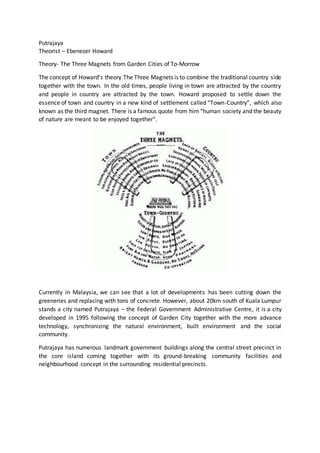
The concept of Howard’s theory The Three Magnets is to combine the traditional country side
together with the town. In the old times, people living in town are attracted by the country
and people in country are attracted by the town. Howard proposed to settle down the
essence of town and country in a new kind of settlement called “Town-Country”, which also
known as the third magnet. There is a famous quote from him“human society and the beauty
of nature are meant to be enjoyed together”.
Currently in Malaysia, we can see that a lot of developments has been cutting down the
greeneries and replacing with tons of concrete. However, about 20km south of Kuala Lumpur
stands a city named Putrajaya – the Federal Government Administrative Centre, it is a city
developed in 1995 following the concept of Garden City together with the more advance
technology, synchronizing the natural environment, built environment and the social
community.
Putrajaya has numerous landmark government buildings along the central street precinct in
the core island coming together with its ground-breaking community facilities and
neighbourhood concept in the surrounding residential precincts.
As Howard mentioned in his book “Garden Cities of To-morrow”, eachgarden city would offer
a wide range of jobs and services, but each would also be connected to the others by a rapid
transit system, an Inter-Municipal Railway. Putrajaya also adapted this by having multiple
routes connected to the city including highways and roads to Kuala Lumpur and the Kuala
Lumpur International Airport. In Putrajaya itself, all the precincts are linked together by high
standard roads with parks and public places in between the zonings.
Nevertheless, many citizens in the Kuala Lumpur find it inconvenient to go to Putrajaya
because of the long travelling distance and time even though they are connected by many
highways. Moreover, many government departments can be easily found in Kuala Lumpur.
Putrajaya is lacking of an indispensable factor that can attract the crowds to visit despite the
beautiful town planning of the city. Recently a mega mall named Putrajaya IOI City Mall just
held the opening ceremony, having a mall in the city is also part of the strategy to attract
people into Putrajaya.
In the town-country magnet proposed by Howard, there are several prerequisite to archive
the ideal state of garden city which consist of cooperation, beauty, nature, green fields, green
parks, good utilities, good commerce, social opportunity, high wages, low pollution, low rents
and low price rates. Things are a little different in Putrajaya, the advantages of this garden
city are bought at a high cost, and most of the citizens are in middle – high income categories,
whereas blue-collar workers are minimum or none can be found in the residentialof Putrajaya.
Despitethe hope of socialmix as proposed in the theory of three magnet, Putrajaya is heading
towards a direction of noble district. Putrajaya is literally going the opposite direction of low
rents and low price rates, in order to achieve the ideal utopian garden cities, more affordable
housing projects should be implemented instead of filling up the housing development areas
with more and more luxurious residential.
Reference
ARCHITECTURE URBANISM. (n.d.).RetrievedApril 6,2015, from
http://architectureandurbanism.blogspot.com/2010/10/ebenezer-howard-garden-cities-of-to.html
DiscoveringUrbanism:EbenezerHoward'sGardenCityconcept.(n.d.).RetrievedApril 6,2015, from
http://discoveringurbanism.blogspot.com/2009/06/ebenezer-howards-garden-city-concept.html
World’sFirstIntelligentGardenCity.(n.d.).RetrievedApril 6,2015, from
http://www.putrajaya.gov.my/tourist/green_city/
Spartacus Educational.(n.d.).Retrieved April 6,2015, from
http://spartacus-educational.com/Ebenezer_Howard.htm
Howard,E. (1902). Garden Cities of To-morrow (2nded.,p.167). London:Swansonnenschein&co.

Reflective essays the three magnets

  • 1.
    THEORY OF ARCHITECTURE& URBANISM [ARC 2224] PROJECT THEORIZING ARCHITECTURE THEORIST: EBENEZER HOWARD (URBAN PLANNER) THEORY: THE THREE MAGNETS FROM <THE GARDEN CITIES OF TO-MORROW> PLACE: PUTRAJAYA, WILAYAH PERSEKUTUAN, MALAYSIA NAME: NG YOU SHENG ID: 0309997 DATE: 20-04-2015
  • 2.
    Putrajaya Theorist – EbenezerHoward Theory- The Three Magnets from Garden Cities of To-Morrow The concept of Howard’s theory The Three Magnets is to combine the traditional country side together with the town. In the old times, people living in town are attracted by the country and people in country are attracted by the town. Howard proposed to settle down the essence of town and country in a new kind of settlement called “Town-Country”, which also known as the third magnet. There is a famous quote from him“human society and the beauty of nature are meant to be enjoyed together”. Currently in Malaysia, we can see that a lot of developments has been cutting down the greeneries and replacing with tons of concrete. However, about 20km south of Kuala Lumpur stands a city named Putrajaya – the Federal Government Administrative Centre, it is a city developed in 1995 following the concept of Garden City together with the more advance technology, synchronizing the natural environment, built environment and the social community. Putrajaya has numerous landmark government buildings along the central street precinct in the core island coming together with its ground-breaking community facilities and neighbourhood concept in the surrounding residential precincts.
  • 3.
    As Howard mentionedin his book “Garden Cities of To-morrow”, eachgarden city would offer a wide range of jobs and services, but each would also be connected to the others by a rapid transit system, an Inter-Municipal Railway. Putrajaya also adapted this by having multiple routes connected to the city including highways and roads to Kuala Lumpur and the Kuala Lumpur International Airport. In Putrajaya itself, all the precincts are linked together by high standard roads with parks and public places in between the zonings. Nevertheless, many citizens in the Kuala Lumpur find it inconvenient to go to Putrajaya because of the long travelling distance and time even though they are connected by many highways. Moreover, many government departments can be easily found in Kuala Lumpur. Putrajaya is lacking of an indispensable factor that can attract the crowds to visit despite the beautiful town planning of the city. Recently a mega mall named Putrajaya IOI City Mall just held the opening ceremony, having a mall in the city is also part of the strategy to attract people into Putrajaya. In the town-country magnet proposed by Howard, there are several prerequisite to archive the ideal state of garden city which consist of cooperation, beauty, nature, green fields, green parks, good utilities, good commerce, social opportunity, high wages, low pollution, low rents and low price rates. Things are a little different in Putrajaya, the advantages of this garden city are bought at a high cost, and most of the citizens are in middle – high income categories, whereas blue-collar workers are minimum or none can be found in the residentialof Putrajaya. Despitethe hope of socialmix as proposed in the theory of three magnet, Putrajaya is heading towards a direction of noble district. Putrajaya is literally going the opposite direction of low rents and low price rates, in order to achieve the ideal utopian garden cities, more affordable housing projects should be implemented instead of filling up the housing development areas with more and more luxurious residential.
  • 4.
    Reference ARCHITECTURE URBANISM. (n.d.).RetrievedApril6,2015, from http://architectureandurbanism.blogspot.com/2010/10/ebenezer-howard-garden-cities-of-to.html DiscoveringUrbanism:EbenezerHoward'sGardenCityconcept.(n.d.).RetrievedApril 6,2015, from http://discoveringurbanism.blogspot.com/2009/06/ebenezer-howards-garden-city-concept.html World’sFirstIntelligentGardenCity.(n.d.).RetrievedApril 6,2015, from http://www.putrajaya.gov.my/tourist/green_city/ Spartacus Educational.(n.d.).Retrieved April 6,2015, from http://spartacus-educational.com/Ebenezer_Howard.htm Howard,E. (1902). Garden Cities of To-morrow (2nded.,p.167). London:Swansonnenschein&co.