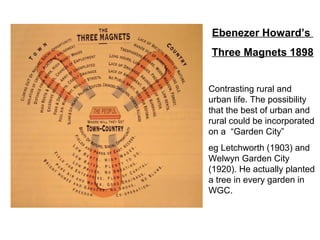
Ebenezer Howard’s
Three Magnets 1898
Contrasting rural and
urban life. The possibility
that the best of urban and
rural could be incorporated
on a “Garden City”
eg Letchworth (1903) and
Welwyn Garden City
(1920). He actually planted
a tree in every garden in
WGC.
Ebenezer Howard
‘Garden Cities of To-
morrow’ in 1902.
Influenced the later
strategy of building new
towns in the UK, US,
Canada, Argentina, Israel
and Germany.
As with most instances of
social engineering, the
garden city movement
didn’t quite achieve what it
set out to do. Its laudable
motives and egalitarian
vision contrast with the
often depressing
artificiality of ‘garden
cities’, and the fact that
they merely function as
dormitories to the larger
cities they so often adjoin.
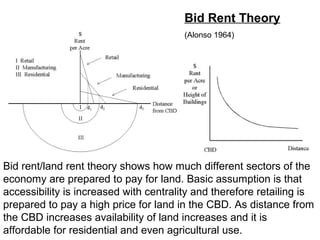
Bid Rent Theory
(Alonso 1964)
Bid rent/land rent theory shows how much different sectors of the
economy are prepared to pay for land. Basic assumption is that
accessibility is increased with centrality and therefore retailing is
prepared to pay a high price for land in the CBD. As distance from
the CBD increases availability of land increases and it is
affordable for residential and even agricultural use.
A – CBD
B– Commerce /industry
C – residential high– mediumdensity
D– sub-centres
E – Suburbia
Variations to bid-rent theory
rent
A B C D E
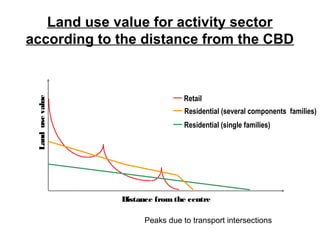
Land use value for activity sector
according to the distance from the CBD
Distance from the centre
Landusevalue
Retail
Residential (several components families)
Residential (single families)
Peaks due to transport intersections
IV – working class area
V – residential area
VI – suburban area
I - Loop (downtown; CBD)
II – industries
III – transition area
LOOP
LittleSicily
Apartm
entHouses
Bungalow
Section
SingleFam
ilyDwellings
Residential District
Ghetto
Two Plan
Area
Second
Im
m
igrant
Settlem
ent
Model Chicago, years ‘20
BlackBelt
Bugess’ model of land use
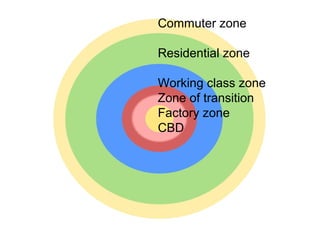
Commuter zone
Residential zone
Working class zone
Zone of transition
Factory zone
CBD
Core Frame Model – CBD Morphology
2
3
4
4
5
3
3
1
3
3
3
1 CBD
2 Wholesale and light manufacturing
3 Low-class residential
4 Middle-class residential
5 High-class residential
1
2
3
4
5
3
3
6
7
89
6 Heavy manufacturing
7 Sub business district
8 Residential suburb
9 Industrial suburb
Sector Multi centres
Models: ‘sectors’ (Hoyt) and
‘multi centres’ (Harris and Ullman)
2
Mann’s
concentric
circles and
sector model
Classic industrial city 1850s
Konx and Pinch 2000 – Urban Social Geography
Industrial city 1945-1975
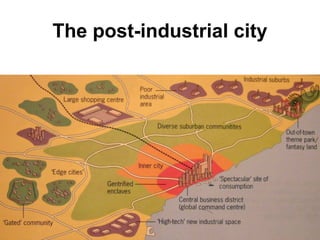
The post-industrial city
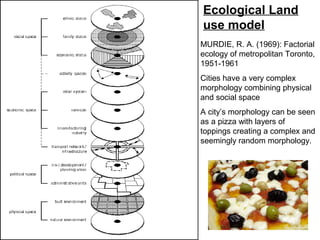
MURDIE, R. A. (1969): Factorial
ecology of metropolitan Toronto,
1951-1961
Cities have a very complex
morphology combining physical
and social space
A city’s morphology can be seen
as a pizza with layers of
toppings creating a complex and
seemingly random morphology.
Ecological Land
use model
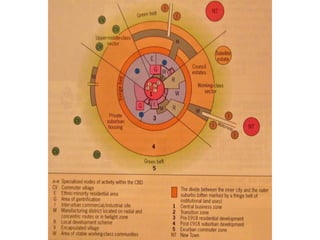
Kearsley’s model
includes contemporary
urban processes and
changes such as
gentrification,
commuter villages,
development projects.
Family Life cycles and movement within a city
Low income life cycle model
Middle income life cycle model
Changing housing tenure in the UK
Urban densities and private transport

5urbanmodels 090312094928-phpapp01

  • 1.
    Ebenezer Howard’s Three Magnets1898 Contrasting rural and urban life. The possibility that the best of urban and rural could be incorporated on a “Garden City” eg Letchworth (1903) and Welwyn Garden City (1920). He actually planted a tree in every garden in WGC.
  • 2.
    Ebenezer Howard ‘Garden Citiesof To- morrow’ in 1902. Influenced the later strategy of building new towns in the UK, US, Canada, Argentina, Israel and Germany. As with most instances of social engineering, the garden city movement didn’t quite achieve what it set out to do. Its laudable motives and egalitarian vision contrast with the often depressing artificiality of ‘garden cities’, and the fact that they merely function as dormitories to the larger cities they so often adjoin.
  • 3.
    Bid Rent Theory (Alonso1964) Bid rent/land rent theory shows how much different sectors of the economy are prepared to pay for land. Basic assumption is that accessibility is increased with centrality and therefore retailing is prepared to pay a high price for land in the CBD. As distance from the CBD increases availability of land increases and it is affordable for residential and even agricultural use.
  • 4.
    A – CBD B–Commerce /industry C – residential high– mediumdensity D– sub-centres E – Suburbia Variations to bid-rent theory rent A B C D E
  • 5.
    Land use valuefor activity sector according to the distance from the CBD Distance from the centre Landusevalue Retail Residential (several components families) Residential (single families) Peaks due to transport intersections
  • 6.
    IV – workingclass area V – residential area VI – suburban area I - Loop (downtown; CBD) II – industries III – transition area LOOP LittleSicily Apartm entHouses Bungalow Section SingleFam ilyDwellings Residential District Ghetto Two Plan Area Second Im m igrant Settlem ent Model Chicago, years ‘20 BlackBelt Bugess’ model of land use
  • 7.
    Commuter zone Residential zone Workingclass zone Zone of transition Factory zone CBD
  • 8.
    Core Frame Model– CBD Morphology
  • 9.
    2 3 4 4 5 3 3 1 3 3 3 1 CBD 2 Wholesaleand light manufacturing 3 Low-class residential 4 Middle-class residential 5 High-class residential 1 2 3 4 5 3 3 6 7 89 6 Heavy manufacturing 7 Sub business district 8 Residential suburb 9 Industrial suburb Sector Multi centres Models: ‘sectors’ (Hoyt) and ‘multi centres’ (Harris and Ullman) 2
  • 10.
  • 11.
    Classic industrial city1850s Konx and Pinch 2000 – Urban Social Geography
  • 12.
  • 13.
  • 14.
    MURDIE, R. A.(1969): Factorial ecology of metropolitan Toronto, 1951-1961 Cities have a very complex morphology combining physical and social space A city’s morphology can be seen as a pizza with layers of toppings creating a complex and seemingly random morphology. Ecological Land use model
  • 15.
    Kearsley’s model includes contemporary urbanprocesses and changes such as gentrification, commuter villages, development projects.
  • 17.
    Family Life cyclesand movement within a city
  • 18.
    Low income lifecycle model
  • 19.
    Middle income lifecycle model
  • 20.
  • 21.
    Urban densities andprivate transport

Editor's Notes