Journal Impact Measures
The Impact Factor
Leuven 2019
Presented at the european
summer school for
scientometrics
ESSS
July 16th, 2019
● Daniel Torres Salinas - Univ Granada / EC3metrics
● Nicolás Robinson García - TU Delft
1
Introduction
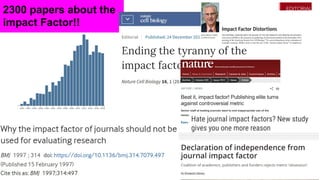
2300 papers about the
impact Factor!!
Journal Impact Measures
The Impact Factor
Our presentation
● Definition and calculation
● Problems and limitations
● The Journal Citation Reports
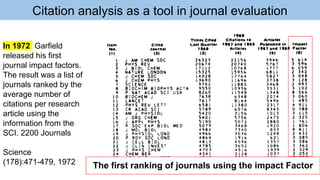
Citation analysis as a tool in journal evaluation
In 1972 Garfield
released his first
journal impact factors.
The result was a list of
journals ranked by the
average number of
citations per research
article using the
information from the
SCI. 2200 Journals
Science
(178):471-479, 1972 The first ranking of journals using the impact Factor
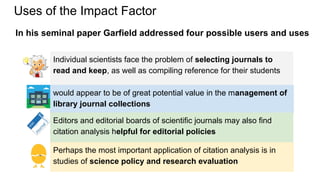
Uses of the Impact Factor
Perhaps the most important application of citation analysis is in
studies of science policy and research evaluation
would appear to be of great potential value in the management of
library journal collections
Individual scientists face the problem of selecting journals to
read and keep, as well as compiling reference for their students
Editors and editorial boards of scientific journals may also find
citation analysis helpful for editorial policies
In his seminal paper Garfield addressed four possible users and uses
2
Definition and calculation
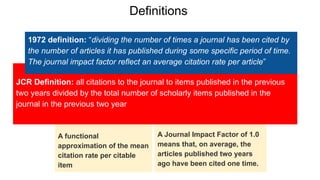
A functional
approximation of the mean
citation rate per citable
item
A Journal Impact Factor of 1.0
means that, on average, the
articles published two years
ago have been cited one time.
JCR Definition: all citations to the journal to items published in the previous
two years divided by the total number of scholarly items published in the
journal in the previous two year
1972 definition: “dividing the number of times a journal has been cited by
the number of articles it has published during some specific period of time.
The journal impact factor reflect an average citation rate per article”
Definitions
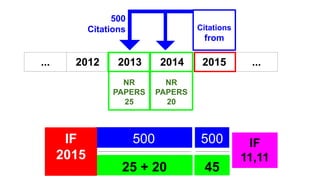
... 2012 2013 2014 2015 ...
NR
PAPERS
25
NR
PAPERS
20
25 + 20
Citations
from
500
Citations
500IF
2015
500
45
IF
11,11
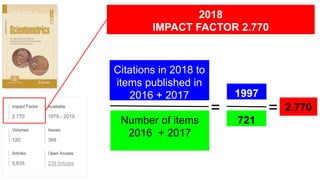
2018
IMPACT FACTOR 2.770
Number of items
2016 + 2017
Citations in 2018 to
items published in
2016 + 2017
=
1997
721
= 2.770
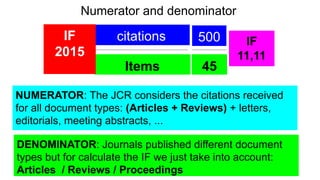
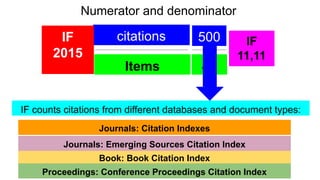
Numerator and denominator
Items
citationsIF
2015
500
45
IF
11,11
DENOMINATOR: Journals published different document
types but for calculate the IF we just take into account:
Articles / Reviews / Proceedings
NUMERATOR: The JCR considers the citations received
for all document types: (Articles + Reviews) + letters,
editorials, meeting abstracts, ...
Numerator and denominator
Items
citationsIF
2015
500
45
IF
11,11
IF counts citations from different databases and document types:
Journals: Citation Indexes
Book: Book Citation Index
Proceedings: Conference Proceedings Citation Index
Journals: Emerging Sources Citation Index
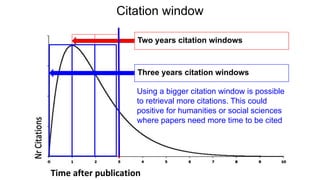
Citation window
Two years citation windows
Three years citation windows
Time after publication
Using a bigger citation window is possible
to retrieval more citations. This could
positive for humanities or social sciences
where papers need more time to be cited
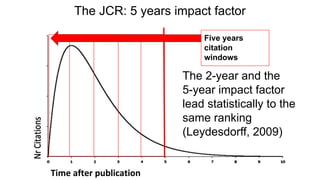
The JCR: 5 years impact factor
Five years
citation
windows
The 2-year and the
5-year impact factor
lead statistically to the
same ranking
(Leydesdorff, 2009)
Time after publication
3
Problems & limitations
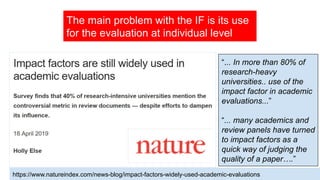
The main problem with the IF is its use
for the evaluation at individual level
“... In more than 80% of
research-heavy
universities.. use of the
impact factor in academic
evaluations...”
“... many academics and
review panels have turned
to impact factors as a
quick way of judging the
quality of a paper….”
https://www.natureindex.com/news-blog/impact-factors-widely-used-academic-evaluations
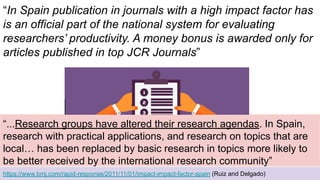
“In Spain publication in journals with a high impact factor has
is an official part of the national system for evaluating
researchers’ productivity. A money bonus is awarded only for
articles published in top JCR Journals”
https://www.bmj.com/rapid-response/2011/11/01/impact-impact-factor-spain (Ruiz and Delgado)
“...Research groups have altered their research agendas. In Spain,
research with practical applications, and research on topics that are
local… has been replaced by basic research in topics more likely to
be better received by the international research community”
San Francisco Declaration on Research Assessment
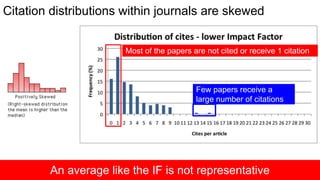
An average like the IF is not representative
Citation distributions within journals are skewed
Most of the papers are not cited or receive 1 citation
Few papers receive a
large number of citations
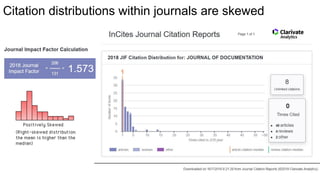
Citation distributions within journals are skewed
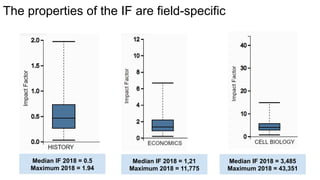
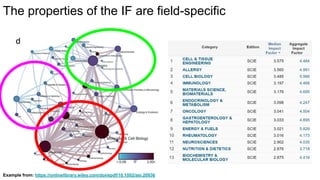
The properties of the IF are field-specific
Median IF 2018 = 0.5
Maximum 2018 = 1.94
Median IF 2018 = 1,21
Maximum 2018 = 11,775
Median IF 2018 = 3,485
Maximum 2018 = 43,351
The properties of the IF are field-specific
Example from: https://onlinelibrary.wiley.com/doi/epdf/10.1002/asi.20936
4
The Journal Citation Reports
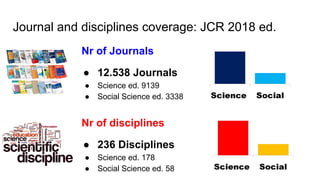
Journal and disciplines coverage: JCR 2018 ed.
Nr of Journals
● 12.538 Journals
● Science ed. 9139
● Social Science ed. 3338
Nr of disciplines
● 236 Disciplines
● Science ed. 178
● Social Science ed. 58
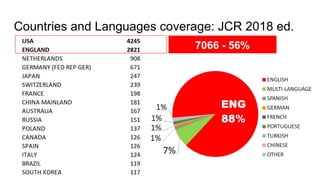
Countries and Languages coverage: JCR 2018 ed.
7066 - 56%
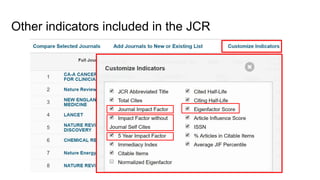
Other indicators included in the JCR
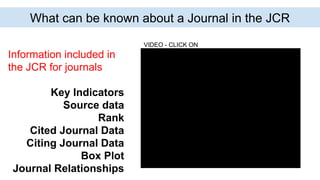
What can be known about a Journal in the JCR
Information included in
the JCR for journals
Key Indicators
Source data
Rank
Cited Journal Data
Citing Journal Data
Box Plot
Journal Relationships
VIDEO - CLICK ON
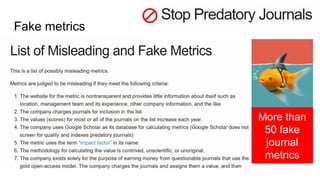
Fake metrics
More than
50 fake
journal
metrics
Global Impact Factor: http://globalimpactfactor.com
Journal Impact Factor (JIF):
http://www.jifactor.com
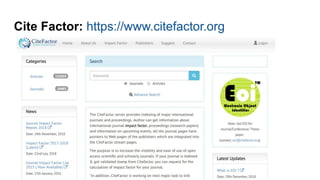
Cite Factor: https://www.citefactor.org
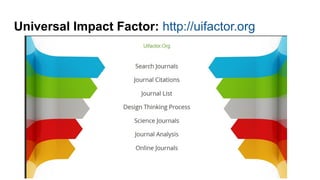
Universal Impact Factor: http://uifactor.org
Bonus1
Practical applications
Sometimes we need to calculate impact factor for a set of documents,

for examples the output a institution or author. In this tutorial:
● How can we download data from JCR?
● How can we import this JCR data in a local database?
● How can we connect data from web of science with data from JCR?
● How can we can calculate impact factors for a set of WoS records?
Example:
Calculating impact factor and quartile for the scientific output of the
university of Granada in Artificial Intelligence
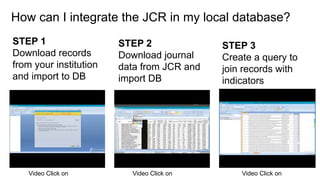
How can I integrate the JCR in my local database?
STEP 1
Download records
from your institution
and import to DB
STEP 2
Download journal
data from JCR and
import DB
STEP 3
Create a query to
join records with
indicators
Video Click on Video Click on Video Click on

Journal impact measures: the Impact Factor

  • 1.
    Journal Impact Measures TheImpact Factor Leuven 2019
  • 2.
    Presented at theeuropean summer school for scientometrics ESSS July 16th, 2019 ● Daniel Torres Salinas - Univ Granada / EC3metrics ● Nicolás Robinson García - TU Delft
  • 3.
  • 4.
    2300 papers aboutthe impact Factor!!
  • 5.
    Journal Impact Measures TheImpact Factor Our presentation ● Definition and calculation ● Problems and limitations ● The Journal Citation Reports
  • 6.
    Citation analysis asa tool in journal evaluation In 1972 Garfield released his first journal impact factors. The result was a list of journals ranked by the average number of citations per research article using the information from the SCI. 2200 Journals Science (178):471-479, 1972 The first ranking of journals using the impact Factor
  • 7.
    Uses of theImpact Factor Perhaps the most important application of citation analysis is in studies of science policy and research evaluation would appear to be of great potential value in the management of library journal collections Individual scientists face the problem of selecting journals to read and keep, as well as compiling reference for their students Editors and editorial boards of scientific journals may also find citation analysis helpful for editorial policies In his seminal paper Garfield addressed four possible users and uses
  • 8.
  • 9.
    A functional approximation ofthe mean citation rate per citable item A Journal Impact Factor of 1.0 means that, on average, the articles published two years ago have been cited one time. JCR Definition: all citations to the journal to items published in the previous two years divided by the total number of scholarly items published in the journal in the previous two year 1972 definition: “dividing the number of times a journal has been cited by the number of articles it has published during some specific period of time. The journal impact factor reflect an average citation rate per article” Definitions
  • 10.
    ... 2012 20132014 2015 ... NR PAPERS 25 NR PAPERS 20 25 + 20 Citations from 500 Citations 500IF 2015 500 45 IF 11,11
  • 11.
    2018 IMPACT FACTOR 2.770 Numberof items 2016 + 2017 Citations in 2018 to items published in 2016 + 2017 = 1997 721 = 2.770
  • 12.
    Numerator and denominator Items citationsIF 2015 500 45 IF 11,11 DENOMINATOR:Journals published different document types but for calculate the IF we just take into account: Articles / Reviews / Proceedings NUMERATOR: The JCR considers the citations received for all document types: (Articles + Reviews) + letters, editorials, meeting abstracts, ...
  • 13.
    Numerator and denominator Items citationsIF 2015 500 45 IF 11,11 IFcounts citations from different databases and document types: Journals: Citation Indexes Book: Book Citation Index Proceedings: Conference Proceedings Citation Index Journals: Emerging Sources Citation Index
  • 14.
    Citation window Two yearscitation windows Three years citation windows Time after publication Using a bigger citation window is possible to retrieval more citations. This could positive for humanities or social sciences where papers need more time to be cited
  • 15.
    The JCR: 5years impact factor Five years citation windows The 2-year and the 5-year impact factor lead statistically to the same ranking (Leydesdorff, 2009) Time after publication
  • 16.
  • 17.
    The main problemwith the IF is its use for the evaluation at individual level “... In more than 80% of research-heavy universities.. use of the impact factor in academic evaluations...” “... many academics and review panels have turned to impact factors as a quick way of judging the quality of a paper….” https://www.natureindex.com/news-blog/impact-factors-widely-used-academic-evaluations
  • 18.
    “In Spain publicationin journals with a high impact factor has is an official part of the national system for evaluating researchers’ productivity. A money bonus is awarded only for articles published in top JCR Journals” https://www.bmj.com/rapid-response/2011/11/01/impact-impact-factor-spain (Ruiz and Delgado) “...Research groups have altered their research agendas. In Spain, research with practical applications, and research on topics that are local… has been replaced by basic research in topics more likely to be better received by the international research community”
  • 19.
    San Francisco Declarationon Research Assessment
  • 20.
    An average likethe IF is not representative Citation distributions within journals are skewed Most of the papers are not cited or receive 1 citation Few papers receive a large number of citations
  • 21.
    Citation distributions withinjournals are skewed
  • 22.
    The properties ofthe IF are field-specific Median IF 2018 = 0.5 Maximum 2018 = 1.94 Median IF 2018 = 1,21 Maximum 2018 = 11,775 Median IF 2018 = 3,485 Maximum 2018 = 43,351
  • 23.
    The properties ofthe IF are field-specific Example from: https://onlinelibrary.wiley.com/doi/epdf/10.1002/asi.20936
  • 24.
  • 25.
    Journal and disciplinescoverage: JCR 2018 ed. Nr of Journals ● 12.538 Journals ● Science ed. 9139 ● Social Science ed. 3338 Nr of disciplines ● 236 Disciplines ● Science ed. 178 ● Social Science ed. 58
  • 26.
    Countries and Languagescoverage: JCR 2018 ed. 7066 - 56%
  • 27.
  • 28.
    What can beknown about a Journal in the JCR Information included in the JCR for journals Key Indicators Source data Rank Cited Journal Data Citing Journal Data Box Plot Journal Relationships VIDEO - CLICK ON
  • 29.
    Fake metrics More than 50fake journal metrics
  • 30.
    Global Impact Factor:http://globalimpactfactor.com
  • 31.
    Journal Impact Factor(JIF): http://www.jifactor.com
  • 32.
  • 33.
    Universal Impact Factor:http://uifactor.org
  • 34.
  • 35.
    Sometimes we needto calculate impact factor for a set of documents, for examples the output a institution or author. In this tutorial: ● How can we download data from JCR? ● How can we import this JCR data in a local database? ● How can we connect data from web of science with data from JCR? ● How can we can calculate impact factors for a set of WoS records? Example: Calculating impact factor and quartile for the scientific output of the university of Granada in Artificial Intelligence
  • 36.
    How can Iintegrate the JCR in my local database? STEP 1 Download records from your institution and import to DB STEP 2 Download journal data from JCR and import DB STEP 3 Create a query to join records with indicators Video Click on Video Click on Video Click on