Bibliometrics:
H index and the Journal
Impact Factor
Rachel Lane Walden, MLIS
Eskind Biomedical Library
2015
Is anyone interested in publishing?
Do you know the best journals in your field
to publish in?
Would you like to know how to find that
information?
Objectives
• Explore Bibliometrics
-define terms
• H Index
-background
-how to calculate
-resources
• Journal Impact Factor
-Journal Citation Reports
What Is Bibliometrics?
Bibliometrics is defined as the application of
statistical and mathematical methods to
quantitatively analyze scholarly documents in an
effort to establish indicators of research
performance1.
1. Khan NR, Thompson CJ, Taylor DR, Venable GT, Wham RM, Michael LM 2nd,
Klimo P Jr. An analysis of publication productivity for 1225 academic
neurosurgeons and 99 departments in the United States. J Neurosurg. 2013
Dec 20.
The H Index
“I propose the index h, defined as the number of papers
with citation number ≤ h, as a useful index to calculate the
scientific output of a researcher” .1
“A scientist has index h if h of [his/her] Np papers have at
least h citations each, and the other (Np − h) papers have
at most h citations each.”2
1. Hirsch, J. E. (2005). An index to quantify an individual's scientific research output. Proceedings
of the National Academy of Sciences of the United States of America, 102(46), 16569-16572.
doi:10.1073/pnas.0507655102
2. University Library. Measuring Your Impact: Impact Factor, Citation Analysis, and other Metrics.
Research and Subject Guides. Illinois, Chicago: University of Illinois at Chicago; 2015.
H – Index Example
If an author has 15 papers cited 15 times his or her h-index would be
15. Publications with less than 15 citations do not contribute to the h-
index of the author.
What Resources Provide the H-Index?
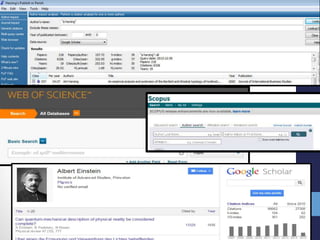
h-index is automatically calculated by:
• Web of Science
• Scopus
• Publish or Perish (free download), based on
Google Scholar’s data
• Google Scholar Citations (to track your
personal h-index)
Can also do a manual calculation of h- Index
Web of Science h-index analysis
Google Scholar
Determining the H-index Manually
Articles Citations
1 35
2 29
3 24
4 13
5 9
6 6
7 5
8 3
H- Index
Limitations of h-index
• Can be influenced by self-citations
• Does not account for first authors
• Looks at quantity versus influence
• Dependent on career length
• All types of citations are weighted the
same: reviews, books, primary research,
etc.
• Dependent on the size of the field
• H-index for an author varies when
calculated by different resources
H-index variants
The following sample of h-index variants address
h-index limitations:
• E-index: addresses excess citations
• Contemporary h-index: places greater weight
on newer publications
• G-index: aims to improve on the h-index by
giving more weight to highly-cited articles
• M-quotient also proposed by Hirsch: allows
for a more accurate comparison of veteran to
junior researchers
Journal Impact Factor
“A journal's impact factor is based on 2 elements: the
numerator, which is the number of citations in the
current year to items published in the previous 2 years,
and the denominator, which is the number of substantive
articles and reviews published in the same 2 years.”1
1. Garfield E. The History and Meaning of the Journal Impact Factor. JAMA.
2006;295(1):90-93. doi:10.1001/jama.295.1.90.
Andrew P. Kurmis J Bone Joint Surg Am 2003;85:2449-2454
Journal Citation Reports
FromWeb of Science
Limitations of the Impact Factor
•Citations to non- source items may
inflate the Impact factor
• Self-citation
• Journal impact factor varies when
calculated by different resources
•Publishing time penalizes disciplines with
longer turnover times
• Review articles heavily cited
Practice Questions
• What is the H Index for Harold E. Varmus?
• What are the top two journals in Clinical
Neurology based on impact factor?
H Index = 112
Lancet Neurology &
Alzheimer's and Dementia
Questions
Debord-Lazaro, V. “questions.” 12 Aug 2010. Online image. Flickr. 19 May 2015.
https://www.flickr.com/photos/debord/4932655275
Rachel Lane Walden, MLIS
rachel.l.walden@vanderbilt.edu
Works Citied
Garfield E. The History and Meaning of the Journal Impact Factor. JAMA. 2006;295(1):90-93.
doi:10.1001/jama.295.1.90.
Ha, Tam Cam, Say Beng Tan, and Khee Chee Soo. "The journal impact factor: too much of an
impact?." ANNALS-ACADEMY OF MEDICINE SINGAPORE 35.12 (2006): 911.
Harzing, A.W. (2007) Publish or Perish, available from http://www.harzing.com/pop.htm
Hirsch, J. E. (2005). An index to quantify an individual's scientific research output. Proceedings of
the National Academy of Sciences of the United States of America, 102(46), 16569-16572.
doi:10.1073/pnas.0507655102
Khan NR, Thompson CJ, Taylor DR, Venable GT, Wham RM, Michael LM 2nd, Klimo P Jr. An analysis
of publication productivity for 1225 academic neurosurgeons and 99 departments in the United
States. J Neurosurg. 2013 Dec 20.
University Library. Measuring Your Impact: Impact Factor, Citation Analysis, and other Metrics.
Research and Subject Guides. Illinois, Chicago: University of Illinois at Chicago; 2015.

H-Index_Impact Factor2015

  • 1.
    Bibliometrics: H index andthe Journal Impact Factor Rachel Lane Walden, MLIS Eskind Biomedical Library 2015
  • 2.
    Is anyone interestedin publishing? Do you know the best journals in your field to publish in? Would you like to know how to find that information?
  • 3.
    Objectives • Explore Bibliometrics -defineterms • H Index -background -how to calculate -resources • Journal Impact Factor -Journal Citation Reports
  • 4.
    What Is Bibliometrics? Bibliometricsis defined as the application of statistical and mathematical methods to quantitatively analyze scholarly documents in an effort to establish indicators of research performance1. 1. Khan NR, Thompson CJ, Taylor DR, Venable GT, Wham RM, Michael LM 2nd, Klimo P Jr. An analysis of publication productivity for 1225 academic neurosurgeons and 99 departments in the United States. J Neurosurg. 2013 Dec 20.
  • 6.
    The H Index “Ipropose the index h, defined as the number of papers with citation number ≤ h, as a useful index to calculate the scientific output of a researcher” .1 “A scientist has index h if h of [his/her] Np papers have at least h citations each, and the other (Np − h) papers have at most h citations each.”2 1. Hirsch, J. E. (2005). An index to quantify an individual's scientific research output. Proceedings of the National Academy of Sciences of the United States of America, 102(46), 16569-16572. doi:10.1073/pnas.0507655102 2. University Library. Measuring Your Impact: Impact Factor, Citation Analysis, and other Metrics. Research and Subject Guides. Illinois, Chicago: University of Illinois at Chicago; 2015.
  • 7.
    H – IndexExample If an author has 15 papers cited 15 times his or her h-index would be 15. Publications with less than 15 citations do not contribute to the h- index of the author.
  • 8.
    What Resources Providethe H-Index? h-index is automatically calculated by: • Web of Science • Scopus • Publish or Perish (free download), based on Google Scholar’s data • Google Scholar Citations (to track your personal h-index) Can also do a manual calculation of h- Index
  • 9.
    Web of Scienceh-index analysis
  • 10.
  • 11.
    Determining the H-indexManually Articles Citations 1 35 2 29 3 24 4 13 5 9 6 6 7 5 8 3 H- Index
  • 12.
    Limitations of h-index •Can be influenced by self-citations • Does not account for first authors • Looks at quantity versus influence • Dependent on career length • All types of citations are weighted the same: reviews, books, primary research, etc. • Dependent on the size of the field • H-index for an author varies when calculated by different resources
  • 13.
    H-index variants The followingsample of h-index variants address h-index limitations: • E-index: addresses excess citations • Contemporary h-index: places greater weight on newer publications • G-index: aims to improve on the h-index by giving more weight to highly-cited articles • M-quotient also proposed by Hirsch: allows for a more accurate comparison of veteran to junior researchers
  • 14.
    Journal Impact Factor “Ajournal's impact factor is based on 2 elements: the numerator, which is the number of citations in the current year to items published in the previous 2 years, and the denominator, which is the number of substantive articles and reviews published in the same 2 years.”1 1. Garfield E. The History and Meaning of the Journal Impact Factor. JAMA. 2006;295(1):90-93. doi:10.1001/jama.295.1.90. Andrew P. Kurmis J Bone Joint Surg Am 2003;85:2449-2454
  • 15.
  • 16.
    Limitations of theImpact Factor •Citations to non- source items may inflate the Impact factor • Self-citation • Journal impact factor varies when calculated by different resources •Publishing time penalizes disciplines with longer turnover times • Review articles heavily cited
  • 17.
    Practice Questions • Whatis the H Index for Harold E. Varmus? • What are the top two journals in Clinical Neurology based on impact factor? H Index = 112 Lancet Neurology & Alzheimer's and Dementia
  • 18.
    Questions Debord-Lazaro, V. “questions.”12 Aug 2010. Online image. Flickr. 19 May 2015. https://www.flickr.com/photos/debord/4932655275 Rachel Lane Walden, MLIS rachel.l.walden@vanderbilt.edu
  • 19.
    Works Citied Garfield E.The History and Meaning of the Journal Impact Factor. JAMA. 2006;295(1):90-93. doi:10.1001/jama.295.1.90. Ha, Tam Cam, Say Beng Tan, and Khee Chee Soo. "The journal impact factor: too much of an impact?." ANNALS-ACADEMY OF MEDICINE SINGAPORE 35.12 (2006): 911. Harzing, A.W. (2007) Publish or Perish, available from http://www.harzing.com/pop.htm Hirsch, J. E. (2005). An index to quantify an individual's scientific research output. Proceedings of the National Academy of Sciences of the United States of America, 102(46), 16569-16572. doi:10.1073/pnas.0507655102 Khan NR, Thompson CJ, Taylor DR, Venable GT, Wham RM, Michael LM 2nd, Klimo P Jr. An analysis of publication productivity for 1225 academic neurosurgeons and 99 departments in the United States. J Neurosurg. 2013 Dec 20. University Library. Measuring Your Impact: Impact Factor, Citation Analysis, and other Metrics. Research and Subject Guides. Illinois, Chicago: University of Illinois at Chicago; 2015.

Editor's Notes

  • #4 Our objectives today are to explore Bibliometrics and define some terms. Look at the H index and how it is calculated and also resources that can used to find it. Finish up by looking at the journal impact factor and Journal Citation Reports
  • #5 Bibliometrics is defined as the application of statistical and mathematical methods to quantitatively analyze scholarly documents in an effort to establish indicators of research performance. So the use of math and statistics to examine measurable and verifiable data to determine performance
  • #6 There are a number of metrics (bibliometrics) that you need to use as a researcher, such as publication counts, citation counts, h-index and journal impact factors. You can use these metrics to choose high quality authors and publications for your research and to identify high impact researchers for collaboration.
  • #7 The h-index was developed by physicist Jorge E. Hirsch and presented in 2005 in the Proceedings of the National Academy of Sciences. Citation Counts and publication counts are used in the H- Index. Hirsh proposed the index h, to be defined as the number of papers with citation number less than or equal to h, as a useful index to calculate the scientific output of a researcher. So a scientist will have an index of H if h of his the number of his papers published over the years have at least h citations each, and the other (Np − h) papers have at most h citations each. number (Np ) of papers published over n years
  • #8 Here is an example if an author’s H index is 15 it means that that author has published 15 papers each of which has been cited in other papers at least 15 times.
  • #9 h-index is automatically calculated by the following resources Web of Science is a bibliographic database containing abstracts and citations for academic journal articles it is not a free database but the VU libraries do have a subscription to it Scopus is similar to Web of Science, we do not have a subscription to Scopus here at Vanderbilt Google Scholar gives you article citation counts. Publish or Perish is a freely available software that retrieves and analyses academic citations using Google Scholar data to generate metrics for authors, journals and articles. It calculates the h-index of authors and more. If you create a profile in Google Scholar Citations you can track your citations and it will compute metrics including the H-Index. You can see other authors’ profiles if they are public The H index can also be calculated manually
  • #10 Here is what the citation report for Web of Science will look like and the H index is given in the table on far right, the bottom line Need to also be aware that only 15 people at any one time will be allowed to be on Web of Science, so if you try to get on and get an error message just try again later.
  • #11 Public author profiles already appear in Google Scholar search results when someone searches for an author’s name, example: hal varian. Once at the profile page can see the H Index on the right side of the page.
  • #12 To determine the h-index of a researcher, organize articles in descending order, based on the number of times they have been cited.  The first paper 35, gives us a 1 – there is one paper that has been cited at least once, the second paper gives a 2, there are two papers that have been cited at least twice, the third paper, 3 and all the way up to 6 with the sixth highest paper
  • #13 The H- index does have some limitations that you need to be aware of Can be influenced by self-citations Does not account for first authors (papers with many authors has equal weight with one author papers) It looks at quantity versus influence, so landmark papers with hundreds of citations that are important in a particular field will not have an effect on the H Index of an author who has only written a couple of papers Dependent on career length All types of citations are weighted the same: reviews, books, primary research, etc. Dependent on the size of the field Varies when calculated by different resources
  • #14 Many other indexes have been designed to account for some of the limitations of the H-index E-index: addresses excess citations Contemporary h-index: places greater weight on newer publications G-index: aims to improve on the h-index by giving more weight to highly-cited articles M-quotient also proposed by Hirsch: allows for a more accurate comparison of veteran to junior researchers
  • #15 Now we are going to switch over to looking at journals instead of individual authors The Journal impact factor was first described in 1955 by Dr. Eugene Garfield The impact factor reflects the number of citations of a journal’s material in the preceding two-year period divided by the number of citable materials (source items) published by that same journal within the same period
  • #16 Journal Citation Reports (JCR) is an annual publication of Thomson Reuters. It provides information about academic journals in the sciences and social sciences, including impact factors. To determine the impact factor for a particular journal, select a JCR edition (Science or Social Science) and year. Next, select a search option (view journals by subject, search for a specific journal, or view all journals) to find if the journal you're looking for has an impact. Because impact factors mean little on their own, it's best to select the 'view journals by subject' option to the journal you are interested in compared to the other journals in the same category. Sort your results by impact factor so you can see how the journal compares.
  • #17 There are also limitations when looking at the impact factor Citations to non- source items such as editorials, letters, news items, book reviews, and abstracts may inflate the Impact factor. Just like with the H-Index the impact factor varies when calculated by different resources along with the inflation caused by self citation and in-house citation (Citing articles that are in the same journals) Publishing time penalizes disciplines with longer turnover times and review articles are heavily cited which can inflate the impact factor.
  • #19 Any Questions?