Variety Development,
Evaluation, Testing & Release
Dr. Prabhat Kr. Singh
Assistant Professor,
Department of Genetics and Plant Breeding
MSSSoA, CUTM, Paralakhemundi, Odisha, India
Testing, release and notification of
varieties
❖ Botanically a variety is a sub group of a species. According
to seed act (1966, sub section 16 of section 2) it is a
sub division of a kind identified by its growth, yield,
plant fruit, seed or other characters.
❖ Where as seed technology considers a group of plants
uniform in their morphological, physiological, biochemical
and other characters without any variation from
generation to generation and can be differentiated
from other groups of plants of the same species by some
distinguishing characters as variety after its release and
notification.
Variety:
➢ In India, new improved varieties of crops are
developed by Crop Research Institutes of Indian
Council of Agricultural Research, State Agricultural
Universities and few Private Seed Companies.
➢ These varieties are tested (evaluated) for a minimum
period of three years, before consideration of release
for cultivation.
➢ The important characters for which the new varieties
are evaluated / tested are:
a) Yield
b) Resistance to disease and pests
c) Quality of product
d) Resistance to adverse environmental factors (viz.
drought)
e) Adaptation to different agro climatic conditions
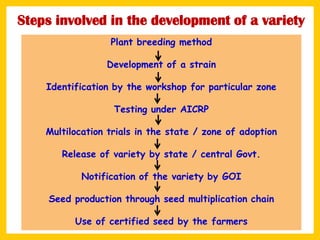
Steps involved in the development of a variety
Plant breeding method
Development of a strain
Identification by the workshop for particular zone
Testing under AICRP
Multilocation trials in the state / zone of adoption
Release of variety by state / central Govt.
Notification of the variety by GOI
Seed production through seed multiplication chain
Use of certified seed by the farmers
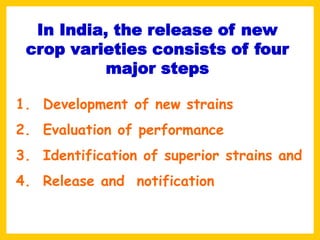
In India, the release of new
crop varieties consists of four
major steps
1. Development of new strains
2. Evaluation of performance
3. Identification of superior strains and
4. Release and notification
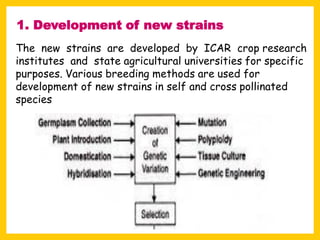
The new strains are developed by ICAR crop research
institutes and state agricultural universities for specific
purposes. Various breeding methods are used for
development of new strains in self and cross pollinated
species
1. Development of new strains
❖ The performance of newly developed strains is
evaluated in All India Coordinated Crop Improvement
Project (AICCIP), ICAR institutes, SAUs and private
registered seed companies enter their improved strains /
hybrids in the AICCIP of respective crop for
multilocation testing.
❖ The new strains are tested at multilocation under the
AICCIP of concerned crop for a minimum period of three
years / seasons.
❖ The new variety is first tested for yield under the initial
varietal trials (IVT) for one year and for two years under
Advanced Varietal Trials (AVT).
❖ The strains that give good performance in AVT for two
years are selected.
2. Evaluation of performance
❖ The strains which show good yield
performance in AVT are identified as superior
strains and are considered for release in the
workshop meetings.
❖ The new agro and plant protection techniques
required to obtain potential yield of new strains
are also worked out by that time.
❖ The workshop after considering the new
promoting varieties recommend them to replace
existing varieties.
3. Identification of superior strains
❖ The proposal for release of new varieties is put up in a prescribed
proforma to variety release committee viz, state variety release
committee (SVRR) and central variety release committee
(CVRC).
❖ In case of SVRC, Director of Agriculture for field crops and
Director of Horticulture for vegetable and horticulture crops
is the chairman. In CVRC, Deputy Director General (Crop Science)
of ICAR is the chairman.
❖ The release proposal of varieties recommended for All India
release is put up before CVRC, while for those for a particular
state is placed before the SVRC of respective state.
❖ These committees consist of scientists and representatives of
seed producing organizations (NSC, SSC and SSCA) and other
related govt. agencies
❖ After release, the variety is notified.
❖ Seed production can be taken up only after notification of new
varieties.
❖ The notification is done by the govt. of India.
4. Release and notification
➢ In general 7 different types of trials/ tests conducted
during evaluation to determine the superiority of new strain
over the best existing variety in term of yield and other
agronomic traits, and its stability for consumption.
1. Station trial
2. Multilocation trial
3. National trial
4. Adoptive trial
5. Minikit trial
6. Disease and insect test and
7. Quality test
❖ In all these trials, the best existing varieties (3
Varieties) are included as CHECK for comparison
GENERAL PROCEDURE FOR VARIETY TESTING
General procedure for variety testing
Promising
Entries
identified
at
Research
Centres
International
nurseries
Station traits
State
Multiplication
Trials
Germplasm
Evaluation
Nurseries
Disease / pest
screening nurseries
Multilocational
trial
Initial Varietal / Hybrid Trial
IVT / IHT / IET
Multilocational
trial
Initial Varietal / Hybrid Trial
AVT / AST / URT
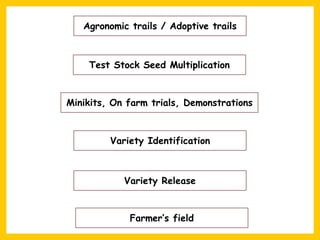
Agronomic trails / Adoptive trails
Test Stock Seed Multiplication
Minikits, On farm trials, Demonstrations
Variety Identification
Variety Release
Farmer’s field
1.Station trial
❖ It is conducted by the breeder who develops the variety.
❖ It is conducted for one or more years before it is
entered in the trial conducted under All India Coordinated Crop
Improvement Project.
❖ The objective of station trial is to make sure that the new
stains are superior in performance (at that location) to the
best available variety for the region.
❖ In station trial of wheat, the plot size is generally 5m Χ
1.84m with spacing of 23 cm between rows. But, plot to plot
spacing is not maintained.
❖ Number of replication should not be less than 3-4.
❖ Disease reaction and quality are also evaluated
❖ The data from station trial are not required for the inclusion
of a strain in multilocation trial; except wheat.
❖ These trials are carried out under respective AICCIP.
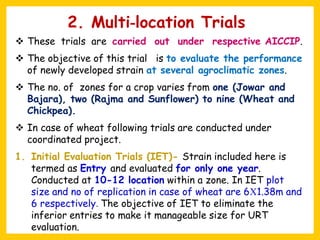
❖ The objective of this trial is to evaluate the performance
of newly developed strain at several agroclimatic zones.
❖ The no. of zones for a crop varies from one (Jowar and
Bajara), two (Rajma and Sunflower) to nine (Wheat and
Chickpea).
❖ In case of wheat following trials are conducted under
coordinated project.
1. Initial Evaluation Trials (IET)- Strain included here is
termed as Entry and evaluated for only one year.
Conducted at 10-12 location within a zone. In IET plot
size and no of replication in case of wheat are 6Χ1.38m and
6 respectively. The objective of IET to eliminate the
inferior entries to make it manageable size for URT
evaluation.
2. Multi‐location Trials
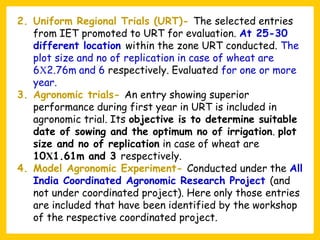
2. Uniform Regional Trials (URT)- The selected entries
from IET promoted to URT for evaluation. At 25-30
different location within the zone URT conducted. The
plot size and no of replication in case of wheat are
6Χ2.76m and 6 respectively. Evaluated for one or more
year.
3. Agronomic trials- An entry showing superior
performance during first year in URT is included in
agronomic trial. Its objective is to determine suitable
date of sowing and the optimum no of irrigation. plot
size and no of replication in case of wheat are
10Χ1.61m and 3 respectively.
4. Model Agronomic Experiment- Conducted under the All
India Coordinated Agronomic Research Project (and
not under coordinated project). Here only those entries
are included that have been identified by the workshop
of the respective coordinated project.
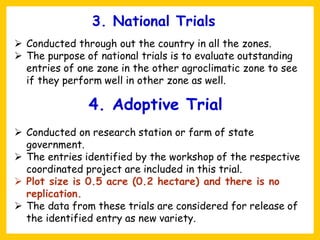
3. National Trials
➢ Conducted through out the country in all the zones.
➢ The purpose of national trials is to evaluate outstanding
entries of one zone in the other agroclimatic zone to see
if they perform well in other zone as well.
4. Adoptive Trial
➢ Conducted on research station or farm of state
government.
➢ The entries identified by the workshop of the respective
coordinated project are included in this trial.
➢ Plot size is 0.5 acre (0.2 hectare) and there is no
replication.
➢ The data from these trials are considered for release of
the identified entry as new variety.
5. Minikit Trials
❖ Conducted in farmers field along with adoptive
trials in the crop season.
❖ Conducted under supervision of Director, HYV,
Ministry of .Agriculture and Irrigation, GOI.
❖ Conducted at 300-400 places within the zone.
❖ In wheat, 5kg of seed of each variety is planted
without any replication.
❖ The objective of minikit trials is to popularise the
new variety among the farmers of the zone.
❖ It also serve another purpose ; the seed of a good
new variety reaches the farmers one year earlier
than when its certified seed would be available in
the market.
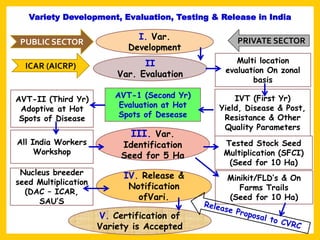
Variety Development, Evaluation, Testing & Release in India
I. Var.
Development
PUBLIC SECTOR PRIVATE SECTOR
II
Var. Evaluation
ICAR (AICRP)
Multi location
evaluation On zonal
basis
AVT-1 (Second Yr)
Evaluation at Hot
Spots of Desease
IVT (First Yr)
Yield, Disease & Post,
Resistance & Other
Quality Parameters
III. Var.
Identification
Seed for 5 Ha
IV. Release &
Notification
ofVari.
V. Certification of
Variety is Accepted
Tested Stock Seed
Multiplication (SFCI)
(Seed for 10 Ha)
Minikit/FLD’s & On
Farms Trails
(Seed for 10 Ha)
AVT-II (Third Yr)
Adoptive at Hot
Spots of Disease
All India Workers
Workshop
Nucleus breeder
seed Multiplication
(DAC – ICAR,
SAU’S

Variety-Development-Evaluation-Testing-Release-in-India.pdf

  • 1.
    Variety Development, Evaluation, Testing& Release Dr. Prabhat Kr. Singh Assistant Professor, Department of Genetics and Plant Breeding MSSSoA, CUTM, Paralakhemundi, Odisha, India
  • 2.
    Testing, release andnotification of varieties ❖ Botanically a variety is a sub group of a species. According to seed act (1966, sub section 16 of section 2) it is a sub division of a kind identified by its growth, yield, plant fruit, seed or other characters. ❖ Where as seed technology considers a group of plants uniform in their morphological, physiological, biochemical and other characters without any variation from generation to generation and can be differentiated from other groups of plants of the same species by some distinguishing characters as variety after its release and notification. Variety:
  • 3.
    ➢ In India,new improved varieties of crops are developed by Crop Research Institutes of Indian Council of Agricultural Research, State Agricultural Universities and few Private Seed Companies. ➢ These varieties are tested (evaluated) for a minimum period of three years, before consideration of release for cultivation. ➢ The important characters for which the new varieties are evaluated / tested are: a) Yield b) Resistance to disease and pests c) Quality of product d) Resistance to adverse environmental factors (viz. drought) e) Adaptation to different agro climatic conditions
  • 4.
    Steps involved inthe development of a variety Plant breeding method Development of a strain Identification by the workshop for particular zone Testing under AICRP Multilocation trials in the state / zone of adoption Release of variety by state / central Govt. Notification of the variety by GOI Seed production through seed multiplication chain Use of certified seed by the farmers
  • 5.
    In India, therelease of new crop varieties consists of four major steps 1. Development of new strains 2. Evaluation of performance 3. Identification of superior strains and 4. Release and notification
  • 6.
    The new strainsare developed by ICAR crop research institutes and state agricultural universities for specific purposes. Various breeding methods are used for development of new strains in self and cross pollinated species 1. Development of new strains
  • 7.
    ❖ The performanceof newly developed strains is evaluated in All India Coordinated Crop Improvement Project (AICCIP), ICAR institutes, SAUs and private registered seed companies enter their improved strains / hybrids in the AICCIP of respective crop for multilocation testing. ❖ The new strains are tested at multilocation under the AICCIP of concerned crop for a minimum period of three years / seasons. ❖ The new variety is first tested for yield under the initial varietal trials (IVT) for one year and for two years under Advanced Varietal Trials (AVT). ❖ The strains that give good performance in AVT for two years are selected. 2. Evaluation of performance
  • 8.
    ❖ The strainswhich show good yield performance in AVT are identified as superior strains and are considered for release in the workshop meetings. ❖ The new agro and plant protection techniques required to obtain potential yield of new strains are also worked out by that time. ❖ The workshop after considering the new promoting varieties recommend them to replace existing varieties. 3. Identification of superior strains
  • 9.
    ❖ The proposalfor release of new varieties is put up in a prescribed proforma to variety release committee viz, state variety release committee (SVRR) and central variety release committee (CVRC). ❖ In case of SVRC, Director of Agriculture for field crops and Director of Horticulture for vegetable and horticulture crops is the chairman. In CVRC, Deputy Director General (Crop Science) of ICAR is the chairman. ❖ The release proposal of varieties recommended for All India release is put up before CVRC, while for those for a particular state is placed before the SVRC of respective state. ❖ These committees consist of scientists and representatives of seed producing organizations (NSC, SSC and SSCA) and other related govt. agencies ❖ After release, the variety is notified. ❖ Seed production can be taken up only after notification of new varieties. ❖ The notification is done by the govt. of India. 4. Release and notification
  • 10.
    ➢ In general7 different types of trials/ tests conducted during evaluation to determine the superiority of new strain over the best existing variety in term of yield and other agronomic traits, and its stability for consumption. 1. Station trial 2. Multilocation trial 3. National trial 4. Adoptive trial 5. Minikit trial 6. Disease and insect test and 7. Quality test ❖ In all these trials, the best existing varieties (3 Varieties) are included as CHECK for comparison GENERAL PROCEDURE FOR VARIETY TESTING
  • 11.
    General procedure forvariety testing Promising Entries identified at Research Centres International nurseries Station traits State Multiplication Trials Germplasm Evaluation Nurseries Disease / pest screening nurseries Multilocational trial Initial Varietal / Hybrid Trial IVT / IHT / IET Multilocational trial Initial Varietal / Hybrid Trial AVT / AST / URT
  • 12.
    Agronomic trails /Adoptive trails Test Stock Seed Multiplication Minikits, On farm trials, Demonstrations Variety Identification Variety Release Farmer’s field
  • 13.
    1.Station trial ❖ Itis conducted by the breeder who develops the variety. ❖ It is conducted for one or more years before it is entered in the trial conducted under All India Coordinated Crop Improvement Project. ❖ The objective of station trial is to make sure that the new stains are superior in performance (at that location) to the best available variety for the region. ❖ In station trial of wheat, the plot size is generally 5m Χ 1.84m with spacing of 23 cm between rows. But, plot to plot spacing is not maintained. ❖ Number of replication should not be less than 3-4. ❖ Disease reaction and quality are also evaluated ❖ The data from station trial are not required for the inclusion of a strain in multilocation trial; except wheat.
  • 14.
    ❖ These trialsare carried out under respective AICCIP. ❖ The objective of this trial is to evaluate the performance of newly developed strain at several agroclimatic zones. ❖ The no. of zones for a crop varies from one (Jowar and Bajara), two (Rajma and Sunflower) to nine (Wheat and Chickpea). ❖ In case of wheat following trials are conducted under coordinated project. 1. Initial Evaluation Trials (IET)- Strain included here is termed as Entry and evaluated for only one year. Conducted at 10-12 location within a zone. In IET plot size and no of replication in case of wheat are 6Χ1.38m and 6 respectively. The objective of IET to eliminate the inferior entries to make it manageable size for URT evaluation. 2. Multi‐location Trials
  • 15.
    2. Uniform RegionalTrials (URT)- The selected entries from IET promoted to URT for evaluation. At 25-30 different location within the zone URT conducted. The plot size and no of replication in case of wheat are 6Χ2.76m and 6 respectively. Evaluated for one or more year. 3. Agronomic trials- An entry showing superior performance during first year in URT is included in agronomic trial. Its objective is to determine suitable date of sowing and the optimum no of irrigation. plot size and no of replication in case of wheat are 10Χ1.61m and 3 respectively. 4. Model Agronomic Experiment- Conducted under the All India Coordinated Agronomic Research Project (and not under coordinated project). Here only those entries are included that have been identified by the workshop of the respective coordinated project.
  • 16.
    3. National Trials ➢Conducted through out the country in all the zones. ➢ The purpose of national trials is to evaluate outstanding entries of one zone in the other agroclimatic zone to see if they perform well in other zone as well. 4. Adoptive Trial ➢ Conducted on research station or farm of state government. ➢ The entries identified by the workshop of the respective coordinated project are included in this trial. ➢ Plot size is 0.5 acre (0.2 hectare) and there is no replication. ➢ The data from these trials are considered for release of the identified entry as new variety.
  • 17.
    5. Minikit Trials ❖Conducted in farmers field along with adoptive trials in the crop season. ❖ Conducted under supervision of Director, HYV, Ministry of .Agriculture and Irrigation, GOI. ❖ Conducted at 300-400 places within the zone. ❖ In wheat, 5kg of seed of each variety is planted without any replication. ❖ The objective of minikit trials is to popularise the new variety among the farmers of the zone. ❖ It also serve another purpose ; the seed of a good new variety reaches the farmers one year earlier than when its certified seed would be available in the market.
  • 18.
    Variety Development, Evaluation,Testing & Release in India I. Var. Development PUBLIC SECTOR PRIVATE SECTOR II Var. Evaluation ICAR (AICRP) Multi location evaluation On zonal basis AVT-1 (Second Yr) Evaluation at Hot Spots of Desease IVT (First Yr) Yield, Disease & Post, Resistance & Other Quality Parameters III. Var. Identification Seed for 5 Ha IV. Release & Notification ofVari. V. Certification of Variety is Accepted Tested Stock Seed Multiplication (SFCI) (Seed for 10 Ha) Minikit/FLD’s & On Farms Trails (Seed for 10 Ha) AVT-II (Third Yr) Adoptive at Hot Spots of Disease All India Workers Workshop Nucleus breeder seed Multiplication (DAC – ICAR, SAU’S