Selection with progeny testing is a plant breeding method used in cross-pollinated crops where initial selection is based on phenotype but final selection is based on evaluating progeny. Two key methods are ear-to-row selection and selfed progeny testing. Ear-to-row selection involves growing progeny rows from individually harvested ears to identify superior families, while selfed progeny testing uses self-fertilization over multiple generations to expose recessive alleles and increase additive genetic variation before selection. Both aim to more accurately select genotypes through progeny evaluation but require more time and generations than mass selection.
Introduction to Progeny Testing and Ear to Row method for plant breeding focusing on phenotype selection before progeny evaluation.
Details about Ear to Row method, its merits such as reflecting genotype accurately and demerits regarding uncontrolled pollination and selection time.
Explanation of selfed (S1 and S2) progeny testing to enhance genetic variation and the multi-season evaluation process.
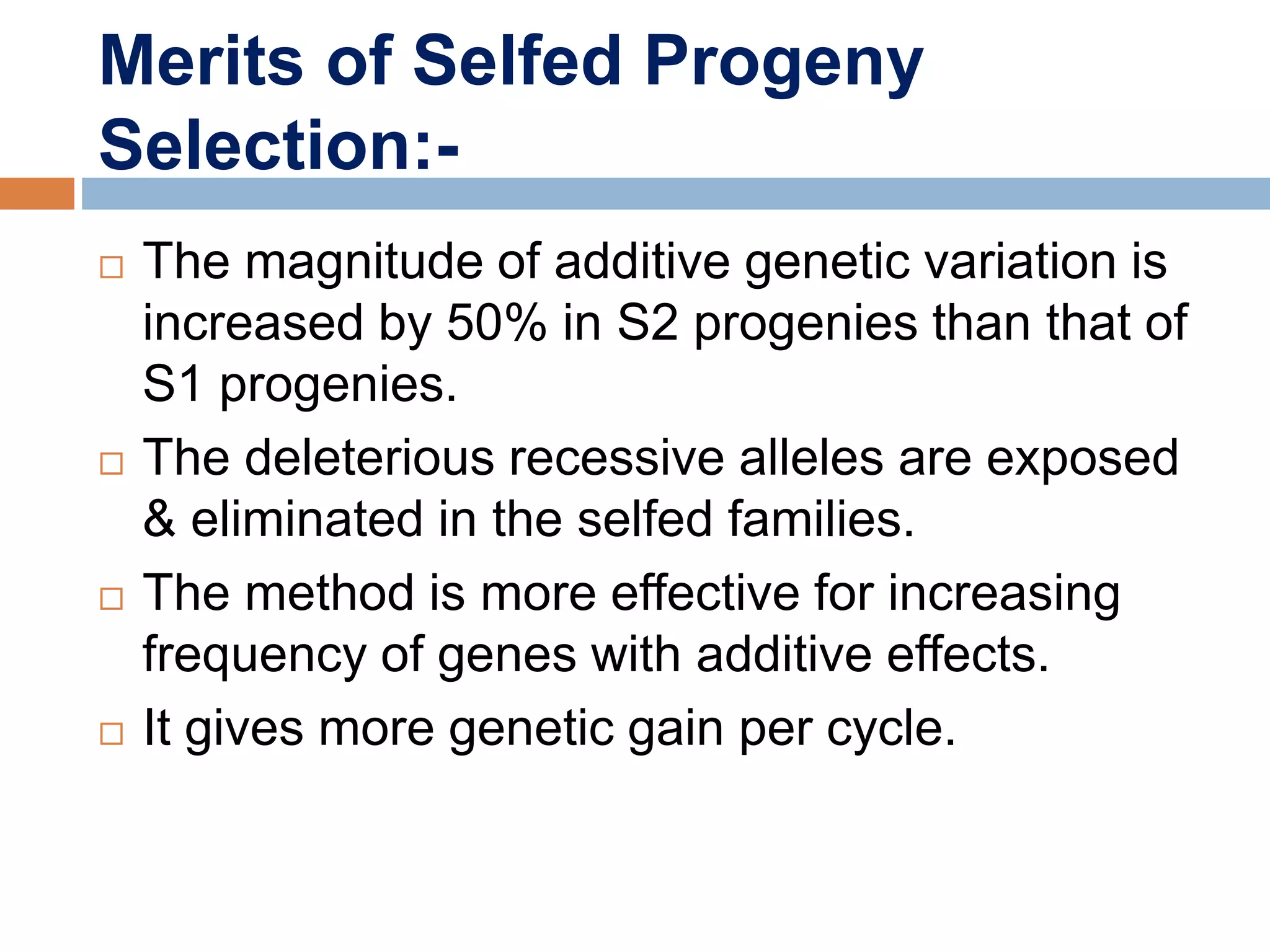
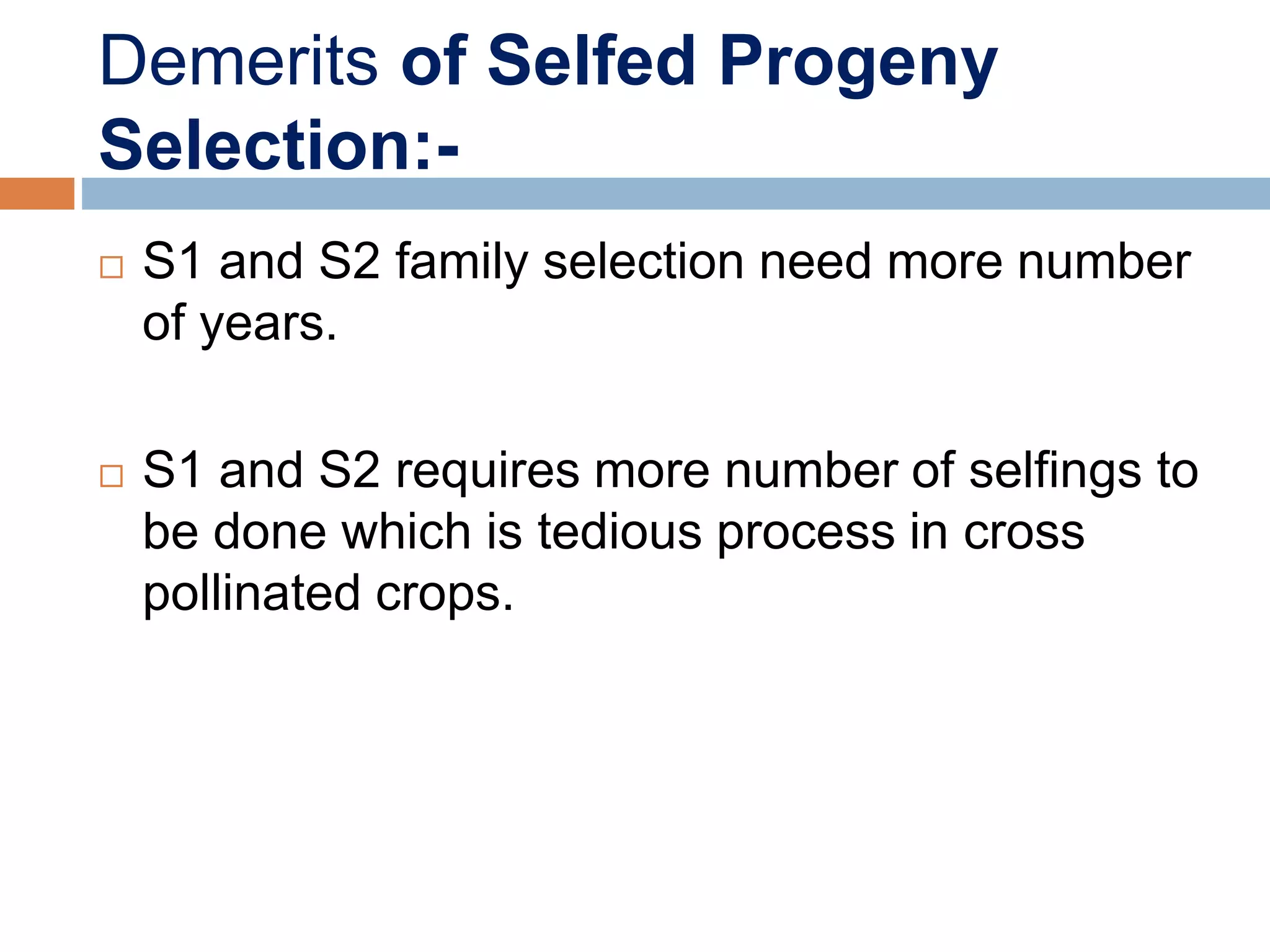
Merits include increased genetic variation and effective elimination of deleterious alleles; demerits involve longer selection time and tedious selfing process.
Selection with ProgenyTesting
It is a method of plant breeding in Cross
Pollinated crops.
With Progeny Testing:-
In this method initially plants are selected on the
basis of their phenotype, but the final selection
of plant is based on progeny test.
This method includes progeny selection on Ear
to Row method & Recurrent Selection.
3.
Progeny Selection (Earto Row
Method)
Hopkins in 1908 developed this method,
extensively used in maize.
A method in which selection is
carried out on progenies derived from
individual ears is called Ear To Row
Method.
4.
Procedure:-
In itssimplest form it consists of-
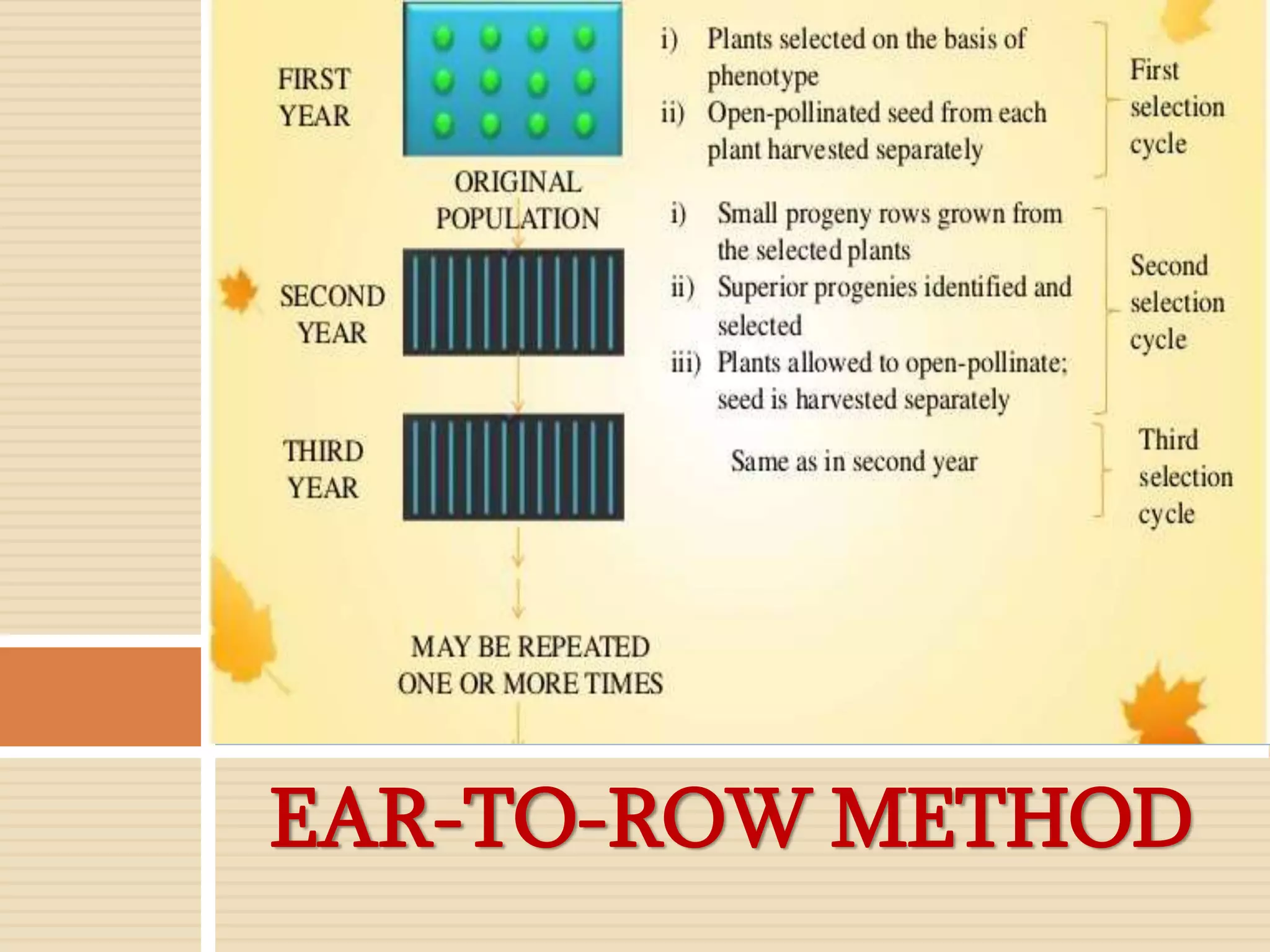
50-100 number of plants are selected on the
basis of their phenotype and are allowed to
open pollinate . The seeds from indiidual
plants are harvested separately.
A single row of 10-50 plants i.e. A progeny row,
is grown from each selected plant. The
progeny rows are evaluated for desirable
character and superior are identified.
5.
Continue...
Several phenotypicallysuperior plants are
selected fro the superior progenies and
selected plants are permitted to open pollinate.
Small progeny rows are again grown from the
selected plants, and the process of selection is
repeated.
Merits of Earto Row Method
1. It is based on progeny test and not on the
phenotypes of individual plants, hence it is far
ore accurate reflection of the genotype than
phenotype.
2. Inbreeding may be avoided if care is taken to
select a sufficiently large number of plant
progenies.
3. Selection schee is relatiely siple and easy.
8.
Demerits of EarTo Row Method
1. There is no control on pollination and plants
are allowed to open pollinate. Thus the
selection is based on the maternal parent
only.
2. The selection tie is 2 years. Thus the time
required for selection is as much as in case
of Mass Selection.
9.
Selfed (S1 orS2) Progeny
Testing Method
The basic concept behind selfed progeny
selection is to increase the magnitude of
available additive genetic variation.
The additive genetic variation is about 50%
higher in S2 progenies than that of S1
progenies.
10.
Procedure:-
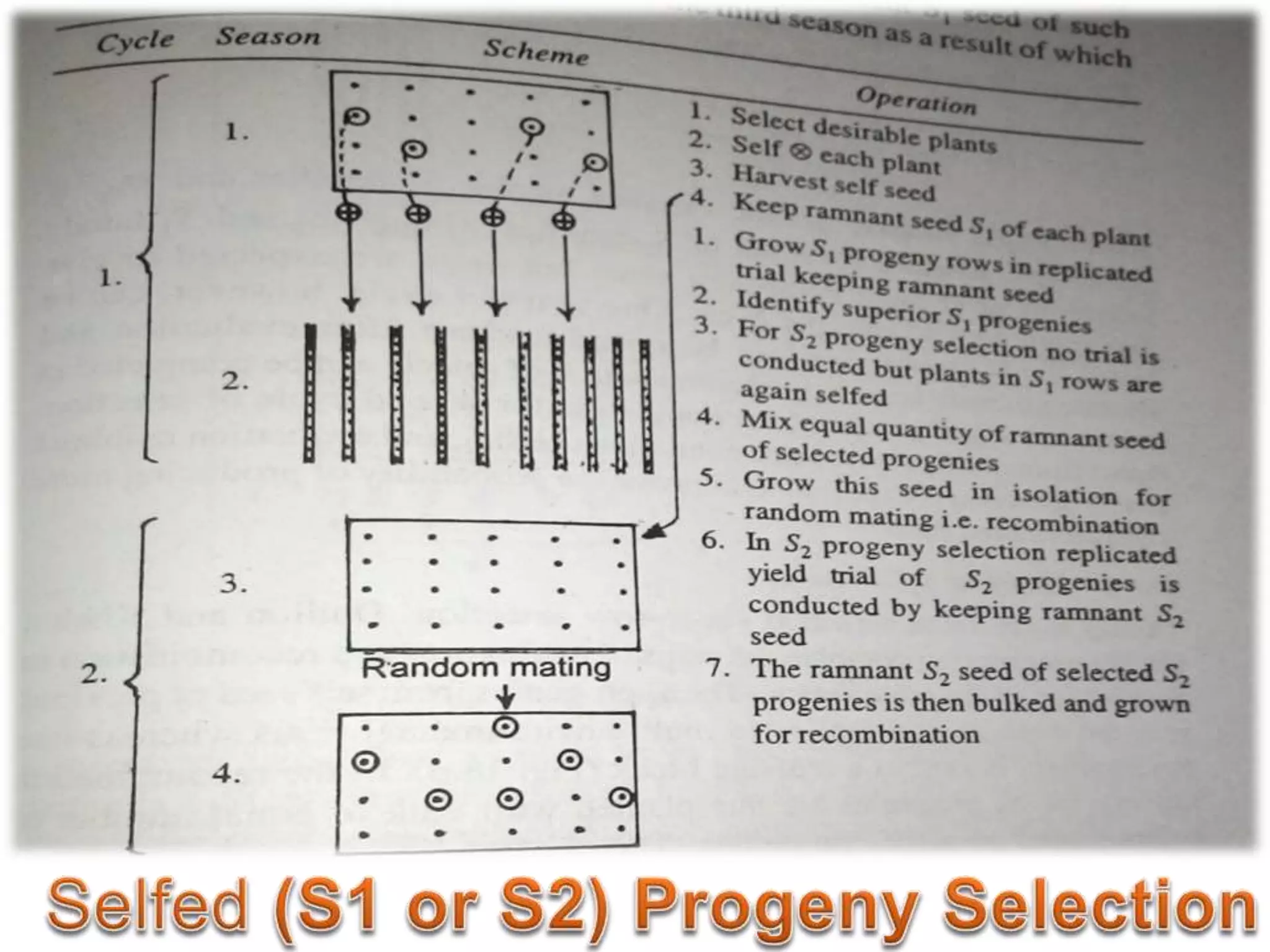
The plantsin original base population are
selfed to produce S1 progenies.
The progenies are evaluated next season in
replicated multi-environmental trials to identify
promising families.
The remnant S1 seed of such selected
families is then recombined in the third
season.
Thus one
cycle is completed in 3 seasons.
11.
Continue...
Similarly forS2 family selection, selfing of
individual plants is continued for 2 years.
Thus
taking 4 years for one cycle of selection.
Here the units of selection and recombination
for S2 progenies are S1 progenies.
13.
Merits of SelfedProgeny
Selection:-
The magnitude of additive genetic variation is
increased by 50% in S2 progenies than that of
S1 progenies.
The deleterious recessive alleles are exposed
& eliminated in the selfed families.
The method is more effective for increasing
frequency of genes with additive effects.
It gives more genetic gain per cycle.
14.
Demerits of SelfedProgeny
Selection:-
S1 and S2 family selection need more number
of years.
S1 and S2 requires more number of selfings to
be done which is tedious process in cross
pollinated crops.