RECTANGULAR MICRO-STRIP PATCH ANTENNA
Outline
• Introduction
• Applications of Microstrip Patch Antenna Technical
• Shapes of Micro Strip Patch Antenna
• Bandwidth
• Feeding techniques
• S-parameters
• VSWR (Voltage Standing Waves Ratio)
• Gain
• Calculation of width and length of RMPA
• Microstrip Antenna Advantages and Limitations
RECTANGULAR MICRO-STRIP PATCH ANTENNA
_______________________________
_______________________________
Introduction
• Antenna is basic component of any electronic system
which depends on free space as a propagation
medium
• The basic antenna parameters like gain, bandwidth,
beam width and return loss are the main things to be
considered while designing an antenna
• But our work will be more focused to increase
bandwidth using slotting. All this work will be done
by using HFSS (High Frequency Structure Simulator)
• The concept of Microstrip antenna was first proposed
by Deschamps in 1953
RECTANGULAR MICRO-STRIP PATCH ANTENNA
_______________________________
_______________________________
RECTANGULAR MICRO-STRIP PATCH ANTENNA
Applications of Microstrip Patch
Antenna
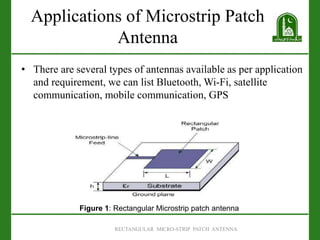
Figure 1: Rectangular Microstrip patch antenna
• There are several types of antennas available as per application
and requirement, we can list Bluetooth, Wi-Fi, satellite
communication, mobile communication, GPS
RECTANGULAR MICRO-STRIP PATCH ANTENNA
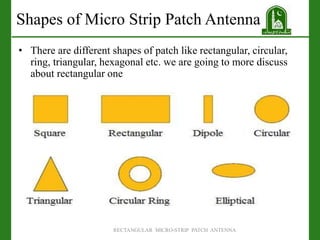
• There are different shapes of patch like rectangular, circular,
ring, triangular, hexagonal etc. we are going to more discuss
about rectangular one
Shapes of Micro Strip Patch Antenna
Bandwidth
RECTANGULAR MICRO-STRIP PATCH ANTENNA
• The bandwidth of the patch is defined as the frequency
range over which it is matched with that of the feed line
within specified limits
• The bandwidth of an antenna is usually defined by the
acceptable S-parameters or Return Loss S11 from -10 dB
to down value over the concerned frequency range.
• To calculate the measure of percentage of the bandwidth
(%B), we have:
• 𝐹 𝐻−𝐹 𝐿
• %𝐵= 𝐹𝐶 ×100 : Where 𝐹 𝐻 is the highest frequency, 𝐹 𝐿 is
the lowest frequency and 𝐹 𝐶 is the central frequency
Feeding techniques
• Feeding technique influences the input impedance and
polarization characteristics of the antenna
• These are coaxial probe feeds, microstrip line feeds,
and aperture coupled feeds
• Microstrip line-feeds structures are more suitable
compared to probe feeds and aperture coupled feeds ,
due to easy of fabrication and lower costs
RECTANGULAR MICRO-STRIP PATCH ANTENNA
_______________________________
_______________________________
8RECTANGULAR MICRO-STRIP PATCH ANTENNA
S-parameters
• S-parameters are a function of frequency
• S11 represents how much power is reflected from the
antenna, and hence is known as the reflection coefficient or
return loss
• If S11=0 dB, then all the power is reflected from the antenna
and nothing is radiated
• If S11= -3 dB, it means 50% of the signal is throwing back
before starting sending. It is for calculate HPBW (half power
bandwidth)
• If S11= -10 dB (acceptable value), it means 10% of the
incident power is reflected back towards the source from
antenna
VSWR (Voltage Standing
Waves Ratio)
•VSWR is a function of the reflection coefficient, which describes
the power reflected from the antenna
•VSWR is a measure of how much power is delivered to an
antenna.
•An antenna matches well when VSWR is comprised between
(1 < VSWR <2).
RECTANGULAR MICRO-STRIP PATCH ANTENNA
Gain
_______________________________
_______________________________
• The gain of the antenna is a basic property which is frequently
used as figure of merit
• The power radiated by any practical antenna is concentrated
more in one direction and less in others directions
• the gain of any antenna can be defined as
RECTANGULAR MICRO-STRIP PATCH ANTENNA
Calculation of width and length of
RMPA
RECTANGULAR MICRO-STRIP PATCH ANTENNA
Calculations
RECTANGULAR MICRO-STRIP PATCH ANTENNA
Microstrip Antenna Advantages and
Limitations
• Advantages of microstrip antenna
• Low weight, low volume, and then profile configurations,
which can be conform.
• Low fabrication cost, eagerly amenable to mass production.
• Linear and circular polarizations are possible with simple
feed.
• Dual frequency and dual polarization antennas can be easily
made.
• Can be easily integrated with microwave integrated circuit.
• Feed lines and matching networks can be fabricated
concurrently with the antenna structure.
_______________________________
_______________________________
RECTANGULAR MICRO-STRIP PATCH ANTENNA
Limitations
RECTANGULAR MICRO-STRIP PATCH ANTENNA
_______________________________
_______________________________
• Narrow Bandwidth (BW) and associated tolerance
problems.
• Complex feed structure required for high
performance arrays.
• Unrelated radiation from feeds and junction.
• Excitation of surface waves.
• Lower power handling capability
RECTANGULAR MICRO-STRIP PATCH ANTENNA

Rectangular antenna

  • 1.
  • 2.
    Outline • Introduction • Applicationsof Microstrip Patch Antenna Technical • Shapes of Micro Strip Patch Antenna • Bandwidth • Feeding techniques • S-parameters • VSWR (Voltage Standing Waves Ratio) • Gain • Calculation of width and length of RMPA • Microstrip Antenna Advantages and Limitations RECTANGULAR MICRO-STRIP PATCH ANTENNA _______________________________ _______________________________
  • 3.
    Introduction • Antenna isbasic component of any electronic system which depends on free space as a propagation medium • The basic antenna parameters like gain, bandwidth, beam width and return loss are the main things to be considered while designing an antenna • But our work will be more focused to increase bandwidth using slotting. All this work will be done by using HFSS (High Frequency Structure Simulator) • The concept of Microstrip antenna was first proposed by Deschamps in 1953 RECTANGULAR MICRO-STRIP PATCH ANTENNA _______________________________ _______________________________
  • 4.
    RECTANGULAR MICRO-STRIP PATCHANTENNA Applications of Microstrip Patch Antenna Figure 1: Rectangular Microstrip patch antenna • There are several types of antennas available as per application and requirement, we can list Bluetooth, Wi-Fi, satellite communication, mobile communication, GPS
  • 5.
    RECTANGULAR MICRO-STRIP PATCHANTENNA • There are different shapes of patch like rectangular, circular, ring, triangular, hexagonal etc. we are going to more discuss about rectangular one Shapes of Micro Strip Patch Antenna
  • 6.
    Bandwidth RECTANGULAR MICRO-STRIP PATCHANTENNA • The bandwidth of the patch is defined as the frequency range over which it is matched with that of the feed line within specified limits • The bandwidth of an antenna is usually defined by the acceptable S-parameters or Return Loss S11 from -10 dB to down value over the concerned frequency range. • To calculate the measure of percentage of the bandwidth (%B), we have: • 𝐹 𝐻−𝐹 𝐿 • %𝐵= 𝐹𝐶 ×100 : Where 𝐹 𝐻 is the highest frequency, 𝐹 𝐿 is the lowest frequency and 𝐹 𝐶 is the central frequency
  • 7.
    Feeding techniques • Feedingtechnique influences the input impedance and polarization characteristics of the antenna • These are coaxial probe feeds, microstrip line feeds, and aperture coupled feeds • Microstrip line-feeds structures are more suitable compared to probe feeds and aperture coupled feeds , due to easy of fabrication and lower costs RECTANGULAR MICRO-STRIP PATCH ANTENNA _______________________________ _______________________________
  • 8.
    8RECTANGULAR MICRO-STRIP PATCHANTENNA S-parameters • S-parameters are a function of frequency • S11 represents how much power is reflected from the antenna, and hence is known as the reflection coefficient or return loss • If S11=0 dB, then all the power is reflected from the antenna and nothing is radiated • If S11= -3 dB, it means 50% of the signal is throwing back before starting sending. It is for calculate HPBW (half power bandwidth) • If S11= -10 dB (acceptable value), it means 10% of the incident power is reflected back towards the source from antenna
  • 9.
    VSWR (Voltage Standing WavesRatio) •VSWR is a function of the reflection coefficient, which describes the power reflected from the antenna •VSWR is a measure of how much power is delivered to an antenna. •An antenna matches well when VSWR is comprised between (1 < VSWR <2). RECTANGULAR MICRO-STRIP PATCH ANTENNA
  • 10.
    Gain _______________________________ _______________________________ • The gainof the antenna is a basic property which is frequently used as figure of merit • The power radiated by any practical antenna is concentrated more in one direction and less in others directions • the gain of any antenna can be defined as RECTANGULAR MICRO-STRIP PATCH ANTENNA
  • 11.
    Calculation of widthand length of RMPA RECTANGULAR MICRO-STRIP PATCH ANTENNA
  • 12.
  • 13.
    Microstrip Antenna Advantagesand Limitations • Advantages of microstrip antenna • Low weight, low volume, and then profile configurations, which can be conform. • Low fabrication cost, eagerly amenable to mass production. • Linear and circular polarizations are possible with simple feed. • Dual frequency and dual polarization antennas can be easily made. • Can be easily integrated with microwave integrated circuit. • Feed lines and matching networks can be fabricated concurrently with the antenna structure. _______________________________ _______________________________ RECTANGULAR MICRO-STRIP PATCH ANTENNA
  • 14.
    Limitations RECTANGULAR MICRO-STRIP PATCHANTENNA _______________________________ _______________________________ • Narrow Bandwidth (BW) and associated tolerance problems. • Complex feed structure required for high performance arrays. • Unrelated radiation from feeds and junction. • Excitation of surface waves. • Lower power handling capability
  • 15.