Download to read offline
![International Research Journal of Engineering and Technology (IRJET) e-ISSN: 2395-0056
Volume: 06 Issue: 10 | Oct 2019 www.irjet.net p-ISSN: 2395-0072
© 2019, IRJET | Impact Factor value: 7.34 | ISO 9001:2008 Certified Journal | Page 1185
ANALYSIS OF TRIANGULAR SLOT MICROSTRIP PATCH ANTENNA FOR
MULTIBAND APPLICATIONS
Akila G1& Mrs.Binisha X.M2&Mrs.Riyaz Fathima H3
1
PG Scholar, Department of Electronics and Communication Engineering, PET Engg. College, Vallioor, India
2,3
Assistant Professor, Department of Electronics and Communication Engg., PET Engg. College, Vallioor, India
-----------------------------------------------------------------------***------------------------------------------------------------------------
Abstract – A triangular slot is introduced at the upper
edge of the patch to reduce the resonant frequency a small
piece of triangular patch is grown within the triangular
slot to improve the gain bandwidth performance of the
patch and ground plane. Patch antennas have narrow
bandwidth and the improvement of bandwidth is essential
for most applications. The antenna parameters like Return
loss, VSWR, Radiation pattern are verified and stimulated
on CST Microwave Studio.
Key Words: Directivity, Gain, Return loss, Bandwidth
1. INTRODUCTION
Two microstrip patch antennas (MPAs) are presented,
one is conventional MPA and another is metamaterial
based MPA which is made by introducing three dual
isosceles triangular slots on the copper patch of the
conventional MPA. Metamaterial properties of the
designed and proposed isosceles triangular slotted
structure are investigated and proved as metamaterial by
using Nicolson Ross Weir (NRW) approach. The proposed
slotted structure exhibits double negative (DNG) property
of metamaterial and the proposed metamaterial antenna
shows improved bandwidth, greater directivity, lower
return loss, comparatively more suitable VSWR than the
conventional MPA.[1]. Microstrip patch antennas have
made a great progress in the recent years. Compared with
the conventional antennas, microstrip patch antennas
have more advantages and better prospects. A microstrip
patch design of a probe- fed antenna is presented for
simultaneously Wireless Local Area Network (WLAN).The
growth of wireless systems and booming demand for a
variety of new wireless applications such as WLAN
(Wireless Local Area Network), it is important to design
broadband and high gain antennas to cover a wide
frequency range. The design of an efficient wide band
small size antenna, for recent wireless applications, is a
major challenge. In applications like high performance
aircraft, satellite, missile, mobile radio and wireless
communications small size, low-cost fabrication, low
profile, conformability and ease of installation and
integration with feed networks are the main constraints.
Also, with advancement of the technology, the
requirement of an antenna to resonate at more than one
frequency i.e. multi-banding is also increasing day by
day[2]. A rectangular microstrip antenna is conceived for
a UWB system communication application, which is
operating at a frequency of 4.1 GHz. The microstrip UWB
antennas is one of the most commonly used antennas in
radar applications. It has attracted a lot of attention
because of their advantages such as ease of fabrication
simple structure, easy integration with microwave
integrated circuits. Geometric shape of a microstrip
antenna comprises a radiating element on the dielectric
substrate and on the other side a ground plane. There are
several category of the microstrip patch antenna, can be
cited some example the circular, a square radiating
element, triangular, semicircular..., but the most common
is rectangular element[3]. A lot of UWB antenna has been
proposed since past years, but not many of them are
compact in size. The FR4 is used as substrate material and
the width of the substrate is 1.63 mm. The patch width is
kept 0.035 mm. The width of the feed line is different
over the whole feed line. On the backside of the antenna,
the partial grounding technique is applied to triangular
slots within the ground plane. The partial ground plane
has an impact behind providing wide bandwidth. The
triangular shaped microstrip patch antenna is designed
and simulated under CST Microwave Studio environment.
Partial ground is used for the antenna for grounding
purpose. The triangular shaped slots are used to enhance
the bandwidth for the antenna[4]. In general an antenna
is a part of transmitting or receiving system that can
transmit or receive electromagnetic waves. There are
different kinds of antenna that used in several
applications. Some of them are: wire antenna, aperture
antenna, printed antenna, array antenna, reflector
antenna, and lens antenna. Among these antennas printed
antenna is fabricated using photolithography technique.
Most common version of the printed antenna is
microstrip antenna. It is constructed using conventional
microstrip fabrication technique. Microstrip antenna
consist of a radiating patch on one side of a dielectric
substrate and has a ground plane on the other side. There
are three types in microstrip antenna.Microstrip](https://image.slidesharecdn.com/irjet-v6i10206-191231071114/85/IRJET-Analysis-of-Triangular-Slot-Microstrip-Patch-Antenna-for-Multiband-Applications-1-320.jpg)
![International Research Journal of Engineering and Technology (IRJET) e-ISSN: 2395-0056
Volume: 06 Issue: 10 | Oct 2019 www.irjet.net p-ISSN: 2395-0072
© 2019, IRJET | Impact Factor value: 7.34 | ISO 9001:2008 Certified Journal | Page 1185
ANALYSIS OF TRIANGULAR SLOT MICROSTRIP PATCH ANTENNA FOR
MULTIBAND APPLICATIONS
Akila G1& Mrs.Binisha X.M2&Mrs.Riyaz Fathima H3
1
PG Scholar, Department of Electronics and Communication Engineering, PET Engg. College, Vallioor, India
2,3
Assistant Professor, Department of Electronics and Communication Engg., PET Engg. College, Vallioor, India
-----------------------------------------------------------------------***------------------------------------------------------------------------
Abstract – A triangular slot is introduced at the upper
edge of the patch to reduce the resonant frequency a small
piece of triangular patch is grown within the triangular
slot to improve the gain bandwidth performance of the
patch and ground plane. Patch antennas have narrow
bandwidth and the improvement of bandwidth is essential
for most applications. The antenna parameters like Return
loss, VSWR, Radiation pattern are verified and stimulated
on CST Microwave Studio.
Key Words: Directivity, Gain, Return loss, Bandwidth
1. INTRODUCTION
Two microstrip patch antennas (MPAs) are presented,
one is conventional MPA and another is metamaterial
based MPA which is made by introducing three dual
isosceles triangular slots on the copper patch of the
conventional MPA. Metamaterial properties of the
designed and proposed isosceles triangular slotted
structure are investigated and proved as metamaterial by
using Nicolson Ross Weir (NRW) approach. The proposed
slotted structure exhibits double negative (DNG) property
of metamaterial and the proposed metamaterial antenna
shows improved bandwidth, greater directivity, lower
return loss, comparatively more suitable VSWR than the
conventional MPA.[1]. Microstrip patch antennas have
made a great progress in the recent years. Compared with
the conventional antennas, microstrip patch antennas
have more advantages and better prospects. A microstrip
patch design of a probe- fed antenna is presented for
simultaneously Wireless Local Area Network (WLAN).The
growth of wireless systems and booming demand for a
variety of new wireless applications such as WLAN
(Wireless Local Area Network), it is important to design
broadband and high gain antennas to cover a wide
frequency range. The design of an efficient wide band
small size antenna, for recent wireless applications, is a
major challenge. In applications like high performance
aircraft, satellite, missile, mobile radio and wireless
communications small size, low-cost fabrication, low
profile, conformability and ease of installation and
integration with feed networks are the main constraints.
Also, with advancement of the technology, the
requirement of an antenna to resonate at more than one
frequency i.e. multi-banding is also increasing day by
day[2]. A rectangular microstrip antenna is conceived for
a UWB system communication application, which is
operating at a frequency of 4.1 GHz. The microstrip UWB
antennas is one of the most commonly used antennas in
radar applications. It has attracted a lot of attention
because of their advantages such as ease of fabrication
simple structure, easy integration with microwave
integrated circuits. Geometric shape of a microstrip
antenna comprises a radiating element on the dielectric
substrate and on the other side a ground plane. There are
several category of the microstrip patch antenna, can be
cited some example the circular, a square radiating
element, triangular, semicircular..., but the most common
is rectangular element[3]. A lot of UWB antenna has been
proposed since past years, but not many of them are
compact in size. The FR4 is used as substrate material and
the width of the substrate is 1.63 mm. The patch width is
kept 0.035 mm. The width of the feed line is different
over the whole feed line. On the backside of the antenna,
the partial grounding technique is applied to triangular
slots within the ground plane. The partial ground plane
has an impact behind providing wide bandwidth. The
triangular shaped microstrip patch antenna is designed
and simulated under CST Microwave Studio environment.
Partial ground is used for the antenna for grounding
purpose. The triangular shaped slots are used to enhance
the bandwidth for the antenna[4]. In general an antenna
is a part of transmitting or receiving system that can
transmit or receive electromagnetic waves. There are
different kinds of antenna that used in several
applications. Some of them are: wire antenna, aperture
antenna, printed antenna, array antenna, reflector
antenna, and lens antenna. Among these antennas printed
antenna is fabricated using photolithography technique.
Most common version of the printed antenna is
microstrip antenna. It is constructed using conventional
microstrip fabrication technique. Microstrip antenna
consist of a radiating patch on one side of a dielectric
substrate and has a ground plane on the other side. There
are three types in microstrip antenna.Microstrip](https://image.slidesharecdn.com/irjet-v6i10206-191231071114/75/IRJET-Analysis-of-Triangular-Slot-Microstrip-Patch-Antenna-for-Multiband-Applications-1-2048.jpg)
![International Research Journal of Engineering and Technology (IRJET) e-ISSN: 2395-0056
Volume: 06 Issue: 10 | Oct 2019 www.irjet.net p-ISSN: 2395-0072
© 2019, IRJET | Impact Factor value: 7.34 | ISO 9001:2008 Certified Journal | Page 1186
slot/travelling antenna and Printed dipole antenna.
Among the above three types microstrip patch antenna
can have any shape. Microstrip slot/travelling antenna is
mostly rectangular or circular shape. Printed dipole
antenna have triangular and rectangular shape. The most
important thing in antenna design is to select the
appropriate substrate material[5]. The conducting strip is
smaller in width as compared to the patch. This kind of
feed arrangement has the advantage that the feed can be
etched on the same substrate to provide a planar
structure. An inset cut can be incorporated into the patch
in order to obtain good impedance matching without the
need for any additional matching element[6].Triangular
patch antenna provide radiation characteristics which is
similar to rectangular patches with smaller size. The
antenna size can be further reduced by loading it with a
short and/or slot. The simplest triangular shape
considered to be equilateral triangle with grounded
dielectric substrate[7].
2. METHODOLOGIES
a)Microstrip patch antenna with triangular slot
The aim of this work is to design and analysis the
performance of a metamaterial (MTM) based microstrip
patch antenna (MPA) by introducing three dual isosceles
triangular slots on the metallic patch. At First, a
conventional microstrip patch antenna is designed using
Isola FR-408 (loss free) substrate material having
dielectric constant of 3.75. Then the slotted microstrip
patch antenna has been designed and verified as left
handed metamaterial (LHM) with the help of Nicolson
Ross Weir (NRW) method. All the simulations have been
accomplished by CST microwave studio 2011. The
bandwidth of the proposed MTM antenna is enhanced by
464.93% compared to our designed conventional MPA
(77 MHz for conventional MPA and 435 MHz for
metamaterial MPA) and the return loss is reduced from -
11.89 dB to -55.34 dB and directivity is increased from
6.713 dB to 7.187 dB. The voltage standing wave ratio
(VSWR) of the proposed metamaterial antenna is of
1.0034 which is very close to unity.
Fig-1:Return loss characteristics.
From the above figure 1 it shows that, the
conventional microstrip patch antenna possesses return
loss of -11.89 dB.
b)Microstrip patch antenna with rectangular slot
In this paper, the performance of a rectangular
microstrip patch antenna fed by microstrip line has been
designed to operate for multiband applications. It
consists of a rectangular patch with four L-slots at the
corners and one rectangular- slot in the center. The
antenna has designed using FR-4 lossy substrate
material with relative permittivity I:r is 4.3 and
thickness of 1.6mm. Simulation has realized by using
CST microwave studio software and the results shows
that the antenna resonates at the frequencies of 2.4GHz,
3.8GHz, 4.9GHz, 6.5GHz, 7.2GHz and 8.1GHz.
Fig-2: Return loss charactersticss
From the above Figure 2 it shows that at 2.4GHz,
3.8GHz, 4.9GHz ,6.5GHz, 7.2GHz and 8.1GHz freuencies
has return loss of
13.8dB,19.1dB,20dB,19.9dB,17dB,14.9dB.
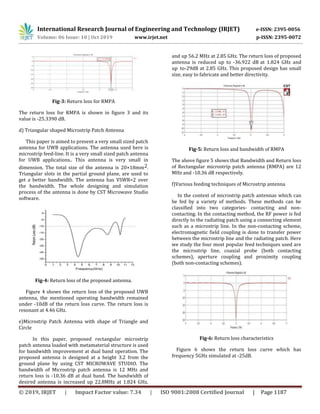
c)Rectangular Microstrip Patch Antenna
In this paper at 2.4835 GHz same RMPA is designed
with different types of feed line. By designing antenna
with 3 types of feeding some remarkable changes in
reflection coefficient, resonant frequency, gain, VSWR,
directivity is observed. RMPA is a narrow band Antenna
with low profile. The comparison of all the parameters is
done. This antenna most widely used in Wi-Fi
applications for transmitting and receiving signals. Hence
this paper describes the design of RMPA Wi-Fi antenna.](https://image.slidesharecdn.com/irjet-v6i10206-191231071114/85/IRJET-Analysis-of-Triangular-Slot-Microstrip-Patch-Antenna-for-Multiband-Applications-2-320.jpg)
![International Research Journal of Engineering and Technology (IRJET) e-ISSN: 2395-0056
Volume: 06 Issue: 10 | Oct 2019 www.irjet.net p-ISSN: 2395-0072
© 2019, IRJET | Impact Factor value: 7.34 | ISO 9001:2008 Certified Journal | Page 1188
g) Microstrip Triangular Patch Antenna
In this paper, the microstrip patch antennas are used
in various applications for the high performance in the
wireless communication system. The simple method is
designed and analysis of triangular shape microstrip
antenna by varying FR-4 substrate with CST (Computer
Simulation Technology) to obtain various results. We
have taken the rectangular substrate FR-4 of dimension
7×7 mm. The antenna operates between 5 GHz to 25GHz
range. The design of an antenna is described and
simulated results for the main parameters like return
loss, directivity, and radiation patterns are discussed.
These antennas are useful for the applications like UMTS,
ISM.
Fig-7:Return loss characteristics for triangular patch
antenna
From the above Figure 7 represents the return loss
at four different frequencies i.e. (10.8, 15.4, 17.8, 21.8
GHz) which are used as ultra wide band for different
applications.
Fig-8: VSWR for triangular patch antenna
Figure 8 shows the VSWR curve which has frequency 10
GHz to 24 GHz simulated at frequency 10.72 GHz which
shows the good impedance matching between the
antenna and transmission line.
3. RESULT AND DISCUSSION
In this paper, the different antennas structures such
as microstrip patch antenna with triangular slot,
microstrip patch antenna with rectangular slot,
rectangular microstrip patch antenna, triangular shaped
microstrip patch antenna, microstrip triangular patch
antennas designs were analyzed. From the above
observation it is inferred that microstrip patch antennas
provide less return loss.
4. CONCLUSION
In this survey paper, various antennas designs were
analyzed. From the observation it was found microstrip
patch antenna produced lower return loss of -35dB.
REFERENCES
[1].L.C.Paul, L. C., Haque, M. A., Haque, M. A., Rashid, M. M.
U., Islam, M. F., & Rahman, M. M. (2017). “Design a slotted
metamaterial microstrip patch antenna by creating three
dual isosceles triangular slots on the patch and
bandwidth enhancement”. 2017 3rd International
Conference on Electrical Information and Communication
Technology (EICT).
[2]Kalika Mehra, K., & Jain, A. (2017). “Design and
analysis of L-slots with rectangular slot multiband
microstrip rectangular patch antenna”. 2017
International Conference on Computer, Communications
and Electronics (Comptelix).
[3] Rahul Dev Mishra(2016) “RMPA Design and Analysis
for Wi-Fi Applications at ISM Band”, International Journal
of Computer & Communication Engineering Research
(IJCCER)
[4] Ullah, M. A., Ashraf, F. B., Alam, T., Alam, M. S., Kibria,
S., & Islam, M. T. (2016). “ A compact triangular shaped
microstrip patch antenna with triangular slotted ground
for UWB application”.2016 International Conference on
Innovations in Science, Engineering and Technology
(ICISET).
[5]Abhishek Vyas, S.S. Dhakad(2014) “Microstrip Patch
Antenna Loaded with Shapes of Triangle and Circle using
Metamaterial Structure”, International Journal of
Engineering and Advanced Technology(IJEAT).](https://image.slidesharecdn.com/irjet-v6i10206-191231071114/85/IRJET-Analysis-of-Triangular-Slot-Microstrip-Patch-Antenna-for-Multiband-Applications-4-320.jpg)
![International Research Journal of Engineering and Technology (IRJET) e-ISSN: 2395-0056
Volume: 06 Issue: 10 | Oct 2019 www.irjet.net p-ISSN: 2395-0072
© 2019, IRJET | Impact Factor value: 7.34 | ISO 9001:2008 Certified Journal | Page 1189
[6] Sourabh Bisht , Shweta Saini , Dr Ved Prakash ,
Bhaskar Nautiyal(2013). “Study The Various Feeding
Techniques of Microstrip Antenna Using Design and
Simulation Using CST Microwave Studio”, International
Journal of Emerging Technology and Advanced
Engineering(IJETAE).
[7] Nishat, Ratish Kumar Dhiman, “Performance Analysis
of Microstrip Triangle Patch Antenna Using FR-4
Substrate”, International Journal of Science and Research
(IJSR).](https://image.slidesharecdn.com/irjet-v6i10206-191231071114/85/IRJET-Analysis-of-Triangular-Slot-Microstrip-Patch-Antenna-for-Multiband-Applications-5-320.jpg)

The document discusses several designs of microstrip patch antennas with modifications like triangular slots, rectangular slots, and different feeding techniques. It analyzes how these modifications impact antenna parameters like return loss, bandwidth, directivity, and voltage standing wave ratio (VSWR). The key findings are that introducing triangular slots can reduce return loss to -35dB and increase bandwidth up to 464.93%. Rectangular slotted designs achieved return loss as low as -19.1dB across multiple bands. Feeding techniques like microstrip lines and coaxial probes were also compared. In general, the analyzed modifications helped improve antenna performance for multiband applications.


