











Nitisha Goyal (108)
Karan Paleja (111)
Deepak Mehta (114)
Shivendra Singh (122)
Chittesh Khilnani (310)
Ishan Parekh (315)
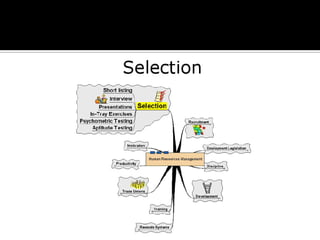
Selection
“Hire hard, manage easy.”
 “Good training will not make up for
bad selection.”
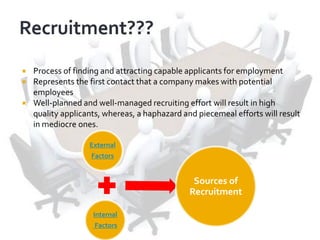
 Process of finding and attracting capable applicants for employment
 Represents the first contact that a company makes with potential
employees
 Well-planned and well-managed recruiting effort will result in high
quality applicants, whereas, a haphazard and piecemeal efforts will result
in mediocre ones.
External
Factors
Internal
Factors
Sources of
Recruitment
 Transfer
 Promotion
 Job Posting
 Former Employees
 Employee’s reference
 Direct Recruitment (Recruitment at factory gate)
 Casual Callers
 Media advertisement
 Employment Consultants
 Educational Institutions or Campus Recruitment
 Recommendations
 Labour Contractors
 Telecasting
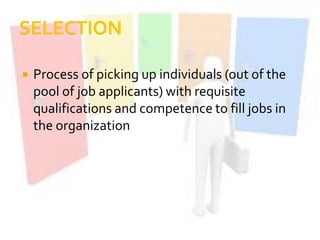
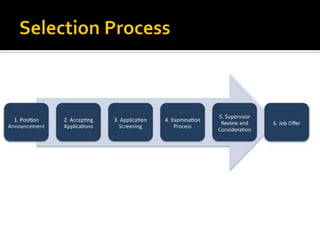
 Process of picking up individuals (out of the
pool of job applicants) with requisite
qualifications and competence to fill jobs in
the organization
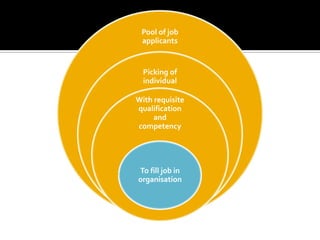
Pool of job
applicants
Picking of
individual
With requisite
qualification
and
competency
To fill job in
organisation
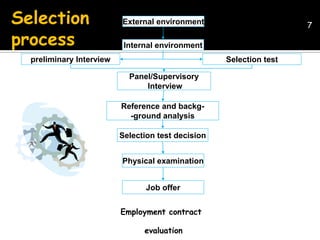
External environment
Internal environment
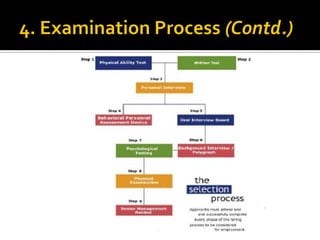
preliminary Interview Selection test
Panel/Supervisory
Interview
Reference and backg-
-ground analysis
Selection test decision
Physical examination
Job offer
Employment contract
evaluation
Selection
process
7
 .
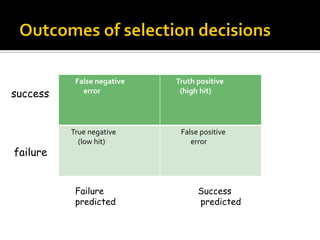
False negative
error
Truth positive
(high hit)
True negative
(low hit)
False positive
error
Failure
predicted
Success
predicted
success
failure
13
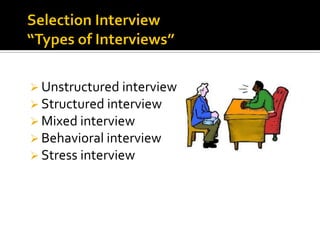
 Unstructured interview
 Structured interview
 Mixed interview
 Behavioral interview
 Stress interview
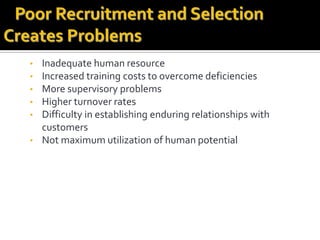
• Inadequate human resource
• Increased training costs to overcome deficiencies
• More supervisory problems
• Higher turnover rates
• Difficulty in establishing enduring relationships with
customers
• Not maximum utilization of human potential
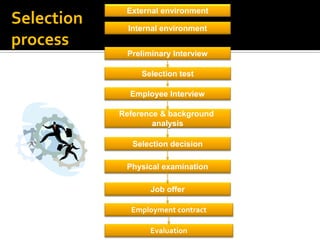
External environment
Internal environment
Preliminary Interview
Selection test
Employee Interview
Reference & background
analysis
Selection decision
Physical examination
Job offer
Employment contract
Evaluation
Selection
process
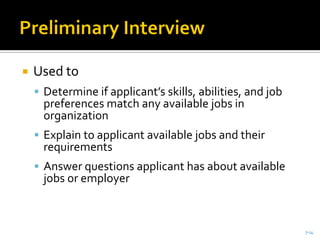
 Used to
 Determine if applicant’s skills, abilities, and job
preferences match any available jobs in
organization
 Explain to applicant available jobs and their
requirements
 Answer questions applicant has about available
jobs or employer
7-14
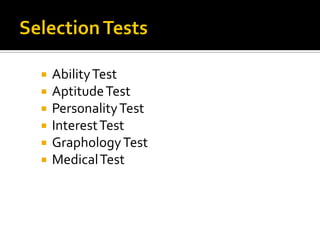
 AbilityTest
 AptitudeTest
 PersonalityTest
 InterestTest
 GraphologyTest
 MedicalTest
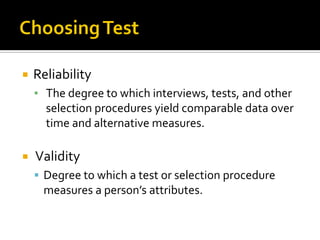
 Reliability
▪ The degree to which interviews, tests, and other
selection procedures yield comparable data over
time and alternative measures.
 Validity
 Degree to which a test or selection procedure
measures a person’s attributes.
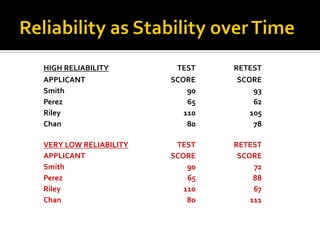
HIGH RELIABILITY TEST RETEST
APPLICANT SCORE SCORE
Smith 90 93
Perez 65 62
Riley 110 105
Chan 80 78
VERY LOW RELIABILITY TEST RETEST
APPLICANT SCORE SCORE
Smith 90 72
Perez 65 88
Riley 110 67
Chan 80 111
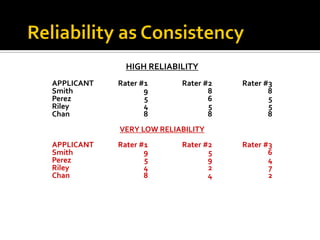
HIGH RELIABILITY
APPLICANT Rater #1 Rater #2 Rater #3
Smith 9 8 8
Perez 5 6 5
Riley 4 5 5
Chan 8 8 8
VERY LOW RELIABILITY
APPLICANT Rater #1 Rater #2 Rater #3
Smith 9 5 6
Perez 5 9 4
Riley 4 2 7
Chan 8 4 2
 One-to-one
 Sequential
 Panel
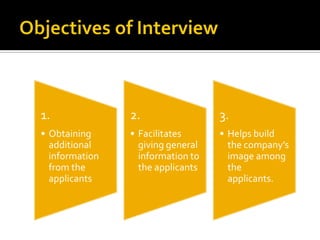
1.
• Obtaining
additional
information
from the
applicants
2.
• Facilitates
giving general
information to
the applicants
3.
• Helps build
the company’s
image among
the
applicants.
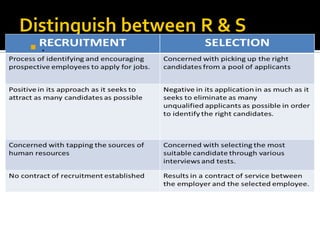
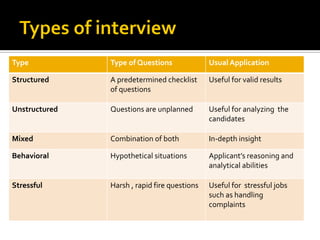
Type Type of Questions Usual Application
Structured A predetermined checklist
of questions
Useful for valid results
Unstructured Questions are unplanned Useful for analyzing the
candidates
Mixed Combination of both In-depth insight
Behavioral Hypothetical situations Applicant’s reasoning and
analytical abilities
Stressful Harsh , rapid fire questions Useful for stressful jobs
such as handling
complaints
 No Complete job description.
 No accurate appraisal.
 Snap judgements.
 Halo effect.
 Tendency to be swayed by negative
information.
 Information not discussed in a systematic
manner.
 Pressure to fill position.
 Affected by a list of available applicants.
 Differences between interviewers.
 Sex, race and attitudes.
 Plan the interview.
 Establish an easy and informal relationship.
 Cover the ground as planned.
 Probe.
 Analyse.
 Maintain control over direction.
 Start the interview unprepared.
 Plunge too quickly into demanding questions.
 Ask leading questions.
 Jump to conclusions.
 Pay too much attention to isolated strength
and weaknesses.
 Talk too much.
 Use structured form.
 Evaluate immediately.
 Focus on traits.
 Get the interviewee to talk.
 Respect reservation policy of concerned
government.
 Openers.
 Regarding Motivation.
 Regarding Education.
 Regarding Experience.
 Regarding Pay.
 Reference and Background Checks.
 Selection Process.
 Physical Examination.
 Cleared all previous processes of selection.
 Letter of appointment containing reporting date.
 Inform rejected applicants about non-selection.
 Preserve applications for future use.
 Document executed between employer &
candidate.
 Attestation form
 Job title
 Employee duties
 Reporting date
 Payment details
 Working hours
 Holidays
 Sickness
 Grievance procedure
 Disciplinary procedure
 Work rules
 Arrangement for terminating employment
 Arrangement for union membership
 Rights related to patents, information
confidentiality…
 Rights related to change contract terms
Contracts help in
 Restraining job-hoppers
 Protect information
 Preventing competitors from poaching highly
valued employees.
 Doesn’t end with execution of employment
contract.
 Important to reassure candidates who were
not selected.
 Issues related to “No Shows”.
 No Shows is time & money consuming
process.
 No Shows result in loss of face, business &
trust for the company.
 Firm must have quality personnel who is
competent as well as committed.
 Steps-
 Analysis of programme
 Adequate communication of programme &
its procedures to personnel involved.
 Implementation of programme.
 Feedback
 Analysis of results.
 Special method of selection.
 Not a physical location but approach to select
managers based on measuring & evaluating
their ability of performing critical tasks.
 Takes place for 2-5 days between group of 6-12
people taking series of work sample tests.
 Panel of line managers drawn from different
departments act as evaluators.
 Perception
 Fairness
 Validity
 Reliability
 Pressure
- Nitisha Goyal
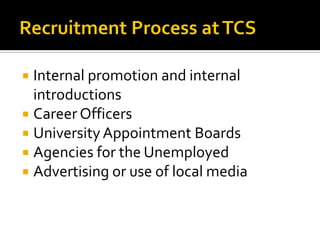
 Internal promotion and internal
introductions
 Career Officers
 University Appointment Boards
 Agencies for the Unemployed
 Advertising or use of local media
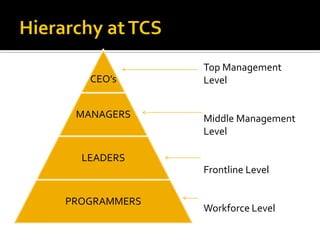
CEO’s
MANAGERS
LEADERS
PROGRAMMERS
Top Management
Level
Middle Management
Level
Frontline Level
Workforce Level
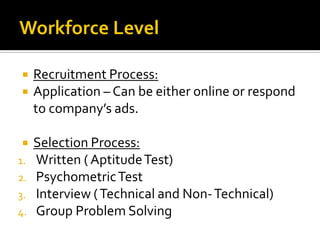
 Recruitment Process:
 Application – Can be either online or respond
to company’s ads.
 Selection Process:
1. Written ( AptitudeTest)
2. PsychometricTest
3. Interview (Technical and Non-Technical)
4. Group Problem Solving
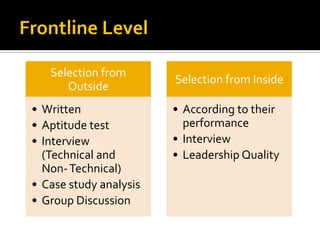
Selection from
Outside
• Written
• Aptitude test
• Interview
(Technical and
Non-Technical)
• Case study analysis
• Group Discussion
Selection from Inside
• According to their
performance
• Interview
• Leadership Quality
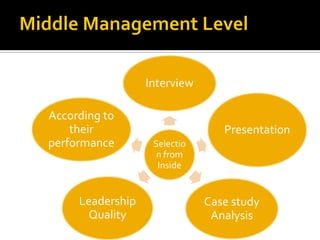
Selectio
n from
Inside
Interview
Presentation
Case study
Analysis
Leadership
Quality
According to
their
performance
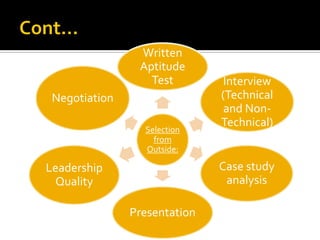
Selection
from
Outside:
Written
Aptitude
Test Interview
(Technical
and Non-
Technical)
Case study
analysis
Presentation
Leadership
Quality
Negotiation
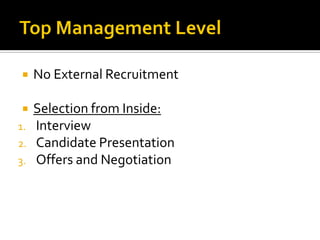
 No External Recruitment
 Selection from Inside:
1. Interview
2. Candidate Presentation
3. Offers and Negotiation
Selection Process at Google Inc.
-Ishan Parekh
THANK YOU

Selection & Recruitment in HRM

  • 1.
    Nitisha Goyal (108) KaranPaleja (111) Deepak Mehta (114) Shivendra Singh (122) Chittesh Khilnani (310) Ishan Parekh (315) Selection
  • 2.
    “Hire hard, manageeasy.”  “Good training will not make up for bad selection.”
  • 3.
     Process offinding and attracting capable applicants for employment  Represents the first contact that a company makes with potential employees  Well-planned and well-managed recruiting effort will result in high quality applicants, whereas, a haphazard and piecemeal efforts will result in mediocre ones. External Factors Internal Factors Sources of Recruitment
  • 4.
     Transfer  Promotion Job Posting  Former Employees  Employee’s reference
  • 5.
     Direct Recruitment(Recruitment at factory gate)  Casual Callers  Media advertisement  Employment Consultants  Educational Institutions or Campus Recruitment  Recommendations  Labour Contractors  Telecasting
  • 6.
     Process ofpicking up individuals (out of the pool of job applicants) with requisite qualifications and competence to fill jobs in the organization
  • 7.
    Pool of job applicants Pickingof individual With requisite qualification and competency To fill job in organisation
  • 8.
    External environment Internal environment preliminaryInterview Selection test Panel/Supervisory Interview Reference and backg- -ground analysis Selection test decision Physical examination Job offer Employment contract evaluation Selection process 7
  • 9.
  • 10.
    False negative error Truth positive (highhit) True negative (low hit) False positive error Failure predicted Success predicted success failure 13
  • 11.
     Unstructured interview Structured interview  Mixed interview  Behavioral interview  Stress interview
  • 12.
    • Inadequate humanresource • Increased training costs to overcome deficiencies • More supervisory problems • Higher turnover rates • Difficulty in establishing enduring relationships with customers • Not maximum utilization of human potential
  • 13.
    External environment Internal environment PreliminaryInterview Selection test Employee Interview Reference & background analysis Selection decision Physical examination Job offer Employment contract Evaluation Selection process
  • 14.
     Used to Determine if applicant’s skills, abilities, and job preferences match any available jobs in organization  Explain to applicant available jobs and their requirements  Answer questions applicant has about available jobs or employer 7-14
  • 15.
     AbilityTest  AptitudeTest PersonalityTest  InterestTest  GraphologyTest  MedicalTest
  • 16.
     Reliability ▪ Thedegree to which interviews, tests, and other selection procedures yield comparable data over time and alternative measures.  Validity  Degree to which a test or selection procedure measures a person’s attributes.
  • 17.
    HIGH RELIABILITY TESTRETEST APPLICANT SCORE SCORE Smith 90 93 Perez 65 62 Riley 110 105 Chan 80 78 VERY LOW RELIABILITY TEST RETEST APPLICANT SCORE SCORE Smith 90 72 Perez 65 88 Riley 110 67 Chan 80 111
  • 18.
    HIGH RELIABILITY APPLICANT Rater#1 Rater #2 Rater #3 Smith 9 8 8 Perez 5 6 5 Riley 4 5 5 Chan 8 8 8 VERY LOW RELIABILITY APPLICANT Rater #1 Rater #2 Rater #3 Smith 9 5 6 Perez 5 9 4 Riley 4 2 7 Chan 8 4 2
  • 19.
  • 20.
    1. • Obtaining additional information from the applicants 2. •Facilitates giving general information to the applicants 3. • Helps build the company’s image among the applicants.
  • 21.
    Type Type ofQuestions Usual Application Structured A predetermined checklist of questions Useful for valid results Unstructured Questions are unplanned Useful for analyzing the candidates Mixed Combination of both In-depth insight Behavioral Hypothetical situations Applicant’s reasoning and analytical abilities Stressful Harsh , rapid fire questions Useful for stressful jobs such as handling complaints
  • 22.
     No Completejob description.  No accurate appraisal.  Snap judgements.  Halo effect.  Tendency to be swayed by negative information.
  • 23.
     Information notdiscussed in a systematic manner.  Pressure to fill position.  Affected by a list of available applicants.  Differences between interviewers.  Sex, race and attitudes.
  • 25.
     Plan theinterview.  Establish an easy and informal relationship.  Cover the ground as planned.  Probe.  Analyse.  Maintain control over direction.
  • 26.
     Start theinterview unprepared.  Plunge too quickly into demanding questions.  Ask leading questions.  Jump to conclusions.  Pay too much attention to isolated strength and weaknesses.  Talk too much.
  • 27.
     Use structuredform.  Evaluate immediately.  Focus on traits.  Get the interviewee to talk.  Respect reservation policy of concerned government.
  • 28.
     Openers.  RegardingMotivation.  Regarding Education.  Regarding Experience.  Regarding Pay.
  • 29.
     Reference andBackground Checks.  Selection Process.  Physical Examination.
  • 31.
     Cleared allprevious processes of selection.  Letter of appointment containing reporting date.  Inform rejected applicants about non-selection.  Preserve applications for future use.
  • 32.
     Document executedbetween employer & candidate.  Attestation form
  • 33.
     Job title Employee duties  Reporting date  Payment details  Working hours  Holidays  Sickness
  • 34.
     Grievance procedure Disciplinary procedure  Work rules  Arrangement for terminating employment  Arrangement for union membership  Rights related to patents, information confidentiality…  Rights related to change contract terms
  • 35.
    Contracts help in Restraining job-hoppers  Protect information  Preventing competitors from poaching highly valued employees.
  • 36.
     Doesn’t endwith execution of employment contract.  Important to reassure candidates who were not selected.  Issues related to “No Shows”.  No Shows is time & money consuming process.  No Shows result in loss of face, business & trust for the company.
  • 37.
     Firm musthave quality personnel who is competent as well as committed.  Steps-  Analysis of programme  Adequate communication of programme & its procedures to personnel involved.  Implementation of programme.  Feedback  Analysis of results.
  • 38.
     Special methodof selection.  Not a physical location but approach to select managers based on measuring & evaluating their ability of performing critical tasks.  Takes place for 2-5 days between group of 6-12 people taking series of work sample tests.  Panel of line managers drawn from different departments act as evaluators.
  • 39.
     Perception  Fairness Validity  Reliability  Pressure
  • 40.
  • 41.
     Internal promotionand internal introductions  Career Officers  University Appointment Boards  Agencies for the Unemployed  Advertising or use of local media
  • 42.
  • 43.
     Recruitment Process: Application – Can be either online or respond to company’s ads.  Selection Process: 1. Written ( AptitudeTest) 2. PsychometricTest 3. Interview (Technical and Non-Technical) 4. Group Problem Solving
  • 44.
    Selection from Outside • Written •Aptitude test • Interview (Technical and Non-Technical) • Case study analysis • Group Discussion Selection from Inside • According to their performance • Interview • Leadership Quality
  • 45.
  • 46.
  • 47.
     No ExternalRecruitment  Selection from Inside: 1. Interview 2. Candidate Presentation 3. Offers and Negotiation
  • 48.
    Selection Process atGoogle Inc. -Ishan Parekh
  • 61.