Chapter 5
Chapter 5
Recruiting and Selecting
Employees
5-1
Course Instructor: Rajja Rashad
HUMAN RESOURCE MANAGEMENT
Topics Covered
Topics Covered
1. Human resource planning: Labor supply
and demand
2. The hiring process
3. Challenges in the hiring process
4. Recruitment & its sources
5. Selection & the tools of selection
6. Selection and the Person/Organization
Fit
7. Legal issues in staffing
5-2
Human Resources Planning
5-3
Human Resources Planning
• Human resource planning (HRP) is the process an
organization uses to ensure that it has the right amount
and the right kind of people to deliver a particular
level of output or services in the future.
• Labor Demand
Labor Demand
o The number of workers the organization will need in the future.
The number of workers the organization will need in the future.
o The first HRP activity entails forecasting labor demand. Labor
demand is likely to increase as demand for the firm’s product
or services increases and is likely to decrease as labor
productivity increases.
• Labor Supply
Labor Supply
o The availability of workers with the required skills to meet the
The availability of workers with the required skills to meet the
firm’s labor demand.
o The second part of HRP entails estimating labor supply. The
labor supply may come from existing employees or from
outside the organization.
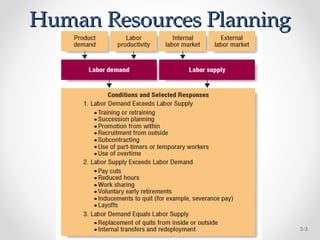
After estimating labor demand and supply for a future period, a
firm faces one of the three conditions, each of which requires
a different set of responses.
4
The Hiring Process
The Hiring Process
5-5
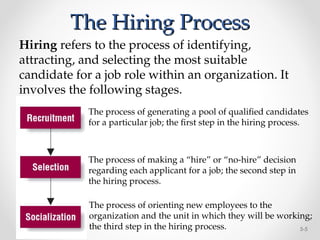
Hiring refers to the process of identifying,
attracting, and selecting the most suitable
candidate for a job role within an organization. It
involves the following stages.
The process of generating a pool of qualified candidates
for a particular job; the first step in the hiring process.
The process of making a “hire” or “no-hire” decision
regarding each applicant for a job; the second step in
the hiring process.
The process of orienting new employees to the
organization and the unit in which they will be working;
the third step in the hiring process.
Challenges of the Hiring Process
• Determining characteristics important to
performance
• Measuring characteristics that determine
performance
• The motivation factor
o Performance = ability x motivation
• Achieving coordination between HR managers
and line managers to make the decision.
5-6
An Approach to Recruitment
• Recruitment can be effective when it is
viewed from the applicant’s perspective.
Because applicants are customers of the
organization, the organization hopes that
applicants make a buy decision about
the job opening.
o Go to where the customers are
o What do they want and what do you have to
offer?
o Treat applicants like customers
5-7
Sources of Recruitment
5-8
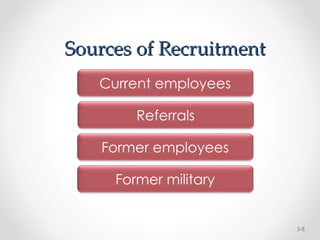
Current employees
Referrals
Former employees
Former military
Sources of Recruitment
5-9
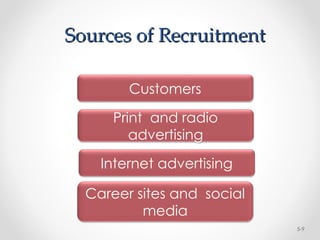
Customers
Print and radio
advertising
Internet advertising
Career sites and social
media
Sources of Recruitment
5-10
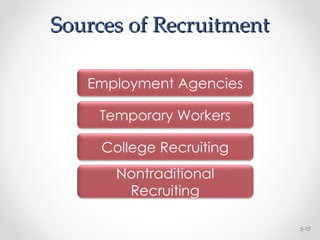
Employment Agencies
Temporary Workers
College Recruiting
Nontraditional
Recruiting
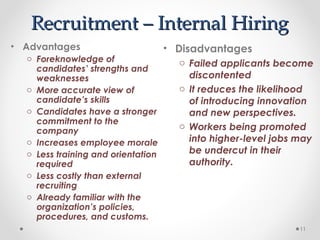
Recruitment – Internal Hiring
• Disadvantages
o Failed applicants become
discontented
o It reduces the likelihood
of introducing innovation
and new perspectives.
o Workers being promoted
into higher-level jobs may
be undercut in their
authority.
11
• Advantages
o Foreknowledge of
candidates’ strengths and
weaknesses
o More accurate view of
candidate’s skills
o Candidates have a stronger
commitment to the
company
o Increases employee morale
o Less training and orientation
required
o Less costly than external
recruiting
o Already familiar with the
organization’s policies,
procedures, and customs.
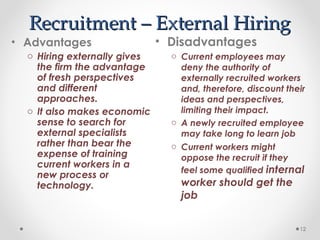
Recruitment – External Hiring
• Disadvantages
o Current employees may
deny the authority of
externally recruited workers
and, therefore, discount their
ideas and perspectives,
limiting their impact.
o A newly recruited employee
may take long to learn job
o Current workers might
oppose the recruit if they
feel some qualified internal
worker should get the
job
12
• Advantages
o Hiring externally gives
the firm the advantage
of fresh perspectives
and different
approaches.
o It also makes economic
sense to search for
external specialists
rather than bear the
expense of training
current workers in a
new process or
technology.
Recruitment
Recruitment
5-13
How to recruit effectively?
•External vs. Internal Candidates
•Protected Class
•Planning the Recruitment Effort
•Planning the Job Search
Selection
Selection
5-14
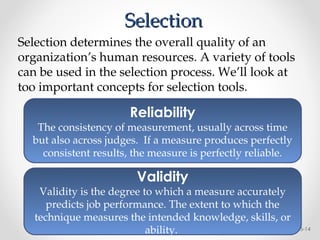
Reliability
The consistency of measurement, usually across time
but also across judges. If a measure produces perfectly
consistent results, the measure is perfectly reliable.
Validity
Validity is the degree to which a measure accurately
predicts job performance. The extent to which the
technique measures the intended knowledge, skills, or
ability.
Selection determines the overall quality of an
organization’s human resources. A variety of tools
can be used in the selection process. We’ll look at
too important concepts for selection tools.
Selection Tools
Selection Tools
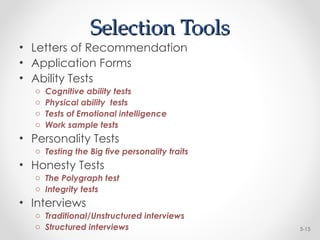
• Letters of Recommendation
• Application Forms
• Ability Tests
o Cognitive ability tests
o Physical ability tests
o Tests of Emotional intelligence
o Work sample tests
• Personality Tests
o Testing the Big five personality traits
• Honesty Tests
o The Polygraph test
o Integrity tests
• Interviews
o Traditional/Unstructured interviews
o Structured interviews 5-15
5-16
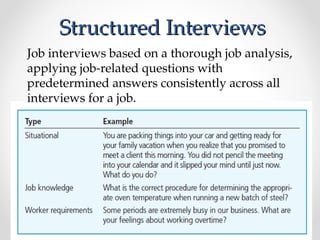
Structured Interviews
Job interviews based on a thorough job analysis,
applying job-related questions with
predetermined answers consistently across all
interviews for a job.
Interviewer Don’ts
Interviewer Don’ts
• Don’t ask applicants if they have children
• Don’t ask applicant’s age
• Don’t ask applicants whether they have a physical
or mental disability
• Don’t ask for height or weight on an application
• Don’t ask a female candidate for her maiden
name
• Don’t ask about citizenship
• Don’t ask applicants about their arrest records
• Don’t ask applicants if they smoke
• Don’t ask applicants if they are HIV positive or have
AIDS
5-17
Selection Tools
Selection Tools
5-18
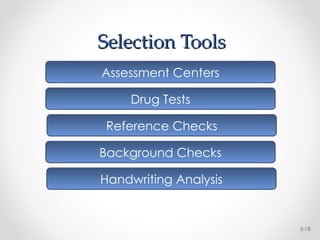
Assessment Centers
Drug Tests
Reference Checks
Background Checks
Handwriting Analysis
Combining Predictors
• Organizations often use multiple methods to collect
information about applicants.
• Three strategies are used to combine these pieces
of information to make an effective selection
decision:
o Multiple-hurdle strategy
o Clinical strategy
o Statistical strategy
19
Selection and the
Selection and the
Person/Organization Fit
• Person-Organization fit (P-O fit) is generally defined
as compatibility between employees and their
organizations. Compatibility can result from one
party supplying a need of the other party, similar
values across parties, or both.
• To bring people aboard who match the
organization, a Person-Organization fit test,
interview, or other form of selection tool will likely
need to be implemented.
20
Reaction to Selection devices
• Applicant reactions to selection devices
Applicant reactions to selection devices
• Applicants’ reactions to selection methods can
influence their attraction to and opinions of an
organization and their decision to accept or
reject an offer of employment.
• Manager reaction to selection systems
Manager reaction to selection systems
• Managers need selection systems that are quick
and easy to administer and that deliver results
that are easy to understand.
21
Legal Issues in Staffing
• Discrimination Laws
o Develop clear hiring policies
• Affirmative Action
o Making job-related decisions without
discrimination
• Negligent Hiring
o Develop clear policies on hiring as well as on
disciplining and dismissing employees.
o Check state laws regarding hiring applicants
with criminal records.
o Learn as much as possible about past work-
related behavior
22
Summary and Conclusions
• Human Resource Planning: Labor Supply
and Demand
• The Hiring Process
• Challenges in the Hiring Process
• Meeting the Challenge of Effective Staffing
• Recruitment
• Selection
• Legal Issues in Staffing
5-23

Chapter 5 Recruiting and Selecting Employees.ppt

  • 1.
    Chapter 5 Chapter 5 Recruitingand Selecting Employees 5-1 Course Instructor: Rajja Rashad HUMAN RESOURCE MANAGEMENT
  • 2.
    Topics Covered Topics Covered 1.Human resource planning: Labor supply and demand 2. The hiring process 3. Challenges in the hiring process 4. Recruitment & its sources 5. Selection & the tools of selection 6. Selection and the Person/Organization Fit 7. Legal issues in staffing 5-2
  • 3.
    Human Resources Planning HumanResources Planning 5-3
  • 4.
    Human Resources Planning HumanResources Planning • Human resource planning (HRP) is the process an organization uses to ensure that it has the right amount and the right kind of people to deliver a particular level of output or services in the future. • Labor Demand Labor Demand o The number of workers the organization will need in the future. The number of workers the organization will need in the future. o The first HRP activity entails forecasting labor demand. Labor demand is likely to increase as demand for the firm’s product or services increases and is likely to decrease as labor productivity increases. • Labor Supply Labor Supply o The availability of workers with the required skills to meet the The availability of workers with the required skills to meet the firm’s labor demand. firm’s labor demand. o The second part of HRP entails estimating labor supply. The labor supply may come from existing employees or from outside the organization. After estimating labor demand and supply for a future period, a After estimating labor demand and supply for a future period, a firm faces one of the three conditions, each of which requires firm faces one of the three conditions, each of which requires a different set of responses. a different set of responses. 4
  • 5.
    The Hiring Process TheHiring Process 5-5 Hiring refers to the process of identifying, attracting, and selecting the most suitable candidate for a job role within an organization. It involves the following stages. The process of generating a pool of qualified candidates for a particular job; the first step in the hiring process. The process of making a “hire” or “no-hire” decision regarding each applicant for a job; the second step in the hiring process. The process of orienting new employees to the organization and the unit in which they will be working; the third step in the hiring process.
  • 6.
    Challenges of theHiring Process Challenges of the Hiring Process • Determining characteristics important to performance • Measuring characteristics that determine performance • The motivation factor o Performance = ability x motivation • Achieving coordination between HR managers and line managers to make the decision. 5-6
  • 7.
    An Approach toRecruitment An Approach to Recruitment • Recruitment can be effective when it is viewed from the applicant’s perspective. Because applicants are customers of the organization, the organization hopes that applicants make a buy decision about the job opening. o Go to where the customers are o What do they want and what do you have to offer? o Treat applicants like customers 5-7
  • 8.
    Sources of Recruitment Sourcesof Recruitment 5-8 Current employees Referrals Former employees Former military
  • 9.
    Sources of Recruitment Sourcesof Recruitment 5-9 Customers Print and radio advertising Internet advertising Career sites and social media
  • 10.
    Sources of Recruitment Sourcesof Recruitment 5-10 Employment Agencies Temporary Workers College Recruiting Nontraditional Recruiting
  • 11.
    Recruitment – InternalHiring Recruitment – Internal Hiring • Disadvantages o Failed applicants become discontented o It reduces the likelihood of introducing innovation and new perspectives. o Workers being promoted into higher-level jobs may be undercut in their authority. 11 • Advantages o Foreknowledge of candidates’ strengths and weaknesses o More accurate view of candidate’s skills o Candidates have a stronger commitment to the company o Increases employee morale o Less training and orientation required o Less costly than external recruiting o Already familiar with the organization’s policies, procedures, and customs.
  • 12.
    Recruitment – ExternalHiring Recruitment – External Hiring • Disadvantages o Current employees may deny the authority of externally recruited workers and, therefore, discount their ideas and perspectives, limiting their impact. o A newly recruited employee may take long to learn job o Current workers might oppose the recruit if they feel some qualified internal worker should get the job 12 • Advantages o Hiring externally gives the firm the advantage of fresh perspectives and different approaches. o It also makes economic sense to search for external specialists rather than bear the expense of training current workers in a new process or technology.
  • 13.
    Recruitment Recruitment 5-13 How to recruiteffectively? •External vs. Internal Candidates •Protected Class •Planning the Recruitment Effort •Planning the Job Search
  • 14.
    Selection Selection 5-14 Reliability The consistency ofmeasurement, usually across time but also across judges. If a measure produces perfectly consistent results, the measure is perfectly reliable. Validity Validity is the degree to which a measure accurately predicts job performance. The extent to which the technique measures the intended knowledge, skills, or ability. Selection determines the overall quality of an organization’s human resources. A variety of tools can be used in the selection process. We’ll look at too important concepts for selection tools.
  • 15.
    Selection Tools Selection Tools •Letters of Recommendation • Application Forms • Ability Tests o Cognitive ability tests o Physical ability tests o Tests of Emotional intelligence o Work sample tests • Personality Tests o Testing the Big five personality traits • Honesty Tests o The Polygraph test o Integrity tests • Interviews o Traditional/Unstructured interviews o Structured interviews 5-15
  • 16.
    5-16 Structured Interviews Structured Interviews Jobinterviews based on a thorough job analysis, applying job-related questions with predetermined answers consistently across all interviews for a job.
  • 17.
    Interviewer Don’ts Interviewer Don’ts •Don’t ask applicants if they have children • Don’t ask applicant’s age • Don’t ask applicants whether they have a physical or mental disability • Don’t ask for height or weight on an application • Don’t ask a female candidate for her maiden name • Don’t ask about citizenship • Don’t ask applicants about their arrest records • Don’t ask applicants if they smoke • Don’t ask applicants if they are HIV positive or have AIDS 5-17
  • 18.
    Selection Tools Selection Tools 5-18 AssessmentCenters Drug Tests Reference Checks Background Checks Handwriting Analysis
  • 19.
    Combining Predictors Combining Predictors •Organizations often use multiple methods to collect information about applicants. • Three strategies are used to combine these pieces of information to make an effective selection decision: o Multiple-hurdle strategy o Clinical strategy o Statistical strategy 19
  • 20.
    Selection and the Selectionand the Person/Organization Fit Person/Organization Fit • Person-Organization fit (P-O fit) is generally defined as compatibility between employees and their organizations. Compatibility can result from one party supplying a need of the other party, similar values across parties, or both. • To bring people aboard who match the organization, a Person-Organization fit test, interview, or other form of selection tool will likely need to be implemented. 20
  • 21.
    Reaction to Selectiondevices Reaction to Selection devices • Applicant reactions to selection devices Applicant reactions to selection devices • Applicants’ reactions to selection methods can influence their attraction to and opinions of an organization and their decision to accept or reject an offer of employment. • Manager reaction to selection systems Manager reaction to selection systems • Managers need selection systems that are quick and easy to administer and that deliver results that are easy to understand. 21
  • 22.
    Legal Issues inStaffing Legal Issues in Staffing • Discrimination Laws o Develop clear hiring policies • Affirmative Action o Making job-related decisions without discrimination • Negligent Hiring o Develop clear policies on hiring as well as on disciplining and dismissing employees. o Check state laws regarding hiring applicants with criminal records. o Learn as much as possible about past work- related behavior 22
  • 23.
    Summary and Conclusions Summaryand Conclusions • Human Resource Planning: Labor Supply and Demand • The Hiring Process • Challenges in the Hiring Process • Meeting the Challenge of Effective Staffing • Recruitment • Selection • Legal Issues in Staffing 5-23

Editor's Notes

  • #1 Recruiting and selecting the right employees is crucial for higher performance and to avoid the costs of hiring the “wrong” employee. Chapter 5 provides the foundation for knowing the processes used in recruiting and selecting the right employees.
  • #2 In Chapter 5, we’ll look at understanding human resource supply and demand and gaining familiarity with the hiring process. We’ll also recognize the challenges in the hiring process.
  • #3 After estimating labor demand and supply for a future period, a firm faces one of the three conditions, each of which requires a different set of responses. 1. The first condition is when the labor demand exceeds labor supply. In this scenario, the firm will need more workers than will be available. A variety of approaches can then be used to increase the labor supply available to a specific firm. These include training or retraining existing workers, grooming current employees to take over vacant positions ( succession planning ), promoting from within, recruiting new employees from outside the firm, subcontracting part of the work to 2. The second condition is when labor supply exceeds labor demand. In this scenario, labor supply is expected to exceed labor demand. This excess means that the firm will have more employees than it needs. Firms may use a variety of measures to deal with this situation. These include pay cuts, reducing the number of hours worked, and work sharing (all of which may save jobs). In addition, the firm may eliminate positions through a combination of tactics, including early retirement incentives, severance pay, and outright layoffs. 3. The third condition is when labor demand equals labor supply. In this scenario, labor demand is expected to match labor supply. The organization can deal with this situation by replacing employees who quit with people promoted from inside the business or hired from the outside. The firm may also transfer or redeploy employees internally, with training and career development programs designed to support these moves.
  • #4 Firms that do not conduct HRP may not be able to meet their future labor needs or may have to resort to layoffs, which leads to significant costs. HRP uses both qualitative and quantitative forecasting techniques. After estimating labor demand and supply for a future period, a firm faces one of the three conditions, each of which requires a different set of responses. The first condition is when the labor demand exceeds labor supply. The second condition is when labor supply exceeds labor demand. The third condition is when labor demand equals labor supply.
  • #5 The hiring process includes: 1. Recruitment—The process of generating a pool of qualified candidates for a particular job; the first step in the hiring process. 2. Selection—The process of making a “hire” or “no-hire” decision regarding each applicant for a job; the second step in the hiring process. 3. Socialization—The process of orienting new employees to the organization and the unit in which they will be working; the third step in the hiring process.
  • #6 The hiring process has its challenges. The most important of these are: 1. Determining which personal characteristics are most important to performance: The characteristics a person needs to perform a job effectively are not always obvious. The knowledge, skills, and abilities needed for jobs change as technological and other changes happen. Additionally, people have differing opinions of desired characteristics for a particular job. 2. Measuring characteristics that determine performance: Tests must be administered in some cases (assessing math skills, for example), for specific abilities. Many tests yield different outcomes, some are better at predicting performance, and tests vary in administrative costs. 3. The motivation factor: Although many tests measure abilities, motivation is also a key principle in performance. The equation is Performance = Ability x Motivation. Someone’s ability alone is not enough for performance. Likewise, much motivation and little ability is also not enough for higher performance. However, motivation is very difficult to measure. Many employers assess motivation in the interview. 4. Who should make the hiring decision? There are two good reasons for letting HR run the staffing process. The organization must ensure that the employment practices comply with legal standards Letting HR run it is convenient. However, managers should be in on the process, especially if the individual will be working under him or her. Additionally, many organizations are also including peers and subordinates in the hiring process.
  • #7 Recruitment is the opportunity to sell the job, the organization, and the community to the job applicant. Here’s the approach to take when recruiting: Go to where the customers are: Go to social media like Facebook, Twitter, and LinkedIn. What do they want and what do you have to offer? People join organizations for a variety of reasons, some of which include working atmosphere, career opportunities, work–life value, job characteristics, and pay. Treat applicants like customers: Do your job applicants feel like they were treated as customers? Applicants who have a positive experience are more likely to pursue employment with an organization.
  • #8 The most prominent sources of recruitment for organizations are: Current employees: Many companies have policies about job openings before recruitment to the outside sources. Internal job postings give current employees the opportunity to move into the firm’s more desirable jobs. However, the internal promotion also creates another job to fill. Referrals from current employees: Studies have shown that employees who were hired through referrals from current employees tended to stay with the organization longer and displayed greater loyalty and job satisfaction. However, one issue with this type of recruitment is that it causes those to seek referrals that are similar to themselves, and thus fosters the lack of the diversity that an organization needs, so this needs to be monitored closely. Former employees: A firm may decide to recruit employees who previously worked for the organization. Typically, these people were laid off. Also, forming an online alumni network could be a simple and cost-effective way to maintain a hiring pool of candidates. Former military: Since 2001, there has been a pool of former military personnel to hire. Some organizations believe that hiring a former military person means hiring a more consistent job performer.
  • #9 Customers: Customers can be a convenient and cost-effective source of employees. Because customers are already familiar with the organization’s products and services, recruiting can capitalize on this familiarity. Print and radio advertising: Advertising can be used both for local recruitment efforts and for targeted regional, national, or international searches. Internet advertising: Employers are increasingly turning to the Web as a recruitment tool because online ads are relatively cheap, more dynamic, and can produce faster results than newspapers. The Web is also a convenient place for employee candidates. Career sites and social media: Thousands of career sites are available for recruitment and employment information. The Web makes it easy for job candidates to seek jobs by industry, geographic location, and job description. Social media sites such as Facebook, Twitter, and LinkedIn are also heavily used by job seekers.
  • #10 Employment agencies: Many organizations use external contractors to recruit and screen applicants. Typically, the employment agency is paid a fee based on salary offered to the new employee. Agencies can be especially effective when the firm is looking for an employee with a specialized skill. Temporary workers: Provide employers the flexibility to quickly meet fluctuating demands. Bringing in temporary workers enables employers to bypass the time-consuming hiring process of job interviews and background checks. College recruiting: Most schools have a job placement service office that helps students make contacts with employers. Many companies seek college placement services to find job candidates. Furthermore, employers visit campuses and job fairs, and create relationships through internships. Nontraditional recruiting: Includes labor pools such as prisoners, welfare recipients, senior citizens, and workers from foreign countries. These can be an excellent source of untapped labor for certain jobs. Greystone Bakery in New York is a great example of a company that embraces a nontraditional labor pool for its hiring.
  • #13 External vs. internal candidates: Hiring externally gives the firm the advantage of fresh perspectives and different approaches. Sometimes it also makes sense to hire externally, as it would be more expensive to train or educate some skills and knowledge that is easier to obtain rather than recruit. However, sometime new hires are perceived as “rookies” and not readily accepted by current employees. Internal candidates offer less expensive (at times) means of recruitment and they are already familiar with the company, product, and industry, which alone saves in “training/orientation” cost. However, one of the biggest disadvantages of internal recruiting is not taking advantage of new and innovative ways of thinking that may be needed to move the organization forward. Protected class: An important recruitment initiative is to actively attract and recruit women, minorities, and persons with disabilities. A good rule of thumb is to target potential recruits through media or recruitment methods aimed at the protected class. Going to the places where these people are most likely found (professional organizations, colleges, etc.) is a good way to seek these candidates. Planning the recruitment effort: For an organization to recruit effectively, recruitment must be tied to sound HRP. Calculating yield ratios and investigation into anticipated market conditions is prudent. Additionally, revisiting the HRP numbers will ensure an organization stays on track with recruitment planning. Planning the job search: In addition to the other means of finding a job, a good source to look is through the Dictionary of Occupational Titles, the Occupational Outlook Handbook on the Bureau of Labor Statistics website, and the O*Net Web site, to name a few.
  • #14 The economic value of good selection procedures is higher than most people realize. A variety of tools can be used in the selection process. We’ll look at too important concepts for selection tools: Reliability and Validity Selection methods can be reliable, but not valid; however, selection methods that are not reliable cannot be valid.
  • #15 Additional common methods of selection are the following: Letters of recommendation—A content approach to considering letters of recommendation can increase the validity of this selection tool. Assessment is done in terms of the traits the letter writer attributes to the job candidate. Application forms—Organizations often use application forms as a screening device to determine whether a candidate satisfies minimum job specifications, particularly for entry-level jobs. The forms typically ask for information regarding past jobs and present employment status. Ability tests—Various tests measure a wide range of abilities, from verbal and qualitative skills to perceptual speed. Cognitive ability tests measure a candidate’s capability in a certain area, and are valid predictors of job performance when the abilities tested are based on a job analysis. Physical ability tests measure strength and endurance for physical and mechanical jobs Work sample tests measure performance ability by asking applicants to perform the exact same tasks that they will be performing on the job Emotional intelligence tests measure candidate’s ability to perceive and manage emotions in the self and in others. Personality tests—Assess traits of individual workers’ characteristics that tend to be consistent and enduring. Personality tests have been widely used since the 1940s. The “Big Five” factors, now widely accepted in the field of personality psychology, are: Extroversion—the degree to which someone is talkative, sociable, active, aggressive, and excitable. Agreeableness—the degree to which someone is trusting, amiable, generous, tolerant, honest, cooperative, and flexible. Conscientiousness—the degree to which someone is dependable and organized and conforms and perseveres on tasks. Emotional stability—the degree to which someone is secure, calm, independent, and autonomous. Openness to experience—the degree to which someone is intellectual, philosophical, insightful, creative, artistic, and curious. Honesty tests—Because employee theft is a serious and costly problem, honesty tests have become important. Honesty tests are designed to identify job applicants who are likely to engage in theft and other undesirable behavior. The polygraph test measures an interviewee’s pulse, breathing rate, and galvanic skin response (perspiration) while he or she is asked a series of questions. The theory is that these physiological measures will change when the interviewee is not telling the truth. Integrity tests can now be administered in a variety of forms, including paper and pencil, via telephone, and via the Internet, among others. The typical test measures attitudes toward honesty, particularly whether the applicant believes that dishonest behavior is normal and not criminal. Interviews—Even though studies have shown that interviewers do not agree (biases and human judgment) with one another on candidate assessments, interviews are still widely used today. We’ll now look at the structured interview. Criticism on traditional/Unstructured interviews Snapped or hasty decisions Traditional interviews are conducted in such a way that the interview experience is very different from interviewee to interviewee
  • #16 Structured interviews—Job interviews based on a thorough job analysis, applying job-related questions with predetermined answers consistently across all interviews for a job. The three types of questions commonly used in structure interviews are as follows: Situational—these questions try to elicit from candidates how they would respond to particular work situations. Job knowledge—the questions assess whether candidates have the basic knowledge needed to perform the job. Worker requirements—these questions assess candidate’s willingness to perform under prevailing job conditions. Structured interviews are valid predictors of job performance. The content of a structured interview is, by design, limited to job-related factors. The questions asked are consistent across all interviewees. All responses are scored the same way. Because a panel of interviewers is typically involved in conducting the structured interview, the impact of individual interviewers’ idiosyncrasies and biases is limited. Why does the traditional interview remain popular despite the effectiveness of structured interviews? One reason is that many equate the panel format of structured interviews with a stress test Another is that organizations find the traditional interview quite useful, probably because it serves more functions than just selection. 78 For example, it can be an effective public relations tool in which the interviewer gives a positive impression of the organization Finally, the open-ended nature of unstructured interviews may provide an opportunity for unsuitable candidates to demonstrate the qualities that make them less desirable as potential employees.
  • #17 Whether employers choose structured or unstructured interviews, they need to make sure their interview questions are not illegal. Following are illegal questions that should NOT be asked in an interview: Don’t ask applicants if they have children Don’t ask applicant’s age Don’t ask applicants whether they have a physical or mental disability Don’t ask for height or weight on an application Don’t ask a female candidate for her maiden name Don’t ask about citizenship Don’t ask applicants about their arrest records Don’t ask applicants if they smoke Don’t ask applicants if they are HIV positive or have AIDS
  • #18 Assessment centers—A set of simulated tasks or exercises that candidates are asked to perform. This is usually done with manager candidates. These can be simulation types of assessments, work-related types of activities, and scenario-based assessments (problem-solving). Most assessment centers evaluate each candidate’s abilities in four areas: organizing, planning, decision making, and leadership Task-based assessment centers focus more directly on work-related situations and how well people perform on these specific tasks. The in-basket exercise is probably the exercise most widely associated with assessment centers. It includes the kinds of problems, messages, reports, and so on that might be found in a manager’s in-basket. The candidates are asked to deal with these issues as they see fit, and then are assessed on how well they prioritized the issues, how creative and responsive they were in dealing with each one, the quality of their decisions, and other factors. Drug tests—Pre-employment drug testing typically requires job applicants to undergo urinalysis as a part of routine selection procedures. These tests are generally more common in jobs that require special equipment handling, but now these tests have extended to other types of jobs. Reference checks—One of the best methods of predicting the future success of prospective employees regarding their past employment record. However, note that there are some legal issues regarding giving out information about an job candidate. Background checks—Can be distinguished from reference checks and can include criminal background checks, verification of academic achievement, driving histories, immigration status checks, and social security checks. The primary reason for this type of check is to avoid negligent hiring charges. Handwriting analysis—Graphology, the study of handwriting for the purpose of measuring personality or other individual traits, is routinely used to screen job applicants in Europe, the birthplace of the technique. Graphology is not yet considered a valid measure of performance. Note that organizations use multiple methods to collect information on candidates and it’s now easier with the Internet.
  • #19  Organizations often use multiple methods to collect information about applicants. Multiple-hurdle strategy requires making a preliminary selection decision after completion of each method, because an applicant has to clear each hurdle before moving on to the next one. Those who do not clear the hurdle are eliminated from further consideration In a clinical strategy, the decision maker subjectively evaluates all the information and comes to an overall judgment. In a statistical strategy, the various pieces of information are combined according to a mathematical formula, and the job goes to the candidate with the highest score.
  • #21 Although validity must remain a central concern in selection, applicant and manager reactions to selection methods also need to be considered in the design of a selection system. Managers who are not happy with a selection method may ignore the data collected using that method or find a way to eliminate the use of the method. Applicants who perceive a method to be unfair may be more likely to file a discrimination charge over its use. In short, validity is critical, but applicant and manager perceptions can determine if a method is going to be useful in practice.
  • #23 To summarize, hiring is a critical component of human resource function and there are many steps to recruit and select effectively. The challenges to finding the right employee are many, but it’s very important to utilize all effective and innovative tools in recruiting the most talented and desirable performers for the organization.