RECRUITMENT

1
Group members
Saba Afaq
Saba Mehboob
Reeha Noor

2
Recruitment
Meaning:
In simple terms, recruitment is understood as the
process of searching for & obtaining applicants for
jobs, from among whom the right people can be
selected.
Definition:
“It is the process of finding & attracting capable
applicants for employment. The process begins when
new recruits are sought and ends when their
applications are submitted. The result is a pool of
applicants form which new employees are selected.
3
A human resource management function, is one of the activities
that impact most critically on the performance of an
organization.
Steps in the recruitment process:

• Advertisement of a job vacancy.
• Preliminary contact with potential job candidates.
• Initial screening to create a pool of qualified applicants.
4
Purpose & Importance
 Determine the present & future requirements of the
organization.
 Identifying potential job applicants.
 Increase the pool of job candidates at minimum cost.
 Help reduce the probability of candidates leaving the
organization
 Meet the organization’s legal & social obligations
regarding the composition of its workforce.
 Increase organizational & individual effectiveness.
5
Factors Governing Recruitment
 Skill demand
 Labor market
 Time and Cost
 Size of the Firm
 Recruitment Policy
 Lengthy Process

6
Recruitment Process









Identify vacancy
Prepare job description and person specification
Advertising the vacancy
Short-listing
Arrange interviews
Conducting interview and decision making
Job offer
Negotiation and Contract

.
7
Recruitment Process


Identify vacancy

It is the first step of recruitment process.
Vacancy occurred through
1 Resign
2
Expansion

There may be other ways of filling the gap, includes
•
•
•
•
•
•
•

Reorganize the work
Use overtime
Mechanize the work
Stagger the hours
Make the job part time
Subcontract the work
Use an agency

8
Recruitment Process
 Prepare job description and person
specification
If your decision is that you are going to recruit, the next
step is to prepare job description and person
specification.
Job description includes
breaking the job down into its component parts
Highlighting the chief objectives
person specification
listing the key attributes required to undertake the role

9
Sources of recruitment
Internal Recruitment
Persons who are already working in an
organization constitute the ‘internal sources’. It
includes the existing employees, the retrenched
& retired employees & dependents of deceased
employees.

10
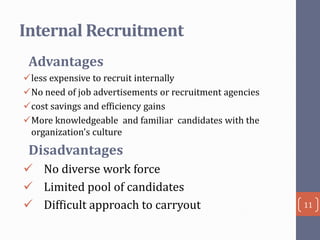
Internal Recruitment
Advantages
less expensive to recruit internally
No need of job advertisements or recruitment agencies
cost savings and efficiency gains
More knowledgeable and familiar candidates with the
organization's culture

Disadvantages
 No diverse work force
 Limited pool of candidates
 Difficult approach to carryout

11
Sources of recruitment
External Recruitment
External recruitment is a type of
recruitment where organizations rely on
suitable applicants from outside the
organization to fill a vacancy.

12
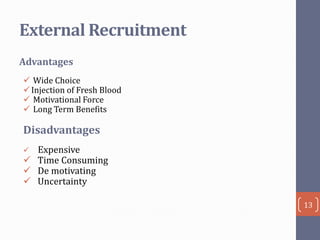
External Recruitment
Advantages
 Wide Choice
 Injection of Fresh Blood
 Motivational Force
 Long Term Benefits

Disadvantages
Expensive
 Time Consuming
 De motivating
 Uncertainty


13
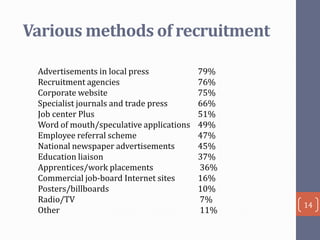
Various methods of recruitment
Advertisements in local press
Recruitment agencies
Corporate website
Specialist journals and trade press
Job center Plus
Word of mouth/speculative applications
Employee referral scheme
National newspaper advertisements
Education liaison
Apprentices/work placements
Commercial job-board Internet sites
Posters/billboards
Radio/TV
Other

79%
76%
75%
66%
51%
49%
47%
45%
37%
36%
16%
10%
7%
11%

14
RECRUITMENT ADVERTISEMENT


Recruitment advertising, also known as Recruitment
communications and Recruitment agency, includes all
communications used by an organization to attract talent to
work within it.

15
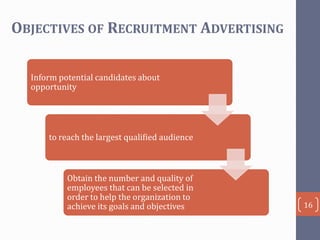
OBJECTIVES OF RECRUITMENT ADVERTISING
Inform potential candidates about
opportunity

to reach the largest qualified audience

Obtain the number and quality of
employees that can be selected in
order to help the organization to
achieve its goals and objectives

16
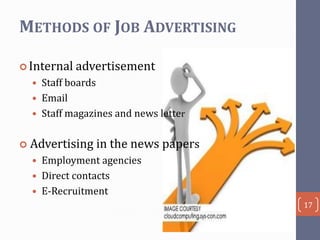
METHODS OF JOB ADVERTISING
 Internal advertisement






Staff boards
Email
Staff magazines and news letter

Advertising in the news papers




Employment agencies
Direct contacts
E-Recruitment
17
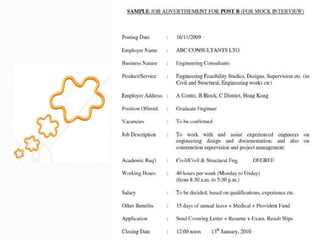
DRAFTING THE ADVERTISEMENT
An advertisement should include
 Name and brief details of employing
organization
 Job role and duties
 Requirements
 Salary
 Instructions about how to apply

18
A GOOD JOB ADVERTISEMENT

19
20
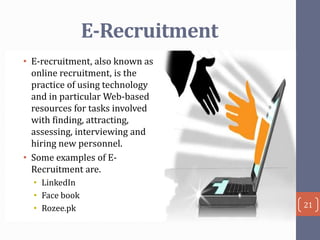
E-Recruitment
• E-recruitment, also known as
online recruitment, is the
practice of using technology
and in particular Web-based
resources for tasks involved
with finding, attracting,
assessing, interviewing and
hiring new personnel.
• Some examples of ERecruitment are.
• LinkedIn
• Face book
• Rozee.pk

21
Purpose of E-Recruitment
The purpose of e-recruitment is to
• make the processes involved more efficient and
effective,
• less expensive.
• To reach a larger pool of potential employees

22
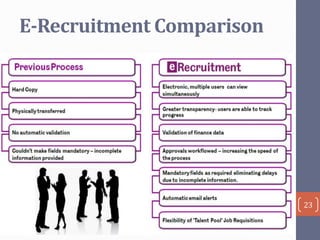
E-Recruitment Comparison

23
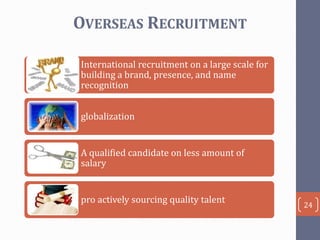
OVERSEAS RECRUITMENT
International recruitment on a large scale for
building a brand, presence, and name
recognition
globalization

A qualified candidate on less amount of
salary

pro actively sourcing quality talent

24
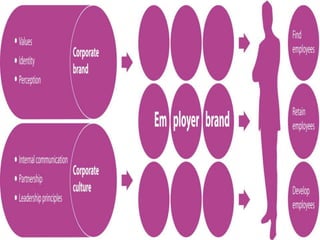
Employer Branding
• An employer brand represents the image a company
projects as a potential employer. If you have a strong
employer brand, then your company is considered a
distinctive place to work, with attractive brand values and
career prospect

25
Employer Branding
The following questions are important in this context:
• What makes your company attractive to applicants and
why?

• What unique selling points should you develop and why?
• What are the reasons that would make an applicant with
similar options decide for or against your offer?
26
27
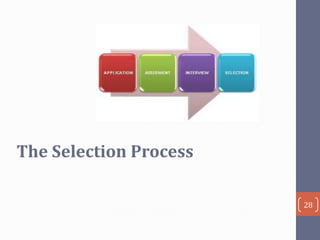
The Selection Process
28
Selection
 Selection is the process of picking individuals (out of the pool
of job applicants) with requisite qualifications and competence
to fill jobs in the organization.
 A formal definition of Selection is:- “ It is the process of
differentiating between applicants in order to identify (and here)
those with a greater likelihood of success in a job.’’

29
Importance Of Selection
Selecting the right employees is important
for three main reasons: performance, costs
and legal obligations.
Performance:

Cost:
Legal Obligations:
30
Application Forms
 Personal information
 Educational qualifications
 Work experience
 Salary
 Personality items
 Reference checks
31
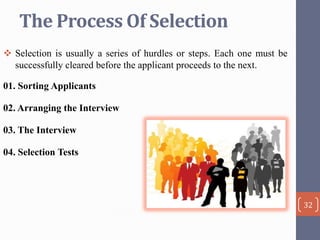
The Process Of Selection
 Selection is usually a series of hurdles or steps. Each one must be
successfully cleared before the applicant proceeds to the next.
01. Sorting Applicants
02. Arranging the Interview
03. The Interview
04. Selection Tests

32
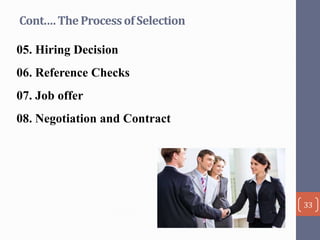
Cont.… The Process of Selection
05. Hiring Decision
06. Reference Checks
07. Job offer
08. Negotiation and Contract

33
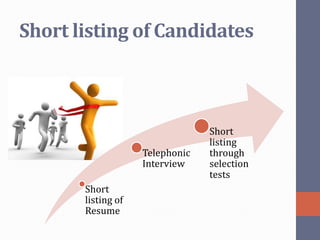
Short listing of Candidates

Telephonic
Interview
Short
listing of
Resume

Short
listing
through
selection
tests
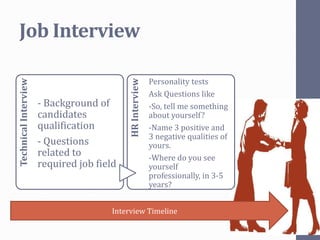
- Background of
candidates
qualification
- Questions
related to
required job field

HR Interview

Technical Interview

Job Interview
Personality tests
Ask Questions like
-So, tell me something
about yourself?
-Name 3 positive and
3 negative qualities of
yours.
-Where do you see
yourself
professionally, in 3-5
years?

Interview Timeline
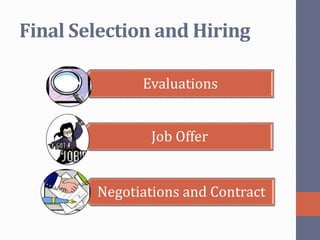
Final Selection and Hiring
Evaluations
Job Offer

Negotiations and Contract
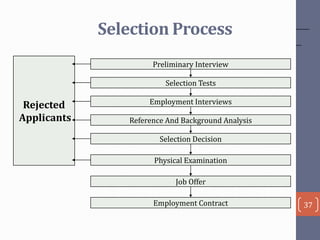
Selection Process
Preliminary Interview

Selection Tests

Rejected
Applicants

Employment Interviews
Reference And Background Analysis

Selection Decision
Physical Examination
Job Offer
Employment Contract

37
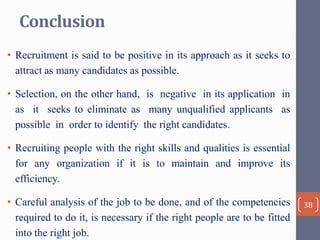
Conclusion
• Recruitment is said to be positive in its approach as it seeks to
attract as many candidates as possible.
• Selection, on the other hand, is negative in its application in
as it seeks to eliminate as many unqualified applicants as
possible in order to identify the right candidates.
• Recruiting people with the right skills and qualities is essential
for any organization if it is to maintain and improve its
efficiency.

• Careful analysis of the job to be done, and of the competencies
required to do it, is necessary if the right people are to be fitted
into the right job.

38
Any Questions

39

recruitment

  • 1.
  • 2.
    Group members Saba Afaq SabaMehboob Reeha Noor 2
  • 3.
    Recruitment Meaning: In simple terms,recruitment is understood as the process of searching for & obtaining applicants for jobs, from among whom the right people can be selected. Definition: “It is the process of finding & attracting capable applicants for employment. The process begins when new recruits are sought and ends when their applications are submitted. The result is a pool of applicants form which new employees are selected. 3
  • 4.
    A human resourcemanagement function, is one of the activities that impact most critically on the performance of an organization. Steps in the recruitment process: • Advertisement of a job vacancy. • Preliminary contact with potential job candidates. • Initial screening to create a pool of qualified applicants. 4
  • 5.
    Purpose & Importance Determine the present & future requirements of the organization.  Identifying potential job applicants.  Increase the pool of job candidates at minimum cost.  Help reduce the probability of candidates leaving the organization  Meet the organization’s legal & social obligations regarding the composition of its workforce.  Increase organizational & individual effectiveness. 5
  • 6.
    Factors Governing Recruitment Skill demand  Labor market  Time and Cost  Size of the Firm  Recruitment Policy  Lengthy Process 6
  • 7.
    Recruitment Process         Identify vacancy Preparejob description and person specification Advertising the vacancy Short-listing Arrange interviews Conducting interview and decision making Job offer Negotiation and Contract . 7
  • 8.
    Recruitment Process  Identify vacancy Itis the first step of recruitment process. Vacancy occurred through 1 Resign 2 Expansion There may be other ways of filling the gap, includes • • • • • • • Reorganize the work Use overtime Mechanize the work Stagger the hours Make the job part time Subcontract the work Use an agency 8
  • 9.
    Recruitment Process  Preparejob description and person specification If your decision is that you are going to recruit, the next step is to prepare job description and person specification. Job description includes breaking the job down into its component parts Highlighting the chief objectives person specification listing the key attributes required to undertake the role 9
  • 10.
    Sources of recruitment InternalRecruitment Persons who are already working in an organization constitute the ‘internal sources’. It includes the existing employees, the retrenched & retired employees & dependents of deceased employees. 10
  • 11.
    Internal Recruitment Advantages less expensiveto recruit internally No need of job advertisements or recruitment agencies cost savings and efficiency gains More knowledgeable and familiar candidates with the organization's culture Disadvantages  No diverse work force  Limited pool of candidates  Difficult approach to carryout 11
  • 12.
    Sources of recruitment ExternalRecruitment External recruitment is a type of recruitment where organizations rely on suitable applicants from outside the organization to fill a vacancy. 12
  • 13.
    External Recruitment Advantages  WideChoice  Injection of Fresh Blood  Motivational Force  Long Term Benefits Disadvantages Expensive  Time Consuming  De motivating  Uncertainty  13
  • 14.
    Various methods ofrecruitment Advertisements in local press Recruitment agencies Corporate website Specialist journals and trade press Job center Plus Word of mouth/speculative applications Employee referral scheme National newspaper advertisements Education liaison Apprentices/work placements Commercial job-board Internet sites Posters/billboards Radio/TV Other 79% 76% 75% 66% 51% 49% 47% 45% 37% 36% 16% 10% 7% 11% 14
  • 15.
    RECRUITMENT ADVERTISEMENT  Recruitment advertising,also known as Recruitment communications and Recruitment agency, includes all communications used by an organization to attract talent to work within it. 15
  • 16.
    OBJECTIVES OF RECRUITMENTADVERTISING Inform potential candidates about opportunity to reach the largest qualified audience Obtain the number and quality of employees that can be selected in order to help the organization to achieve its goals and objectives 16
  • 17.
    METHODS OF JOBADVERTISING  Internal advertisement     Staff boards Email Staff magazines and news letter Advertising in the news papers    Employment agencies Direct contacts E-Recruitment 17
  • 18.
    DRAFTING THE ADVERTISEMENT Anadvertisement should include  Name and brief details of employing organization  Job role and duties  Requirements  Salary  Instructions about how to apply 18
  • 19.
    A GOOD JOBADVERTISEMENT 19
  • 20.
  • 21.
    E-Recruitment • E-recruitment, alsoknown as online recruitment, is the practice of using technology and in particular Web-based resources for tasks involved with finding, attracting, assessing, interviewing and hiring new personnel. • Some examples of ERecruitment are. • LinkedIn • Face book • Rozee.pk 21
  • 22.
    Purpose of E-Recruitment Thepurpose of e-recruitment is to • make the processes involved more efficient and effective, • less expensive. • To reach a larger pool of potential employees 22
  • 23.
  • 24.
    OVERSEAS RECRUITMENT International recruitmenton a large scale for building a brand, presence, and name recognition globalization A qualified candidate on less amount of salary pro actively sourcing quality talent 24
  • 25.
    Employer Branding • Anemployer brand represents the image a company projects as a potential employer. If you have a strong employer brand, then your company is considered a distinctive place to work, with attractive brand values and career prospect 25
  • 26.
    Employer Branding The followingquestions are important in this context: • What makes your company attractive to applicants and why? • What unique selling points should you develop and why? • What are the reasons that would make an applicant with similar options decide for or against your offer? 26
  • 27.
  • 28.
  • 29.
    Selection  Selection isthe process of picking individuals (out of the pool of job applicants) with requisite qualifications and competence to fill jobs in the organization.  A formal definition of Selection is:- “ It is the process of differentiating between applicants in order to identify (and here) those with a greater likelihood of success in a job.’’ 29
  • 30.
    Importance Of Selection Selectingthe right employees is important for three main reasons: performance, costs and legal obligations. Performance: Cost: Legal Obligations: 30
  • 31.
    Application Forms  Personalinformation  Educational qualifications  Work experience  Salary  Personality items  Reference checks 31
  • 32.
    The Process OfSelection  Selection is usually a series of hurdles or steps. Each one must be successfully cleared before the applicant proceeds to the next. 01. Sorting Applicants 02. Arranging the Interview 03. The Interview 04. Selection Tests 32
  • 33.
    Cont.… The Processof Selection 05. Hiring Decision 06. Reference Checks 07. Job offer 08. Negotiation and Contract 33
  • 34.
    Short listing ofCandidates Telephonic Interview Short listing of Resume Short listing through selection tests
  • 35.
    - Background of candidates qualification -Questions related to required job field HR Interview Technical Interview Job Interview Personality tests Ask Questions like -So, tell me something about yourself? -Name 3 positive and 3 negative qualities of yours. -Where do you see yourself professionally, in 3-5 years? Interview Timeline
  • 36.
    Final Selection andHiring Evaluations Job Offer Negotiations and Contract
  • 37.
    Selection Process Preliminary Interview SelectionTests Rejected Applicants Employment Interviews Reference And Background Analysis Selection Decision Physical Examination Job Offer Employment Contract 37
  • 38.
    Conclusion • Recruitment issaid to be positive in its approach as it seeks to attract as many candidates as possible. • Selection, on the other hand, is negative in its application in as it seeks to eliminate as many unqualified applicants as possible in order to identify the right candidates. • Recruiting people with the right skills and qualities is essential for any organization if it is to maintain and improve its efficiency. • Careful analysis of the job to be done, and of the competencies required to do it, is necessary if the right people are to be fitted into the right job. 38
  • 39.