Recruitment and Selection
Finding the Best Fit
Definition of Recruitment and Selection
Benefits of Effective
Recruitment and Selection
Process
• Improved Candidate Quality - Effective recruitment and selection processes ensure that the
best candidates are selected for the job, leading to improved overall candidate quality.
• Reduced Turnover - When the right candidates are selected for the job, they are more likely to
stay in the position for a longer period of time, leading to reduced turnover and associated
costs.
• Increased Productivity - With the right candidate in the job, productivity is likely to increase
due to their skills and experience being a better match for the role.
• Improved Company Reputation - A strong recruitment and selection process can help to build
a positive reputation for your company, attracting top talent and improving overall perception
of the company.
• Reduced Hiring Costs - Effective recruitment and selection processes can help to reduce hiring
costs by reducing the need for repeat hires and associated recruitment costs.
• Better Fit for Company Culture - Having a good recruitment and selection process can help to
ensure that candidates who are a good fit for the company culture are selected, improving
overall employee satisfaction and retention.
Purpose of
Effective
Recruitment
and
Selection
Process
To ensure the right candidate is selected for
the right job, leading to better job
performance, retention, and organizational
success.
The Recruitment
Process
Step 1: Job Analysis
To explain the importance of job analysis in the recruitment process
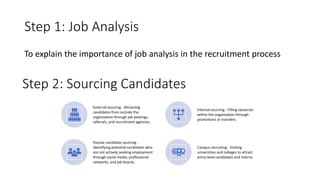
Step 2: Sourcing Candidates
External sourcing - Attracting
candidates from outside the
organization through job postings,
referrals, and recruitment agencies.
Internal sourcing - Filling vacancies
within the organization through
promotions or transfers.
Passive candidate sourcing -
Identifying potential candidates who
are not actively seeking employment
through social media, professional
networks, and job boards.
Campus recruiting - Visiting
universities and colleges to attract
entry-level candidates and interns.
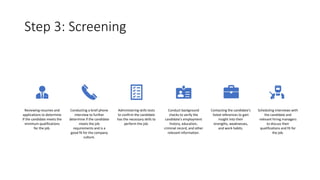
Step 3: Screening
Reviewing resumes and
applications to determine
if the candidate meets the
minimum qualifications
for the job.
Conducting a brief phone
interview to further
determine if the candidate
meets the job
requirements and is a
good fit for the company
culture.
Administering skills tests
to confirm the candidate
has the necessary skills to
perform the job.
Conduct background
checks to verify the
candidate's employment
history, education,
criminal record, and other
relevant information.
Contacting the candidate's
listed references to gain
insight into their
strengths, weaknesses,
and work habits.
Scheduling interviews with
the candidate and
relevant hiring managers
to discuss their
qualifications and fit for
the job.
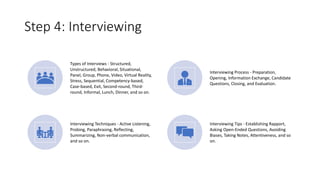
Step 4: Interviewing
Types of Interviews - Structured,
Unstructured, Behavioral, Situational,
Panel, Group, Phone, Video, Virtual Reality,
Stress, Sequential, Competency-based,
Case-based, Exit, Second-round, Third-
round, Informal, Lunch, Dinner, and so on.
Interviewing Process - Preparation,
Opening, Information Exchange, Candidate
Questions, Closing, and Evaluation.
Interviewing Techniques - Active Listening,
Probing, Paraphrasing, Reflecting,
Summarizing, Non-verbal communication,
and so on.
Interviewing Tips - Establishing Rapport,
Asking Open-Ended Questions, Avoiding
Biases, Taking Notes, Attentiveness, and so
on.
Step 5: Background Checks
Step 6: Selection and Hiring
The Selection Process
Step 1: Application
Step 2: Testing
• Cognitive Ability Tests - Measures reasoning,
memory, perception, and problem-solving
skills
• Personality Tests - Assesses an individual's
personality traits and characteristics
• Job Skills Tests - Evaluate whether a
candidate possesses the required skills for
the job
• Physical Aptitude Tests - Tests an individual's
strength, endurance, and physical abilities
• Drug and Alcohol Tests - Screening for drug
and alcohol use in the workplace
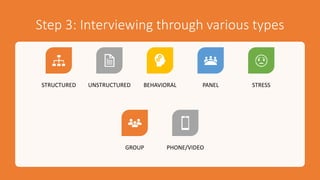
Step 3: Interviewing through various types
STRUCTURED UNSTRUCTURED BEHAVIORAL PANEL STRESS
GROUP PHONE/VIDEO
Step 4: Reference Checks
Step 5: Selection
Decision
The final stage in the selection process
where a decision is made on the candidate
to be hired.
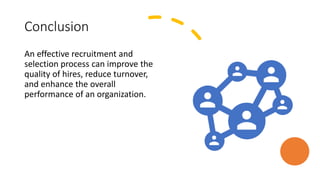
Conclusion
An effective recruitment and
selection process can improve the
quality of hires, reduce turnover,
and enhance the overall
performance of an organization.

Recruitment and Selection.pptx

  • 1.
  • 2.
  • 3.
    Benefits of Effective Recruitmentand Selection Process • Improved Candidate Quality - Effective recruitment and selection processes ensure that the best candidates are selected for the job, leading to improved overall candidate quality. • Reduced Turnover - When the right candidates are selected for the job, they are more likely to stay in the position for a longer period of time, leading to reduced turnover and associated costs. • Increased Productivity - With the right candidate in the job, productivity is likely to increase due to their skills and experience being a better match for the role. • Improved Company Reputation - A strong recruitment and selection process can help to build a positive reputation for your company, attracting top talent and improving overall perception of the company. • Reduced Hiring Costs - Effective recruitment and selection processes can help to reduce hiring costs by reducing the need for repeat hires and associated recruitment costs. • Better Fit for Company Culture - Having a good recruitment and selection process can help to ensure that candidates who are a good fit for the company culture are selected, improving overall employee satisfaction and retention.
  • 4.
    Purpose of Effective Recruitment and Selection Process To ensurethe right candidate is selected for the right job, leading to better job performance, retention, and organizational success.
  • 5.
  • 6.
    Step 1: JobAnalysis To explain the importance of job analysis in the recruitment process Step 2: Sourcing Candidates External sourcing - Attracting candidates from outside the organization through job postings, referrals, and recruitment agencies. Internal sourcing - Filling vacancies within the organization through promotions or transfers. Passive candidate sourcing - Identifying potential candidates who are not actively seeking employment through social media, professional networks, and job boards. Campus recruiting - Visiting universities and colleges to attract entry-level candidates and interns.
  • 7.
    Step 3: Screening Reviewingresumes and applications to determine if the candidate meets the minimum qualifications for the job. Conducting a brief phone interview to further determine if the candidate meets the job requirements and is a good fit for the company culture. Administering skills tests to confirm the candidate has the necessary skills to perform the job. Conduct background checks to verify the candidate's employment history, education, criminal record, and other relevant information. Contacting the candidate's listed references to gain insight into their strengths, weaknesses, and work habits. Scheduling interviews with the candidate and relevant hiring managers to discuss their qualifications and fit for the job.
  • 8.
    Step 4: Interviewing Typesof Interviews - Structured, Unstructured, Behavioral, Situational, Panel, Group, Phone, Video, Virtual Reality, Stress, Sequential, Competency-based, Case-based, Exit, Second-round, Third- round, Informal, Lunch, Dinner, and so on. Interviewing Process - Preparation, Opening, Information Exchange, Candidate Questions, Closing, and Evaluation. Interviewing Techniques - Active Listening, Probing, Paraphrasing, Reflecting, Summarizing, Non-verbal communication, and so on. Interviewing Tips - Establishing Rapport, Asking Open-Ended Questions, Avoiding Biases, Taking Notes, Attentiveness, and so on.
  • 9.
  • 10.
  • 11.
  • 12.
  • 13.
    Step 2: Testing •Cognitive Ability Tests - Measures reasoning, memory, perception, and problem-solving skills • Personality Tests - Assesses an individual's personality traits and characteristics • Job Skills Tests - Evaluate whether a candidate possesses the required skills for the job • Physical Aptitude Tests - Tests an individual's strength, endurance, and physical abilities • Drug and Alcohol Tests - Screening for drug and alcohol use in the workplace
  • 14.
    Step 3: Interviewingthrough various types STRUCTURED UNSTRUCTURED BEHAVIORAL PANEL STRESS GROUP PHONE/VIDEO
  • 15.
  • 16.
    Step 5: Selection Decision Thefinal stage in the selection process where a decision is made on the candidate to be hired.
  • 17.
    Conclusion An effective recruitmentand selection process can improve the quality of hires, reduce turnover, and enhance the overall performance of an organization.