RECRUITMENT & SELECTION
Recruitment
• This is one step in the process
of employment having a long process that involves
a series of tasks, starting with an analysis of the job
requirements and ending with the appointment of
the employee.
Specific tasks involved in the process
of recruitment include:
• Analyzing job requirements
• Advertising the vacancy
• Attracting candidates to apply for the job
• Managing response
• Scrutinizing applications
• Shortlisting candidates
Recruitment activities are typically performed by
Human Resource practitioners, either internally or externally
• Internal recruitment sources are promotion, transfers, retrenched
employees, contact or references, ex-employees, retired employees,
etc.
• External recruitment sources are recruitment through advertisement,
campus recruitment, recruitment by employee exchanges,
recruitment by third parties, internet recruitment, etc.
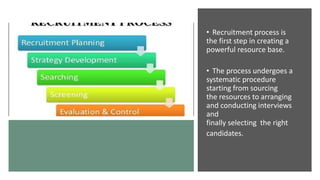
• Recruitment process is
the first step in creating a
powerful resource base.
• The process undergoes a
systematic procedure
starting from sourcing
the resources to arranging
and conducting interviews
and
finally selecting the right
candidates.
Recruitment
Planning
• Recruitment planning is the first step of the
recruitment process, where the vacant positions
are analyzed and described. It includes job
specifications and its nature, experience,
qualifications and skills required for the job, etc.
• A structured recruitment plan is mandatory to
attract potential candidates from a pool of
candidates.
• The potential candidates should be qualified,
experienced with a capability to take the
responsibilities required to achieve the objectives
of the organization.
Identifying
Vacancy
• The first and foremost process of recruitment plan is
identifying the vacancy. This process begins with
receiving the requisition for recruitments from different
department of the organization to the HR Department,
which contains −
• Number of posts to be filled
• Number of positions
• Duties and responsibilities to be performed
• Qualification and experience required
• When a vacancy is identified, it the responsibility of the
sourcing manager to ascertain whether the position is
required or not, permanent or temporary, full-time or
part-time, etc.
• These parameters should be evaluated before
commencing recruitment. Proper identifying, planning
and evaluating leads to hiring of the right resource for
the team and the organization.
Recruitment
Strategy
• Recruitment strategy is the second step of the
recruitment process, where a strategy is
prepared for hiring the resources.
• After completing the preparation of job
descriptions and job specifications, the next step
is to decide which strategy to adopt for recruiting
the potential candidates for the organization.
• While preparing a recruitment strategy, the HR
team considers the following points −
• Types of recruitment
• Geographical area
• Recruitment sources
The development of a recruitment
strategy is a long process, but having a
right strategy is mandatory to attract the
right candidates. The steps involved in
developing a recruitment strategy
include −
• Setting up a board team
• Analyzing HR strategy
• Collection of available data
• Analyzing the collected data
• Setting the recruitment strategy
Searching the
Right Candidates
• Searching is the process of recruitment where the
resources are sourced depending upon the
requirement of the job. After the recruitment
strategy is done, the searching of candidates will be
initialized. This process consists of two steps −
• Source activation − Once the line manager verifies
and permits the existence of the vacancy, the
search for candidates starts.
• Selling − Here, the organization selects the media
through which the communication of vacancies
reaches the prospective candidates.
• Searching involves attracting the job seekers to the
vacancies.
• The sources are broadly divided into two
categories: Internal Sources and External Sources.
Internal
Sources
• Internal sources of recruitment refer to hiring
employees within the organization through −
• Promotions
• Transfers
• Former Employees
• Internal Advertisements (Job Posting)
• Employee Referrals
• Previous Applicants
External
Sources
• External sources of recruitment refer to hiring
employees outside the organization through −
• Direct Recruitment
• Employment Exchanges
• Employment Agencies
• Advertisements
• Professional Associations
• Campus Recruitment
• Word of Mouth
Screening
/ Shortlisting
• Screening starts after completion of the process
of sourcing the candidates.
• Screening is the process of filtering the
applications of the candidates for further
selection process.
• Screening is an integral part of recruitment
process that helps in removing unqualified or
irrelevant candidates, which were received
through sourcing.
• https://elite-human-capital.com/2020/01/07/case-studies-in-the-
recruitment-process-an-assessment-method-for-gathering-data-on-a-
candidate/
• The screening process of recruitment consists of
three steps −
Reviewing of
Resumes and
Cover Letters
• Reviewing is the first step of screening candidates. In
this process, the resumes of the candidates are
reviewed and checked for the candidates’ education,
work experience, and overall background matching
the requirement of the job
• While reviewing the resumes, an HR executive must
keep the following points in mind, to ensure better
screening of the potential candidates −
• Reason for change of job
• Longevity with each organization
• Long gaps in employment
• Job-hopping
• Lack of career progression
Conducting
Telephonic or
Video Interview
• Conducting telephonic or video interviews is the
second step of screening candidates.
• In this process, after the resumes are screened,
the candidates are contacted through phone or
video by the hiring manager. This screening
process has two outcomes −
• It helps in verifying the candidates, whether they
are active and available.
• It also helps in giving a quick insight about the
candidate’s attitude, ability to answer interview
questions, and communication skills.
Identifying
the top
candidates
• Identifying the top candidates is the final step of
screening the resumes/candidates. In this
process, the cream/top layer of resumes are
shortlisted, which makes it easy for the hiring
manager to take a decision. This process has the
following three outcomes −
• Shortlisting 5 to 10 resumes for review by the
hiring managers
• Providing insights and recommendations to the
hiring manager
• Helps the hiring managers to take a decision in
hiring the right candidate
Evaluation
and Control
• Evaluation and control is the last stage in the
process of recruitment.
• In this process, the effectiveness and the
validity of the process and methods are
assessed.
• Recruitment is a costly process; hence it is
important that the performance of the
recruitment process is thoroughly evaluated.
• The costs incurred in the recruitment process are to be evaluated and
controlled effectively. These include the following −
• Salaries to the Recruiters
• Advertisements cost and other costs incurred in recruitment methods, i.e.,
agency fees.
• Administrative expenses and Recruitment overheads
• Overtime and Outstanding costs, while the vacancies remain unfilled
• Cost incurred in recruiting suitable candidates for the final selection process
• Time spent by the Management and the Professionals in preparing job description,
job specifications, and conducting interviews.
• Finally, the question that is to be asked is, whether the recruitment methods
used are valid or not?
• And whether the recruitment process itself is effective or not? Statistical
information on the costs incurred for the process of recruitment should be
effective.
• https://www.hrzone.com/lead/strategy/case-study-e-recruitment-gets-nike-
on-track
• https://www.ere.net/a-case-study-of-google-recruiting/
What is
Selection?
• Selection is the process of identifying an
individual from a pool of job applicants with the
requisite qualifications and competencies to fill
jobs in the organization.
• This is an HR process that helps differentiate
between qualified and unqualified applicants by
applying various techniques.
• The term ‘selection’ comes with the connotation
of placing the right person in the right job.
Selection is the process in which various
strategies are employed to help recruiters decide
which applicant is best suited for the job
Some activities in
selection include:
• Screening
• Eliminating unsuitable candidates
• Conducting an examination (aptitude test, intelligence test,
performance test, personality test, etc.)
• Interviews
• Checking references
• Medical tests
• The selection process is a largely time-consuming step in an employee’s
hiring experience.
• HR managers must carefully identify the eligibility of every candidate for
the post, being careful not to disregard important factors such as
educational qualification, background, age, etc.
• The employee selection process is a series of steps that companies use
to hire the best workers.
• Matching the right skills to the open roles is key, and effective selection
can result in hiring the kind of employees that will boost company
morale, add to your corporate culture, and keep turnover low.
• It’s important to note that employee selection is different from
recruitment.
• Each is a distinctly separate phase. Recruitment happens first, and
selection takes place after you have a suitable pool of applicants.
• Think of selection as the part of hiring where the funnel narrows
significantly, and the most promising hires are found.
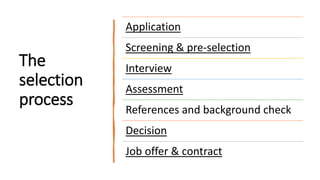
The
selection
process
Application
Screening & pre-selection
Interview
Assessment
References and background check
Decision
Job offer & contract
• After the job opening has been posted, candidates can apply. The amount of
people applying depends on the company, the specific function, and the
availability of work and workers.
• The number of applicants can range between zero and thousands, depending
primarily on the size of the company, the type of job and the industry, and on
how successful your sourcing strategy and employer brand are.
• Google, for example, receives around 3 million applications a year. This means
that on average more than 400 people apply per job opening.
1. Application
• The number and type of applicants also depend on
the job advertisement
• In fact, the way a job ad is written, meaning the words and language
used in it, has a direct impact on the people you attract.
• A tool like Textio uses data and machine learning to help
companies optimize their job advertisements and make sure the text
reflects not only what they are looking for in a candidate, but also what
they are about as a company.
2. Screening & Pre-Selection
• The second step is the initial screening of candidates. This can happen in
multiple ways.
• Resume screening. The most known technique is resume or CV screening.
• Resume screening helps to assess if candidates comply with the criteria
needed for the job.
• If you require 5+ years of work experience and you see that a college graduate
applied, you can easily disqualify this person. Thankfully, there are great tools
available that can do the resume screening ranging from built-in resume
screening tools to resume screeners that use artificial intelligence to predict
the quality of hire.
• Phone screening/ chatbot. After the resume screening, often a phone
screening happens.
• This helps to align expectations between the candidate and employer. The recruiter
can ask the questions they had after screening the candidate’s resume.
• In addition, the recruiter can walk through a checklist that may include topics like
pay expectations, full time or flexible commitment, starting date, and other potential
deal-breakers.
• Since this is a standard procedure, having a chatbot ask these questions is also an
option.
• These days, technology enables us to do these screening in an
automated way.
• One example are chatbots, which ask candidates questions and make
the interview interactive.
• An example is a large engineering company that implemented a chatbot
intended to optimize the recruitment process and keep candidates
engaged. The data showed that after the chatbot was
implemented, completion rates went up from 74% to 96%, an increase
of 22 percentage points.
• These pre-selection tests are often used for functions with a high
volume of applicants, in other words, for high-volume recruiting. To give
an example of such a test, a sales rep might be assessed on their service
orientation and how much they smile on video. These screening tools
‘weed out’ the obvious misfits so only the most suitable
candidates remain.
• The goal of this second phase is to reduce the number of candidates
from a large group to a manageable group of between 3-10 people that
can be interviewed in-person. Be aware that not all pre-selection tools
and screenings are fully accurate. Oftentimes there is a trade-off
between accuracy and convenience.
Pre-selection
• Pre-selection is a powerful screening method that helps to weed out
potential mismatches.
• Pre-selection tools provide assessments that can include
cognitive testing, a job sample, or other tests that help to predict the
quality of the new hire. Sometimes the resume screening is included
in these tools.
• Pre-employment assessment tools often also include a realistic job
preview. This shows both the positive but also the negative sides of
the job, resulting in a more truthful description of the good and bad
aspects of a given job. This helps to align expectations between
employer and employee and leads to better hires.
3. Interview
• The third step in the funnel is the best known and most visible of them all: the job
interview. The job interview involves the candidate being interviewed by their direct
manager or the recruiter to assess how well-suited they are for the job.
• The interview offers some insight into a person’s verbal fluency and sociability. It also
provides the opportunity to ask the candidate questions related to the job and it
presents the opportunity to sell the job to the candidate.
• There are two kinds of interviews, the unstructured and structured interview. In a
structured interview, a standardized set of questions is used. This provides the
interviewer with a uniform method of recording information and standardizing the
rating of the applicant’s qualifications.
• In scientific literature, the structured interview has proven to be almost twice as
reliable as the unstructured interview.
• The structured interview enables the interviewer to accurately compare candidates
and to make the best decision purely on data.
Besides standardized questions, a common
method used in interviews is the STAR method.
This method offers a structured way to retrieve information from
the candidate. STAR is an acronym for:
• Situation. Have the candidate describe the situation that they were in.
• Task. What goal was the candidate working towards?
• Action. Have the candidate describe in detail what actions they took to
make the best of the situation and complete their task.
• Result. Have the candidate describe the outcome of the action and ask
what the candidate learned.
• The STAR method is great to test the candidate’s experience in different
situations that are relevant to the job. If a candidate needs experience in
managing different shareholders, an example question could be: -
A. Describe a situation in which you had to manage different shareholders. Using the
STAR method, you can then easily test the candidate experience in these
situations.
B. Using this method to test for the key competencies of the job is highly
recommended. Indeed, asking multiple candidates the same question enables you
to easily compare how much experience they have in these key competencies from
their previous jobs.
4. Assessment
• Good assessments are either a General Mental Ability (GMA) test (also known as an IQ test) or
testing the employee’s personality using a Five-Factor Model of Personality.
• Higher IQ is associated with faster learning and higher top performance. This means that for high IQ
candidates the Time to Optimum Productivity is lower and candidates are likely to perform better.
• When it comes to personality, more conscientious candidates perform better in their job. Candidates
who score high in conscientiousness are often described as hard-working, dutiful, achievement-
oriented, and detail-oriented.
• The literature shows that one’s level of conscientiousness influences around 10% of one’s job
performance.
• Other assessments include work sample tests, integrity tests, and job knowledge tests. Literature
shows that work sample tests are especially reliable. A best practice is, therefore, to have candidates
do a case study or solve a real problem during their interview.
• The quality of a candidate’s work is usually easy to compare with the other applicants, adding an
important data point to the final decision.
• Assessments and interviews are sometimes switched around. A full
assessment is usually expensive but it will save considerable time
interviewing candidates who are potentially unsuited for the role.
5. References and background check
• In this stage, you have reduced the long list of candidates to a shortlist of one to three candidates.
• An essential step now is the reference check.
• Reference checks are a way to confirm your perception of the candidate. Ask the candidate to give you
references and follow up on these. If during the interview you have doubts about a certain competency
or skill, the reference check is an excellent way to gather more information from different perspectives.
• A background check is commonly used for government functions and other jobs that involve access to
highly confidential information. The use of background checks is also culturally determined. Countries
like the U.S. use it more than most European countries for example.
• The background check can also be a prerequisite before applying and be a part of the pre-selection. An
example is a certification of good conduct or other criminal record checks for teaching positions and
other jobs that involve a high responsibility for others.
6. Decision
• The next step is making the decision and choosing the candidate with the greatest future
potential for the organization.
• Sometimes this means picking someone less qualified now – but who is committed to
growing and staying with the organization longer.
• The decision is best made based on a data-driven approach.
• In practice, this means pre-defined criteria on which each candidate is rated during the
selection process. The best candidate is then chosen and given an offer.
7. Job offer & contract
• After the company has made the decision, the selection
process isn’t over. The candidate still needs to accept the
offer.
• At this point, the organization should have all the
information that will make the candidate say yes. This has
been retrieved during the phone screening and job
interview.
• The offer is then made to the candidate. If the offer is
accepted a contract is drawn and signed. Only when the
employment contract is signed by all parties, will the
selection process be completed.
Metrics used in the selection process
• Several important metrics should be tracked when it comes to the
selection process.
• These are indicators of how well you are performing in your selection
process.
• Time to fill. The time it takes to find and hire a candidate. A long
time to fill is an indication of an inefficient selection process.
• 90-day attrition. Attrition within the first three months is a clear
indication of a bad hire – that you as an organization are responsible
for.
• The estimations of the cost of a bad hire differ between sources but
are estimated to be between 50% to 200% of their annual salary.
• It is recommended to treat every case of 90-day attrition as a critical
HR incident that should be analyzed and prevented the next time
through better communication, selection, onboarding, and
management.
First-year attrition. Like the 90-day attrition
Candidate experience. How did the candidates rate their
experience in this selection process?
This is an important indicator as candidates are often a fan
and/or customer of your brand – that’s why they want to work
for you! Happy candidates might (one day) be customers or refer
customers to you.
This Photo by Unknown author is licensed under CC BY-SA-NC.
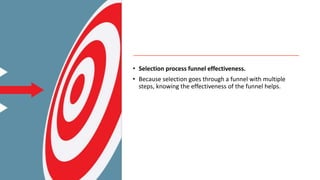
• Selection process funnel effectiveness.
• Because selection goes through a funnel with multiple
steps, knowing the effectiveness of the funnel helps.
Quality of hire.
• This metric measures how well a new hire is
performing after a year in their job.
• This is usually rated by their manager in the
annual performance appraisal.
• If the quality of hire is consistently good, it is an indication
that the selection process works.
RECRUITMENT & SELECTION.pptx

RECRUITMENT & SELECTION.pptx

  • 1.
  • 2.
    Recruitment • This isone step in the process of employment having a long process that involves a series of tasks, starting with an analysis of the job requirements and ending with the appointment of the employee. Specific tasks involved in the process of recruitment include: • Analyzing job requirements • Advertising the vacancy • Attracting candidates to apply for the job • Managing response • Scrutinizing applications • Shortlisting candidates
  • 3.
    Recruitment activities aretypically performed by Human Resource practitioners, either internally or externally • Internal recruitment sources are promotion, transfers, retrenched employees, contact or references, ex-employees, retired employees, etc. • External recruitment sources are recruitment through advertisement, campus recruitment, recruitment by employee exchanges, recruitment by third parties, internet recruitment, etc.
  • 4.
    • Recruitment processis the first step in creating a powerful resource base. • The process undergoes a systematic procedure starting from sourcing the resources to arranging and conducting interviews and finally selecting the right candidates.
  • 5.
    Recruitment Planning • Recruitment planningis the first step of the recruitment process, where the vacant positions are analyzed and described. It includes job specifications and its nature, experience, qualifications and skills required for the job, etc. • A structured recruitment plan is mandatory to attract potential candidates from a pool of candidates. • The potential candidates should be qualified, experienced with a capability to take the responsibilities required to achieve the objectives of the organization.
  • 6.
    Identifying Vacancy • The firstand foremost process of recruitment plan is identifying the vacancy. This process begins with receiving the requisition for recruitments from different department of the organization to the HR Department, which contains − • Number of posts to be filled • Number of positions • Duties and responsibilities to be performed • Qualification and experience required • When a vacancy is identified, it the responsibility of the sourcing manager to ascertain whether the position is required or not, permanent or temporary, full-time or part-time, etc. • These parameters should be evaluated before commencing recruitment. Proper identifying, planning and evaluating leads to hiring of the right resource for the team and the organization.
  • 7.
    Recruitment Strategy • Recruitment strategyis the second step of the recruitment process, where a strategy is prepared for hiring the resources. • After completing the preparation of job descriptions and job specifications, the next step is to decide which strategy to adopt for recruiting the potential candidates for the organization. • While preparing a recruitment strategy, the HR team considers the following points − • Types of recruitment • Geographical area • Recruitment sources
  • 8.
    The development ofa recruitment strategy is a long process, but having a right strategy is mandatory to attract the right candidates. The steps involved in developing a recruitment strategy include − • Setting up a board team • Analyzing HR strategy • Collection of available data • Analyzing the collected data • Setting the recruitment strategy
  • 9.
    Searching the Right Candidates •Searching is the process of recruitment where the resources are sourced depending upon the requirement of the job. After the recruitment strategy is done, the searching of candidates will be initialized. This process consists of two steps − • Source activation − Once the line manager verifies and permits the existence of the vacancy, the search for candidates starts. • Selling − Here, the organization selects the media through which the communication of vacancies reaches the prospective candidates. • Searching involves attracting the job seekers to the vacancies. • The sources are broadly divided into two categories: Internal Sources and External Sources.
  • 10.
    Internal Sources • Internal sourcesof recruitment refer to hiring employees within the organization through − • Promotions • Transfers • Former Employees • Internal Advertisements (Job Posting) • Employee Referrals • Previous Applicants
  • 11.
    External Sources • External sourcesof recruitment refer to hiring employees outside the organization through − • Direct Recruitment • Employment Exchanges • Employment Agencies • Advertisements • Professional Associations • Campus Recruitment • Word of Mouth
  • 12.
    Screening / Shortlisting • Screeningstarts after completion of the process of sourcing the candidates. • Screening is the process of filtering the applications of the candidates for further selection process. • Screening is an integral part of recruitment process that helps in removing unqualified or irrelevant candidates, which were received through sourcing. • https://elite-human-capital.com/2020/01/07/case-studies-in-the- recruitment-process-an-assessment-method-for-gathering-data-on-a- candidate/ • The screening process of recruitment consists of three steps −
  • 13.
    Reviewing of Resumes and CoverLetters • Reviewing is the first step of screening candidates. In this process, the resumes of the candidates are reviewed and checked for the candidates’ education, work experience, and overall background matching the requirement of the job • While reviewing the resumes, an HR executive must keep the following points in mind, to ensure better screening of the potential candidates − • Reason for change of job • Longevity with each organization • Long gaps in employment • Job-hopping • Lack of career progression
  • 14.
    Conducting Telephonic or Video Interview •Conducting telephonic or video interviews is the second step of screening candidates. • In this process, after the resumes are screened, the candidates are contacted through phone or video by the hiring manager. This screening process has two outcomes − • It helps in verifying the candidates, whether they are active and available. • It also helps in giving a quick insight about the candidate’s attitude, ability to answer interview questions, and communication skills.
  • 15.
    Identifying the top candidates • Identifyingthe top candidates is the final step of screening the resumes/candidates. In this process, the cream/top layer of resumes are shortlisted, which makes it easy for the hiring manager to take a decision. This process has the following three outcomes − • Shortlisting 5 to 10 resumes for review by the hiring managers • Providing insights and recommendations to the hiring manager • Helps the hiring managers to take a decision in hiring the right candidate
  • 16.
    Evaluation and Control • Evaluationand control is the last stage in the process of recruitment. • In this process, the effectiveness and the validity of the process and methods are assessed. • Recruitment is a costly process; hence it is important that the performance of the recruitment process is thoroughly evaluated.
  • 17.
    • The costsincurred in the recruitment process are to be evaluated and controlled effectively. These include the following − • Salaries to the Recruiters • Advertisements cost and other costs incurred in recruitment methods, i.e., agency fees. • Administrative expenses and Recruitment overheads • Overtime and Outstanding costs, while the vacancies remain unfilled • Cost incurred in recruiting suitable candidates for the final selection process • Time spent by the Management and the Professionals in preparing job description, job specifications, and conducting interviews.
  • 18.
    • Finally, thequestion that is to be asked is, whether the recruitment methods used are valid or not? • And whether the recruitment process itself is effective or not? Statistical information on the costs incurred for the process of recruitment should be effective. • https://www.hrzone.com/lead/strategy/case-study-e-recruitment-gets-nike- on-track • https://www.ere.net/a-case-study-of-google-recruiting/
  • 19.
    What is Selection? • Selectionis the process of identifying an individual from a pool of job applicants with the requisite qualifications and competencies to fill jobs in the organization. • This is an HR process that helps differentiate between qualified and unqualified applicants by applying various techniques. • The term ‘selection’ comes with the connotation of placing the right person in the right job. Selection is the process in which various strategies are employed to help recruiters decide which applicant is best suited for the job
  • 20.
    Some activities in selectioninclude: • Screening • Eliminating unsuitable candidates • Conducting an examination (aptitude test, intelligence test, performance test, personality test, etc.) • Interviews • Checking references • Medical tests
  • 21.
    • The selectionprocess is a largely time-consuming step in an employee’s hiring experience. • HR managers must carefully identify the eligibility of every candidate for the post, being careful not to disregard important factors such as educational qualification, background, age, etc.
  • 22.
    • The employeeselection process is a series of steps that companies use to hire the best workers. • Matching the right skills to the open roles is key, and effective selection can result in hiring the kind of employees that will boost company morale, add to your corporate culture, and keep turnover low.
  • 23.
    • It’s importantto note that employee selection is different from recruitment. • Each is a distinctly separate phase. Recruitment happens first, and selection takes place after you have a suitable pool of applicants. • Think of selection as the part of hiring where the funnel narrows significantly, and the most promising hires are found.
  • 24.
  • 25.
    • After thejob opening has been posted, candidates can apply. The amount of people applying depends on the company, the specific function, and the availability of work and workers. • The number of applicants can range between zero and thousands, depending primarily on the size of the company, the type of job and the industry, and on how successful your sourcing strategy and employer brand are. • Google, for example, receives around 3 million applications a year. This means that on average more than 400 people apply per job opening. 1. Application
  • 26.
    • The numberand type of applicants also depend on the job advertisement • In fact, the way a job ad is written, meaning the words and language used in it, has a direct impact on the people you attract. • A tool like Textio uses data and machine learning to help companies optimize their job advertisements and make sure the text reflects not only what they are looking for in a candidate, but also what they are about as a company.
  • 27.
    2. Screening &Pre-Selection • The second step is the initial screening of candidates. This can happen in multiple ways. • Resume screening. The most known technique is resume or CV screening. • Resume screening helps to assess if candidates comply with the criteria needed for the job. • If you require 5+ years of work experience and you see that a college graduate applied, you can easily disqualify this person. Thankfully, there are great tools available that can do the resume screening ranging from built-in resume screening tools to resume screeners that use artificial intelligence to predict the quality of hire.
  • 28.
    • Phone screening/chatbot. After the resume screening, often a phone screening happens. • This helps to align expectations between the candidate and employer. The recruiter can ask the questions they had after screening the candidate’s resume. • In addition, the recruiter can walk through a checklist that may include topics like pay expectations, full time or flexible commitment, starting date, and other potential deal-breakers. • Since this is a standard procedure, having a chatbot ask these questions is also an option.
  • 29.
    • These days,technology enables us to do these screening in an automated way. • One example are chatbots, which ask candidates questions and make the interview interactive. • An example is a large engineering company that implemented a chatbot intended to optimize the recruitment process and keep candidates engaged. The data showed that after the chatbot was implemented, completion rates went up from 74% to 96%, an increase of 22 percentage points.
  • 30.
    • These pre-selectiontests are often used for functions with a high volume of applicants, in other words, for high-volume recruiting. To give an example of such a test, a sales rep might be assessed on their service orientation and how much they smile on video. These screening tools ‘weed out’ the obvious misfits so only the most suitable candidates remain. • The goal of this second phase is to reduce the number of candidates from a large group to a manageable group of between 3-10 people that can be interviewed in-person. Be aware that not all pre-selection tools and screenings are fully accurate. Oftentimes there is a trade-off between accuracy and convenience.
  • 31.
    Pre-selection • Pre-selection isa powerful screening method that helps to weed out potential mismatches. • Pre-selection tools provide assessments that can include cognitive testing, a job sample, or other tests that help to predict the quality of the new hire. Sometimes the resume screening is included in these tools. • Pre-employment assessment tools often also include a realistic job preview. This shows both the positive but also the negative sides of the job, resulting in a more truthful description of the good and bad aspects of a given job. This helps to align expectations between employer and employee and leads to better hires.
  • 32.
    3. Interview • Thethird step in the funnel is the best known and most visible of them all: the job interview. The job interview involves the candidate being interviewed by their direct manager or the recruiter to assess how well-suited they are for the job. • The interview offers some insight into a person’s verbal fluency and sociability. It also provides the opportunity to ask the candidate questions related to the job and it presents the opportunity to sell the job to the candidate. • There are two kinds of interviews, the unstructured and structured interview. In a structured interview, a standardized set of questions is used. This provides the interviewer with a uniform method of recording information and standardizing the rating of the applicant’s qualifications. • In scientific literature, the structured interview has proven to be almost twice as reliable as the unstructured interview. • The structured interview enables the interviewer to accurately compare candidates and to make the best decision purely on data.
  • 33.
    Besides standardized questions,a common method used in interviews is the STAR method. This method offers a structured way to retrieve information from the candidate. STAR is an acronym for: • Situation. Have the candidate describe the situation that they were in. • Task. What goal was the candidate working towards? • Action. Have the candidate describe in detail what actions they took to make the best of the situation and complete their task. • Result. Have the candidate describe the outcome of the action and ask what the candidate learned.
  • 34.
    • The STARmethod is great to test the candidate’s experience in different situations that are relevant to the job. If a candidate needs experience in managing different shareholders, an example question could be: - A. Describe a situation in which you had to manage different shareholders. Using the STAR method, you can then easily test the candidate experience in these situations. B. Using this method to test for the key competencies of the job is highly recommended. Indeed, asking multiple candidates the same question enables you to easily compare how much experience they have in these key competencies from their previous jobs.
  • 35.
    4. Assessment • Goodassessments are either a General Mental Ability (GMA) test (also known as an IQ test) or testing the employee’s personality using a Five-Factor Model of Personality. • Higher IQ is associated with faster learning and higher top performance. This means that for high IQ candidates the Time to Optimum Productivity is lower and candidates are likely to perform better. • When it comes to personality, more conscientious candidates perform better in their job. Candidates who score high in conscientiousness are often described as hard-working, dutiful, achievement- oriented, and detail-oriented. • The literature shows that one’s level of conscientiousness influences around 10% of one’s job performance. • Other assessments include work sample tests, integrity tests, and job knowledge tests. Literature shows that work sample tests are especially reliable. A best practice is, therefore, to have candidates do a case study or solve a real problem during their interview. • The quality of a candidate’s work is usually easy to compare with the other applicants, adding an important data point to the final decision.
  • 36.
    • Assessments andinterviews are sometimes switched around. A full assessment is usually expensive but it will save considerable time interviewing candidates who are potentially unsuited for the role.
  • 37.
    5. References andbackground check • In this stage, you have reduced the long list of candidates to a shortlist of one to three candidates. • An essential step now is the reference check. • Reference checks are a way to confirm your perception of the candidate. Ask the candidate to give you references and follow up on these. If during the interview you have doubts about a certain competency or skill, the reference check is an excellent way to gather more information from different perspectives. • A background check is commonly used for government functions and other jobs that involve access to highly confidential information. The use of background checks is also culturally determined. Countries like the U.S. use it more than most European countries for example. • The background check can also be a prerequisite before applying and be a part of the pre-selection. An example is a certification of good conduct or other criminal record checks for teaching positions and other jobs that involve a high responsibility for others.
  • 38.
    6. Decision • Thenext step is making the decision and choosing the candidate with the greatest future potential for the organization. • Sometimes this means picking someone less qualified now – but who is committed to growing and staying with the organization longer. • The decision is best made based on a data-driven approach. • In practice, this means pre-defined criteria on which each candidate is rated during the selection process. The best candidate is then chosen and given an offer.
  • 39.
    7. Job offer& contract • After the company has made the decision, the selection process isn’t over. The candidate still needs to accept the offer. • At this point, the organization should have all the information that will make the candidate say yes. This has been retrieved during the phone screening and job interview. • The offer is then made to the candidate. If the offer is accepted a contract is drawn and signed. Only when the employment contract is signed by all parties, will the selection process be completed.
  • 40.
    Metrics used inthe selection process • Several important metrics should be tracked when it comes to the selection process. • These are indicators of how well you are performing in your selection process. • Time to fill. The time it takes to find and hire a candidate. A long time to fill is an indication of an inefficient selection process.
  • 41.
    • 90-day attrition.Attrition within the first three months is a clear indication of a bad hire – that you as an organization are responsible for. • The estimations of the cost of a bad hire differ between sources but are estimated to be between 50% to 200% of their annual salary. • It is recommended to treat every case of 90-day attrition as a critical HR incident that should be analyzed and prevented the next time through better communication, selection, onboarding, and management.
  • 42.
    First-year attrition. Likethe 90-day attrition Candidate experience. How did the candidates rate their experience in this selection process? This is an important indicator as candidates are often a fan and/or customer of your brand – that’s why they want to work for you! Happy candidates might (one day) be customers or refer customers to you. This Photo by Unknown author is licensed under CC BY-SA-NC.
  • 43.
    • Selection processfunnel effectiveness. • Because selection goes through a funnel with multiple steps, knowing the effectiveness of the funnel helps.
  • 44.
    Quality of hire. •This metric measures how well a new hire is performing after a year in their job. • This is usually rated by their manager in the annual performance appraisal. • If the quality of hire is consistently good, it is an indication that the selection process works.