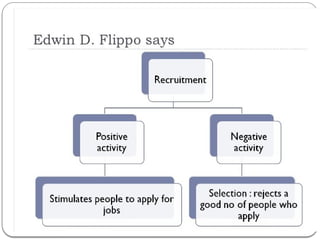
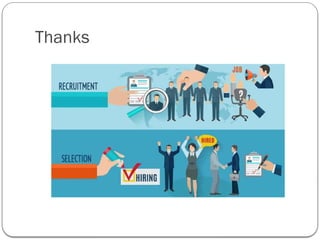
RECRUITMENT AND SELECTION
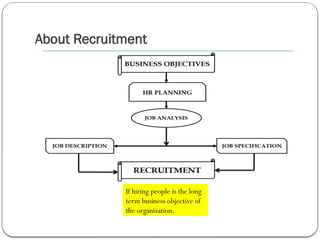
About Recruitment
If hiring people is the long
term business objective of
the organization.
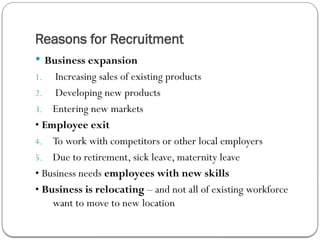
Reasons for Recruitment
 Business expansion
1. Increasing sales of existing products
2. Developing new products
3. Entering new markets
• Employee exit
4. To work with competitors or other local employers
5. Due to retirement, sick leave, maternity leave
• Business needs employees with new skills
• Business is relocating – and not all of existing workforce
want to move to new location
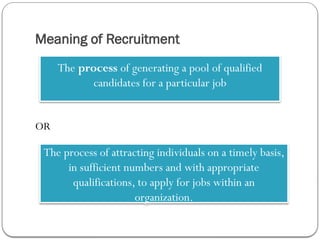
Meaning of Recruitment
OR
The process of generating a pool of qualified
candidates for a particular job
The process of attracting individuals on a timely basis,
in sufficient numbers and with appropriate
qualifications, to apply for jobs within an
organization.
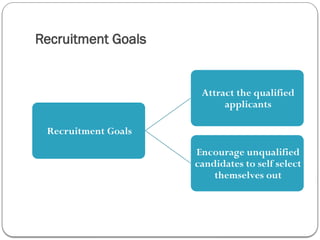
Recruitment Goals
Recruitment Goals
Attract the qualified
applicants
Encourage unqualified
candidates to self select
themselves out
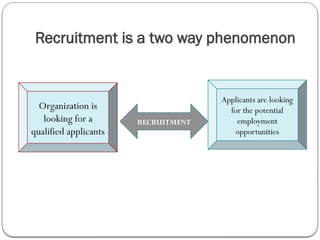
Recruitment is a two way phenomenon
RECRUITMENT
Organization is
looking for a
qualified applicants
Applicants are looking
for the potential
employment
opportunities
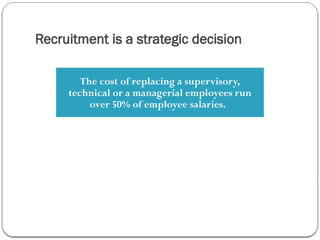
Recruitment is a strategic decision
The cost of replacing a supervisory,
technical or a managerial employees run
over 50% of employee salaries.
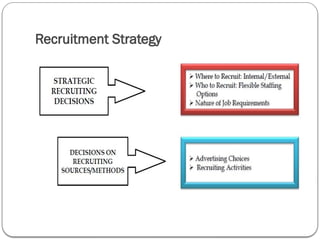
Recruitment Strategy
Recruitment strategy
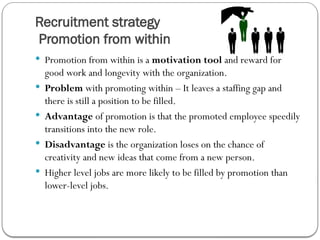
Promotion from within
 Promotion from within is a motivation tool and reward for
good work and longevity with the organization.
 Problem with promoting within – It leaves a staffing gap and
there is still a position to be filled.
 Advantage of promotion is that the promoted employee speedily
transitions into the new role.
 Disadvantage is the organization loses on the chance of
creativity and new ideas that come from a new person.
 Higher level jobs are more likely to be filled by promotion than
lower-level jobs.
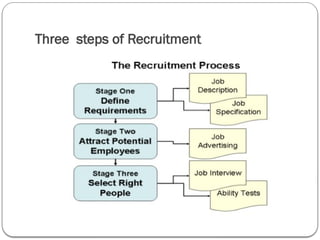
Three steps of Recruitment
Stages of Recruitment Process
1. Preparation
a) Identifying what jobs need filling
b) Identifying what is the role and job specification
2. Finding suitable candidates – through advertising
encouraging employees to apply for job
a) External sources
b) Internal sources
3. Selection – Processes to choose best person for job
a) Job offer
b) Introducing selected candidate to business
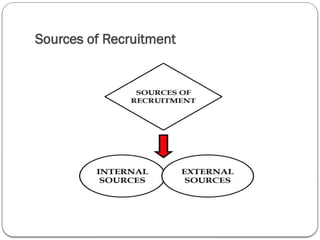
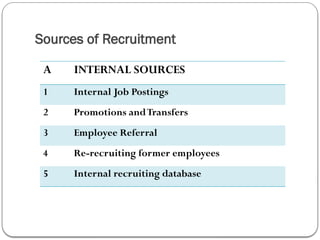
Sources of Recruitment
A INTERNAL SOURCES
1 Internal Job Postings
2 Promotions andTransfers
3 Employee Referral
4 Re-recruiting former employees
5 Internal recruiting database
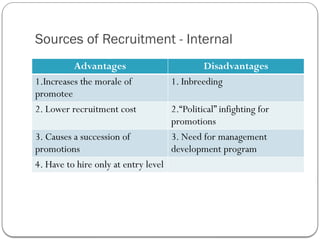
Sources of Recruitment - Internal
Advantages Disadvantages
1.Increases the morale of
promotee
1. Inbreeding
2. Lower recruitment cost 2.“Political” infighting for
promotions
3. Causes a succession of
promotions
3. Need for management
development program
4. Have to hire only at entry level
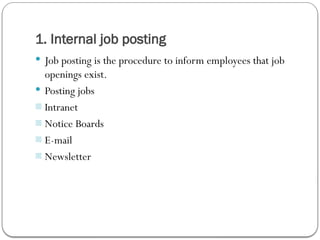
1. Internal job posting
 Job posting is the procedure to inform employees that job
openings exist.
 Posting jobs
- Intranet
- Notice Boards
- E-mail
- Newsletter
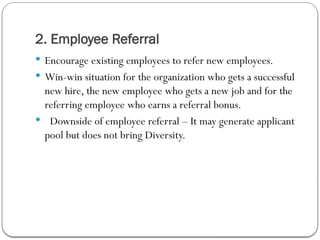
2. Employee Referral
 Encourage existing employees to refer new employees.
 Win-win situation for the organization who gets a successful
new hire, the new employee who gets a new job and for the
referring employee who earns a referral bonus.
 Downside of employee referral – It may generate applicant
pool but does not bring Diversity.
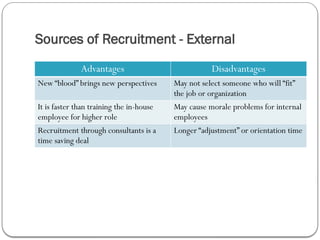
Sources of Recruitment - External
Advantages Disadvantages
New “blood” brings new perspectives May not select someone who will “fit”
the job or organization
It is faster than training the in-house
employee for higher role
May cause morale problems for internal
employees
Recruitment through consultants is a
time saving deal
Longer “adjustment” or orientation time
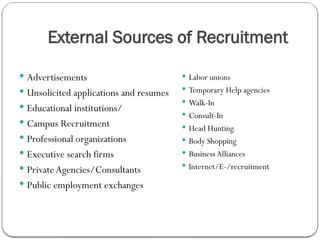
External Sources of Recruitment
 Advertisements
 Unsolicited applications and resumes
 Educational institutions/
 Campus Recruitment
 Professional organizations
 Executive search firms
 Private Agencies/Consultants
 Public employment exchanges
 Labor unions
 Temporary Help agencies
 Walk-In
 Consult-In
 Head Hunting
 Body Shopping
 Business Alliances
 Internet/E-/recruitment
Campus Internships
 An internship is an arrangement in which the student is
placed temporarily in a position with no obligation to the
student or the organization to make position permanent.
 Enables the student to learn about the organization and try
out the job before settling into a career.
 Also enables the organization to try out a possible future
employee before making a job offer.
Recruitment consultants
 A recruitment consultant works to provide a link
between the employer and employee.
 Executive search firms specialize in recruitment of associate,
middle to senior level jobs
 Staffing companies recruit entry level jobs
 Consultants generate a pool of applicants and screen the qualified
viz unqualified candidates
 Consultants charge recruitment fee( % of the position’s annual
CTC)
 Consultants specialize in particular industries – E.g. IT, financial
services, Retail, Real estate, Healthcare
Internal Recruitment team
 Large organizations hire dedicated in-house Recruiters
 TalentAcquisition team generate qualified candidates for
open positions.
 In-house recruiters represent the organization’s image when
interacting with the applicant.
Media sources
 Classified in news papers
 Online application on company’s website - Careers section
 Job portals
Sources of Recruitment – Internet
Recruitment
Advantages Disadvantages
Cost savings More unqualified applicants
It is easy and quick to post
anAd
Additional work for HR staff
members
Expanded pool of applicants Many applicants are not
seriously seeking
employment
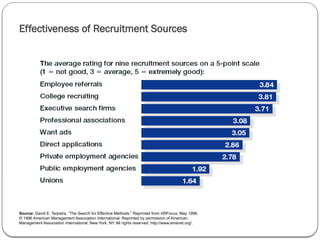
Effectiveness of Recruitment Sources
Source: David E. Terpstra, “The Search for Effective Methods.” Reprinted from HRFocus, May 1996.
© 1996 American Management Association International. Reprinted by permission of American
Management Association International, New York, NY. All rights reserved. http://www.amanet.org/.
Recruiting evaluation
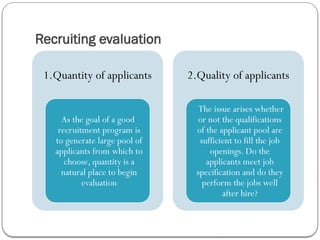
1.Quantity of applicants
As the goal of a good
recruitment program is
to generate large pool of
applicants from which to
choose, quantity is a
natural place to begin
evaluation
2.Quality of applicants
The issue arises whether
or not the qualifications
of the applicant pool are
sufficient to fill the job
openings. Do the
applicants meet job
specification and do they
perform the jobs well
after hire?
Recruiting evaluation
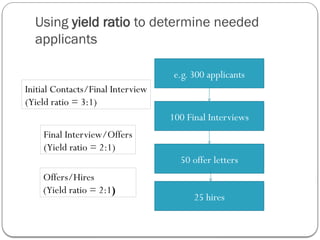
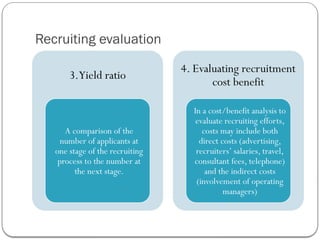
3.Yield ratio
A comparison of the
number of applicants at
one stage of the recruiting
process to the number at
the next stage.
4. Evaluating recruitment
cost benefit
In a cost/benefit analysis to
evaluate recruiting efforts,
costs may include both
direct costs (advertising,
recruiters’ salaries, travel,
consultant fees, telephone)
and the indirect costs
(involvement of operating
managers)
Using yield ratio to determine needed
applicants
e.g. 300 applicants
100 Final Interviews
50 offer letters
25 hires
Initial Contacts/Final Interview
(Yield ratio = 3:1)
Final Interview/Offers
(Yield ratio = 2:1)
Offers/Hires
(Yield ratio = 2:1)
Gender Diversity Recruitment
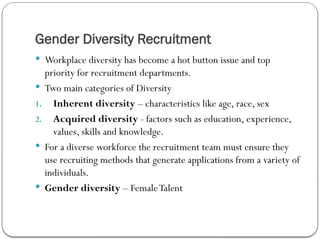
 Workplace diversity has become a hot button issue and top
priority for recruitment departments.
 Two main categories of Diversity
1. Inherent diversity – characteristics like age, race, sex
2. Acquired diversity - factors such as education, experience,
values, skills and knowledge.
 For a diverse workforce the recruitment team must ensure they
use recruiting methods that generate applications from a variety of
individuals.
 Gender diversity – FemaleTalent
Selection
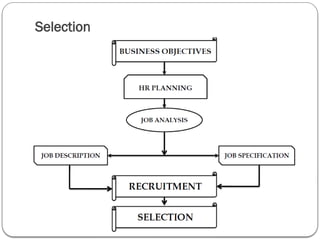
Meaning of Selection
OR
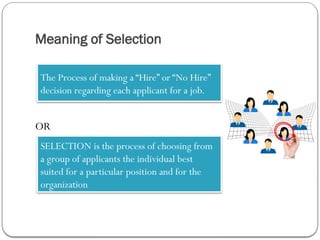
The Process of making a “Hire” or “No Hire”
decision regarding each applicant for a job.
SELECTION is the process of choosing from
a group of applicants the individual best
suited for a particular position and for the
organization
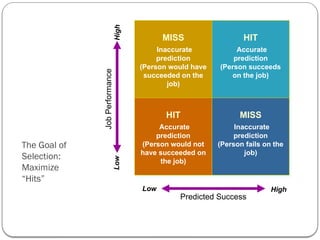
The Goal of
Selection:
Maximize
“Hits”
MISS
Inaccurate
prediction
(Person would have
succeeded on the
job)
HIT
Accurate
prediction
(Person succeeds
on the job)
HIT
Accurate
prediction
(Person would not
have succeeded on
the job)
MISS
Inaccurate
prediction
(Person fails on the
job)
Predicted Success
Job
Performance
Low
Low
High
High
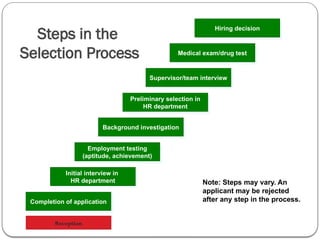
Steps in the
Selection Process
Note: Steps may vary. An
applicant may be rejected
after any step in the process.
Completion of application
Initial interview in
HR department
Employment testing
(aptitude, achievement)
Background investigation
Preliminary selection in
HR department
Supervisor/team interview
Medical exam/drug test
Hiring decision
Reception
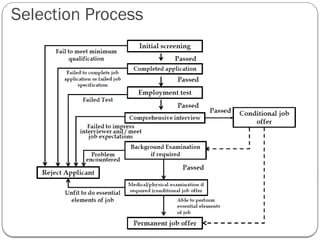
Selection Process
The Process
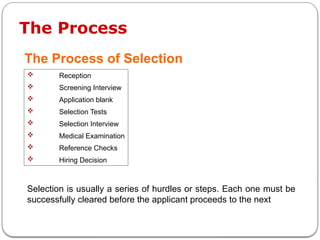
The Process of Selection
 Reception
 Screening Interview
 Application blank
 Selection Tests
 Selection Interview
 Medical Examination
 Reference Checks
 Hiring Decision
Selection is usually a series of hurdles or steps. Each one must be
successfully cleared before the applicant proceeds to the next
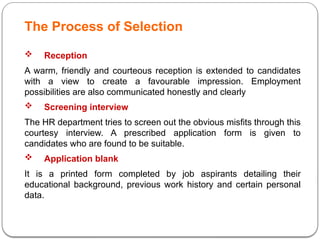
 Reception
A warm, friendly and courteous reception is extended to candidates
with a view to create a favourable impression. Employment
possibilities are also communicated honestly and clearly
 Screening interview
The HR department tries to screen out the obvious misfits through this
courtesy interview. A prescribed application form is given to
candidates who are found to be suitable.
 Application blank
It is a printed form completed by job aspirants detailing their
educational background, previous work history and certain personal
data.
The Process of Selection
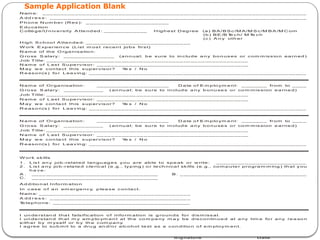
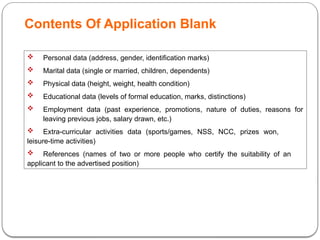
Contents Of Application Blank
 Personal data (address, gender, identification marks)
 Marital data (single or married, children, dependents)
 Physical data (height, weight, health condition)
 Educational data (levels of formal education, marks, distinctions)
 Employment data (past experience, promotions, nature of duties, reasons for
leaving previous jobs, salary drawn, etc.)
 Extra-curricular activities data (sports/games, NSS, NCC, prizes won,
leisure-time activities)
 References (names of two or more people who certify the suitability of an
applicant to the advertised position)
Sample Application Blank
Nam e: _ __ __ __ __ _ __ __ __ __ __ _ __ __ __ __ _ ___________ __ __ __ __ _ __ __ __ __ __ _ __ __ __ __ _ __ _
A dd r e s s : _ __ __ __ __ _ ____ __ __ __ _ __ __ __ __ _ __ __ __ __ __ _ __ __ __ __ _ __ __ __ __ __ _ __ __ __ __ _ _
P h on e N um ber (R es ): _ __ __ __ __ _ __ __ __ __ __ _ __
E du ca tion
C olle g e/U n iv e rsity A tte nd ed : _ __ _ __ __ __ __ H ighest D eg ree (a ) B A /B S c /M A /M S c/M B A /M C om
(b ) B E /B T
e c h/ M T
e c h
(c ) A n y oth er
H ig h S ch oo l A ttende d: __ __ __ _ __ __ __ __ __ _ __ __ __ __ _ __
W ork E xp erien ce (List m os t recen t jo bs first)
N am e of the O rganisa tio n:
G ro ss S alary: _ __ __ _ __ __ __ _ _ (a nn ua l; be sure to in clu de a n y bo n uses or com m iss io n ea rn ed )
J ob Title: _ __ __ ____ __ __ __ __ __ __ __ __ __ __ _ __ __ __ __ __ __ __ __ __ __ __ __ __
N am e of L ast S u pe rvisor : __ __ _ __ __ __ __ _ __ __ __ __ _ __ _________ __ __ __ __
M ay w e con ta ct this s up ervisor? Y
e s / N o
R easo n(s ) fo r L ea v in g: __ __ __ _ __ __ _ __ __ __ _ __ __ _ __ __ __ _ __ __ _ __ __ __ _ __ __ _ __ __ __ _ __ __ _
N am e of Or ga nisation : __ _ __ __ __ __ _ __ __ __ __ D a te o f E m p lo ym e nt: _ __ _ __ _ from to _ __ _
G ro ss S alary: _ __ __ _ __ __ _ ( an nu a l; be su re to in clud e a ny b o nu se s o r co m m ission e a rne d)
J ob Title: _ __ __ ____ __ __ __ __ __ __ __ __ __ __ _ __ __ __ __ __ __ __ __ __ __ __ __ __
N am e of L ast S u pe rvisor : __ __ _ __ __ __ __ _ __ __ __ __ _ __ _________ __ __ __ __
M ay w e con ta ct this s up ervisor? Y
e s / N o
R easo n(s ) fo r L ea v in g: __ __ __ _ __ __ _ __ __ __ _ __ __ _ __ __ __ _ __ __ _ __ __ __ _ __ __ _ __ __ __ _ __ __ _
N am e of Or ga nisation : __ _ __ __ __ __ _ __ __ __ __ D a te o f E m p lo ym e nt: _ __ _ __ _ from to _ __ _
G ro ss S alary: _ __ __ _ __ __ _ ( an nu a l; be su re to in clud e a ny b o nu se s o r co m m ission e a rne d)
J ob Title: _ __ __ ____ __ __ __ __ __ __ __ __ __ __ _ __ __ __ __ __ __ __ __ __ __ __ __ __
N am e of L ast S u pe rvisor : __ __ _ __ __ __ __ _ __ __ __ __ _ __ _________ __ __ __ __
M ay w e con ta ct this s up ervisor? Y
e s / N o
R easo n(s ) fo r L ea v in g: __ __ __ _ __ __ _ __ __ __ _ __ __ _ __ __ __ _ __ __ _ __ __ __ _ __ __ _ __ __ __ _ __ __ _
W or k skills
1 . L is t an y job -related lan gu ag es you are ab le to spe ak or w rite : ____ __ __ _ __ __ __ __ __ __ ____
2 . L is t a ny jo b-r ela ted cle rica l (e .g., ty p ing ) o r te ch nica l skills (e.g., co m pute r pro gra m m ing ) th at you
h a ve :
A . __ __ __ __ __ ___ __ __ __ _ __ __ __ __ __ _ __ __ B . _ __ __________ __ __ __ __ __ _ __ __ __ __ _ __
C. __ __ __ _ __ ____ __ _ __ __ __ __ __ _ __ __ __ __
A d ditio n al Info rm atio n
In c ase o f a n em er ge ncy
, p lea se c on tact.
Nam e: _ __ ____ __ _ __ __ __ __ __ _ __ __ __ __ _ __ __ __ __ __ _ _
A dd r e s s : _ __ __ __ __ _ ____ __ __ __ _ __ __ __ __ _ __ __ __ __ _
T
e lep ho ne : __ _ ____ __ __ __ _ __ __ __ __ _ __ __ __ __ __ _ __ __
I un de rstan d tha t fa lsific ation o f info rm ation is g ro un ds fo r d ism iss a l.
I un de rs tan d th at m y em plo ym en t at th e co m pa ny m a y be d iscon tin ue d at a ny tim e fo r a ny re a so n
e ith er by m yself or b y th e c om pa ny
.
I ag ree to su b m it to a dru g an d/o r a lcoh ol te st as a con ditio n o f e m ploym en t.
S ig na tu re Date
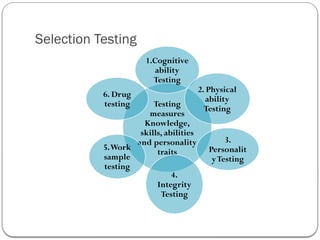
Selection Testing
Testing
measures
Knowledge,
skills, abilities
and personality
traits
1.Cognitive
ability
Testing
2. Physical
ability
Testing
3.
Personalit
yTesting
4.
Integrity
Testing
5.Work
sample
testing
6. Drug
testing
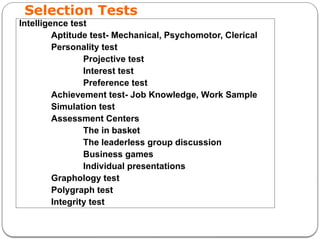
Selection Tests
Intelligence test
Aptitude test- Mechanical, Psychomotor, Clerical
Personality test
Projective test
Interest test
Preference test
Achievement test- Job Knowledge, Work Sample
Simulation test
Assessment Centers
The in basket
The leaderless group discussion
Business games
Individual presentations
Graphology test
Polygraph test
Integrity test
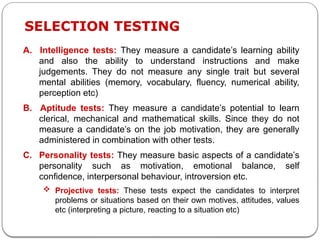
A. Intelligence tests: They measure a candidate’s learning ability
and also the ability to understand instructions and make
judgements. They do not measure any single trait but several
mental abilities (memory, vocabulary, fluency, numerical ability,
perception etc)
B. Aptitude tests: They measure a candidate’s potential to learn
clerical, mechanical and mathematical skills. Since they do not
measure a candidate’s on the job motivation, they are generally
administered in combination with other tests.
C. Personality tests: They measure basic aspects of a candidate’s
personality such as motivation, emotional balance, self
confidence, interpersonal behaviour, introversion etc.
 Projective tests: These tests expect the candidates to interpret
problems or situations based on their own motives, attitudes, values
etc (interpreting a picture, reacting to a situation etc)
SELECTION TESTING
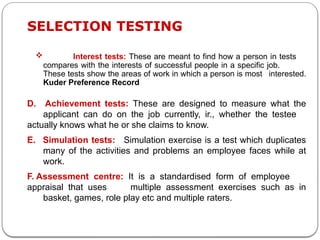
 Interest tests: These are meant to find how a person in tests
compares with the interests of successful people in a specific job.
These tests show the areas of work in which a person is most interested.
Kuder Preference Record
SELECTION TESTING
D. Achievement tests: These are designed to measure what the
applicant can do on the job currently, ir., whether the testee
actually knows what he or she claims to know.
E. Simulation tests: Simulation exercise is a test which duplicates
many of the activities and problems an employee faces while at
work.
F. Assessment centre: It is a standardised form of employee
appraisal that uses multiple assessment exercises such as in
basket, games, role play etc and multiple raters.
 The in-basket: From out of reports, memos, letters etc placed in the
in-basket, a candidate is supposed to initiate relevant actions within a limited
period of time.
 The leaderless group discussion: This exercise involves groups of
managerial candidates working together on a job related problem so as to
measure skills such as oral communication, tolerance, self- confidence,
adaptability, etc.
 Business games: Here participants try to solve a problem, usually as
members of two or more simulated companies that are competing in the
market place.
 Individual presentations: In this case the participants are given a limited
amount of time to plan, organise and prepare a presentation on a given topic.
SELECTION TESTING – Assessment center
G. Graphology tests: Here a trained evaluator tries to examine the
lines, loops, hooks, strokes, curves etc in a person's handwriting
to assess the person's personality and emotional make-up.
H. Polygraph : It is a lie detection test. During the test, the operator
records the respiration, blood pressure and perspiration of the
subject as he or she responds to s series of questions posed to
elicit the truth.
I. Integrity tests: these are designed to measure employee's
honesty to predict those who are more likely to indulge in
unacceptable behaviour
SELECTION TESTING
Interviewing
 The most frequently used selection method.
 Interviewing occurs when applicants respond to questions
posed by an interviewer
 Chance for the interviewer to meet applicant face to face
(except web conferencing)
 Can obtain much more information on: –What person is like –
Whether they are suitable for job –Whether they will fit into
the organization
 Interview is also an important for the candidate – Obtain
information about job – Assess the working culture of a possible
new employer
Information to obtain during a Recruitment
Interview
 By the employer:
1. Information that cannot be obtained on paper from a CV or
application form
2. Conversational ability- often known as people skills
3. Natural enthusiasm or manner of applicant
4. See how applicant reacts under pressure
• By the employee
5. Whether job or business is right for them
6. What is culture of company like
7. What are exact details of job that may be omitted from job
description
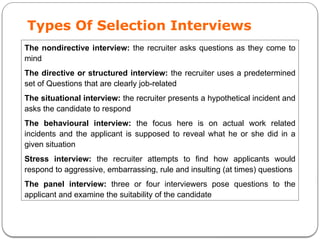
Types Of Selection Interviews
The nondirective interview: the recruiter asks questions as they come to
mind
The directive or structured interview: the recruiter uses a predetermined
set of Questions that are clearly job-related
The situational interview: the recruiter presents a hypothetical incident and
asks the candidate to respond
The behavioural interview: the focus here is on actual work related
incidents and the applicant is supposed to reveal what he or she did in a
given situation
Stress interview: the recruiter attempts to find how applicants would
respond to aggressive, embarrassing, rule and insulting (at times) questions
The panel interview: three or four interviewers pose questions to the
applicant and examine the suitability of the candidate
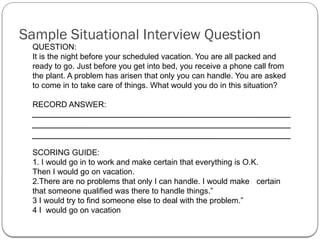
QUESTION:
It is the night before your scheduled vacation. You are all packed and
ready to go. Just before you get into bed, you receive a phone call from
the plant. A problem has arisen that only you can handle. You are asked
to come in to take care of things. What would you do in this situation?
RECORD ANSWER:
SCORING GUIDE:
1. I would go in to work and make certain that everything is O.K.
Then I would go on vacation.
2.There are no problems that only I can handle. I would make certain
that someone qualified was there to handle things.”
3 I would try to find someone else to deal with the problem.”
4 I would go on vacation
Sample Situational Interview Question
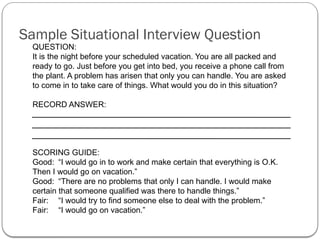
QUESTION:
It is the night before your scheduled vacation. You are all packed and
ready to go. Just before you get into bed, you receive a phone call from
the plant. A problem has arisen that only you can handle. You are asked
to come in to take care of things. What would you do in this situation?
RECORD ANSWER:
SCORING GUIDE:
Good: “I would go in to work and make certain that everything is O.K.
Then I would go on vacation.”
Good: “There are no problems that only I can handle. I would make
certain that someone qualified was there to handle things.”
Fair: “I would try to find someone else to deal with the problem.”
Fair: “I would go on vacation.”
Sample Situational Interview Question
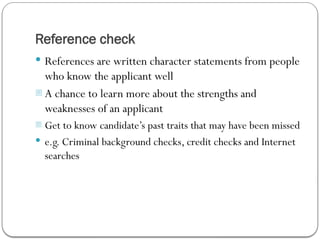
Reference check
 References are written character statements from people
who know the applicant well
- A chance to learn more about the strengths and
weaknesses of an applicant
- Get to know candidate’s past traits that may have been missed
 e.g. Criminal background checks, credit checks and Internet
searches
Making the Job Offer
 A job offer may be extended by phone, letter or in person
 The job offer is handled by the HR department where salary
and benefits are discussed
Reliability and Validity of Selection Methods
 Reliability is the consistency of a selection method. If a method is
reliable, it produces the same results under consistent conditions. For
example, if an aptitude test for business analysts is reliable, a candidate
taking it multiple times under similar conditions should get similar
scores.
 Validity refers to how well a selection method predicts future job
performance. A valid method ensures that candidates chosen through
the process perform well in the job. For example, a simulation test for
data analysts that closely mirrors actual job tasks (e.g., working with
large data sets or building predictive models) is likely to be a valid
predictor of their future performance.
Human Bias in Recruitment and Selection
 Human Bias in recruitment refers to favoritism or prejudice in
hiring that may arise based on personal characteristics such as race,
gender, age, or educational background, rather than job-related
qualifications.
Mitigating Bias:
 Diverse training data
 Unbiased interviews (such as structured interviews)
 Auditing recruitment practices
Validating Selection Techniques as Predictors of Performance
 Validation involves testing whether the selection method accurately
predicts job performance.This is crucial for ensuring that hiring
decisions are made based on the right criteria.
Steps forValidation:
 Track candidate performance after they’ve been hired.
 Compare this data to their selection process results.
 Adjust the selection methods based on performance data to improve
future hiring decisions.
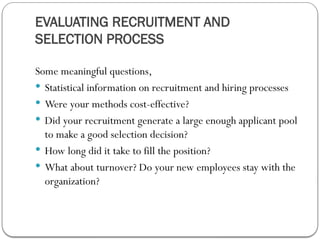
EVALUATING RECRUITMENT AND
SELECTION PROCESS
Some meaningful questions,
 Statistical information on recruitment and hiring processes
 Were your methods cost-effective?
 Did your recruitment generate a large enough applicant pool
to make a good selection decision?
 How long did it take to fill the position?
 What about turnover? Do your new employees stay with the
organization?
Thanks

Recruitment and Selection.pptx for Human Resource Management

  • 1.
  • 2.
    About Recruitment If hiringpeople is the long term business objective of the organization.
  • 3.
    Reasons for Recruitment Business expansion 1. Increasing sales of existing products 2. Developing new products 3. Entering new markets • Employee exit 4. To work with competitors or other local employers 5. Due to retirement, sick leave, maternity leave • Business needs employees with new skills • Business is relocating – and not all of existing workforce want to move to new location
  • 4.
    Meaning of Recruitment OR Theprocess of generating a pool of qualified candidates for a particular job The process of attracting individuals on a timely basis, in sufficient numbers and with appropriate qualifications, to apply for jobs within an organization.
  • 5.
    Recruitment Goals Recruitment Goals Attractthe qualified applicants Encourage unqualified candidates to self select themselves out
  • 7.
    Recruitment is atwo way phenomenon RECRUITMENT Organization is looking for a qualified applicants Applicants are looking for the potential employment opportunities
  • 8.
    Recruitment is astrategic decision The cost of replacing a supervisory, technical or a managerial employees run over 50% of employee salaries.
  • 9.
  • 10.
    Recruitment strategy Promotion fromwithin  Promotion from within is a motivation tool and reward for good work and longevity with the organization.  Problem with promoting within – It leaves a staffing gap and there is still a position to be filled.  Advantage of promotion is that the promoted employee speedily transitions into the new role.  Disadvantage is the organization loses on the chance of creativity and new ideas that come from a new person.  Higher level jobs are more likely to be filled by promotion than lower-level jobs.
  • 11.
    Three steps ofRecruitment
  • 12.
    Stages of RecruitmentProcess 1. Preparation a) Identifying what jobs need filling b) Identifying what is the role and job specification 2. Finding suitable candidates – through advertising encouraging employees to apply for job a) External sources b) Internal sources 3. Selection – Processes to choose best person for job a) Job offer b) Introducing selected candidate to business
  • 13.
  • 14.
    Sources of Recruitment AINTERNAL SOURCES 1 Internal Job Postings 2 Promotions andTransfers 3 Employee Referral 4 Re-recruiting former employees 5 Internal recruiting database
  • 15.
    Sources of Recruitment- Internal Advantages Disadvantages 1.Increases the morale of promotee 1. Inbreeding 2. Lower recruitment cost 2.“Political” infighting for promotions 3. Causes a succession of promotions 3. Need for management development program 4. Have to hire only at entry level
  • 16.
    1. Internal jobposting  Job posting is the procedure to inform employees that job openings exist.  Posting jobs - Intranet - Notice Boards - E-mail - Newsletter
  • 17.
    2. Employee Referral Encourage existing employees to refer new employees.  Win-win situation for the organization who gets a successful new hire, the new employee who gets a new job and for the referring employee who earns a referral bonus.  Downside of employee referral – It may generate applicant pool but does not bring Diversity.
  • 18.
    Sources of Recruitment- External Advantages Disadvantages New “blood” brings new perspectives May not select someone who will “fit” the job or organization It is faster than training the in-house employee for higher role May cause morale problems for internal employees Recruitment through consultants is a time saving deal Longer “adjustment” or orientation time
  • 19.
    External Sources ofRecruitment  Advertisements  Unsolicited applications and resumes  Educational institutions/  Campus Recruitment  Professional organizations  Executive search firms  Private Agencies/Consultants  Public employment exchanges  Labor unions  Temporary Help agencies  Walk-In  Consult-In  Head Hunting  Body Shopping  Business Alliances  Internet/E-/recruitment
  • 20.
    Campus Internships  Aninternship is an arrangement in which the student is placed temporarily in a position with no obligation to the student or the organization to make position permanent.  Enables the student to learn about the organization and try out the job before settling into a career.  Also enables the organization to try out a possible future employee before making a job offer.
  • 21.
    Recruitment consultants  Arecruitment consultant works to provide a link between the employer and employee.  Executive search firms specialize in recruitment of associate, middle to senior level jobs  Staffing companies recruit entry level jobs  Consultants generate a pool of applicants and screen the qualified viz unqualified candidates  Consultants charge recruitment fee( % of the position’s annual CTC)  Consultants specialize in particular industries – E.g. IT, financial services, Retail, Real estate, Healthcare
  • 22.
    Internal Recruitment team Large organizations hire dedicated in-house Recruiters  TalentAcquisition team generate qualified candidates for open positions.  In-house recruiters represent the organization’s image when interacting with the applicant.
  • 23.
    Media sources  Classifiedin news papers  Online application on company’s website - Careers section  Job portals
  • 24.
    Sources of Recruitment– Internet Recruitment Advantages Disadvantages Cost savings More unqualified applicants It is easy and quick to post anAd Additional work for HR staff members Expanded pool of applicants Many applicants are not seriously seeking employment
  • 25.
    Effectiveness of RecruitmentSources Source: David E. Terpstra, “The Search for Effective Methods.” Reprinted from HRFocus, May 1996. © 1996 American Management Association International. Reprinted by permission of American Management Association International, New York, NY. All rights reserved. http://www.amanet.org/.
  • 26.
    Recruiting evaluation 1.Quantity ofapplicants As the goal of a good recruitment program is to generate large pool of applicants from which to choose, quantity is a natural place to begin evaluation 2.Quality of applicants The issue arises whether or not the qualifications of the applicant pool are sufficient to fill the job openings. Do the applicants meet job specification and do they perform the jobs well after hire?
  • 27.
    Recruiting evaluation 3.Yield ratio Acomparison of the number of applicants at one stage of the recruiting process to the number at the next stage. 4. Evaluating recruitment cost benefit In a cost/benefit analysis to evaluate recruiting efforts, costs may include both direct costs (advertising, recruiters’ salaries, travel, consultant fees, telephone) and the indirect costs (involvement of operating managers)
  • 28.
    Using yield ratioto determine needed applicants e.g. 300 applicants 100 Final Interviews 50 offer letters 25 hires Initial Contacts/Final Interview (Yield ratio = 3:1) Final Interview/Offers (Yield ratio = 2:1) Offers/Hires (Yield ratio = 2:1)
  • 29.
    Gender Diversity Recruitment Workplace diversity has become a hot button issue and top priority for recruitment departments.  Two main categories of Diversity 1. Inherent diversity – characteristics like age, race, sex 2. Acquired diversity - factors such as education, experience, values, skills and knowledge.  For a diverse workforce the recruitment team must ensure they use recruiting methods that generate applications from a variety of individuals.  Gender diversity – FemaleTalent
  • 30.
  • 31.
    Meaning of Selection OR TheProcess of making a “Hire” or “No Hire” decision regarding each applicant for a job. SELECTION is the process of choosing from a group of applicants the individual best suited for a particular position and for the organization
  • 32.
    The Goal of Selection: Maximize “Hits” MISS Inaccurate prediction (Personwould have succeeded on the job) HIT Accurate prediction (Person succeeds on the job) HIT Accurate prediction (Person would not have succeeded on the job) MISS Inaccurate prediction (Person fails on the job) Predicted Success Job Performance Low Low High High
  • 34.
    Steps in the SelectionProcess Note: Steps may vary. An applicant may be rejected after any step in the process. Completion of application Initial interview in HR department Employment testing (aptitude, achievement) Background investigation Preliminary selection in HR department Supervisor/team interview Medical exam/drug test Hiring decision Reception
  • 35.
  • 36.
    The Process The Processof Selection  Reception  Screening Interview  Application blank  Selection Tests  Selection Interview  Medical Examination  Reference Checks  Hiring Decision Selection is usually a series of hurdles or steps. Each one must be successfully cleared before the applicant proceeds to the next
  • 37.
     Reception A warm,friendly and courteous reception is extended to candidates with a view to create a favourable impression. Employment possibilities are also communicated honestly and clearly  Screening interview The HR department tries to screen out the obvious misfits through this courtesy interview. A prescribed application form is given to candidates who are found to be suitable.  Application blank It is a printed form completed by job aspirants detailing their educational background, previous work history and certain personal data. The Process of Selection
  • 38.
    Contents Of ApplicationBlank  Personal data (address, gender, identification marks)  Marital data (single or married, children, dependents)  Physical data (height, weight, health condition)  Educational data (levels of formal education, marks, distinctions)  Employment data (past experience, promotions, nature of duties, reasons for leaving previous jobs, salary drawn, etc.)  Extra-curricular activities data (sports/games, NSS, NCC, prizes won, leisure-time activities)  References (names of two or more people who certify the suitability of an applicant to the advertised position)
  • 39.
    Sample Application Blank Name: _ __ __ __ __ _ __ __ __ __ __ _ __ __ __ __ _ ___________ __ __ __ __ _ __ __ __ __ __ _ __ __ __ __ _ __ _ A dd r e s s : _ __ __ __ __ _ ____ __ __ __ _ __ __ __ __ _ __ __ __ __ __ _ __ __ __ __ _ __ __ __ __ __ _ __ __ __ __ _ _ P h on e N um ber (R es ): _ __ __ __ __ _ __ __ __ __ __ _ __ E du ca tion C olle g e/U n iv e rsity A tte nd ed : _ __ _ __ __ __ __ H ighest D eg ree (a ) B A /B S c /M A /M S c/M B A /M C om (b ) B E /B T e c h/ M T e c h (c ) A n y oth er H ig h S ch oo l A ttende d: __ __ __ _ __ __ __ __ __ _ __ __ __ __ _ __ W ork E xp erien ce (List m os t recen t jo bs first) N am e of the O rganisa tio n: G ro ss S alary: _ __ __ _ __ __ __ _ _ (a nn ua l; be sure to in clu de a n y bo n uses or com m iss io n ea rn ed ) J ob Title: _ __ __ ____ __ __ __ __ __ __ __ __ __ __ _ __ __ __ __ __ __ __ __ __ __ __ __ __ N am e of L ast S u pe rvisor : __ __ _ __ __ __ __ _ __ __ __ __ _ __ _________ __ __ __ __ M ay w e con ta ct this s up ervisor? Y e s / N o R easo n(s ) fo r L ea v in g: __ __ __ _ __ __ _ __ __ __ _ __ __ _ __ __ __ _ __ __ _ __ __ __ _ __ __ _ __ __ __ _ __ __ _ N am e of Or ga nisation : __ _ __ __ __ __ _ __ __ __ __ D a te o f E m p lo ym e nt: _ __ _ __ _ from to _ __ _ G ro ss S alary: _ __ __ _ __ __ _ ( an nu a l; be su re to in clud e a ny b o nu se s o r co m m ission e a rne d) J ob Title: _ __ __ ____ __ __ __ __ __ __ __ __ __ __ _ __ __ __ __ __ __ __ __ __ __ __ __ __ N am e of L ast S u pe rvisor : __ __ _ __ __ __ __ _ __ __ __ __ _ __ _________ __ __ __ __ M ay w e con ta ct this s up ervisor? Y e s / N o R easo n(s ) fo r L ea v in g: __ __ __ _ __ __ _ __ __ __ _ __ __ _ __ __ __ _ __ __ _ __ __ __ _ __ __ _ __ __ __ _ __ __ _ N am e of Or ga nisation : __ _ __ __ __ __ _ __ __ __ __ D a te o f E m p lo ym e nt: _ __ _ __ _ from to _ __ _ G ro ss S alary: _ __ __ _ __ __ _ ( an nu a l; be su re to in clud e a ny b o nu se s o r co m m ission e a rne d) J ob Title: _ __ __ ____ __ __ __ __ __ __ __ __ __ __ _ __ __ __ __ __ __ __ __ __ __ __ __ __ N am e of L ast S u pe rvisor : __ __ _ __ __ __ __ _ __ __ __ __ _ __ _________ __ __ __ __ M ay w e con ta ct this s up ervisor? Y e s / N o R easo n(s ) fo r L ea v in g: __ __ __ _ __ __ _ __ __ __ _ __ __ _ __ __ __ _ __ __ _ __ __ __ _ __ __ _ __ __ __ _ __ __ _ W or k skills 1 . L is t an y job -related lan gu ag es you are ab le to spe ak or w rite : ____ __ __ _ __ __ __ __ __ __ ____ 2 . L is t a ny jo b-r ela ted cle rica l (e .g., ty p ing ) o r te ch nica l skills (e.g., co m pute r pro gra m m ing ) th at you h a ve : A . __ __ __ __ __ ___ __ __ __ _ __ __ __ __ __ _ __ __ B . _ __ __________ __ __ __ __ __ _ __ __ __ __ _ __ C. __ __ __ _ __ ____ __ _ __ __ __ __ __ _ __ __ __ __ A d ditio n al Info rm atio n In c ase o f a n em er ge ncy , p lea se c on tact. Nam e: _ __ ____ __ _ __ __ __ __ __ _ __ __ __ __ _ __ __ __ __ __ _ _ A dd r e s s : _ __ __ __ __ _ ____ __ __ __ _ __ __ __ __ _ __ __ __ __ _ T e lep ho ne : __ _ ____ __ __ __ _ __ __ __ __ _ __ __ __ __ __ _ __ __ I un de rstan d tha t fa lsific ation o f info rm ation is g ro un ds fo r d ism iss a l. I un de rs tan d th at m y em plo ym en t at th e co m pa ny m a y be d iscon tin ue d at a ny tim e fo r a ny re a so n e ith er by m yself or b y th e c om pa ny . I ag ree to su b m it to a dru g an d/o r a lcoh ol te st as a con ditio n o f e m ploym en t. S ig na tu re Date
  • 40.
    Selection Testing Testing measures Knowledge, skills, abilities andpersonality traits 1.Cognitive ability Testing 2. Physical ability Testing 3. Personalit yTesting 4. Integrity Testing 5.Work sample testing 6. Drug testing
  • 41.
    Selection Tests Intelligence test Aptitudetest- Mechanical, Psychomotor, Clerical Personality test Projective test Interest test Preference test Achievement test- Job Knowledge, Work Sample Simulation test Assessment Centers The in basket The leaderless group discussion Business games Individual presentations Graphology test Polygraph test Integrity test
  • 42.
    A. Intelligence tests:They measure a candidate’s learning ability and also the ability to understand instructions and make judgements. They do not measure any single trait but several mental abilities (memory, vocabulary, fluency, numerical ability, perception etc) B. Aptitude tests: They measure a candidate’s potential to learn clerical, mechanical and mathematical skills. Since they do not measure a candidate’s on the job motivation, they are generally administered in combination with other tests. C. Personality tests: They measure basic aspects of a candidate’s personality such as motivation, emotional balance, self confidence, interpersonal behaviour, introversion etc.  Projective tests: These tests expect the candidates to interpret problems or situations based on their own motives, attitudes, values etc (interpreting a picture, reacting to a situation etc) SELECTION TESTING
  • 43.
     Interest tests:These are meant to find how a person in tests compares with the interests of successful people in a specific job. These tests show the areas of work in which a person is most interested. Kuder Preference Record SELECTION TESTING D. Achievement tests: These are designed to measure what the applicant can do on the job currently, ir., whether the testee actually knows what he or she claims to know. E. Simulation tests: Simulation exercise is a test which duplicates many of the activities and problems an employee faces while at work. F. Assessment centre: It is a standardised form of employee appraisal that uses multiple assessment exercises such as in basket, games, role play etc and multiple raters.
  • 44.
     The in-basket:From out of reports, memos, letters etc placed in the in-basket, a candidate is supposed to initiate relevant actions within a limited period of time.  The leaderless group discussion: This exercise involves groups of managerial candidates working together on a job related problem so as to measure skills such as oral communication, tolerance, self- confidence, adaptability, etc.  Business games: Here participants try to solve a problem, usually as members of two or more simulated companies that are competing in the market place.  Individual presentations: In this case the participants are given a limited amount of time to plan, organise and prepare a presentation on a given topic. SELECTION TESTING – Assessment center
  • 45.
    G. Graphology tests:Here a trained evaluator tries to examine the lines, loops, hooks, strokes, curves etc in a person's handwriting to assess the person's personality and emotional make-up. H. Polygraph : It is a lie detection test. During the test, the operator records the respiration, blood pressure and perspiration of the subject as he or she responds to s series of questions posed to elicit the truth. I. Integrity tests: these are designed to measure employee's honesty to predict those who are more likely to indulge in unacceptable behaviour SELECTION TESTING
  • 46.
    Interviewing  The mostfrequently used selection method.  Interviewing occurs when applicants respond to questions posed by an interviewer  Chance for the interviewer to meet applicant face to face (except web conferencing)  Can obtain much more information on: –What person is like – Whether they are suitable for job –Whether they will fit into the organization  Interview is also an important for the candidate – Obtain information about job – Assess the working culture of a possible new employer
  • 47.
    Information to obtainduring a Recruitment Interview  By the employer: 1. Information that cannot be obtained on paper from a CV or application form 2. Conversational ability- often known as people skills 3. Natural enthusiasm or manner of applicant 4. See how applicant reacts under pressure • By the employee 5. Whether job or business is right for them 6. What is culture of company like 7. What are exact details of job that may be omitted from job description
  • 48.
    Types Of SelectionInterviews The nondirective interview: the recruiter asks questions as they come to mind The directive or structured interview: the recruiter uses a predetermined set of Questions that are clearly job-related The situational interview: the recruiter presents a hypothetical incident and asks the candidate to respond The behavioural interview: the focus here is on actual work related incidents and the applicant is supposed to reveal what he or she did in a given situation Stress interview: the recruiter attempts to find how applicants would respond to aggressive, embarrassing, rule and insulting (at times) questions The panel interview: three or four interviewers pose questions to the applicant and examine the suitability of the candidate
  • 49.
    QUESTION: It is thenight before your scheduled vacation. You are all packed and ready to go. Just before you get into bed, you receive a phone call from the plant. A problem has arisen that only you can handle. You are asked to come in to take care of things. What would you do in this situation? RECORD ANSWER: SCORING GUIDE: 1. I would go in to work and make certain that everything is O.K. Then I would go on vacation. 2.There are no problems that only I can handle. I would make certain that someone qualified was there to handle things.” 3 I would try to find someone else to deal with the problem.” 4 I would go on vacation Sample Situational Interview Question
  • 50.
    QUESTION: It is thenight before your scheduled vacation. You are all packed and ready to go. Just before you get into bed, you receive a phone call from the plant. A problem has arisen that only you can handle. You are asked to come in to take care of things. What would you do in this situation? RECORD ANSWER: SCORING GUIDE: Good: “I would go in to work and make certain that everything is O.K. Then I would go on vacation.” Good: “There are no problems that only I can handle. I would make certain that someone qualified was there to handle things.” Fair: “I would try to find someone else to deal with the problem.” Fair: “I would go on vacation.” Sample Situational Interview Question
  • 51.
    Reference check  Referencesare written character statements from people who know the applicant well - A chance to learn more about the strengths and weaknesses of an applicant - Get to know candidate’s past traits that may have been missed  e.g. Criminal background checks, credit checks and Internet searches
  • 52.
    Making the JobOffer  A job offer may be extended by phone, letter or in person  The job offer is handled by the HR department where salary and benefits are discussed
  • 53.
    Reliability and Validityof Selection Methods  Reliability is the consistency of a selection method. If a method is reliable, it produces the same results under consistent conditions. For example, if an aptitude test for business analysts is reliable, a candidate taking it multiple times under similar conditions should get similar scores.  Validity refers to how well a selection method predicts future job performance. A valid method ensures that candidates chosen through the process perform well in the job. For example, a simulation test for data analysts that closely mirrors actual job tasks (e.g., working with large data sets or building predictive models) is likely to be a valid predictor of their future performance.
  • 54.
    Human Bias inRecruitment and Selection  Human Bias in recruitment refers to favoritism or prejudice in hiring that may arise based on personal characteristics such as race, gender, age, or educational background, rather than job-related qualifications. Mitigating Bias:  Diverse training data  Unbiased interviews (such as structured interviews)  Auditing recruitment practices
  • 55.
    Validating Selection Techniquesas Predictors of Performance  Validation involves testing whether the selection method accurately predicts job performance.This is crucial for ensuring that hiring decisions are made based on the right criteria. Steps forValidation:  Track candidate performance after they’ve been hired.  Compare this data to their selection process results.  Adjust the selection methods based on performance data to improve future hiring decisions.
  • 56.
    EVALUATING RECRUITMENT AND SELECTIONPROCESS Some meaningful questions,  Statistical information on recruitment and hiring processes  Were your methods cost-effective?  Did your recruitment generate a large enough applicant pool to make a good selection decision?  How long did it take to fill the position?  What about turnover? Do your new employees stay with the organization?
  • 57.

Editor's Notes

  • #2 When the manpower planning indicates the need for additional manpower for the organization the first step is the full scale recruitment and selection process. Sometimes, the organization may consider alternates to recruitment such as outsourcing instead of hiring the regular employees. If there is a short term surge in work volume then part-time employees can be engaged or overtime can be discussed with existing employees.
  • #8 The cost of recruitment and selection is higher so it should be only done if hiring people is the long term business objective of the organization. The cost of replacing a supervisory, technical or a managerial employees run over 50% of employee salaries. Therefore, recruitment is a strategic decision.
  • #10 The organization’s promotion policy will have a significant effect on the recruitment process. If the open position is above entry level, it may be appropriate to promote someone from within the organization. Many organizations use promotion from within as a motivation tool and a reward for good work or longevity with the organization. Also when employees see their co-workers being promoted, they become more aware of their career goals. The problem with promotion from within is that the promoted person leaves a staffing gap so there is still a position to be filled. The gap is at a lower, less-skilled position, and therefore it may be an easier position to fill. The advantage of promotion from within is that your promoted employee is already comfortable with the corporate culture, knows organization policies and will likely get up to speed much faster than a person new to the organization. The disadvantage of promotion from within is that the organization loses out on the chance for new ideas and the creativity that can come from a new person entering the organization for the first time. Higher-level jobs are more likely to be filled by promotion than are lower-level jobs.
  • #16 The most common method used to find qualified applicants from inside the organization is job posting. Job posting is the procedure to inform employees that job openings exist. The traditional method to announce a job opening was to post notice of the job on the HR bulletin board; no doubt this is the origin of the term job posting. Today, many organizations post jobs electronically through organization-wide intranets or send e-mails to all employees about the job vacancy. The job announcement should include information about the position, the required qualifications and instructions on how to apply. It is important that the job announcement is made available to all employees.
  • #17 Current employees can play an important role in recruiting new employees, and some organizations pay a bonus to employees for successful referrals. Many organizations today run an employee referral program and encourage employees to refer the new employee. It is a win—win situation for the organization who gets a successful new hire, the new employee has a job, and the referring employee has a bonus in his or her pocket. There is a downside to extensive use of employee referrals. The word-of-mouth recruiting may generate applicant pools that do not reflect the diversity. Therefore, employee referrals are one of the recruitment sources.
  • #20 An internship is an arrangement in which a student is placed temporarily in a position with no obligation by either the student or the organization to make the position permanent. The internship enables the student to learn the organization and try out the job before settling into a career. It also enables the organization to try out a possible future employee before making a job offer.
  • #21 The organization provides the job description and the consultant will generate a pool of applicants and do the preliminary interviews. They will screening out unqualified candidates and send only those who are actually qualified. This can save a great deal of time; however, consultants fees are costly (often a percentage of the position’s annual salary).
  • #22 Large organizations often hire in-house recruiters whose sole focus is to generate qualified candidates for open positions. Since in-house recruiters are employees of the organization, applicants generally base their perception of the organization on their interaction with the internal recruiter. Therefore, recruiters must be made aware of the image they present during the screening interview; it can significantly influence the applicant’s attitude toward the organization.
  • #23 One can advertise the open position in classified section of the newspaper, internet and social media. Advertising can range from a simple help wanted ad in the classifieds to an extensive multimedia campaign saying “We are hiring”. Some organizations accept only online applications on their website. Historically, local newspaper advertising was the common recruitment method, particularly for entry-level positions, because it was low cost and could generate a good number of applicants.
  • #24 There are advantages to online recruiting. First, it costs less than traditional advertising. Second, It’s easy and quick to post an ad; responses arrive faster and in greater quantity; and a wider range of applicants can be generated. Online processes can also screen applications and administer some selection tests, thereby significantly reducing the HR time required to generate a pool of qualified candidates. The online format is immensely popular with job seekers as well because the ease of submission allows them to send out dozens of résumés with just a few mouse clicks. This can create a problem for HR, however. There must be processes in place to filter out those who do not meet minimum job qualifications. The ease of applying for a job online can generate a great number of applications, requiring HR staff to spend time sorting through applications and filtering actually who are qualified for the job.
  • #29 Workplace diversity has become a hot button issue and top priority for recruitment departments. For a diverse workforce the recruitment team must ensure they use recruiting methods that generate applications from a variety of individuals. The recruitment flyers can include pictures of disabled employees, advertisements can be bilingual. Gender diversity is another area that the recruitment looks into finding and retaining the female talent.
  • #31 SELECTION is the process of choosing from a group of applicants the individual best suited for a particular position and for the organization
  • #40 1. Cognitive ability testing – These are psychological tests that measure the learning, understanding, and ability to solve problems. e.g. IQ tests 2. Physical ability testing - It assesses muscular strength, cardiovascular endurance, and coordination. E.g. defense and police recruitment, fitness instructors 3. Personality testing - It measures the patterns of thought, emotion, and behavior. e.g. Myers Briggs Type indicator (MBTI) 16 different type of personalities 4. Integrity testing - It is designed to assess the likelihood that applicants will be dishonest or engage in illegal activity or theft. 5. Work sample testing - Measures performance on some element of the job. E.g. Case study or presentation deck submitted by a fresh MBA, keyboarding skill test of Executive Assistant. 6. Drug testing - Normally requires applicants to provide required sample that is tested for illegal substances.
  • #46 About Interviews Interview is a crucial part of the selection. Interviewing occurs when applicants respond to questions posed by an interviewer. Questions may include about education, prior experience, job knowledge, personality, communication ability and social skills.
  • #51 Once you have made your selection decision, you must verify the information provided by the candidate and check the candidate’s references. Many a times the information on application forms and résumés is inaccurate. Difficult as it may be to check references, you must get accurate information on your prospective new References• What are references? – Written character statements from people who know the applicant well – An important “safety check” – A chance to learn more about the strengths and weaknesses of an applicant• Final check that all information given by candidate is correct• Good honest reference from an independent source can also reveal good or bad incidences from candidate’s past or particular traits that may have been missed. For e.g. criminal background checks, credit checks and Internet searches to find information on job candidates.
  • #53 Example: A coding test for hiring data analysts must reliably evaluate a candidate’s coding skills, and if this test can consistently predict their ability to handle real-world coding problems in the role, it is also valid. Key Takeaway: Reliable methods ensure consistency; valid methods ensure the best predictors of job success.
  • #54 Automation tools and algorithms are being increasingly used to reduce human bias, but biases can sometimes exist in these systems too, often due to biased data used in training algorithms. Companies can mitigate bias by using diverse training data for AI tools, conducting unbiased interviews (such as structured interviews), and regularly auditing recruitment practices to ensure fairness. Example: A data analytics company uses an AI-powered recruitment tool to screen resumes. If the tool’s training data primarily reflects male candidates, it might unconsciously favor male applicants, reinforcing bias.
  • #55 For example, data-driven companies often evaluate the effectiveness of their selection tests by tracking job performance metrics (such as project success rates or efficiency in solving complex data problems) and comparing them to initial test scores. Example: A data visualization test used for business analyst candidates could be validated by measuring how those who performed well on the test fare in real projects. If there’s a strong correlation, the test is a good predictor of success.