

Recovery From Anaesthesia
HOSAM M ATEF
* Recovery is a continual process, the
early stages of which overlap the end of
intraoperative care.
* Patients cannot be considered fully
recovered until they have returned to
their preoperative phsiological state.
The entire process may last many days
Divided into three phases :
1- Early recovering (awaking and recovery of
vital reflexes)
2- Intermediate recovery (immediate clinical
recovery and home readiness)
3- Late recovery(full recovery and
psycholgical recovery).
 Early recovery commences on discontinuation
of anesthetic agent, which allows the patient
to awaken, recover protective airway reflexes,
and resume motor activity.
 It traditionaly continues in postanesthsia care
unit (PACU).
 Patients are likely to begin responding to
verbal stimuli when alveolar anesthetic
concentrations are decreased to about 0.5
MAC for the volatile anesthetic drug (MAC
awake) if unimpeded by other factors.
 Increased ventilation results in a more rapid
decline in alveolar anesthetic concentration
which hastens recovery, provided that the
arterial carbon dioxide pressure is not so low
that it diminshes cerebral blood flow and the
removal of aneshetic agent from the brain.
 Recovery from neuromuscular blockade may be
monitored by peripheral nerve stimulation and
by clinical indices.
 Recovery from intravenous opioids and
hypnotics may be more variable and difficult to
quantify than recovery from inhalation and
neuromuscular blocking agents.
 Transport from the operating room is usually
complicated by the lack of adequate monitors, access to
drugs, or resuscitative equipment.
 Patients should not leave the operating room unless
they have a stable and patent airway, have adequate
ventilation and oxygenation, and are hemodynamically
stable.
 All patients should be taken to the PACU on a bed that
can be placed in either the head down or head up
position.
Transport
 The PACU should be located near the operating
rooms. A central location in the operating room
area, Proximity to radiographic, laboratory, and
other intensive care facilities on the same floor
is also highly desirable.
 A ratio of 1.5 beds per operating room is
customary.
 Every effort should be made to diminish
unnecessary noise in PACU.
PACU
 The PACU should be staffed only by nurses specifically
trained in the care of patients emerging from anesthesia.
They should have expertise in airway management and
advanced cardiac life support as well as problems
commonly encountered in surgical patients relating to
wound care, drainage catheters, and post operative
bleeding.
 The nurse-to-patient ratio is 1:1 for sick patients and 1:2
or 1:3 for routine cases.
 Vital signs should be recorded at least every 15
minutes and recorded on a separate sheet. The
patient is encouraged by the nurse to cough,
breathe deeply, and change body position.
Monitoring
 The most important monitor is a well informed
and skilled person; with immediate access to
anaesthetic assistance. Technical support is
important but sophisticated electronic
monitors are not universally essential
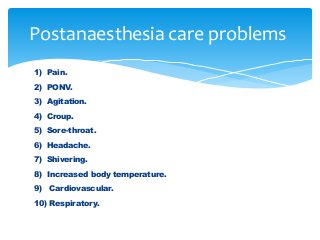
1) Pain.
2) PONV.
3) Agitation.
4) Croup.
5) Sore-throat.
6) Headache.
7) Shivering.
8) Increased body temperature.
9) Cardiovascular.
10) Respiratory.
Postanaesthesia care problems
 Scores determines when patients are fit for
discharge from PACU, various criteria for
readiness for discharge from PACUs have been
established. The modified Aldrete score is the
most common system used. A score> or = 9 is
required for discharge.
 .
Discharge
 Postaesthesia discharge scoring
system(PADSS) determines home readiness
and the optimal length a patient stays after
day-case surgery.
 Scoring system must be practical, simple, easy
to remember, and not place additional burden
on personnel
 It is the ability to transfer suitably recovered
patients from the OR directly to the phase II
recovery area, by passing the most costly PACU.
 Children derive an additional benefit from fast
tracking in that they are more quickly reunited
with their parents.
Fast track recovery
 To institute successful fast tracking
programs, it is necessary to modify
anesthetic techniques and to use the newer
shorter acting anesthetics, narcotics and
muscle relaxants.
 Modified aldretes scoring system may not be
adequate after day case procedures because it
fails to consider common side effects as pain
nausea and vomiting, therefore a new fast
track scoring system that incorporates both
has been proposed.
 It is delayed return of level of conscious.
 There are several causes:
 metabolic and electrolytes.
 Cerebral hypoperfusion.
 Cerebral depression by drugs.
Delayed recovery
 Delayed recovery of sensory or motor may
occur after regional or neuroaxial block
 Delayed recovery of consciousness , vital and
cognitive functions may occur after general
anesthesia
 Over dose iv anesth ,inhalational, opioid
 Benzodiazepines , sedative
 NMB
 Antihistaminic ,alcohol ,street drugs
 Antiepileptic ,cimetidine , tranquilizers ,
antipsychotic
 Antidepressant , analgesics , addiction
Drugs
 Hypothermia , hyperthermia , hypotension ,
hypertension , hypoxia , hypercarbia
 Pediatric, geriatric, prolonged surgery
 Anxiety ,pain ,apprehension , acidosis ,alkalosis
 Organ failure ( cardiovascular ,respiratory ,renal
,neuromuscular ,endocrinal ,liver )
 Genetic diseases

metabolic
 Anoxia ,TBI , embolic ,hemorrhagic ,
epileptic
 Mental retardation
 Hypertenive encephalopathy
 Neuromuscular diseases
 Neuropathy ,UMNL ,LMNL (upper and lower
motor )
CNS
 Nerve injury
 Nerve compression
 Wrong dose or concentration or additives
 Adjuvant effect
 Hypersensitivity to LA OR preservatives
Delayed recovery from regional
 1. Immediate recovery from anaesthesia
is a concept of care during not just a
place to put the patient after surgery.
Responsibility can never be fully
delegated by the anaesthetist to others.
Summary
 2. Most problems relate to Airway,
Breathing and/or Circulation; with
delayed return of consciousness and
inadequate analgesia being other
common related issues. All these should
be anticipated.
 3. Facilities required are the same as those
necessary for anaesthesia where-ever that
might be administered. If such facilities cannot
be duplicated in a separate location, then the
safest place to recover patients is in the
operating room.
 4. The most important monitor is a well
informed and skilled person; with
immediate access to anaesthetic
assistance. Technical support is important
but sophisticated electronic monitors are
not universally essential
 5. Discharge to a general ward should
only be considered when you have a
conscious, co-operative and
comfortable patient who is well
oxygenated and well perfused; and
likely to remain so.
THANK YOU

Recovery from anesthesia

  • 1.
  • 2.
    * Recovery isa continual process, the early stages of which overlap the end of intraoperative care. * Patients cannot be considered fully recovered until they have returned to their preoperative phsiological state.
  • 3.
    The entire processmay last many days Divided into three phases : 1- Early recovering (awaking and recovery of vital reflexes) 2- Intermediate recovery (immediate clinical recovery and home readiness) 3- Late recovery(full recovery and psycholgical recovery).
  • 4.
     Early recoverycommences on discontinuation of anesthetic agent, which allows the patient to awaken, recover protective airway reflexes, and resume motor activity.  It traditionaly continues in postanesthsia care unit (PACU).
  • 5.
     Patients arelikely to begin responding to verbal stimuli when alveolar anesthetic concentrations are decreased to about 0.5 MAC for the volatile anesthetic drug (MAC awake) if unimpeded by other factors.
  • 6.
     Increased ventilationresults in a more rapid decline in alveolar anesthetic concentration which hastens recovery, provided that the arterial carbon dioxide pressure is not so low that it diminshes cerebral blood flow and the removal of aneshetic agent from the brain.
  • 7.
     Recovery fromneuromuscular blockade may be monitored by peripheral nerve stimulation and by clinical indices.  Recovery from intravenous opioids and hypnotics may be more variable and difficult to quantify than recovery from inhalation and neuromuscular blocking agents.
  • 8.
     Transport fromthe operating room is usually complicated by the lack of adequate monitors, access to drugs, or resuscitative equipment.  Patients should not leave the operating room unless they have a stable and patent airway, have adequate ventilation and oxygenation, and are hemodynamically stable.  All patients should be taken to the PACU on a bed that can be placed in either the head down or head up position. Transport
  • 9.
     The PACUshould be located near the operating rooms. A central location in the operating room area, Proximity to radiographic, laboratory, and other intensive care facilities on the same floor is also highly desirable.  A ratio of 1.5 beds per operating room is customary.  Every effort should be made to diminish unnecessary noise in PACU. PACU
  • 10.
     The PACUshould be staffed only by nurses specifically trained in the care of patients emerging from anesthesia. They should have expertise in airway management and advanced cardiac life support as well as problems commonly encountered in surgical patients relating to wound care, drainage catheters, and post operative bleeding.  The nurse-to-patient ratio is 1:1 for sick patients and 1:2 or 1:3 for routine cases.
  • 11.
     Vital signsshould be recorded at least every 15 minutes and recorded on a separate sheet. The patient is encouraged by the nurse to cough, breathe deeply, and change body position. Monitoring
  • 12.
     The mostimportant monitor is a well informed and skilled person; with immediate access to anaesthetic assistance. Technical support is important but sophisticated electronic monitors are not universally essential
  • 13.
    1) Pain. 2) PONV. 3)Agitation. 4) Croup. 5) Sore-throat. 6) Headache. 7) Shivering. 8) Increased body temperature. 9) Cardiovascular. 10) Respiratory. Postanaesthesia care problems
  • 14.
     Scores determineswhen patients are fit for discharge from PACU, various criteria for readiness for discharge from PACUs have been established. The modified Aldrete score is the most common system used. A score> or = 9 is required for discharge.  . Discharge
  • 15.
     Postaesthesia dischargescoring system(PADSS) determines home readiness and the optimal length a patient stays after day-case surgery.  Scoring system must be practical, simple, easy to remember, and not place additional burden on personnel
  • 16.
     It isthe ability to transfer suitably recovered patients from the OR directly to the phase II recovery area, by passing the most costly PACU.  Children derive an additional benefit from fast tracking in that they are more quickly reunited with their parents. Fast track recovery
  • 17.
     To institutesuccessful fast tracking programs, it is necessary to modify anesthetic techniques and to use the newer shorter acting anesthetics, narcotics and muscle relaxants.
  • 18.
     Modified aldretesscoring system may not be adequate after day case procedures because it fails to consider common side effects as pain nausea and vomiting, therefore a new fast track scoring system that incorporates both has been proposed.
  • 19.
     It isdelayed return of level of conscious.  There are several causes:  metabolic and electrolytes.  Cerebral hypoperfusion.  Cerebral depression by drugs. Delayed recovery
  • 20.
     Delayed recoveryof sensory or motor may occur after regional or neuroaxial block  Delayed recovery of consciousness , vital and cognitive functions may occur after general anesthesia
  • 21.
     Over doseiv anesth ,inhalational, opioid  Benzodiazepines , sedative  NMB  Antihistaminic ,alcohol ,street drugs  Antiepileptic ,cimetidine , tranquilizers , antipsychotic  Antidepressant , analgesics , addiction Drugs
  • 22.
     Hypothermia ,hyperthermia , hypotension , hypertension , hypoxia , hypercarbia  Pediatric, geriatric, prolonged surgery  Anxiety ,pain ,apprehension , acidosis ,alkalosis  Organ failure ( cardiovascular ,respiratory ,renal ,neuromuscular ,endocrinal ,liver )  Genetic diseases  metabolic
  • 23.
     Anoxia ,TBI, embolic ,hemorrhagic , epileptic  Mental retardation  Hypertenive encephalopathy  Neuromuscular diseases  Neuropathy ,UMNL ,LMNL (upper and lower motor ) CNS
  • 24.
     Nerve injury Nerve compression  Wrong dose or concentration or additives  Adjuvant effect  Hypersensitivity to LA OR preservatives Delayed recovery from regional
  • 25.
     1. Immediaterecovery from anaesthesia is a concept of care during not just a place to put the patient after surgery. Responsibility can never be fully delegated by the anaesthetist to others. Summary
  • 26.
     2. Mostproblems relate to Airway, Breathing and/or Circulation; with delayed return of consciousness and inadequate analgesia being other common related issues. All these should be anticipated.
  • 27.
     3. Facilitiesrequired are the same as those necessary for anaesthesia where-ever that might be administered. If such facilities cannot be duplicated in a separate location, then the safest place to recover patients is in the operating room.
  • 28.
     4. Themost important monitor is a well informed and skilled person; with immediate access to anaesthetic assistance. Technical support is important but sophisticated electronic monitors are not universally essential
  • 29.
     5. Dischargeto a general ward should only be considered when you have a conscious, co-operative and comfortable patient who is well oxygenated and well perfused; and likely to remain so.
  • 30.