Post anesthesia care Unit
(PACU)
Amanuel Sisay (MSc)
1
Course objectives (1/4)
• Explain techniques of postoperative patient’s
transportation.
• Recognize methods of handover for postoperative
patients.
• Recognize recovery and other positions in the PACU.
• Describe the required equipment’s and monitoring in the
PACU.
• Explore patient follow up strategies in the PACU.
• Analyze monitoring parameters in the PACU.
• Identify common postoperative complications in PACU.
• Discussed adverse outcomes of untreated postoperative
pain
2
Course objectives (2/4)
• Explore different modalities of postoperative pain
management.
• Describe adverse effects of different analgesics.
• Recognize the impact of PONV
• Describe the factors that predispose to PONV
• Describes prevention, treatment the basic pharmacology of
anti-emetic drugs .
• Identify possible causes of hypoxia and hypoventilation
• Describes how to evaluate neuro-muscular blocker with the
nerve stimulator.
• Identify management of laryngospasm and other complications
of extubation
• List indications of oxygen therapy
• Describe techniques of oxygen therapy
3
Course objectives (3/4)
• Describes the causes and management of postoperative atelectasis,
tachycardia, bradycardia, arrhythmias, bleeding, hypotension and hypertension.
• Describe mechanisms and management of hypothermia.
• Describes the possible causes and management of postoperative confusion
and cognitive deterioration.
• Identify conditions that need higher level of postoperative care.
• Explain discharge criteria (Modified Aldrete Criteria )from PACU (in-
hospital or home)
• Identify organizational and structural requirements of the PACU
• Identify common critical incidents (Cardiorespiratory arrest) in the PACU
and early warning assessment methods
• Arrange the organization and requirements of safe PACU
• Interpret monitoring parameters and intervene accordingly.
• Evaluates neuromuscular blockade using a nerve stimulator.
4
Course objectives (4/4)
• Administer oxygen with different techniques (nasal
prongs, facemasks…)
• Assess postoperative pain.
• Prescribes appropriate postoperative analgesia.
• Prescribes appropriate postoperative fluid regimes
• Manage amenable bleeding and provide resuscitation.
• Prevent, assess and manage hypothermia in the PACU
5
Session 1: (Start from tomorrow)
• Organization, staffing and safety of PACU
• Admission and discharge criteria to PACU
• Transportation handover and positioning
• Equipment and monitoring required in the PACU
• Physiology, assessment, management of postoperative
acute pain
6
Session 2:
• Mechanisms, impacts, factors, prevention and
management of PONV
• Causes of hypoxia and hypoventilation, oxygen therapy
• Identification prevention and management of other
common postoperative complications (atelectasis,
tachycardia, bradycardia, arrhythmias, bleeding, hypotension,
hypertension, hypothermia, confusion and cognitive
deterioration )
7
Session 3:
• Assessment and management of Post anesthesia cognition
and confusion
• Assessment for discharge from PACU (in-hospital and
home)
• Reassuring and helping patients in CRC manner and
develop interdepartmental communication and collaboration
8
Methods of Assessment (1/1)
• Formative
• Drills, essay exams,
quizzes, and practical test
(direct observation of skills)
• Structured feedback
report
• Logbook
• Portfolio
• DOP, PCE, CBD
• And other assessment
methods
• Summative
• Progressive/ Continuous
assessment: (10%)
• DOP, PCE, CBD: (15%)
• Written exam (50%)
• Objectively Structured
Clinical Examination (OSCE):
(15%)
9
Reference Books
• Paul G Barash: Handbook of Clinical Anesthesia (6th edition).
Lippincott Williams & Wilkins publications, Inc., 2009.
• Paul G Barash: Clinical Anesthesia (7th edition). Lippincott Williams
&Wilkins publications, Inc., 2014.
• Ronald D. Miller: Millers Anesthesia (8th edition). Churchill
Livingstone publication, An Imprint of Elsevier, 2015.
• G. Edward Morgan: Clinical Anesthesiology (5th edition). McGraw-
Hill Companies, Inc., 2006
• Ronald D. Miller: Basics of Anesthesia (7th edition). Saunders, an
imprint of Elsevier Inc. 2011.
• Fleisher: Anesthesia and Uncommon Diseases, (5th edition).
Elsevier Saunders Inc., 2005
• James C. Duke: Duke’s Anesthesia Secretes (5th edition). Saunders, 10
Postanesthesia Recovery
• Patients recovering from an anesthetic has circumstances that
require individualized problem-oriented approach.
• Postanesthesia recovery must continue to adapt to meet the
needs of the changing - - perioperative landscape
- advances in technology
- changing surgical techniques
- to respond to improved evidence-based research
11
Levels of Postoperative/Postanesthesia
Care
• anesthesia services expand to cover a variety of patient types
• everincreasing areas outside the operating room
• selecting the correct type of recovery is essential
12
• many differing anesthesia areas ranging from inpatient
surgery, ambulatory surgery, to off-site procedures
• the level of postoperative care that a patient requires is
determined by:
• the degree of underlying illness, comorbidities, and the duration
• the type of anesthesia and surgery.
13
• Phase I recovery would be reserved for more intense recovery
and would require more one-on-one care for staff.
• Phase II recovery should be less intensive and is appropriate
for patients after less invasive procedures requiring less
attention from nursing while recovering.
• If separation of different phases of care is not possible, then
providing the appropriate level of monitoring and coverage to
the degree of postoperative impairment achieves similar
results in a single PACU area.
14
Postanesthetic Triage
• Triage should be based on
• clinical condition,
• length/type of procedure and anesthetic,
• the potential for complications that require intervention.
• Arbitrary criteria should not be used for determining the level
of recovery care.
• age,
• ASA classification,
• ambulatory versus
• inpatient versus off-site procedure status
• type of insurance
15
• intensive procedures and patients with greater acuity,
bypassing the PACU
• direct admission to intensive care units can reduce demands
on the PACU
• reduce errors with decreased number of hand offs
16
Safety in the Postanesthesia Care Unit
• Every PACU should have medical oversight in the form of a
medical director
• Medical director must ensure the PACU environment is as safe
as possible for both patients and staff
• Beyond usual safety policies, maintain staffing and training to
ensure that an appropriate coverage and skill mix is available
to deal with unforeseen crises.
• Incidence of adverse events in the PACU correlates with
nursing workload and staff availability.
• Ideally, all staff should have PACU certification, and staffing
ratios should never fall below acceptable standards 17
• The staff is obligated
• to optimize each patient’s privacy and dignity
• to minimize the psychological impact of unpleasant or frightening
events.
• Observance of procedures for handwashing, sterility, and
infection control should be strictly enforced.
• Access to the PACU should be strictly controlled.
• Increasing acceptance of reuniting patients with
family/friends, safety and privacy issues need to be
continually addressed.
18
• The PACU environment must also be safe for professionals.
• Air handling should guarantee that personnel are not exposed
to unacceptable levels of trace anesthetic gases (although
trace gas monitoring is not necessary)
• Staff members receive appropriate vaccinations, including
those for hepatitis B, flu, and others required by their
institution.
• Personal protective equipment (PPE) such as
• gloves and eye protection
• Worn to protect both the patient and provider
• Having masks, gowns, and appropriate particulate respiratory
equipment easily accessible is needed for particular cases. 19
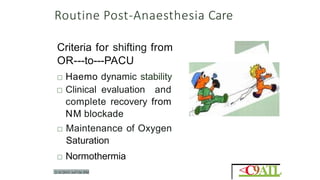
Routine Post-Anaesthesia Care
Criteria for shifting from
OR---to---PACU
□ Haemo dynamic stability
□ Clinical evaluation and
complete recovery from
NM blockade
□ Maintenance of Oxygen
Saturation
□ Normothermia
<C9ATL
-
- , a . j cow.,
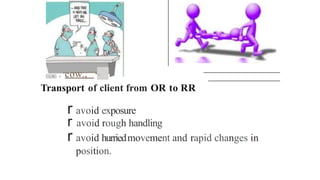
Transport of client from OR to RR
r avoid exposure
r avoid rough handling
r avoid hurriedmovement and rapid changes in
position.
Admission Report
Preoperative history
Intra-operative factors:
• Procedure
• Type of anesthesia
• Estimated Blood Loss (EBL)
. Urine output
·You seem quieter tonight. Did they
giveyousomething tohelpyourelax?"
Assessment and report of current status
Post-operative instructions
PACU
• Vital signs are recorded as often as
necessary but at least every 15 minutes
while the patient is in the unit.
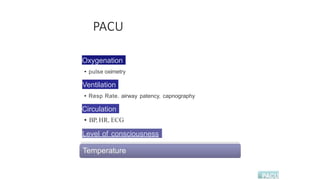
PACU
Oxygenation
• pulse oximetry
Ventilation
• Resp Rate, airway patency, capnography
Circulation
• BP, HR, ECG
Level of consciousness
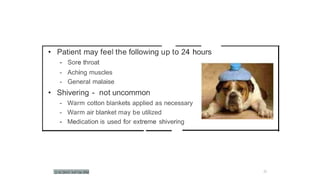
• Patient may feel the following up to 24 hours
- Sore throat
- Aching muscles
- General malaise
• Shivering - not uncommon
- Warm cotton blankets applied as necessary
- Warm air blanket may be utilized
- Medication is used for extreme shivering
2')
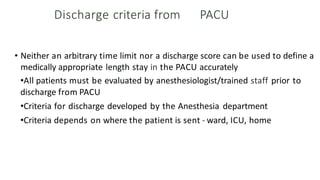
Discharge criteria from PACU
• Neither an arbitrary time limit nor a discharge score can be used to define a
medically appropriate length stay in the PACU accurately
•All patients must be evaluated by anesthesiologist/trained staff prior to
discharge from PACU
•Criteria for discharge developed by the Anesthesia department
•Criteria depends on where the patient is sent - ward, ICU, home
Discharge criteria from PACU
Easy arousability
Full orientation
•: Ability to maintain & protect airway
•! Stable vital signs for at least 15 - 30
minutes
The ability to call for help if necessary
No obvious surgical complication (active
bleeding)
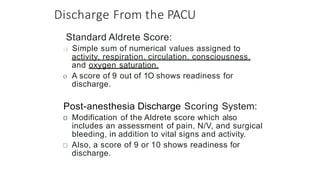
Discharge From the PACU
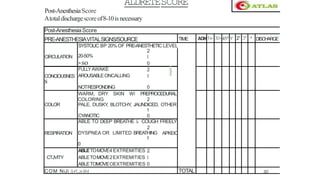
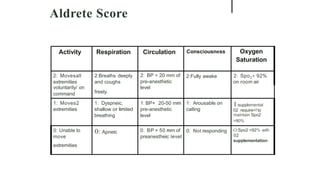
Standard Aldrete Score:
::i Simple sum of numerical values assigned to
activity, respiration, circulation, consciousness,
and oxygen saturation.
o A score of 9 out of 1O shows readiness for
discharge.
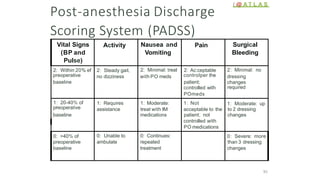
Post-anesthesia Discharge Scoring System:
o Modification of the Aldrete score which also
includes an assessment of pain, N/V, and surgical
bleeding, in addition to vital signs and activity.
□ Also, a score of 9 or 10 shows readiness for
discharge.
ALDRETESCORE
Post-AnesthesiaScore
Atotaldischargescoreof8-10isnecessary
Post-AnesthesiaScore
PRE-ANESTHESIAVITALSIGNS/SOURCE TIME ADM1s- 3
0
-45" 1' 2' 3
' • DISCHARGE
SYSTOLIC BP 20% OF PRE-ANESTHETIC LEVEL
CIRCULATION 20-50%
>so
2
1
0
)
CONCIOUSNES
FULLYAWAKE
AROUSABLEONCALLING
2
1
s
NOTRESPONDING 0
WARM, DRY SKIN WI PREPROCEDURAL
COLORING 2
COLOR PALE, DUSKY
, BLOTCHY
, JAUNDICED, OTHER
CYANOTIC
1
0
ABLE TO DEEP BREATHE & COUGH FREELY
RESPIRATION APKEIC
2
DYSPNEA OR LIMITED BREATHING
1
0
CTJVITY
ABLETOMOVE4 EXTREMITIES 2
ABLETOMOVE2EXTREMITIES 1
ABLETOMOVEOEXTREMITIES 0
COM NiJi 3,41,.;a JIM TOTAL so
Activity Respiration Circulation Consciousness Oxygen
Saturation
2: Movesall
extremities
2:Brealhs deeply
and coughs
2: BP + 20 mm of
pre-anesthetic
2:Fully awake 2: Spo2> 92%
on room air
voluntarily/ on
command freely.
level
1: Moves2
extremities
1: Dyspneic,
shallow or limited
breathing
1: BP+ 20-50 mm
pre-anesthetic
level
1: Arousable on
calling
1:supplemental
02 require<! to
maintain Spo2
>90%
0: Unable lo
move
extremities
0: Apneic 0: BP + 50 mm of
preanestheic level
0: Not responding O:Spo2 <92% with
02
supplementation
Aldrete Score
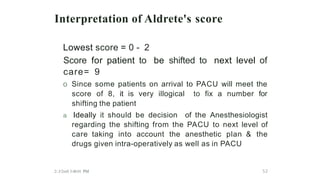
Interpretation of Aldrete's score
Lowest score = 0 - 2
Score for patient to be shifted to next level of
care= 9
o Since some patients on arrival to PACU will meet the
score of 8, it is very illogical to fix a number for
shifting the patient
a Ideally it should be decision of the Anesthesiologist
regarding the shifting from the PACU to next level of
care taking into account the anesthetic plan & the
drugs given intra-operatively as well as in PACU
2/.J/2mS 3:48:01 PM 52
Vital Signs
(BP and
Pulse)
Activity Nausea and
Vomiting
Pain Surgical
Bleeding
2: Within 20% ef
preoperative
2: Steady gait,
no dizziness
2: Minimal: treat
with PO meds
2: Ac:ceptable
controlper the
2: Minimal: no
dressing
baseline patient;
controlled with
changes
required
POmeds
1: 20-40% of
preoperative
1: Requires
assistance
1: Moderate:
treat with IM
1: Not
acceptable to the
1: Moderate: up
to 2 dressing
baseline medications patient; not changes
controlled with
PO medications
0: >40% of
preoperative
baseline
0: Unable to
ambulate
0: Continues:
repeated
treatment
0: Severe: more
than 3 dressing
changes
( @ A T L A S
Post-anesthesia Discharge
Scoring System (PADSS)
S3
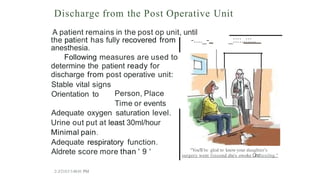
Discharge from the Post Operative Unit
A patient remains in the post op unit, until
the patient has fully recovered from -...._- _::::..:::..
anesthesia.
Following measures are used to
determine the patient ready for
discharge from post operative unit:
Stable vital signs
Orientation to Person, Place
Time or events
Adequate oxygen saturation level.
Urine out put at least 30ml/hour
Minimal pain.
Adequate respiratory function.
Aldrete score more than ' 9 ' "You'll be glod to know your daughter's
surgery went fineond she's owoke Clndtextlng."
2/.J/21l153:48:01 PM
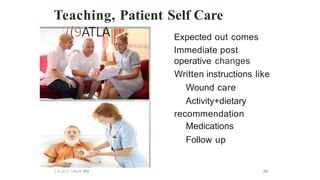
Teaching, Patient Self Care
((9ATLA Expected out comes
Immediate post
operative changes
Written instructions like
Wound care
Activity+dietary
recommendation
Medications
Follow up
2/4/2015 3:48:01 PM ss

Post anesthesia care Unit (PACU).pptx

  • 1.
    Post anesthesia careUnit (PACU) Amanuel Sisay (MSc) 1
  • 2.
    Course objectives (1/4) •Explain techniques of postoperative patient’s transportation. • Recognize methods of handover for postoperative patients. • Recognize recovery and other positions in the PACU. • Describe the required equipment’s and monitoring in the PACU. • Explore patient follow up strategies in the PACU. • Analyze monitoring parameters in the PACU. • Identify common postoperative complications in PACU. • Discussed adverse outcomes of untreated postoperative pain 2
  • 3.
    Course objectives (2/4) •Explore different modalities of postoperative pain management. • Describe adverse effects of different analgesics. • Recognize the impact of PONV • Describe the factors that predispose to PONV • Describes prevention, treatment the basic pharmacology of anti-emetic drugs . • Identify possible causes of hypoxia and hypoventilation • Describes how to evaluate neuro-muscular blocker with the nerve stimulator. • Identify management of laryngospasm and other complications of extubation • List indications of oxygen therapy • Describe techniques of oxygen therapy 3
  • 4.
    Course objectives (3/4) •Describes the causes and management of postoperative atelectasis, tachycardia, bradycardia, arrhythmias, bleeding, hypotension and hypertension. • Describe mechanisms and management of hypothermia. • Describes the possible causes and management of postoperative confusion and cognitive deterioration. • Identify conditions that need higher level of postoperative care. • Explain discharge criteria (Modified Aldrete Criteria )from PACU (in- hospital or home) • Identify organizational and structural requirements of the PACU • Identify common critical incidents (Cardiorespiratory arrest) in the PACU and early warning assessment methods • Arrange the organization and requirements of safe PACU • Interpret monitoring parameters and intervene accordingly. • Evaluates neuromuscular blockade using a nerve stimulator. 4
  • 5.
    Course objectives (4/4) •Administer oxygen with different techniques (nasal prongs, facemasks…) • Assess postoperative pain. • Prescribes appropriate postoperative analgesia. • Prescribes appropriate postoperative fluid regimes • Manage amenable bleeding and provide resuscitation. • Prevent, assess and manage hypothermia in the PACU 5
  • 6.
    Session 1: (Startfrom tomorrow) • Organization, staffing and safety of PACU • Admission and discharge criteria to PACU • Transportation handover and positioning • Equipment and monitoring required in the PACU • Physiology, assessment, management of postoperative acute pain 6
  • 7.
    Session 2: • Mechanisms,impacts, factors, prevention and management of PONV • Causes of hypoxia and hypoventilation, oxygen therapy • Identification prevention and management of other common postoperative complications (atelectasis, tachycardia, bradycardia, arrhythmias, bleeding, hypotension, hypertension, hypothermia, confusion and cognitive deterioration ) 7
  • 8.
    Session 3: • Assessmentand management of Post anesthesia cognition and confusion • Assessment for discharge from PACU (in-hospital and home) • Reassuring and helping patients in CRC manner and develop interdepartmental communication and collaboration 8
  • 9.
    Methods of Assessment(1/1) • Formative • Drills, essay exams, quizzes, and practical test (direct observation of skills) • Structured feedback report • Logbook • Portfolio • DOP, PCE, CBD • And other assessment methods • Summative • Progressive/ Continuous assessment: (10%) • DOP, PCE, CBD: (15%) • Written exam (50%) • Objectively Structured Clinical Examination (OSCE): (15%) 9
  • 10.
    Reference Books • PaulG Barash: Handbook of Clinical Anesthesia (6th edition). Lippincott Williams & Wilkins publications, Inc., 2009. • Paul G Barash: Clinical Anesthesia (7th edition). Lippincott Williams &Wilkins publications, Inc., 2014. • Ronald D. Miller: Millers Anesthesia (8th edition). Churchill Livingstone publication, An Imprint of Elsevier, 2015. • G. Edward Morgan: Clinical Anesthesiology (5th edition). McGraw- Hill Companies, Inc., 2006 • Ronald D. Miller: Basics of Anesthesia (7th edition). Saunders, an imprint of Elsevier Inc. 2011. • Fleisher: Anesthesia and Uncommon Diseases, (5th edition). Elsevier Saunders Inc., 2005 • James C. Duke: Duke’s Anesthesia Secretes (5th edition). Saunders, 10
  • 11.
    Postanesthesia Recovery • Patientsrecovering from an anesthetic has circumstances that require individualized problem-oriented approach. • Postanesthesia recovery must continue to adapt to meet the needs of the changing - - perioperative landscape - advances in technology - changing surgical techniques - to respond to improved evidence-based research 11
  • 12.
    Levels of Postoperative/Postanesthesia Care •anesthesia services expand to cover a variety of patient types • everincreasing areas outside the operating room • selecting the correct type of recovery is essential 12
  • 13.
    • many differinganesthesia areas ranging from inpatient surgery, ambulatory surgery, to off-site procedures • the level of postoperative care that a patient requires is determined by: • the degree of underlying illness, comorbidities, and the duration • the type of anesthesia and surgery. 13
  • 14.
    • Phase Irecovery would be reserved for more intense recovery and would require more one-on-one care for staff. • Phase II recovery should be less intensive and is appropriate for patients after less invasive procedures requiring less attention from nursing while recovering. • If separation of different phases of care is not possible, then providing the appropriate level of monitoring and coverage to the degree of postoperative impairment achieves similar results in a single PACU area. 14
  • 15.
    Postanesthetic Triage • Triageshould be based on • clinical condition, • length/type of procedure and anesthetic, • the potential for complications that require intervention. • Arbitrary criteria should not be used for determining the level of recovery care. • age, • ASA classification, • ambulatory versus • inpatient versus off-site procedure status • type of insurance 15
  • 16.
    • intensive proceduresand patients with greater acuity, bypassing the PACU • direct admission to intensive care units can reduce demands on the PACU • reduce errors with decreased number of hand offs 16
  • 17.
    Safety in thePostanesthesia Care Unit • Every PACU should have medical oversight in the form of a medical director • Medical director must ensure the PACU environment is as safe as possible for both patients and staff • Beyond usual safety policies, maintain staffing and training to ensure that an appropriate coverage and skill mix is available to deal with unforeseen crises. • Incidence of adverse events in the PACU correlates with nursing workload and staff availability. • Ideally, all staff should have PACU certification, and staffing ratios should never fall below acceptable standards 17
  • 18.
    • The staffis obligated • to optimize each patient’s privacy and dignity • to minimize the psychological impact of unpleasant or frightening events. • Observance of procedures for handwashing, sterility, and infection control should be strictly enforced. • Access to the PACU should be strictly controlled. • Increasing acceptance of reuniting patients with family/friends, safety and privacy issues need to be continually addressed. 18
  • 19.
    • The PACUenvironment must also be safe for professionals. • Air handling should guarantee that personnel are not exposed to unacceptable levels of trace anesthetic gases (although trace gas monitoring is not necessary) • Staff members receive appropriate vaccinations, including those for hepatitis B, flu, and others required by their institution. • Personal protective equipment (PPE) such as • gloves and eye protection • Worn to protect both the patient and provider • Having masks, gowns, and appropriate particulate respiratory equipment easily accessible is needed for particular cases. 19
  • 20.
    Routine Post-Anaesthesia Care Criteriafor shifting from OR---to---PACU □ Haemo dynamic stability □ Clinical evaluation and complete recovery from NM blockade □ Maintenance of Oxygen Saturation □ Normothermia <C9ATL
  • 21.
    - - , a. j cow., Transport of client from OR to RR r avoid exposure r avoid rough handling r avoid hurriedmovement and rapid changes in position.
  • 22.
    Admission Report Preoperative history Intra-operativefactors: • Procedure • Type of anesthesia • Estimated Blood Loss (EBL) . Urine output ·You seem quieter tonight. Did they giveyousomething tohelpyourelax?" Assessment and report of current status Post-operative instructions
  • 23.
    PACU • Vital signsare recorded as often as necessary but at least every 15 minutes while the patient is in the unit.
  • 24.
    PACU Oxygenation • pulse oximetry Ventilation •Resp Rate, airway patency, capnography Circulation • BP, HR, ECG Level of consciousness
  • 25.
    • Patient mayfeel the following up to 24 hours - Sore throat - Aching muscles - General malaise • Shivering - not uncommon - Warm cotton blankets applied as necessary - Warm air blanket may be utilized - Medication is used for extreme shivering 2')
  • 26.
    Discharge criteria fromPACU • Neither an arbitrary time limit nor a discharge score can be used to define a medically appropriate length stay in the PACU accurately •All patients must be evaluated by anesthesiologist/trained staff prior to discharge from PACU •Criteria for discharge developed by the Anesthesia department •Criteria depends on where the patient is sent - ward, ICU, home
  • 27.
    Discharge criteria fromPACU Easy arousability Full orientation •: Ability to maintain & protect airway •! Stable vital signs for at least 15 - 30 minutes The ability to call for help if necessary No obvious surgical complication (active bleeding)
  • 28.
    Discharge From thePACU Standard Aldrete Score: ::i Simple sum of numerical values assigned to activity, respiration, circulation, consciousness, and oxygen saturation. o A score of 9 out of 1O shows readiness for discharge. Post-anesthesia Discharge Scoring System: o Modification of the Aldrete score which also includes an assessment of pain, N/V, and surgical bleeding, in addition to vital signs and activity. □ Also, a score of 9 or 10 shows readiness for discharge.
  • 29.
    ALDRETESCORE Post-AnesthesiaScore Atotaldischargescoreof8-10isnecessary Post-AnesthesiaScore PRE-ANESTHESIAVITALSIGNS/SOURCE TIME ADM1s-3 0 -45" 1' 2' 3 ' • DISCHARGE SYSTOLIC BP 20% OF PRE-ANESTHETIC LEVEL CIRCULATION 20-50% >so 2 1 0 ) CONCIOUSNES FULLYAWAKE AROUSABLEONCALLING 2 1 s NOTRESPONDING 0 WARM, DRY SKIN WI PREPROCEDURAL COLORING 2 COLOR PALE, DUSKY , BLOTCHY , JAUNDICED, OTHER CYANOTIC 1 0 ABLE TO DEEP BREATHE & COUGH FREELY RESPIRATION APKEIC 2 DYSPNEA OR LIMITED BREATHING 1 0 CTJVITY ABLETOMOVE4 EXTREMITIES 2 ABLETOMOVE2EXTREMITIES 1 ABLETOMOVEOEXTREMITIES 0 COM NiJi 3,41,.;a JIM TOTAL so
  • 30.
    Activity Respiration CirculationConsciousness Oxygen Saturation 2: Movesall extremities 2:Brealhs deeply and coughs 2: BP + 20 mm of pre-anesthetic 2:Fully awake 2: Spo2> 92% on room air voluntarily/ on command freely. level 1: Moves2 extremities 1: Dyspneic, shallow or limited breathing 1: BP+ 20-50 mm pre-anesthetic level 1: Arousable on calling 1:supplemental 02 require<! to maintain Spo2 >90% 0: Unable lo move extremities 0: Apneic 0: BP + 50 mm of preanestheic level 0: Not responding O:Spo2 <92% with 02 supplementation Aldrete Score
  • 31.
    Interpretation of Aldrete'sscore Lowest score = 0 - 2 Score for patient to be shifted to next level of care= 9 o Since some patients on arrival to PACU will meet the score of 8, it is very illogical to fix a number for shifting the patient a Ideally it should be decision of the Anesthesiologist regarding the shifting from the PACU to next level of care taking into account the anesthetic plan & the drugs given intra-operatively as well as in PACU 2/.J/2mS 3:48:01 PM 52
  • 32.
    Vital Signs (BP and Pulse) ActivityNausea and Vomiting Pain Surgical Bleeding 2: Within 20% ef preoperative 2: Steady gait, no dizziness 2: Minimal: treat with PO meds 2: Ac:ceptable controlper the 2: Minimal: no dressing baseline patient; controlled with changes required POmeds 1: 20-40% of preoperative 1: Requires assistance 1: Moderate: treat with IM 1: Not acceptable to the 1: Moderate: up to 2 dressing baseline medications patient; not changes controlled with PO medications 0: >40% of preoperative baseline 0: Unable to ambulate 0: Continues: repeated treatment 0: Severe: more than 3 dressing changes ( @ A T L A S Post-anesthesia Discharge Scoring System (PADSS) S3
  • 33.
    Discharge from thePost Operative Unit A patient remains in the post op unit, until the patient has fully recovered from -...._- _::::..:::.. anesthesia. Following measures are used to determine the patient ready for discharge from post operative unit: Stable vital signs Orientation to Person, Place Time or events Adequate oxygen saturation level. Urine out put at least 30ml/hour Minimal pain. Adequate respiratory function. Aldrete score more than ' 9 ' "You'll be glod to know your daughter's surgery went fineond she's owoke Clndtextlng." 2/.J/21l153:48:01 PM
  • 34.
    Teaching, Patient SelfCare ((9ATLA Expected out comes Immediate post operative changes Written instructions like Wound care Activity+dietary recommendation Medications Follow up 2/4/2015 3:48:01 PM ss