The Post-Anaesthesia
Care Unit (PACU):
Concept and Design
(Modul R4)
POST ANAESTHESIA CARE UNIT
• A unit located as close to operating theatres as
possible,
• staffed and equipped for serving for treatment
and care of patients during their immediate
postanaesthesia or post surgery period,
• regardless of the type of interventions,
• before they are scheduled to be admitted to
general wards or other units of the hospital or
discharged home.
2
PACU is:
 Specially designated
 Specially designed
 Specially located
 Specially staffed
 Specially equipped
for specific purpose!
3
AREA OF HOSPITAL
• Recovery from anaesthesia can range from
completely uncomplicated to life threatening
complications.
• Emergence from general anaesthesia and
surgery may be accompanied by a number of
physiologic disturbances that affect multiple
organ systems.
4
• Must be managed by skilled medical and
nursing personnel; in a well planned and
protocol based fashion.
• Anaesthesiologist plays a key role in
optimizing safe recovery from anaesthesia
and also its complications.
5
PURPOSE OF PACU
 To enable a successful and faster recovery
of the patient post operatively.
 To reduce post operative mortality rate.
 To reduce the length of hospital stay.
 To provide quality care service.
 To reduce hospital and patient cost during
post operative period.
6
PACU LOCATION
 Should be located close to the operating
room.
 As it ensures that the patient can be rushed
back to surgery if needed or members of the
operating room staff can quickly attend the
patients.
7
 Immediate access to x-ray, blood bank,
blood gas and clinical labs & on same
floor.
 Central nursing station must be present.
8
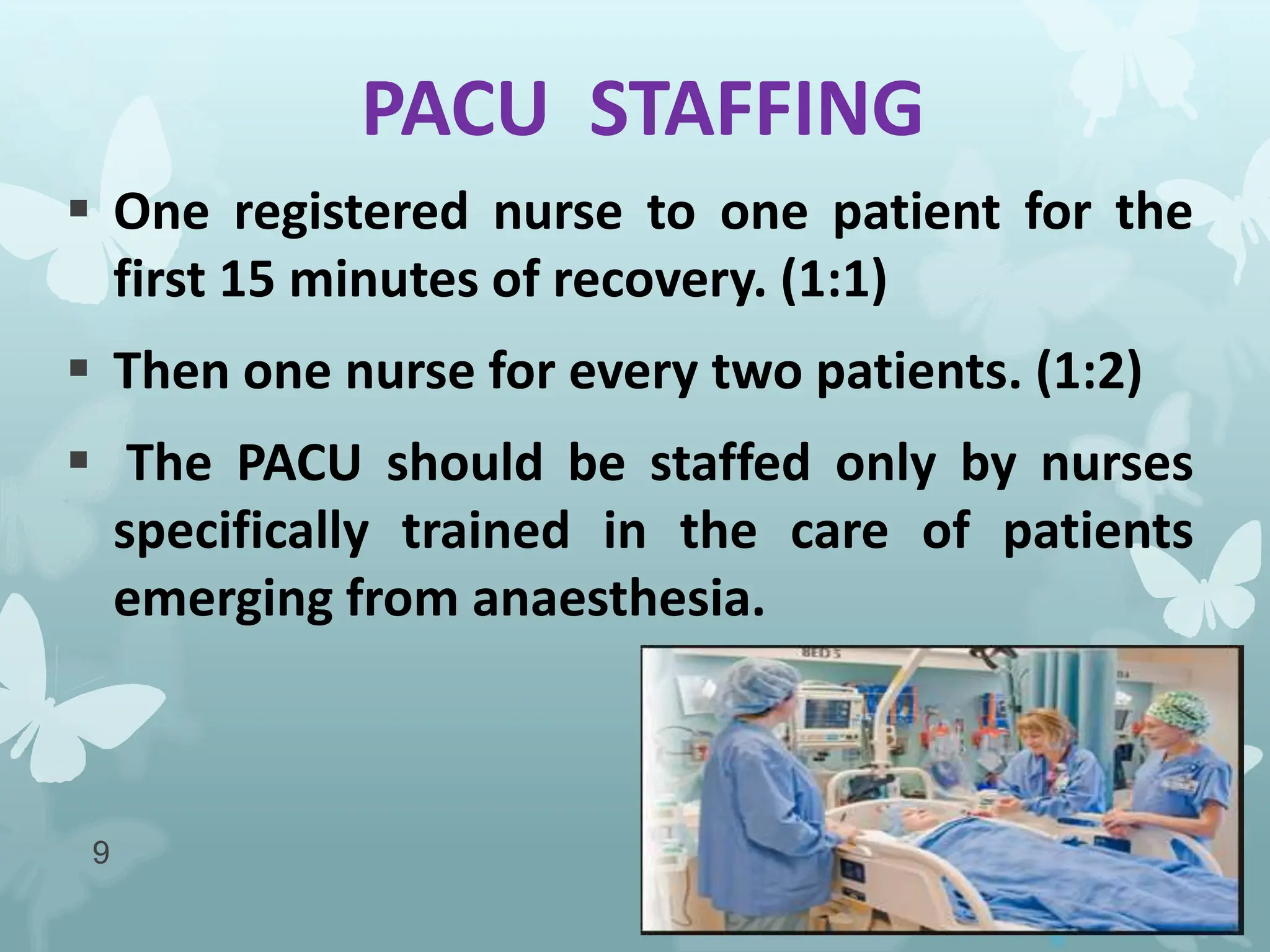
PACU STAFFING
 One registered nurse to one patient for the
first 15 minutes of recovery. (1:1)
 Then one nurse for every two patients. (1:2)
 The PACU should be staffed only by nurses
specifically trained in the care of patients
emerging from anaesthesia.
9
10
The PACU should be under the medical direction of
an anaesthesiologist, who must immediately
respond to urgent conditions
 A physician assigned full-time to the PACU is
desirable, in busy centers but is not mandatory
in smaller centers.
 The anaesthesiologist manages the analgesia
as well as airway, cardiac, pulmonary, and
metabolic problems whereas the surgeon
manages any problems directly related to the
surgical procedure itself
11
12
The management of the patient in the PACU
should not differ from management in the
operating room and should reflect a
coordinated effort among the
anaesthesiologist, surgeon, nurses, respiratory
therapists and appropriate consultant.
PACU EQUIPMENTS
 Automated NIBP
 Pulse Oximetery
 Thermometer
 EtCO2
 ECG
 Intravenous supports
 Defibrillator
13
Located at each bed.
CRITERIA FOR SHIFTING FROM OR
TO PACU
 Conscious, awake, responds to simple
commands
 Haemodynamic stable.
 Complete recovery from NM blockade.
 Maintenance of Oxygen Saturation.
 Normothermia
14
TRANSPORT TO THE PACU
 Steps should be taken to protect the patient
during transfer mainly from:
 Traumatic injury,
Hypoxia,
Hypothermia,
Soiling of the airway,
Accidental disconnections or removal of drains,
lines, and catheters
15
TRANSPORT TO THE PACU
 Upper airway patency and effectiveness of
respiratory efforts of the patient must be
monitored when transporting the patient
from operating room to the PACU.
16
 Adequate ventilation can be confirmed by
watching the appropriate rise and fall of the chest
with inspiration & expiration, listening to breath
sounds, or simply feeling for exhaled breath with
palm of one's hand over the patient's nose and
mouth.
17
 All patients should be taken to the PACU on a
bed and can be nursed in either head-up
position or leg-up position or in lateral
position [eg. following tonsillectomy].
 The transfer of critically ill patients on
elevators or through long corridors can
jeopardize their care, because emergencies
may arise along the way.
18
 Patients who undergo general anaesthesia should
receive supplemental oxygen during their
transport to the PACU.
 In an observational study of 502 patients
admitted to the PACU, breathing air during
transport was the single most significant factor to
correlate with hypoxemia (O2 sat < 90%) on
arrival.
19
 Although the majority of otherwise healthy
patients undergoing ambulatory surgery can be
transported safely on room air, the decision to
do so must be made on a case-by-case basis.
 In the ambulatory setting, age (>60 years) and
weight (>100 kg) identifies, who are at
increased risk for oxygen desaturation when
breathing room air on transport to the PACU.
20
PACU STANDARDS
21
All patients who have received
general anaesthesia, regional
anaesthesia, or monitored
anaesthesia care should receive
post-anaesthesia management.
The patient should be transported to
the PACU by a member of the
anaesthesia care team that is
knowledgeable about the patient’s
condition.
 Upon arrival in the PACU, the patient should
be re-evaluated
 A verbal and a written report should be
provided to the nurse.
 The patient shall be evaluated continuasly in
the PACU.
 Anaesthesiologist, concerned is responsible for
discharge of the patient.
22
Responsibilities of PACU staff
Protect Airway
Maintaining IV Stability
Assesment of surgical site
Keep the patient warm
Relieving pain and anxiety
23
MANAGEMENT OF COMPLICATIONS
PONV
Pain
Hypoxia
Hyperthermia/Hypothermia
Shivering
Agitation & Delirium
Cardiovascular or Respiratory
24
LENGHTH OF STAY IN PACU
 VARIES. Depends upon several factors:
-Type of surgery
-Patients response to surgery and
anaesthesia
-Medical history
 Average length of stay is 1-3 hrs
 Longer stays may be necessary to meet
discharge criteria.
25
DISCHARGE CRITERIA FROM PACU
 Neither an arbitrary time limit nor a
discharge score can be used to define a
medically appropriate length stay in the
PACU accurately.
 All patients must be evaluated by
anesthesiologist/trained staff prior to
discharge from PACU.
26
DISCHARGE CRITERIA FROM PACU
 Criteria for discharge developed by the
Anesthesia department.
 Criteria depends on where the patient
is sent –ward, ICU, home.
 Modified Aldretes score and PADS
score.
27
Aldrete’s criteria
Developed In 1970, by Aldrete and Kroulik.
The original Aldrete score assigned a
number of 0, 1, or 2 to five variables:
activity, respiration, circulation,
consciousness, and color, A score of 9 out of
10 was considered adequate for discharge
from the PACU.
In 1995, pulse oximetry replaced visual
assessment of oxygenation.
29
Postanesthesia Discharge
Scoring System (PADS)
Postanesthesia Discharge Scoring
System (PADS)?
1. Vital signs
2. Activity level
3. Nausea and vomiting
4. Pain
5. Surgical bleeding
Postanesthesia Discharge Scoring System (PADS)
Criteria Points
Vital Signs
Within 20% of baseline 2
Within 20-40% of baseline 1
>40% of baseline 0
Activity Level
Steady gait, no dizziness, at preoperative level 2
Requires assistance 1
Unable to ambulate 0
Nausea and vomiting
Minimal, treated with oral medication 2
Moderate, treated with parenteral medication 1
Continues after repeated medication 0
Criteria
Points
Pain: minimal or none, acceptable to patient,
controlled with oral medication
Yes 2
No 1
Surgical Bleeding
Minimal: no dressing change required 2
Moderate: up to two dressing changes 1
Severe: three or more dressing changes 0
* Score ≥9 is required for discharge.
OTHER DISCHARGE CRITERIA
FROM PACU
 Easy arousability
 Full orientation
 Ability to maintain & protect airway
 Stable vital signs for at least 15 –30 minutes
 The ability to call for help if necessary
 No obvious surgical complication
33
Safe Guidelines For Discharging
Home After Ambulatory Surgery
 Patient should be able to stand & take a few
steps .
 Should be able to sip fluids
 Should be able to urinate
 Should be able to identify the escort
(cognitive function)
34
Teaching, Patient Self Care
 Expected out comes
 Written instructions like:
-Wound care
-Activity and Dietary recommendations
 Medications
 Follow up
35
PACU VISITATIONS
 LIMITED due to:
-Safety and confidentiality
of PACU patients
-Risk of infection
-Interruption to workflow
 PACU nurse will call family when pt is
settled
 One visitor for 5 min is permitted
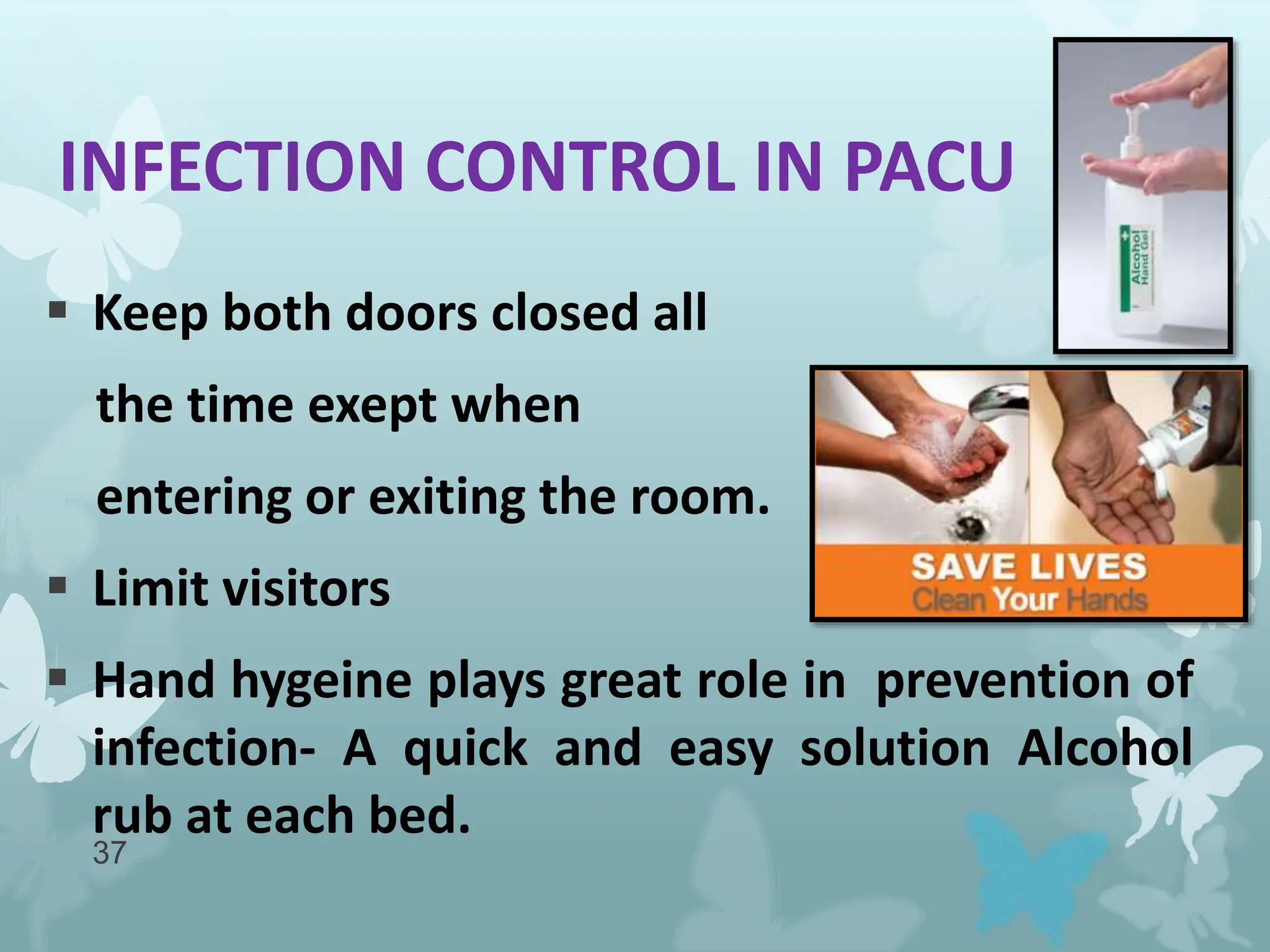
INFECTION CONTROL IN PACU
 Keep both doors closed all
the time exept when
entering or exiting the room.
 Limit visitors
 Hand hygeine plays great role in prevention of
infection- A quick and easy solution Alcohol
rub at each bed.
37
SPECIAL CONSIDERATIONS FOR
PEDIATRIC PACU
 Anesthesiologist or other physician trained
and experienced in pediatric perioperative
care and Pediatric advanced life support
certification is recommended.
 A range of paediatric equipment and drugs
must be available.
 Nurse to patient ratio of 1:1 is required all the
time.
38
QUALITY CONTROL
 Annual Audit for compliance with
local and National standards.
-Quality of recovery
-Violation of discharge protocol,
-Documentation of critical incidents.
 Education and training of PACU staff.
39
40
THANK YOU!!

Post Anesthesia Care (PACU) for anesthesia resident.ppt

  • 1.
    The Post-Anaesthesia Care Unit(PACU): Concept and Design (Modul R4)
  • 2.
    POST ANAESTHESIA CAREUNIT • A unit located as close to operating theatres as possible, • staffed and equipped for serving for treatment and care of patients during their immediate postanaesthesia or post surgery period, • regardless of the type of interventions, • before they are scheduled to be admitted to general wards or other units of the hospital or discharged home. 2
  • 3.
    PACU is:  Speciallydesignated  Specially designed  Specially located  Specially staffed  Specially equipped for specific purpose! 3 AREA OF HOSPITAL
  • 4.
    • Recovery fromanaesthesia can range from completely uncomplicated to life threatening complications. • Emergence from general anaesthesia and surgery may be accompanied by a number of physiologic disturbances that affect multiple organ systems. 4
  • 5.
    • Must bemanaged by skilled medical and nursing personnel; in a well planned and protocol based fashion. • Anaesthesiologist plays a key role in optimizing safe recovery from anaesthesia and also its complications. 5
  • 6.
    PURPOSE OF PACU To enable a successful and faster recovery of the patient post operatively.  To reduce post operative mortality rate.  To reduce the length of hospital stay.  To provide quality care service.  To reduce hospital and patient cost during post operative period. 6
  • 7.
    PACU LOCATION  Shouldbe located close to the operating room.  As it ensures that the patient can be rushed back to surgery if needed or members of the operating room staff can quickly attend the patients. 7
  • 8.
     Immediate accessto x-ray, blood bank, blood gas and clinical labs & on same floor.  Central nursing station must be present. 8
  • 9.
    PACU STAFFING  Oneregistered nurse to one patient for the first 15 minutes of recovery. (1:1)  Then one nurse for every two patients. (1:2)  The PACU should be staffed only by nurses specifically trained in the care of patients emerging from anaesthesia. 9
  • 10.
    10 The PACU shouldbe under the medical direction of an anaesthesiologist, who must immediately respond to urgent conditions
  • 11.
     A physicianassigned full-time to the PACU is desirable, in busy centers but is not mandatory in smaller centers.  The anaesthesiologist manages the analgesia as well as airway, cardiac, pulmonary, and metabolic problems whereas the surgeon manages any problems directly related to the surgical procedure itself 11
  • 12.
    12 The management ofthe patient in the PACU should not differ from management in the operating room and should reflect a coordinated effort among the anaesthesiologist, surgeon, nurses, respiratory therapists and appropriate consultant.
  • 13.
    PACU EQUIPMENTS  AutomatedNIBP  Pulse Oximetery  Thermometer  EtCO2  ECG  Intravenous supports  Defibrillator 13 Located at each bed.
  • 14.
    CRITERIA FOR SHIFTINGFROM OR TO PACU  Conscious, awake, responds to simple commands  Haemodynamic stable.  Complete recovery from NM blockade.  Maintenance of Oxygen Saturation.  Normothermia 14
  • 15.
    TRANSPORT TO THEPACU  Steps should be taken to protect the patient during transfer mainly from:  Traumatic injury, Hypoxia, Hypothermia, Soiling of the airway, Accidental disconnections or removal of drains, lines, and catheters 15
  • 16.
    TRANSPORT TO THEPACU  Upper airway patency and effectiveness of respiratory efforts of the patient must be monitored when transporting the patient from operating room to the PACU. 16
  • 17.
     Adequate ventilationcan be confirmed by watching the appropriate rise and fall of the chest with inspiration & expiration, listening to breath sounds, or simply feeling for exhaled breath with palm of one's hand over the patient's nose and mouth. 17
  • 18.
     All patientsshould be taken to the PACU on a bed and can be nursed in either head-up position or leg-up position or in lateral position [eg. following tonsillectomy].  The transfer of critically ill patients on elevators or through long corridors can jeopardize their care, because emergencies may arise along the way. 18
  • 19.
     Patients whoundergo general anaesthesia should receive supplemental oxygen during their transport to the PACU.  In an observational study of 502 patients admitted to the PACU, breathing air during transport was the single most significant factor to correlate with hypoxemia (O2 sat < 90%) on arrival. 19
  • 20.
     Although themajority of otherwise healthy patients undergoing ambulatory surgery can be transported safely on room air, the decision to do so must be made on a case-by-case basis.  In the ambulatory setting, age (>60 years) and weight (>100 kg) identifies, who are at increased risk for oxygen desaturation when breathing room air on transport to the PACU. 20
  • 21.
    PACU STANDARDS 21 All patientswho have received general anaesthesia, regional anaesthesia, or monitored anaesthesia care should receive post-anaesthesia management. The patient should be transported to the PACU by a member of the anaesthesia care team that is knowledgeable about the patient’s condition.
  • 22.
     Upon arrivalin the PACU, the patient should be re-evaluated  A verbal and a written report should be provided to the nurse.  The patient shall be evaluated continuasly in the PACU.  Anaesthesiologist, concerned is responsible for discharge of the patient. 22
  • 23.
    Responsibilities of PACUstaff Protect Airway Maintaining IV Stability Assesment of surgical site Keep the patient warm Relieving pain and anxiety 23
  • 24.
  • 25.
    LENGHTH OF STAYIN PACU  VARIES. Depends upon several factors: -Type of surgery -Patients response to surgery and anaesthesia -Medical history  Average length of stay is 1-3 hrs  Longer stays may be necessary to meet discharge criteria. 25
  • 26.
    DISCHARGE CRITERIA FROMPACU  Neither an arbitrary time limit nor a discharge score can be used to define a medically appropriate length stay in the PACU accurately.  All patients must be evaluated by anesthesiologist/trained staff prior to discharge from PACU. 26
  • 27.
    DISCHARGE CRITERIA FROMPACU  Criteria for discharge developed by the Anesthesia department.  Criteria depends on where the patient is sent –ward, ICU, home.  Modified Aldretes score and PADS score. 27
  • 28.
    Aldrete’s criteria Developed In1970, by Aldrete and Kroulik. The original Aldrete score assigned a number of 0, 1, or 2 to five variables: activity, respiration, circulation, consciousness, and color, A score of 9 out of 10 was considered adequate for discharge from the PACU. In 1995, pulse oximetry replaced visual assessment of oxygenation.
  • 29.
  • 30.
    Postanesthesia Discharge Scoring System(PADS) Postanesthesia Discharge Scoring System (PADS)? 1. Vital signs 2. Activity level 3. Nausea and vomiting 4. Pain 5. Surgical bleeding
  • 31.
    Postanesthesia Discharge ScoringSystem (PADS) Criteria Points Vital Signs Within 20% of baseline 2 Within 20-40% of baseline 1 >40% of baseline 0 Activity Level Steady gait, no dizziness, at preoperative level 2 Requires assistance 1 Unable to ambulate 0 Nausea and vomiting Minimal, treated with oral medication 2 Moderate, treated with parenteral medication 1 Continues after repeated medication 0
  • 32.
    Criteria Points Pain: minimal ornone, acceptable to patient, controlled with oral medication Yes 2 No 1 Surgical Bleeding Minimal: no dressing change required 2 Moderate: up to two dressing changes 1 Severe: three or more dressing changes 0 * Score ≥9 is required for discharge.
  • 33.
    OTHER DISCHARGE CRITERIA FROMPACU  Easy arousability  Full orientation  Ability to maintain & protect airway  Stable vital signs for at least 15 –30 minutes  The ability to call for help if necessary  No obvious surgical complication 33
  • 34.
    Safe Guidelines ForDischarging Home After Ambulatory Surgery  Patient should be able to stand & take a few steps .  Should be able to sip fluids  Should be able to urinate  Should be able to identify the escort (cognitive function) 34
  • 35.
    Teaching, Patient SelfCare  Expected out comes  Written instructions like: -Wound care -Activity and Dietary recommendations  Medications  Follow up 35
  • 36.
    PACU VISITATIONS  LIMITEDdue to: -Safety and confidentiality of PACU patients -Risk of infection -Interruption to workflow  PACU nurse will call family when pt is settled  One visitor for 5 min is permitted
  • 37.
    INFECTION CONTROL INPACU  Keep both doors closed all the time exept when entering or exiting the room.  Limit visitors  Hand hygeine plays great role in prevention of infection- A quick and easy solution Alcohol rub at each bed. 37
  • 38.
    SPECIAL CONSIDERATIONS FOR PEDIATRICPACU  Anesthesiologist or other physician trained and experienced in pediatric perioperative care and Pediatric advanced life support certification is recommended.  A range of paediatric equipment and drugs must be available.  Nurse to patient ratio of 1:1 is required all the time. 38
  • 39.
    QUALITY CONTROL  AnnualAudit for compliance with local and National standards. -Quality of recovery -Violation of discharge protocol, -Documentation of critical incidents.  Education and training of PACU staff. 39
  • 40.