1.3.3 Flow Process Chart
A flow process chart is a graphical
representation of the sequence of all the
activities (operation, inspection, transport,
delay and storage) taking place in a process.
Process chart symbols are used here to
represent the activities. There are three types
of flow process charts.
1. Man type flow process chart
This flow process chart records what the
worker does.
2. Material type flow process chart
This flow process chart records how the
material is handled or treated
3. Equipment type flow process chart
This flow process chart records how the
equipment or machine is used.
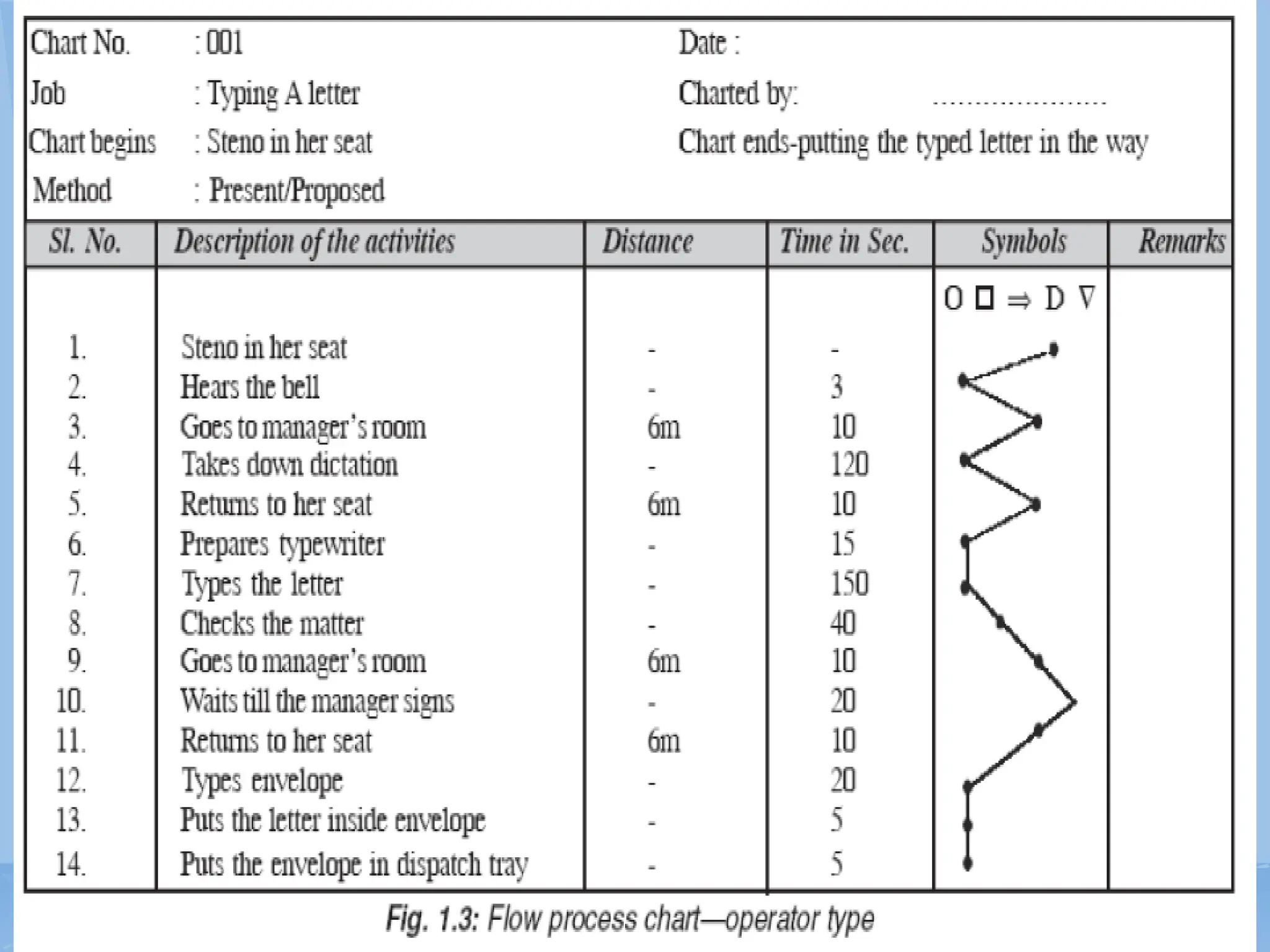
Example 1.7
The activities of a stenographer in preparation
of a letter are recorded in the operator type
flow process chart shown in figure 1.3.
The chart records the activities of the steno. Here, the
manager calls the steno and dictates a letter. The steno
takes notes of the letter, types it, gets the signature of
the manager and sends it for dispatching. These
activities are shown in the chart. This is operator type
flow process chart.
Considering the message in the letter as material, we
can prepare the material type flow process chart.
General guidelines for making a flow process
chart
1. The details must be obtained by direct
observation—charts must not be based on
memory.
2. All the facts must be correctly recorded.
3. No assumptions should be made.
4. Make it easy for future reference.
5. All charts must have the following details:
(a) Name of the product, material or equipment
that is observed.
(b) Starting point and ending point.
(c) The location where the activities take place.
(d) The chart reference number, sheet number
and number of total sheets.
(e) Key to the symbols used must be stated.
1.3.4 Two-Handed Process Chart (or) Right
Hand, Left Hand Chart
➢ It is the process chart in which the activities
of two hands of the operator are recorded.
➢ It shows whether the two hands of the
operator are idle or moving in relation to one
another, in a timescale.
➢ It is generally used for repetitive
Operation: Represents the activities grasp,
position, use, release etc. of a tool, component
or material.
Transport: Represents the movement of the
hand or limb to or from the work or a tool or
material.
Delay: Refers to the time when the hand or limb
is idle.
Storage (Hold): The term ‘hold’ is used here
instead of storage. This refers to the time
when the work is held by hand.
The activity ‘inspection’ by hand is considered
as an operation. Hence, the symbol for
inspection is not used in this chart.
Two-handed process chart can be used for
assembly, machining and clerical jobs.
General guidelines for preparing the chart
1. Provide all information about the job in the
chart.
2. Study the operation cycle a few times before
starting to record.
3. Record one hand at a time.
4. First record the activities of the hand which
starts the work first.
5. Do not combine the different activities like
operations, transport etc.
Example 1.8
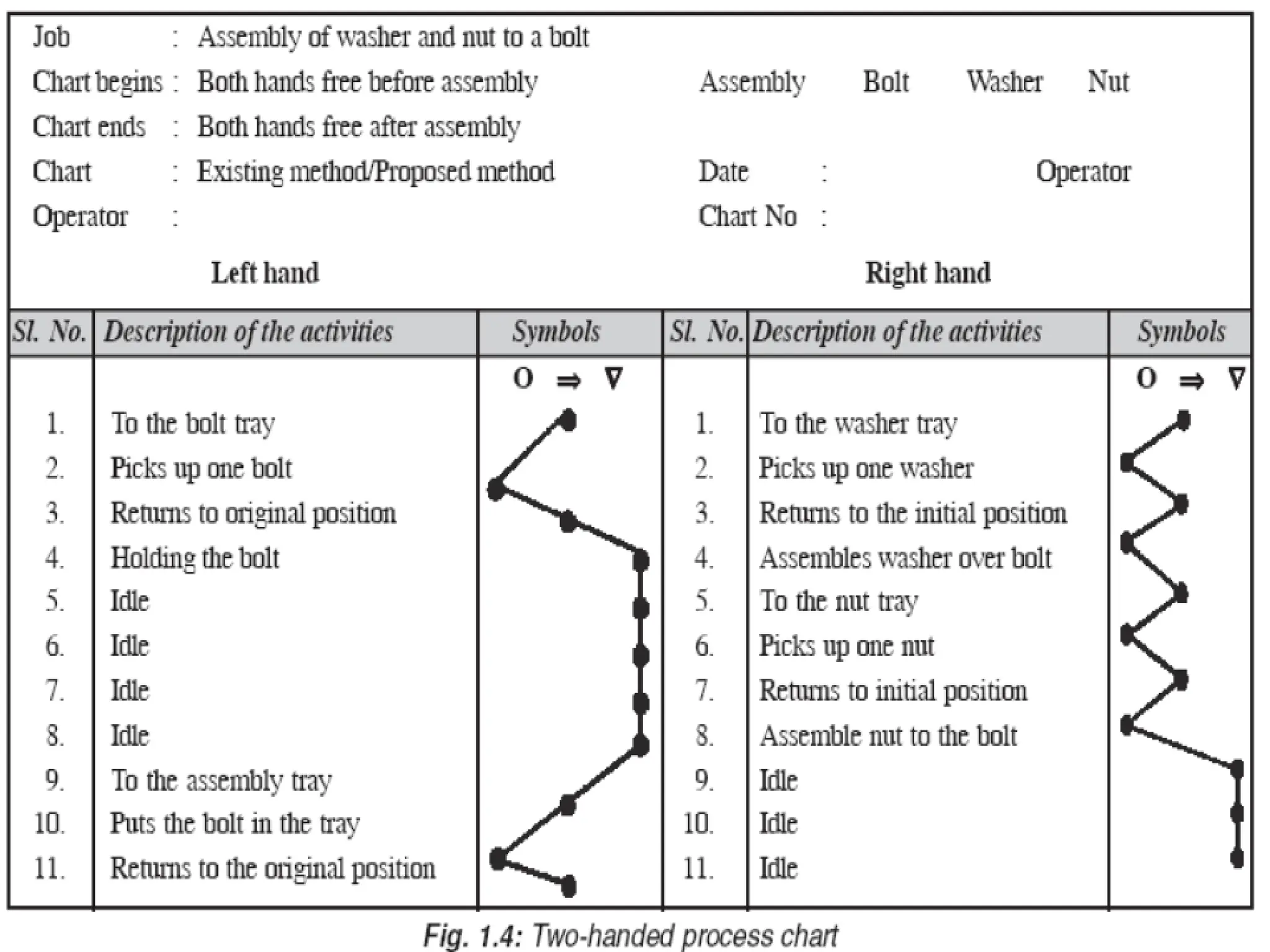
Example of a two-handed process chart is
shown in figure 1.4.
Here the assembly of a nut and washer over a
bolt is recorded.
The work place layout is shown in the right
hand corner. The activities of left hand are
recorded at left half of the chart.
The activities of the right hand are recorded
at the right half of the chart.
The horizontal lines represent the time scale.
Activities of left hand and right hand shown in
the same line occur at the same moment.
Summary of the number of each activity can be
tabulated at the bottom of the chart. The chart is
first drawn for the existing method.
This chart is analysed and if it is found that
one hand is over loaded than the other,
modification are done in the layout of the
workplace or in the sequence of activities.
Then a new chart is made for the proposed
cycle.
1.3.5 Man-Machine Chart
A man-machine chart is a chart in which the
activities of more than one worker or machine
are recorded. Activities are recorded on a
common time scale to show the inter-
relationship. It is also known as multiple activity
chart.
It is used when a worker operates a number of
machines at a time.
It is also used when a number of workers
jointly do a job.
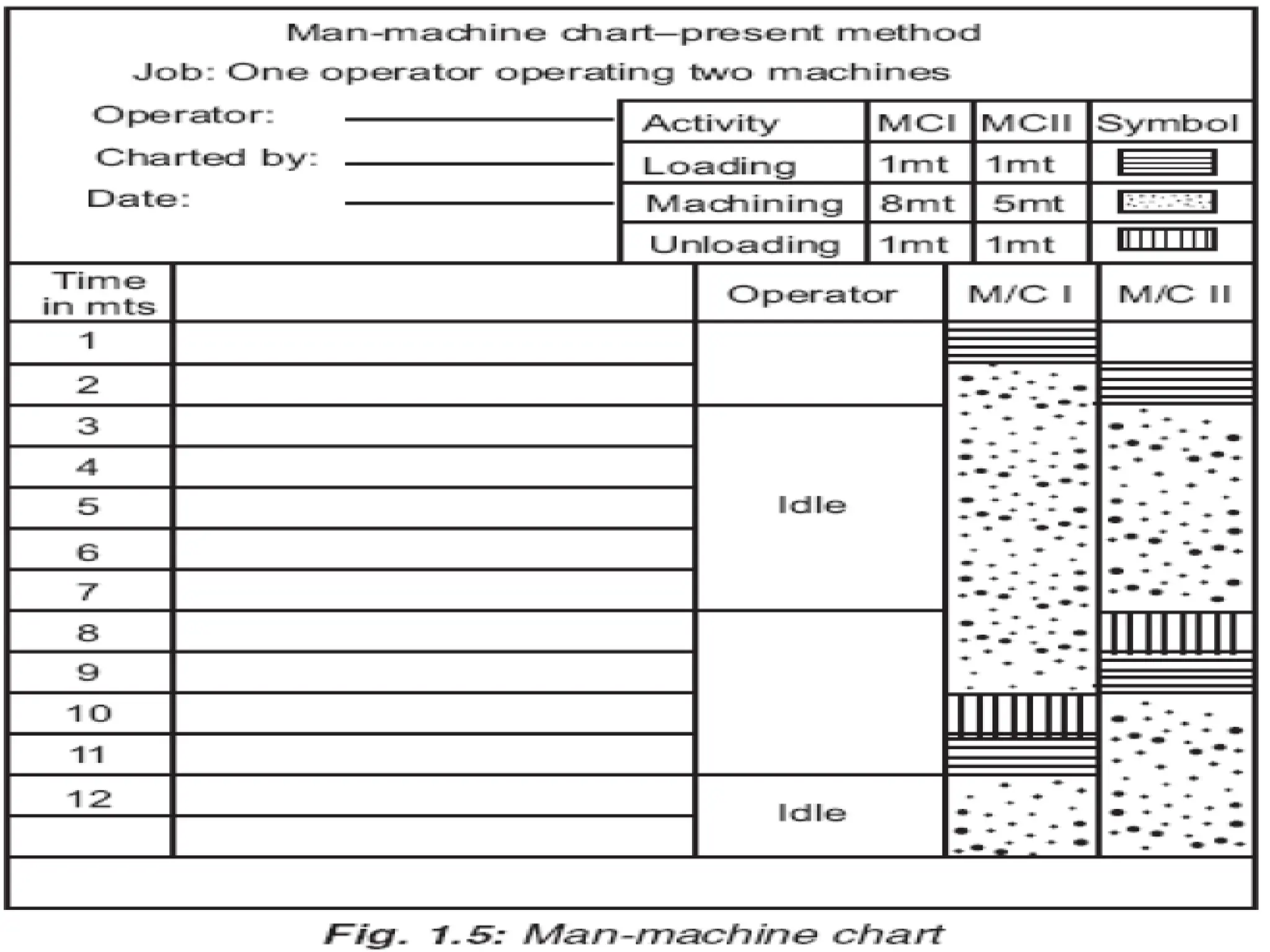
Activities of workers or machines are
recorded in separate vertical columns (bars)
with a horizontal time scale.
Man-machine chart is a type of multiple activity
chart. Here, the activities of a number of
machines are recorded. An example of man-
machine chart is shown in figure 1.5. Here one
operator two semi-automatic machines
simultaneously.
The activities of the operator is recorded in a
separate vertical column. The activities of the
two machines are recorded in two separate
vertical columns. The different activities like
loading, machining and unloading are
represented by different symbols. Blank space
shows the idle time.
1.3.6 Flow Diagram
In any production shop, repair shop or any other
department, there are movements of men and
material from one place to another.
Process charts indicate the sequence of
activities..
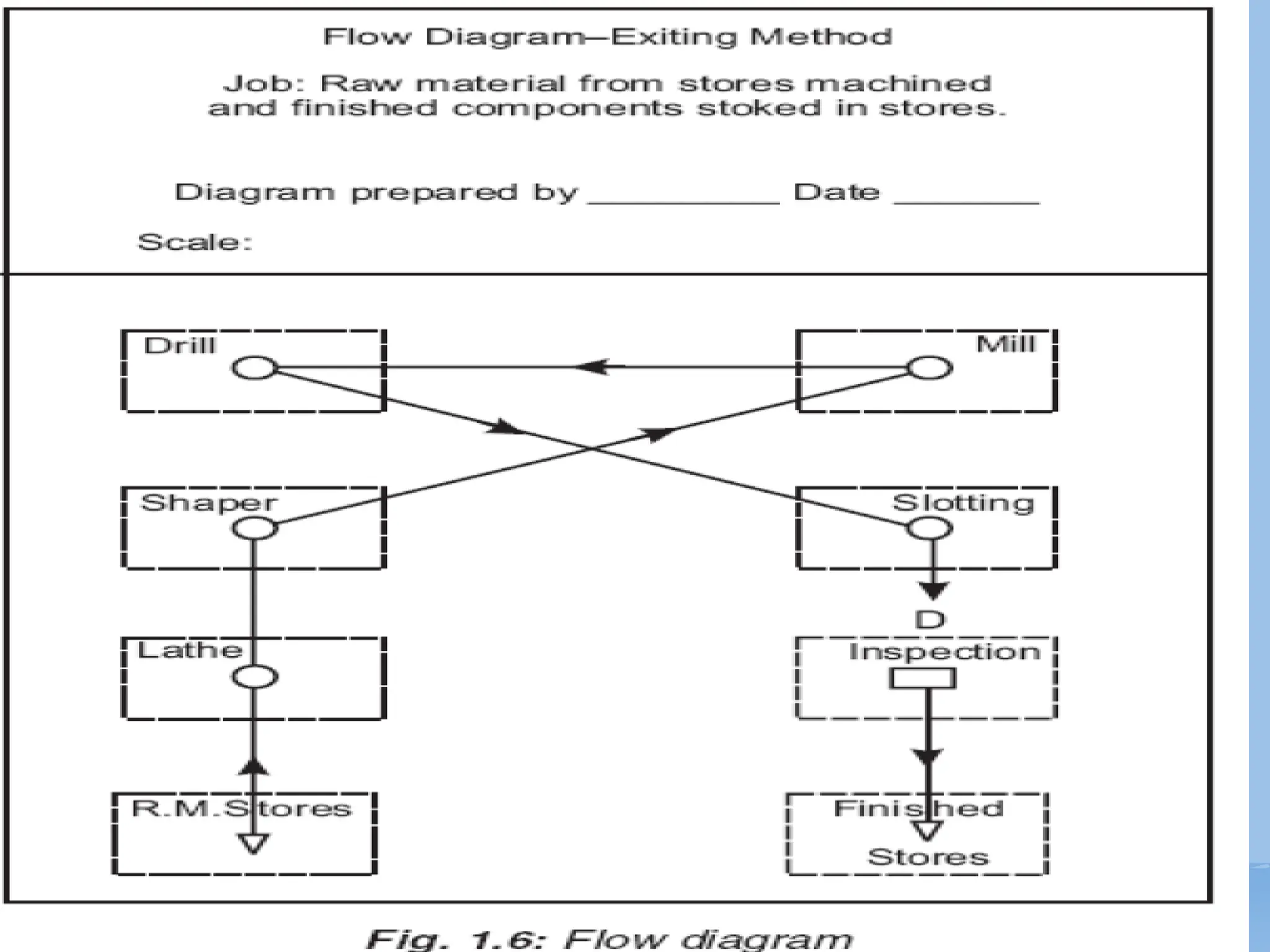
A flow diagram is a diagram which is drawn to
scale.
The relative position of machineries, gang
ways, material handling equipment etc. are
drawn first. Then the path followed by men or
material is marked on the diagram. Process
symbols are added to the diagram to identify
the different activities at different work centres
The flow diagram are used for the following
purposes:
1. To remove unwanted material movement.
2. To remove back tracking.
3. To avoid traffic congestion.
4. To improve the plant layout
Conventions adopted are
1. Heading and description of the process should
be given at the top of the diagram.
2. Other information like location, name of the
shop, name of the person drawing the diagram
are also given.
3. The path followed by the material is shown
by a flow line.
4. Direction of movement is shown by small
arrows along the flow lines.
5. The different activities are represented by the
symbols on the flow lines. (Same symbols used
in flow process chart are used here).
6. If more than one product is to be shown in the
diagram different colours are used for each path.
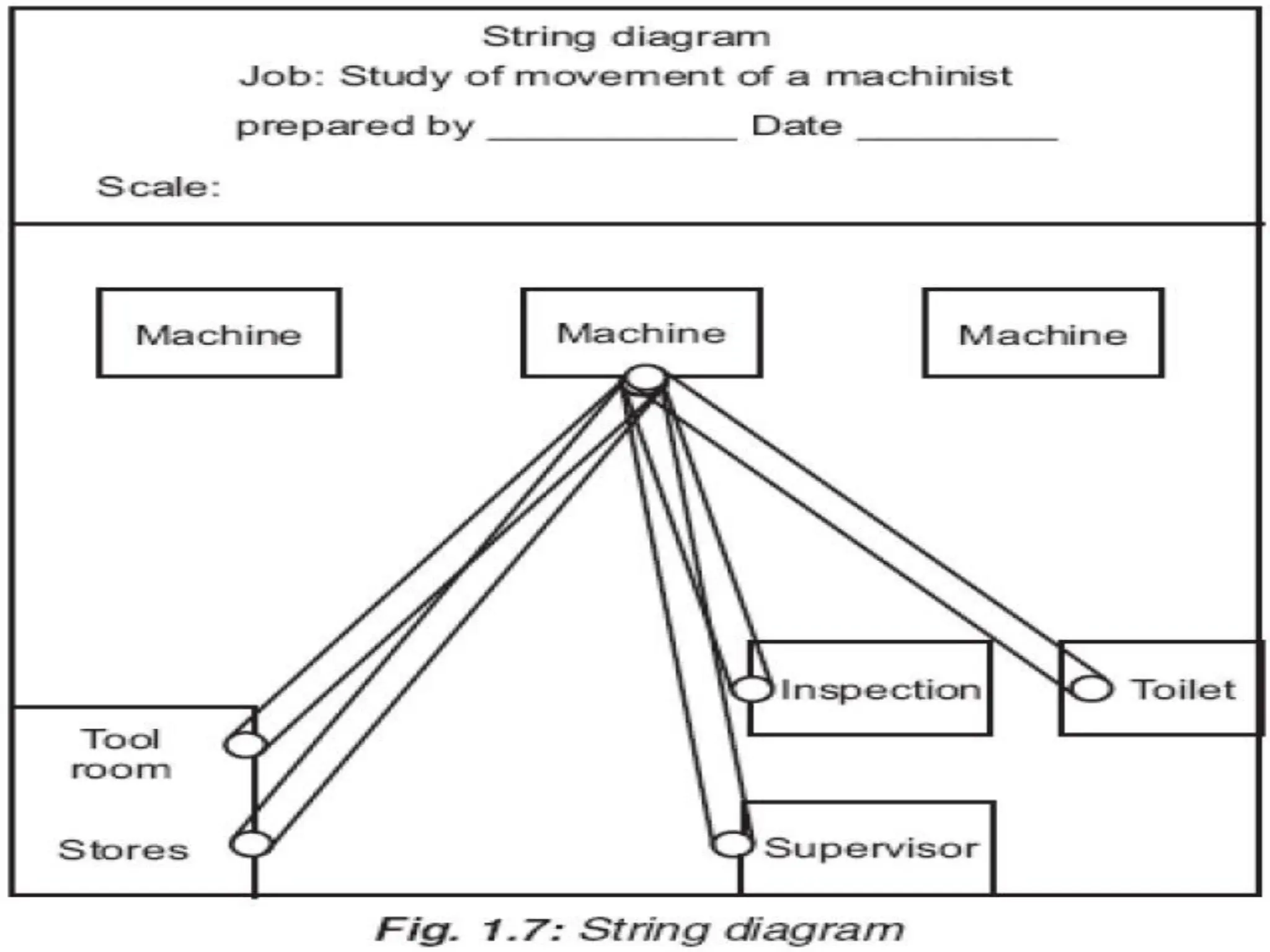
1.3.7 String Diagram
We make use of flow diagram for recording the
movement of men or material when the
movement is simple and the path is almost
fixed. But when the paths are many and are
repetitive, it may not be possible to record them
in a flow diagram. Here a string diagram is
used.
Constructions
1. Draw the layout of the shop to scale in a
drawing sheet.
2. Mark the various work centres like machines,
stores, work bench etc. in the diagram.
3. Hold the drawing sheet on a soft board and
fix pins at the work centres.
4. Tie one end of a coloured string to the work
centre from which the movement starts.
5. Follow the path of the worker to different work
centre and accordingly take the thread to different
points on the drawing board.
6. At the end of the session note down the number of
movements from one work centre to another.
7. Remove the string and measure the total length of
the string. Multiply by the scale and get the actual
distance of movement.
Applications
1. It is used for recording the complex movements
of material or men.
2. Back tracking, congestion, bottlenecks, under
utilized paths are easily found out.
3. It is used to check whether the work station is
correctly located.
4. Used to record irregular movements.
5. Used to find out the most economical route.

(WORKSTUDY AND ERGONOMICS) lecture. 5

  • 1.
    1.3.3 Flow ProcessChart A flow process chart is a graphical representation of the sequence of all the activities (operation, inspection, transport, delay and storage) taking place in a process. Process chart symbols are used here to represent the activities. There are three types of flow process charts.
  • 2.
    1. Man typeflow process chart This flow process chart records what the worker does. 2. Material type flow process chart This flow process chart records how the material is handled or treated 3. Equipment type flow process chart This flow process chart records how the equipment or machine is used.
  • 3.
    Example 1.7 The activitiesof a stenographer in preparation of a letter are recorded in the operator type flow process chart shown in figure 1.3.
  • 5.
    The chart recordsthe activities of the steno. Here, the manager calls the steno and dictates a letter. The steno takes notes of the letter, types it, gets the signature of the manager and sends it for dispatching. These activities are shown in the chart. This is operator type flow process chart. Considering the message in the letter as material, we can prepare the material type flow process chart.
  • 6.
    General guidelines formaking a flow process chart 1. The details must be obtained by direct observation—charts must not be based on memory. 2. All the facts must be correctly recorded. 3. No assumptions should be made. 4. Make it easy for future reference.
  • 7.
    5. All chartsmust have the following details: (a) Name of the product, material or equipment that is observed. (b) Starting point and ending point. (c) The location where the activities take place. (d) The chart reference number, sheet number and number of total sheets. (e) Key to the symbols used must be stated.
  • 8.
    1.3.4 Two-Handed ProcessChart (or) Right Hand, Left Hand Chart ➢ It is the process chart in which the activities of two hands of the operator are recorded. ➢ It shows whether the two hands of the operator are idle or moving in relation to one another, in a timescale. ➢ It is generally used for repetitive
  • 9.
    Operation: Represents theactivities grasp, position, use, release etc. of a tool, component or material. Transport: Represents the movement of the hand or limb to or from the work or a tool or material.
  • 10.
    Delay: Refers tothe time when the hand or limb is idle. Storage (Hold): The term ‘hold’ is used here instead of storage. This refers to the time when the work is held by hand. The activity ‘inspection’ by hand is considered as an operation. Hence, the symbol for inspection is not used in this chart. Two-handed process chart can be used for assembly, machining and clerical jobs.
  • 11.
    General guidelines forpreparing the chart 1. Provide all information about the job in the chart. 2. Study the operation cycle a few times before starting to record. 3. Record one hand at a time.
  • 12.
    4. First recordthe activities of the hand which starts the work first. 5. Do not combine the different activities like operations, transport etc.
  • 13.
    Example 1.8 Example ofa two-handed process chart is shown in figure 1.4. Here the assembly of a nut and washer over a bolt is recorded. The work place layout is shown in the right hand corner. The activities of left hand are recorded at left half of the chart. The activities of the right hand are recorded at the right half of the chart.
  • 15.
    The horizontal linesrepresent the time scale. Activities of left hand and right hand shown in the same line occur at the same moment. Summary of the number of each activity can be tabulated at the bottom of the chart. The chart is first drawn for the existing method.
  • 16.
    This chart isanalysed and if it is found that one hand is over loaded than the other, modification are done in the layout of the workplace or in the sequence of activities. Then a new chart is made for the proposed cycle.
  • 17.
    1.3.5 Man-Machine Chart Aman-machine chart is a chart in which the activities of more than one worker or machine are recorded. Activities are recorded on a common time scale to show the inter- relationship. It is also known as multiple activity chart.
  • 18.
    It is usedwhen a worker operates a number of machines at a time. It is also used when a number of workers jointly do a job. Activities of workers or machines are recorded in separate vertical columns (bars) with a horizontal time scale.
  • 19.
    Man-machine chart isa type of multiple activity chart. Here, the activities of a number of machines are recorded. An example of man- machine chart is shown in figure 1.5. Here one operator two semi-automatic machines simultaneously.
  • 20.
    The activities ofthe operator is recorded in a separate vertical column. The activities of the two machines are recorded in two separate vertical columns. The different activities like loading, machining and unloading are represented by different symbols. Blank space shows the idle time.
  • 22.
    1.3.6 Flow Diagram Inany production shop, repair shop or any other department, there are movements of men and material from one place to another. Process charts indicate the sequence of activities..
  • 23.
    A flow diagramis a diagram which is drawn to scale. The relative position of machineries, gang ways, material handling equipment etc. are drawn first. Then the path followed by men or material is marked on the diagram. Process symbols are added to the diagram to identify the different activities at different work centres
  • 25.
    The flow diagramare used for the following purposes: 1. To remove unwanted material movement. 2. To remove back tracking. 3. To avoid traffic congestion. 4. To improve the plant layout
  • 26.
    Conventions adopted are 1.Heading and description of the process should be given at the top of the diagram. 2. Other information like location, name of the shop, name of the person drawing the diagram are also given. 3. The path followed by the material is shown by a flow line.
  • 27.
    4. Direction ofmovement is shown by small arrows along the flow lines. 5. The different activities are represented by the symbols on the flow lines. (Same symbols used in flow process chart are used here). 6. If more than one product is to be shown in the diagram different colours are used for each path.
  • 28.
    1.3.7 String Diagram Wemake use of flow diagram for recording the movement of men or material when the movement is simple and the path is almost fixed. But when the paths are many and are repetitive, it may not be possible to record them in a flow diagram. Here a string diagram is used.
  • 30.
    Constructions 1. Draw thelayout of the shop to scale in a drawing sheet. 2. Mark the various work centres like machines, stores, work bench etc. in the diagram. 3. Hold the drawing sheet on a soft board and fix pins at the work centres. 4. Tie one end of a coloured string to the work centre from which the movement starts.
  • 31.
    5. Follow thepath of the worker to different work centre and accordingly take the thread to different points on the drawing board. 6. At the end of the session note down the number of movements from one work centre to another. 7. Remove the string and measure the total length of the string. Multiply by the scale and get the actual distance of movement.
  • 32.
    Applications 1. It isused for recording the complex movements of material or men. 2. Back tracking, congestion, bottlenecks, under utilized paths are easily found out. 3. It is used to check whether the work station is correctly located. 4. Used to record irregular movements. 5. Used to find out the most economical route.