TO KILL A MOCKINGBIRD:
SUPPLEMENTAL
LESSON:

AFRICAN AMERICAN
DISCRIMINATION: THE
CIVIL WAR TO THE 1960’S

By: Julie Braam
Unit Plan Basics
   I’m a future Language Arts Instructor and I want my
    students to learn the history of African Americans, to
    help them understand the characters in To Kill a
    Mockingbird. Through this PowerPoint, I will trace the
    events from the end of the Civil War through the Civil
    Rights Movement of the 1950’s and 60’s. By learning
    this history, hopefully the students will understand the
    motivations of the characters. Also, by presenting the
    students with occasional questions, they will personalize
    the events and be able to put themselves in the place of
    the characters. They will be assessed with a quiz to
    ensure they paid attention to the lecture and later, they
    will write their journal entries in the voice of one of the
    characters from the novel.
History from 1863-1865
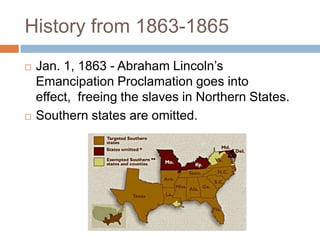
   Jan. 1, 1863 - Abraham Lincoln’s
    Emancipation Proclamation goes into
    effect, freeing the slaves in Northern States.
   Southern states are omitted.
Slavery Abolished
   Dec. 1865 – 13th Amendment
    ratified, abolishing slavery.

   April 7, 1865 – Lee surrenders to
    Grant, ending the Civil War.

   Did the end of the war automatically give
    African Americans equal rights?
History from 1865 - 1870
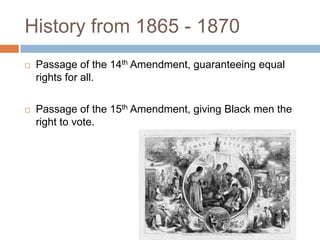
   Passage of the 14th Amendment, guaranteeing equal
    rights for all.

   Passage of the 15th Amendment, giving Black men the
    right to vote.
The Reconstruction Period: 1865-1877

   Federal troops occupied the
    South, maintaining peace, enforcing new
    amendments, and protecting the rights of
    Blacks.

   Period of Black activism, including running for
    political office, building churches/community
    buildings, and much educational
    advancement.
Set-Backs: 1883
   The 14th Amendment, Civil Rights Act is found
    unconstitutional and is no longer enforceable.

   Southern states rewrite their
    constitutions, taking most rights away from
    Blacks.

   Why didn’t the Federal government intervene
    with the States taking away African American
    rights?
Blacks Lose Political and Personal Power

   Within a few short years, the percentage of
    blacks that can vote in the South is reduced to
    miniscule amounts.

   Beginning of time period called Jim
    Crow, referring to laws passed specifically to
    keep Whites and Blacks separated in
    educational, personal, and political ways.
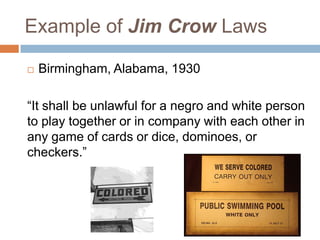
Example of Jim Crow Laws

   Birmingham, Alabama, 1930

“It shall be unlawful for a negro and white person
to play together or in company with each other in
any game of cards or dice, dominoes, or
checkers.”
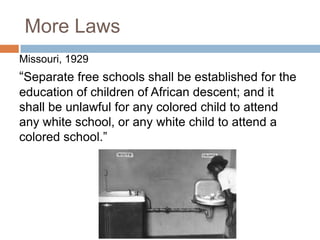
More Laws
Missouri, 1929
“Separate free schools shall be established for the
education of children of African descent; and it
shall be unlawful for any colored child to attend
any white school, or any white child to attend a
colored school.”
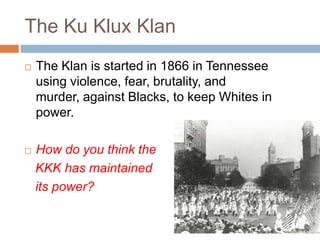
The Ku Klux Klan
   The Klan is started in 1866 in Tennessee
    using violence, fear, brutality, and
    murder, against Blacks, to keep Whites in
    power.

   How do you think the
    KKK has maintained
    its power?
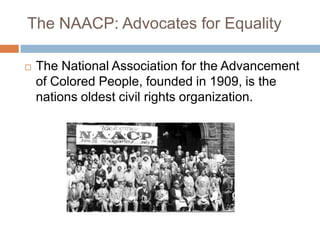
The NAACP: Advocates for Equality

   The National Association for the Advancement
    of Colored People, founded in 1909, is the
    nations oldest civil rights organization.
NAACP Focus
   Anti-lynching legislation

   Voter participation

   Employment

   Due process under the law

   Education.
Supreme Court Ruling: 1953
Brown vs. the Board of Education Reversal
“We conclude that in the field of public education
the doctrine of separate but equal has no place.
Separate educational facilities are inherently
unequal.”

Earl Warren, Chief Justice of the Supreme Court.

Why didn’t this alone end discrimination against
African Americans?
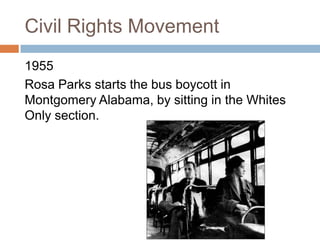
Civil Rights Movement
1955
Rosa Parks starts the bus boycott in
Montgomery Alabama, by sitting in the Whites
Only section.
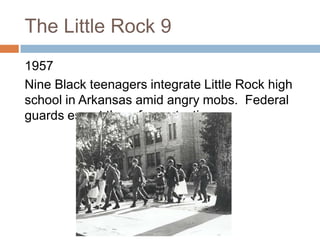
The Little Rock 9
1957
Nine Black teenagers integrate Little Rock high
school in Arkansas amid angry mobs. Federal
guards escort them for protection.
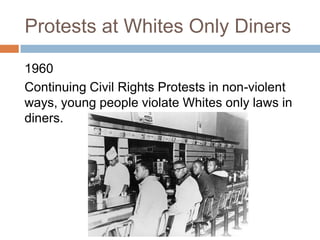
Protests at Whites Only Diners

1960
Continuing Civil Rights Protests in non-violent
ways, young people violate Whites only laws in
diners.
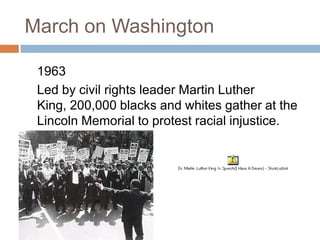
March on Washington

 1963
 Led by civil rights leader Martin Luther
 King, 200,000 blacks and whites gather at the
 Lincoln Memorial to protest racial injustice.
24th Amendment
 1964
Congress passes law forbidding racial
discrimination in many areas of life, including
hotels, voting, employment, and school.

But the fight for equality will always continues…

Why do you think it should always continue?
References
   Chancellor, Carl. 5-17-2011. After Civil War, Blacks Fought
    for Rights. USA Today. Retrieved 4-14-2013.
   http://usatoday30.usatoday.com/news/nation/2011-04-11-civil-
    war-civil-rights_N.htm

   Separate is Not Equal: Jim Crowe Laws.
    Smithsonian, National History Museum. Retrieved 4-14-
    2013.
   http://americanhistory.si.edu/brown/history/1-segregated/jim-
    crow.html

   Little Rock Nine. The Encyclopedia of Arkansas History and
    Culture. Retrieved 4-14-2013.
   http://www.encyclopediaofarkansas.net/encyclopedia/entry-
    detail.aspx?entryid=723

To kill a mockingbird powerpoint

  • 1.
    TO KILL AMOCKINGBIRD: SUPPLEMENTAL LESSON: AFRICAN AMERICAN DISCRIMINATION: THE CIVIL WAR TO THE 1960’S By: Julie Braam
  • 2.
    Unit Plan Basics  I’m a future Language Arts Instructor and I want my students to learn the history of African Americans, to help them understand the characters in To Kill a Mockingbird. Through this PowerPoint, I will trace the events from the end of the Civil War through the Civil Rights Movement of the 1950’s and 60’s. By learning this history, hopefully the students will understand the motivations of the characters. Also, by presenting the students with occasional questions, they will personalize the events and be able to put themselves in the place of the characters. They will be assessed with a quiz to ensure they paid attention to the lecture and later, they will write their journal entries in the voice of one of the characters from the novel.
  • 3.
    History from 1863-1865  Jan. 1, 1863 - Abraham Lincoln’s Emancipation Proclamation goes into effect, freeing the slaves in Northern States.  Southern states are omitted.
  • 4.
    Slavery Abolished  Dec. 1865 – 13th Amendment ratified, abolishing slavery.  April 7, 1865 – Lee surrenders to Grant, ending the Civil War.  Did the end of the war automatically give African Americans equal rights?
  • 5.
    History from 1865- 1870  Passage of the 14th Amendment, guaranteeing equal rights for all.  Passage of the 15th Amendment, giving Black men the right to vote.
  • 6.
    The Reconstruction Period:1865-1877  Federal troops occupied the South, maintaining peace, enforcing new amendments, and protecting the rights of Blacks.  Period of Black activism, including running for political office, building churches/community buildings, and much educational advancement.
  • 7.
    Set-Backs: 1883  The 14th Amendment, Civil Rights Act is found unconstitutional and is no longer enforceable.  Southern states rewrite their constitutions, taking most rights away from Blacks.  Why didn’t the Federal government intervene with the States taking away African American rights?
  • 8.
    Blacks Lose Politicaland Personal Power  Within a few short years, the percentage of blacks that can vote in the South is reduced to miniscule amounts.  Beginning of time period called Jim Crow, referring to laws passed specifically to keep Whites and Blacks separated in educational, personal, and political ways.
  • 9.
    Example of JimCrow Laws  Birmingham, Alabama, 1930 “It shall be unlawful for a negro and white person to play together or in company with each other in any game of cards or dice, dominoes, or checkers.”
  • 10.
    More Laws Missouri, 1929 “Separatefree schools shall be established for the education of children of African descent; and it shall be unlawful for any colored child to attend any white school, or any white child to attend a colored school.”
  • 11.
    The Ku KluxKlan  The Klan is started in 1866 in Tennessee using violence, fear, brutality, and murder, against Blacks, to keep Whites in power.  How do you think the KKK has maintained its power?
  • 12.
    The NAACP: Advocatesfor Equality  The National Association for the Advancement of Colored People, founded in 1909, is the nations oldest civil rights organization.
  • 13.
    NAACP Focus  Anti-lynching legislation  Voter participation  Employment  Due process under the law  Education.
  • 14.
    Supreme Court Ruling:1953 Brown vs. the Board of Education Reversal “We conclude that in the field of public education the doctrine of separate but equal has no place. Separate educational facilities are inherently unequal.” Earl Warren, Chief Justice of the Supreme Court. Why didn’t this alone end discrimination against African Americans?
  • 15.
    Civil Rights Movement 1955 RosaParks starts the bus boycott in Montgomery Alabama, by sitting in the Whites Only section.
  • 16.
    The Little Rock9 1957 Nine Black teenagers integrate Little Rock high school in Arkansas amid angry mobs. Federal guards escort them for protection.
  • 17.
    Protests at WhitesOnly Diners 1960 Continuing Civil Rights Protests in non-violent ways, young people violate Whites only laws in diners.
  • 18.
    March on Washington 1963 Led by civil rights leader Martin Luther King, 200,000 blacks and whites gather at the Lincoln Memorial to protest racial injustice.
  • 19.
    24th Amendment  1964 Congresspasses law forbidding racial discrimination in many areas of life, including hotels, voting, employment, and school. But the fight for equality will always continues… Why do you think it should always continue?
  • 20.
    References  Chancellor, Carl. 5-17-2011. After Civil War, Blacks Fought for Rights. USA Today. Retrieved 4-14-2013.  http://usatoday30.usatoday.com/news/nation/2011-04-11-civil- war-civil-rights_N.htm  Separate is Not Equal: Jim Crowe Laws. Smithsonian, National History Museum. Retrieved 4-14- 2013.  http://americanhistory.si.edu/brown/history/1-segregated/jim- crow.html  Little Rock Nine. The Encyclopedia of Arkansas History and Culture. Retrieved 4-14-2013.  http://www.encyclopediaofarkansas.net/encyclopedia/entry- detail.aspx?entryid=723